
Reviewed by Marta García Cabrera
The Ministry of Information has long occupied a central place in the historiography of Britain’s Second World War. From studies of propaganda and censorship to analyses of broadcasting, publishing, cinema, public opinion and political communication, historians have explored many facets of an institution that became synonymous with Britain’s wartime information effort. Yet much of that scholarship has tended to examine these responsibilities as distinct fields of enquiry. Simon Eliot and Henry Irving’s edited collection, Information at War: A Communication History of the Ministry of Information, 1939–1946, invites readers to look beyond these individual functions and reconsider the Ministry as a single, integrated system of wartime communication.
This shift in perspective constitutes the volume’s principal historiographical contribution. Rather than presenting propaganda, censorship, audience research, photography, exhibitions, films, publishing or overseas publicity as discrete activities, the contributors reconstruct them as interconnected elements within a continuous process of communication. The Ministry emerges not simply as an organisation that sought to persuade the public, but as one that constantly gathered evidence about public responses, evaluated the effectiveness of its messages and adapted its strategies accordingly. Communication, in other words, was conceived as an ongoing process of exchange rather than a one-way transmission of information.
The volume’s greatest strength lies not in uncovering unknown aspects of the Ministry’s history, but in demonstrating how its many responsibilities functioned together. Home Intelligence reports, regional offices, audience research, postal censorship and overseas publicity all contributed to a communication system in which government messaging was continuously refined in response to public reactions. This emphasis on feedback and adaptation offers an important corrective to more traditional accounts that privilege propaganda as a largely top-down exercise in persuasion. Instead, the Ministry appears as an institution that recognised the importance of understanding its audiences as much as addressing them.
This integrated approach also reshapes several well-established historiographical debates. Press censorship is presented not simply as an instrument of wartime control but as part of a broader process of managing communication in a democratic society under exceptional circumstances. Publications, photography, exhibitions, cinema and public meetings emerge as complementary media operating within a coordinated strategy rather than as isolated forms of publicity. Likewise, overseas campaigns demonstrate the Ministry’s capacity to adapt its messages to diverse political, cultural and linguistic contexts, reminding readers that successful wartime communication depended as much upon sensitivity to local audiences as upon the consistency of official narratives.
Another notable achievement is the attention devoted to the material infrastructures that sustained communication. Rather than focusing exclusively on famous posters or films, the contributors reconstruct the networks through which messages travelled: archives, administrative offices, mobile film units, exhibition spaces, regional committees, distribution systems and audience research mechanisms all become central to the narrative. Richly illustrated throughout, the volume shows that communication depended not only upon persuasive messages but also upon organisation, logistics and professional expertise. The visual material does far more than decorate the text; it reinforces the central argument by revealing the institutional and material processes through which wartime communication was produced, circulated and received.
Equally important is the book’s sensitivity to the democratic tensions inherent in government communication during wartime. The contributors avoid both celebratory accounts of British propaganda and simplistic comparisons with totalitarian information systems. Censorship appears as a negotiated practice balancing military necessity with public trust; audience research reflects a genuine effort to understand civilian concerns rather than merely manipulate opinion; and public meetings provided opportunities for dialogue as much as instruction. Credibility, responsiveness and adaptability emerge as fundamental principles underpinning the Ministry’s activities throughout the conflict.
Perhaps the volume’s most original contribution, however, lies in refusing to allow the Ministry to disappear with its formal dissolution in 1946. Instead, its personnel, methods and visual culture are traced into the Central Office of Information, the Festival of Britain, post-war public relations and Britain’s wider cultural memory of the conflict. Particularly illuminating is the discussion of Keep Calm and Carry On, whose transformation from an almost unused wartime poster into a global symbol of British resilience neatly illustrates how the afterlife of communication can become more influential than the communication itself. In doing so, the volume reminds us that the Ministry’s legacy extended far beyond the war, shaping both the practices of government communication and the ways in which Britain has remembered the conflict ever since.
If the collection has one limitation, it is perhaps that its ambitious conceptual framework invites a more explicit comparison with the communication systems developed by other belligerent states. A broader transnational perspective might have further highlighted what was distinctive about the British experience. This, however, is a minor reservation within an exceptionally coherent and consistently high-quality edited volume.
Richly illustrated, meticulously researched and supported by valuable documentary and biographical appendices, Information at War succeeds because it changes the questions historians ask. Rather than treating propaganda, censorship, publishing, exhibitions or public opinion as separate subjects, it demonstrates the value of examining them as interconnected parts of a broader communication system. In doing so, it establishes the Ministry of Information not simply as an institution of wartime publicity, but as one of the most significant laboratories of modern government communication. It is an important contribution to the histories of war, media, propaganda and political communication, and will undoubtedly become essential reading for scholars interested in how democratic societies communicate under the pressures of total war.
Information at War: A Communication History of the Ministry of Information, 1939–1946, ed. by Simon Eliot and Henry Irving (Oxford: Oxford University Press, 2026; 714 pp.; £50.00).
Marta García Cabrera is a Ramón y Cajal Research Fellow in Contemporary History at the University of Las Palmas de Gran Canaria and an Honorary Research Fellow at the University of Kent. Her research explores propaganda, political communication and foreign intelligence in Spain during the First and the Second World War, with particular emphasis on the Canary Islands as a strategic crossroads in the wartime Atlantic.
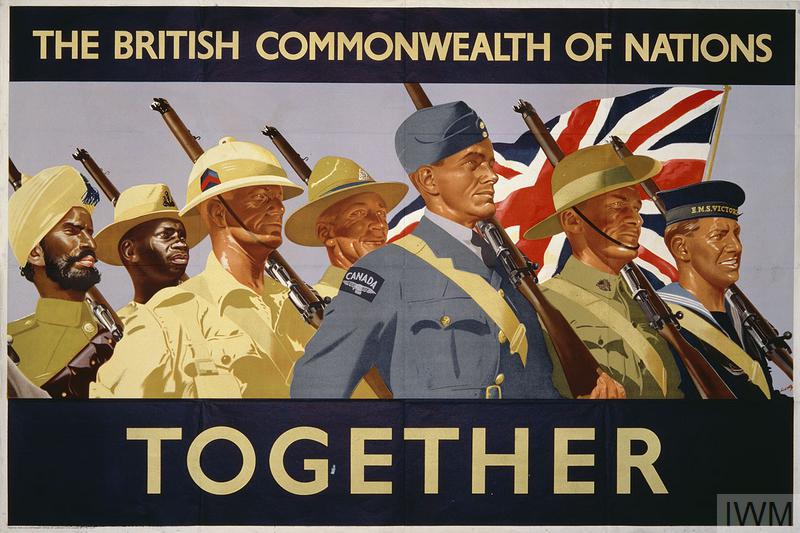
Image Credit: The British Commonwealth of Nations – Together ©IWM Art.IWM PST 8457, Licence: IWM Non-Commercial Licence.