
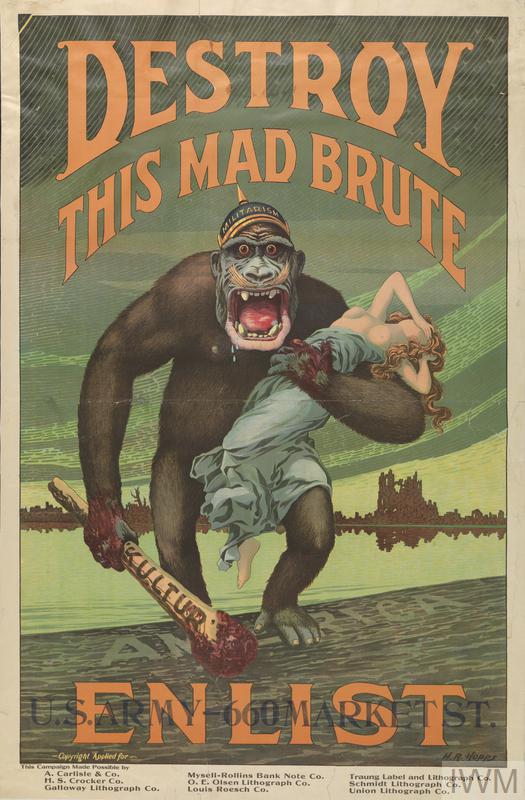
Reviewed by Edward Corse
David Monger’s British First World War Propaganda: From A to Z is an interesting and innovative way of constructing an analysis of an important historical subject and demonstrates that propaganda in this period went beyond the ‘falsehood in war-time’ that sometimes shrouds study of the topic. He divides the book into 26 main chapters, one for each letter of the English alphabet, devoting each chapter to a short study guided by a word or phrase he has chosen. The benefit of such an approach is that it can draw in new readers to a topic with bite-sized summaries of a variety of different issues relating to the topic who might be attracted to this style of book compared with a lengthy academic monograph, such as Eberhard Demm’s Censorship and Propaganda in World War I: A Comprehensive History (2019). Other historians of propaganda have also navigated similar innovative approaches in recent years with David Welch completing his The Story of Propaganda in 50 images (2022) a few years ago – although Welch’s method with 50 images is naturally more flexible than an A–Z approach. Whilst Monger restricts himself to one word or phrase per chapter (with one exception), other approaches such as the Imperial War Museum’s The First World War A-Z: From Assassination to Zeppelin – Everything You Need to Know (2014), allows itself multiple entries for each letter. Monger’s book is in this sense, therefore, if not unique, certainly more restricting than other comparable titles.
Nearly two thirds of English words start with just 9 letters (S, C, P, A, D, R, B, M and T). Monger, therefore, has plenty of choice to decide which words he uses for these chapters, choosing Soldiers, Children, Propagandists, Atrocities, Duty, Religion, Britain, Mother or Munition Worker, and Truth. By contrast, the 7 least frequently used letters (X, Y, Z, Q, J, K and V) make up less than five percent of the total. Monger uses the following words and phrases for these letters: X – Censorship, Yanks, Zero-Sum Bias, Quotidian Propaganda, Jokes, Kultur and Voluntarism. An A–Z approach, therefore, raises an interesting question about the way historical subjects are told to readers and how any historian makes choices about what to reference and leave out, and the proportion of time and space any book uses to talk about different topics.
Clearly, by deciding to structure his book in this way, with broadly equal emphasis on each of the 26 chapters, there could have been a risk that too much weight was put on topics which are of less importance than others, and not enough space elsewhere for the most significant topics. Clearly different historians might take a variety of views of what is most important to focus on. Monger admitted he was struggling somewhat with X, given that ‘X’ was not used to redact censored words until after the First World War – although the concept of censorship was one that I would agree could not be ignored as it is central to the control of propaganda; Yanks is clearly well-known slang for Americans and convenient to use when other Y-beginning words are hard to come by, and a phrase that was in use at the time; Zero-Sum Bias and Quotidian Propaganda do perhaps feel made to work to fit the A–Z structure, but admittedly Monger uses these chapters convincingly to cover really important topics and in a way that other studies of First World War propaganda might gloss over. Monger has clearly thought long and hard about making sure each chapter earns its place and is not there just to make up the 26 chapters. In my view Monger manages the risks of such an approach well.
The other risk that I see is the length of chapters. With 26 in total, this usually means only 8 pages are allocated per chapter (Religion, is the only outlier with 10), which is shorter than many academic journal articles. This naturally means that Monger needs to be sharp and to the point in each chapter with no room for lengthy debate. Whilst this might not satisfy everyone, I think this works well for its intended purpose – it is easy to briefly dip into each chapter without the need to read the rest of the book, and Monger does an excellent job of introducing the topic of the chapter on its own merits; but you can, as I did, read the book from start to finish. Both approaches can be beneficial depending on what you want and how much time you have available.
Monger is an expert in the field of First World War propaganda and has been studying the topic in depth for many years. He can talk at length about many of the issues covered in the book, from the types of organisations involved (such as Wellington House and MI7b) as well as unofficial propagandists, propaganda themes, depictions of stereotypes, atrocities and women, and the variety of target audiences. Whilst he gives sufficient consideration to propaganda issues around the fight with Germany – the key issue from a British propaganda point of view – he also takes time to consider issues around censorship, the role of Ireland, the Ottomans and the effect of the Russian Revolution. He masterfully explains how different events and issues in the war interplayed with propaganda planning and outputs, with a firm grip on the importance of the personalities in the story of war propaganda such as Charles Masterman (Head of Wellington House), Lord Bryce (former British Ambassador to the USA), John Buchan (author of The 39 Steps) and A.A. Milne (the creator of Winnie the Pooh).
From my own perspective, as a historian of propaganda and neutrality, I was particularly pleased to see N devoted to Neutrals, and for these to hold an accepted place in the wider analysis. He also applies concepts invented in the age of social media to events from over a hundred years ago. For H, he uses ‘humblebragging’ which he states, ‘describes posts that seem modest and self-deprecating but actually show something the author is proud of. Such posts seek positive reactions, reversing the false modesty, from audiences but can be transparently insincere. Despite complaining about or disavowing something, the author ultimately expects praise.’ He persuasively argues that humblebragging was used by British propagandists to try to influence audiences in the United States in particular, by underplaying the strength of the British Empire.
There are not many people who have such a comprehensive knowledge base and Monger is the perfect guide to take his readers through his analysis. He explains his thoughts and the evidence well, does not assume too much knowledge, yet also does not patronise his readers. There is plenty of depth in what is an introduction to the topic and he has a comprehensive knowledge of other historians’ views which he references throughout. Examples include Demm (mentioned above) and chapters in John Griffiths’ edited volume Communication and the First World War (Routledge, 2020). There are plenty of illustrations too, almost one for every chapter, which help emphasise his points. Posters, cartoons and magazines are all in the mix, showing the often visual nature of the propaganda. Perhaps most surprising is Figure 13, demonstrating the National War Savings Committee’s use of the swastika on its logo, a couple of decades before the Nazis ruined the swastika’s reputation forever.
Monger’s approach is thoughtful, and challenges popular assumptions about what propaganda is – he rightly says that propaganda is more usually based on truth than people might expect. His argument is that if propaganda is based on falsehood, and this is discovered, the whole credibility of the propagandist falls apart. Indeed, he devotes T to Truth in order to emphasise and explain the point. Seeing propaganda in this way is not an uncommon approach in academic circles – Welch takes a similar view, and I’ve sought to explain similar reasoning in a recent Routledge Handbook. It is not, therefore, revolutionary in that sense. However, given the influence of Lord Arthur Ponsonby’s post-war Falsehood in War-Time (1928) – which essentially argued that British propaganda in the First World War was just lies and exaggerations – this is an argument that still needs to be made. John Horne and Alan Kramer showed that much of the atrocity propaganda that Ponsonby claimed was simply invented was, in fact, based in truth. Monger goes further with his excellent guide for the new reader, in showing that British propaganda in the First World War was far more sophisticated, diverse and widespread in many aspects of life than Ponsonby suggested.
British First World War Propaganda: From A to Z, by David Monger (London: Bloomsbury Academic, 2025, 248pp., £26.99)
Edward Corse is an Honorary Research Fellow at the Centre for the History of War, Media and Society. His forthcoming publication: British Propaganda in Neutral Turkey: Pursuing a Reluctant Ally in the Second World War, is under contract with Bloomsbury. He co-edited the Open Access volume Propaganda and Neutrality with Marta García Cabrera in 2023.
Image Credit: Destroy This Mad Brute – Enlist. ©Art.IWM PST 0243, Licence: IWM Non-Commercial Licence.