
Reviewed by Freddie Ping
The question of whether Confederate leaders, cast in bronze, should loom over the residents of American cities has become as pressing as it has been provocative in the last decade. Between 1865 and 2014, just five monuments to the Confederacy were removed from public places; since then, perhaps two hundred of them—mostly statues—have been hidden away, or in the case of Robert E. Lee’s Charlottesville likeness, melted down. While some seven hundred statues remain standing, the willingness of local and state governments to entertain removal proposals is testament to a shifting racial consciousness which has placed Civil War memory at the centre of public discourse.
Conceived in the wake of the 2017 white supremacist rally in Charlottesville, and first published in 2021 and now out in a revised edition, Karen L. Cox’s No Common Ground: Confederate Monuments and the Ongoing Fight for Racial Justice is transparently an effort to contextualise our current reckoning with Confederate memory. This racial reckoning, catalysed by the 2015 Charleston Church shooting, in which a white supremacist brandishing the Confederate battle flag murdered nine worshippers at the city’s oldest Black church, asks fundamental questions about how we remember those who waged war against the Union. What and who do Confederate statues represent? Who funded and constructed them, and when? And when did backlash to these statues first arise? In six brisk chapters aimed at a wide audience, Cox—one of the leading historians of Confederate memory—provides insights and answers to each of these salient questions.
Perhaps the most important of Cox’s arguments is that Confederate statues have never been ‘innocuous symbols’, and that neither those who sponsored their construction nor those who they were designed to belittle ever thought otherwise (p. 3). Rather, symbols of the Confederacy are ‘weapons in a larger arsenal of white supremacy’ that Black Americans have always recognised as such (p. 3). In fleshing out this point, Cox maintains a particular focus on two parties: the women’s groups that played a disproportionate role in the proliferation of statues; and the Black Americans who consistently threw scorn at ‘monuments to folly’, in Frederick Douglass’s phrase (p. 60). By focusing on women’s groups, Cox builds upon three decades of cognate research experience, including her well-regarded 2003 book, Dixie’s Daughters: The United Daughters of the Confederacy and the Preservation of Confederate Culture.
While Confederate statues began to appear across the South not long after the peace at Appomattox, it was not until Plessy v. Ferguson, the 1896 Supreme Court decision upholding the logic of ‘separate but equal’, that the majority of Confederate statues were constructed, oftentimes taking up conspicuous positions outside state capitols and courthouses where they made a mockery of the expectation of free and fair trials. It was, of course, no coincidence that statues multiplied at the height of the Jim Crow era, during which revanchist Americans looked to restore the racial disparities on which the Confederacy and a wider system of white supremacy had rested. Across the South, women’s groups like the United Daughters of the Confederacy—founded in the aftermath of the Civil War but thriving to this day—fundraised and campaigned for monuments to their soldiers, employing nakedly white supremacist language during statue ‘unveiling speeches as a badge of honour for the men who helped reverse the gains made by freedmen during Reconstruction’ (p. 15).
When we consider that so few statues were removed before the 2010s, it might be tempting to forget that opposition to the Lost Cause narrative—the sanitised idea that the Civil War was a noble struggle for states’ rights—has been a consistent feature of public discourse, particularly among Black communities. It was Black Americans, after all, who knew most intimately—and painfully—that if the Civil War was a contest over states’ rights, it was a contest over a state’s right to decide whether one person could enslave another. And it is Black Americans, moreover, who have more than others felt the gaze of the bronze and marble Confederates that look down at them. Cox rightly gives space to the Black people who have voiced their dismay at what Frederick Douglass described as ‘nauseating flatteries’ to the Confederacy, from the outset of Reconstruction to the present day (p. 60). It is through their words that we can understand clearly what statues really represent, what their effect upon locals really is. When asked to articulate the meaning of a statue of John C. Calhoun (who died before his pro-slavery views could give birth to the Confederacy), Mamie Garvin Fields, an 1888 resident of Charleston, responded in no uncertain terms: ‘you may not be a slave, but I am back to see you stay in your place’ (p. 61).
At around two-hundred pages, No Common Ground is not an exhaustive contextualisation of Confederate monuments, nor does it pretend to be. After all, Cox is contributing once again to an already lively field of study driven by scholars like David Blight and Adam Domby—as well as, of course, Cox herself. With this in mind, it is worthwhile considering what Cox’s parameters inadvertently mask, rather than what subject matter isn’t covered. Here, questions of geographical scope are pertinent. No Common Ground centres on the American South, which may be a natural setting, but it is one that quietly conceals the true dimensions of Confederate appeal and indeed American racism. All too often, racism in the United States has been framed—at least in public forums—as a sin of the South rather than a national disease. So, what do we make of the spread of Confederate statues beyond the old Confederacy? In Montana, Washington, Ohio, and scores of other states, monuments to Jefferson Davis, to Stonewall Jackson, to the Confederacy at large, have been constructed (and in many cases removed).
Perhaps there is something revealing here that only serves to underscore Cox’s overarching claim: Confederate memorialisation is less a defanged celebration of Southern identity and culture—its music, its food, its hospitality—than a reification of the white supremacy that once undergirded the nation’s system of slavery. That Confederate symbols have always been references to racial hierarchy rather than regional mores helps explain their prescence beyond the borders of the South and beyond the confines of the nineteenth century. As scholars have documented in great detail, and as everyone else knows through lived experience, white supremacist movements are not peculiar to the South; they are not peculiar to the United States. Over time, the Confederacy has morphed into an elastic symbol of racial domination, useful to a transnational far-right that has sought to reject efforts to remove statues across the Atlantic world, from Richmond, to Bristol, to Cape Town—indeed, the Charleston church shooter imagined himself as ‘the last Rhodesian’.
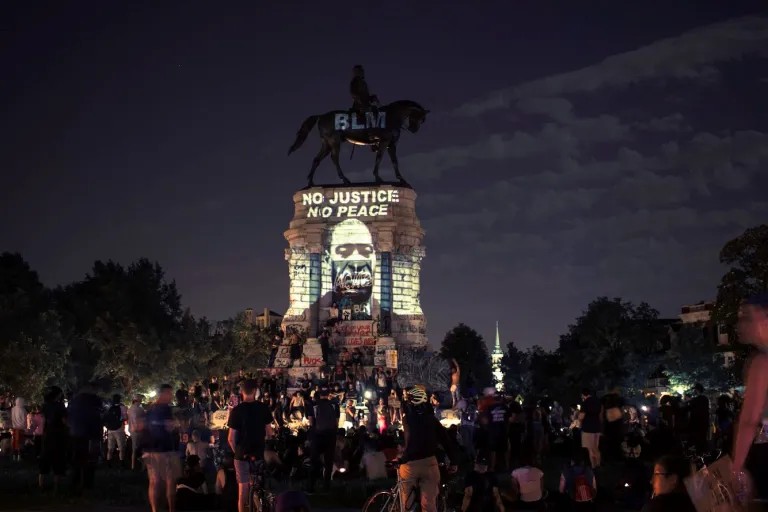
What next for Confederate statues? Since Cox began working on No Common Ground, the sweeping race protests of 2020, in the wake of the murder of George Floyd, have inspired a flurry of removals. Since then, Cox notes in the introduction to her 2026 second edition, ‘there’s been a virtual cottage industry’ of scholarship examining Confederate statues (p. xv). Still, the battle over their meaning and future remains. ‘Is it not about time that this bombastic laudation of the rebel chief should cease?’, asked Douglass after the death of Robert E. Lee in 1870 (p. 60). Americans remain uncertain. In 2019, Elon University in North Carolina asked residents whether Confederate monuments should continue to exist in public places. As Cox explains, while sixty-five percent thought they should, ‘an even higher percentage favoured adding contextual panels or plaques’ (p. 5). What’s most interesting about this poll is that those who viewed the Civil War as a contest over states’ rights, as opposed to slavery, were most likely to believe monuments had a place in the twenty-first century. There is an irony here that, according to this logic, enacting what might be the apologist position of adding contextual panels to these monuments to white supremacy should in fact pave the way for further removals, as Americans grapple with the essential fact that it was chattel slavery and not abstract rights animating their Civil War. By relearning this history, Cox argues, we might finally meet on common ground.
No Common Ground: Confederate Monuments and the Ongoing Fight for Racial Justice, by Karen L. Cox (Chapel Hill: University of North Carolina Press, 2nd edn., 2026; 232pp.; $18.00).
Freddie Ping is a historian of the United States in the nineteenth century. His latest work, an examination of American attitudes toward empire after the Civil War, can be found in the Journal of the Civil War Era.
Image Credit: Demonstrators at the Robert E. Lee Monument in Richmond, Virginia, on Wednesday, Jun. 3, 2020. Protestors graffitied the monument in recent days and on Wednesday evening, an image of George Floyd and the phrases, “No justice, no peace” and “BLM” were projected onto the monument. (Photo: Jordan Vance)