
Reviewed by Daniel Schuster
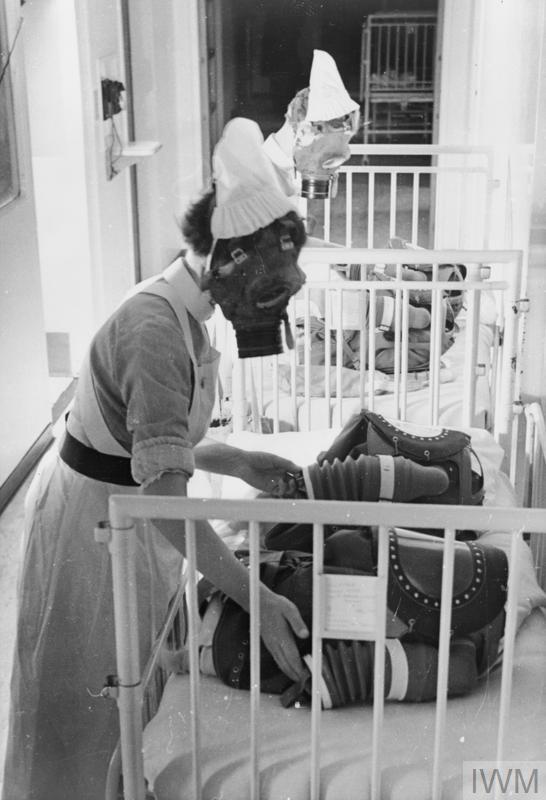
Susan R. Grayzel’s The Age of the Gas Mask offers a compelling material history of one of the twentieth century’s most unsettling objects. Tracing the civilian gas mask from the ‘weaponisation of the air’ in the First World War through to its ubiquitous presence during the Second, Grayzel demonstrates how the advent of chemical warfare fundamentally altered the relationship between civilians and the state. The book is at its strongest in showing how, during the interwar period, the expected horror of renewed use of chemical weapons permeated cultural life, with novels, political debates, and visual culture repeatedly returning to nightmarish scenes of women and children suffocating in poisoned air.
A major contribution of the book lies in its detailed reconstruction of Britain’s civil defence apparatus. Grayzel meticulously charts the extraordinary efforts of the Air Raid Precautions Department (ARP), emphasising that the government’s strategy rested on persuasion rather than coercion. Rather than forcing compliance, the state sought to cultivate a particular form of civic subject: a citizen who willingly carried, trusted, and identified with the gas mask. Crucially, Grayzel does not romanticise this process. She highlights the profound inequalities embedded within it, particularly the inadequacy of provision for infants and the stark disparities between protection offered in the metropole and across the British Empire. The tiered and conditional distribution of gas masks subtly but powerfully undermines the egalitarian rhetoric of the ‘People’s War.’ Here, the gas mask threatens to disrupt Britain’s story of national unity and virtue by revealing the uneven value placed on different lives, a tension the book identifies but does not fully pursue.
Nevertheless, the book excels in capturing the ‘community’ aspect of gas mask culture in interwar Britain, tracing how a device intended for mass protection was absorbed into everyday life through practices of personalisation, such as decorated or modified gas mask cases. Grayzel shows that this domestication of preparedness also generated political unease, particularly for pacifist organisations and the Labour Party, who were caught between opposing war in principle and confronting the moral implications of encouraging civilians to prepare for its apparent inevitability. Written largely in 2019, the epilogue resonates strongly with contemporary readers. Grayzel draws explicit parallels with the Covid-19 pandemic, offering several ‘ways of looking’ at the gas mask as an object that has come to symbolise protection, fear, compliance, resistance, and governmental overreach. Her discussion of gas masks in modern protest culture, particularly in relation to tear gas, is insightful and timely. Yet this epilogue also inadvertently highlights the monograph’s most significant limitation.
Despite repeatedly stressing the symbolic power of the gas mask, the book declines to substantively engage with its longer cultural and mnemonic afterlife. While Grayzel briefly gestures toward the gas mask as a ‘vector of popular memory’, drawing on the work of Gabriel Moshenska, who has explored how material remnants of conflict mediate public engagement with the past, this intervention remains cursory. By relegating the object’s mnemonic life to one of several ‘brief’ forms of consideration in the Epilogue, the book bypasses a rich body of scholarship concerned with how the Second World War has been remembered, transmitted, and reworked across generations.
A more sustained engagement with the work of Lucy Noakes and Juliette Pattinson for example, who have examined how wartime experience is culturally mediated through gender, emotion, and everyday practice, would have helped situate the gas mask within the broader social life of British war memory. Likewise, engagement with Marianne Hirsch’s concept of ‘postmemory,’ which describes how later generations come to feel the impact of traumatic events they did not directly experience, would have illuminated how the gas mask operates not merely as a historical artefact of 1939-45, but as a vessel through which the anxieties and moral ambiguities of the war continue to be inherited and negotiated in the present.
This limitation is most evident in Grayzel’s discussion of the 2005 Doctor Who episodes ‘The Empty Child’ and ‘The Doctor Dances,’ set in London during the Blitz. The narrative centres on a child killed in an air raid who returns as a haunting figure, his gas mask grotesquely fused to his face, endlessly repeating the plaintive question, “Are you my mummy?” Grayzel turns to this episode because it captures, in distilled form, the gas mask’s enduring symbolic ambiguity. An object originally designed to protect civilian life and reassure anxious populations is transformed into a source of uncanny horror, marking abandonment, loss, and the failure of care.
Grayzel’s reading is perceptive and convincing, linking the episode’s disturbing imagery to wartime anxieties surrounding welfare provision, state responsibility, and the exposure of the most vulnerable civilian bodies. Yet precisely because this example so vividly demonstrates the gas mask’s capacity to haunt later cultural forms, it also exposes the limits of the book’s engagement with cultural memory. The discussion remains largely confined to the episode itself, rather than being situated within broader frameworks of collective memory and postmemory that might explain why such imagery continues to resonate so powerfully across generations.
The book might also have benefited from a more sustained comparative perspective. Grayzel’s analysis remains firmly anchored in the British case, yet interwar anxieties about chemical warfare were far from unique. As Peter Thompson has shown in his work on gas masks and civil defence in interwar Germany, fears of aerial gas attack similarly permeated German political culture, where preparedness was bound not only to civilian protection but to projects of national discipline, bodily regulation, and ideological mobilisation. Read alongside Paul Skrebels’ work on the cultural legacy of First World War gas warfare, particularly his analysis of how gas came to symbolise a uniquely modern, indiscriminate, and morally transgressive form of violence, such a comparison could have sharpened Grayzel’s argument. It would have allowed the gas mask to be situated within a transnational memory of chemical warfare, rather than as a predominantly British artefact, and further illuminated how ‘preparedness’ could slide between reassurance, coercion, and militarised social control in different political systems.
This absence is particularly evident in the book’s brief treatment of the relationship between the gas mask and the Holocaust. Here, the object’s meaning was fundamentally inverted: from a device intended to protect civilian life to an instrument that enabled industrialised mass murder. Gas masks were routinely issued to German personnel operating gas vans and chambers, allowing perpetrators to function efficiently within environments rendered lethal to their victims and formalising a stark moral asymmetry between protected and disposable bodies. This inversion is especially striking given Grayzel’s repeated emphasis on gas inflicting a form of death understood to be uniquely inhumane, creating, as she writes, ‘a world where the enemy might deliberately poison the air around you to kill without discrimination, a world where you carried the tangible reminder that, at any moment and without warning, you could cease to breathe.’
What the book does not fully explore is how this genocidal deployment of gas decisively reshaped the gas mask’s symbolic afterlife. It can be argued that the Holocaust fixed the object’s association with facelessness, dehumanisation, and bureaucratised killing, transforming it from a symbol of collective protection into one of technological domination and moral rupture. Seen in this light, the persistence of gas mask imagery in postwar popular culture takes on sharper meaning. From Darth Vader and the Imperial stormtroopers in Star Wars to the dystopian aesthetics of video games such as Fallout, Battlefield, and Call of Duty, the gas mask rarely appears as a benign artefact of civil defence. Instead, it signals authoritarian power, the mechanisation of violence, and the reduction of human bodies to interchangeable units. Read as part of the gas mask’s post-Holocaust mnemonic afterlife, these representations suggest that it was not interwar preparedness but genocidal modernity that most decisively reoriented the object’s symbolic charge, from reassurance to menace, from protection to oppression.
Ultimately, The Age of the Gas Mask is an authoritative and richly textured history of a material object and its immediate social world. Grayzel’s archival work and cultural sensitivity are exemplary. Yet by stopping short of engaging with theories of collective and cultural memory, the book misses a vital opportunity to update our understanding of how the imagery of the First and Second World Wars continues to haunt the present. The gas mask, as Grayzel so clearly shows, did not disappear in 1945; its meanings merely changed. That afterlife, in a time of renewed chemical warfare in Ukraine, remains ripe for further exploration.
The Age of the Gas Mask: How British Civilians Faced the Terrors of Total War by Susan R. Grayzel (Cambridge: Cambridge University Press, 2022; 288pp.; £26.00)
Daniel Schuster is a PhD candidate in History at the University of Kent. His research explores how Britain’s Second World War memory is contested and re-authorised in digital media, with a focus on online reactions to the Dresden bombing.
Image Credit: Gas drill at a London hospital: Gas masks for babies are tested, England, 1940. ©IWM D 655, Licence: IWM Non-Commercial Licence.