
Too much in the way: from artwork to consumer

I’ve written previously about the lack of power cultural consumers appear to wield, given that it’s our wallets that arts companies and institutions are fighting over. What should put us in a position of strength, and result in a Golden Age of Artistic Creations which the masses are clamouring to experience, doesn’t seem to be happening. Why ?

Part of the reason, it seems to me, may lie in the infrastructure that comes between the artistic object (a concert, CD, art exhibition, or latest novel) and the consumer experience.

Before the object even reaches the public, all manner of individuals have made decisions about it: what people want, what they will like, what they might pay, how it should be packaged to appeal to them, and so on. From marketing managers to distribution teams, sales executives and in-house staff, the object has had decisions made about it, and the way it should be pigeon-hold, packaged, promoted and presented long before the actual consumer gets anywhere near it.

This means that all sorts of decisions are made as a result of distribution strategies (release date, performance run, tour dates, retail price) and marketing psychology (presentation style, launch, advertising imagery and attendant promotional campaign) without necessarily having any bearing on the work itself.

How the cultural object reaches the public is the result of protracted planning and ideas about what will appeal, and ultimately what will contribute to successful sales. This takes away the innate appeal of the object itself, and replaces it with hyper-marketing trappings designed, not to make it accessible, but to make it sell well.
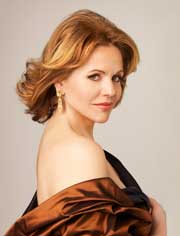
Renee Fleming
Renee Fleming: out of this world

This latter factor, the distinction between accessibility and successful sales, is where part of the problem may lie. If everything is made accessible, there could be too much to choose from, and consumers would drown in a wealth of too much to experience. Instead, let’s make certain things inaccessible, either through pricing or rendering something Esoteric and Difficult in comparison, so that people will buy the rubbish. Let’s package artists that are only half-decent as easy to access, performing works that everyone half-knows or knows that they like, such that they will sell. Why buy discs of Renée Fleming or Cecilia Bartoli, when you can have a CD by this lovely young girl with blonde hair singing stuff you probably already know, and ok, she doesn’t sing it very well at all, but hey, she’s a Bright Pretty Young Thing and the album won’t challenge you ?

How can that be good for the cultural market-place ? Instead, why not let consumers decide, and trust that they can make informed decisions for themselves ?
Contemporary music: is it beyond our reach ?

Contemporary music festivals are often perceived as being notoriously expensive. They can need dedicated professionals working at the peak of their powers to realise extremely demanding repertoire, Rolls Royce ensembles, high-profile conductors. Scores and music are expensive to hire or purchase. The music can be fiendishly difficult both to execute and to comprehend: or of course, the music of composers like Howard Skempton and Michael Nyman, which is challenging in a different way. Brash, modern ensembles, amplified instruments, electronics, a battery of percussion: think of groups like Icebreaker, the Orkest de Volharding, or Bang On a Can.

Commensurately, ticket prices can be high, as festival organisers endeavour to recoup some of the cost.

This is, of course, not true. Or at least – not always.

The widespread nature of this misconception is a shame, because contemporary music is part of the lifeblood of contemporary culture. It reflects modern concerns, resonating with the sounds of urban life and society’s hang-ups: the forthcoming opera by Mark-Anthony Turnage is a meditation on the life and untimely death of Anna Nicole Smith. Contemporary music can be riotous and fun: think of the music of Graham Fitkin or John Adams, with its exciting rhythmic vibrancy. It is a way of engaging with current issues, and making audiences consider political or social issues: Nixon in China, for example.

The music of Xenakis might not be the most accessible of modern compositions – Psappha for percussion solo, for instance.

But it has great conviction, and great virtuosity: seeing the performer is as much a part of the performance as listening to the piece itself. Toru Takemitsu’s wonderful soundscapes are full of colour and luminosity.

American composers such as Michael Torke or Nico Mulhy write music brim-full of rhythmic energy and bouncing textures. Torke’s saxophone quartet, July, is full of funky lines, bouncing rhythm and punchy textures.

Or, on the other hand, the contemplative scores of Arvo Pärt, John Tavener, or another Adams, John Luther Adams’ evocative In a Treeless Place, Only Snow.

And modern music concerts can be heard at the Proms for a mere £5, like Prom 28 with pieces by Oliver Knussen and George Benjamin; or discounted on-line prices to hear Stockhausen and Rebecca Saunders at this year’s Huddersfield Contemporary Music Festival. Or for £8, you could have had a ticket to hear David Matthews and John Casken at the recent Brighton Festival. 

It’s an exciting time for contemporary music, and it’s not always inaccessible, incomprehensible, or expensive. Don’t let it pass you by.

The jazz-man’s necessary beat: rhythm in Swing.

Jazz may be all about the elasticity of time, about syncopation and the louche indolence of swing, but, to paraphrase George Gershwin, it don’t mean a thing if it ain’t got a regular pulse. (I can see why Ira changed the lyrics…)

You can’t pull against something if it’s not firmly fixed: in jazz, that’s the hi-hat. The crisp snap of the hi-hat on the second and fourth beat of a swing tune in 4/4 represents the twin pillars of the piece’s rhythm, around which swing can loll and flounce, secure in the knowledge that it is underpinned by a rock-solid rhythmic foundation. Music is often about the suspension of time, or what the American composer Elliot Carter has called the debate between ‘chronometric time versus psychological time,’ the regular pulse of the daily passage of life pitted against a time-scale imposed by the piece of music itself. Time, in jazz, slips and slides like a novice ice-skater, but one clinging firmly to the hoarding lining the rink: the security of the drum-kit.

Listen to the opening of Milestones, where the crisp homophony of the sideways triadic motion in the saxes and trumpet only works because the percussion defines exactly where the beats against which they are pulling lie: the driving ride cymbal and crisp rim-shot anchoring the beats.

And Dave Brubeck’s Take Five succeeds because the bass player roots the pulse firmly on the tonic ‘E’ every time the five-beat cycle begins anew, along with the pianist’s left-hand and a solid kick on the bass-drum.

(And, as an extra bonus, I love the descisive thwack on the snare(less) drum that marks the beginning of Desmond’s alto-sax solo when the tune ends in this clip).

The writer Michael Hall’s epithet which titles this post is spot on: the hi-hat provides the necessary beat. Next time you’re playing in a jazz ensemble, or improvising a solo, or simply listening to some Charlie Parker or Dizzy Gillespie, keep an ear out for the drummer: he’s holding it all together.

Not so singing and dancing at the Prom?

There’s been some discussion amongst friends and acquaintances since last night’s Prom celebrating Stephen Sondheim’s eightieth birthday, which was also broadcast on BBC2.
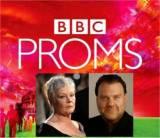
Much debate has centred upon Dame Judi Dench’s performance of Send in the Clowns (which, for my money, is the piece which would alone guarantee Sondheim’s place amongst Song-Writing Immortals, even if he hadn’t written another note). Dame Judi is not, and nor does she pretend to be, a singer. She didn’t sing the song particularly well, which prompted heated discussion.

But she performed it brilliantly. That’s what she does. She delivered an evocative, moving performance of the song that captured the spirit and emotional intensity of the song in a way that commanded the attention. Ok, her singing might not have been first-class, but that wasn’t why she was there: she was there to perform the song, which she did. Fantastically.

And then there was Bryn. He delivered a colossal performance of part of Sweeney Todd that pretty much knocked everyone else’s singing into a cocked hat: the sheer physicality, charged gaze and demonstrative gestures meant he dominated the stage and had total authority: he didn’t just sing the part, he was the part.

The Heated Discussion resumed when he came on to sing and dance in part of Everybody Ought To Have A Maid. Of course, Bryn isn’t the most light-footed, gazelle-like creature, and suddenly the same voices debating Dench’s singing were chattering about Bryn’s dancing. But Bryn’s efforts didn’t matter: he doesn’t aspire to be a dancer, and it was a light-hearted moment in which he good-naturedly joined in, which contrasted with the demonic performance he had just given as the Demon Barber.

People don’t go to hear Judi Dench sing, or Bryn Terfel dance: they go to see them perform. And perform they did – two contrasting pieces, one moving, one menacing. Had they gone to a vocal masterclass by the Dame, or a dancing lesson from Bryn, they might have cause: but it was a Prom concert, where performance is meant sometimes to be diverse and theatrical.

Anyone who grumbles about it will perhaps have missed the point.

Freaked out by Bowie

I’m going through a David Bowie phase in my car at the moment – in-car listening is a terrific way of exploring music – and am working through Changes, Black Tie, White Noise and Reality,

All was going well until three tracks into Black Tie,White Noise when Bowie started singing his cover version of Cream’s I Feel Free. I’ve not heard it before – and it was terrifying.

A 60’s super-group comprising guitarist Eric Clapton, bassist Jack Bruce and drummer Ginger Baker, Cream’s original version of I Feel Free has a manic, slightly trippy euphoria about it, a recklessly exuberant feel.

Bowie’s, however, has none of that: instead, there’s a brooding menace about his version: he sings in a very low register, the rhythmic feel is halved, such that it is much slower, there’s none of the jolly hand-clapping of the Cream original. All in all, it adds up to a very creepy rendition: I think it works, but I’m still not wholly sure, being slightly freaked out at hearing a song I’ve loved for years delivered in such a brooding and ominous fashion (once you get past the opening twenty seconds, that is…).

Combined with a slightly deranged guitar improvised chorus, it’s quite disturbing: shades of Buffalo Bill or the Jigsaw Man’s soundtrack inside their head as they stalk the pavements for their next victim.

Compare them for yourself, and let me know what you think. If you dare…

Wondrous Stories, or the love of Prog Rock

A new album has got me excited. Admittedly, it’s a new album of old stuff, but even so. The old stuff in question is about forty years old, and can be found on Wondrous Stories, a new compilation of the best of Progressive Rock.

Most people I know hate prog rock: a former colleague of mine called it ‘pomp rock,’ and was infuriated with its self-indulgent self-belief and over-blown self-importance (features encountered in classical music too, I countered: think of Wagner…).

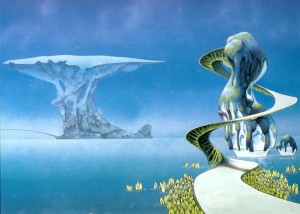
Roger Dean album art
Wondrous worlds: album artwork by Roger Dean

Prog rock was about exploration: extending the structure of songs beyond the three-minute wonder of the traditional pop song; extending the textural soundscapes using electronics,  singing about bizarre, elliptical subjects, and often incorporating elements of improvisation from jazz. The swirling synthesiser sounds of Rick Wakeman and the melodramatic Mellotron in the hands of Tony Banks (think of the opening of ‘Watcher of the Skies’ from Foxtrot, where the whole album seems to appear out the fog); and rhythmic trickery (see the opening of BBC 4’s marvellous ‘Prog Rock Britannia’ for a vocal rendition of some of the movement’s famous rhythms): all these elements contributed to drive rock to new dimensions.

Prog rock also embraced instruments not usually associated with pop, such as the violin and the flute, and live experiences often included heightened theatricality aided by bizarre costumes (think of Gabriel’s flower-costume for ‘Return of the Giant Hogweed’ or the face-painted fire-dancing of Arthur Brown).

The wonderfully tactile nature of gate-fold LPs gave full reign to the imaginary invention of prog rock albums, with fantastic imagery and the often incomprehensible lyrics of the quasi-erudite subject matter adorning the inner covers. Artist Roger Dean’s dream-like escapist album art for the group Yes revelled in the panaromic possibilities the gate-fold album offered, a visual feast sadly diminished with the arrival of CDs and all but lost with the mp3-download culture.

Admittedly, prog rock threw up some turkeys: Rick Wakeman’s Journey to the Centre of the Earth recorded live at the Royal Albert Hall is so dreadfully awful that it put me off going any further in my Wakeman exploration of discovery, which is good because I enjoyed The Six Wives of Henry VIII and Criminal Record without the horror, so I’m informed, of The Myths and Legends of King Arthur on Ice that still awaits me.

But consider the endless inventiveness of King Crimson, led by Robert Fripp, with its deliberately complicated time-signatures;  Pink Floyd’s marvellous Animals; very early Genesis (before the departures of Peter Gabriel and later Steve Hackett, turning Genesis into Phil Collin’s pop backing band and ruining them forever), with great albums Nursery Crymes and Foxtrot; Yes’s ‘Close to the Edge;’

Closer to home, Canterbury also had a foothold in the prog rock movement, with the Canterbury Scene including bands such as Soft Machine, Matching Mole, Steve Hillage and Hatfield and the North. Hillage’s music may often be just the product of guitar-loop trickery, delay and repetition (as in ’Meditation of the Snake’ from Fish Rising and ‘Ether Ships’ from Green), but I like the cascading textures;  whilst his Rainbow Dome Musik (1979) anticipates some of the New Age music’s ambient sonic soundscapes.

Yes, prog rock sometimes was hideously self-indulgent, often took itself far too seriously, and had an inflated view of its own importance. But it also yielded some classic albums, and allowed pop music to spread its wings beyond traditional structures, liberating it from the confines of the three-minute cage to envisage new landscapes and new musical textures.

It’s no good: I’m going to have to get this album. Amazon, here I come…

Stormin’ Norman: Lebrecht livid

Ouch. A touch of outrage manifests itself in critic Norman Lebrecht’s lastest blogpost over on Slipped Disc.

Lebrecht poses a series of eight scathing questions concerning recent events in the nation’s cultural life:  the fourth concerns one summer music festival, which is billing itself as ‘Britiain’s first classical music festival’ (anyone heard of the Proms over there ?) and is featuring Katherine Jenkins and Russell Watson. The festival’s website even features a video of Jenkins singing, erm, Bring Me To Life by American rockers Evanescence (at least, the one I found by using Google did: Lebrecht seems to avoid potential litigation by neglecting to name the festival directly. Perhaps Google led me to the wrong one…).

Read the questions for yourself.

Double ouch.

The Minstrel Effect: music and acoustic space

I was struck the other day, whilst reading Donald Mitchell’s excellent book Cradles of the New, by a passage in which he describes Debussy’s Fêtes as ‘one of the earliest explorations of acoustic space.’ There is a section in the work, the middle movement of his orchestral Nocturnes, in which a march-theme appears in the orchestra, grows louder and then recedes. Mitchell suggests Debussy is creating the sense of a marching band appearing and receding into the distance, and the work is re-creating the effect of music moving through space.

This practice of moving sound around, it seems to me, becomes an increasingly significant aspect of composition in twentieth- and twenty-first century music: think of the lone trumpeter in Ives’ The Unanswered Question or the structural arrangement of the score in Stravinsky’s Canticum Sacrum which reflects the layout in St. Mark’s, Venice; the off-stage ensemble in Mahler’s Resurrection symphony; or Turnage’s About Time, for modern ensemble and the period-instrument Orchestra of the Age of Enlightenment, where the initial brass chorale is played by instruments arrayed around the tower of Ely Cathedral.

The movement of sound around the performance venue (I’m having to avoid the phrase ‘concert hall,’ given the nature of the Turnage piece!) has become a very real phenomenon with the advent of amplification in performance, in particular with electro-acoustic music: rather than move the performers around the space, the sound itself can be transported around the environment. Think of Stockhausen, or Jonathan Harvey’s Mortuos Plango, Vivos Vocos: no longer is the sound static, in the sense that it is being created in one place in relation to the listener: now, the actual sonic space in which the listener is immersed can be altered and moved – the distribution of sound itself becomes as much a part of the compositional process, and the listening experience, as is the choice of instrumentation or harmonic modulation.

Medieval minstrels performed in the city streets, at festivals and mystery plays, playing as they moved, often in order to advertise their playing and draw listeners towards the eventual site of the performance. The sonorous music of Gabrieli in the Renaissance period was working with its acoustic environment, exploring textures and effects dictated by the intended performance space. Modern concert audiences can have a similar experience without leaving the comfort of their seats: the music is moving, receding, diminishing, or growing louder all around them.

Listening to music is no longer about being a fixed point in a static sonic environment: we can be moved by sound, in more ways than one.

Because it does. Doesn't it ? Blogging about extra-curricular musical life at the University of Kent.