Neglected masterpieces: John Surman’s Stranger than Fiction

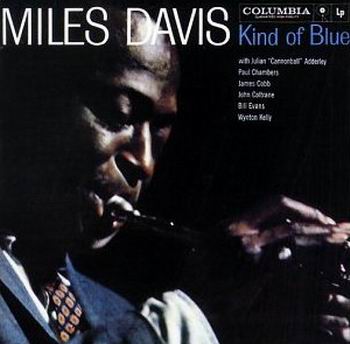
Just occasionally, a jazz album comes along that stands outside of its time, and becomes a classic. Miles Davis’ 1959 recording, Kind of Blue, Charles Mingus’ Ah Um, John Coltrane’s Blue Train; the list goes on. More often, perhaps, albums are released that as equally as timeless, yet somehow fail to attract the acclaim and the status that they might deserve.

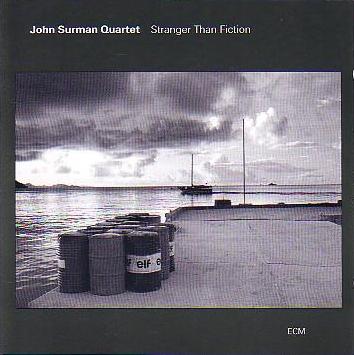
Album artStranger than Fiction, by British saxophonist John Surman, is a wonderfully lyrical and expressive album on which the pieces display the trademark organic, melodic improvisational skills of Surman, matched by some beautiful exploratory playing from pianist John Taylor, whose careful attention to balance and texture recalls some of Morton Feldman’s piano pieces. There’s some understated support from bassist Chris Laurence, and delicate drumming from John Marshall.

The wonderful climbing line that opens ‘Tess,’ or the asymmetrical shifting patterns of the accompaniment which opens ‘Moonshine Dancer’ show the evocative colours that the group can weave; the mood is contemplative, almost spiritual, and the album never puts a foot wrong. No gesture is wasted, no phrase surplus to requirements: deft yet sure, the players are working together seamlessly yet creating plenty of space for one another.

Here’s ‘Moonshine Dancer;’

Released in 2007 on the ECM label, home of such artists as Keith Jarrett, Jan Garbarek, Marcin Wasilewski and other greats, the album is presented in the hallmark ECM style, monochromatic colours with no textural clutter and expressionist cover photography.

Inventive, expressive, and timeless. Listen for yourself to extracts from the album on Amazon here: you won’t be disappointed.

A great deal from not much: composing with small ideas

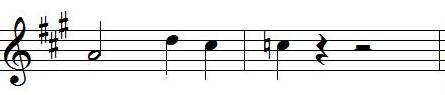
Take two tiny ideas: first, this one.

Add this one.

Not much to look at on paper, really.

But wait. Add a driving rhythm, an insistent pulse, and you get this:

Well, alright, perhaps there’s a little more to it than that: choice of instrumentation, texture, articulation. But that’s all it boils down to, really: two simple ideas, from which a fantastic energy is created. And the ambiguity of the C# – C natural motion in the second idea: is the piece in A major, or A minor ?

I remember the exact moment when I heard this for the first time: at a friend’s house at university; he was playing it in the living-room of his house near the river, and was playing it very loudly on an extremely good hi-fi. (Tim Ward, wherever you are: I salute you!).

Or how about this: a descending minor third.

OK, fairly straightforward. But to build a whole line from this, nay, a whole piece ? Begin stringing descending thirds and variants together, and you get this.

One of music’s great strengths is its ability to create interest from small ideas, which can be sustained over the length of an entire piece. Whether it’s a Baroque keyboard prelude, a piece of Steve Reich, or a pop song: music can unlock magic from the tiniest of blocks of material.

Bach and the Red Hot Chilli Peppers: creative with small ideas.

Secret Sibelius

 Tom Service, over on The Guardian, has noticed a similarity between Sibelius and the James Bond theme by Monty Norman.

Alex Ross on The Rest is Noise has helpfully put together an audio extract comparing the two examples here.

I’d like to add another Sibelian Similarity: this time, by saxophonist Wayne Shorter, one-time sideman with Miles Davis and sax player with the great fusion band, Weather Report.

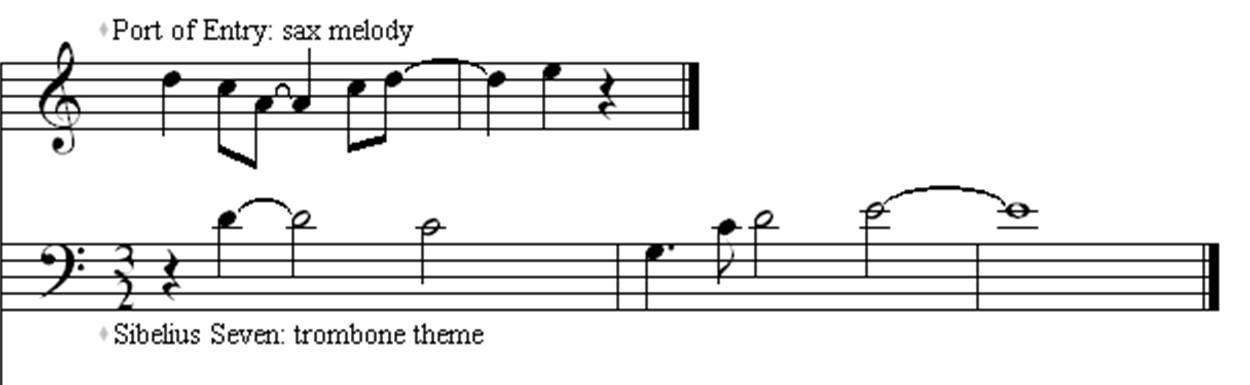
The melodic line from the theme to ‘Port of Entry’ on Weather Report’s live album from 1980, Night Passage, has always reminded me of the beginning of the trombone theme from Sibelius’ great Seventh Symphony.

(The sax theme enters at 25”.)

And the Sibelius theme:

(The theme itself starts at 5’ 25’’). 

With a difference in the third note (and obviously in the rhythmic design), the shape articulated by the first gesture of the melody is similar in both cases:

Thematic comparison
Thematic comparison

Was Wayne Shorter, like Monty Norman, a secret Sibelius fan as well ?

Is it Worf it ? Premiere of first Klingon opera

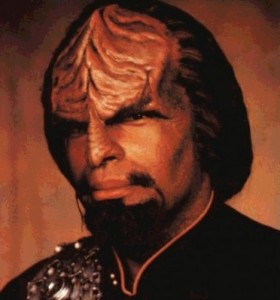
Today is a good day to, erm, sing. As reported in yesterday’s Guardian and also recently by the BBC, a Dutch company has premiered the first opera entirely in Klingon. Called ‘u,‘ the piece is created by the Klingon Terran Research Ensemble.

Lieutenant Worf
Heghlu'meH QaQ jajvam!

The fictional warrior-race from the iconic sci-fi series Star Trek is famed for its guttural, consonant-rich language that sounds as aggressive as its speakers are to behold, as you can hear in a video by the language’s creator, Marc Okrand, which has been sent to the Klingon’s home-planet.

You can view moments from the opera and an interview with key figures involved in the project on the BBC site here.

Whether it can compete with Shakespeare’s famous soliloquy from Hamlet, ‘To be or not to be,’ as it appears in the original Klingon, remains to be seen.

Whatever next: ‘Dancing with Wookies on Ice ?’ I think I need to go and lie down now…

Turn it up: Jonathan Harvey on concert audiences and amplification

In a recent article, composer Jonathan Harvey proposes abandoning the idea of conventional audience behaviour at concert halls, in a bid to attract younger audiences.

Jonathan HarveyI’ve written previously about expected audience behaviour, as it’s important to make music accessible to everyone without burying it beneath all manner of stultifying conventions that will almost certainly put people off, especially younger audiences who are potentially the Ticket-buyers of Tomorrow. The almost religious state of obeisance required to sit still and attentively through classical repertoire is alien to those who attend jazz gigs and rock concerts. Clap in the wrong place during a symphony, and you’re greeted with icy stares or patronising glances: clap after a particularly fine instrumental improvisation at a jazz gig, the musicians will nod their thanks.                      

Harvey advocates amplifying music in performance, standard practice in rock and jazz gigs but greeted with a sharp intake of breath at classical concerts.

“There is a big divide between amplified and non-amplified music. The future must bring things that are considered blasphemous, like amplifying classical music in an atmosphere where people can come and go … and certainly leave in the middle of a movement if they feel like it.”

Leave in the middle if they feel like it ? Blasphemous indeed, perhaps – to some. But precisely this premise was part of Einstein on the Beach by Philip Glass and Robert Wilson – written in 1976, the opera lasts for around five hours, and consists of nine scenes linked by short interludes known as ‘Knee Plays;’ there is no plot, and the audience members are free to enter and leave when they wish.

Harvey has composed in the electro-acoustic field as well as traditional choral and instrumental works: Le Tombeau de Messiaen is composed for piano and tape;  Mortuos Plango, Vivos Vocos whizzes the tenor bell of Winchester Cathedral and voice of a boy soprano (Harvey’s son) around in space, whilst Speakings portrays the birth, development and establishment of language and is written for orchestra and live electronics.  His choral compositions range from the dancing Virgo Virginum to the beguiling mesmerism of The Angels. 

There is of course a divide between audiences for classical concert repertoire and jazz and rock lovers: but as composers such as Mark-Anthony Turnage and Tansy Davies are proving, it’s not an insurmountable one. (Frank Zappa’s The Yellow Shark, anyone ?) And if you go to a concert given by groups like Icebreaker or to hear music by Steve Reich, amplification is almost de rigeur.

Harvey makes the prediction that “if orchestras and conductors hang on to the orthodox method of performance they will end up playing to empty halls.” Whilst one hopes fervently that this will not be the case, there is surely some room to accommodate new ways of listening to music, in a way that will attract younger audiences: isn’t there ?

Bernstein on how does music mean ?

Ah, the thorny question: how does music mean ? Can it have external meaning, or does meaning derive solely from its internal content – harmony, tonality, the working out of ideas ? Does it – indeed, can it – express ideas, emotions, characters, or does it simply ask the listener to follow the unfolding events, the order of ideas and the relationships between them ?

Leonard Bernstein offers some thoughts in a lecture from Harvard:

As he says: ”Music does possess the power of expressivity (sic).” Whether, like Stravinsky, you feel that music is “by its very nature, powerless to express anything at all” (1)  (Stravinsky was talking about his so-called ‘white’ music at the time, such as the ballet Apollon Musagete: Variation de Calliope for strings), or that music conjures its meaning from associations brought by the listener (i.e. previous experiences of similar chords and keys), music certainly has the power to move listeners. A listener with a half-decent wealth of listening experience perhaps comes to a piece with all that listening and its commensurate baggage: one melodic shape reminds them of another piece they’ve heard, a particular sonority or chord reminds them of another piece in which they’ve heard it, or a tonality is associated with a certain mood or frame of mind.

Lute Player by Caravaggio
'The Lute Player,' Caravaggio

Bernstein distinguishes between ‘what music expresses’ and ‘how music expresses it’ by talking about metaphor, music as a language rich in metaphor, ‘meaning beyond the literal.’

Leonard B. Meyer’s Emotion and Meaning in Music defines two types of listener: those for whom musical meaning “lies exclusively within the work itself, in the perception of the relationships set forth within the musical work of art” and those for whom music also “communicates meanings which in some way to the extramusical world of concepts, actions, emotional states and character.” Meyer calls the former ‘absolutists’ and the latter ‘referentialists.’ (2)

Or perhaps you have a foot in both camps: a piece of music has its internal order, its sequence of events with its conflicts and resolutions, that it articulates and which the listener may follow;  but it also taps into a listener’s previous experience and associated personal meanings ? Meyer declares that they “are not mutually exclusive: that they can and do co-exist in one and the same piece of music.”

Absolutist or referentialist: which one are you ? 

—————

1 Stravinsky, I, (1975), An Autobiography, Calder & Boyars: 163 

2 Meyer, L (1963), Emotion and Meaning in Music, University of Chicago: 1

Exuberance in music: Joe Zawinul’s ‘Patriots’

For sheer unbridled exuberance in music and matchless energy, here’s the late, great Joe Zawinul’s ‘Zawinul Syndicate’ performing Patriots live in 1997.

After an all too brief but dizzying bass solo from the great Richard Bona, the unstoppable rhythmic drive of the piece kicks in: it’s hard not to be carried away by its infectious joie de vivre and sheer pleasure in playing. Once the groove has begun, propelled by some astonishing percussion work, it never lets up: the piece just cooks nicely and with such ease, you can forget that it’s leading at such a frenetic pace.

Zawinul led the great fusion band Weather Report in the 1970s and 80s, a legendary ensemble including ex-Miles Davis sideman, saxophonist Wayne Shorter, bassist Jaco Pastorius (listen to Teen Town to get an idea of Jaco’s astonishing virtuosity and raising of the bass to a melodic instrument; Bach would have loved it), and drummer Peter Erskine. The group’s dazzling blending of jazz, rock and world music saw the creation of great albums such as Black Market, Heavy Weather, 8.30 and Sportin’ Life.

 Zawinul himself played with Miles Davis for a brief period, and wrote the lyrical In A Silent Way from Davis’ album of the same name, and also played on Davis’ Bitches Brew, the fastest-selling jazz album of all time.

Zawinul’s own Zawinul Syndicate saw the same driving and energetic performances typified in Patriots right up until Zawinul’s death in September, 2007.

That’s the secret to music-making, and to great performances: passion, commitment and joy in performing.

(And to the members of the University Chamber Choir 2008-09, for whom I wrote a choral arrangement of Patriots: remember this ?! Happy days.)

Hidden Beyonce: the truth about Turnage’s new piece

Oh, wow. As Alex Ross points out in a recent post on The Rest is Noise, critics in the media are gradually picking up on the idea that Mark-Anthony Turnage’s Hammered Out, premiered at the BBC Proms last week (discussed in a previous post here), has more than a nodding reference to Beyoncé.

Beyonce
Ring of truth ? Beyonce Knowles

Some bright spark has superimposed Beyoncé’s hit Single Ladies, released in the UK in February last year, onto the first three minutes of video footage of the Turnage piece on YouTube, and it’s hard not to be convinced. Brass riffs imitate vocal lines, chords on the piano and strings are following patterns in the pop song: even the speed David Robertson takes the piece at is the same. Turnage is a confessed jazz and pop enthusiast as well as being a ‘classical’ composer (if the term can be said to have any meaning these days).

In an interview about the piece, Turnage acknowledged several pop references, but also mentioned secret ones that he would prefer listeners to discover for themselves. This seems to be one of them.

Watch it for yourself and make up your own mind.

Because it does. Doesn't it ? Blogging about extra-curricular musical life at the University of Kent.