
Be My Guest: an occasional series featuring guest post and contributions. This week, third-year student Andrew Bailey reviews the Rite of Spring lunchtime concert.
—-
The reputation of Stravinsky’s magnum opus had clearly preceded it, with a packed Gulbenkian visibly demonstrating the esteem that ‘The Rite of Spring’ continues to hold with audiences today. Sitting with a clear view of the grand piano and the score, I wondered how Peter Hill and Benjamin Frith’s interpretation of the infamous score would challenge my own understanding of it. Having worn out three copies of “Fantasia” on VHS when I was a toddler, The Rite and Stravinsky’s work has always continued to fascinate me and I have continuously endeavoured to experience its different adaptations. As my old music teacher used to recount: “Every time you listen to The Rite, you always discover something new; be it a note, a motif, or a new feeling”. She has yet to be proved wrong.
Prior to the performance, Hill presented a concise yet detailed synopsis of the piece’s origins and I was glad that he took care in running through the “plot” of the piece. What was clear from his emphasis on its genesis and the difficulty in rehearsals was that Hill wanted us to appreciate the piece as Stravinsky would have first written it and how innovative it is musically; discarding our memories of the spectacle we now associate it with. It was then that the theatre went silent; a soft C was then heard, almost floating its way around the room, as the infamous opening began.
Without the visuals of an extravagant ballet, the audience’s attention was drawn to the physical performance of the musicians; clearly caught in the music as they thrashed their heads to the rumblings of ‘The Augurs of Spring’. Undoubtedly, one could not ignore the musicality of the piece as its dissonance, sometimes suppressed by an orchestra, was all but fully exposed on the piano. Despite what could seem a cacophony of sound, Hill and Frith demonstrated without a doubt that they knew the piece intimately and that all the right notes were indeed being played in the right order. The rapturous applause the musicians received was indisputably well deserved (alongside Dan Harding’s impeccable page turning skills!)
This Lunchtime Concert definitely demonstrated the musical complexities of The Rite and the four hands arrangement is certainly the optimum version to take notice of if one wishes to examine Stravinsky’s musical innovations. Is it now my favourite arrangement though? No. Not that I believe Hill and Frith did not play well enough; on the contrary I think they performed outstandingly! However in my opinion, The Rite should be as much a spectacle as it is a musical innovation. As Hill pointed out in his synopsis, Stravinsky remembered the violent image of the Spring as the ice would crack open around St Petersburg; he dreamt the disturbing image of a girl dancing herself to death. The notorious riot at its premiere was as much a reaction to Vaslav Nijinsky’s controversial choreography, as to Stravinsky’s score.
Don’t get me wrong, I don’t believe the piece is not ‘innovative’ enough; I will happily acknowledge and rant about how it is a landmark piece in the history of music. What I want to emphasise it that I personally believe the piece works best with a spectacle to watch. In Sir Simon Rattle’s documentary on the piece, ‘The Augurs of Spring’ and ‘Sacrificial Dance’ are performed whilst images of a maiden dancing through a forest are shown, consequently making the piece more haunting in my opinion. There is even some filtered footage of the First World War thrown in to demonstrate how the violence of the work was reflected the following year with the outbreak of the conflict.
Although a complete different interpretation of Stravinsky’s intentions (as well as harshly cutting out and editing the various sections all over the place) I still think that watching The Rite segment in Fantasia is fascinating and the fight between the Stegosaurus and the Tyrannosaurus heightens the tension and excitement of “The Naming and Honouring of the Chosen One” movement.
But that is just my opinion.
Overall, a great Lunchtime Concert which will, I feel, be talked about for years. But if you want to experience more Stravinsky before the Colyer-Fergusson Concert on March 12th, where “The Firebird Suite (1919 Version)” will be performed by the UKC Music Society Orchestra, then I cannot recommend highly enough watching The Rite in its original ballet form (choreography, sets, costumes etc) to truly experience its spectacle.




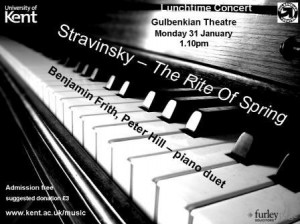 The first of this term’s lunchtime concerts on Monday 31 January in the Gulbenkian Theatre is an unmissable occasion: two of the country’s leading pianists grappling with Stravinsky’s notorious, barbarous tour de force. More commonly heard in its orchestral incarnation, the piece caused a scandal at its premiere in 1913; this is an opportunity to hear it in its piano-duo arrangement, which loses none of its vibrantly destructive energy.
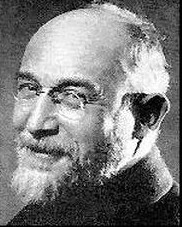
 Composed in 1917, at a time when the rest of the world had gone mad with wholesale slaughter and mechanised forms of destruction, Satie’s evocation of the Classical period is a reminiscence of, almost a hankering after, an old order where unity and structure prevailed; at the same time, his usurping of its principles reflects the breakdown of society and its values which was going on around him: despite its apparent jocular tone, the shadow of the Western Front is never far away.
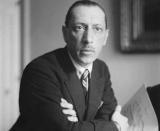 The Lunchtime Concert series kicks off with Stravinsky’s four-hands piano version of The Rite of Spring performed by the internationally-acclaimed duo of Peter Hill and Benjamin Frith; later in the term, the Colyer-Fergusson Cathedral Concert includes more Stravinsky, as the Symphony Orchestra plays the 1919 version of the Firebird Suite alongside Mozart’s Requiem with the University Chorus; the Concert and Big Band will present their usual barn-storming Gulbenkian Theatre concert in February; the Chamber Choir explore choral music from England, Scotland and Wales in the Cathedral Crypt in February and will give a second concert, in Wye, in April; the Camerata performs Wagner’s Siegfried Idyll in March; plus three Jazz @ 5’s.
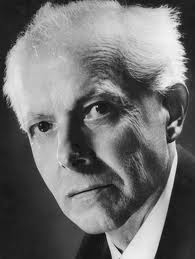 It’s a masterpiece: the visual element is so brilliantly rendered in the orchestral score that it almost makes a staged realisation unnecessary. The glittering yet bloody armoury, the sweeping views of Bluiebeard’s seemingly limitless kingdom, the dazzling treasury where the priceless artefacts are tinged with blood, the lake of tears – the music creates these scenes so well, you almost don’t need to see a stage production’s version: better to leave it to the imagination.