All posts by Daniel Harding

Head of Music Performance, University of Kent: pianist, accompanist and conductor: jazz enthusiast.

Haydn’s Creation: reflections of an American violinist

Masters student and violinist Jon-Mark Grussenmeyer reviews the  recent Cathedral concert.

—-
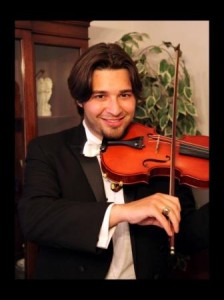
On the fiddle: Jon-Mark Grussenmeyer

After rehearsing with Sue into the late hours of countless Thursdays, performance day was finally upon us.  It promised to be a busy day, not least because my family had flown in from New Jersey to watch the concert.

My father kindly offered to drive me from my flat to the pre-concert rehearsal, at which we were supposed to arrive by 10:45.  He promptly made a wrong turn at one of the roundabouts, though thankfully he was, at least, still driving on the wrong—I mean left—side of the road.  By the time we pulled into town, I was nearly late.  Knowing the English fondness for punctuality, and fearing being skewed by Sue’s angry baton, I sprinted into the Cathedral only to find that half of the orchestra had yet to arrive!

As a postgraduate student of Mediaeval Studies, I am often in the Cathedral, usually examining tombs and other objects related to long-dead people, but filling such a building with beautiful music was completely new to me.  To sit and play in the vast nave, the gothic vaulting soaring far above our heads, sunlight piercing the leaded windows in dusty golden shafts, was, for me, an unforgettable experience.

After practicing for a while, we were allowed a brief respite, during which my stand partner and I rushed to purchase the coffee and muffins that would keep us alive for the rest of the afternoon.  Of course, as we ate, poor Miriam was then subjected to a mini-lecture on the finer points of the Great Cloister’s architecture, which was only halted when we heard the rest of the orchestra tuning inside.

The second half of the rehearsal went quite well for the orchestra.  Several times, the combination of such beautiful harmonies and stunning setting was so powerful that it brought tears to my eyes.  Then, the beautiful shafts of sunlight began to shift until they shone directly in my face whenever I attempted to look up at Sue, so teary eyes necessarily remained an integral part of the rehearsal.

Rehearsal at an end, I ate a late lunch and wandered around town with my family.  As evening wore on, we repaired back to my parents’ room in the Falstaff Hotel, where I changed into my dinner jacket and then walked back to the Cathedral, violin in hand.  The only mishap en route was a ‘gentleman’ who attempted to lay hands on my dinner jacket whilst babbling something unintelligible, though I rid myself of him with a fierce look and a few well-chosen words.

We set up our instruments in the shadowy Cathedral Crypt, one of my favourite places in all of Canterbury, and waited for the concert to begin.  As 7:30 rolled around, the chorus marched out to take their places on the enormous risers that seemed to reach as high as the quire’s rood screen, and we took our seats and tuned our instruments.  I was stunned by the number of people filling the Nave, including the Lord Mayor, who was sitting across from me in the front row with his impressive chain of office.  We certainly ought to have chains of office in the States.  Finally, Sue, Jeremy, and the soloists emerged to thunderous applause, and the concert took off in the whirlwind of Haydn’s interpretation of Chaos.  I am glad that I had time to appreciate my surroundings whilst playing during the rehearsal, for I had little time to notice anything but the notes, the baton, and Jeremy’s bow as I shifted into my intense concert mode.  As I am on the front edge of the orchestra, I found it amply necessary to concentrate; in the complete view of the audience, I have to at least appear to know what I’m doing.

As with any performance I have ever completed, orchestral or theatrical, the concert seemed to fly by at breakneck speed, and suddenly, after weeks and weeks of tiring rehearsals, the orchestra and chorus were belting out the last magnificent strains of the Creation.  As the echoes of our final chord lingered among the high-flung columns and the audience filled the nave with applause, I gazed up at that splendid Cathedral and at my fellow musicians, trying to etch the moment into my memory.  Though I shall take many amazing memories back with me to New Jersey when my time here is over, the memory of this concert numbers among the very best.

All that Jazz: Jazz @ 5 this Wednesday

The ever-popular Jazz @ 5 series returns for a one-off special this Wednesday, on the Gulbenkian Theatre’s foyer stage. 

Jazz @ 5
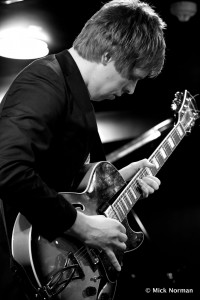
Lickety-spit: Andrew Kitchin

University musicians will gather at 5pm to provide an informal gig, including jazz standards, showtunes and songs. Appearing at the gig will be Jazz @ 5 regulars Andrew Kitchin (guitar), Steph Richardson and Jo Gray (voice), along with this year’s Big Band singer, Ruby Mutlow.

Making their Jazz @ 5 debut will be saxophonist with the Concert and Big Bands, Tim Pickering, and pianist with the London Community Gospel Choir and second-year Economics student, Niji Adeleye.

The gig starts at 5pm, and admission is free: come and enjoy some laid-back mid-week jazz at the end of the day.

Out of the Woods to touch the stars: triumphant success for Music Theatre Society

The curtain has sadly fallen for the last time on this year’s production by the Music Theatre Society, and their assured performance of Sondheim’s Into the Woods that never puts a foot wrong. A strong cast and crew combined to give a professional production that at times transcended the auditorium and swept the audience beyond the theatre into the dark moral territory of Sondheim’s show in overwhelming fashion.

Into the WoodsAs Cinderella, Cheryl Ahmet demonstrated a refined, clear tone, and sang ‘No-one Is Alone’ in particular with a touching simplicity that was deeply moving.

Tenor Richard Simpson as the Baker projected great stage presence, and showed he had a clear insight into the musicality of his arias; he sang with considerable nuance to phrasing, and there’s a fine voice there as well. His delivery of ‘No More’ was full of subtlety and emotion, and held the attention of a rapt audience. Jenni Stewart played Little Red Riding Hood’s impudent childishness to perfection, and her face-muscles must have been working overtime as she portrayed the full range of impish expressions of the ever-snacking child.

The two princes were in very jolly form – the line ‘I was raised to be charming, not sincere’ was greeted with an appreciative and spontaneous round of applause.

Star of the show, however, has to have been scene-stealing Lucie Nash who, as the Baker’s Wife, was in inspired form as she painted the full spectrum of her character’s emotional range; moving from heart-rending desire for a child to puckish swagger and sultry seductress with the Prince, her comic timing in particular was immaculate, and the on-stage rapport with Richard Simpson as the Baker had a genuine warmth.  Moving around the stage with an ease that radiated confidence, her ‘Moments in the Woods’ aria was especially beautifully crafted, and sensitive to the nuances in the score.

The orchestra and singers were held together well by the efficient direction of conductor Adam Abo Henriksen.

All in all, this is a triumphant achievement for director and this year’s society President, Lisa Crowhurst. The overall integrity of her sure-footed directorial vision was alive to the sophistication of both Sondheim’s music and text, and its clarity allowed a natural ebb and flow to the narrative drama in a manner which allowed the nuances of the players and the changing emotional and moral relationships between the characters to stand clear.

Music Theatre SocietyBy the time you read this, the run will have come to its end and the woods will have been cleared; but the entire company can look back on three days of terrific accomplishment in the seaside playhouse.  A triumphant achivement for the cast, crew and Society: bravo.
Korngold: talent or time-waster? The Brodskys can help you decide…

It’s over fifty years since the death of Erich Wolfgang Korngold, presciently given his middle name by parents who must have been sure their child would, like the other great Wolfgang, be something of a child prodigy. Fifty years later, opinion is divided over whether Korngold was a musical genius or a reactionary who preferred to ignore musical modernism in favour of self-indulgent music, pining for a lost age.

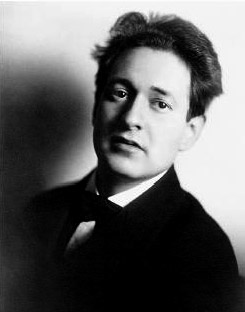
Wunderkind: the young composer

The talented Viennese wunderkind was hailed by Mahler and Puccini as a child, and by the tender age of nineteen Korngold had already written a clutch of chamber works and had two one-act operas staged to great acclaim.

Korngold moved to Hollywood in the 1930s to write film scores for Warner Bros, a move which has perhaps contributed to his lack of esteem in critical circles: sadly, there’s still a sense that ‘great composers don’t write film music,’ an idea with which John Williams and Jerry Goldsmith might take issue… And anyone who has heard the sweeping lyricism of the Violin Concerto or the effortless handling of musical ideas in the second and third string quartets might also have something to say about Korngold’s facility for melodic invention and expressive writing.

You can make up your own minds as the Brodsky Quartet brings Korngold’s lyrical Second String Quartet to the Gulbenkian Theatre in their concert this month, along with Gershwin’s evocative Lullaby, Wolf’s sunny Italian Serenade, and Beethoven’s mighty op.132; details and tickets online here.

Here’s a foretaste of the Korngold with the lyrically dancing ‘Waltz’ of the final movement.


Let there be Light…

The whole of the Creation process, from the gradual emergence out of Chaos through first Light to Man and Woman, will take place in Canterbury Cathedral tomorrow in considerably less time than the original Seven Days the Lord took.

The University Chorus, Orchestra and soloists will render the whole series of events for you at one sitting (well, two, if you count the Interval) on Saturday at 7.30pm in the Nave.
Tickets and details here: think of us all early tomorrow morning, as the logistical process gets underway at 9am as we move instruments and stands down into Canterbury in preparation for the morning rehearsal…

Let’s go Into the Woods…

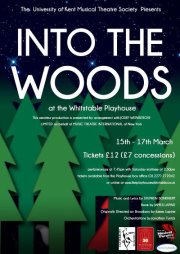
The University’s Music Theatre Society is currently  getting ready to take you ‘Into the Woods’ next week, as it brings Sondheim’s musical to the Playhouse, Whitstable.

Into the WoodsFrom Thursday 15 to Saturday 17 March, Sondheim’s music will be resounding around the seaside town’s theatre auditorium to accompany the darker adventures of some of the better-known characters from the Brothers Grimm’s classic fairy-tales.

At the helm of the orchestra this year is Masters student and tenor with the Chamber Choir, Adam Abo Henriksen, who is relishing the opportunity to get to grips with an orchestra. A member of the Chamber Choir for four consecutive years, Adam has also previously conducted and played the piano for the student vocal group, Sing!, and sung with the University Chorus. He’s also been spotted singing with a barbershop group around the campus as well.  Some of the University Music Scholars will be playing in the orchestral pit for the production.

Evening performances begin at 7.45pm, and there’s also a matinee on Saturday at 2.30pm.

Tickets are £12.00 / £7.00 (concessions), and can be booked online here, or contact the booking office on 01227 272042

Visit the ‘Into the Woods’ Facebook page here.

And to whet your appetite, here’s the original Broadway cast version of the intimately heart-rending ‘No-one is Alone’ and ‘Children will Listen.’ These songs do what Sondheim does best: they reach into your soul without your realising. Prepare to be moved…