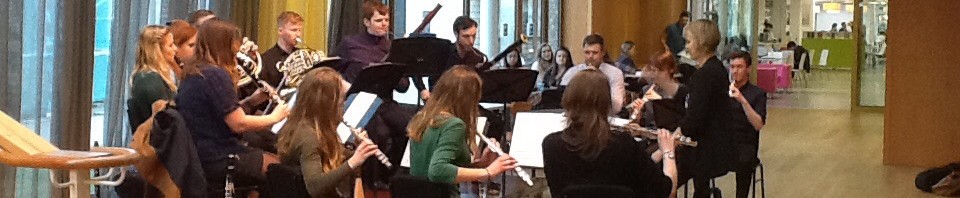
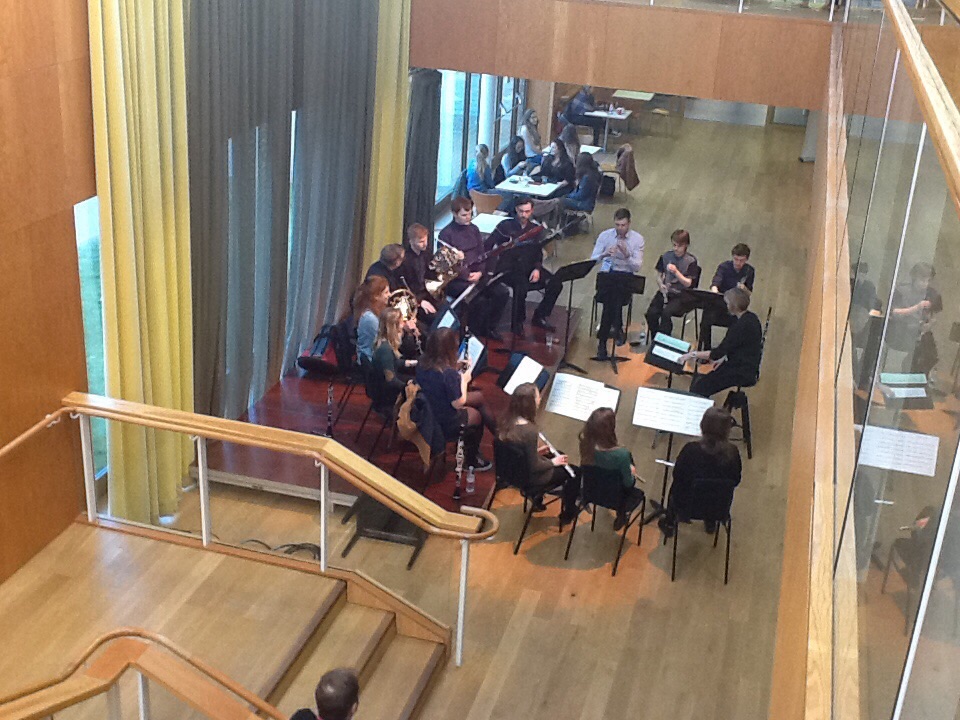
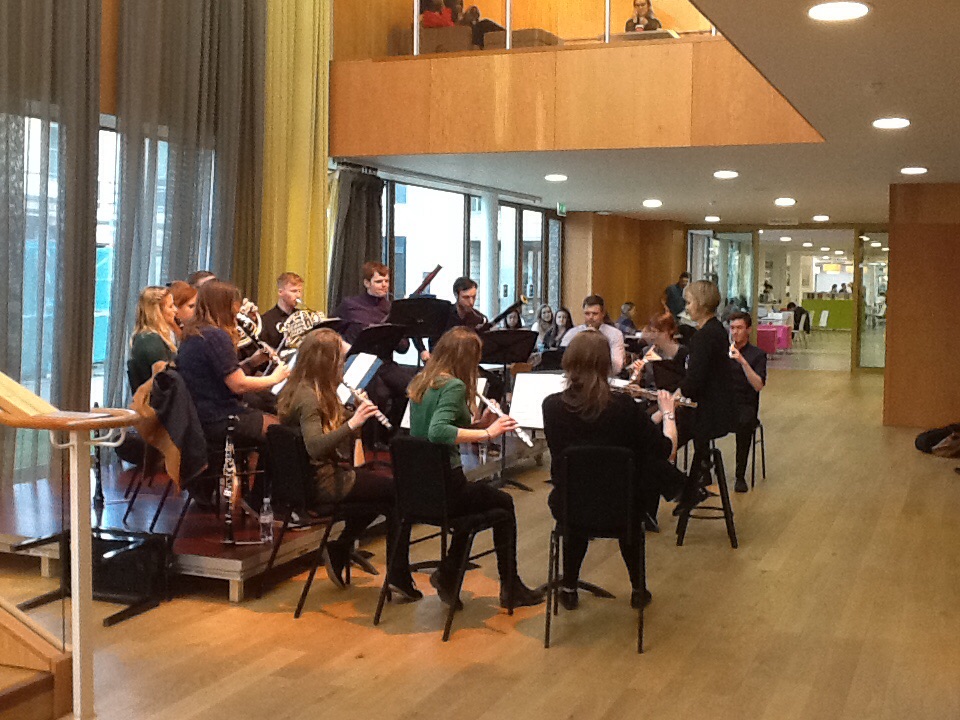
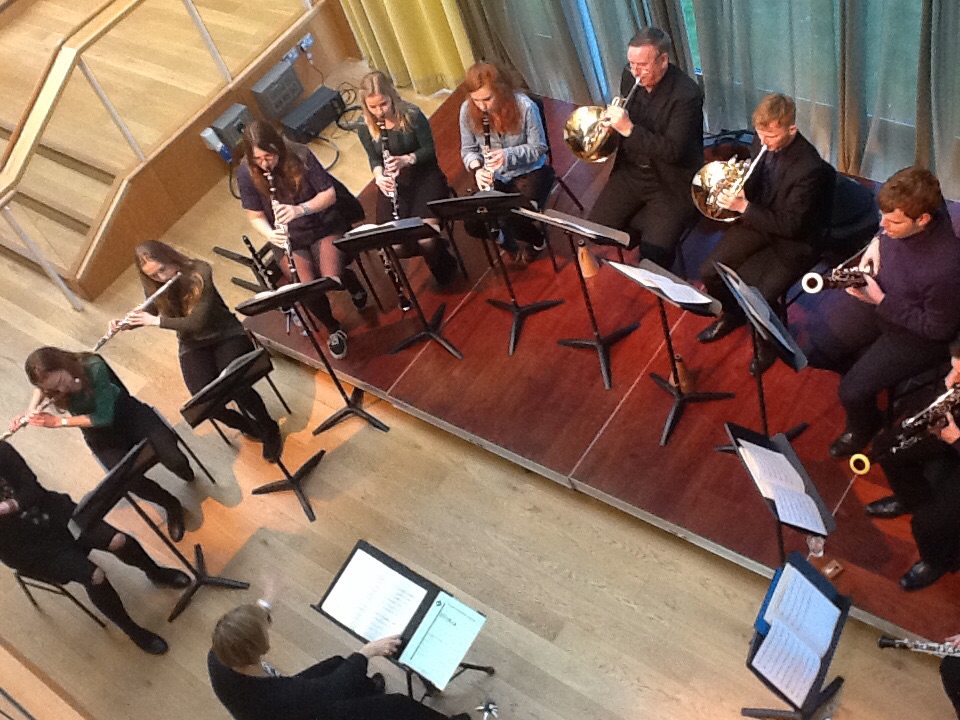
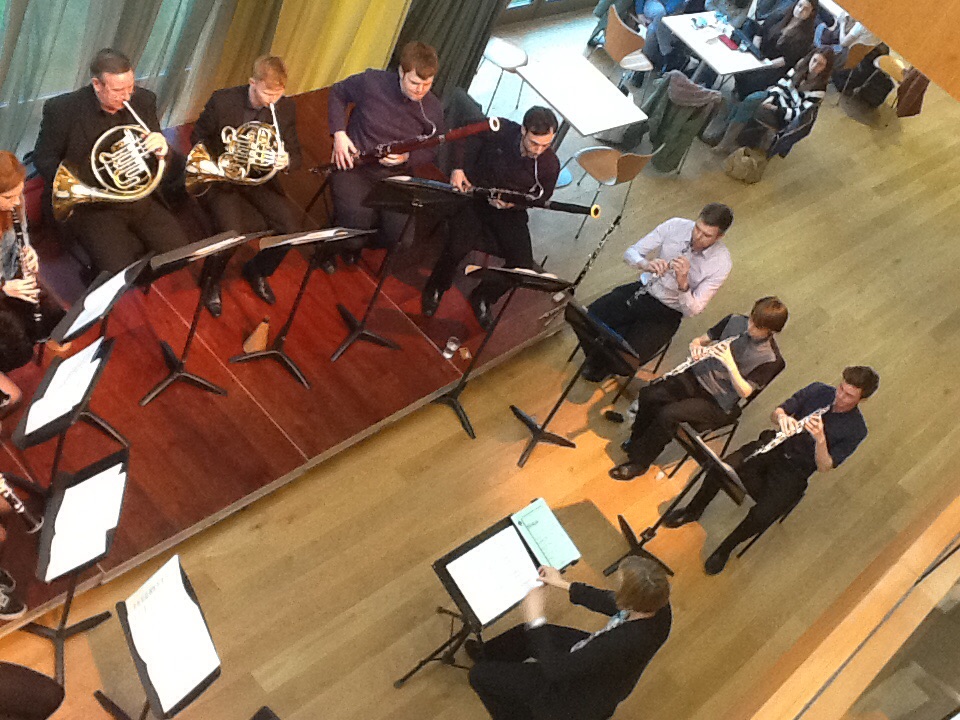
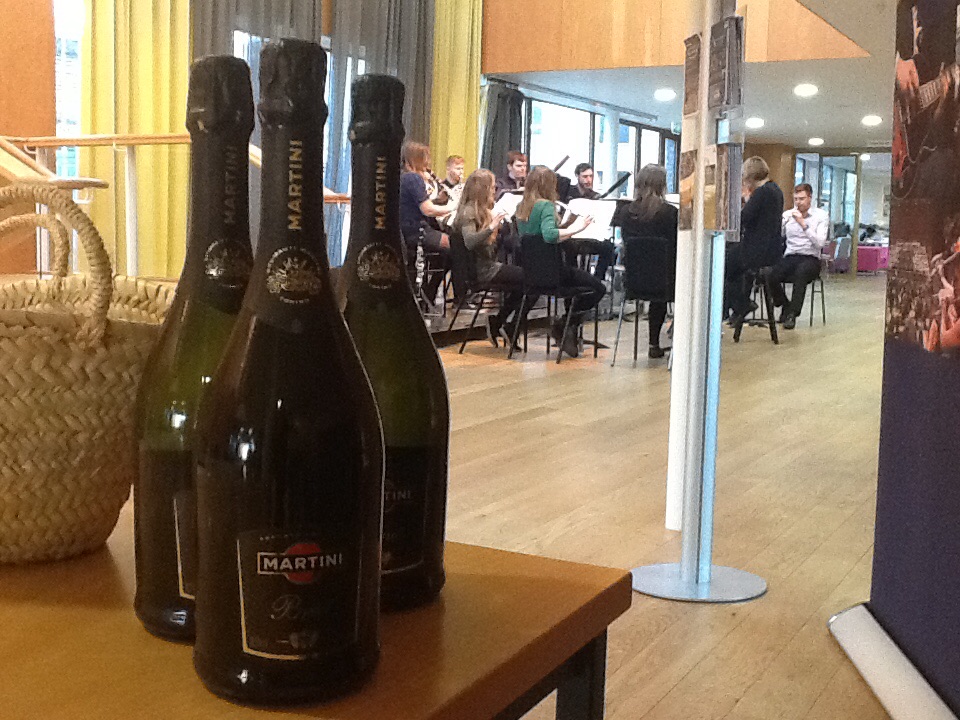
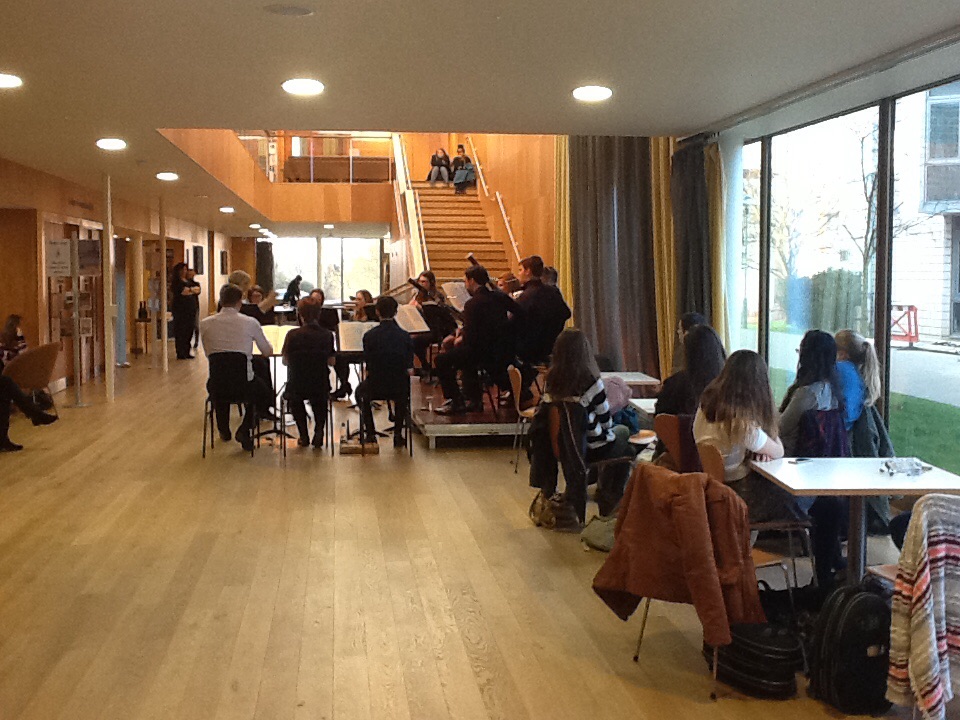
Great stuff from the Wind Ensemble, which gathered on the foyer-stage earlier this evening to play a feisty arrangement of Queen’s Bohemian Rhapsody and movements from Dvorak’s Czech Suite.
Next week’s tea-time gig features the String Sinfonia.
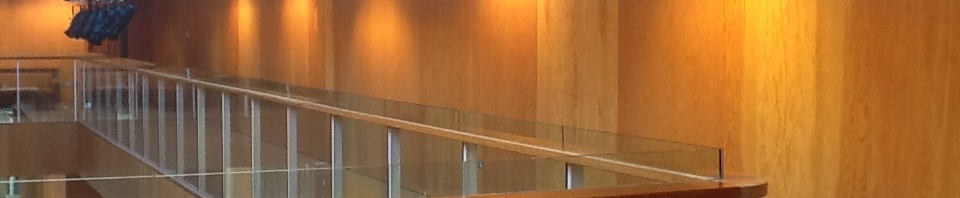
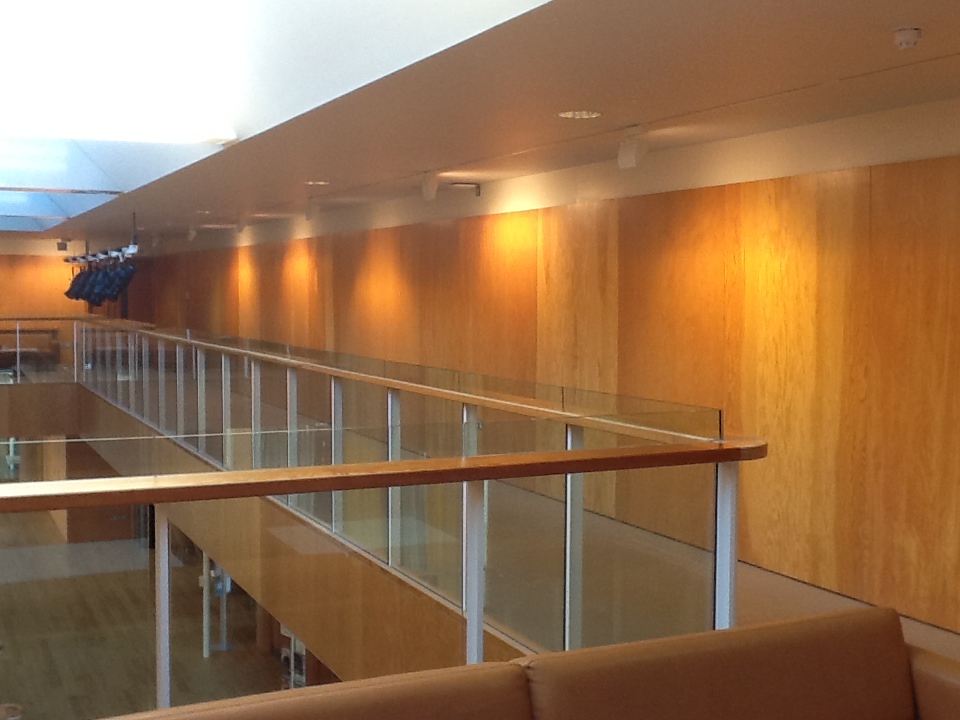
One of the very great strengths about Colyer-Fergusson is its mulitplicity of purposing – the flexibility of the concert-hall, the practice-rooms functioning as green rooms during events, the social area that also works as a performance space – and we are very excited to be drawing further on the building’s potential next month by launching the Colyer-Fergusson Gallery, which will run the length of the upper balcony.
The building welcomes plenty of visitors on a daily basis – people using the practice rooms, ensembles using the rehearsal spaces, music teachers working with the Scholarship students, as well as members of the University community and the general public using the social areas or passing through on their way through to the Gulbenkian. At weekends, the building throngs with external events; choral concerts, orchestral performances, visiting performers. The first-floor balcony is a large space that offers scope for visual art to be presented to those moving through the building, and next month sees the first of three planned exhibitions which will adorn its walls.
The first two exhibitions form part of the Tokaido Roadproject (a touring chamber opera with a libretto by Nancy Gaffield, Senior Lecturer in Creative Writing, to music by Nicola LeFanu, which comes to the Gulbenkian Theatre in May): Walk Swale Medway by Faversham-based artist Hope Fitzgerald, and Saxon Shore Way: a response to Tokaido Road by the local collective, Earthbound Women. Both exhibitions will explore similar themes of journeying and of travel, as part of the project, drawing inspiration from the landscape and the history of Kent. In September, to coincide with the Alumni Weekend, the gallery will host a photographic exhibition by the University’s very own Matt Wilson, whose excellent photographs of music events often feature on these pages.
Image: Hope Fitzgerald
There’ll be more about each exhibition nearer the time. Walk Swale Medway will be the first to grace the exhibition space, and will run from Friday 14 April to Friday 1 May. Leaflets about the new gallery can now be found in the foyer.
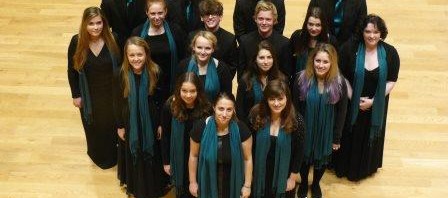
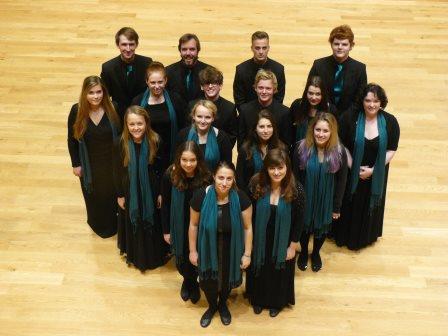
There’s no respite in the calendar of performing commitments; fresh from Saturday’s epic Colyer-Fergusson Concert, the University Chamber Choir returns to the Cathedral Crypt this coming Friday for an evocative programme, Then Comes The Day.
The title of the concert is taken from a line in the Hymn to the Virgin, ‘Darkest night / Then comes the day,’ which features in the concert, representing the triumph of optimism over despair in a programme that commemorates European countries involved in the First World War. Your Loyal Correspondent will be joined in conducting duties by fourth-year Music Scholar Emma Murton to fill the ancient and echoing spaces of the Cathedral Crypt with what promises to be a vividly expressive sequence of music.
From the Renaissance austerity of Tallis’ Nine Tunes for Archbishop Parker’s Psalter through to the contemporary colours of Jussi Chydenius, Friday’s concert travels through England, France, Germany, Italy and Finland, and will include Schutz’ glorious Jauchzet den Herren, earthy part-songs by Lassus, Stanford’s purple-hued The Blue Bird and works by Purcell, JC Bach and Elgar. Second-year Music Scholar Anne Engels will join the Choir, performing pieces for solo flute including Debussy’s lissom Syrinx.
The concert starts at 7.30pm; more details and tickets here.
To whet your appetites, here’s Stanford’s The Blue Bird, sung by the Choir of Gonville and Caius College, Cambridge.
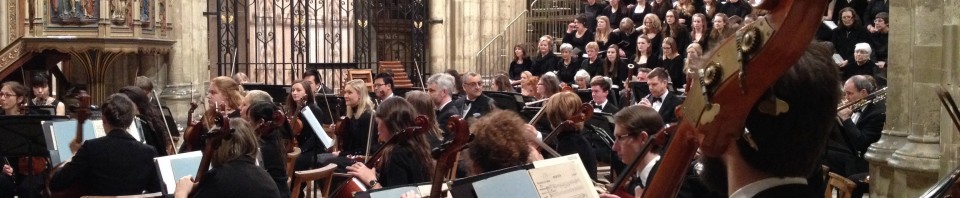
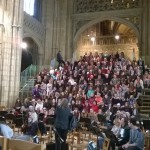
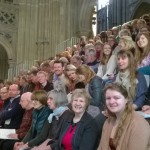
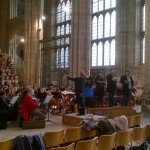
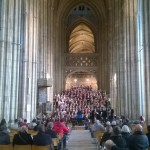
From the infinite mystery of the opening bars to the dramatically hushed close, Saturday’s performance of Verdi’s Requiem by the University Chorus and Symphony Orchestra for this year’s Colyer-Fergusson Cathedral Concert was full of high drama.
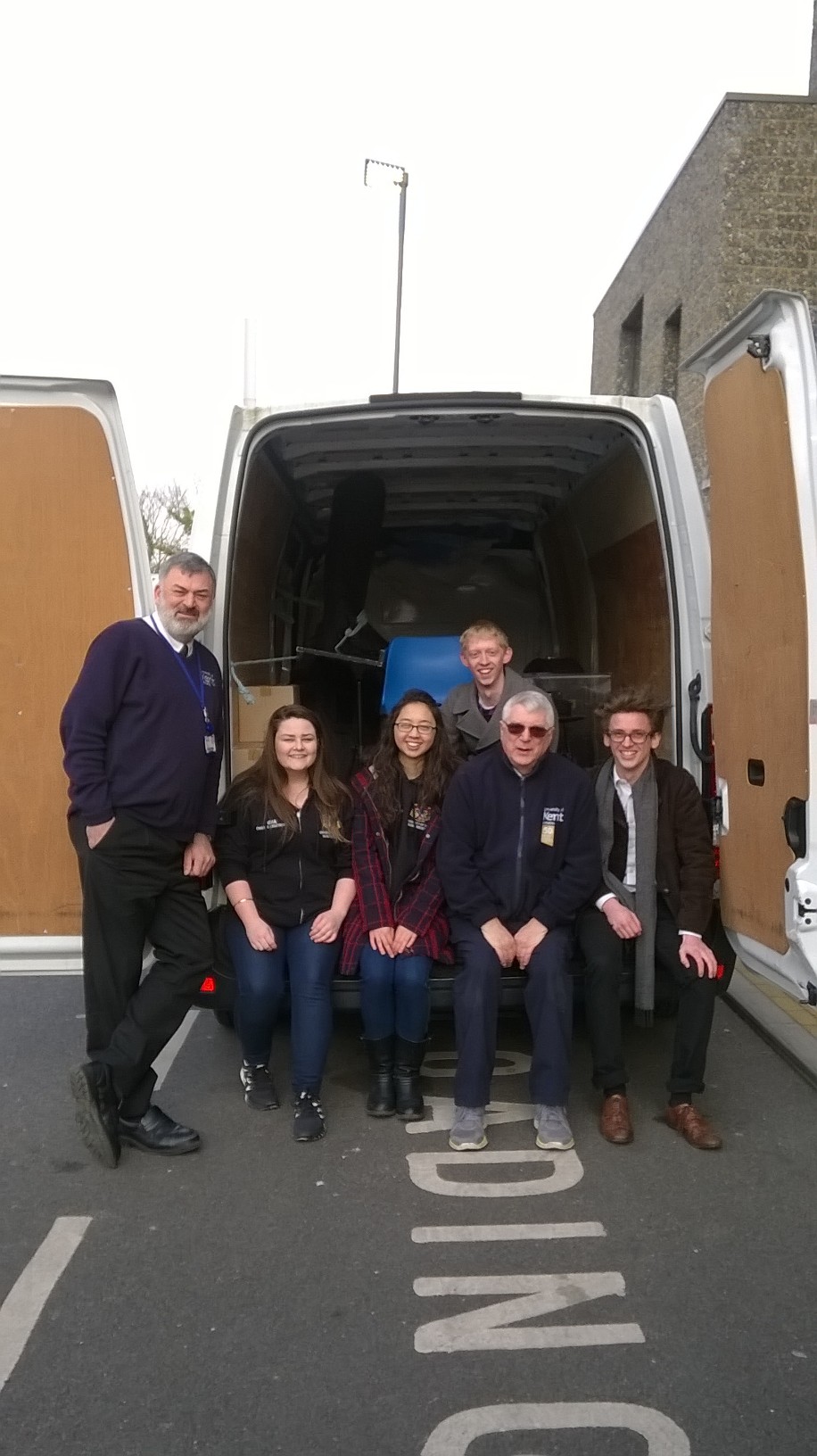
The morning shift crew
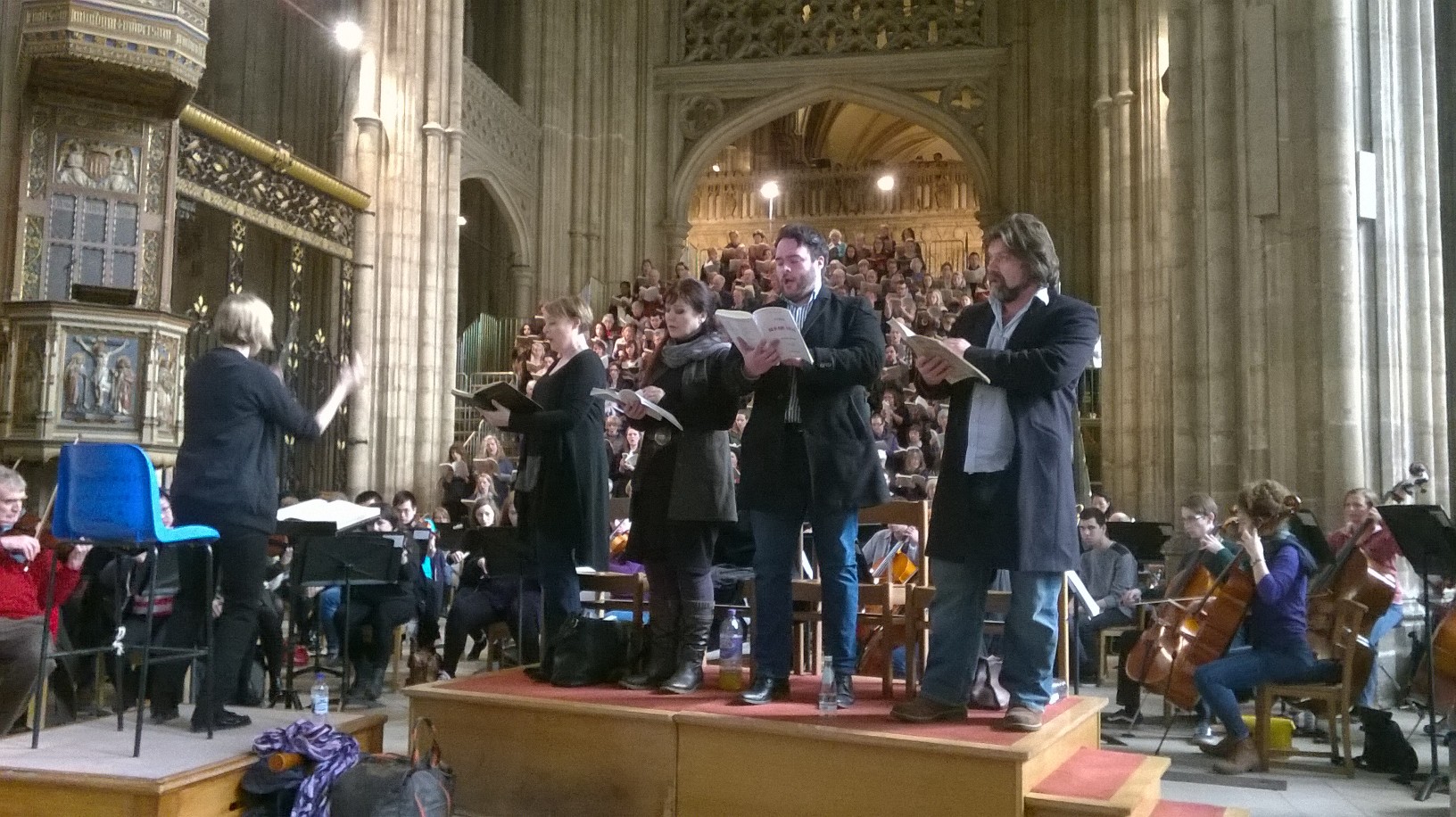
Standing in as a last-minute replacement for the billed soprano soloist, Rachel Nicholls took time out from her current ENO run of Die Meistersingers to step up alongside mezzo Carolyn Dobbins, tenor Gerard Schneider and bass Simon Thorpe, and together all four singers delivered Verdi’s demanding solo parts with consummate skill. Under the baton of Susan Wanless, the Chorus and Orchestra both rose to the occasion superbly. From the off-stage trumpets ranged high above in the organ-loft to the bass-drum positioned down the side-aisle, the combined forces filled the majestic Cathedral with Verdi’s profound meditation on death and redemption, rich in operatic detail crammed into oratorio form.
Rachel Nicholls, Carolyn Dobbins, Gerard Schneider, Simon Thorpe
It’s a long day that starts at 9am with the heroic crew who pitched up on campus to load two vans with all the equipment to take down to the Cathedral, and ends with that same equipment delivered back to campus at 10.30pm, with rehearsal and performance in between. It was lovely to see many alumni come back to sing in the Chorus, with the concert a major highlight of the University’s 50th anniversary celebrations throughout this year.
Alumnus & percussionist, Carina Evans and tuba-player Chris Gray
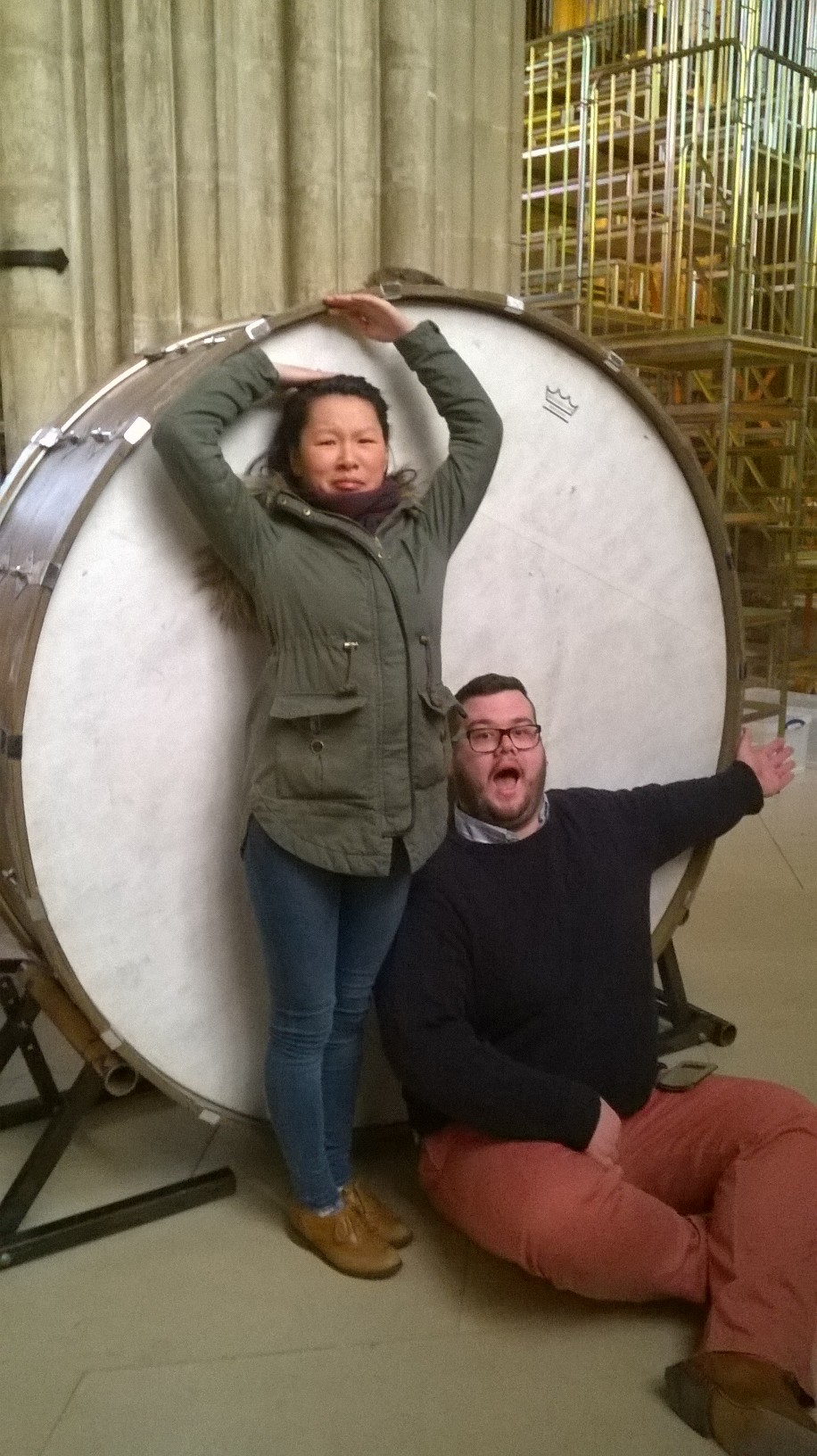
(Much excitement was caused by the arrival of the 66-inch bass drum from Bell Percussion, which was mobbed by many people eager to be photographed with the monster-drum, you’d have thought it was a Hollywood Celebrity…)
Very many thanks to everyone involved; a triumphant conclusion to all the hard work put it by students, staff, alumni and members of the local community, who came together in the splendour of Canterbury Cathedral for a memorable performance.
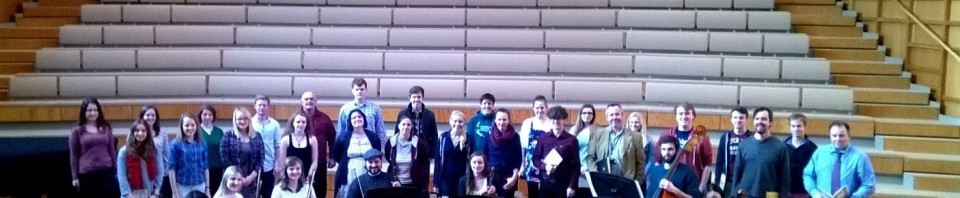
The University Cecilian Choir and String Sinfonia have each been quietly preparing for the concert at the end of the month, at which they will come together to perform Monteverdi’ brilliant Beatus Vir and a motet by Hassler.
The two forces came together for the first time yesterday to unleash Monterverdi’s dramatic piece in the hall, with fantastically exciting results. It’s not an easy work; dialogue between the various sections of the choir, and between the choir and the strings, means that there’s no respite – you can’t lose concentration for a moment, and need to be poised constantly for the next entry.
The eagle-eyed amongst you will have noticed the digital piano to the fore, which with its harpsichord patch is currently standing in for the genuine article, which is being built and which we hope will be arriving in time for the concert.
Well done to the assembled team; the final performance will involve yet more musicians who were unable to make yesterday’s rehearsal, bringing the combined forces to just under fifty students, staff and alumni. Choir and Sinfonia will be performing on Friday 27 March in a programme shared with the University Chamber Choir and the launching of the new Alumni Chamber Choir, Invicta Voices. The concert is free to attend: more details here.
To whet your appetites, here’s the piece in a vivacious performance from the excellent Collegium Vocale Seoul.
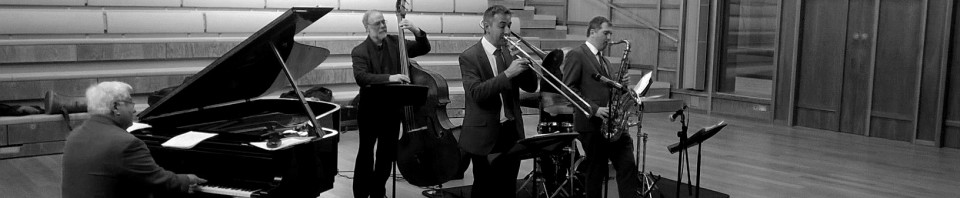
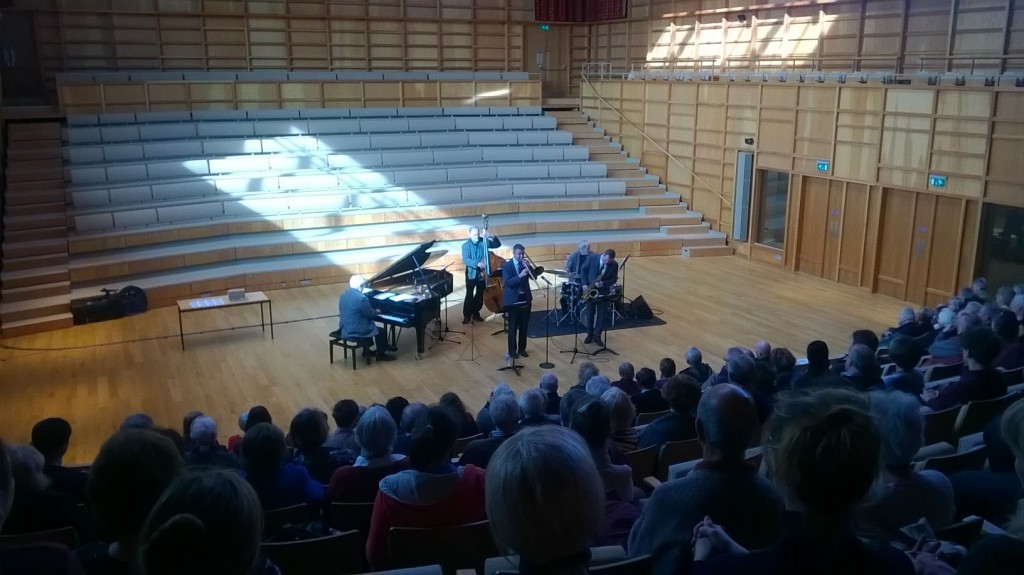
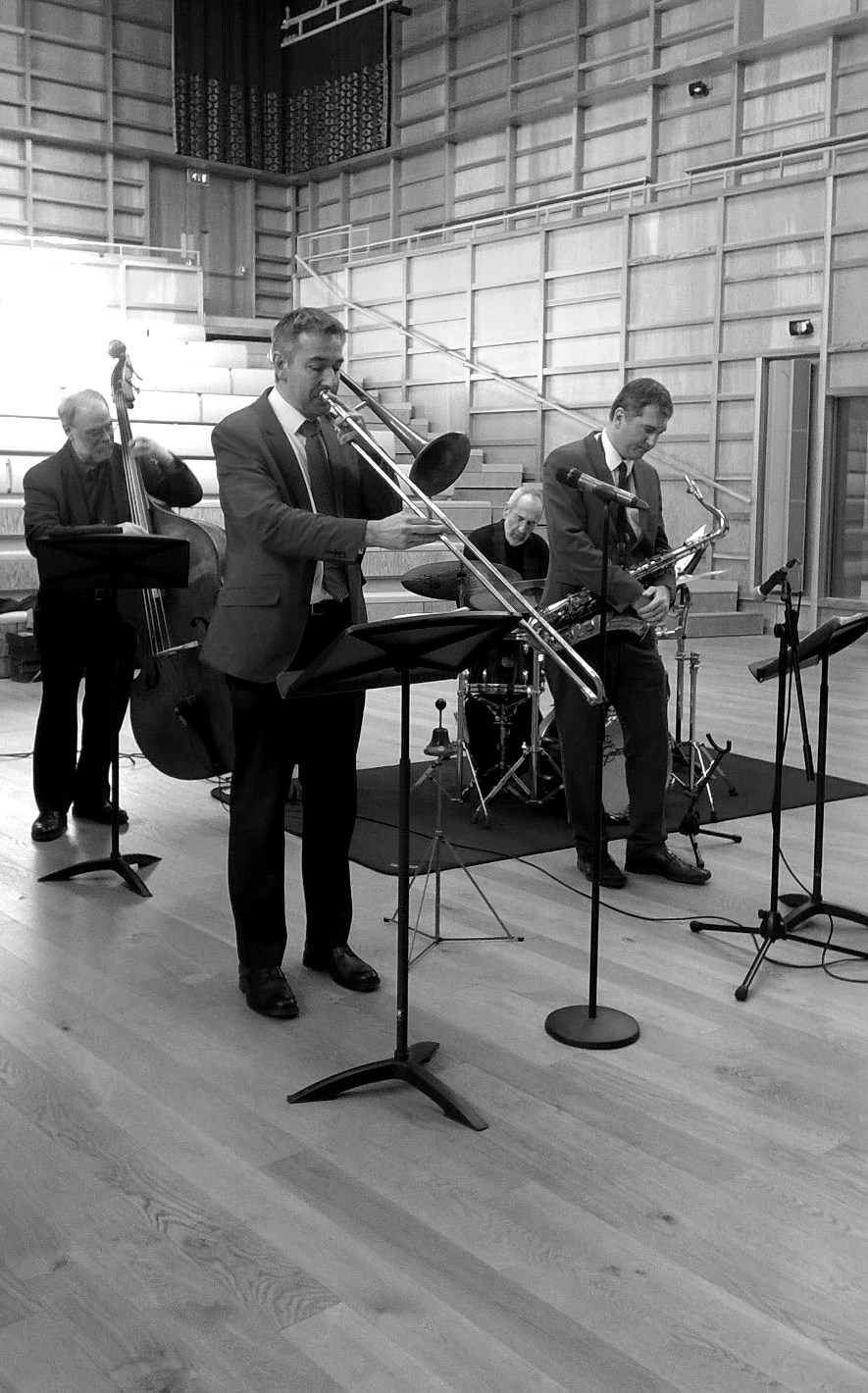
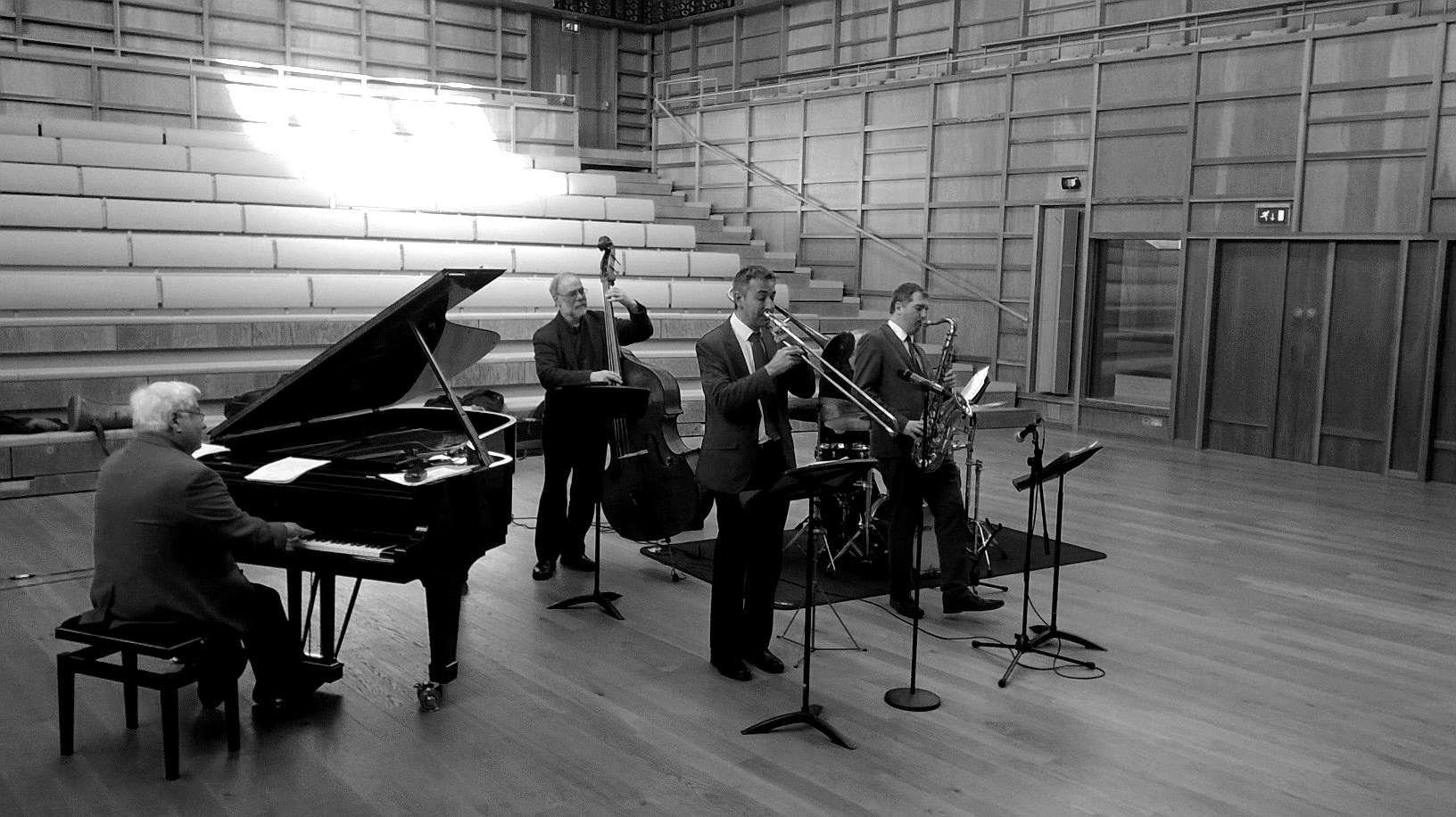
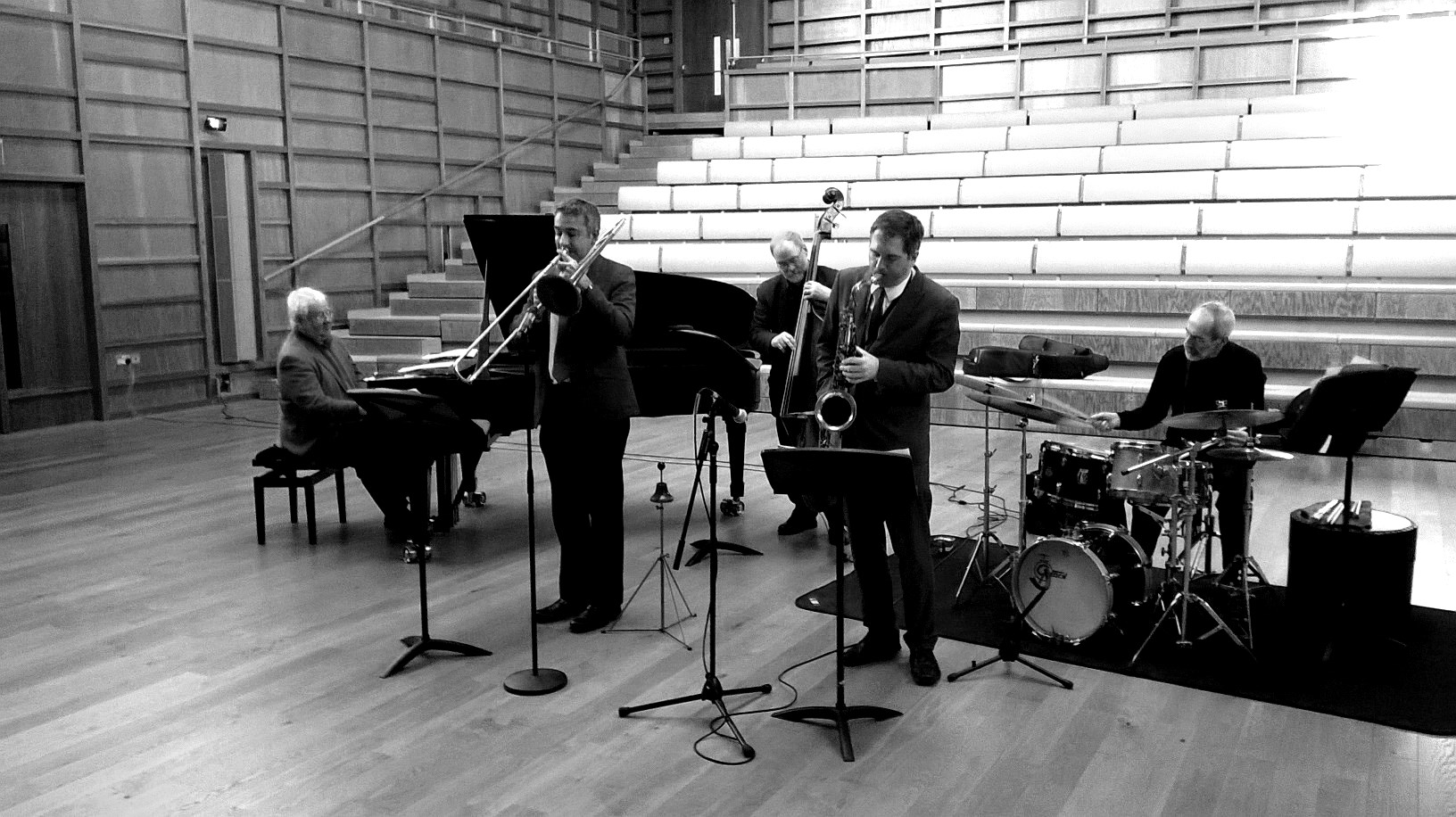
Fantastic gig this lunchtime from the Geoff Mason Quintet.
A bustling set opened with One By One, which included some fleet-footed, cascading improvisation from Simon Spillett on tenor sax. A lyrical waltz by the late Kenny Wheeler called forth some colourful piano-playing from John Horler, answered by a nimble bass solo from Tim Wells. A white-hot reading of Monk’s Hackensack saw some blistering improv again from Spillett, underpinned by solid bass Wells, each in turn supported by some deft and inventive drumming from Trevor Tomkin.
The high-octane set came to a close with McCoy Tyner’s robust Blues on the Corner, which was greeted by an enthusiastic reception from a large audience.
Here’s the group in rehearsal earlier in the morning;
A big week this week, as we continue our preparations ahead of the annual Colyer-Fergusson Cathedral Concert on Saturday, for which the combined might of the University Chorus and Symphony Orchestra will come together in Verdi’s Requiem.
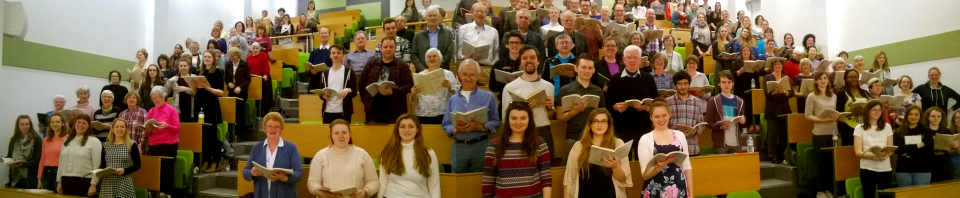
Here’s the Chorus in fine form yesterday afternoon, rehearsing old-skool style in Grimond, where for many years the Chorus used to meet each Monday night. Although we don’t recall its ever having been quite so green before…
Dies irae: Chorus rehearsing in Grimond
Yesterday’s all-day rehearsal is followed by rehearsals tonight, Thursday and on Saturday morning. It all culminates on Saturday evening; how much tremor there shall be…
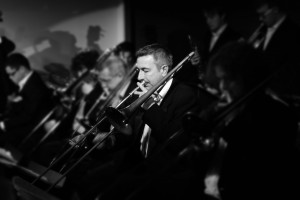
Our next lunchtime concert on Weds 11 March sees trombonist Geoff Mason bring his quintet to Colyer-Fergusson for what promises to be a mouth-watering gig.
A regular with the Ronnie Scott’s Big Band, Geoff Mason is widely regarded as the leading exponent of ‘Blue Note Era’ jazz in the UK, named for legendary sound engineer Ruby van Gelder’s recordings by players such as Lee Konitz, Dexter Gordon, Freddie Hubbard and Cannonball Adderley during the 1950s and 60s.
The quintet line-up reads like a veritable ‘Who’s Who’ of British jazz, and includes drummer Trevor Tomkins, saxophonist Simon Spillett and pianist John Horler. I remember hearing a gig with John Horler and guitarist John Etherbridge broadcast on Radio 3 a few years ago that was mesmerising.
The programme promises a blend of jazz standards and bebop tunes, and will surely be a highlight of the year; the concert starts at 1.10pm, admission is free with a retiring donation.
Here’s a classic of the Blue Note sound: Cannonball Adderley as front-man to a group including Miles Davis, in ‘Love for Sale’ from the 1958 classic, Somethin’ Else. (Just look at that line-up…)
Sponsors of the Lunchtime Concert series
Because it does. Doesn't it ? Blogging about extra-curricular musical life at the University of Kent.





 The quintet line-up reads like a veritable ‘Who’s Who’ of British jazz, and includes drummer Trevor Tomkins, saxophonist Simon Spillett and pianist John Horler. I remember hearing a gig with John Horler and guitarist John Etherbridge broadcast on Radio 3 a few years ago that was mesmerising.