Bernstein on how does music mean ?

Ah, the thorny question: how does music mean ? Can it have external meaning, or does meaning derive solely from its internal content – harmony, tonality, the working out of ideas ? Does it – indeed, can it – express ideas, emotions, characters, or does it simply ask the listener to follow the unfolding events, the order of ideas and the relationships between them ?

Leonard Bernstein offers some thoughts in a lecture from Harvard:

As he says: ”Music does possess the power of expressivity (sic).” Whether, like Stravinsky, you feel that music is “by its very nature, powerless to express anything at all” (1)  (Stravinsky was talking about his so-called ‘white’ music at the time, such as the ballet Apollon Musagete: Variation de Calliope for strings), or that music conjures its meaning from associations brought by the listener (i.e. previous experiences of similar chords and keys), music certainly has the power to move listeners. A listener with a half-decent wealth of listening experience perhaps comes to a piece with all that listening and its commensurate baggage: one melodic shape reminds them of another piece they’ve heard, a particular sonority or chord reminds them of another piece in which they’ve heard it, or a tonality is associated with a certain mood or frame of mind.
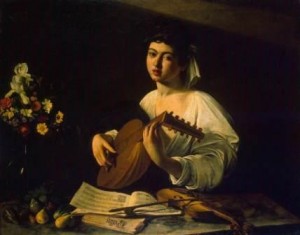
Lute Player by Caravaggio
'The Lute Player,' Caravaggio

Bernstein distinguishes between ‘what music expresses’ and ‘how music expresses it’ by talking about metaphor, music as a language rich in metaphor, ‘meaning beyond the literal.’

Leonard B. Meyer’s Emotion and Meaning in Music defines two types of listener: those for whom musical meaning “lies exclusively within the work itself, in the perception of the relationships set forth within the musical work of art” and those for whom music also “communicates meanings which in some way to the extramusical world of concepts, actions, emotional states and character.” Meyer calls the former ‘absolutists’ and the latter ‘referentialists.’ (2)

Or perhaps you have a foot in both camps: a piece of music has its internal order, its sequence of events with its conflicts and resolutions, that it articulates and which the listener may follow;  but it also taps into a listener’s previous experience and associated personal meanings ? Meyer declares that they “are not mutually exclusive: that they can and do co-exist in one and the same piece of music.”

Absolutist or referentialist: which one are you ? 

—————

1 Stravinsky, I, (1975), An Autobiography, Calder & Boyars: 163 

2 Meyer, L (1963), Emotion and Meaning in Music, University of Chicago: 1
Exuberance in music: Joe Zawinul’s ‘Patriots’

For sheer unbridled exuberance in music and matchless energy, here’s the late, great Joe Zawinul’s ‘Zawinul Syndicate’ performing Patriots live in 1997.

After an all too brief but dizzying bass solo from the great Richard Bona, the unstoppable rhythmic drive of the piece kicks in: it’s hard not to be carried away by its infectious joie de vivre and sheer pleasure in playing. Once the groove has begun, propelled by some astonishing percussion work, it never lets up: the piece just cooks nicely and with such ease, you can forget that it’s leading at such a frenetic pace.

Zawinul led the great fusion band Weather Report in the 1970s and 80s, a legendary ensemble including ex-Miles Davis sideman, saxophonist Wayne Shorter, bassist Jaco Pastorius (listen to Teen Town to get an idea of Jaco’s astonishing virtuosity and raising of the bass to a melodic instrument; Bach would have loved it), and drummer Peter Erskine. The group’s dazzling blending of jazz, rock and world music saw the creation of great albums such as Black Market, Heavy Weather, 8.30 and Sportin’ Life.

 Zawinul himself played with Miles Davis for a brief period, and wrote the lyrical In A Silent Way from Davis’ album of the same name, and also played on Davis’ Bitches Brew, the fastest-selling jazz album of all time.

Zawinul’s own Zawinul Syndicate saw the same driving and energetic performances typified in Patriots right up until Zawinul’s death in September, 2007.

That’s the secret to music-making, and to great performances: passion, commitment and joy in performing.

(And to the members of the University Chamber Choir 2008-09, for whom I wrote a choral arrangement of Patriots: remember this ?! Happy days.)

Hidden Beyonce: the truth about Turnage’s new piece

Oh, wow. As Alex Ross points out in a recent post on The Rest is Noise, critics in the media are gradually picking up on the idea that Mark-Anthony Turnage’s Hammered Out, premiered at the BBC Proms last week (discussed in a previous post here), has more than a nodding reference to Beyoncé.

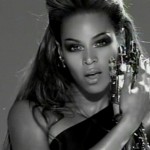
Beyonce
Ring of truth ? Beyonce Knowles

Some bright spark has superimposed Beyoncé’s hit Single Ladies, released in the UK in February last year, onto the first three minutes of video footage of the Turnage piece on YouTube, and it’s hard not to be convinced. Brass riffs imitate vocal lines, chords on the piano and strings are following patterns in the pop song: even the speed David Robertson takes the piece at is the same. Turnage is a confessed jazz and pop enthusiast as well as being a ‘classical’ composer (if the term can be said to have any meaning these days).

In an interview about the piece, Turnage acknowledged several pop references, but also mentioned secret ones that he would prefer listeners to discover for themselves. This seems to be one of them.

Watch it for yourself and make up your own mind.

Hold onto your hats: new Concert Diary published on-line

I’m already overwhelmed by the Autumn music events calendar: and it hasn’t even begun.

The Eden-Stell Guitar Duo

The new Music brochure has just been published on-line, including details of the forthcoming free Lunchtime Concert Series, the Scholars’ Festival Lunchtime Concert as part of the Canterbury International Festival, and concerts by the Chamber Choir and University Chorus and Symphony Orchestra: not to mention the Jazz @ 5 series and a festive Carols Round the Tree.

The Lunchtime Concert features music from remote parts of Africa with the vibrant Kasai Masai; a programme including Bach and Rodrigo from the Eden-Stell Guitar Duo; and a seasonal concert from the Choristers of Canterbury Cathedral in December.

The popular Jazz @ 5 series returns to the Gulbenkian Foyer Stage with jazz, cabaret and showtunes and one or two surprises.

Kasai Masai

There’s also an seasonal concert by candelight by the Chamber Choir to mark the beginning of Advent, and the term finishes in epic style with works by Dvorak and Verdi in the December choral and orchestral concert.

Something for everyone in our busiest diary yet: click here to see the on-line calendar or here to download the PDF, and get the dates in your diaries now!

Furley Page logo
Sponsors of the Lunchtime Concert series

Hammer Time: Turnage premiere on-line for a week

A new piece by a major contemporary composer is always something of an event – I still get ridiculously excited when a Steve Reich premiere is announced – and a new work by Mark-Anthony Turnage will always be exciting, challenging, and slightly alarming: you never quite know what you’re in for.

Mark-Anthony TurnageLast night, the BBC Symphony Orchestra and David Robertson gave the first performance of Turnage’s new Hammered Out, commisioned for the Proms. Turnage’s familiar thumbprints are all there: shrieking orchestral textures, brash walls of brass, chattering woodwind and driving percussion. Funky rhythms and homophonic brass writing (Turnage is an avowed fan of James Brown and Tower of Power), the piece is a wildly exuberant celebration of orchestral writing meeting elements of popular music and a go-to-hell attitude to the composer’s own fiftieth birthday year.
Turnage sounds as fresh as ever, the sound-worlds of his earlier Three Screaming Popes and Drowned Out still vibrantly alive.

You can hear the piece on-line for the next seven days here, and the concert itself will be repeated on Radio 3 next week, at which point it will again be available for another week.

Two weeks to enjoy a new work by Turnage: now that’s a real treat.

(And here’s a short extract from Turnage’s previous piece, Texan Tenebrae, from his forthcoming opera about the life of Anna Nicole Smith, in rehearsal).

Send in the Clowns: Satie and … Take That ?

United across centuries: weird composer Erik Satie and Brit pop group Take That. Surely not ?
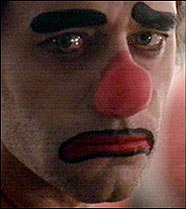
But yes. In Satie’s ballet-realiste Parade from 1917, three Actor-Managers set up a side-show outside their tent, in an effort to attract an audience to see their show. Sadly, their efforts prove in vain: the spectacle outside the tent becomes the main attraction, and no-one is enticed in to see the proper performance inside.

You can hear this sense of desperate futility in the episode of the Chinese Magician, where the jollity of the music and the whistling in the percussion are overwhelmed by ponderous orchestration and repetition leading nowhere. At the end of the piece, exhausted by their futile efforts, the characters slump to the ground in defeat.

This sense of desperation is also captured to great effect in the video to Take That’s Said It All, released in 2009, where all the energy and antics of the clowns cannot move the audience, because the tent is empty. There’s no-one there to appreciate their manic efforts: as with the Satie, the main focus of the show, the audience, is absent, and the characters can only act out their performances with a sense of forlorn hope.
Shot in muted and washed-out colours, thereby depriving them even of the imposed jollity of their colourful outfits, there are some beautiful sequences; there’s a sense of resignation about them as they dress for what they know will be a pointless show. Clowns are rescued from the ludicrous nature of their garb and their slapstick antics through audience laughter, redeemed through the mirth they create for others. There’s none of that here: no redemption for them at all.

(You can see the actual video to the piece here.)

In both works, futility is elevated to the status of art, and circus characters, whose very existence is to entertain, end up deprived of their ability to do so. The same sentiment expressed over a distance of over ninety years in two very different cultures.

Satie and Take That ? Absolutely.

The Piano Illusion: two Prom concerts

Piano
All keyed up

The two Proms from Friday night both employed the piano not as a percussion instrument, but as a weaver of illusions.

In the first concert, Jean-Efflam Bavouzet gave a dazzling performance of Ravel’s often brooding Piano Concerto for the Left Hand, written between 1929-30, in which the piano part is so carefully constructed that, if you’d missed the title of the piece, you could be forgiven for not realising it was written for a single hand. Rather like the single instrumental voice in Bach’s solo partitas for cello and for violin, the single part executes both melody and accompaniment in a way which convinces the ear that there’s another part also involved. Ravel built the piano part so carefully that, when an arrangement was made for both hands, it actually destroyed the careful balancing and textural placing that Ravel had so diligently organised.

The second, late-night Prom saw a very different piano concerto, Morton Feldman’s Piano and Orchestra of 1975, in which the piano explores distilled vertical sonorities, often at times either blending into or emerging out of the accompanying orchestral texture. John Tilbury’s delicately-balanced reading made the piano seem as though it were dripping dabs of colour into the surrounding air. Unlike the traditional concerto, which pitches the solo instrument against the orchestra and includes a solo cadenza to display the virtuosity of the instrument, here piano and orchestra are united in a sonic exploration, defeating time by eschewing the traditional three-movement structure and using instead a slow-moving, metre-less feel over a single movement. The sense of time pausing, of contemplative reflection and of the slow examination of ideas from several perspectives are concepts another Frenchman would have recognised – Satie’s Trois Gymnopédies achieve something similar in condensed form.

Working towards the end of the nineteenth and early twentieth centuries, Debussy talked of composing for the piano a ‘music without hammers.’ The piano is essentially a percussion instrument: rather than strings being bowed or plucked, they are struck with hammers, and you can’t get more percussive than that. It was Debussy who began the idea of treating the piano contrary to its essentially percussive nature, and Feldman’s piece stands in the tradition Debussy began nearly a century earlier.

Two concerts, using the piano to weave two very different illusions: one to overcome the absence of a right-hand (I avoid the word ‘missing,’as the concerto certainly doesn’t suffer from the absence of the upper hand), and one to pretend the piano isn’t a piano at all. Would Debussy have approved of Ravel’s piano concerto, had he lived to hear it ? I feel certain he would have approved of the Feldman. 

(You can hear the concerts for a week on-line on BBC iPlayer, and the concerts will be repeated on Radio 3 later next week).

Music, artistry and the problem of popularity.

Mahler’s portentous statement about being appreciated not in his own lifetime but after his death has been negated by the Digital Age. Thanks to the affordability of home computing, music software and YouTube, bedroom music studios have become ubiquitous, amateur performances are posted on-line, and you can have your fifteen minutes of fame spread in short bursts across the globe.

But popularity’s problem exists not only in the medium, which makes performers of many but professionals of few, but in the message. Alexander Goehr identifies the beginning of the avant-garde movement as being the moment when music turned its back on the audience and lost its appeal, when it became concerned less with communication with its audience than expressing the ideas of the composer, irrespective of whether the audience related to those ideas or not. Schoenberg’s twelve-tone system: Stockhausen’s electronica; the New Complexity movement of the 1970s; or jazz’s escape from tonal and harmonic structures into the realms of spontaneous improvisation in free jazz in the 60s with Ornette Coleman: such times often coincide with episodes of great creativity but little commercial success – audiences can’t understand what is going on, and feel left behind.

Pop music, however, is all about instant gratification: as its name implies, it is written to appeal to people immediately, and survives (or expires) for as long as that particular musical fad holds sway – and sells records.

Jonathan Harvey considers the relationship between artist and audience in the third chapter of Music and Inspiration, where he comments on composers such as Hindemith and Copland actually altering the path of their musical development, in order to directly engage the listener once more after they felt they had alienated them.

Is it important to consider the appeal of your music as you write it ? Should the listener be taken into account ? If you are using a tonal or harmonic palette which might be difficult for the audience to follow, or are using effects and technical devices that are challenging to the ear, is that a factor that should govern the way a composition is realised ? Or, more succinctly, can a composer take the listener into account when writing without compromising their artistry, what it is they are saying and how they are saying it ?

Of course, it is not all about making the listener’s life easy: otherwise, Schoenberg would not have created the twelve-tone system, and Ferneyhough would never have written a note; and new music is all about a new listener experience. Then again, composing ought not to be about deliberately challenging the listener in such a way as to alienate them: ought it ?

Composing in the Darmstadt School in the 1960’s was aggressively confrontational, seeking willfully to alienate the listener in order, it seems, to validate its own modernity by repudiating consonant sonorities associated with tradition. As Hans Werner Henze writes, ‘Any encounter with the audience that was not catastrophic and scandalous would defile the artist.’

But time is a great agent of acclimatisation. What caused an uproar when first written, or met with audience bewilderment and critical hostility – the Rite of Spring, for instance – often settles down into becoming a part of the great canon of concert repertoire. The message a piece is trying to convey, innovations it is trying to wreak, or a musical language that at first seems incomprehensible, often crystallises over time, usually with greater listener experience.

I speak from personal experience here. When I was about 11, in a spirit of musical enquiry, I lowered onto the record-player an LP from my father’s collection, an album with a slightly far-out artistic cover depicting a sax player called, the liner notes revealed, Charlie Parker.

I’d been playing the piano from a tender age, the usual fodder of examination repertoire distilled from the Classical tradition, but this was utterly alien to me: I had no idea what was going on, and put it to the back of the stack of records. About three years later, I’d been playing some jazz pieces with a clarinettist – Benny Goodman, Count Basie – and I came across the same LP. This time, when I listened to it, I could see where the music was going, harmonically-speaking: I could hear the underlying harmonies and had a sense of the musical landscape the notes Parker’s improvisation occupied. The music hadn’t changed in the intervening years: I had, my listening experience had widened and my understanding had developed. (Although I’m not sure I will ever comprehend Free Jazz).

Perhaps composers should follow their musical Muse wherever it leads them, trusting in posterity to allow audiences to comprehend their work if the contemporary critical response is not positive. Artistic integrity versus commercial appeal: where do you stand ?

Because it does. Doesn't it ? Blogging about extra-curricular musical life at the University of Kent.