Over on ‘Playing Up,’ a look back at yesterday’s rehearsal with the Chorus and Orchestra – and tenor soloist – ahead of Saturday’s Colyer-Fergusson Cathedral Concert.
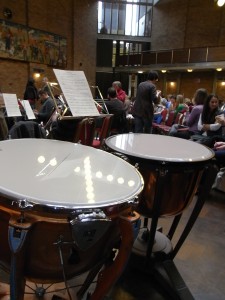 Achieved was some glorious work…

The philosophy of music: or the music of philosophy ?
Over on ‘Playing Up,’ a look back at yesterday’s rehearsal with the Chorus and Orchestra – and tenor soloist – ahead of Saturday’s Colyer-Fergusson Cathedral Concert.
Achieved was some glorious work…
This weekend sees not only the all-day Sunday rehearsal with the University Chorus and Orchestra for next week’s concert (end of shameless plug…), but across the country, the cultural curtain-raiser event, ‘Music Nation,’ to the London Olympics.
A joint venture between the Olympic organisation committee and the BBC, as the webpage proclaims,
Music Nation’s programme will showcase the best of the UK’s musical talent through ambitious and innovative partnerships and musical performances.

Click here to find out more: there’s also a day of programmed events being broadcast on Radio 3 on Sunday. (Those of us in the rehearsal that day will just have to catch up on iPlayer!).
Second-year International Business student Matthew Bamford reviews last week’s Crypt Concert.
—-
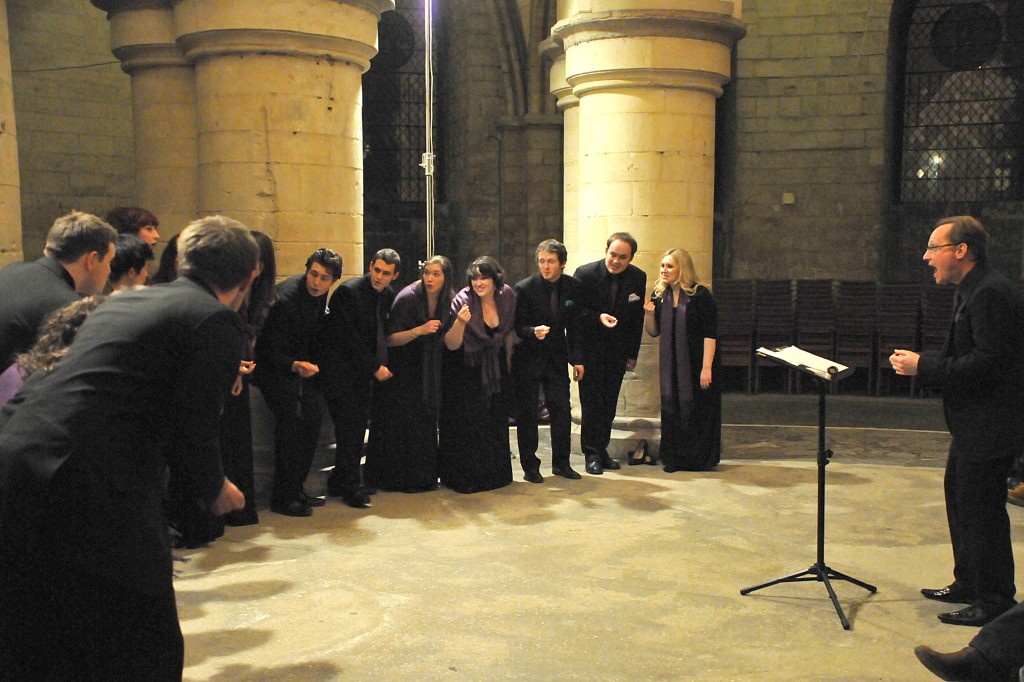
The crypt of Canterbury Cathedral is an incredibly special and unique performance space. This intimate venue was host to the University of Kent Chamber Choir, conducted by Dan Harding and Steph Richardson.
The aim of the concert was to explore a whole day from the rise of the sun right the way through until midnight. Using a blend of sacred and secular pieces the programme consisted of madrigals, part-songs, motets and two pieces for solo piano.
From the first words of the plainsong Salve festa dies, I knew that I was in for a very enjoyable evening. This set the mood for the first section of the concert. Eric Barnum’s Dawn followed; the beginning of the piece using an incredibly simple harmonic structure. However at the end of the piece there was an interesting section where each of the sopranos sang an individual note of the scale. The composer’s idea here was to ‘create a golden light’. I think it is fair to say that this was most definitely captured.
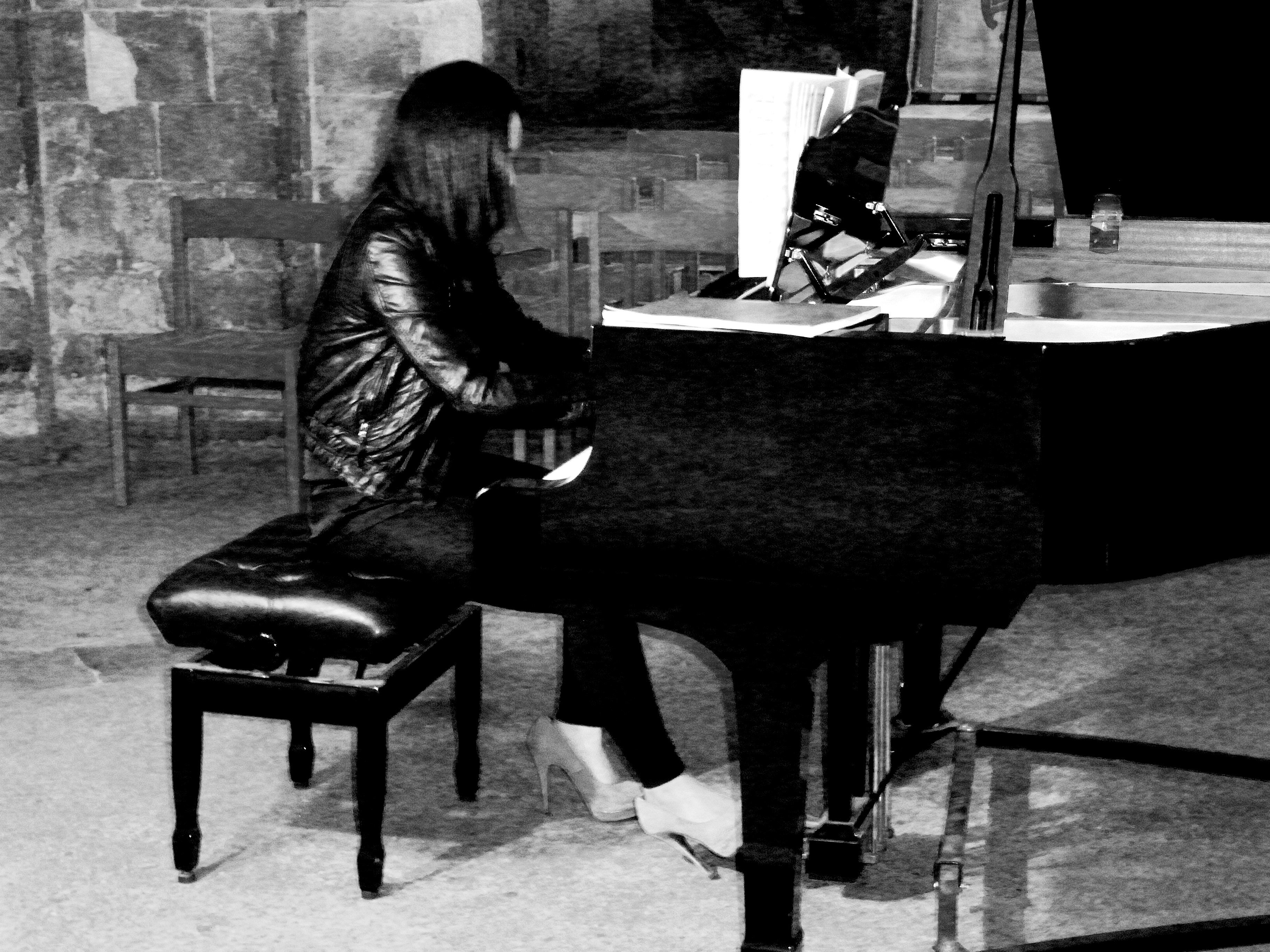
My next highlight was the solo piano piece Un Sospiro. One of Liszt’z concert studies was expertly handled by second year music scholar Susan Li. The piece was received with rapturous applause after Li really brought out the richness of the piece.
As the day began to draw to a close, there was time for some playful madrigal singing before bed. Tutto lo di, a lively and fun piece written by Orlando di Lassus was intelligently sung by the choir. Despite the choir wanting to ‘play all day’, the long day did have to draw to a close with a beautiful rendition of this piece by Sullivan, conducted by Steph Richardson.
After twenty minutes in which to dwell on the first half, carrying a zebra print handbag (thanks Sophie!), the second half opened with the beautiful Sleep, Wayward Thoughts. The mood of the concert then headed to a more relaxed state as we heard In Stiller Nacht by Brahms. Sung in German, this piece focused on exploring the timelessness of night. This was captured well by the rhythmic sense of the choir and really was a very relaxing piece.
We were treated to another lovely piano solo, Chopin’s Nocturne in F Minor,’again received by the audience with excellent applause.
The concert ended with Eric Whitacre’s Sleep, which really is full of colour. This contemporary piece was delivered to an outstanding standard which left the audience wanted more (although I’m sure nobody was expecting the encore!).
We all thought it was over, until we had the pleasure of Harding’s arrangement of ‘Moondance’ by the legend that is Van Morrison. A completely contrasting piece to hear in the context of the rest of the programme, although everybody thoroughly enjoyed it and if like me, carried on singing it for the whole weekend.
Thank you to Dan Harding, Steph Richardson, Susan Li and The University Chamber Choir for a fantastic Friday evening; I’m looking forward to the next concert on March 30th.
The Director of Music writes:
We should all go round whistling something from William Tell or the Barber of Seville today, as it’s Giaochino Rossini’s birthday.
 As far as I know, he is the only composer to have been born on 29 February. Not counting all the ‘substitute’ birthdays on February 28, how many birthdays would he have celebrated – or, how old would he have been today ?
As the cellists know, it’s green-light for this weekend’s all-day rehearsal on Haydn’s The Creation with the Choir and Orchestra ahead of the Cathedral Concert a week on Saturday.
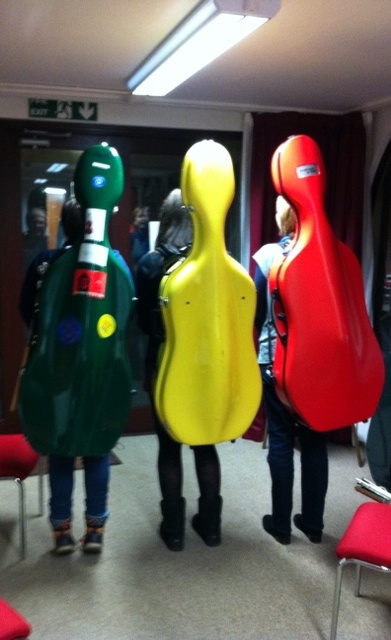
Sunday will see the combined forces gather in Eliot Hall to rehearse together for the first time, in preparation for the concert; next week sees a particularly busy time for the University’s musicians, with rehearsals on Monday, Thursday and Friday; not to mention the rehearsal in the Cathedral itself on the morning of the day.
Details of the concert on our online diary here. It should prove to be a memorable occasion…
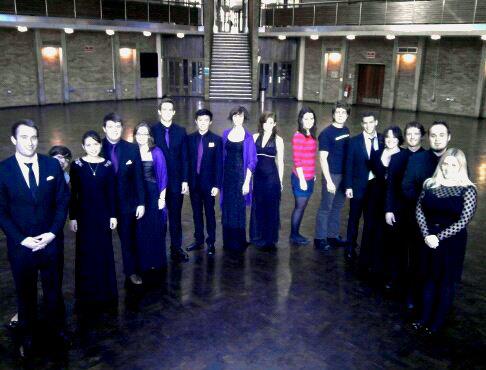
Still reeling from the vibrancy of last week’s Gulbenkian gig with the Concert and Big Bands, thoughts turn to a more contemplative state for the Chamber Choir concert next week.
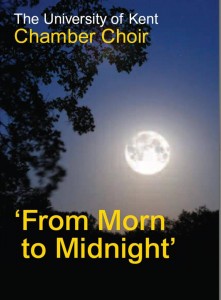 On Friday 24 February, the Chamber Choir will present From Morn to Midnight, an evocative programme exploring the differing colours in a single day. In a blend of sacred and secular pieces, and including works for solo piano by Chopin and Liszt, the programme moves from Eric Barnum’s Dawn to Eric Whitacre’s Sleep. There are also works by Vaughan Williams, Saint-Saëns and Brahms, Italian madrigals, Elizabethan part-songs and plainsong.
The journey from the Choir’s first rehearsal to its current final preparations for next week’s performance have been charted over on its blog, Cantus Firmus, where you can read about how the Choir has been exploring the repertoire and developing its sound, as well as important matters such as deciding what to wear and phoning out for pizza. It’s all part of the process…
In the sonorous acoustics of Canterbury Cathedral’s historic Norman Crypt, the Choir will release a multitudinous array of colours, ranging from birdsong in Monteverdi to sunlight in Barnum and the deep colours of Whitacre’s mesmerising masterpiece: it promises to be a memorable occasion.
Further details and ticket details online here.
It’s not very often that a superstar of the international bebop world lands in Canterbury, but that’s what’s happening on Saturday 11 February, as Eddie Daniels plays with the David Rees-Williams Trio.
 Reading Thomas Owens’ excellent Bebop: the music and its players, a survey of key figures in the bebop movement – Charlie Parker, Dizzy Gillespie to name but two – recently, the writer makes the following observation:
In recordings such as To Bird with Love, [Daniels] combines an astonishing technical command of the instrument, a beautiful, warm tone quality over the entire range of the instrument, a great sense of swing, and a rich melodic imagination. He has proven repeatedly and conclusively that bebop can fit the clarinet; the only barrier to a flood of bebop clarinetists appearing may be the challenge of meeting Daniels’s awesome standards.
Daniels has been called a ‘thoroughly well-bred demon’ by none other than Leonard Bernstein; with an equal foothold in the world of jazz and classical music (Wynton Marsalis, anyone ?), Daniels has been a colossus since his early days with the Thad Jones band back in the 60’s. There’s a profile of Daniels over on that great jazz blog, LondonJazz.
Bebop remains, for me at least, one of the critical artistic movements of the twentieth century; witnessing the development of an harmonically more adventurous, and rhythmically more exploratory style, it represented a move away from more traditional big band swing to a tighter, more focused style emphasising a richer inventiveness. Greater technical prowess was required to execute improvisation at break-neck speed: the almost instantaneous translation from harmonic and melodic thought to the physical execution of its ideas, at such speed, leading to some of the greatest recorded solos ever made. There was no room for error: a sure-footed way of working with a linear logic through the harmonic changes required a firm grasp of the underlying chords and their extensions, to allow ideas to unfold with such rapidity and yet stilll retain a melodic integrity. In the white heat of spontaneous creativity at a live gig, you had to know exactly what you were doing.
Tickets and details about the event on the Gulbenkian Theatre’s website here: one not to be missed.
And here’s a foretaste of Daniel’s terrific dexterity allied with a dazzling gift for melodic improvisation, on scintillating form in After You’ve Gone. Thomas Owens may have a point…
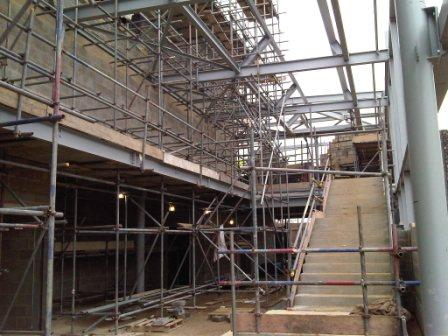
A fistful of photographs from last week’s site meeting at the construction of the new music building, showing the latest developments.

Exciting stuff: click the album below to view the rest.