Coraline showing at the Gulbenkian Cinema on the 22nd of March

Posted by Sarah

The sixth film in the Gulbenkian  Cinema’s Gothic Season –  Henry Selick’s Coraline (2009) – screens on Saturday the 22nd of March at 3pm. The 3D film will be introduced by the Melodrama Research Group’s Frances Kamm.

Coraline

 The Gulbenkian Cinema’s description of the film:

Henry Selick | US | 2009 | 100mins | Dakota Fanning, Teri Hatcher, John Hodgman (voice cast)

Henry Selick’s (James and the Giant Peach) beautiful, spiky stop-motion animation,  halfway between horror and fantasy, has become a bona fide classic. Coraline is  the young girl who, moving from their beloved Michigan home to the Pink Palace  apartment building in Oregon, finds herself lonely – despite her new, eccentric  neighbours – as her parents fuss over their new home. Exploring the building,  Coraline finds a small door which at night, becomes a corridor into a  fantastical parallel universe, in which versions of her parents and her  neighbours – with, disquietingly, buttons for eyes – live.

Basking in their attention and the  excitement of this magical place, Coraline overlooks its more troubling  elements; until one night, she can’t get back home…

“Combines  stunning visuals – there are scenes of incredible beauty – with good  old-fashioned storytelling that is funny, inventive and at times scary.  Destined to be a classic.” Cosmo Landesman, The Times

“A  gorgeously hand-crafted and pleasurably detailed piece of work. It’s also  genuinely strange, creepy and arresting.” Tim Robey, The Daily  Telegraph

 For more information and to book your ticket please go to: http://www.thegulbenkian.co.uk/events/cinema/2014/March/2014-03-coraline-3d.html

Summary of Discussion on Black Swan

Posted by Sarah

Ann-Marie has very kindly provided the following:

We had a varied and detailed discussion about Black Swan (Darren Aronofsky, 2010). Please find our discussion under theme/subject:


Motherhood
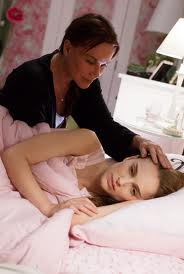
Black Swan mother and childEach member found the relationship between mother and daughter disturbing. Firstly, we were unsure whether the mother was a villain or whether we see her through Nina’s interpretation. The film is not always explicit in its depiction of reality (part of its power) but this also leaves for questionable gaps in its reading. A question was raised if ​we should cast blame on the mother? It seems like a “chicken and egg” scenario and is open to either interpretation. Option A: Mother is to blame, showing the danger of the matriarch. Option B: Nina’s illness has caused an over-protective mother, showing the responsibility placed on the role of matriarch.

The mother’s lack of career did not escape us, particularly because she was supposedly destined to the life that Nina has gained.  Two things are suggested here: the mother as self-sacrificing (she gave up her career to have Nina) for the advancement of future women. Or, the continuous replacement of younger women in the entertainment industry. Nina informs us that her mother was already 28, thus past her expiry date. The mother viewed in this sense is a tragic character because she lacks a career, (because of age and children) and is also losing her daughter to the strain of an industry, one that she is acutely aware of.

Another odd occurrence: the moment of Nina’s first sexual experience. Did she imagine her mother in the room during masturbation, or was the mother by her bedside?  If the first interpretation is correct then what does this mean? One option could be part of a guilt complex, but should we be more psychoanalytic?

Yet another confusing mother moment occurs when Nina’s mother attempts to throw away the celebration cake. What are we to make of this over-blown reaction? It was noted that Nina is a ballerina and thus most likely on a strict diet so cake would be out-of-bounds, and Nina suggests this very idea to her mother.

Let’s break this down:

  • ​​Mother buys a giant cake, but knows Nina will not be able to eat much of it. Is the mother masochistic?
  • ​​Nina refuses, as we would expect, so the mother attempts to throw the cake away.
  • ​​Nina pleads her to stop, agreeing to eat the cake. The mother is victorious, firmly establishing the power boundaries.

In this scene we can see a guilt complex working in favour of the mother, and if we then connect this to the masturbation scene we could surmise: the mother keeps her in a virginal room made for a young girl, complete with the habitual tucking into bed and brushing of the hair. Nina moves away from the mother’s “ideal” (good little girl) and is struck by an imaginative view of her mother, caused by an inherent guilt complex. These are merely speculations, but what is important to note is how the power boundaries change and evolve. 

 Female performers/ All About Eve syndrome 
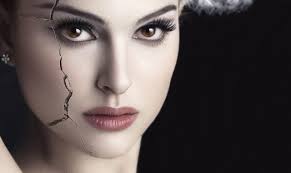
Black Swan fragmentA possible fear that is shown through Nina’s character is the dissolution of self. Nina’s submersion into the two roles that she plays begs the question: is a personality lost when one becomes a performer, and if one can lose the self in a part then what is the self, is it something we continually construct? If this Is the case it is no wonder that Nina would fear others, but more importantly the particular danger of other performers. Alternately, we could also consider Nina (or indeed any performer) as an example of the role picked for us and the person we are. 

The performer is presented to us as a fragmented person (Nina, Erica, Beth). The best example of this can be found in:

  • ​​Nina – Throughout, often by the use of shots, particularly as she dances. Nina is also is often viewed through another object, such as the window on the subway.
  • ​Beth – First caught in a glimpse through a door, and later becomes both Nina and Beth in the process of self-mutilation.
  • ​Erica (the mother) – her drawings are sharp and disjointed, representing an element of her psyche.
  • ​The obscured view of Nina during the dance sequence in the club could also be noted as the completion of this fragmented self because it is from this that she accepts her duality.

We also noted similar connections to this film and The Red Shoes (Powell and Pressburger, UK, 1948). The film shows a performer that lives her role to such an extent that it becomes her literal destruction.

 The uncanny and the double 
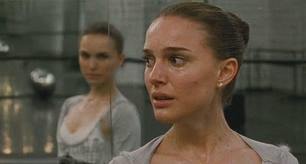
Black Swan mirrorThe use of the double was the reason for the initial interest in the film. In many melodramas we have seen the clear distinctions between good and bad (The Wicked Lady, Leslie Arliss, UK, 1945) and the nature of disguise/hiding true self (Gaslight, Thorold Dickinson, UK, 1940 and George Cukor, US, 1945). Black Swan is no exception, in fact, its use of double and its cause for female stress is explicit. Here are just some of the ways the film shows us that the duality of self is at its core:​

  • ​​Half man/ half bird statue
  • ​The use of black and white throughout the film, particularly in décor. Note: the shift between pink/pastel sheets to white and black on Nina’s bed. 
  • ​Costume, particularly Nina’s in contrast to Lily.
  • ​The plot mimics the ballet.
  • ​Use of mirrors and reflections, we view Nina/ Nina’s double/and see other characters.
  • ​Nina replaces a random woman, Beth, Lily, and she also appears in places we least expect, such as the bathtub.
  • Shadow manifestation at the end of the Black Swan’s sequence. Note: there are two shadows.
  • The performance styles, particularly the sexual prowess and make-up of the Black Swan in contrast with the pastel colours and timid, girl-like performance of Nina.

These are just a few examples, but the message is clear: duality is inherent, and it’s everywhere. Interestingly, the duality causes fear and paranoia at first and then destruction by its acceptance.

Sexuality and gender roles
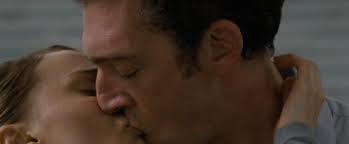
Black Swan Nina and ThomasPurity is seen as a form of weakness. Thomas tells Nina at various intervals to stop being weak and that she seems too reserved, thus, has an inability to lose herself in a good performance. Perhaps most fascinating is Thomas’ mention of Beth. He tells Nina that it is the dark impulses of Beth that makes her perfect, albeit destructive. It seems that the film suggests that a woman finds perfection in accepting her inherent dichotomy. Often the stereotyped woman is the virgin or the whore, and this film challenges those preconceptions as well as challenging the idea of a defined sexuality. Nina experiments with men and has fantasises about women, thus showing the possibility of both a fluid Black Swan Nina and Lilysexuality as well as a rejection of gender roles. However, the “perfection” that Nina feels she achieves by the end of her performance suggests that it is still not possible for a woman to reach the “ideal fluidity,” instead these women will be destroyed by the pressures put upon them.
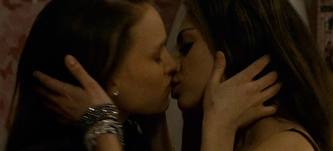
Another comment in regards to women and sexuality was the intriguing fact that women fear each other.  This fear seems to derive from the opposing woman’s bodily power. The fear results in jealousy and paranoia, reminding the group  of hysteria as a woman’s problem. Note that Thomas finds the notion of another woman trying to steal Nina’s part as ridiculous and he is almost unaware of the pain and stress caused by the decline of Beth’s career.

 Please comment further to continue the discussion on this interesting film.

 You can log in to do so, or email me on  sp458@kent.ac.uk

Many thanks to Ann-Marie for choosing such a  thought-provoking film, providing an interesting introduction and the above excellent summary of our discussion.
Maternal Melodrama Symposium 3rd of June, GLT 3

Posted by Sarah

Exciting news! We can confirm the date and location of the Melodrama Research Group’s first symposium.

maternal melodrama

Sponsored by CISFMI and KIASH, the Melodrama Research Group will host a Symposium on Maternal Melodrama during the 3rd of June in GLT3. While Maternal Melodrama is often associated with Hollywood films of the 1930s and 1940s, and actresses such as Bette Davis, Joan Crawford and Barbara Stanwyck, recent academic work on this topic has explored a new area. Sue Thornham’s ‘”A HATRED SO INTENSE” We Need to Talk About Kevin, Postfeminism and Women’s Cinema’ discusses the relevance of maternal melodrama to contemporary cinema, prompting us to re-evaluate some tired assumptions.

The Symposium will be a great opportunity to debate maternal melodrama generally and to respond specifically to Thornham’s argument. Her article appeared in the new journal Sequence: Serial Studies in Media, Film and Music 2.1, 2013. Unlike most journals, Sequence encourages a sequential approach to academic deliberations and its emphasis on a variety of forms for the submission of responses (the traditional written word, but also audio and video) will allow the Melodrama Research Group to engage more fully, and fruitfully, with the Digital Humanities.

The Group is delighted to welcome our special guests: Professor Pam Cook (University of Southampton) and Dr Catherine Grant (University of Sussex). Pam and Katie will present on video essays.

Sue Thornham’s article: http://reframe.sussex.ac.uk/sequence2/archive/sequence-2-1/

Pam Cook’s University of Southampton page:

http://www.southampton.ac.uk/film/about/staff/pc3.page

Katie Grant’s University of Sussex page:

http://www.sussex.ac.uk/profiles/183852

More details, including a timetable and the titles of talks, will be posted here in due course.

Timetable for Meetings in the Summer Term

Posted By Sarah

Leading up to the symposium on Maternal Melodrama on Tuesday the 3rd of June, the Group will be meeting on the preceding Tuesdays from 4-7pm to screen and discuss maternal melodrama.

screening

The meeting dates:

Tuesday 13 May, 4-7pm, Studio 6
Tuesday 20 May, 4-7pm, Studio 6
Tuesday 27 May, 4-7pm, Studio 6

More details on films to be screened will be posted here in due course.

And please note the room change: we will be in Jarman Studio 6.

Melodrama Research Talk 25th of March, GLT3, 5-6pm

Posted by Sarah

The Melodrama Research Group is very pleased to welcome Matt Buckley, Rutgers University, to give a talk entitled ‘On Melodrama as a Modern Art’ on Tuesday the 25th of March, in GLT3, from 5-6 pm.

murray-left

Talk Abstract:

Just fifty years ago, melodrama was regarded, if at all, whether on stage, film, or tv, as a negligible, ephemeral, antiquated form of drama, a laughable thing, enjoyed by the poor, the illiterate, and the naïve—a thing, most importantly, perhaps, that modern realism had, or surely would soon, make obsolete and supersede.  Today, it is starkly apparent that such dismissals were acts of monumental misperception.  In theatre history, film and television studies, cultural history and narrative theory; in studies of the novel, the detective story, science fiction, and popular literature in general; of the vaudeville, the musical, silent film, and Hollywood cinema, and in the vast and diverse histories of popular literature, cinema, and television worldwide, we find melodrama everywhere.  And melodrama is not only modernity’s dominant narrative form: it has become a kind of meme that has penetrated and suffused the modern world.  As a now substantial body of scholarship has made evident, its assumptions and conventions color our fictive drama in every medium and mode, tacitly inflect our political and social performance, implicitly structure our narrative construction of events in the press and in our lives, and appear even to inform our apprehension of external reality and our consciousness of self.

In this talk, I try to come to terms with this emergent history, first by looking to melodrama’s origins and early development in an effort to discern more clearly what makes melodrama distinctive, and then by outlining the primary methods and processes that appear to characterize its development over time, its adaptation to new contexts and media, and its penetration and suffusion of discourse, imagination, and mind.  In closing, I explore the challenges this emergent view of melodrama’s larger history presents to traditional research methods and perspectives, and suggest some of the ways in which those might be overcome.


Matt Buckley’s Bio:

Matthew Buckley is an Associate Professor in the Department of English at Rutgers University, New Brunswick, where he teaches courses on comparative drama, media, and visual culture in modernity. He is the author of Tragedy Walks the Streets: The French Revolution in the Making of Modern Drama (Johns Hopkins University Press, 2006) and has published articles on radical dramatic aesthetics, embodiment in early      modern theatre, and the history and historiography of early melodrama in Modern Drama, Theatre Survey, Theatre Journal, Studies in Romanticism, and Victorian Studies.  He is currently at work on two books: Becoming Melodramatic, a study of the formal and cultural development of early stage melodrama, and Place of Seeing, a series of essays on theatre iconography and visual performance between 1580 and 1880.  He is the founding director of the Melodrama Research Consortium, an      international interdisciplinary organization devoted to the comparative study of stage, film, television, and new media melodrama. He is now developing a digital database project on the emergence of melodramatic theatre in Britain, France, Germany, and America.

More details will be posted to the blog in due course.

Do put the date in your diaries, and please note that our planned meeting on the 26th of March will no longer take place.

The Orphanage showing at The Gulbenkian Cinema on the 4th of March

Posted by Sarah

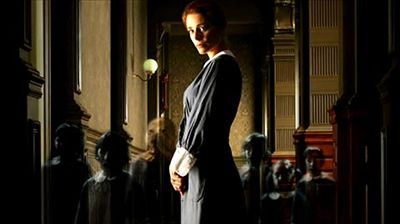
The fifth film in the Gulbenkian  Cinema’s Gothic Season – J.A. Bayona’s The Orphanage (2007) – screens on Tuesday 4th of March  at 9.30pm. It will be preceded by a panel discussion which will include contributions from the Melodrama Research Group’s Dr Tamar Jeffers McDonald, as well as Dr Cecilia Sayad and Professor Nuria Triana-Toribio.

The OrphanageThe Gulbenkian Cinema’s description of the film:

J. A. Bayona | Spain | 2007 | 106mins | Belén  Rueda, Fernando Cayo, Roger Príncep

This terrific Spanish horror film, the debut of J. A.  Bayona and produced by Guillermo del Toro, director of Pan’s Labyrinth, received great acclaim on its release in 2007.

After thirty years, Laura returns to orphanage where she  grew up, accompanied by her husband Carlos and their 7-year-old son Simón, with  a dream of restoring and reopening the long-abandoned mansion as a home for  disabled children. The place awakens Simón’s imagination, and he soon begins  playing not-so-innocent games.

As events take a sinister turn, Laura slowly becomes  convinced that something long-hidden and terrible is lurking in the old house,  something waiting to emerge and inflict appalling damage on her family, in this  cleverly made, utterly terrifying film.

“A shiver of fear  runs right through Juan Antonio Bayona’s pungent and scary film” Peter Bradshaw, The  Guardian, 4 stars

“A good old-fashioned  horror in the best possible way, this is a beautifully told, terrifying ghost  story that lingers with you long after the shivers have stopped” Olly Richards, Empire  Magazine

Spanish  w/Eng ST

For more information and to book your ticket please go to: http://www.thegulbenkian.co.uk/events/cinema/2014/March/2014-03-the-orphanage.html

Melodrama Screening and Discussion, 5th of March, Keynes Seminar Room 6, 4-7pm

Posted by Sarah

All are welcome to attend the fifth of this term’s screening and discussion sessions which will take place on the 5th of March in Keynes Seminar Room 6, from 4pm to 7pm.

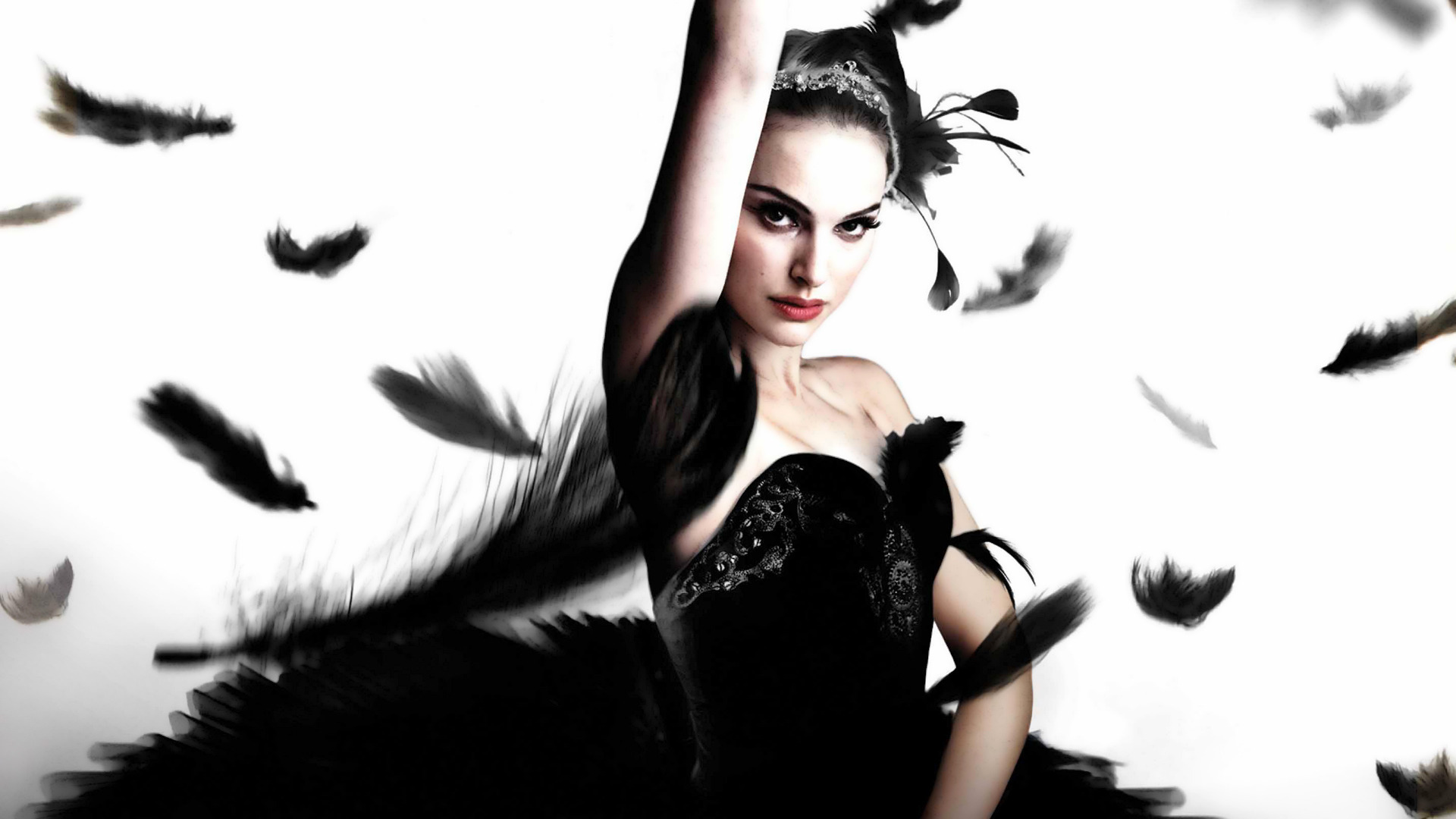
We will be screening Black Swan (2010, Darren Aronofsky, 108 mins).

Black Swan

Ann-Marie has very kindly provided the following introduction:

The film is said to be inspired by Fyodor Dostoyevsky’s 1846 novel The Double. In the book a man goes mad when he encounters his double, and, like Black Swan, the double in Dostoyevsky’s novel is the polar opposite of the original self.

The film revolves around Tchaikovsky’s brilliant ballet, Swan Lake. Natalie Portman plays both the White and the Black Swan. Her performance, (for which she won a Best Actress Oscar) focuses on the slow spiral into madness caused by an over-protective mother, the intense pressure of her work, confusion of her sexual orientation, and perhaps, the acknowledgment of the short-lived career of her predecessor (Winona Ryder). In fact, it is not hard to see the All About Eve (1950) links throughout the film, particularly if we consider the fear and paranoia of the younger/prettier/talented performers. Show business has a shelf-life, something the women in this film are more than acutely aware of.

The film was chosen for multiple reasons, but none more so than the idea of the doppelganger. The doppelganger is the paranormal double of a living person. The doppelganger is seen to be sinister and bad luck, often regarded as an omen of death. Perhaps most fascinating about the use of the double in this film is the idea of identity, both hidden and the eventual loss of it, and it is this that could be further expanded in our meeting.

 Potential discussion points:

The use of music, particularly in reference to Portman’s character, Nina.

Hidden identity and its connection to melodrama.

The extension of a fictional self and/or the dissolution of self.

The double in terms of polar opposites and its importance to narratives as a whole, but particularly melodrama.

Lastly, dance and movement as an expression of character. This brings to mind the sweeping cape of the Victorian melodramas. Plainly, what type of movement do we identify with a type of character? How does this alter our perception and add to the melodramatic mode? Are the villains prone to excessive movement, and how do we interpret that in our culture?

Do join us if you can.

A link to Dostoyevsky’s novella: http://fiction.eserver.org/novels/the_double.html

Summary of Discussion on The Awakening

Posted by Sarah

Frances has very kindly provided the following summary of our discussion on The Awakening (2011):

the awakening


Warning! The following discussion contains spoilers for those who have not seen the film yet…

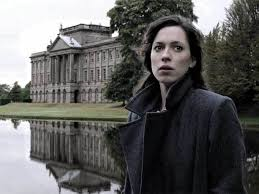
On Wednesday 19th February we watched and discussed The Awakening. I did not want to say too much about the film in my opening remarks and so most of the group present were experiencing the film for the first time and without much previous knowledge. This was an important component for our discussion after the film as quite a lot of time was spent discussing the film’s ending and its twist (or twists). We agreed that the film remained ambiguous about whether Florence is alive or not at the end. We mentioned that, logically, it is probably likely that she survived (the manner in which she interacts with other characters and is about to leave the house points to this) but it is interesting that the film still works to evoke the question of her mortality and does not complete resolve the ambiguity. Costume and performance are important parts to this uncertainty. Florence’s costume has changed and so this suggests she has survived. However we awakening endingnoted how the white coat she wears could make Florence seem ghostly and this is an interpretation reinforced by the way her presence is ignored by the school’s headmaster. In either case, we felt the possibility for different interpretations was a fitting ending to a ghost story where frequently our expectations are continually subverted.

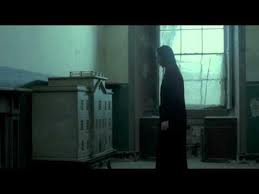
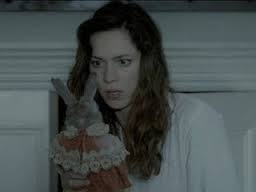
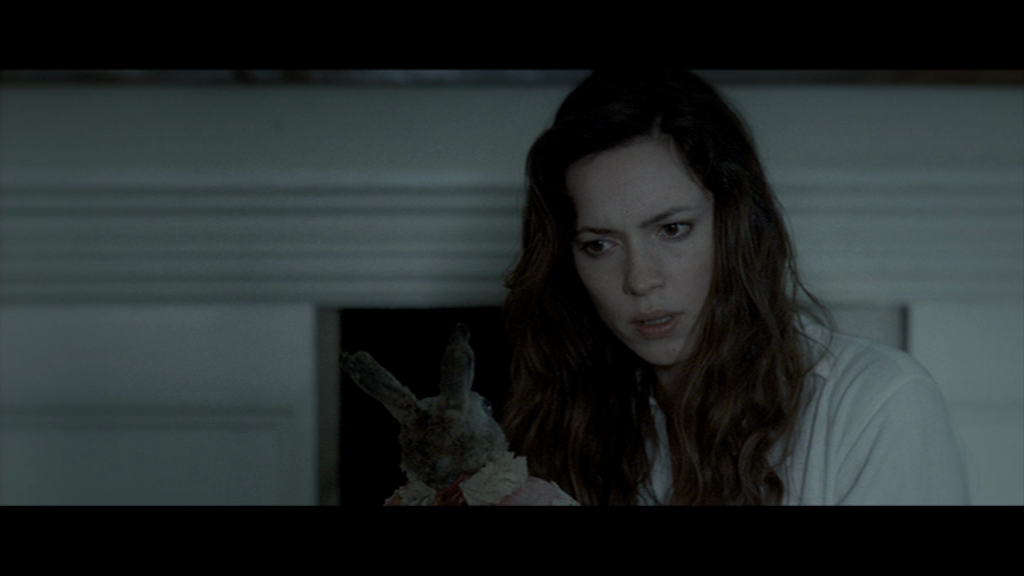
The group commented how, in many ways, The Awakening is a conventional story of a haunted house where the spirits interact with the living in order to resolve unfinished business. The music contributes considerably in establishing this uneasy mood and the film contains some good, unexpected scares. A comparison was made between The Awakening and Turn of the Screw and the relationship between the ghost story in cinema and that in literature. But that is not to say that the film does not contain some very striking moments which we agreed worked especially well. We talked about how the uncanny is evoked by the film, especially in the scene where Florence keeps returning to the same room depicting her mother’s death, despite her attempts to run away. The rabbit toy is also particularly uncanny and signals a rare instance of the use of vivid colour in the film. We discussed how it is possible to extend the Freudian reading of the film further, as the dollhouse functions as another double: it is the double of the house but also metaphorically represents Florence’s mind (it is her ‘mind palace’). Florence’s interaction with the dollhouse – which moves from confusion to trepidation and fear – parallels our protagonist’s the awakening doll's houseincreasing understanding of the haunting. The dollhouse allows Florence to observe the whole house, at once, and yet she is still unable to ‘see’ the larger picture for the majority of the film. This radically changes of course when Florence remembers her traumatic childhood and the memories of those disturbing events are ‘re-lived’ before her eyes.

In this respect the film can be interpretedthe awakening rabbit as a representation of the psychoanalytical process, as a kind of ‘talking cure’. Florence’s experience of the haunted house in the film functions to provide a series of shocks for the heroine so that she may remember the traumatic truth of her childhood. Tom’s presence in the film represents a form of the return of the repressed. The rabbit toy also functions as an important marker and another double. The song which the toy sings remarks that all the children ‘are gone except one’. This creates another double because at first the viewer believes this to be the ghost child (revealed later to be Tom) but this ‘child’ is also Florence herself, as she survived her father’s brutal attack. Only by remembering – or rediscovering – her true ‘self’ can Florence come to terms with this true identity. We discussed how it is interesting that this journey of self-discovery is framed by Florence’s movement from spiritual sceptic to dedicated believer in ghosts. This somewhat undermines Florence’s characterisation at the beginning of the film as an independent, successful author and career woman in the early 20th Century, and so the ultimate ‘message’ of the film is obtuse.

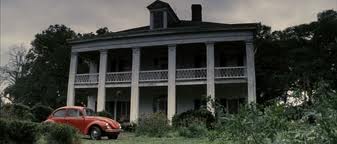
We also discussed the film’s setting and agreed that the post-WWI era is particularly suited to this type of horror story. We said how the film thus taps into a British cultural memory in addition to performing as a conventional ghostly tale. It was commented that The Awakening also correlates to the wider tradition of British horror which emphasises the paganism and spiritualism of the countryside against the supposed rational and sceptical urban city. Additionally, the manor house setting in The Awakening brings in the question of class, particularly through the character of Maud, and how the haunting of the house is caused – in part The Skeleton key– by the oppression of the aristocracy. We commented how this trait in horror extends beyond British films albeit in a slightly different guise: The Skeleton Key is a good comparison point with the manor house now replaced by a plantation house.

Many thanks to Frances for choosing the film, introducing it and providing the above excellent summary of our discussion.

Do, as ever, log in to comment or email me on sp458@kent.ac.uk to add your thoughts.

Alien (1979) Showing at the Gulbenkian Cinema on the 24th of Feb

Posted by Sarah

The fourth film in the Gulbenkian Cinema’s Gothic Season – Ridley Scott’s Alien (1979) – screens on Monday 24th of February at 9.15 pm. It will be introduced by Melodrama Research Group member Frances Kamm.

Alien

The Gulbenkian Cinema’s description of the film:

Ridley Scott | US | 1979 | 113mins | Sigourney Weaver, Tom Skerritt, Harry Dean Stanton, John  Hurt, Veronica Cartwright, Ian Holm

“In space, no one can hear you scream.” Ridley Scott’s (Bladerunner)  1979 modern classic stars a never-better Sigourney Weaver (Gorillas in the Mist) as Ripley, one of  several scientists on board the spaceship Nostromo, on the return leg of a  routine mission when they detect a mysterious transmission from a nearby  planet. Investigating the source, they find the remains of an alien creature  and crew member Kane (John Hurt) is attacked by the creature in one of its  eggs. Back on board, he has seemingly recovered when an uninvited guest  arrives, in gloriously gory fashion, in one of sci-fi’s most memorable  sequences.

The undisputed best of the Alien films, with a cerebral slant  alongside the thrills and gore, and an iconic feminist heroine in Weaver’s  preternaturally cool, tough Ripley, it’s a shocking, seamless ride.

“It  remains a benchmark of extra-terrestrial horror, and gave us a bona fide A-list  star in the shape of Sigourney Weaver” Film4.com

“One  of the greatest sci-fi movies ever made” Jamie Russell, BBC

For more information and to book your ticket please go to: http://www.thegulbenkian.co.uk/events/cinema/2014/February/2014-02-alien.html


Melodrama Screening and Discussion, 19th of February, Keynes Seminar Room 6, 4-7pm

Posted by Sarah

All are welcome to attend the fourth of this term’s screening and discussion sessions which will take place on the 19th of February in Keynes Seminar Room 6, from 4pm to 7pm.

We will be screening The Awakening (2011, Nick Murphy, 107 mins).

TA 4


Frances has very kindly provided the following introduction:

Following on from Kat’s screening of Black Christmas last week, this week’s film The Awakening is another example of the intersection between horror and melodrama in the
Gothic tradition. The Awakening picks up many of the Gothic tropes present in Black Christmas, such as the woman-in-peril and dark house motifs, but uses these elements for a very different effect.

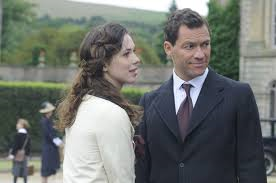
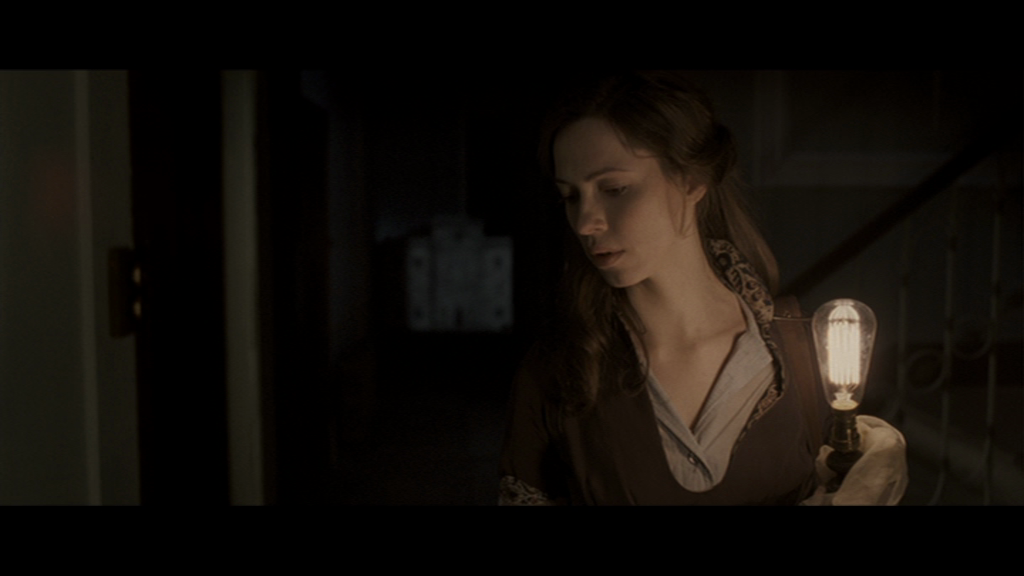
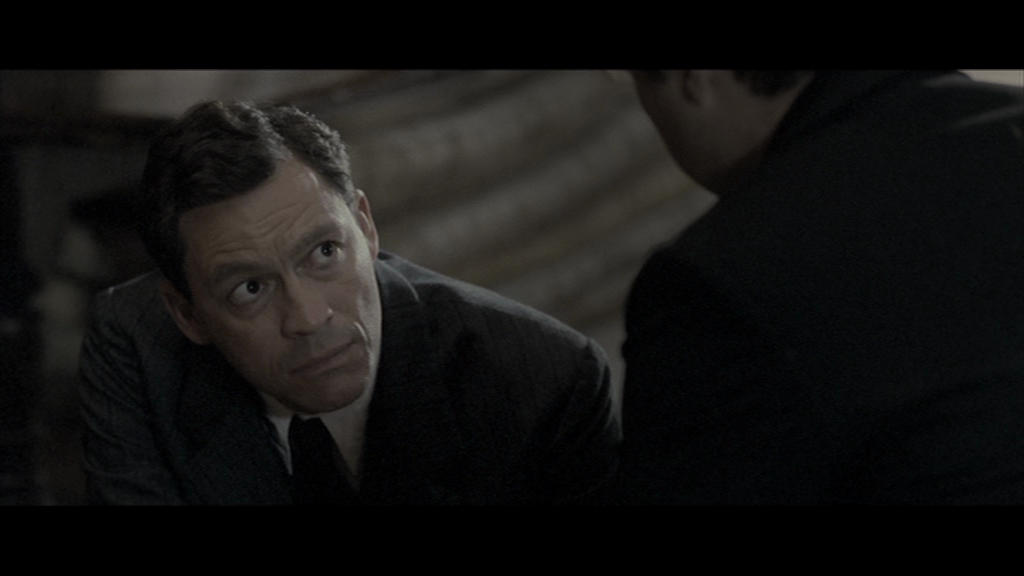
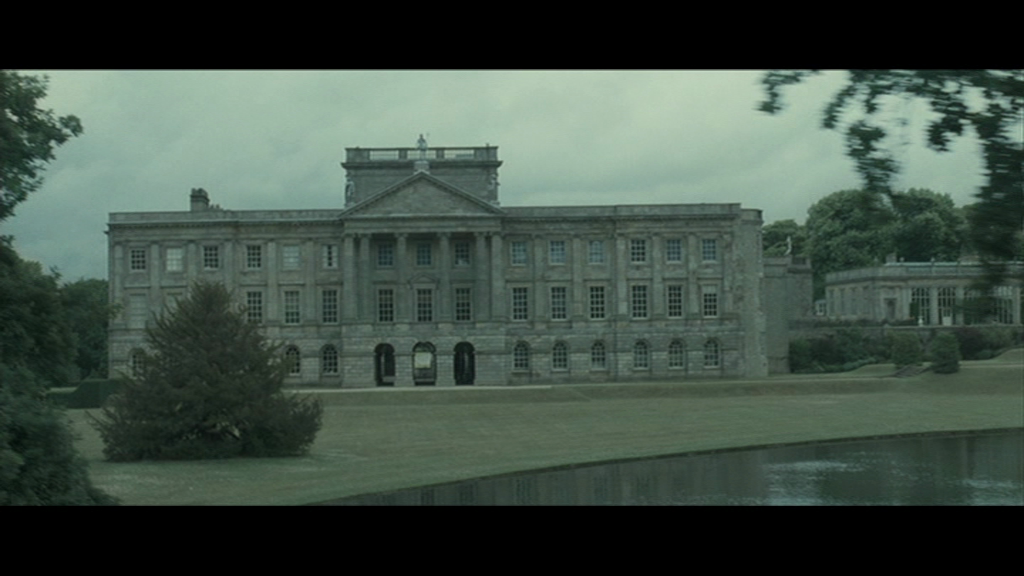
The Awakening TA 1is a 2011 British horror film starring Rebecca Hall, Dominic West and Imelda Staunton and directed by Nick Murphy. In many ways the film contributes to the popularity of the haunted house and ghost story narratives which have been featured and revived in many recent horror films, such as the Paranormal Activity series (2009-present) and, in particular, The Woman in Black (2012 and another British horror film). The Awakening also shares many similarities with The Orphanage (2007), as it seeks to combine a classic chilling story of a house haunted by a supernatural presence with the aftermath of traumatic historic events: in The Awakening’s case, Britain in 1921 after World War One. The Awakening tells the story of writer Florence Cathcart who has made her name as a paranormal sceptic and now helps the police in exposing and arresting charlatans who host spiritualism meetings and séances which promise to reunite paying customers with family members and the soldiers who did not return from the war. A war veteran and teacher, Robert Mallory, meets Florence and requests she return with him to his boarding school in the countryside, where he believes a real ghost of a former schoolboy is haunting the premises. Although initially reluctant at first, Florence agrees to return with Robert and prove the ghost a fraud, and thereby restore order to the school and the boys who believe the recent death of their school friend to be caused by a malicious spirit. With the help of her scientific equipment, Florence quickly believes the mystery to be solved and the ‘ghost’ exposed as a childish prank, until further paranormal occurrences begin to take place and Florence is forced to question her beliefs…

TA 5The film incorporates many of the major themes and tropes of the Gothic, as   established by the Gothic literature of the 18th century and the Bluebeard tale, which in turn inspired the Gothic cycle of films in Hollywood in the 1940s beginning with Rebecca (1940). Florence is the Gothic heroine of the film who is compelled to investigate the mystery of an old, dark house: in this case, the boarding school. In unlocking the secrets of the house, Florence becomes the woman-in-jeopardy conventionally at the heart of these stories: Florence is imperilled by the supernatural presence in the house; by the threats posed by the shady groundskeeper Edward Judd; and by her own stubbornness to question her rationalist convictions. In keeping with the traditions of the Gothic, the film’s narrative hinges on the revelation of a hidden secret which comes to light through Florence’s investigation. In The Awakening this secret is not contained within a single secret, locked room (as conventionally seen in such Bluebeard-inspired tales) but rather the house itself is the mystery to Florence, which must be discovered and understood in order to reveal the building’s – and her own – troubled past. As such we explore the house and experience the supernatural sightings with Florence and this identification with the female protagonist shows the film’s correlation to the conventions of horror established by films like Black Christmas, as discussed last week. The film adheres to other horror generic conventions, particularly in respect to low key lighting and the threat conveyed through effective editing and camera movement, but The Awakening is not just concerned with shocks and jumps. In his 2011 review of the film, Guardian critic Peter Bradshaw describes the film as a ‘supernatural melodrama’ and this description becomes very apt. The film’s horror elements work to illuminate andTA 3 frame the personal (and often private) melodramas which affect each character. The teachers of the school fail to conceal these tragedies as these secrets are also revealed within the course of Florence’s investigation. Central topics include shell-shock, child abuse and death.

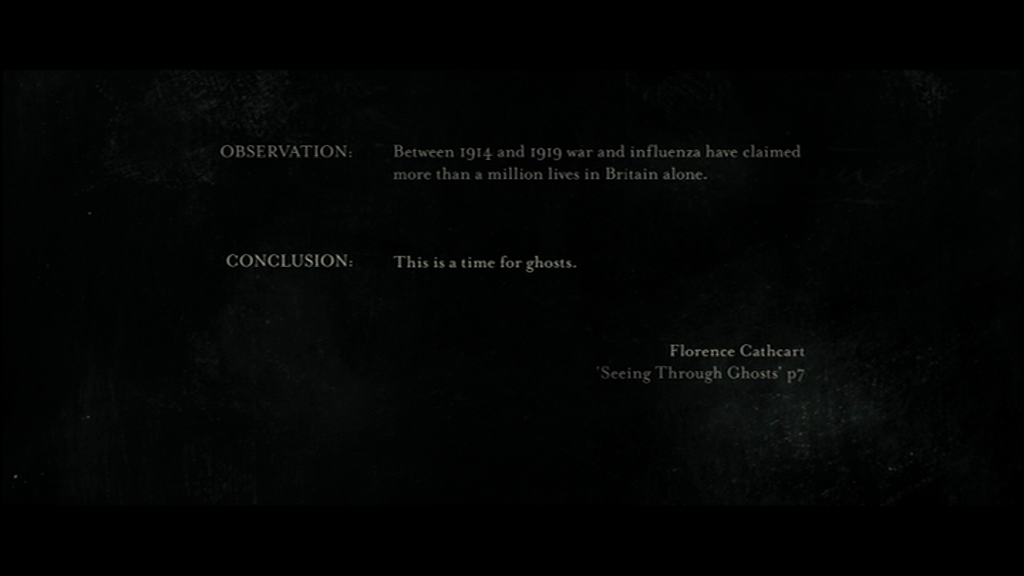
The film extends the Gothic trope of the house revealing secrets to include Florence herself, as The Awakening ultimately performs an in-depth analysis of the heroine and her psyche as well. This commingling of the paranormal or the mysterious with scientific and rational reasoning is a TA6reoccurring trend in the narrative and becomes key to unlocking the secret of Florence and her past. This is evident from the film’s very first frames, when we see a quotation from Florence’s popular book about the debunking of spirits informing us of the high death rate in Britain recently and concluding: ‘This is a time for ghosts’. This sentiment is supported by the opening scene which sees Florence attend a séance. Yet this first ghostly encounter is quickly revealed to be a fraud by Florence, who has the proponents of the meeting arrested. Florence maintains her sceptical, rationalist ideals through the use of advanced technological devices to prove the boarding school’s sightings of ghosts to be a hoax, only to have this same scientific equipment ‘prove’ the opposite is true. The narrative’s vacillation between incredulity and belief highlights the importance of the film’s setting in post-war Britain. The years following the First World War – a conflict which would radically re-define modern warfare and the devastating impact of technology – saw an increase in the popularity of spiritualism and belief in the paranormal. It is important to note that Freud’s essay on the uncanny was also published at this time, in 1919. The uncanny has a long history, which is interwoven with the Gothic tradition and literature of the 18th century, but the fact that Freud should choose to publish his work on the uncanny at this time is significant. Just as the world was recovering from the shock and trauma of the ‘modern’ – in this case, modern warfare – Freud muses upon the affect a displacement from the world, like an experience of the uncanny, has upon the mind. Like Florence, Freud hopes to offer a scientific explanation for these occurrences although, by his own admission, he ultimately fails. It is therefore important to view the film in terms of the uncanny as well, because the concept helps contextualise the historical setting for the film and The Awakening effectively incorporates many of the motifs which Freud identifies as ripe for an uncanny experience. These include representations of the double; the slippage between what is known to be alive or dead; and the unheimlich or the unhomely nature of the house. In testament to Freud’s work, The Awakening reveals that the secret behind the melodrama, the cause of the horror and ‘the uncanny is that species of the frightening that goes back to what was once well known and has long been familiar.’

When watching the film we can think about:

–          How The Awakening fits into this Gothic tradition

–          Why the film has this historical setting

–          Florence’s characterisation

–          The ending: what does it all mean?

Do join us if you can for this chilling screening!