Melodrama Screening and Discussion, 20th of May, Jarman Studio 6, 4-7pm

Posted by Sarah

All are welcome to attend the second of the Summer Term’s Maternal Melodrama themed Screening and Discussion sessions, which will take place on the 20th of May, in Jarman Studio 6, from 4-7pm.

We are screening Tamar’s choice: Mildred Pierce (Michael Curtiz, 1945, 111 mins)

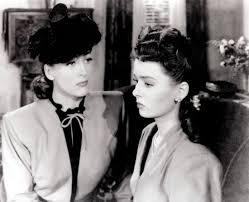
MP mother and daughter

Tamar has very kindly provided the following introduction:

Mildred Pierce – film noir or melodrama?

Mildred Pierce (Michael Curtiz, 1945) is the next film to be screened in the Melodrama Research Group’s series of maternal melodramas, leading up to our symposium on this topic on 3 June. But if it is a maternal melodrama, why is so much written about it under the film noir label?

The film, adapted loosely from the James M. Cain novel of the same name, tells the story of Mildred Pierce and her journey to business success and personal failure. Much of the film’s moody opening seems as if it is trying to force Mildred into the role of noir’s usual femme fatale, but as the narrative succumbs to its flashbacks, her motherhood, as well as other factors, complicates this.

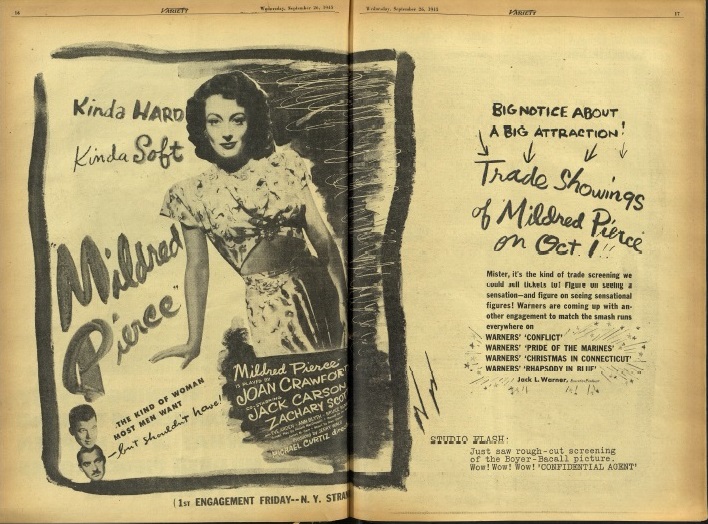
MP double page ad Variety 1

The movie poster’s tagline is in accord with this noir presentation: “The kind of woman most men want – and shouldn’t have! That’s…..Mildred Pierce”, though an earlier piece of publicity had more simply “Kinda Hard Kinda Soft”. Neither seems to do justice to the narrative exigencies to which Mildred is subjected. Perhaps the significant factor for our Melodrama Research Group to ponder is that the film does not easily fit any generic label, but rather exceeds several; furthermore, as theorists have shown, film noir was not an industrial category at the time and, as Steve Neale suggests, neither perhaps was melodrama. There will be much to consider and much to enjoy, then, as we watch Joan Crawford head a talented cast as Mildred and listen to Max Steiner’s supple and evocative score.

Further Reading

Pam Cook, “Duplicity in Mildred Pierce”, Women In Film Noir, London: BFI 1978.

Claudia Gorbman, “The Drama’s Melos: Max Steiner and Mildred Pierce”, The Velvet Light Trap, No. 19, 1982.

Steve Neale, “Melo Talk: On the Meaning and Use of the Term ‘Melodrama’ in the American Trade Press”, The Velvet Light Trap, No. 32, 1993.

 Do join us, if you can, for this Hollywood Classic.

Summary of Discussion on Stella Dallas

Posted by Sarah

Lies has very kindly provided this summary of our discussion on Stella Dallas:

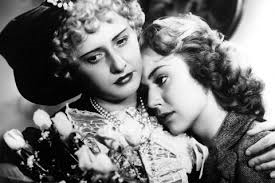
Stella Dallas overdressedFirstly, we discussed the way the film depicts social mobility and its (im)possibility within the supposedly democratic American society of the time. Stella achieves upward social mobility through a respectable marriage to a wealthy man, which is the end goal of many films (The Bride Wore Red comes to mind) but instead of ending on a kiss and a promise of happily ever after, Stella Dallas shows the aftermath of such a match. Stella’s difference from Stephen (and from members of his class) is expressed through her behaviour, her clothes and even, perhaps, her choice in beverage; we discussed her repeated mention of sarsaparilla and how this may be a preference connected to her working class status.

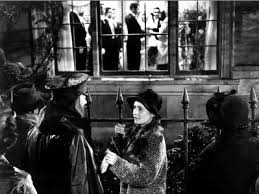
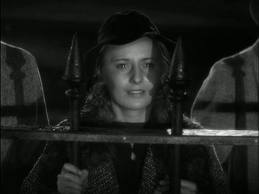
We linked this emphasis on social mobility or lack thereof particularly to the first and last images we get of Stella in the film. At the beginning, she is standing in her family home’s front yard looking out into the street and waiting to catch a glimpse of Stephen Dallas; both Dallas and the road are accessible and within her reach. At the end of the film, however, Stella is standing in the road, behind a fence and outside a closedStella Dallas end window, gazing at her daughter’s wedding, which is physically out of her reach. The wedding is also guarded by a policeman who eventually ushers Stella away. At the film’s beginning, therefore, social mobility (through Stephen) seems achievable, but at the end, it has been closed off to her, and she can only catch a glimpse of Stephen’s world from behind bars.

Nonetheless, we also remarked on Stella’s facial expression as she walks away from the window in the very last seconds of the film; she is sad, but also smiles and looks in a sense victorious. Although Stella has not achieved social mobility directly, she has done so indirectly through Laurel; her daughter has successfully entered Stephen’s world through her marriage to a wealthy man, thanks in part to Stella’s sacrifice. We remarked that this must have echoed the experience of many immigrants to the United States, who may not have personally been able to reap the gains of their decision but whose children and grandchildren received better future opportunities thanks to their immigration.

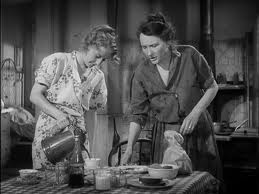
In terms of both Stella’s family situation in a fairly poorStella Dallas home working class family and of Stella’s wishes for social mobility, this film reminded us in some ways of Love on the Dole, which we watched as a group some months ago. In this film, too, daughter Sally (Deborah Kerr) strives for social mobility, but does so through a clandestine relationship with an unattractive, older rich man instead of through legitimate marriage, as Stella does.

Finally, we remarked upon Barbara Stanwyck’s acting style, which has aged well and which is remarkably restrained, particularly for a film dealing with such strong emotional highs and lows – there was little of the excessive acting we have seen featured in some previous films. This is particularly interesting in terms of this film as a classic (maternal) melodrama, since the genre is often characterized by excessive emotion and exaggerated performances.

Many thanks to Lies for organising the screening of Stella Dallas and providing a wonderful introduction and great summary of our discussion.

Do, as ever, log in to comment or email me on sp458@kent.ac.uk to add your thoughts.

Melodrama Screening and Discussion, 13th of May, Jarman Studio 6, 4-7pm

Posted by Sarah

All are welcome to attend the first of the Summer Term’s Screening and Discussion sessions, which will take place on the 13th of May, in Jarman Studio 6, from 4-7pm.

Stella Dallas

In preparation for the Melodrama Research Group’s one-day Symposium on Maternal Melodrama we are screening several related films. The first of these is Stella Dallas (1937, King Vidor). Lies has very kindly provided the following introduction:

Stella Dallas stars Barbara Stanwyck as Stella, the working class daughter of a mill worker who, in an attempt to better herself, seduces and marries mill executive Stephen Dallas (John Boles). The couple have a child, Laurel, but soon discover their marriage is not a success, as their differences in class and taste prove insurmountable. The two divorce and Stella retains custody of Laurel. Years later, however, as Laurel grows into young adulthood, it becomes increasingly obvious that her kind-hearted, but rather tasteless, mother is an obstacle to her introduction into her father’s upper class circles, and Stella is forced to choose between her own wishes and what she believes to be best for her daughter.

Originally published as a novel in 1920 and made into a silent film in 1925 (starring Belle Bennett as Stella and Ronald Colman as Stephen), this film is a maternal melodrama par excellence and should provide ample topics for discussion, such as:
– The ways in which this film can be defined as a melodrama
– The role of female self-sacrifice in (maternal) melodrama
– The role and function of class in this film, or What Happened After Cinderella Married The Prince
– The relationship between mother and daughter
– The relationship between both of Laurel’s mother figures (Stella and the second Mrs Dallas)
Do join us, if you can, for a classic Hollywood melodrama which showcases the talents of one of the most compelling female stars of the 1930s and 1940s.

Maternal Melodrama Titles and Abstracts

Posted by Sarah

The titles and abstracts for our upcoming Maternal Melodrama on the 3rd of June:

Pam Cook, University of Southampton, Film Studies

“Paratext and Subtext: Reading Mildred Pierce as Maternal Melodrama”

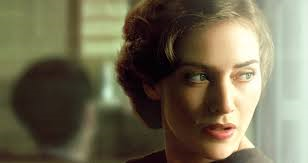
Maternal melodrama has MP TV seriesgenerated an influential body of critical writing that examines the implications of its representations of motherhood for women. Ambivalence towards and desire for mothers continue to inspire stories of maternal suffering, self-sacrifice, guilt and blame that have a powerful emotional appeal. I’ll focus on Mildred Pierce to try to get to the heart of why this genre (cycle?) is so significant and how a diverse collection of films comes to be viewed as maternal melodrama. Using my videographic work, I’ll look at the role of paratexts (Genette) in producing the subtexts that point to the genre’s transgressive potential.
 

 Catherine Grant, University of Sussex, Film Studies

 “Studying Old and New Maternal Melodramas Videographically”
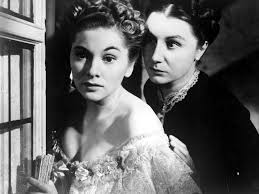
Joan Fontaine Rebecca

In my talk, I will screen a number of my short audiovisual essays on film melodramas which centrally feature mother-daughter relationships (including two cinematic adaptations of Olive Higgins Prouty’s 1922 novel Stella Dallas [1925 and 1937], The Railway Children [1970], and Andrea Arnold’s 2009 film Fish Tank).

I will also explore what “creative critical” videographic methods can bring to the study of old and new maternal melodramas. I will argue not only for the greater potential of audiovisual expression for richer and more precise engagements with the motifs and textures of film melodrama, but also for the benefits of methods which more evidently express, and at times productively foreground, the subjective and affective investments of the individual researcher.

For an example of Katie’s videographic essays on Melodrama please visit her fantastic Film Studies For Free blog, especially the post ‘Voluptuous Masochism: Gothic Melodrama Studies in Memory of Joan Fontaine’:

http://filmstudiesforfree.blogspot.co.uk/2013/12/voluptuous-masochism-gothic-melodrama.html


Keeley Saunders, University of Kent, Film Studies (ks424@kent.ac.uk)

“Transitioning and the Maternal Melodrama: Parental Roles in Transamerica”

In the process of transitioning, many transgender individuals have to learn how to manage their new identity in society: dealing with other people’s perceptions of them, moving jobs or location, or significantly, ‘coming out’ to their family. Trans memoirs, such as Stuck in the Middle with You by Jennifer Finney Boylan, detail the complex process of transitioning as a parent: for Boylan, moving from ‘father’ to ‘mother,’ with a period in between where the subject occupied neither – or both – positions. Documenting this issue draws attention to the traditional roles of gender and the social structures policing gendered parenting responsibilities or behaviours. Elsewhere this can be depicted through a parent’s response to their child coming out and their reaction (and the relationship developed) following such an announcement.

Family dynamics and the role of the parent is a recurring narrative trope within the fictional mode of ‘trans-cinema.’ Transamerica (Duncan Tucker, 2005) Maternal Melodrama Transamerica untitledpresents both of sides of the parental dynamic outlined above, following Bree, a pre-operative trans woman who is in the process of transitioning. This presentation will explore how Transamerica – and trans-cinema more broadly – adopts various melodramatic structures to portray its narratives. With particular reference to the characterisation and role of the mother, I will address how the film utilises the convention of parental roles, situating Bree as both the estranged parent and the estranged child attempting to (reluctantly) reconnect with her family before she undergoes her surgery.

 

 Lavinia Brydon, University of Kent, Film Studies

“The Suffering and Sacrifices of a Mother (Country): Examining the Scarred Irish Landscape in The Last September (1999)”

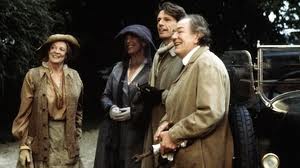
This paper seeks to investigate maternal Melodrama The Last Septemberand interpret the melodramatic tendencies of The Last September (Deborah Warner, 1999), an Anglo-Irish heritage film set just one year prior to the Ireland’s partition in 1921-1922. Taking John Hill’s comments on the melodramatic excess of the similarly concerned Fools of Fortune (Pat O’Connor, 1990) as a starting point, this paper will consider how the violence of the period complicates the restraint that typically marks the heritage film. Indeed, it will argue that the turbulent time frame permits the ‘astonishing twists and turns of fate, suspense, disaster and tragedy’ (Mercer and Shingler 2004: 7) for which early theatrical melodramas were famed. However, given the familiar nationalist allegory of Ireland as a poor old woman (otherwise known as Cathleen ni Houlihan), this paper will move on to consider how the violence inscribed on the Irish landscape allows the film to be framed specifically as a maternal melodrama. It will thus consider how the film depicts the suffering of and sacrifices made by Ireland as a mother (country).
 

Tamar Jeffers McDonald, University of Kent, Film Studies

“All That Costume Allows: Does Dress Tell the Mother’s Story?”

As its title suggests, this short paper seeks to link two famous Film Studies texts: Douglas Sirk’s 1955 melodrama, All That Heaven Allows, and Jane Gaines’ 1991 article, “Costume and Narrative: How dress tells the woman’s story”. Gaines’ piece insists that, because of the gendered division of narrative agency inevitably operating in Classical Hollywood Cinema, character is conveyed in different ways; men, who are active in the narrative, making things happen, are summed up by those happenings, but women, who are passive and acted upon, cannot thus be known. Their characters need to be made apparent to the viewer through other means: Hollywood has traditionally used costume. As Gaines remarks, “a woman’s dress and demeanour, much more than a man’s, indexes psychology: if costume represents interiority, it is she who is turned inside out on screen.” (Gaines, 1991: 181)
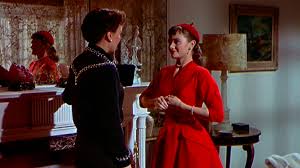
Maternal Melodrama ATHA 3On first consideration, Sirk’s scenario – about a widow’s romance with a younger man seen, by her children and snobbish community, as her social inferior – appears ripe to contest Gaines’s assertions. The film is all about Cary Scott, the central female character, her feelings, motives, decisions. Her status as a mother surely endows her with agency, as she cares for her children and, true to the maternal melodrama formula, sacrifices her own happiness to ensure theirs? Does the film need to employ the ‘storytelling wardrobe’ for a character so at the heart of the story, even when she is female?  This presentation examines Cary’s costumes in detail to find out.

Reference

Gaines, Jane. 1991. “Costume and Narrative: How dress tells the woman’s story” in Gaines, Jane and Herzog, Charlotte, eds, Fabrications: Costume and the Female Body. New York and London: Routledge.

Lies Lanckman, University of Kent, Film Studies

“All the melodramatics of my life are past!”: The Fan Magazine as a Melodramatic Medium

Although the topic of maternal melodrama inMaternal Melodrama Norma Shearer 3 film has received attention by a number of scholars, the focus appears to lie primarily on the study of particular emblematic films or, more broadly, on maternal melodrama on screen. This paper, however, will explore another connection between (Hollywood) film and melodrama; the way in which not just many films, but also the fan magazine and the star narratives contained within its pages can be seen to include a number of melodramatic elements.
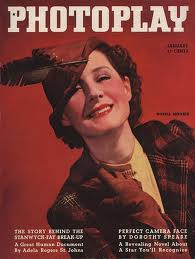
By exploring fan magazine rhetoric produced between 1920 and 1940, I highlight a number of key themes and the way their treatment might be called melodramatic, ranging from the characterisation of particular stars, to the treatment of key life experiences, such as love, marriage and death. In this paper, however, I will particularly highlight the treatment of motherhood in the pages of publications suchMaternal Melodrama Stanwyck as Photoplay, focusing on two separate case studies. One is the treatment of Norma Shearer’s role as a tragic widow and single mother after the premature death of husband Irving Thalberg in September 1936. The other will focus on the rhetoric surrounding the divorce of Barbara Stanwyck and Frank Fay in December 1935, which cast Stanwyck as an excessive/monstrous mother who essentially emasculated her (less successful) husband. Using these two case studies, I will attempt to draw comparisons between Hollywoodian (maternal) melodrama on and off screen.

 

Ann-Marie Fleming, University of Kent, Film Studies

“It’s very difficult to keep the line between the past and the present”:  Exploring the melodramatic depictions of the women from Grey Gardens (1975 and 2009).

This paper seeks to explore how we understand mother-daughter tensions and acceptance through the use of the past in both Grey Gardens (1975) and the docudrama of the same name from 2009. Life at Maternal Melodrama Grey Gardens doc and filmGrey Gardens does not progress; instead the past is the present. Melodramatic moments, particularly the interactions between Edith and Edie, are caused by and centred on past grievances that are as much alive in 1976 as they were in 1952. In contrast, the docudrama’s past is shown as a tool to heighten the pain of the present, whilst stylistically appearing more significant.
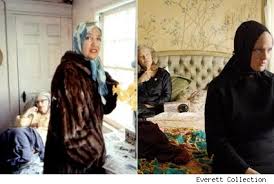
Primarily the paper will focus on the films’ depiction of:

  • The unsaid, said and shown – An examination of the melodrama caused by the discussion of the past in contrast to the performance style of the docudrama.
  • Female urgency – The importance of the female body and its dominance of the frame at the peak of the melodramatic performance/reaction.
  • The rise and fall of tension – How each form manipulates time and remembrance to create melodramatic sympathy.
  • The melodrama of life itself – The re-creation of the past self and the character of the present.

Despite the differences in film form the paper hopes to expose one important factor: familial melodrama arises from the past’s collision with the present.


We hope you’ll be able to join us on the 3rd of June to hear the papers in full!

Update: the event is free, but booking is essential. Please email me on sp458@kent.ac.uk to secure your place.
 

Schedule for Maternal Melodrama Symposium on 3rd of June

Posted by Sarah

Exciting news! We now have a schedule for the Maternal Melodrama Symposium which will take place on the 3rd of June in GLT3 (Grimond Lecture Theatre 3) and GS6 (Grimond Seminar Room 6). The day includes talks by our special guests –  Professor Pam Cook of Southampton University and Dr Catherine Grant of the University of Sussex – as well as from members of the Melodrama Research Group.

Schedule

10.00 – 10.30 Greetings and refreshments GS6

10.30 – 12.30 Videographic essays and the Maternal Melodrama GLT3

                Pam Cook: “Paratext and Subtext: Reading Mildred Pierce as Maternal

                Melodrama”

                Catherine Grant: “Studying Old and New Maternal Melodramas

                Videographically”

12.30 – 1.30 Lunch GS6

1.30 – 3.30 Afternoon papers GLT3

10 minute papers

                 Keeley Saunders: “Transitioning and the Maternal Melodrama:

                 Parental Roles in Transamerica”

                 Lavinia Brydon: The Suffering and Sacrifices of a Mother (Country):

                 Examining the Scarred Irish Landscape in The Last September (1999)”

                Questions

20 minute papers

                Tamar Jeffers McDonald: “All That Costume Allows: Does Dress Tell the 

                Mother’s Story?”

                 Lies Lanckman: “”All the melodramatics of my life are past!”: The  

                  Fan  Magazine as a Melodramatic Medium”

                 Ann- Marie Fleming: “”It’s very difficult to keep the line between the past and

                 the present”:  Exploring the melodramatic depictions of the women from Grey

                 Gardens (1975 and 2009)”

                 Questions

3.30 – 4.00 Afternoon tea GS6

4.00 – 5.00 Roundup of thoughts, responses and future plans GS6

Please see the next post for contributors’ abstracts.

Update: the event is free, but booking is essential. Please email me on sp458@kent.ac.uk to secure your place.
 

Next Term’s Screenings

Posted by Sarah

We can now confirm the films selected for screening in advance of our maternal melodrama symposium on the 3rd of June.

Stella Dallas

These are:

Stella Dallas (1937, King Vidor) Tuesday 13 May, 4-7pm, Studio 6

Mildred Pierce (1945, Michael Curtiz) Tuesday 20 May, 4-7pm, Studio 6

The Old Maid (1939, Edmund Goulding) Tuesday 27 May, 4-7pm, Studio 6

Introductions to these films will be posted at a later date.

And please note the room change: we will be in Jarman Studio 6.


We Need to Talk About Kevin (2012) on BBCiPlayer until Saturday evening


Posted by Sarah


maternal melodrama

Just to let you know that you can catch We Need to Talk About Kevin (2012), an important film for the forthcoming maternal melodrama symposium, on BBC iplayer until Saturday Evening: http://www.bbc.co.uk/iplayer/episode/b01p241z/We_Need_to_Talk_About_Kevin/

Summary of Discussion on Black Book

Posted by Sarah

The discussion on Black Book ranged widely and encompassed: the film’s relationship to melodrama; the trope of the suffering woman; the family in melodrama; rhythm in melodrama and the film’s unending revelations of betrayals; the film’s characters Akkermans and Muntze; moral ambiguity; costume; women’s fluid identity/ies); melodrama and real life.

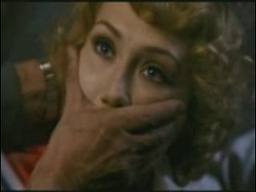
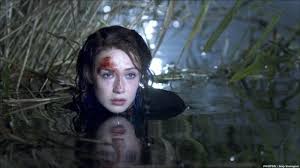
Black book Rachel Ellis sufferingWe began by isolating some of the elements which coincided with our understanding of melodrama. The continuous suffering of the main female character Rachel/Ellis (played by Carice van Houten) was especially noted. The group has commented on the suffering female(s) present in previous, and varied, screenings, including:  D.W. Griffiths’ The Mothering Heart (1913), Gaslight (Thorold Dickinson 1940, George Cukor 1944), Douglas Sirk’s Magnificent Obsession (1954), Twin Peaks (TV 1990-1991), and David Lynch’s Mulholland Drive (2001).

Black Book RachelEllis bombingThe film begins in 1950s Israel but soon a triggered memory causes it to flash back to Nazi-occupied Holland in 1944. At his time Jewish Rachel Stein is separated from her real family and finds shelter with a Christian family.  Her relatively quiet existence is soon shattered as her hiding place is bombed when she is out, presumably along with its inhabitants. Rachel’s real family has been hiding elsewhere but soon they are reunited. This might at first appear coincidental (another important melodramatic trope which is also present elsewhere in the film) but is in fact explained away by a mutual acquaintance (her father’s solicitor Smaal) being aware of Rachel’s plans and informing her family.  Almost immediately after the family reunion Rachel witnesses the slaughter of her mother, father and brother just when they, and other Jewish families, seemed on the road to freedom. After losing her surrogate family and home then, Rachel’s suffering is heightened, indeed overtaken, by the loss of her real family.

The family is often central to melodrama, and it is also the case here since it prompts Rachel’s later action, and she relives this particularly traumatic scene. On the first occasion this is implicit. In Rachel’s new, non-Jewish, identity of Ellis de Vries she has joined the Dutch resistance. These defend themselves against Nazi soldiers, gunning them down, and then stripping their bodies of useful uniforms. This reminds the viewer of the earlier scene since after the slaughter of the Jewish families the Nazi soldiers divest them of their jewellery.  The connection is reinforced as Rachel/Ellis can only stand by as a mute witness as both events occur.  Later on, a powerful reaction to again Black Book RachelEllisrelivingseeing the man who was responsible for Rachel/Ellis’ family’s slaughter is indicated not just physically (Rachel/Ellis runs to the cloakroom to vomit) but psychologically: the film provides a flashback of the earlier scene, from Rachel’s point of view.

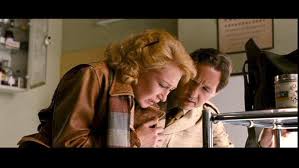
Black Book RachelEllis and Muntze at stationRachel/Ellis’ suffering is not confined to these awful events, however. She suffers more as she witnesses some of her new friends being caught by the secret police. Rachel/Ellis also suffers conflict by falling in love with the high-ranking Nazi official, Ludwig Muntze (played by Sebastian Koch), she has been sent to spy on after meeting him, by chance, on a train and charming him. Tellingly the first scene of their lovemaking is accompanied not by a lush romantic score, but one more indicative of danger, danger Rachel/Ellis (and to an extent) Muntze, cannot for a moment disregard.  Rachel/Ellis later suffers as Muntze is arrested and sentenced to death, and she is imprisoned after a botched attempt to rescue him. Another Nazi official, Gunther Franken (played by Waldemar Kobus), inflicts further suffering as he leads stages a scene within the hearing  of a ‘secret’ microphone Ellis previously hid. This leads Rachel/Ellis’ friends to think she has betrayed them, and is a further level of suffering: others’ belief in her good character is taken from her.  Rachel/Ellis and Muntze later escape together, enjoy a few moments of rare  domestic bliss on a boat, but are captured after confronting Rachel/Ellis’ father’s solicitor Smaal with suspicions of corruption. Franken’s destruction of Ellis’ good name has practical consequences too.  After peace has been declared she is rounded up with other traitors and detained, beaten and humiliated.  Finally she hears that her lover Muntze has been killed. This is tellingly the moment at which she actually lets her emotions out, collapsing to the floor, sobbing uncontrollably and rhetorically asking ‘when does it end?’ Even the film’s conclusion, which returns to a time in the 1950s just after Rachel’s flashback has begun, follows the pattern of a momentary respite before suffering again intrudes. After a brief happy moment with her husband and children we can see that another war rages around them.

We thought that Rachel/Ellis’ continual suffering fitted Matt Buckley’s description of melodrama’s often relentless ‘rhythm’ when he gave a research talk the other week. Further relation to earlier theatrical melodrama, specifically Victorian, was suggested as the ‘Jerries’  were a force outside of the characters’ control, much like fate.  The film’s numerous false reveals of the person who betrayed the whereabouts of the Jewish families can also be seen to be connected to the notion of rhythm. First the ‘friendly’ secret policeman Van Gein is suspected. While he is indeed revealed to be working with the Nazis, he is not the traitor.  Next Rachel/Ellis’ father’s solicitor Smaal is accused. He and his wife are immediately killed however, with Muntze chasing after the offender, but only Black Book Rachel Ellis collapsesucceeding in being caught himself. Finally Hans Akkermans (Thom Hoffman), a Doctor and key resistance figure, is unmasked as the man responsible. He foolishly does this himself after attempting to kill Rachel/Ellis with an injection of insulin, but not waiting for it to take full effect.

The scene ends when Black Book RachelEllis crowd surfingRachel/Ellis manages to grasp some chocolate which rather ironically Akkermans had earlier given her and is able to reverse the effects of the insulin. She then, somewhat implausibly, escapes by rushing past Akkermans who is addressing the crowd from his balcony, and throwing herself into the mob below. (On a side note we also found the ambiguity of Rachel/Ellis’ motives here intriguing: was she bent on survival or destruction?) Nearer the film’s beginning Rachel/Ellis had told Akkermans that a friend of hers used to eat chocolate when he had over-injected with insulin. This is an example of the film’s fairly-heavy handed use of foreshadowing. Another key example occurs in relation to Akkermans. Earlier in the film Akkermans, to the delight of his resistance colleagues, mocks Hitler by donning a makeshift toothbrush moustache and speaking in a mock-German accent. Now he is indeed corrupted by power, with a very high opinion of himself, and is addressing the crowd as a leader might.

Akkermans is certainly a complex character. Some of  this is linked to narrative necessity –  he must appear one thing while actually being another, and do so convincingly as the film works its way through unmasking its variety of different ‘villains’.  This leads to perceived emotional complexity – has he always been corrupt, or been made corrupt through necessity and/or power? We found the character of Muntze more interesting, however. Although a high-ranking Nazi official he is even less the wholly bad villain of melodrama. Muntze is redeemed by the film in several ways. The first of these, which ties him closely to Rachel/Ellis, is that he too has been affected by the loss of his family. His wife and children were bombed by the British. The film also shows Muntze attempting to institute a ceasefire with the resistance. Furthermore, he does not betray Rachel/Ellis to the authorities when she confesses her true identity and purpose.

It was also commented upon that the actor playing the ‘nice’ Nazi Muntze (Sebastian Koch) was attractive, while the actor playing the ‘nasty’ Nazi Franken (Waldemar Kobus) was less easy on the eye. This led to further discussion about the ambiguity of the film’s, and its characters’, morality. The way in which those thought to have betrayed their country by collaborating with the Nazis were treated – Rachel/Ellis’ and others’ humiliation – was lingered on by the film, rather than evaded. Some in the group wanted Rachel/Ellis and Gerben Kuipers (a resistance man who had lost his son because of Akkermans’ betrayal) to take the moral high ground after they had tracked him down. Instead, Rachel/Ellis used the point of her locket containing family pictures to screw down his coffin lid in order to suffocate him – a poetic revenge. Rachel/Ellis and Kuipers discuss the fact that they should let Akkermans live. Neither does, despiteBlack Book RachelEllis and Kuipers Rachel/Ellis’ earlier agreement with Smaal that everyone is entitled to a fair trial. One of them notes that Hans has gone quiet and we might presume he has died. It was thought that some uncertainty, however, allowed Rachel/Ellis and Kuipers some moral leeway.

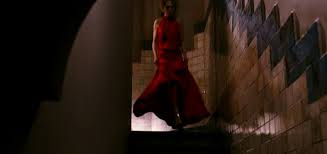
Black Book RachelEllis red dressCostume also featured in our discussion. We questioned the historical accuracy of some of the outfits, especially the women’s.  However of more concern to us was the symbolism of the costumes. The floor-length leather coasts and jack boots which singled out the most high-ranking officers are especially iconic and were easy to identify. In most cases their presence immediately signalled a character’s loyalties and standing, though Muntze was an exception. Rachel/Ellis’s costumes were of particular interest. It was telling that a few in the group who had seen the film before had misremembered the colour of a dress Rachel/Ellis wears at one point. Rachel/Ellis leaves a party she is attending to crawl though the coal store and allow her comrades access to the Nazi’s underground prison. The dress she wears was remembered by some as being white, though it was in fact red. It was thought that this was because white is linked to notions of innocence and that is how we view Rachel/Ellis. The red dress of course has other connotations – to do with passion, desire and sex. This led to further discussion of women’s costumes. We especially noted that Rachel/Ellis and her fellow worker Ronnie use clothing as part of the wiles they rely on to survive from day to day. Rachel/Ellis’ decision to wear to work a see-through blouse which revealed her underwear highlighted this. We further noted the fluid identity of these two main female characters – they have to morph and adapt. Ronnie was very interesting in this regardBlack Book RachelEllis and Ronnie dance as she was revealed to be more scheming than we might have been anticipated: she affects Rachel/Ellis’ and Muntze’s joint escape from prison. We wanted to know more about her, especially as her presence in Israel and recognition of Rachel/Ellis sparked the film’s extended flash back. What was Ronnie’s story?

Whose story is the film based on?’ was another question we asked. The opening credits assert that it is ‘based on a true story’. The film’s many coincidences and revelations may make this seem unlikely. But it chimes again with Matt Buckley’s recent talk. In this he emphasised the increasing relevance of melodrama not just to art, but to lived modern experience.

Many thanks to Tamar for choosing this rich film, especially apt due to the School of Arts upcoming trip to Amsterdam.

Do, as ever, log in to comment or email me on sp458@kent.ac.uk to add your thoughts

Invitation to Exhibition Launch, Templeman Library, Canterbury, Monday 7th April, 6pm

Posted by Sarah

The following has very kindly been forwarded by Melodrama Research Group member Jane Gallagher.


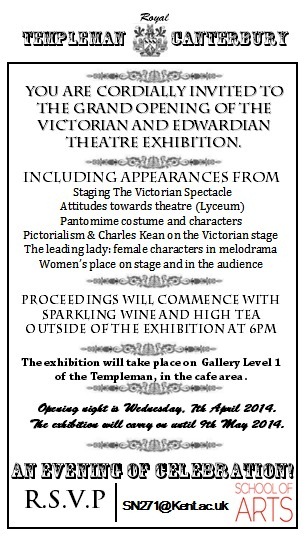
The students of DR575 Victorian and Edwardian Theatre would like to invite you to an exhibition of their work, opening in the Templeman Exhibition Gallery (Ground Floor, Cartoon Archive) at 6pm on Monday 7th April 2014.

The official invitation from the students (see below), contains further details about their work, including some hints about the melodramatic theme which some of them are taking on!

Invitation altered version

The exhibition is a visual tour through the theatre of the Victorian and Edwardian era, based around the primary sources that are only available in Special Collections. This is the second time which this student exhibition has taken pride of place in the Templeman Gallery and we would like you to join our celebrations to mark their success.

This is an innovative form of assessment which has combined primary source work with more detailed secondary research and is going to be an excellent example of Drama students’ work.

 You are warmly invited to the launch event 6pm on Monday 7th April 2014 where you can enjoy meeting the students, hearing a short presentation, and sampling some light refreshments!

We very much hope that you can attend and your presence will be very much appreciated.

Yours,

Jane Gallagher on behalf of the Students of DR575: Victorian and Edwardian Theatre

Many thanks for the email, and the invitation Jane. I’m sure we’ll all hope to attend this exciting event.

Melodrama Screening and Discussion, 2nd of April, Keynes Seminar Room 6, 4-7pm

Posted by Sarah

All are welcome to attend the last of this term’s screening and discussion sessions which will take place on the 2nd of April in Keynes Seminar Room 6, from 4pm to 7pm.

In advance of the School of Arts’ trip to Amsterdam over Easter we have chosen to screen the Dutch film Black Book (2006, Paul Verhoeven, 145 mins).

Black Book

Set in Nazi-occupied Netherlands during World War II, the film’s plot revolves around female Jewish singer Rachel, played by Carice van Houten. After Rachel’s  family is murdered she seeks revenge by infiltrating the regional Gestapo. However, Rachel faces a dilemma as she unexpectedly falls for an officer who represents the regime she passionately wishes to destroy…

Do join us if you can, but please note that due to the film’s length we will start promptly at 4.