Summary of Discussion on Black Christmas

Posted by Sarah

Kat has very kindly provided the following summary of our discussion on Black Christmas (1974):

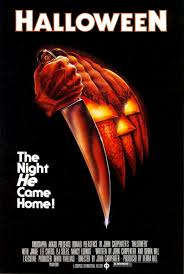
HalloweenDiscussion began with acknowledgement of how the film could be interpreted as the forerunner to the Slasher subgenre. The traits of lone stalker and aspects of cinematography are recognisable when one considers Halloween (1978), especially the opening of Halloween with the POV camera work associating the killer with the viewpoint. There was general agreement on how underrated Black Christmas appears to be, as it is a superior horror film. Focusing on the nihilistic ending, some of the group were surprised and disappointed in how little academic focus there is on this film. Considering writers such as Robin Wood who focus on the nihilistic aspects of 1970s horror, yet fail to mention or reference Black Christmas. Many wondered whether this was because the horror films that define the 1970s were directed by individuals that are now considered ‘horror auteurs’, unlike Bob Clark who went on to direct Porky’s and concentrated on TV work.

There was further discussion on the ending to Black Christmas. We were all slightly incredulous that Jess was left alone in the house (especially as Mr Harrison had only fainted and he was taken to hospital!). However, we were generally in favour of the nihilistic ending as it seemed quite fitting to the rest of the film.

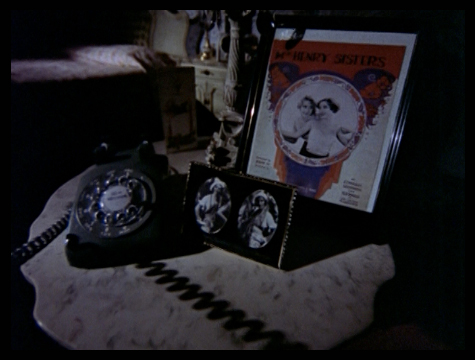
Attention turned to the voice on the phone and consideration was given to whether itMacHenry sisters was more than one voice, or whether the stalker was meant to be schizophrenic. Sarah brought up two points. Firstly, whether Billy was related to the Sorority mother, as in the attic were photos of her and her sister. Secondly, whether there was a vaudeville connection (and related to the multiple voices) as the photos (as well as the comments made by Mrs Mac) indicated to a life on stage.

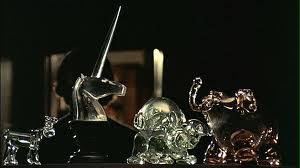
All commented on how well constructed the film was and some admired the linking between scenes – how sound and images were utilised to build continuity between scenes, build suspense and lay suspicion around the different characters, especially the male characters. Some of us mentioned how at different points in the film, our suspicions turned on different characters and this was due to the structure of the film. It was generally agreed that Black Christmas is a genuinely creepy film, especially the image of Clare suffocated in plastic, rocking in the rocking chair while the cat licks her face.

Many thanks to Kat for choosing the film, introducing it and providing the above excellent summary of our discussion.

Do, as ever, log in to comment or email me on sp458@kent.ac.uk to add your thoughts.

Melodrama Screening and Discussion, 12th of February, Keynes Seminar Room 6, 4-7pm

Posted by Sarah

All are welcome to attend the third of this term’s screening and discussion sessions which will take place on the 12th of February in Keynes Seminar Room 6, from 4pm to 7pm.

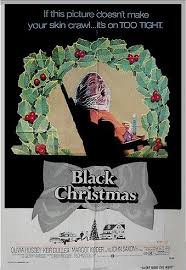
We will be screening Black Christmas (1974, Bob Clark, 98 mins).

Black Christmas

Kat has very kindly provided the following introduction:

Black Christmas (also released under the titles Silent Night, Evil Night, and Stranger in the House) is a 1974 Canadian independent horror film directed by Bob Clark and written by Roy Moore. It stars Olivia Hussey, Keir Dullea, Margot Kidder, Andrea Martin, Marian Waldman and John Saxon.

The reason for choosing this film is that it bears the hallmarks of the ‘woman in peril’ Gothic melodrama, only in this film, it is somewhat multiplied to numerous women. There is also an uneasy ambiguity surrounding the men, most notably the character of Peter, as well as the house containing a ‘secret’ within its walls and history.

There has always been speculation as to what the film is based on, and there are two strands of thought. Firstly, that the narrative takes its cue from the urban legend of ‘The Babysitter and the Man Upstairs’, that dates back to the 1960s and involves a babysitter who begins to receive crank calls from a mysterious man who asks her to continually ‘check on the children’.  The second strain of thought is that the source of the film is sorority murders that took place in Quebec around Christmas time in the years prior to the film. However, there is little evidence to establish this claim and Moore died without ever being interviewed on the subject.  However, it is interesting to note that sorority killings occur in the second episode of American Horror Story: Murder House, and these took place within the 1960s and are meant to be based on actual events (although I am not suggesting a link between American Horror Story and Black Christmas).

The Story

Black Christmas 2Originally written by Roy Moore (and re-written by Clark himself), Black Christmas takes place  just before  Christmas break at a large college, where a group of sorority sisters are making plans for one last party before they all head off on holiday. Jessica (Olivia Hussey), the  serious-minded beauty of the group,  isn’t in such a celebratory mood. She’s just found out that she’s pregnant and she’s struggling with whether or not she wants to keep the baby while also dealing with near constant badgering from her temperamental boyfriend, Peter (Keir Dullea), who wants  her to keep the baby and commit to marriage. As Jessica contemplates her future, her friends plan their party oblivious to her plight and to the fact that the night is about to take a very ugly turn. The house begins to get a rash of obscene phone calls, that at first seem like a harmless prank but quickly turn serious as the caller starts to delve into each girl’s personal life and one of the sorority sisters goes missing. When it becomes clear that Jessica is the caller’s primary target, the police place a wire tap in the house only to find out that the real culprit is closer than anyone ever imagined!

The Significance

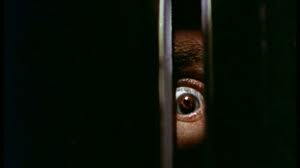
Over the years, the phrase ” the calls are coming from inside the house!” may have become somewhat of a punch line thanks to urban legends about babysitter stalkers  and campy movies like When a Stranger Calls (1979), but back in 1974, Black Christmas established this now seemingly normal horror convention in a way that hasn’t been used quite as effectively since. There’s still some speculation about whether Roy Moore actually based the initial idea for the Black Christmas screenplay on those old babysitter stories, but what is clear is that whatever formula he used  proved influential to many classic horror films that followed. Billy, the film’s main menacing force, roams through the sorority house at will and the audience sees everything through his point of view, a technique that hadn’t been used so effectively  in mainstream cinema up to that point. On the Canadian DVD extras, it’s revealed that although the steadicam wasn’t introduced to filmmakers until 1976, camera operator Bert Dunk created the fluidly roaming “Billy” camera shots by designing a rig that attached to his head – this is especially impressive considering the shot where Billy climbs the trellis outside the house all the way up to the attic. That killer-POV shot went on to become standard in soon-to-be-classic slasher films that followed like John Carpenter’s Halloween (1978) and Friday the 13th (1980) . In fact, many of the Black Christmas eyeelements present in Black Christmas – including its holiday-themed setting and feminist subtext  –  may seem like a cliché when viewed through a present day horror fan lens, but Black Christmas arguably influenced the slasher cycle that began with Halloween and dominated the horror genre in the 1980s and beyond.

Do join us, if you can (and dare!)

Gaslight (1940) Showing at the Gulbenkian Cinema on 9th of Feb

Posted by Sarah

The third film in the Gulbenkian Cinema’s Gothic Season – Thorold Dickinson’s Gaslight (1940) – will screen on Sunday the 9th of Feb at 3pm.

Gaslight UK

The Gulbenkian Cinema’s description of the film:

Thorold Dickinson | UK | 1940 | 82mins | Anton Walbrook, Diana Wynyard, Frank  Pettingell, Robert Newton

A powerful Gothic melodrama of domestic sadism and  psychological suspense, now presented in a sparkling digital restoration. Not  to be confused with George Cukor’s film of the same name – the second  adaptation of novelist/dramatist Patrick Hamilton’s play, and more well-known  until now, as MGM famously tried to suppress the competition – this suspenseful,  stylish classic from Thorold Dickinson (The  Queen of Spades) is an absolute treat.

Diana Wynyard  and Anton Walbrook are Bella and Paul, the young couple settling into a new  house when Bella begins to lose things and becomes fearful when the gaslights  go dim in the middle of the night and she hears footsteps above her head. Fer  husband begins to question her judgement, and Bella herself begins to feel that  her sanity is slipping away. But there is a deception in play – and the key is  in the history of the house itself.

“Walbrook [gives] a brilliant, seething performance” David Thomson, The Guardian

“Sadism propels Thorold Dickinson’s exquisite Victorian  thriller of 1940” Graham Fuller, Artsdesk.com

For more information and to book your ticket please go to:

http://www.thegulbenkian.co.uk/events/cinema/2014/February/2014-02-gaslight.html

Posts on the Melodrama Research Group’s discussion on this film and the Hollywood remake:

http://blogs.kent.ac.uk/melodramaresearchgroup/2013/03/14/melodrama-screening-20th-march-jarman-7-5-7-pm/

http://blogs.kent.ac.uk/melodramaresearchgroup/2013/03/26/melodrama-screening-and-discussion-3rd-april-jarman-7-5-7pm/

http://blogs.kent.ac.uk/melodramaresearchgroup/2013/04/05/summary-of-discussion-on-gaslight/

http://blogs.kent.ac.uk/melodramaresearchgroup/2013/04/05/gaslight-links/

Summary of Discussion on The Wicked Lady

Posted by Sarah

Kat has very kindly provided the following summary of our discussion on The Wicked Lady:

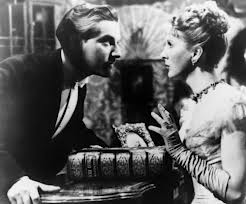
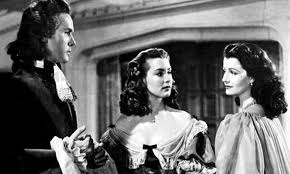
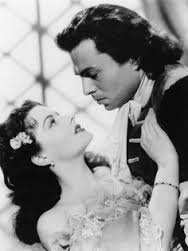
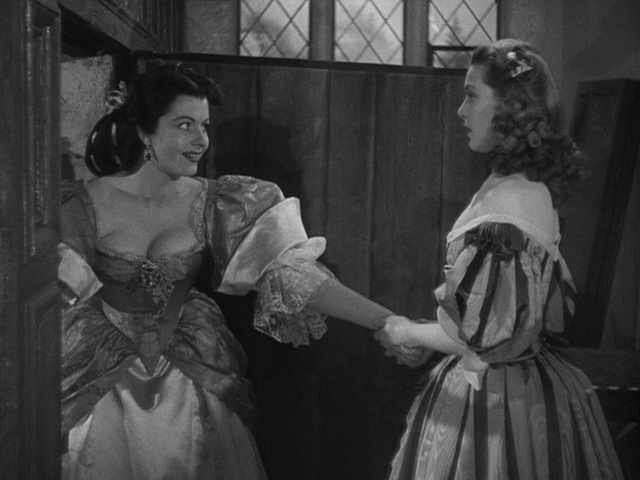
Wicked Lady costumeAfter much expressed delight at this Gainsborough romp, the discussion began with reticence over the time period that the film was representing. Many of us thought the costume, especially the wigs represented differing time periods. Internet searches confirmed the film was set in the Jacobean period. Indeed, it was agreed that the film was not overly concerned with accuracy on period costume. There was a suggestion that Hollywood had requested certain scenes be redone as the line of costumes on the women were too low and showing too much flesh for the Hays Code to approve. As was pointed out in the introduction, both Pam Cook and Sue Thornhill have written extensively on costume, identity and nationality in Gainsborough melodramas. These topics were carried over to the discussion afterwards. Apart from noting the possibility of historical accuracy concerning costume, there was some focus on Margaret Lockwood. Thornhill speaks of how Lockwood’s hair is styled into a vulva shape, and that some of her costumes compliment this phallic design.

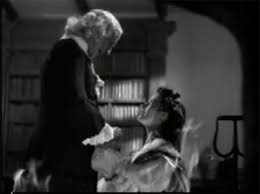
Following from observations of Lockwood’s costume, further discussion focused on Margaret Lockwood’s acting and her character. Lockwood’s haughtiness was decidedly apt and appeared to add to audience identification. There was general agreement between us we would prefer to be Lockwood’s character than Patricia Roc’s. There was vitality to Lockwood’s character which the group found appealing. There was a mention too of a possible reference to war time women, when Lockwood declares she deserves to “do things” as she’s attractive, capable and intelligent. The camera also, rather clumsily at times, focused on Lockwood’s expression whenever an opportunity to kill someone, or undertake an evil deed was presented to her. These shots did appear somewhat heavy handed and caused much laughter in the group. However, one extreme close up of her eyes was a compelling shot. This reference led to further talk two interesting scenes due to their camera work. The first discussed was the scene where Lockwood is kneeling in front of Hogarth seeking forgiveness, by a roaring Wicked Lady firefire. The camera switches to behind the flames, as if in the fireplace. The framing gives the impression of Lockwood already in hell, surrounded by flames. The other unusual shot was when Lockwood’s character is dying and the camera travels backwards, away from Lockwood and out through the window, focusing on the smaller and smaller body of Lockwood. These two shots were the most distinctive in the film.

Lockwood Mason

There was much (delighted) surprise at the bawdiness of the film and many felt that you could sense how The Carry On films came about, that there was a sense of a distinctive Britishness in this film. Many commented on the excessive use of innuendo in the dialogue and how this added to the viewing experience.  Innuendo was prevalent in the exchanges between Lockwood and Mason, who were electric together onscreen and oozed unbuttoned sexuality. All in all, it was universally agreed that this period romp was an excellent screening choice for the group.

Many thanks to Kat for choosing to show this wonderful film, and for the great introduction and summary of discussion.

Do, as ever, log in to comment or email me on sp458@kent.ac.uk to add your thoughts.

Hitchcock’s Dial M For Murder (1954) Showing at Gulbenkian Cinema on 1st of Feb

Posted by Sarah

The second film in the Gulbenkian Cinema’s Gothic Season – Alfred Hitchcock’s Dial M For Murder (1954) – will screen on Saturday the 1st of Feb at 2.30 pm.

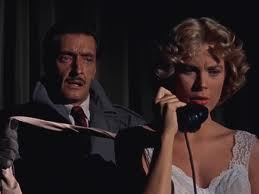
Dial M

The Gulbenkian Cinema description of the film:

Alfred Hitchcock | US  | 1954 | 105mins | Ray Milland, Grace Kelly, Robert Cummings

Originally shot in 3D and newly remastered and restored,  Alfred Hitchcock’s screen version of Frederick Knott’s stage hit Dial M for Murder is a tasty blend of  elegance and suspense casting Grace Kelly, Ray Milland and Robert Cummings as  the points of a romantic triangle.

Kelly won the New York Film Critics and National Board of  Review Best Actress Awards for this and two other acclaimed 1954 performances.  She loves Cummings; her husband Milland plots her murder. But when he dials a  Mayfair exchange to set the plot in motion, his right number gets the wrong  answer – and gleaming scissors become a deadly weapon. Dial “M” for  the Master of Suspense at his most stylish.

“Alfred  Hitchcock’s 1954 thriller is a precision-engineered delight” – The Telegraph

For more information and to book your ticket please go to:

http://www.thegulbenkian.co.uk/events/cinema/2014/February/2014-02-dial-m-for-murder.html

Melodrama Screening and Discussion, 29th of January, Keynes Seminar Room 6, 4-7pm

Posted by Sarah

All are welcome to attend the second of this term’s screening and discussion sessions which will take place on the 29th of January in Keynes Seminar Room 6, from 4pm to 7pm.

We will be screening The Wicked Lady (1945, Leslie Arliss, 104 mins).
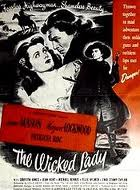
wicked Lady poster


Kat has very kindly provided the following introduction:

The Wicked Lady is a 1945 film starring Margaret Lockwood and James Mason. Known as one of the Gainsborough melodramas, it is reputed to have one of the largest audiences of its period, 18.4 million. The story itself was based on the novel, The Life and Death of the Wicked Lady Skelton by Magdalen King-Hall, which in turn, was based upon the (disputed) events surrounding the life of Lady Katherine Ferrers.

Synopsis

Margaret Lockwood stars as 17th century beauty, Barbara Worth, who steals and marries her best friend’s intended bridegroom, local magistrate Sir Ralph Skelton. At their wedding reception, Barbara meets Kit Locksby. For both, it is love at first sight, but too late as Barbara is now married. As Lady Skelton, she soon bores of rural life and seizes the opportunity to become a highwayman in order to win back her jewels from her sister-in-law, Lady Henrietta Kingsclere. Addicted to the excitement, Lady Skelton continues in her escapades and meets and joins forces (personally and professionally) with fellow highwayman, Capt Jackson. Through murder, robbery and betrayal, Lady Skelton’s double life catches her with her and she is mortally wounded by Kit Locksby. Dying, she confesses all to Kit and asks him to stay with her as she dies. However, appalled and repulsed by the truth, he withdraws, leaving her to die alone.
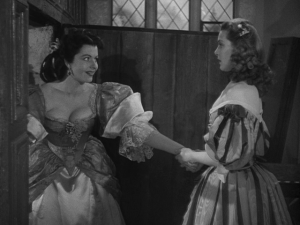
Lockwood Roc Wicked LadyIt is reported that due to issues with the American censors, extensive re-shooting was required before the film was released in the United States. The problems concerned the women’s dress bodices, which were considered low-cut and allowed too much cleavage to be displayed, and therefore unable to meet the requirements of the Hays Code.


The Gainsborough Melodramas

Despite producing a variety of genre films throughout its twenty-five year existence, the Gainsborough studio became synonymous with melodramas, in much the same way as Ealing studios did with comedies. The Gainsborough melodramas were a sequence of films produced by the British film studio Gainsborough Pictures during the 1940s. This cycle of films often touched upon similar themes and frequently starred recurring actors who played similar characters in each film, such as Stewart Granger, Phyllis Calvert, Margaret Lockwood and James Mason.

The first film of the cycle, The Man in Grey, appeared in 1943. Starring both James Mason and Margaret Lockwood, it was based upon the novel of the same name. Its success led to a number of similar films being produced, often based upon on melodramatic period novels, such as, The Wicked Lady (1945), Fanny by Gaslight (1944) and A Place of One’s Own (1945). The films dominated the British box office, grossing top Hollywood productions in the UK. It has been argued that much of their appeal was in their overt escapism at a time when the Second World War was still being fought. However, the popularity of the cycle peaked in the immediate post-war years and the production of the melodramas continued until 1950. At the height of the melodramas’ popularity, both James Mason and Margaret Lockwood were respectively voted the most popular British male and female actors.
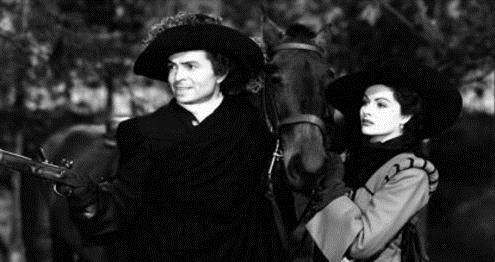
Mason Lockwood Wicked Lady


Focusing on the handful of period costumes romances produced by Gainsborough at this time, Pam Cook argues that although these films were rediscovered in the 1980s by film historians, the films remain largely ‘marginalised, ignored or subsumed into the consensus in discussion of national identity in British cinema’ (Cook, 1996). Even at the time of its release, Cook notes derision in some quarters. Simon Harcourt-Smith writing in Tribune said of the film, ‘…if the future of the British film industry hangs…on the success of The Wicked Lady, then let us dispense with that future.’ (Aspinall and Murphy, 1983, p74). Cook suggests that this critical neglect is due to how the costume and visual style, the representation of history and their mobilization of national identity contravened official strictures and versions of femininity.  Furthermore, Cook argues that costume romances are at the less reputable end of the historical film genre. Where ‘heritage’ historical films would celebrate the past, costume romances such as the those produced by Gainsborough, mobilize a British past of promiscuity, injustice and inequality, ‘a locus of crisis and conflict as well as sensual pleasure’ (Cook, 1996).

Cook also extends the films’ questionable representation of the past extends to costume and mise-en-scene. Sue Harper points out that visual codes in the costume romances have their own language, which often works against the ‘moralistic trajectory of the script’, creating a tension between spectacle and narrative (Harper, 1983: 1994). For Harper, spectacle plays a positive role in costume drama as the carrier of coded meanings which express the powerful status of femininity, overriding the narrative drive to disempower transgressive female protagonists.

As Pam Cook states, ‘Audiences leaving a screening of The Wicked Lady were more likely to remember the stunning image of a fetishized Margaret Lockwood dressed in highwayman gear astride a stallion than to take on board the moral implications of her punishment by death’ (Cook, 1996).

Cook, P. (1996) Fashioning the Nation. London: BFI Publishing.

Harper, S. (1983) ‘Art Direction and Costume Design’, in S. Aspinall and R. Murphy (eds) BFI Dossier 18: Gainsborough Melodrama. London: BFI Publishing, p 40-52

Harper, S. (1994) Picturing the Past: The Rise and Fall of the British Costume Film. London: BFI Publishing.

Do join us, if you can, for some classic British melodrama.
Summary of Discussion on The Hours

Posted by Sarah

Rosa has very kindly summarised our recent discussion on The Hours (2002):

The topics that were discussed after the screening were the essential ones mentioned in the previous introduction: music, costume, narrative and performance in (domestic) melodrama.

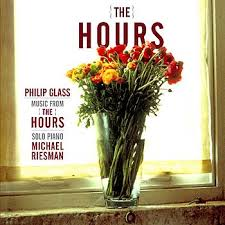
The Hours Glass soundtrackThe original soundtrack, composed by Philip Glass, shows the importance of music, both in this film and in melodrama in general, as an element that supports the narrative as well as being powerful enough to stand out independently. Stephen Daldry, the director, talked about it at length in an interview (DVD extras) and highlighted how the repetition of the same theme over and over again makes the tension stronger in important points of the movie and helps bringing together all three stories, by mainly using the same piano theme.

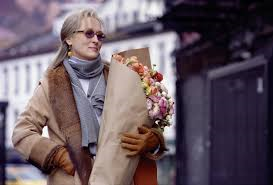
Clarissa Vaughan flowersIn melodrama, costume and décor are crucial, and this film is an extraordinary example of a magnificent use of such resources. It is impossible not to link the initial sentence of the book Mrs. Dalloway, “Mrs.Dalloway said she would buy the flowers herself”, with the multiple patterns, prints and real flowers that from the very beginning of the film flood the screen. They are in the outfits, accessories, robes and dressing gowns of the female protagonists, the ties of the male characters, the wall paper- mainly in the 50s section of the film, there are fresh flowers in every household, a flower shop and a few scenes shot on location in Richmond’s gardens and parks. Katerina pointed out the dual meaning of flowers, which is quite applicable in this film: the ephemeral quality of them is an allegory of life/love, main themes of the story.

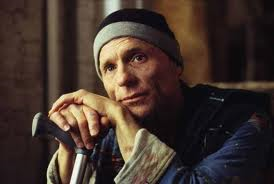
In the The Hours Richard's robesame way as characters are connected by music, flowers and scenography, colours and prints in the outfits give away messages that we are able to read and understand as the film goes by, bringing all characters together once more. There is a hidden and less obvious case, very cleverly placed within the storyline: Richard (Ed Harris) wears a blue robe with some kind of solar system pattern which happens to be the same fabric as the covers in little Richie’s bed back in the 1950s. If you are able to uncover the meaning of this double use of the same material, you will then be able to predict the end before the film finishes. Jane Gaines (“Costume and Narrative: how dress tells the woman’s story.” Fabrications: costume and the female body (1990): 180-211.) asserts that the costume should not anticipate the narrative plot, but on this occasion dialogue and wardrobe do give us hints of what will happen in the scenes to follow. Clarissa Vaughan says she has a premonition and in the next seen we see her wearing black, which we then learn was an anticipation of the death by suicide of her friend and ex-lover Richard. She wears an orange scarf over her total-black outfit, which could be a visual recourse in order to add definition to the silhouette or, reading more into the symbolism in this film, could express change or mutation, a generally accepted meaning of the colour orange.

Ann-Marie pointed out that it would have not been necessary to indicate in which period and place each story takes place, as the set and costumes are so significant, different and remarkable of each of the three stories, we are perfectly able to identify them. We compared it with how the book is organized and how in a written piece, it is necessary to specify more. In classical melodrama, as mentioned above, costume plays a very important role and this film is able to take us back to the original concept because of its richness in meaning and very intelligent use of the wardrobe. The contemporary part of the film is supported by the other two and all of them work together in a great way.

Thank you all very much for your participation and your very interesting comments!

And many thanks to Rosa for choosing such a rich film for us all to enjoy.

Do, as ever, log in comment or email me on sp458@kent.ac.uk to add your thoughts.

Hitchcock’s Rebecca (1940) showing at the Gulbenkian on the 26th of Jan

Posted by Sarah

As mentioned earlier on the blog, the Gulbenkian Cinema, located on the University of Kent campus, is screening a series of Gothic films between January and March.

The first is Alfred Hitchcock’s Rebecca (1940) on the 26th of January at 2.30 pm.

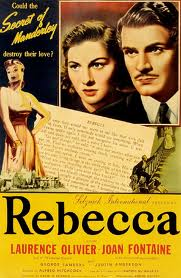
Rebecca poster

The Gulbenkian Cinema description of the film:

Alfred Hitchcock | US | 1940 | 130mins | Laurence Olivier, Joan Fontaine, George Sanders, Judith  Anderson

Alfred Hitchcock’s superlative psychological thriller  adapts Daphne du Maurier’s haunting tale of a naive young woman (Joan Fontaine)  who meets handsome, aristocratic widower Maxim de Winter (Laurence Olivier) on  holiday in Monte Carlo and is swept off her feet by his whirlwind courtship.

Following their wedding, they move to his Cornish estate Manderley, where the  brooding Maxim once lived with his first wife, Rebecca, and where sinister  housekeeper Mrs Danvers (Judith Anderson) who is fiercely devoted to the memory  of her dead mistress, undermines Maxim’s new wife at every turn.

A beautifully  nuanced study in guilt and anxiety about sex, money and class, Rebecca continues to hold audiences  spellbound with its beguiling blend of lush romanticism and bleakly oppressive  suspense.

“A gorgeous treat from one of cinema’s masters. Not to be  missed.” Peter Bradshaw, The Guardian, 5  stars

“Tense, engrossing and deliciously deceitful.” David Parkinson, Empire Magazine

For more information and to book your ticket please go to:

http://www.thegulbenkian.co.uk/events/cinema/2014/January/2014-01-rebecca.html

Melodrama Screening and Discussion, 22nd of January, Keynes Seminar Room 6, 4-7pm

Posted by Sarah

All are welcome to attend the first of this term’s screening and discussion sessions which will take place on the 22nd of January in Keynes Seminar Room 6, from 4pm to 7pm.

We will be screening The Hours (2002, Stephen Daldry, 114 mins).

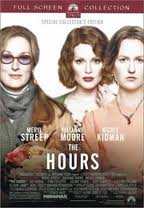
the hours

Rosa has very kindly provided the following introduction which includes some fantastic photographs of some of the costumes:

The Hours (2002) will probably be remembered by the general audience as the film where Nicole Kidman sported a prosthetic nose to play the role of Virginia Woolf –  and for which she gained an Oscar. Nevertheless, it is a truly moving domestic melodrama where feeling identified in some way seems inevitable. Directed by Stephen Daldry and cleverly based on the homonymous novel written by Michael Cunningham, it is the story of three different generations of women living in three different times and places (Richmond, 1923, Los Angeles, 1951 and New York, 2001), but who have many similarities that we can gather from the very first scene. A writer, a reader and a character- Virginia Woolf (Nicole Kidman), Laura Brown (Julianne Moore) and Clarissa Vaughan (Meryl Streep) – are connected by the book Mrs. Dalloway, written by Woolf in the 1920s. As we will learn as the plot unfolds, the link between them goes beyond the expected, surprising us with a narrative twist and showing that each story could not be without the others.

To learn more about Michael Cunningham, the novel and the adaptation of it to screen, I suggest this article written by Cunningham and published a year after the film was released.

http://www.nytimes.com/2003/01/19/movies/my-novel-the-movie-my-baby-reborn-the-hours-brought-elation-but-also-doubt.html?pagewanted=print&src=pm

It analyses the process of creating a character for a book and how, once this piece becomes a screenplay, actors have to bring the characters to life, using various devices: data extracted from the written works, their own instinct, inspiration that can come from a small costume prop or through the transformation after the hair and make-up team have done their job, thinking how the character would behave beyond the story, etc. I suggest paying attention to performance and those details that help us understand the personal drama each of the characters is going through, within the confined spaces of their homes and routines.

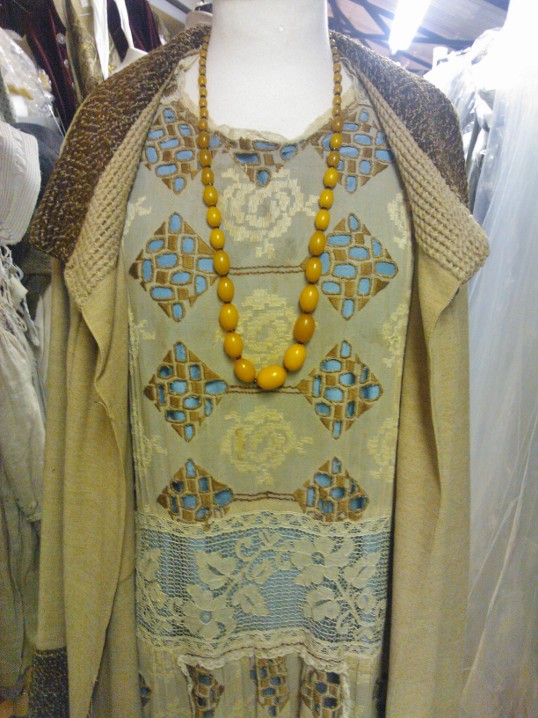
The  film  received  nine  Oscar nominations and excellent reviews but award-winning designer Ann Roth  did  not  get  the  statue  for  Best  Costume  Design  as  the competition that year  was very strong and far more spectacular. Chicago,  The  Pianist,  Frida  and  Gangs  of  New  York  had  some elements  that  The  Hours  did  not  have,  such  as  the  quantity, extravagance  and  luxuriance  of  costume. The wardrobe that Roth created was accurate and straightforward; the nature of the script WP_003209 (1)required a variety of styles and periods but with no apparent opulence, so it could seem simplistic at first sight. However, the costumes were full of symbolism and hidden messages, a perfect example of how the costume plot has an independent language and, in this particular case, a very abundant one. Giving each character a thorough look and jointly with the rest, the richness of meaning is impressive. If costume represents interiority, there is no better example than this  one,  where  each  outfit shouts  something in silence – as Virginia, Laura and Clarissa do.

I would like to draw your attention to the colours and patterns that we see within the life of each character, both in costume and in décor. Every single costume change and scenography in each of the stories has a twin in the others, so I challenge you to find the connections and possible meaning of these repetitions.

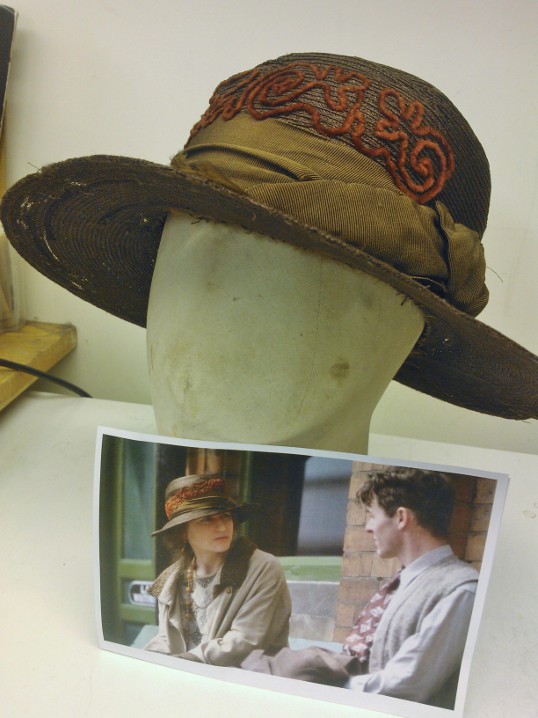
WP_003239 (1)Some of the costumes for Nicole Kidman were hired and made at Cosprop, one of the world´s leading costumiers for theatre and screen, based in London. As you will see from the pictures provided, the state of hat and clothes was not perfect, but this fits the mentally disturbed Virginia, who, despite following the trends, would not worry too much about her looks. We also do not perceive stains and repairs on screen, so the outfit worked perfectly well for actress, designer and spectator.

Finally, and probably most importantly for this group, we have to talk about melodrama in The Hours. I thought the article “The Times of The Hours: Queer Melodrama and the Dilemma of Marriage”, by Julianne Pidduck (http://melodramaresearchgroupextra.wordpress.com/)  would explain this far better than I would, although it gives away a lot of information regarding the plot and could spoil the screening. Here is an abstract if you would like to avoid reading the article for this matter:

http://cameraobscura.dukejournals.org/content/28/1_82/37.abstract

As Stephen Daldry said in an interview “the (book) film celebrates life with all its complexities, life is the most powerful thing we have”. So I hope you enjoy watching The Hours as much as I do and come out of the screening full of hope and inspiration for life.

Always the love. Always the hours.

Do join us, if you can for the screening of a wonderful film and some great insider knowledge!

Gone With the Wind (1939) screening at the Gulbenkian Cinema on Sunday 12th of January

Posted by Sarah

The Gulbenkian Cinema, located on the University of Kent’s Canterbury campus, is screening the classic Hollywood melodrama Gone With the Wind (1939) on Sunday the 12th of January from 1.30 pm – 5.30 pm.

gone with the wind

The following is from the Gulbenkian Cinema’s website http://www.thegulbenkian.co.uk/events/cinema/2014/January/2014-01-gone-with-the-wind.html where you can also book your ticket.

Victor Fleming | USA | 1939/2013 | 233mins | Clark Gable, Vivien Leigh, Thomas Mitchell

Often considered the greatest films of all time – the pinnacle of polished Hollywood storytelling – this truly epic screen adaptation of Margaret Mitchell’s seminal work of American literature bristles with energy and passion and demands to be seen on the big screen following a 4K digital restoration.

It is 1861 on a palatial Southern estate, where Scarlett O’Hara (Leigh) hears that her casual beau Ashley Wilkes (Leslie Howard) plans to marry Melanie Hamilton (Olivia de Havilland). Despite warnings from her father (Thomas Mitchell) and her faithful servant Mammy (Hattie McDaniel), Scarlett intends to throw herself at Ashley at an upcoming social event. Alone with Ashley, she goes into a fit of histrionics, all of which is witnessed by roguish Rhett Butler (Clark Gable), the black sheep of a wealthy Charleston family, who is instantly fascinated by the feisty, thoroughly self-centred Scarlett…

“It’s impossible not to be carried away by the rich arterial force of this storytelling.” Peter Bradshaw, The Guardian

Tickets: Full £7.50 / Concessions £6.50/ GulbCard Members £5.50 / Students £4.50 / GulbCard Students £4

This will be a great opportunity to see a beautifully restored version of the film on the big screen.