Author Archives: Tim Davies

Brexit

Update on Brexit deadline extension

At a summit on Thursday 10 April, the European Union and UK Government have agreed to extend the Brexit deadline to 31 October 2019. This means that the UK will remain part of the EU until that date, unless the Government is able to secure a deal beforehand.

The University’s Brexit Working Group, led by Jeremy Carrette, Dean for Europe, has been meeting for a number of months to prepare for Brexit, prioritising our response in the event of ‘No Deal’ with the EU. This group will continue to work on the various possible outcomes to ensure that – whatever happens – we are well prepared and are doing all we can to minimise disruption to our work. This will include long-term planning for Brexit to ensure continuity of relationships across Europe for teaching and research.

We will continue to update students and colleagues as the situation unfolds. There is more information on settled status, travel and other issues on the Brexit webpages:

http://www.kent.ac.uk/brexit

If you have any further questions about what this could mean for you, please contact one of the following:

For Students: studentEUqueries@kent.ac.uk

For Staff: staffEUqueries@kent.ac.uk
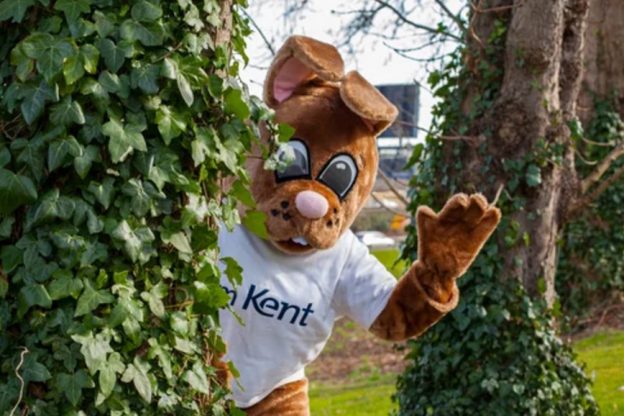
Kent Bunny

Kent Bunny gives back

This Easter, Kent Bunny will be delivering chocolate eggs to Medway hospital children’s ward. We are asking you to help us do this by donating eggs for us to deliver. You can do this by:

💻Going to our Amazon Wishlist and select one of our eggs to purchase.

This will be sent directly to us for Kent Bunny to deliver. https://www.amazon.co.uk/hz/wishlist/ls/5FJ3TK8DELGA/

🏢 Or buying chocolate eggs and dropping them off to us on the Canterbury campus.

Come to Development Office, University of Kent

Room G17, Rutherford Annexe

Canterbury, Kent, CT2 7NX, UK

As the University mascot, Kent Bunny likes spreading cheer around the University and wider community and he would love your help to do this!

Natalia Sobrevilla Perea

Natalia Sobrevilla Perea on abolishing the army in Costa Rica

Natalia Sobrevilla Perea, Professor of Latin American history for the Department of Modern Languages, has recently appeared on the BBC’s Writing History programme in an episode entitled ‘Abolishing the army’.

The programme, presented by Mike Lanchin, considers the example of Costa Rica dissolving its Armed Forces after a brief civil war in 1948. After a brief civil war in March-April 1948, the new president of Costa Rica, Jose Figueres, took the audacious step of dissolving the Armed Forces. Since then Costa Rica has been the only Latin American nation without a standing army. Listeners heard from 94-year-old Enrique Obregon, who served in the military before its dissolution.

On the programme, Natalia commented that: ‘The narrative was that the military was not needed, that the more effective way would be through internal policing. That was a very radical move. [Costa Rica] didn’t really have a very big army to begin with, so it was easier than it would have been in other places… and it was couched in this language of inclusion, modernisation and democracy.’

Jo Stoner

Jo Stone on The Cultural Lives of Domestic Objects in late antiquity

Dr Jo Stoner, Research Associate in the Department of Classical and Archaeological Studies, has published a new book entitled The Cultural Lives of Domestic Objects in Late Antiquity (Brill, 2019).

In her book, Jo investigates the role of domestic material culture in Late Antiquity. Using archaeological, visual and textual evidence from across the Roman Empire, the personal meanings of late antique possessions are revealed through reference to theoretical approaches including ‘object biography’. Heirlooms, souvenirs, and gift objects are discussed in terms of sentimental value, before the book culminates in a case study reassessing baskets as an artefact type. This volume succeeds in demonstrating personal scales of value for artefacts, moving away from the focus on economic and social status that dominate studies in this field. It thus represents a new interpretation of domestic material culture from Late Antiquity, revealing how objects transformed houses into homes during this period.

This book is based upon Jo’s PhD thesis, produced at the University of Kent, as part of the research project The Visualisation of the Late Antique City (2011–2014), funded by the Leverhulme Trust, for which Luke Lavan was Principal investigator and Ellen Swift Co-investigator.

ProgressProfile_news

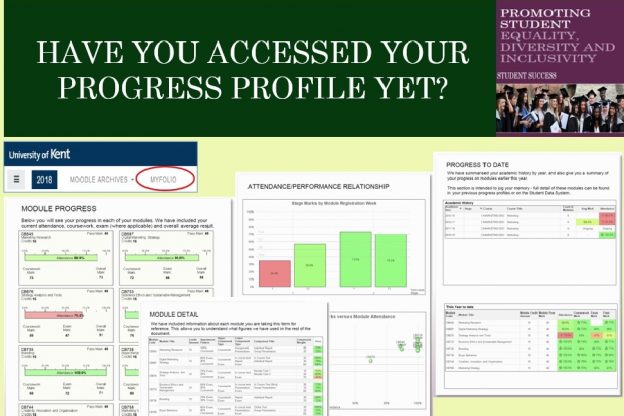
Have you accessed your Progress Profile yet?

What are they?

Progress Profiles are an information sheet produced for students that show you personalised progress and attendance information. They are produced regularly throughout the academic year for all undergraduate students. Progress Profiles show SDS information in a simplified, graphical way making it easier for you to spot anomalies and identify possible areas for improvement, especially when revising for exams. They are also a great starting point for any discussions you have with your Academic Adviser so you can make the most of your contact time with them.

Where are they?

Your current and all previous Progress Profiles can be found on MyFolio. Simply click the ‘MyFolio’ link at the top of your Moodle page and follow the link to Progress Profiles.  Progress Profiles can be viewed, saved or downloaded as required.

Where can I find more information?

For more information about Progress Profiles go to

https://www.kent.ac.uk/studentsuccess/progressprofiles.html

or email studentsuccessproject@kent.ac.uk

Prof Helen Carr

Kent housing law expert speaks to UK policymakers about building regulations

Kent housing law expert Professor Helen Carr has spoken to key UK policymakers at a seminar addressing the future for building regulations in England.

The seminar provided an opportunity to assess the most effective ways forward for improving the safety and standards of buildings in England. In her talk, Professor Carr, whose research interests centre on housing, homelessness and social justice, addressed current building regulations and the priorities going forward.

Among the speakers at the seminar, organised by the Westminster Social Policy Forum, were Clive Betts MP, Chair of the House of Commons Housing, Communities and Local Government Select Committee.

Delegates discussed the Government’s plan to support the development of a more effective regulatory and accountability framework as called for by the Independent Review of Building Regulations and Fire Safety led by Dame Judith Hackitt. They considered what more should be done to implement an effective testing and inspection regime for residents of high-rise buildings and discussed the Government’s ban on combustible materials (and whether it should also apply to non-residential buildings such as hospitals, hotels and student accommodation.)

Among more than 220 attendees were senior government officials, representatives of citizen groups, local authorities, campaigning organisations, businesses and their advisors and social and academic commentators, together with reporters from the national and trade media.

Professor Carr is interested in how law regulates those who are marginal to housing and property. She sits as a part-time judge with the First Tier Tribunal (Property) Chamber and is currently a member of a Civil Justice Council working group on property dispute resolution. She has worked with the Welsh government on proposals to reform housing law and the Renting Homes (Wales) Bill is currently going through the National Assembly.

Calendar

You can now record TOIL in Staff Connect

Following feedback from staff groups, new functionality has been added to Staff Connect and you are now able to record time off in lieu (TOIL) earned and taken in the system. This replaces individual TOIL management systems such as e-Days, spreadsheets or Outlook and provides as consistent way of recording absence across the University.

TOIL balances in Staff Connect are kept separate from annual leave entitlements. For Staff in grades 1-6 TOIL can be earned by the hour. For Staff in grades 7 and above, TOIL should be earned in half day or full day blocks. For all staff TOIL should be taken in half day or full day blocks. More guidance on the use of TOIL can be found in the Overview for Managers and there are employee and manager user guides available.

The introduction of the recording of TOIL in Staff Connect fits with the project’s aim to streamline our HR processes and provide employees and managers with a one-stop-shop for most HR-related activity. It supports the principles of Simplifying Kent in reducing duplication of systems with their associated costs and effort.

Autism Arts Festival

The School of Arts and Gulbenkian are hosting the second biennial Autism Arts Festival to be held on campus from Friday 26 April to Sunday 28 April 2019.

This year’s festival features a mix of performances, screenings and events. The festival will start on the Friday with a comedy double bill featuring Robert White, a Britain’s Got Talent 2018 finalist, and Kate Fox, star of BBC Radio 4’s The Price of Happiness.

Then, on the Saturday and Sunday, the festival will include a range of performances, screenings and events, including Sensory Circus by FEEL Theatre, #BinariesBeGone by Emma Selwyn as well as The Derek Paravicini Quartet and an all-night Avengers movie marathon.

The festival will also include an exhibition in the Studio 3 Gallery, curated by the WEBworks collective, and a programme of literature events with speakers including Katherine May, author of The Whitstable High Tide Swimming Club and The Electricity of Every Living Thing.

Dr Shaun May, Senior Lecturer in the Department of Drama and Theatre, who said: ‘The festival aims to be both a celebration of autistic creativity and an attempt to develop the idea of a relaxed performance more fully to create an entire festival that’s as accessible to neurodivergent people as possible.’

For more information and links to events bookings, please see the Festival’s webpage here: https://autismartsfestival.org/

School of Psychology Annual Lecture 2019

‘Rehearsal and the development of verbal short-term memory’ – Professor Chris Jarrold

University of Kent staff and students and the general public are invited to attend our Annual Lecture, which is to be held on Wednesday, 22 May 2019.   The talk will begin at 3pm in Keynes Lecture Theatre 4 (KLT4) and be followed by a drinks reception in Keynes Atrium Foyer at 4pm.  If you would like to attend this event please email psychannuallecture@kent.ac.uk by 15 May 2019.

The title of the talk is “Rehearsal and the development of verbal short-term memory” and it will be given by Chris Jarrold, Professor in Cognitive Development, School of Psychological Science, University of Bristol.

Abstract

Verbal short-term memory (VSTM) undoubtedly improves across childhood and is thought to support children’s acquisition of vocabulary and other academic abilities. Understanding the causes of VSTM development is therefore of both theoretical and practical importance. An influential view is that apparent changes in VSTM capacity reflect change in the use of rehearsal to support performance. However, in this talk I critique that position, before putting forward a radical reassessment of the status of rehearsal. I focus in particular on the claim that children undergo a qualitative change in their use of rehearsal around the age of 7. Here I show that key evidence to support this view can instead be explained by general improvements in memory capacity, review data showing gradual improvements in the strategic use of rehearsal in children, and develop the implications of my account for neuropsychological cases where VSTM is compromised.

Brief biography

Chris Jarrold is Professor in Cognitive Development and Head of the School of Psychological Science at the University of Bristol (http://www.bristol.ac.uk/expsych/people/christopher-r-jarrold/index.html).  He is a world-leading expert on cognitive development, especially on the processes that support goal-directed behaviour and the maintenance of information in immediate memory, among both typically and atypically developing children.  His work has been funded through numerous research grants, and has had a significant influence on both theory development and educational practice, leading to him receiving prestigious early- and mid-career awards from the British Psychological Society and Experimental Psychology Society.

The talk is being hosted by David Williams, Professor of Developmental Psychology, University of Kent.  We would be delighted if you are able to join us for the talk.

A Roman adventure for students in Classical and Archaeological Studies

Students in the Department of Classical & Archaeological Studies at Kent were thrilled last month by a four-day trip to the Greek and Roman ruins of Campania and Rome. Undergraduates in Ancient History and Classical & Archaeological Studies, led by Dr Luke Lavan, and postgraduates on the MA in Ancient History and Archaeology at the University’s Rome School of Classical and Renaissance Studies, who are in Rome throughout the Spring term under the direction of Dr Christopher Burden-Strevens, were introduced to some of the best that Roman Italy has to offer.

Luke Lavan is an expert in the archaeology of Roman Italy and, as the Director of the Centre for Late Antique Archaeology, has run excavations at Ostia, the most important harbour city of ancient Rome, as well as other sites in Italy. Christopher Burden-Strevens is a specialist in the history and history-writing of the Roman Republic. Uniting these two approaches – archaeology and ancient history – students had an action-packed four days exploring sites both famous and unfamiliar, some of which are normally closed to the public.

The week started with Pompeii, an exceptionally well-preserved settlement whose origins go back to the Greek colonisation of the southern Italian coast in the Archaic Era, then travelled to Paestum. Students ended their rich and full week with an excursion to Ostia, Rome’s ancient port at the mouth of the Tiber, followed by a visit to the ancient heart of the Roman Empire itself: the Roman Forum. where Christopher Burden-Strevens met with MA students from Kent’s Paris School of Arts and Culture to talk them through the history of the Forum as a political space.

Christopher Burden-Strevens said: “four days of constant activity in Campania and Rome is only possible thanks to the enthusiasm and thirst for knowledge of Kent’s undergraduates in Ancient History and Classical & Archaeological Studies and our postgraduates in Ancient History and Archaeology in the city of Rome, and the dedication of the academics who teach them. To teach the history of Roman – and indeed pre-Roman – Italy in the lecture theatre is a pleasure. But to teach it on-site for days on end, in the company of students who have such passion for their subject that they give themselves over to Rome for almost a week—that’s really a privilege. It was an absolutely fantastic four days, and I can’t wait for next year”.

Kent goes to Italy: Pompeii and Paestum

Kent goes to Italy: Ostia and Rome