HR GO partnership to revolutionise UK recruitment with AI

HR GO, one of the UK’s leading recruitment companies, and the University of Kent have been successful in a joint application for a knowledge transfer partnership (KTP) from Innovate UK, the UK’s innovation agency. 

The award for £93,177 will provide half the cost of a two-year research project exploring how technology can better match roles with clients, including improving the feedback job seekers receive. HR GO will match fund the grant, resulting in a total project budget of £186,350.  

KTPs aim to help businesses to improve their competitiveness and productivity through the better use of knowledge, technology and skills within the UK knowledge base.  

John Parkinson, Chief Information Officer, HR GO, said: “We are delighted to have been successful in our application to UKRI for a knowledge transfer partnership (KTP) with the University of Kent. 

“This project will develop innovative AI models and systems to deliver feedback, scoring and matching of candidates at scale. At present, we receive over 500,000 applications for work each year for roles across all sectors, and across the whole of the UK.

“These AI models will power a semi-automated communications process to deliver enhanced feedback to candidates whilst helping HR GO’s clients ensure they find the best possible candidates to meet their needs. 

The project team is now in the process of hiring an associate, who will be delivering the project over the two years. In addition to being tasked with analysing millions of points of HR GO data, they will consider all aspects of machine learning and AI development, from ethics to avoiding bias.  

Dr Anna Jordanous, senior lecturer at the University of Kent’s School of Computing and co-lead of the project said: “This is a fascinating opportunity to work with complex real-life data. There are multiple interesting technical challenges to tackle, and it is exciting to see how research knowledge can be applied to make a real difference to recruitment candidates and clients.” 

HR GO has previously worked with Dr Jordanous to review potential machine learning solutions which could be deployed to automate contractor candidate role matching, as well as having sponsored the Kent HR Network and offered placements for students through the University of Kent’s Employability Points Scheme. 

man looking at laptop in the Templeman library

Learnings from taking part in TASO’s Summer School Evaluation

The University of Kent’s Year 10 ‘Breaking Barriers’ Summer School was involved in the TASO research project to evaluate the impact of virtual summer schools. As TASO publish the interim findings, it provides us with an opportunity to reflect on what we learnt from taking part in this research project and lessons for the sector.

Developing our outreach curriculum

This research project gave us the opportunity to speak to a group of students that we considered to be highly impacted by the pandemic. A number of findings from the Implementation and Process Evaluation (IPE) made us think about how we can adjust our outreach curriculum to accommodate these students (and their influencers), and consider whether they are unique or enduring circumstances.

Despite only being in Year 10 and therefore a few years away from having to make decisions around HE, the students were clear that access to mental health support would be an important factor to them when deciding on university. Perhaps this is due to poor mental health being exacerbated by the pandemic and it’s something that we had already started to consider in activities designed for younger audiences. These findings helped to re-enforce that it was the right direction to go in.

Many of our talks designed for parents focus around student finance and funding, but the parents and guardians that we spoke to worried about their young person’s grades being a barrier to them accessing and succeeding at university. This may be due to the interrupted education their young person has experienced and something worth exploring in our curriculum design for this audience.

One of the key motivators for students taking part in the summer school was just for ‘something to do’; a way to spend their summer –

“Because it’s the Summer and I feel like if I hadn’t have done this, I would’ve wasted my time and not done anything else. So, this feels really productive”

That was something that as an institution we hadn’t considered (or perhaps wanted to consider!) before but we don’t yet know if it’s specific to this cohort – after having 2 years of interrupted study perhaps they’re motivated to do something productive. That’s something that will be interesting to explore this year and going forward.

We would have offered a virtual summer school in 2021 irrespective of our involvement in the TASO research project but it is reassuring that students agreed they had met each of the aims that we had set for the activity and that it did have a positive impact on them. We’ve now been able to adapt this content for in-person delivery this year.

Randomised Control Trials (RCTs) in outreach evaluation

One of our motivations for taking part in this research was because we were interested in the RCT process as a means of being able to demonstrate causality, but reluctant to do it ourselves. Having the support of TASO and the other partners was a real positive influence on our decision to apply. Although the Behavioural Insights Team (BIT) performed the randomisation and selection of participants, the prospect of running an RCT as an evaluator is less daunting than it was before. There are few other outreach programmes in our curriculum that are suitable for this method of evaluation but we will definitely be exploring more Type 3 methods going forward.

The project also allowed us to have additional communication with the control group. Where previously our last communication with unsuccessful applicants was to tell them that they hadn’t got a place, this gave us an opportunity to get in touch with them again and let them know that we wanted to hear from them, and that we valued their thoughts and their opinions. We were able to leave it on a positive note, and we were pleasantly surprised with the response rate.

We look forward to the final research findings once we know whether these students applied to and enrolled in Higher Education or not and can see any differences between the control and treatment groups and any impact that may summer schools had.

Amy Burt, Monitoring & Evaluation Officer, University of Kent

Get involved in the Kent HR Conference 2022

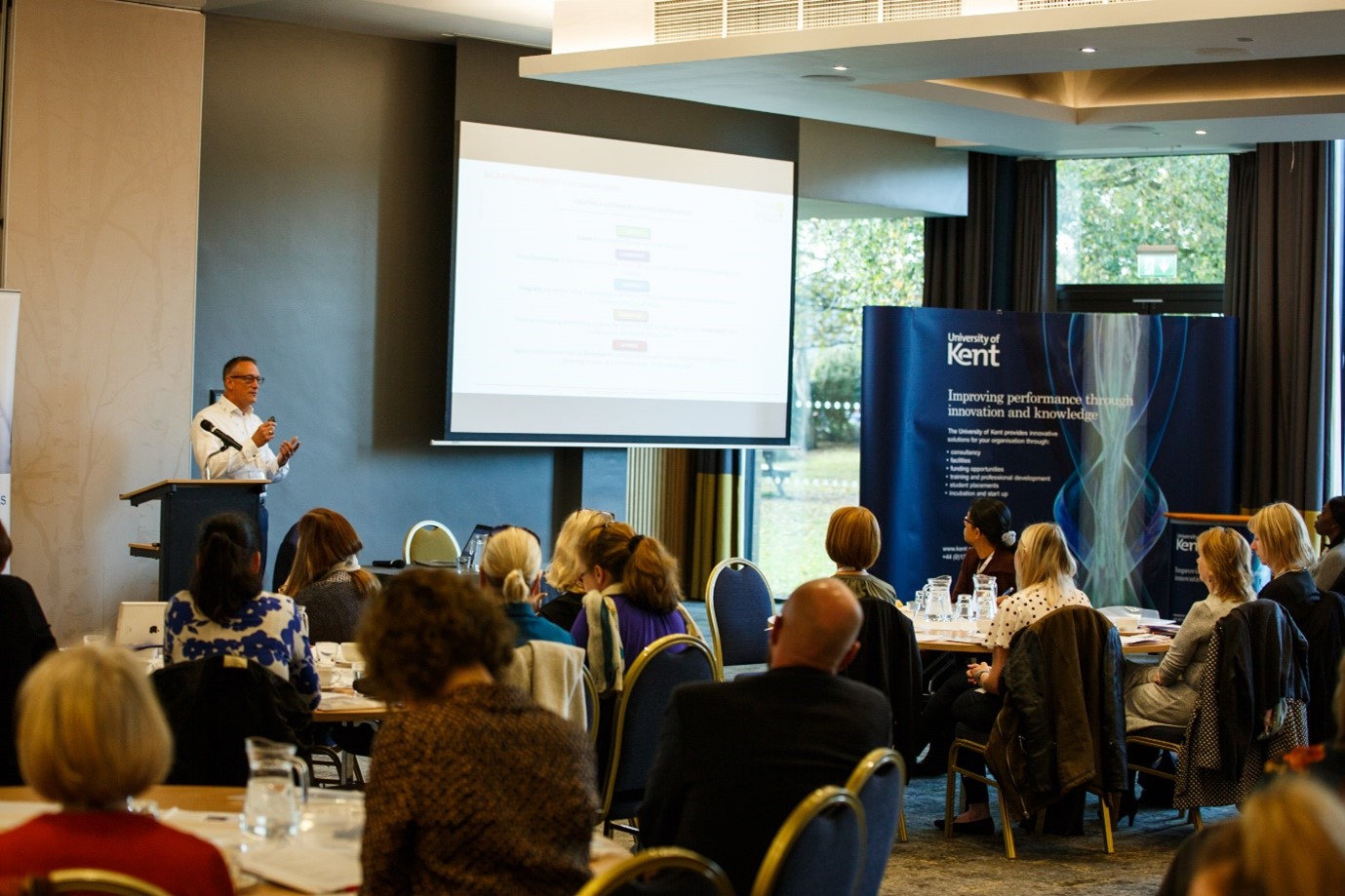
Research and Innovation Services are looking for University of Kent academics to speak at this year’s Kent Human Resources Conference which will take place on our Canterbury campus on Wednesday 23 November.

Now in its eighth year, the conference will provide an opportunity for HR professionals and those responsible for HR in their roles to come together with University of Kent academics and guest speakers to learn, network and spark ideas. Throughout this one-day event, delegates will gain an insight into the latest research, examples of best practice and tips and tools which could be applied in the workplace.

We would like to feature voices from academics from across the university and are looking for proposals on topics relating to HR, or research and approaches which could be applied to overcome common HR challenges. These include but are not limited to:

·       Recruitment and retention

·       Changes in employment law

·       Workplace wellbeing

·       Diversity and inclusion

·       Flexible working practices

·       Training and Development

·       Leadership and management

·       Productivity and performance

·       Reward and Recognition

We actively encourage submissions from our academic colleagues at all stages of their career – from individuals who have never presented or run a session at a conference or event before, to more experienced voices from our community. Please submit your proposal using this form by Friday 9 September.

The Kent HR Network, sponsored by specialist HR platform provider, Ciphr, is an initiative focused on facilitating knowledge exchange between the academic community at the University of Kent and HR professionals, both locally and nationally.

If you have any questions about the conference, please get in touch with Chris McCarthy at c.mccarthy@kent.ac.uk.

We will be announcing further details about the conference over the coming weeks. To be the first to receive future updates on the conference, including ticket availability and our speaker line-up, sign up to our HR Network newsletter.

Lambeth walk

Students and staff come together for the Lambeth Walk

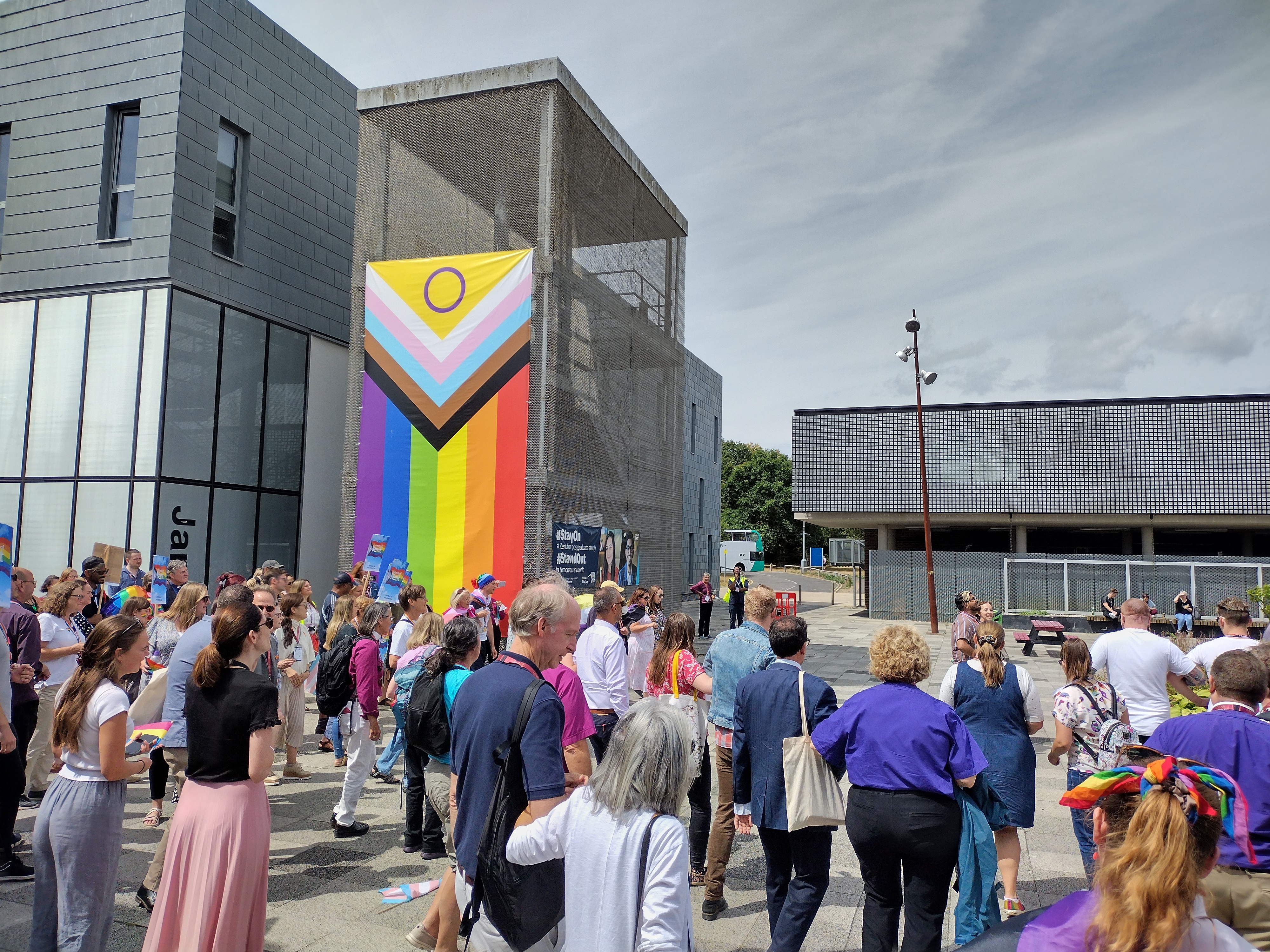
Around 170 people joined the event organised by Kent’s LGBTQ+ Staff Network as a show of support for LGBTQ+ staff and students ahead of the Lambeth Conference.

The march around campus was planned to show the world that people of all gender identities and sexualities are welcome and part of the Kent community. A number of Conference delegates – including gay Bishops with their spouses – joined in along the route, which culminated in a mass dance-off in the University’s central plaza.

Lambeth dance

Following the joyful and celebratory rally, the Network also hosted the Rainbows in Religion Symposium in Marlowe to explore further the intersection of sexuality and religion. Speakers including UoW Trinity St David lecturer Dr Angus M Slater and former UK Government LGBT Advisory Panel member Jayne Ozanne reflected on their own experiences pushing for equal marriage within the Church, before a panel discussion featuring staff and students at the University.

The Lambeth Conference has been hosted at the University since the 1970s, with senior figures from across the worldwide Anglican Communion convening for prayer, reflection, fellowship and dialogue. While we are clear that the Church’s views on equal marriage in particular do not fit with our values as a university, our aim throughout the conference is to facilitate debate and discussion where we can in the interest of positive progress.

Find out more on what to expect during the Conference.

Lambeth walk

Staff and Students come together for the Lambeth Walk

Around 170 people joined the event organised by Kent’s LGBTQ+ Staff Network as a show of support for LGBTQ+ staff and students ahead of the Lambeth Conference. 

The march around campus was planned to show the world that people of all gender identities and sexualities are welcome and part of the Kent community. A number of Conference delegates – including gay Bishops with their spouses – joined in along the route, which culminated in a mass dance-off in the University’s central plaza. 

Lambeth dance

Following the joyful and celebratory rally, the Network also hosted the Rainbows in Religion Symposium in Marlowe to explore further the intersection of sexuality and religion. Speakers including UoW Trinity St David lecturer Dr Angus M Slater and former UK Government LGBT Advisory Panel member Jayne Ozanne reflected on their own experiences pushing for equal marriage within the Church, before a panel discussion featuring staff and students at the University. 

The Lambeth Conference has been hosted at the University since the 1970s, with senior figures from across the worldwide Anglican Communion convening for prayer, reflection, fellowship and dialogue. While we are clear that the Church’s views on equal marriage in particular do not fit with our values as a University, our aim throughout the conference is to facilitate debate and discussion where we can in the interest of positive progress. 

Find out more on what to expect during the Conference 

Find out more about Kent’s LGBTQ+ Staff Network 

Help with the cost of living

The end of the University year is always a chance to reflect on where we are, with the last 12 months once again shining a light on the ways we work together as a community at Kent. While it has been a real pleasure to see more of you face to face as we have re-integrated into campus life, I know that the amount of change we are all having to get used to has added pressure in certain areas and we still have work to do to ensure the wellbeing of all our staff is fully supported. This will be a priority in our new People and Culture Strategy which I look forward to sharing with you all next term. 

Staff Resilience Fund 

While some of the more immediate difficulties presented by Covid have now reduced, we are also now facing a cost of living crisis driven by high energy costs and inflation. This has an impact on our University finances but I am also very aware it will be very worrying for many of you and your families as day-to-day budgets are squeezed by rising prices.  

In the immediate term, Executive Group has agreed to make a one-off payment of £398.06 (pro rata) to all staff who were impacted by the 2020/21 Pay Freeze. This will come out of the Staff Resilience Fund which was established when staff pulled together to help us weather the financial impact of Covid – while budgets remain tight, the impact of rising costs mean we wanted to bring this initial payment forward to do what we can now. Around 75% of our current staff would have been impacted by the pay freeze, with the one-off payment applying to all salaried staff who have been with us since August 2020 and were covered by the agreement – payments will be made directly via the July pay run and, in accordance with the rules of the Fund, will be paid pro rata to hours worked. 

We have also agreed to suspend planned parking charge increases for next year and are looking into what more we can do to support both staff and students, including a possible hardship fund. Both of these immediate measures to help with the cost of living followed helpful input from JSNCC and we will continue to discuss what more we can do – please send any further suggestions either directly to me or via your Staff or Trade Union representative so that we can consider them in full.  

2022/23 Pay Increases 

On 1 August, along with other member universities, we will be implementing the final offer put forward by UCEA on behalf of universities across the sector in the 2022/23 national pay negotiations. The negotiations with trade unions have so far failed to reach agreement and there is understandable concern about how to renumerate staff fairly in an environment where costs are rising so steeply, but the same squeeze felt by households also has an impact on the cost of running the University. 

While I know this won’t feel like enough, increasing salaries by at least 3% for all staff and up to 9% for those in lower grades is felt to be the most that the sector can afford at this time. I am pleased that we can make sure this increase will reach staff pay over the summer and it’s also especially important that the increases are weighted towards those on lower salaries who may be most impacted by the wider pressures we face. It is also important to remember that, as usual, around 50% of colleagues will receive a further 3% increase through moving up an increment on the pay scale in October. 

Wellbeing and Support 

The last few years have felt like a period of constant change, from the top of Government down to our day-to-day working lives. I know this can be very difficult to manage – the way staff have adapted to new ways of working and the frustrations they can bring has, though, shown the best of our community. The way colleagues support each other, and our students, shone through in particular at both our Staff Recognition Awards and the Equality, Diversity and Inclusivity Awards earlier this year.  

I know there is more to do to build a positive working environment at Kent for everybody, with wellbeing and workload pressures being key priorities for us to address next year. I would also encourage all of you to continue to seek support where you need it, from colleagues, your line manager or your local HR team – and remember our Employee Assistance Programme is available for confidential support and advice whenever you need it. 

Martin Atkinson | Director of HR and Organisational Development

Financial Year End: Looking Ahead

Looking ahead to next year’s budget has meant reconciling two different, seemingly contradictory, positions. Our financial position has undoubtedly improved and we are on a much surer footing, including having the means to do more this year to invest in areas like employability, student facilities and enhanced equipment through successful capital funding bids, while also doing what we can to support staff with the cost of living pressures being faced. Meanwhile our underlying performance shows we still face challenges to balance the books, not helped by a number of external factors adding additional pressure on both ourselves and wider society. Income growth remains a key priority for us, while the reality of rising costs means we need to think carefully about where and what we are spending on and ensure a positive return from any investment made. 

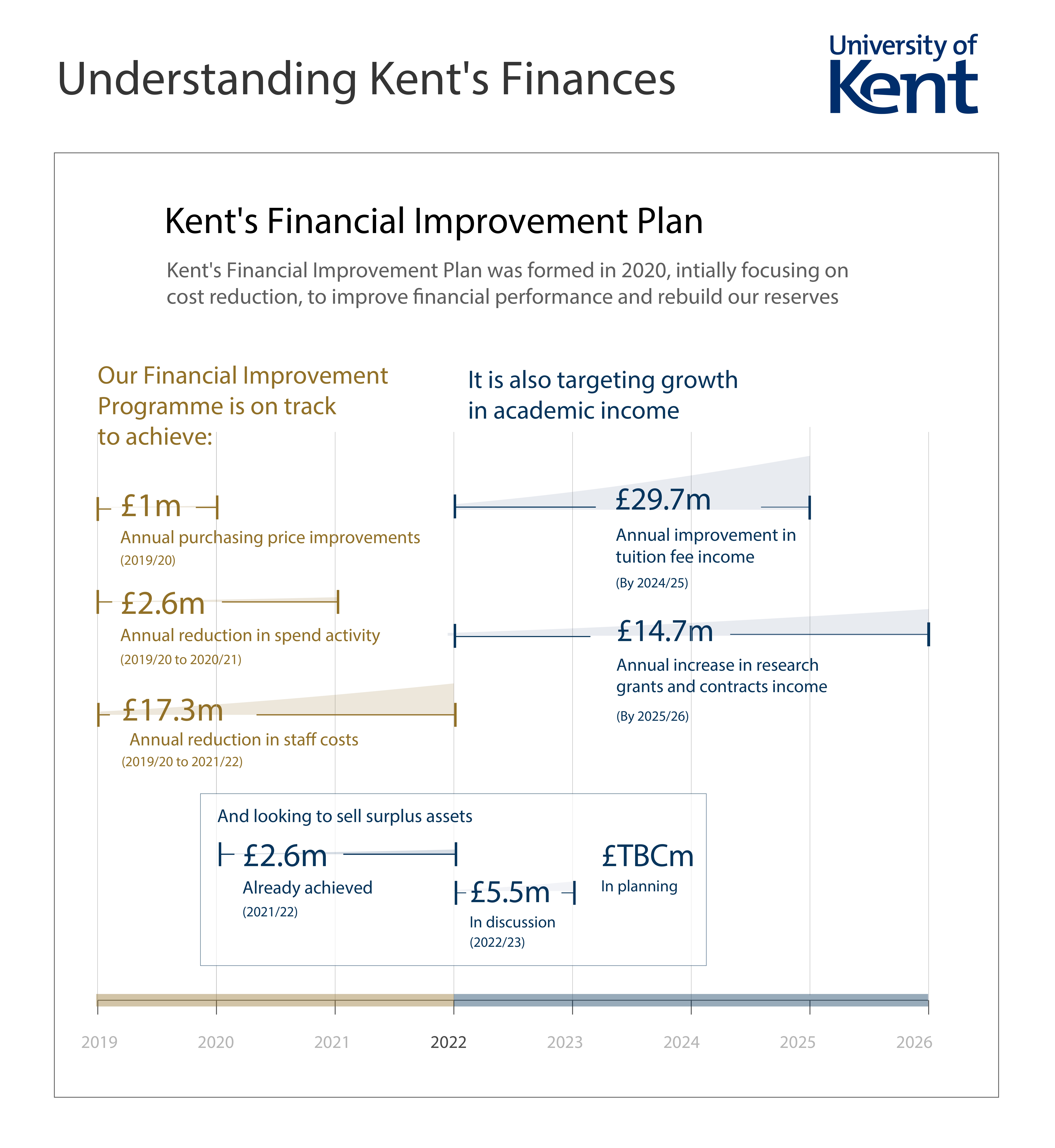
Despite this, it’s important we reflect on how much we have achieved together over the past 30 months during which we ran the Financial Improvement Plan. I know this has been far from easy, but we have delivered huge savings in both pay and non-pay activity which has put us in a much healthier position, while also giving us enough leeway to survive the rigours of Covid and even make some investment in key areas. 

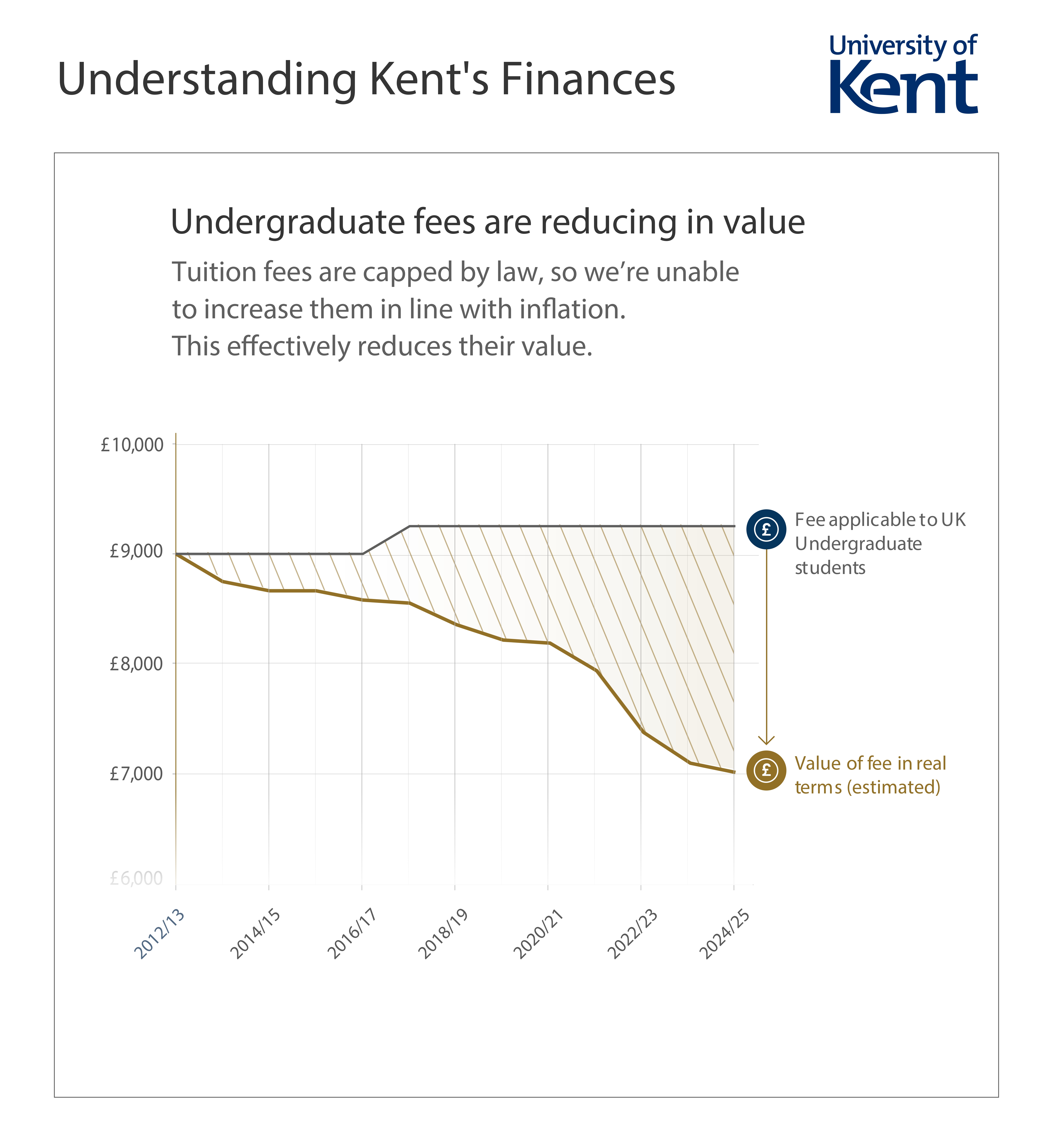
However, our ability to move faster and further is ultimately tied to how much we get in financially compared to how much we have to pay out. Despite the huge progress in recent years, this remains a tricky balance and we are having to weather significant external pressures that have only grown over that time – from rising energy bills and inflation to shifting student priorities leading to a national decline in student applications in some academic areas. Keeping a close eye on how we balance the equation is going to remain critical in the years ahead and we will all need to see this as a normal part of how we work as a University, ensuring we are agile and adaptive to opportunities and threats in an increasingly uncertain world. 

With that in mind, our budgets for next year will require Divisions and Directorates to work their budgets harder and look for further ways to run operations more efficiently and economically, building on the collective efforts already delivered over the past two years. This isn’t just about good financial management, but will involve looking carefully at our processes and activities and determining where these can be simplified or improved – in some cases, we may even decide to stop doing things we’ve done previously. We need to ensure our academic delivery, research and innovation performance and professional support models are resilient and sustainable in the face of change and that we have the flex we need to deliver our wider objectives and take advantage of new opportunities. Part of this will be building on our fantastic REF results to ensure our Research & Innovation income catches up with the best of our peers, including investment in areas with funding potential – we will also need to continue work on how we deliver and support the reshaping of our academic portfolio, and enhance the experience our students have, including the opportunities they are provided with in their journeys through to employment.  

Getting the right balance between being ambitious in our pursuit of a superb student experience while ensuring we are cost-efficient is never easy, but making the right adjustments where we can, to achieve it, will help all of us stay on track in the face of the wider pressures we face. Our immediate priorities are to attract, recruit and retain a sufficient number of students, ensure their time with us is as good as it can be through vibrant campuses and an ambitious, supportive teaching and learning environment, and deliver a high quality and growing research and innovation agenda. To achieve this, we need to have a stable and sustainable financial platform and I look forward to working with all of you to ensure we deliver this over the coming year. 

Jane Higham | Chief Financial Officer 

Templeman Library

Lambeth Conference: What to expect over the next fortnight

The Lambeth Conference is taking place at the University of Kent, Canterbury Cathedral and Lambeth Palace from 26 July – 8 August, with some delegates arriving earlier this week. You can read more about the conference on our website.

Given both the scale and international profile of the Conference, campus will be busy with delegates, support staff, media and members of the public following the different events. We are also likely to see protest from different groups who wish to voice their concern at different aspects of the Church’s work, and we have worked closely with the Conference organisers to ensure this is peaceful and well managed. If you have concerns at the way any protest is being conducted on campus, please contact Campus Security.

Catering and room bookings

The increased numbers of visitors mean that alongside usual summer closures, a number of our catering outlets will be closed for students, staff and the public temporarily – Kent Union-run outlets such as Woody’s and the Library Cafe remain open, along with Co-Op and Caffe Nero. Room bookings will also be much busier due the number of fringe events we are hosting.

Main conference venues

The main meeting venue for the Bishops is the Kent Tennis and Events Arena, with Spouses meeting in the Sports Centre. The Chaplaincy will be based in the Kennedy Building, with numerous seminar rooms and lecture theatres used across campus for fringe events throughout the Conference.

Summer Parking Changes

With a very busy summer of conferences and events taking place at the Canterbury campus, there have been some temporary changes to our car parks. If you are a permit holder, please see notices within car parks and the email sent to permit holders.

Support available

If you feel concerned by any aspect of the Lambeth Conference, please get in touch with Student Support and Wellbeing, College and Community Life or Kent Union, who are all available to provide free, non-judgement support. Read more about support available.

Thank you in advance for helping us make this summer’s conference season a success.

Data Protection Update: July 2022

The University’s data protection, data breach and data subject rights policies have been updated to reflect current data protection requirements and safeguards.

Please read the policies so that you are confident that you are using data lawfully in your role.

These policies help you do the right thing when you are:

  • using personal data
  • responding to requests for personal data
  • reporting a data breach or data security incident
  • contracting with other organisations who use personal data on the University’s behalf
  • handling particularly sensitive data such as allegations or reports of criminal activities.

The policies can be found on the Policies and Procedures page.  You can also contact the Assurance and Data Protection team for further support and guidance by emailing dataprotection@kent.ac.uk

Templeman Library

Lambeth Conference: What to expect over the next fortnight

The Lambeth Conference is taking place at the University of Kent, Canterbury Cathedral and Lambeth Palace from 26 July – 8 August, with early arrivals having started yesterday.

Given both the scale and international profile of the Conference, campus will be busy with delegates, support staff, media and members of the public following the different events. We are also likely to see protest from different groups who wish to voice their concern at different aspects of the Church’s work, and we have worked closely with the Conference organisers to ensure this is peaceful and well managed. If you have concerns at the way any protest is being conducted on campus, please contact Campus Security.

Catering and Room Bookings

The increased numbers of visitors mean that alongside usual summer closures, a number of our catering outlets will be closed to the public and staff temporarily – Kent Union-run outlets such as Woody’s and the Library Cafe remain open, along with Co-Op and Caffe Nero. Room bookings will also be much busier due the number of fringe events we are hosting.

This will be a different environment to what we are all used to over the summer, so do consider working from home where you can and discuss any concerns with your line manager – there is also a wide range of support services available to staff if you need it, including your local HR team and our Employee Assistance Programme.

Main Conference Venues

The main meeting venue for the Bishops is the Kent Tennis and Events Arena, with Spouses meeting in the Sports Centre. The Chaplaincy will be based in the Kennedy Building, with numerous seminar rooms and lecture theatres used across campus for fringe events throughout the Conference.

Summer Parking Changes

With a very busy summer of conferences and events taking place at the Canterbury campus, there have been some temporary changes to our car parks. Please see notices within car parks and the email sent to permit holders for further details of the date and time of closures.

Please note that from Monday 18 July the Pavilion car park will be closed until 12 August and From Monday 25 July to Monday 8 August, all University of Kent permit holders will only be permitted to park within Pink Zone car parks, except Chipperfield and Sibson car parks. 

Thank you in advance for helping us make this summer’s conference season a success.