Category Archives: Student Guide

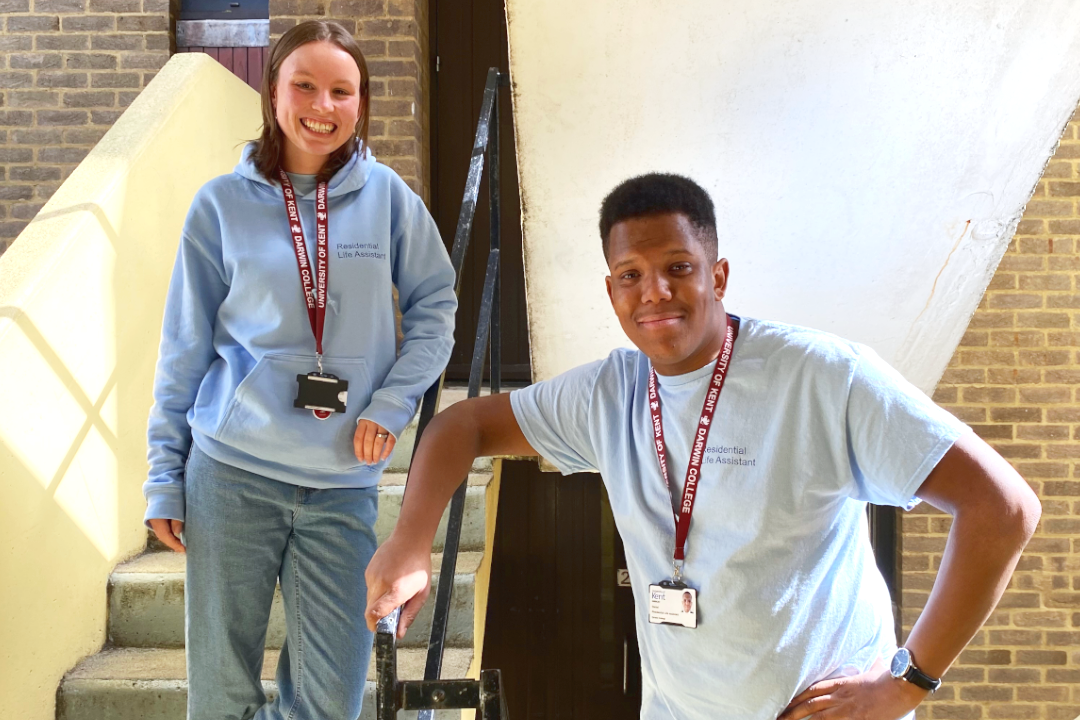
Photo shows Claire and Daniel, 2022-23 RLAs

Ready to be next year’s Residential Life Assistants?

Do you want to be part of creating a memorable student experience for students living on campus at the University of Kent? Join the Residential Life Assistant team, gain invaluable work experience and get a massive 50% discount on your on-campus accommodation for the 2023/24 academic year! Our Residential Life Assistants (RLAs) are part of the College and Community Life team and are at the heart of our College Communities.

You will build relationships both on and off campus, to develop the sense of belonging and community, whilst working together to create exciting events for your peers. This is an great opportunity to get flexible work experience alongside your studies for 8 hours per week, and is open to both postgraduates and undergraduates in their 2nd, 3rd and 4th years of study.

Claire, who is an RLA this academic year says:

“I have really enjoyed being a Residential Life Assistant during my masters degree. It has encouraged me to take breaks when organising fun events rather than just studying, helping to make my degree experience more balanced. I have got to know so many students throughout the year, and I have particularly enjoyed helping students to have fun and get more involved with our events, as well as other events the at the university”.

To apply for the position, read the full job description and email hccl@kent.ac.uk with a statement of no more than 500 words expressing why you’d like to be considered for an RLA post and how your experience makes you the best candidate for the role. Applications must be received by Monday 3 April and interviews are expected to take place in mid-late April.

We look forward to receiving your application, and hearing about how you would like to contributing to a fantastic student experience for everyone at Kent.

Written by Natalia Crisanti, Student Services, 14.03.23

Neurodiversity celebration week

Autism: understanding, embracing and celebrating different ways of thinking

There is a widely reported increase in awareness about autism around the world, probably because there is a long-awaited increase in awareness, identification, diagnosis and capacity to serve the autistic community. At Kent we want to nurture the culture of discourse about different ways of thinking and being, in order to better understand one another and create a supportive atmosphere for everyone to thrive in our diverse university community.

What does it mean to be autistic?

Autism is not an illness or disease. It means your brain works in a different way. If you’re autistic, you’re autistic your whole life: it’s something you’re born with and is often first noticed when you’re very young, although many people don’t know they are autistic until they’re older. Autism can affect the way a person communicates and how they experience the world around them. It is considered a spectrum condition, meaning the way one person experiences their autism can differ a lot to another person with the same diagnosis. Some well known people from all walks of life are autistic, for example, environmental activist Greta Thunberg, actor Anthony Hopkins, writer and outspoken poverty issues campaigner Jack Monroe and film maker Tim Burton. 

Every experience of autism is unique, and no one person will identify with every negative or positive feature of autism. Some autistic people need little or no support, while others may benefit from help from people who know lots about the condition. 

Some difficulties often experienced by autistic people are:

  • Feeling overwhelmed by social interaction
  • High levels of anxiety
  • Specific sensory needs (noise/ light/ physical sensation)
  • Struggling with changes to routine
  • Difficulty processing lots of information

Some positive features of autism*:

  • Attention to detail (thoroughness, accuracy)
  • Deep focus (concentration, freedom from distraction)
  • Observational skills (listen, look, learn approach; fact finding)
  • Absorb and retain facts (excellent long term memory; excellent recall)
  • Visual skills (visual learning and recall; detail-focused)
  • Expertise (in-depth knowledge; high level of skills)
  • Methodical approach (analytical; Spotting patterns, repetition)
  • Novel approaches (unique thought processes; innovative solutions)
  • Creativity (distinctive imagination; expression of ideas)
  • Tenacity and resilience (determination; challenge opinions)
  • Integrity (honesty; loyalty; commitment)
  • Accepting of difference (less likely to judge others; may question norms)

Support for autistic students at Kent

Whether you are autistic or think you might be, looking at strategies to help you, or peers to explore this journey with might be really helpful. SYA? is an 8 week support programme to help students who have an autism diagnosis, or who are seeking one, to explore what being autistic means for them. If you would like to participate, please email AutismSupport@kent.ac.uk.

Student Support and Wellbeing

Student Support and Wellbeing provide assistance to autistic students with transition into university life, peer support and 1:1 guidance on managing academic work, accommodation & socialising. Find out more about autism support at Kent, including how to be supported getting a diagnosis if you think you’re autistic.

Autism social clubs at Kent

As well as support from Advisers and Mentors, autistic students at Kent can take part in various peer support groups. These are facilitated by Student Support and Wellbeing staff, and range from groups specifically for autistic students to explore what it means to be autistic, to social groups which are designed to be accessible to autistic students.

Have a look at the Student Support and Wellbeing events calendar to see what’s on this term, including the autism social club, modelling club and board games club, or attend the university-wide neurodiversity cafe on Monday 13 March from 12:00 – 14:00.

If you have an suggestion for a new group or have feedback on an existing group, please email WellbeingEvents@kent.ac.uk.

Get tailored employability support:

  • Finding disability confident employers: Online workshop for Kent students on Tuesday 14 March 12:00-13:00 – book online to receive details of how to join.
  • How to manage the uncomfortable when looking for employment or navigating challenges at work: Online workshop for Kent students on Thursday 16 March 11:00 – 12:30 – book online to receive details of how to join.
Written by Natalia Crisanti and Siobhan Mcghee, Sudent Services, 01.03.23
Industrial action

Upcoming strike days: Weds 15 – Weds 22 March

From Professor Richard Reece | DVC Education & Student Experience 

At the time of writing there has been no major update from the national negotiations on industrial action currently taking place. While talks are continuing, this means that unfortunately we expect strike days to return this week for six consecutive days starting on Wednesday: 

  • Wednesday 15 – Friday 17 March 
  • Monday 20 – Wednesday 22 March 

I can only apologise for this continued disruption which I know has had a real impact on you this term. As always, the nature of strikes can be very different in different areas so do check in with your lecturers or Division directly and they will advise where they can on what it might mean for you. 

What else is on this week 

While I know it doesn’t make up for missing classes, lots of university activity will carry on as usual across the strike days. Do look at our events roundup to see what is happening, which includes a number of free exam prep sessions. Kent Union has lots of activities running this week too, while our Student Support and Wellbeing team host regular events to get people together throughout the year. 

You can read more on how to prepare for a strike day and how to claim back any expenses directly caused by strikes on our industrial action webpages. 

Ensuring you can progress this year 

I know that many of you also have concerns around the rest of this year with UCU balloting for potential further action. I want to reassure you that we have plans in place to make sure you can progress as normal whatever happens over the coming months. We’ve put together some FAQs with more on the background to this

I know upcoming exams are also a worry – our general approach is that you shouldn’t have to answer anything in an exam that hasn’t been covered in one of your classes. Your teachers will bear this in mind when they are preparing your exam papers – some modules will also have multiple exam questions to choose from, meaning that in these cases you can avoid questions that you don’t think have been covered in a lecture or seminar if you prefer.   

Getting advice and support 

Talks are continuing at national level regarding the strikes so it remains my sincere hope that an agreement is reached that avoids further disruption. I will update you again if we hear more; in the meantime, if you are worried about the effect this is having then do contact us for further advice or support

Neurodiversity celebration week

Specific Learning Differences: the positive aspects

Many of us have heard of the difficulties or ‘deficits’ associated with Specific Learning Difficulties (SpLDs), like dyslexia, dyspraxia, and ADHD.  But are we aware of the positive aspects that can make dyslexic individuals so successful?

Difficulties with attention and concentration? Time management and planning issues?  Short term memory concerns? Persistent difficulties with reading and spelling? Word retrieval problems? Many notable individuals – such as businessman Lord (Alan) Sugar, poet Benjamin Zephaniah and Nobel prize-winning microbiologist Carol Greider – have not just overcome but have harnessed the power of their Specific Learning Difficulties in their lives and careers.

The ‘dyslexic advantages’

Dyslexic minds can be predisposed to specific strengths because of the unique ways they process information.  The book, The Dyslexic Advantage, suggests that these strengths arise from the same variations in processing that cause dyslexic difficulties with literacy, language and learning.

Dyslexic advantages include:

  • Strengths in spatial visualization,
  • Perception of relationships,
  • Narrative reasoning, and
  • Abilities to perceive and use patterns in changing data sets.

So, the flexibility in visual thinking that can cause persistent problems with letter or number reversals when writing (eg b/d/p/q, 6/9 confusion), can also generate a flexibility in spatial visualization that is highly advantageous to a dyslexic working in 3D. This strength in spatial visualization facilitates success in fields such as architecture, engineering and science – see the iconic design of  London’s O2 Arena, by dyslexic architect, Richard Rogers, for example.

Beyond dyslexia

And it is not just dyslexia: dyspraxia too is often associated with strengths in big picture thinking, being able to identify patterns, and problem-solving skills.  Likewise, positive attributes of ADHD are recognized to include strengths in energy, divergent thinking, and adventurousness. Indeed, some individuals with ADHD describe how their divergent ‘outside the box’ thinking inundates them with ideas, providing a great source of creativity.  Some also describe an abundance of physical energy that they can harness productively, and that makes them feel younger than their peers!

Recognizing these positive strengths for individuals with SpLDs is important for building confidence and encouraging success.

Written by Cathy Myers, Specific Learning Difficulties Adviser in Student Support and Wellbeing, 24.02.23.

Are you a Kent student who might benefit from support?

Student Support and Wellbeing have expert staff who are here to offer you support during your studies. If you have a Specific Learning Difficulty (SpLD), or feel that you experience difficulties, register with Student Support and Wellbeing and make an appointment with an SpLD Adviser. Want to know more? Please view this visual guide on How to get Specific Learning Difficulty Support.

Get tailored employability support:

  • Finding disability confident employers: Online workshop for Kent students on Tuesday 14th March 12pm-1pm – book online to receive details of how to join.
  • How to manage the uncomfortable when looking for employment or navigating challenges at work: Online workshop for Kent students on Thursday 16th March 11:00 – 12:30 – book online to receive details of how to join.

Find peers:

Attend the neurodiversity cafe on Monday 13 March from 12:00 – 14:00.

What do you think?

Would you like to contribute your experience and perspective to conversations, podcasts or articles on this or other topics covered by Student Services (employability, support services, student wellbeing, faith and belonging, inclusion, student healthcare)? Please email StudentServicesWeb@kent.ac.uk – we welcome student and staff contributions.

Fruiting trees

Diamond Anniversary Orchard planting, 15 March

This academic year we have launched the Diamond Anniversary Orchard project and planned the planting of an orchard of over 300 fruit and nut trees. This project was designed to celebrate that most undergraduates starting this year will graduate in 2025 which is the University’s 60th birthday and it is hoped that our students can watch the orchard grow and be part of its transformation from grassland to a complete and flourishing space.

Help us plant more trees

We managed to plant some trees last week in the snow (!) but need your help to plant more. Our next planting session is Wednesday 15 March between 10:00-13:00. You can come for as long or as little as you like. There will be a full briefing at the beginning of the session and newcomers throughout will be paired up with someone that has been trained.

Why an orchard?

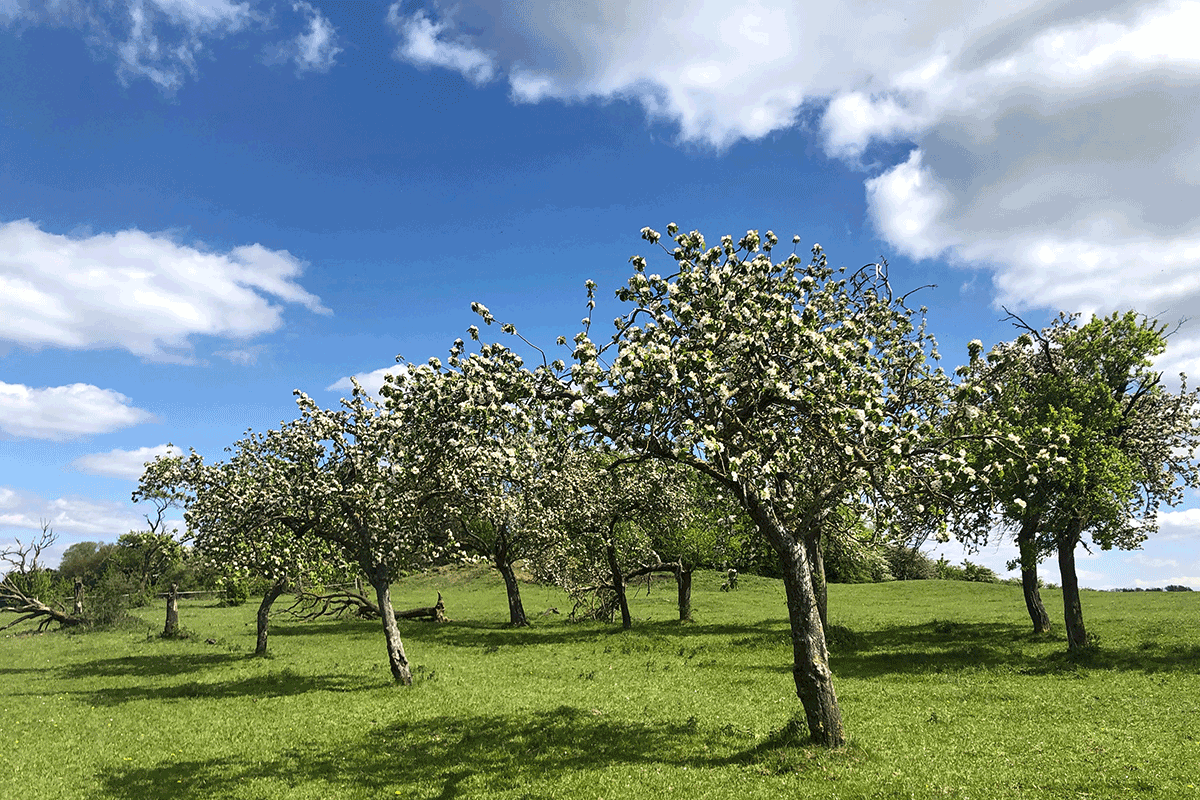
The Southern Slopes provides an ideal setting for a semi-natural orchard and meadow that will not only be a beautiful space for students, staff and community members to enjoy, but also provides a complex habitat that will boost biodiversity in the area.

Step one is planting the fruiting trees, which once mature, will provide future students with fruit and nuts that they can harvest and enjoy. Later this year we will be seeding wildflower seeds to create an understory meadow that we will cut swathes through proving a peaceful space to walk through and enjoy.

Because this orchard will be a mosaic of trees, grasses, shrubs, wildflowers, and a pond, it will support a wide range of wildlife. As fruit trees age quickly, they create the perfect habitats for invertebrates and birds, such as the lesser spotted woodpecker and the rare noble chafer beetle.

This unique habitat will also feature key elements for our human community bring people and nature together. Accessible pathing so everyone can enjoy the space; seating with a view for meditation, rest or socialising; an outdoor teaching area; and a bird hide to spot nature from a quiet vantage point.

All the elements will be tied together with a central point that marks the six academic divisions that make up our learning community, celebrating all the students that will be our class of 2025 and beyond.

Events roundup 13-19 March

Here’s a roundup of what’s on this week.

Online Module Registration (OMR) opens for undergraduate students on Wednesday 15 March. Find out more about choosing your modules for next year.

Industrial action reminder: Wednesday, Thursday and Friday are UCU strike days, so your teaching may be affected on these days. The College and Community Life Team are offering drop-in support sessions on these days in Locke Building between 9:00-17:00. How to prepare for a strike day.

Monday: Graduation Message Day, Neurodiversity Café and PG Coffee Morning (Medway)

In your final year? On Monday head to the plaza outside Co-op to write a message about your time at Kent or a thank you message to friends or family. We’ll take a photo of you with your message and these will be displayed at graduation in July.

As part of Neurodiversity Celebration Week, we’re hosting our first Neurodiversity Café. The event is for students and staff who identify as neurodivergent (that is, who have or may have autism, dyspraxia, dyscalculia, dysgraphia, ADHD, Tourette’s) to get to know one another and share their experiences of neurodivergence at university.

Over Monday lunchtime we have a PG coffee morning in Rochester building at Medway campus. Come along to meet other PG students, staff from the Graduate and Researcher College and PG Network reps. If you’re an undergrad considering postgrad study, you’re also welcome to come along and find out more about the postgrad experience.

Wednesday: Diamond Orchard planting, Language Taster Sessions and Exam Chambers practice sessions

We managed to plant some trees last week in the snow (!) but need your help to plant more. We’re planting 300 trees in our new Diamond Orchard at Canterbury campus to mark our Diamond Anniversary in 2025. Our new undergraduates will graduate in 2025 when we’re celebrating our Diamond Anniversary! Be part of this legacy.

On Wednesday there are free language taster sessions as part of our Study Plus programme to help you develop new skills. You can try learning languages including Mandarin, Ukrainian and Italian. See all Study Plus sessions.

Student Learning Advisory Service (SLAS) are offering an exam practice session at Medway to help you improve your performance in exams and reduce any feelings of anxiety. There’s no revision and no marking, just an opportunity to practice. See all exams preparation events. 

Friday: Gardening and Exam Essay Writing

Get involved at the Kent Community Oasis Garden, located near Park Wood at our Canterbury campus. Every Wednesday and Friday (10:00-14:00) there are open gardening sessions for students, staff and community members.

Starting to think about your exams? Join SLAS session about essay writing in exams, which includes a live presentation and time for questions.

See more student events.

Opportunities

See more student opportunities.

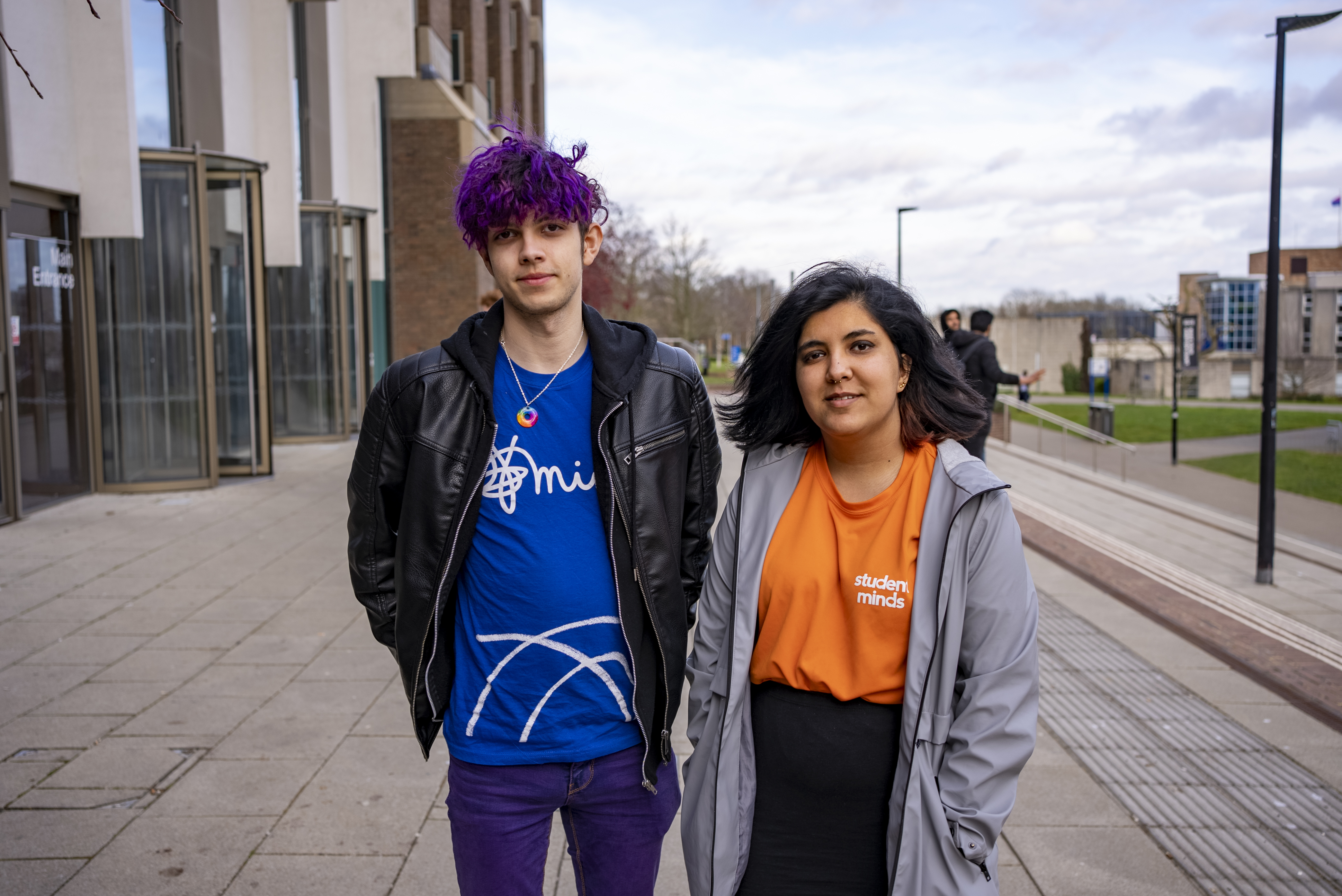
Shivali and Tommy from Kent Mind wearing Mind and Student Minds T shirts

Kent Stars: Kind Kent Mind 

This month’s Kent Stars are the Kent Mind Society. A new society this year, Kent Mind has created supportive events for students and fundraised for charities including Mind and Student Minds. Hear from Shivali and Tommy at Kent Mind: 

Shivali – “Hi, I’m Shivali. I am the President of Kent Mind Society and a third-year Economics student, looking at a career in Philanthropy after my involvement in many of the Community Action Groups here at Kent.”

Tommy – “Hi. My name is Tommy and I am the Campaigns Coordinator for Kent Mind Society. I’m an MSc by Research student in Computer Science and I’ve been a part of many societies throughout my four years at the University of Kent.”

Tell us about Kent Mind Society. 

“Kent Mind Society is a very new society on campus, started in August, with the aims of creating safe and supportive spaces on campus, destigmatising conversations about mental health, and fundraising for Mind and Student Minds. 

We founded Kent Mind to help with the demand for support as we face a student mental health crisis and our desire to enact change on campus. We’ve run a wide variety of events from socials, fundraisers and wellbeing drop-ins, and we’ve raised awareness for important dates like Disability History Month and Time To Talk Day. 

Our greatest success this year was the launch of the ‘Safe Space’ initiative last term, providing a supportive environment with blankets, lights, board games and study materials for anyone who feels lonely, low or bored on a Friday night. This was a safe alternative to ‘Friday Night Drinks’, and we are excited to relaunch the initiative bigger and better in the Summer Term. 

We’ve had the great privilege of working with other local charities such as Porchlight, supporting their NHS-commissioned project on 18-25 year olds who have experienced mental health crises. 

We continued strong this term with our calendar of events for University Mental Health Day, including a Bingo Fundraiser at Woody’s and our Spring Prom at Venue. More details of upcoming events can be found on our Instagram (@kent_mind_society).”

Shivali and Tommy from Kent Mind smiling at each other

 What advice would you give to other students?

Tommy – “I think that it is important to remember that your mental health is the most important thing. It can be very easy for the university workload and life to get on top of us, and we need to remember that it is acceptable for us to take a step back and look after our own wellbeing.”

Shivali – “My best piece of advice is to take note and make sure to do at least one thing every day that’s just ‘time for myself’. Whether it’s 5 minutes of reflection, going for a walk or having a long bath, try and make time once a day to look after yourself.”

What are your plans for next year?

“During our summer term, we hope to continue our ‘Safe Spaces’ initiative to provide a chilled and relaxed space amongst all the exam-related stress. 

In the next year, we would love to continue our fundraising schemes and collaborate with other Community Action Groups, sports clubs and societies to raise even more money for some great causes. 

We’d also love to work closer with student committees to raise awareness of how to look out for your members and be considerate of mental health.”

See more Kent Stars and nominate a Kent Star. 

chef preparing a meal

Get a free ticket for Kent Giving Week’s cooking show

There are 100 free student tickets to see Kent Giving Week’s ‘In The Kitchen Cooking Show’ on Tuesday 21 March at 12:00-13:00 in Darwin Conference Suite.

The show includes free tasters but you will have to be quick before all the free tickets go!

Get your free ticket now!

Professional chefs will provide a masterclass on how to cook their trademark dishes on a budget. What’s more, our fabulous in-house caterers will recreate them for the audience.

Find out more about Kent Giving Week and how you can get involved!

Photo by Jason Briscoe on Unsplash

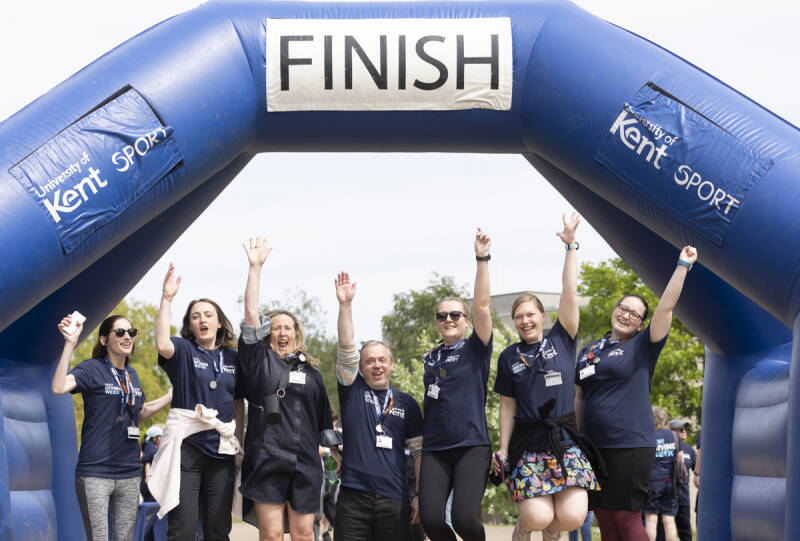
group of staff and students at walk finish line

Join 5k Your Way on 23 March

Come participate or volunteer for 5k Your Way which is a sponsored 5km route around the campus on Thursday 23 March from 12:00-14:00

You can come along as a group to walk (or run!) to help us reach the goal of providing 10,000 meals for students facing extreme financial hardship. Students can register for free. 

Find out more about Kent Giving Week and how you can get involved.

If you are facing financial hardship, please see support available to you and contacts on our cost of living webpages.

Undergraduate Online Module Registration opens 15-26 March

From Wednesday 15 March to Sunday 26 March, Online Module Registration is open for you to choose the undergraduate modules that you wish to study in 2023/2024.

You will receive an email when Online Module Registration is open. Prior to this, you should prepare by reading your Subject Requirements and viewing our guidance, which details the step by step process of how to complete Online Module Registration.

Online Module Registration for students entering Stages 2, 3 and 4 is not first come, first served. In order to give you the best opportunity to register for your preferred choice of modules, please ensure that you have submitted your selections by Sunday 26 March 2023 at the latest.

Please note: Some students do not have to complete Online Module Registration. These students include those who are going abroad or to a year in industry next year, or if your course has entirely compulsory modules.

If you have any questions please contact the Student Administration team.