Giles Family at 75: The Birth of the Giles Family

On Wednesday 5 August 1945 the Giles Family appeared for the first time in the pages of the Sunday Express. The creation of cartoonist Carl Giles (1916-1995), over the course of the next 45 years they would appear in over two thousand cartoons in the Sunday Express and Daily Express. For many people his cartoons capture British life in microcosm, and the Family became a national institution. Giles became the most famous and well-beloved cartoonist of his generation: in 2000 he was voted Britain’s Favourite Cartoonist of the 20th century.
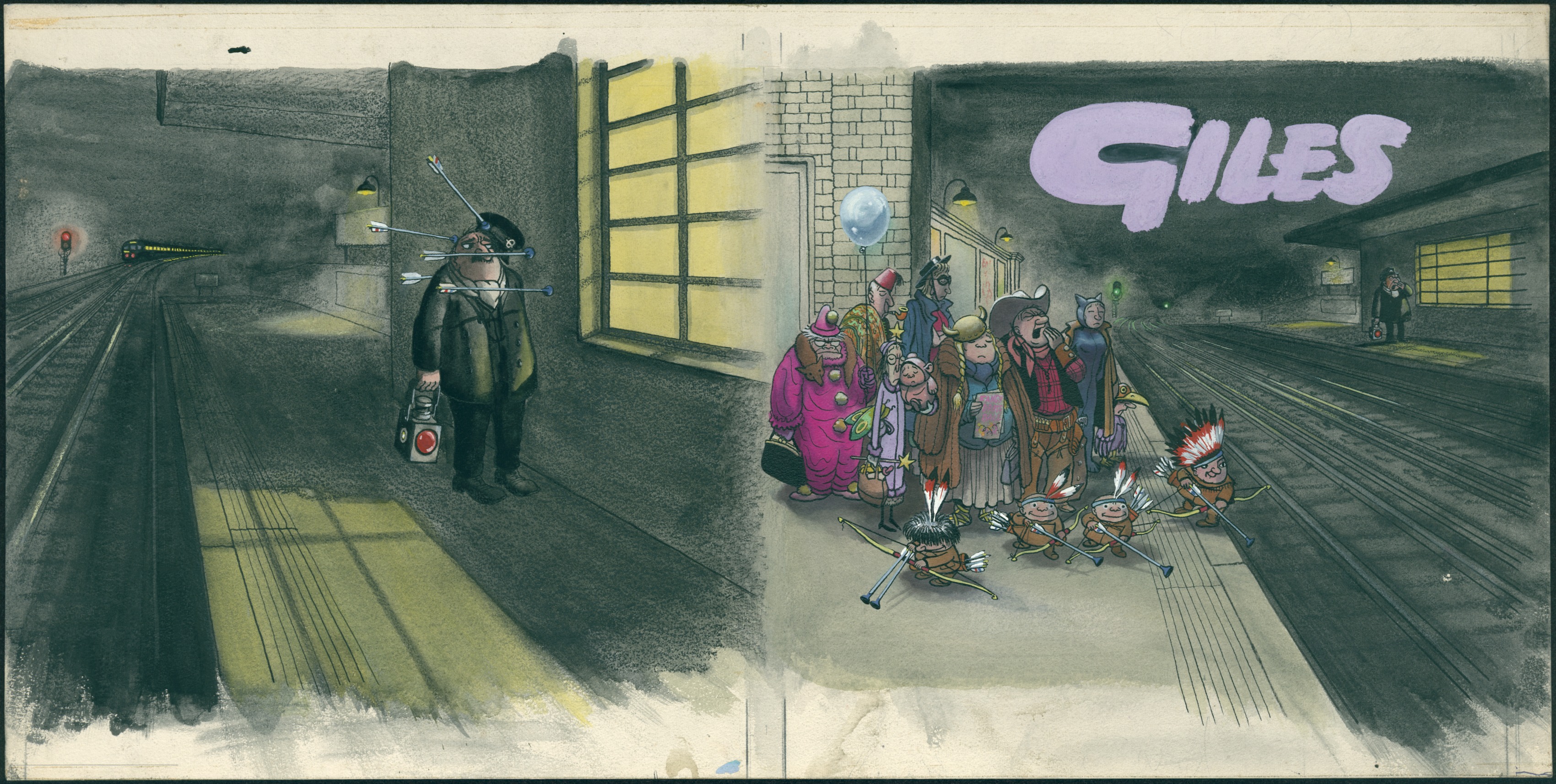
GA5732: Cover artwork for 13th Giles Annual, 1959

This is the first in a series of blog posts and social media posts celebrating the Giles Family, drawing on the riches of the Carl Giles Archive, which has been part of the British Cartoon Archive since 2005. This series is in lieu of a physical exhibition in our Gallery space, owing to the Covid-19 pandemic. This first blog post will explore the origins of Giles the cartoonist and the birth of his Family.

Carl Giles: a brief biography

GAPH00392: Giles at Reynolds News

Ronald ‘Carl’ Giles was born in Islington, London, on 29 September 1916, the youngest son of Albert, a tobacconist, and Edith, a dressmaker. He left school at 13 and spent 5 years as an office boy in the animation studios of a London advertising agency. Giles never had any formal art training, but he began developing his artistic skills as an “in-betweener”, filling in the movement between key drawings. He also gained the lifelong nickname Carl, after the monster played by Boris Karloff in the 1932 release of Frankenstein, because of his short haircut. In 1935, he took a position at film producer Alexander Korda’s London Films, and worked on The Fox Hunt, the first British colour animation with sound. A near-fatal motorbike accident in 1936 left him blind and partially deaf in his right eye and ear, and he went to Suffolk to recuperate. He began submitting cartoons to newspapers and magazines and eventually became a regular with the left-wing London Sunday newspaper Reynolds News, including his first series ‘Young Ernie’.
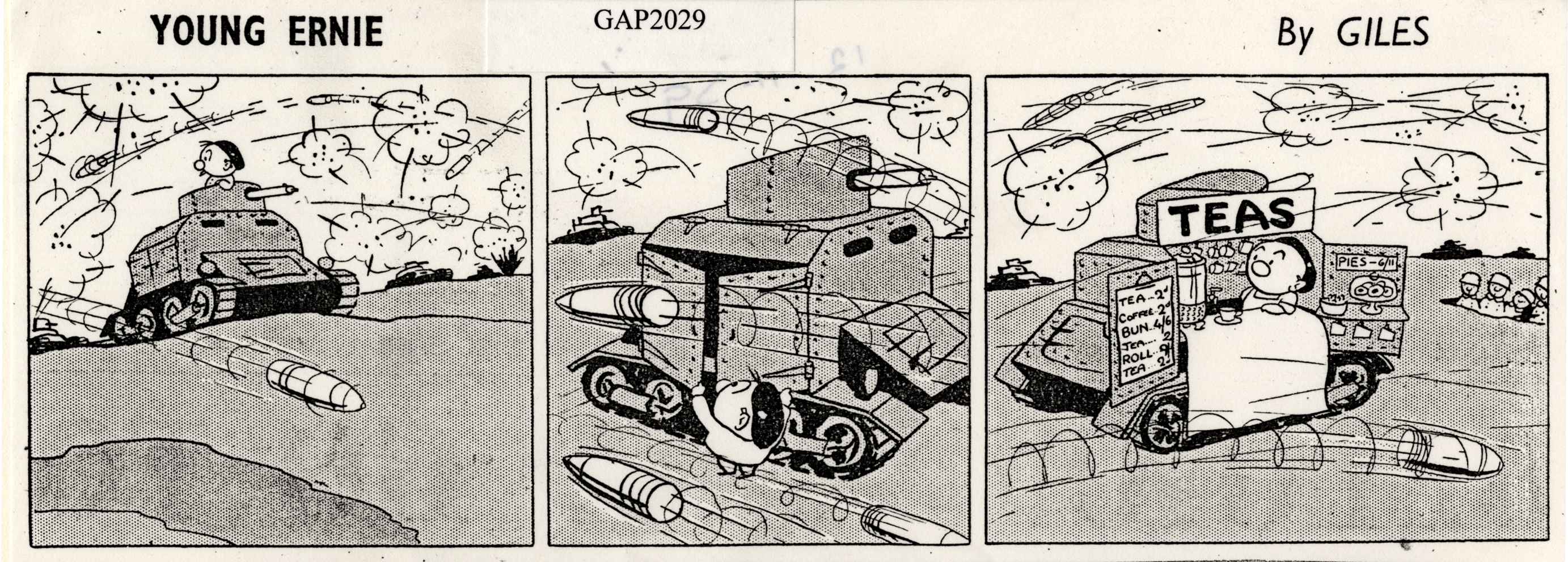
GAP2029: ‘Young Ernie’ strip, published Reynolds News, 12 November 1939

His work was instantly popular, and by 1942, he began attracting attention from other newspapers, and in 1943 signed up with the Sunday Express, which then had the highest circulation in Britain. The self-described “dirty leftist” was initially “thoroughly miserable” at the right-wing Sunday Express, until the increasingly large postbag of fan letters showed him the attractions of addressing a vast readership. By 1947 he was also working for sister paper the Daily Express, and settled into a routine of three single-panel cartoons a week (two for the daily and one for the Sunday).

Exempt from war service because of his motorbike injuries, in September 1944 he became the official war cartoonist for the Express and travelled to the European war zone several times, being present both at the liberation of the Bergen-Belsen concentration camp and the German surrender on Luneberg Heath in May 1945.
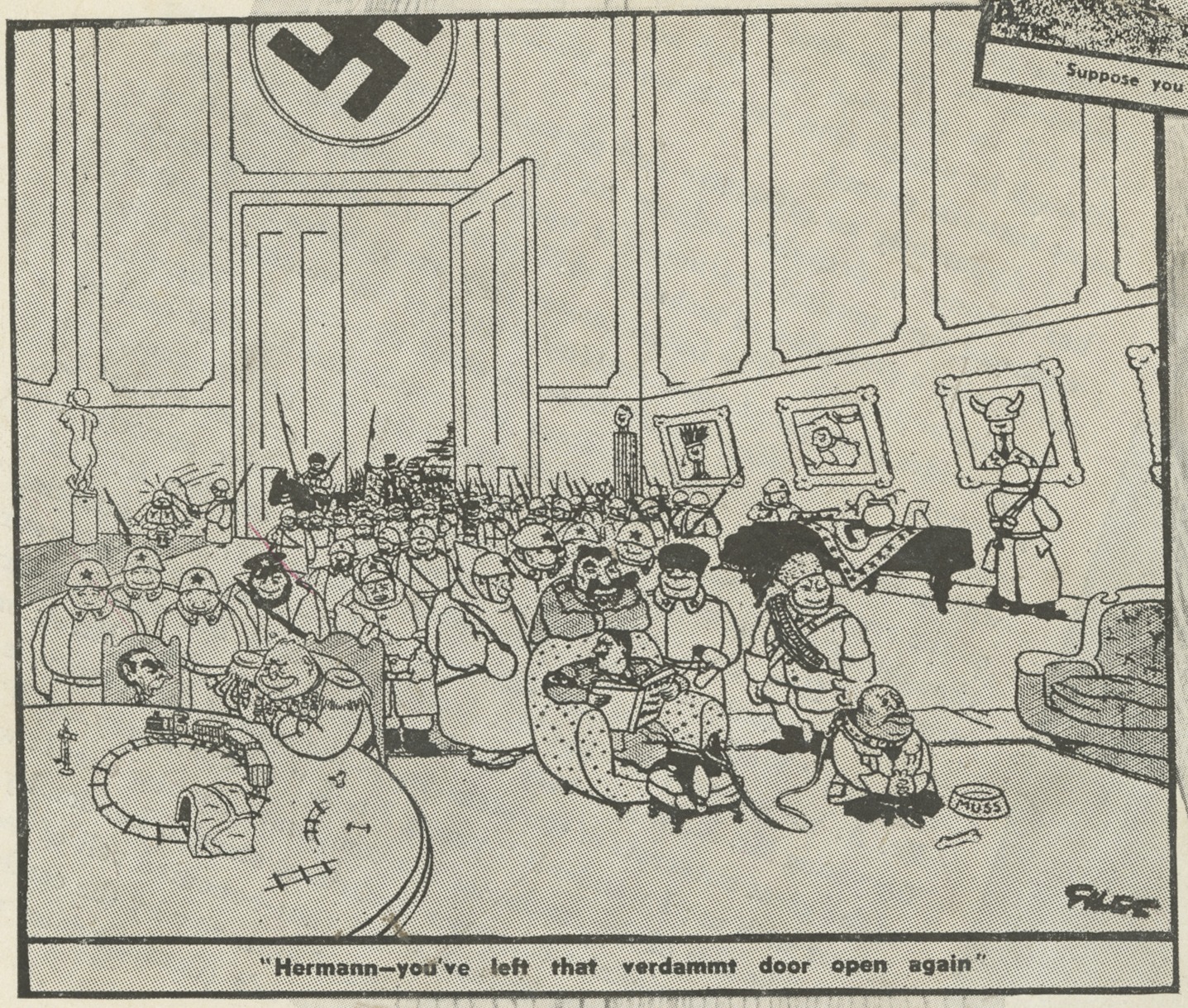
GAPC0466: “Hermann – you’ve left that verdammt door open again”, published Sunday Express, 3 October 1943

As the war in Europe ended, Giles realised that his cast of characters was rapidly diminishing. Giles had ridiculed the Axis leaders by presenting them as a dysfunctional family: his first cartoon for the Sunday Express in October 1943 had imagined Hitler, Goering, Goebbels and Mussolini as living a peculiar domestic life in Berlin, an idea to which he repeatedly returned. On Mussolini’s execution in April 1945, Giles later remarked, “I sure hated to see old Musso go […] he was half my bloody stock-in-trade”.

The Family arrives

The Giles Family was actively created as something to take the place of the ‘Axis Family’. The nominal focus of this new Family was one of his wartime soldier characters, returned to civilian life, and had its first recognisable appearance in the Sunday Express of 5 August 1945.

GA5447: “It’s quicker by rail”, published Sunday Express, 5 August 1945

A comment on the chaotic and unreliable state of the railway network in the immediate aftermath of the war, the Family is shown walking along a deserted railway line with thermos and bucket and spade above the ironic caption “It’s quicker by rail”. All the elements that made Giles’ work so recognisable and beloved are here: the fine rendering of the English countryside, the accuracy in depicting the signalling equipment, the blink-and-you’ll-miss-it details like the child tumbling down the embankment, and, at the rear, a small black figure, so cleverly drawn that the eye is drawn towards her: Grandma.
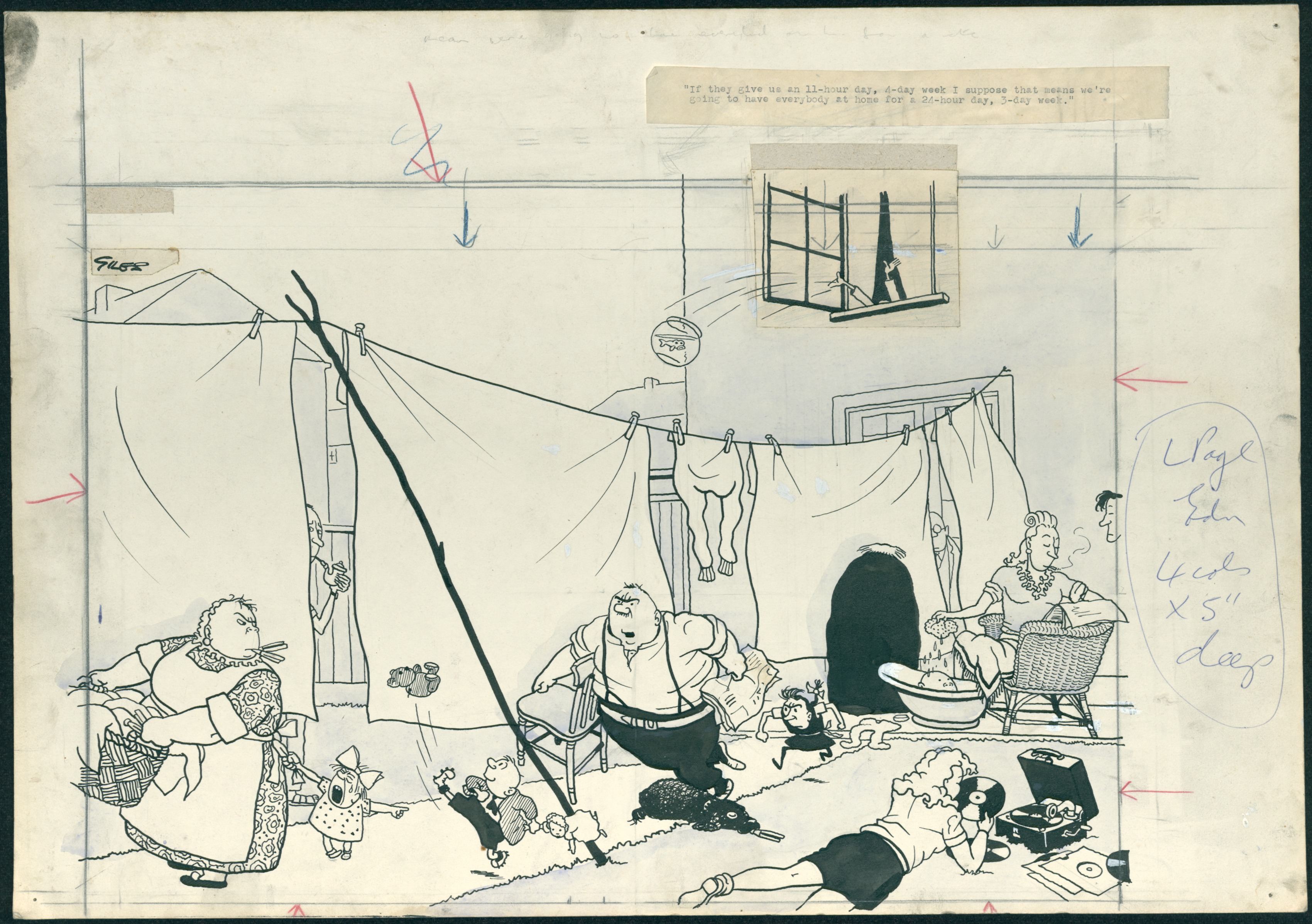
GA0208: “If they give us an 11-hour day and a 4-day week, I suppose that means we’re going to have everybody at home for a 24-hour day 3 days a week.”, published Daily Express, 2 September 1947

In August 1947, the Daily Express ran a series of cartoons introducing the different characters to its readers. After that, as Giles recalled, “the Family took on a life of its own almost immediately”. As a cartoonist, Giles was an amused spectator rather than angry satirist. The Family proved a useful medium for commenting on post-war life, reacting to the confusion of world politics and a rapidly changing society.

The family are archetypally working class characters, a large, multi-generational household that are patriotic yet suspicious of authority. As the series progressed, they took on the attributes of a middle class household, with a car, caravan, yacht and foreign holidays. The family never aged, but their home, their hobbies and their dress reflected the changing British fashions and standard of living. The family’s common humanity had a wide social appeal.

The group of characters had achieved their final form by April 1950, when they were known as “Giles and Family”. By August 1951 this had become “The Giles Family”, and in November 1951, responding to “constant public enquiries”, Giles published “The Giles Family Tree”, explaining who everyone was (more of which in the next post).

GA0683: ‘The Giles Family Tree’, published Daily Express, 23 November 1951

Click here more information on the Giles Collection and the British Cartoon Archive.
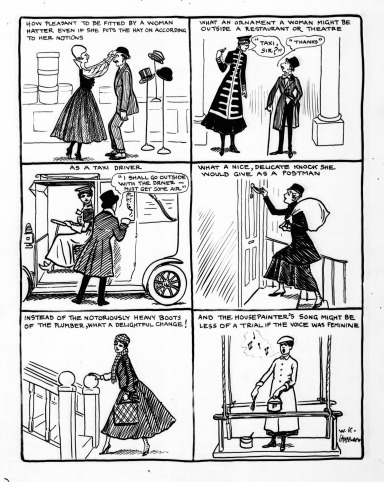
Vote 100: W.K. Haselden and women’s changing role in early 20th century society

This week (6th February, to be exact) marks 100 years since women first gained the right to vote in the United Kingdom. This anniversary is being celebrated across the country and online using #Vote100. Of course, this also gives those of us lucky enough to work with historical collections a chance to explore women’s history in our holdings, so we’re going to be highlighting some of our favourite stories and figures over the next month.

Today, our attention turns to the British Cartoon Archive and a somewhat unexpected supporter of women’s rights – the artist W.K. Haselden…

W.K. Haselden (1872 – 1953) spent most of his career as a cartoonist at the Daily Mirror newspaper, as well as drawing theatrical caricatures for Punch magazine. Haselden is most well known for his art during the First World War – his characters ‘Big and Little Willie’, which mocked Kaiser Wilhelm and his son, were tremendously popular.

Haselden is also famed for shifting his cartooning style from political satire to social commentary. The Daily Mirror, which Haselden joined in its founding year of 1903, was created as a newspaper for women – it focused on human interest stories and had a visual format filled with photographs and images. It is no surprise, then, that women feature heavily in Haselden’s cartoons as the Edwardian era progressed and gender roles were debated extensively in a changing society.

Haselden was broadly flattering towards women, and much of his work suggests that society might be a more pleasant place if women were involved in men’s work, as this cartoon from 1915 shows:

WH1451: ‘Some Trades In Which Women Are Replacing Men’, 12 March 1915, Daily Mirror

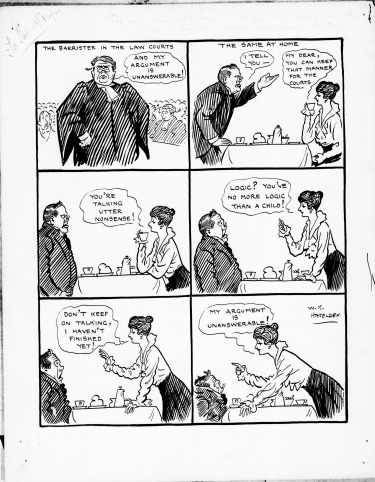
Haselden drew on domestic life to highlight the increasing blurring lines between the private and public realms. In 1916’s cartoon ‘Why women may not be lawyers’, ladies’ ability to have the last word proves frustrating in a judicial context:

WH3827, ‘Why women may not be lawyers’, 20th January 1916, Daily Mirror

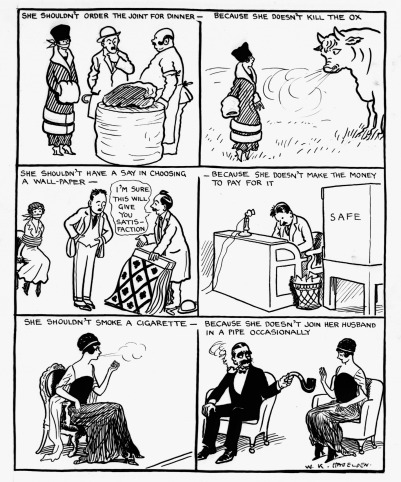
Haselden was critical of some of the hypocrisy in Edwardian society, particularly around what women were and were not allowed to do. The pencil notes at the top of the following cartoon (‘What women mustn’t do – and why’) begin with ‘If a woman shouldn’t vote because she doesn’t fight…’, alluding to the argument that suffrage should not be granted to women because they could not join the British Army:

WH1217, ‘What Women mustn’t do – and Why’, 17 January 1918, Daily Mirror

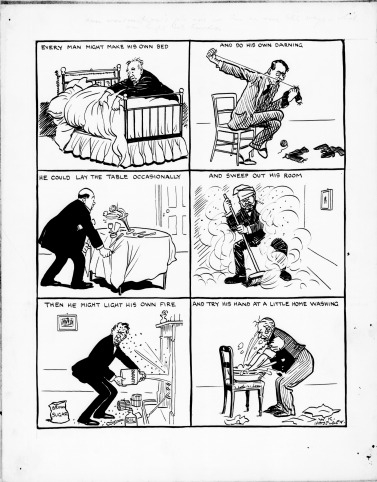
Interestingly, Haselden explores areas where men cannot match women’s skill in certain roles, particularly anything relating to domestic labour. During the First World War, women began working in roles which traditionally employed men, but were now empty as soldiers were needed on the Western Front. This led to discussions around men filling women’s roles in return (often with comical consequences):

WH3817, ‘Now that women are doing men’s jobs’, 17 January 1917, Daily Mirror

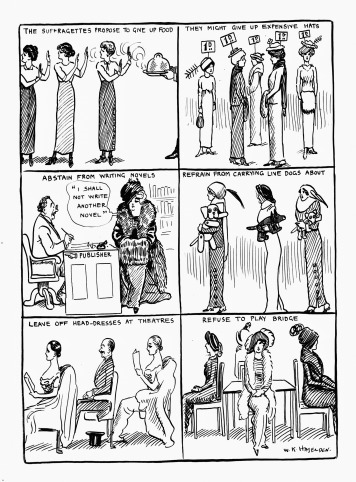
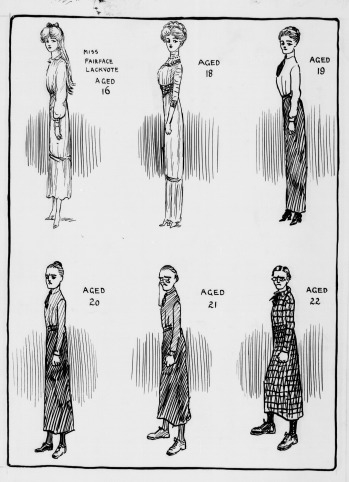
Haselden wasn’t entirely supportive of women’s involvement in politics, being particularly critical of the suffragette campaigns. His cartoons suggest that the suffragettes’ methods were silly and ineffective, and that getting involved with politics was a look most women would wish to avoid:

WH0827, ‘Some useful strikes that women might adopt’. 12 October 1912, Daily Mirror

WH0522 – ‘Effects of “votes for women” – upon Women’s faces’, 15 December 1910. Daily Mirror

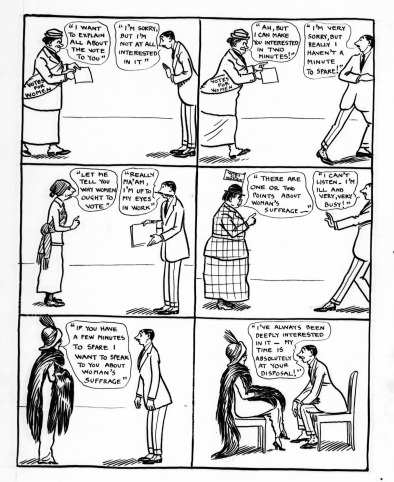
Men were not exempted from criticism of the suffragettes’ cause. In 1912, Haselden jokingly suggested that male responsiveness to women getting the vote depended primarily on the attractiveness of the campaigner in question:

WH1750, ‘His interest in Votes for Women?’, 30 October 1912, Daily Mirror

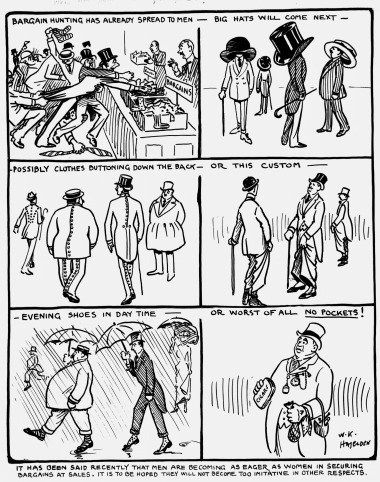
Haselden’s commentary is one of the joys of exploring the British Cartoon Archive; it’s nuanced but surprisingly light-hearted. Haselden highlights the frivolities of both men and women during the early 20th century, but also points out that a more equal society might not be a bad thing for anyone. And, of course, who can disagree with his point that women’s dresses should have more pockets?! A thoroughly modern man, indeed.

WH4765, ‘When men imitate women’, 30 June 1909, Daily Mirror

Our collection of Haselden cartoons can be explored through the British Cartoon Archive catalogue online, and his books are catalogued on LibrarySearch. To view any of Haselden’s original artworks held in the British Cartoon Archive, please do get in touch with us. 


Sources:

Little, D. (2004-09-23). Haselden, William Kerridge (1872–1953), cartoonist and caricaturist. Oxford Dictionary of National Biography. Retrieved 5 Feb. 2018, from http://www.oxforddnb.com.chain.kent.ac.uk/view/10.1093/ref:odnb/9780198614128.001.0001/odnb-9780198614128-e-66122

W.K. Haselden biography at the British Cartoon Archive

https://www.britannica.com/topic/The-Mirror-British-newspaper

Political History is Not My Forte; or, How to Learn History Through Political Cartoons

Many sides of Stalin – as drawn by Cummings

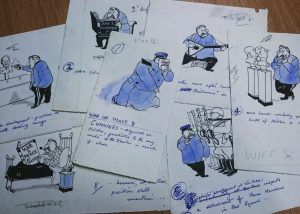
Starting work on new collections is always fun. For a start it means you’re decreasing the number of items that need working on, but you also get to go through something that’s completely new to you. Most recently, I have started cataloguing artwork by cartoonist Michael Cummings, who worked mainly for the Daily Express for a period of nearly fifty years. This particular selection of artwork dates from the early 1950s, a time that seems to be far away in the past, at the beginnings of the Cold War.

Now my first reaction was something along the lines of ‘oh no, I’m not going to know who anybody is’. As it turned out I was wrong. I recognized Clement Attlee, Winston Churchill and Stalin. This didn’t really give me a lot to go on. The 1950s are not exactly my strong point. I enjoy my history, but I enjoy my history quite a lot earlier than that. When I turned to the very first image and had literally no idea what was happening:

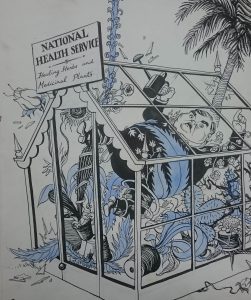
My first Cummings cartoon

My first reaction was, ‘this must be a Tory,’ based entirely on the caption. I had one other thing to go on, as somebody had very kindly written on the back of the artwork when the cartoon was published, and even what page it appeared on. As I knew all students and staff at Kent have access to UK Press Online, I decided to hop along and find the appropriate issue of the Daily Express. The cartoon was precisely where the artwork said it was, which was great. What was less great was the fact that there was nothing surrounding the image, no helpful arrows saying ‘this man is so-and-so’, and no articles relating to the image, as far as I could see, anywhere in the issue. So I hit a dead end. Extremely early on. Now what?

Well, perhaps unsurprisingly, Google searching ‘Conservative 1950s NHS’ didn’t get me very far. I had a look on Lexis Nexis but even narrowing down the date range produced more results to check than was feasible. I was almost on the verge of taking a photo on my phone and seeing if my Dad knew who it was, when I decided to check copies of the Express from the surrounding time period. This turned out to be the right thing to do – I came across a cartoon head of the very same man, this time with a caption telling me it was Aneurin Bevan.

Ok, so I basically got everything wrong. Bevan was a well-known Labour Politician, and at the time of the cartoon Minister of Health. At least I knew what the greenhouse was…

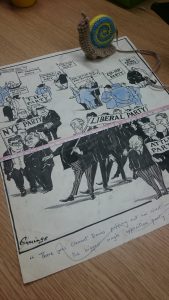
Getting the dimensions – featuring my tape measure, Colin

Establishing who people are in each of the cartoons is probably the hardest aspect of cataloguing them, for me. When I’m cataloguing I look out for specific information every time. First we need the basics: a title, artist, publication, date and size. Next comes recording anything that’s written in the cartoon, which we refer to as embedded text. This text and the image itself provides us with the information to assign subject matters to the item. This would be relevant political parties, or any celebrity and sporting news, or government policy mentioned. Other subjects can include setting, items or animals in the picture or emotions you think the people depicted are feeling. And then comes the time to add the people themselves to the record. This is also significant for the subjects; you can’t add the Chancellor of the Exchequer unless you know he’s actually in the picture.

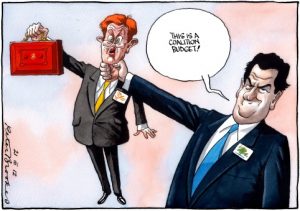
When I first started cataloguing political cartoons, around two and half years ago now, I began with the more modern items. Part of our collections here at the British Cartoon Archive include the newspaper versions of cartoons that appear in the daily papers. This means our collection grows every day, and it’s partly my job to keep on top of this. I won’t pretend that I’ve ever had much of an interest in politics, (I knew next to nothing when I started), but I’ve definitely learnt a lot working here. I could at least recognise most of the Labour and Conservative politics, but my first big stumbling block was Danny Alexander. I think I found him by searching for ‘ginger Liberal politician.’

‘This is a Coalition Budget’ by Peter Brookes

In current cartoons, the colours actually plays a surprisingly large role in identifying who people are. It’s fairly obvious what party a politician is from based on what colour their tie is, (this is obviously a problem for women). This doesn’t work in artwork from the 1950s, which is done in black ink, with a blue wash which would appear grey in the published version. Another clue could be who the person is interacting with and how. If two politicians are having an argument about something it’s likely (although not definite) that they are from opposing parties. This also didn’t help me initially, as Aneurin Bevan was the only person in the first cartoon I catalogued, but it’s certainly helped along the way.

Once you get to know who someone is, there’s usually characteristics that most cartoonists exaggerate when they’re depicting them. For example, Theresa May is always wearing leopard print shoes, whilst Boris Johnson is mainly made of hair. Back in the 1950s, Winston Churchill always has a cigar. This wasn’t strictly speaking helpful, after all if you don’t know what Churchill looks like, where exactly have you been since the start of the 20th century?

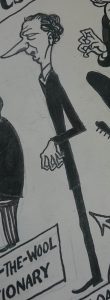
….and Strachey

Gaitskell…

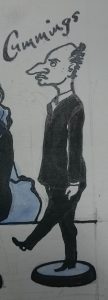
Noses and eyebrows are also quite often notable. Aneurin Bevan always has large black eyebrows paired with his neat white hair. Emanuel Shinwell, (“Who on earth?” – me about a month ago), has a very prominent, bulbous nose. Unfortunately, John Strachey and Hugh Gaitskell seem to have the same long, pointy nose, so initially I had to check which hairstyle any pointy-nosed men had to establish who they are. Here the differences seem obvious, but when you don’t know who they are and their images aren’t next to each, it’s not so easy.

There is an odd enjoyment in all this hunting for people and discovering who they are, even though I often sit there in mild despair when all my methods have failed. I wonder if Poirot ever felt like that.

This brings us to my favourite Cummings cartoon:

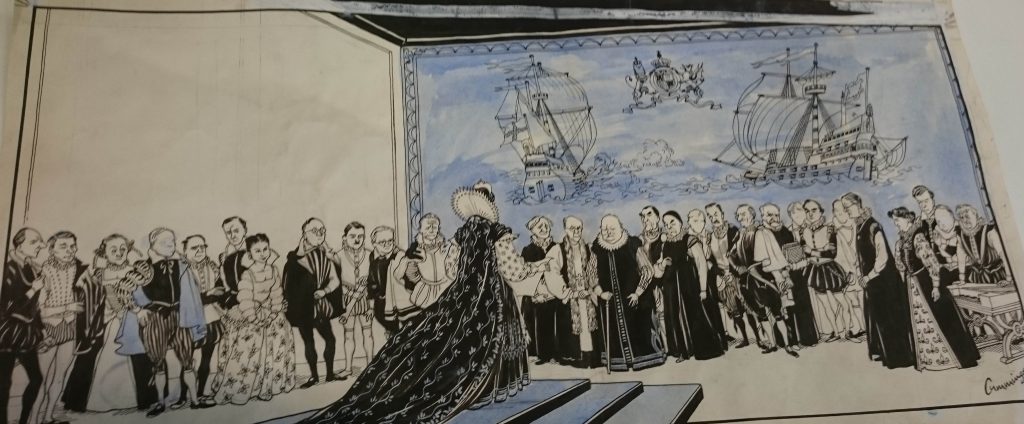
‘The New Elizabethans’ by Cummings

I love this for two reasons. 1. It is genuinely a fabulous cartoon. I love the detail and the period costume. Elizabethans are much more my style. 2. The published version of the cartoon has a key that tells you who everyone in the picture is. That was a happy moment for me.

I’m going to let you all into a little secret now. One of the reasons I have particularly been enjoying my work with the Cummings Collection is that it’s a nice break from cataloguing the cartoons of today. Sometimes working on this kind of material can get a little wearing. Recently there’s been a lot of cartoons focusing on terror attacks, and a lot about Brexit and the US presidential elections, and for the most part these cartoons aren’t overly positive. This is because the cartoonists genuinely believe what they’re depicting, and the whole point of them is to draw your attention to things that they consider need changing. But it can get very repetetive, so the 1950s is like a little holiday in history for me.

Now obviously terrible things happened in the 1950s. The Korean War and the Cold War for a start, and Stalin certainly did some terrible things. But it’s strange how the distance of time can weaken the effects of this in the present day. If it wasn’t something you lived through, or even something your parents lived through, it’s very difficult to get a proper grasp on how it must have felt at the time. If it does affect you, then you know you’ve just come across a powerful cartoon.

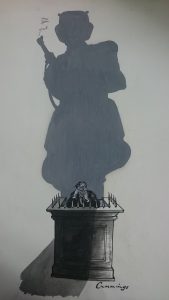
So far, this has happened to me only once whilst cataloguing this collection, when I came across the cartoon on the left. Published in early 1953, initially I didn’t have a lot to go on. It was obviously the shadow of a soldier, and that was enough for me to know if was referencing World War II. I don’t know how common this is generally, but in my head the 1950s and World War II are very, very separate. Even though I knew that 1953 was only eight years removed from the end of the war in Europe, and rationing was still ongoing. Even though I knew that war criminals were being tried, it never really occurred to me that this was something I would come across working on this collection. And that’s what this cartoon is depicting, the trial of men accused of taking part in the massacre of the village of Oradour.

For once the published cartoon actually stood alongside a relevant article in the newspaper, which allowed me to identify what it referenced easily. I had not heard of Oradour before, so I had to read the article to establish what exactly happened. I also used the internet to read more about it, and I was shaken. It wasn’t news to me that this sort of atrocity took place, but I wasn’t prepared for finding it amongst the cartoons.

I do think it’s extremely important that this cartoon, and others like it, exist. Sometimes images can convey more than words, particularly at a distance of seventy years, and cartoons certainly have their place amongst records of history, alongside sources like written accounts and photographs.

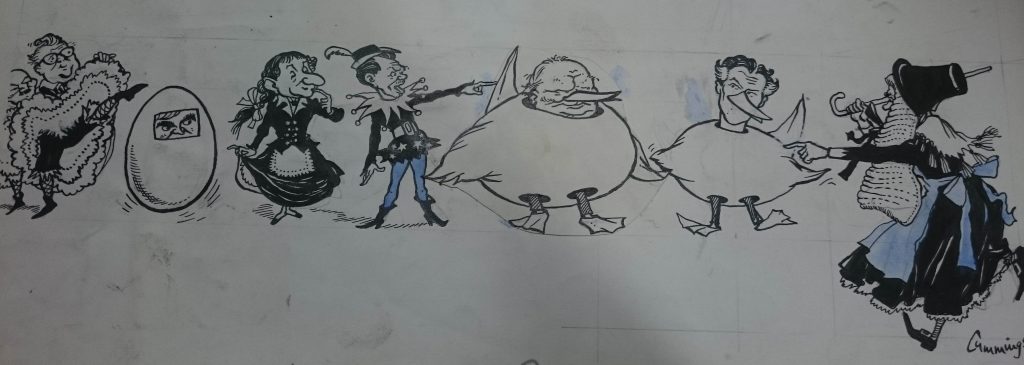
But it’s also important to keep things light. So here’s Churchill dressed as a goose:

A Politician’s Panto

All cartoons (c) Express Syndication Ltd, except Peter Brookes, (c) News UK

Special Collections & Archives 2016: our highlights

With winter frost beginning to appear around campus, the wonderful end of term carol service just around the corner, festive activities everywhere and our Reading Room winter closure dates announced, it seems the end of 2016 is in sight at last. With this in mind, we thought we’d take a look back over our year as a team and share some of our favourite highlights with you all!

2016 has been a big year for Special Collections & Archives: we’re still amidst the ongoing Templeman Library refurbishment, but we’re settling into our new home in the shiny West extension well. We’ve seen launches of a new website for the British Cartoon Archive, and the British Stand-Up Comedy Archive got its collections out to the world online too. We launched our Instagram account, welcomed hundreds of you into our Reading Rooms and got involved with several exhibitions along the way. It’s no surprise that this year has really flown by for us – but there are many events we’ll remember well into the future:

Opening night of the DR575 Victorian Theatre exhibition, April 2016

Rachel (Special Collections & Metadata Library Assistant): “On Wednesday 6th April the yearly exhibition by Kent second year students on the British Theatre History module launched. Whilst this has been an annual event for several years, this time the students faced a bigger challenge than ever: the size of the Templeman exhibition space. This was only the second exhibition in the new space, and was more than twice the size of spaces used in the past! The students rose to the challenge admirably, and created a very successful and effective exhibition on Women on Stage and in Society : 1850-1915.”

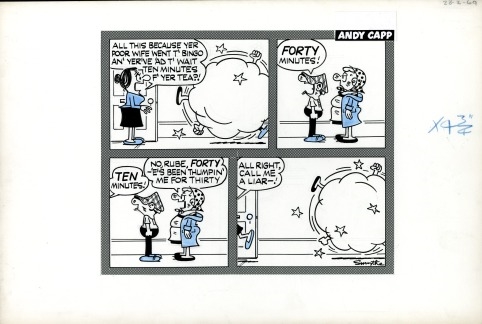
Andy Capp and his wife Flo give as good as they get! AC3414, December 1969, British Cartoon Archive

Mandy (Digital Imaging Assistant): “I’ve been scanning material from the British Cartoon Archive so everyone can view it online. I’ve enjoyed seeing how funny the Andy Capp pictures were, and how things have changed as regards to how women were seen. I also got to catalogue some vinyl records – it was like going back in time! Getting them out of the cardboard sleeves with the A and B sides.”

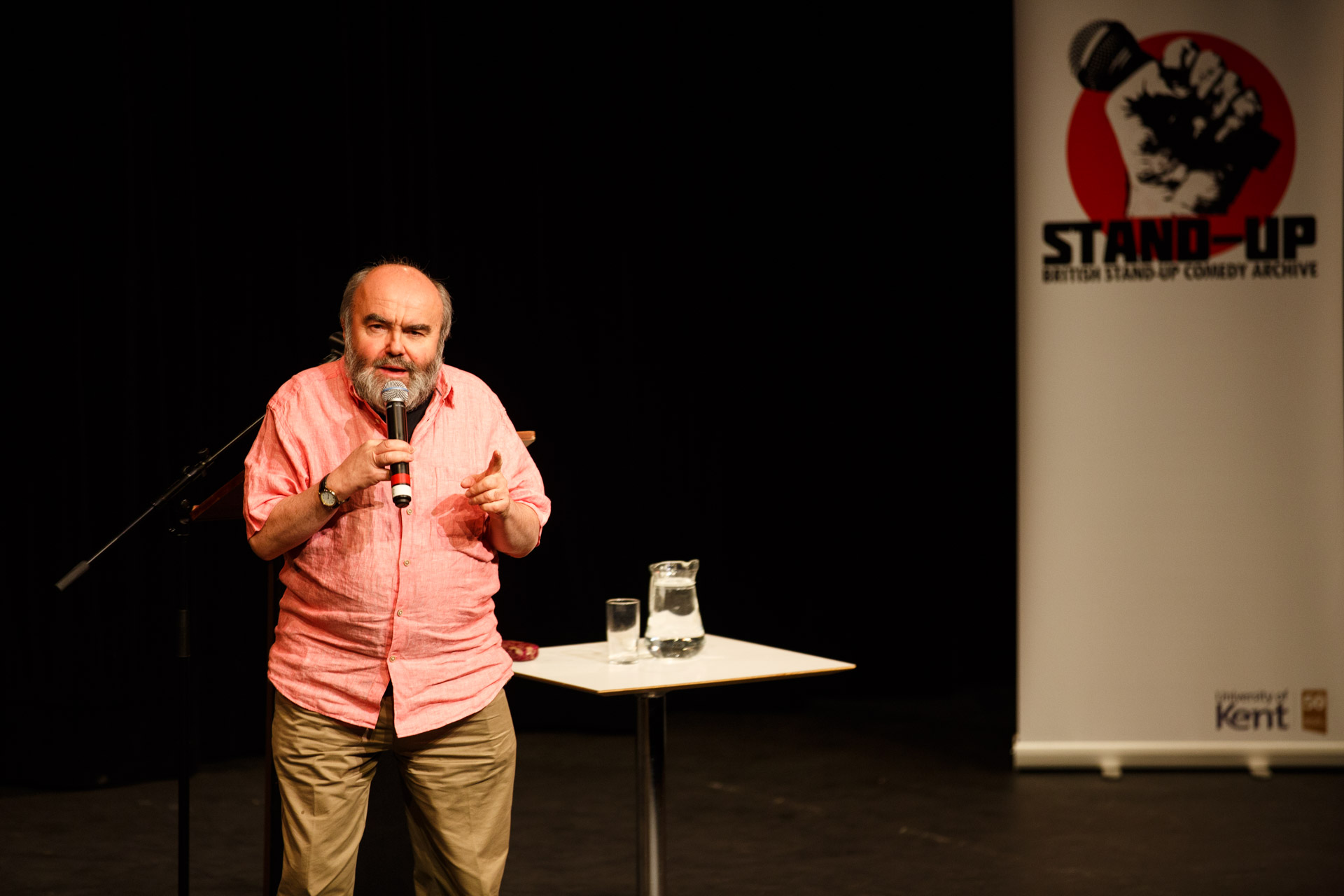
Andy Hamilton talking at the Gulbenkian Theatre on campus, May 2016

Elspeth (Assistant Curator – Special Collections & Archives): “My highlight of the year would be the 2016 Linda Smith Lecture, the second annual lecture which is intended to celebrate comedy and its use in, and for, political and social comment (as well as to promote the British Stand-Up Comedy Archive).  In May 2016 the lecture was given by Andy Hamilton. Andy is a comedian and comedy writer for radio and TV (and well known for regular appearances on topical and panel shows).

Andy covered a number of topics in his lecture, entitled ‘A Life in Comedy (and the Comedy in Life)’, including his career in comedy and the social importance of comedy. The lecture was audio recorded and can be accessed at the University’s Special Collections & Archives.  Keep tuned for news about the 2017 guest lecturer!”

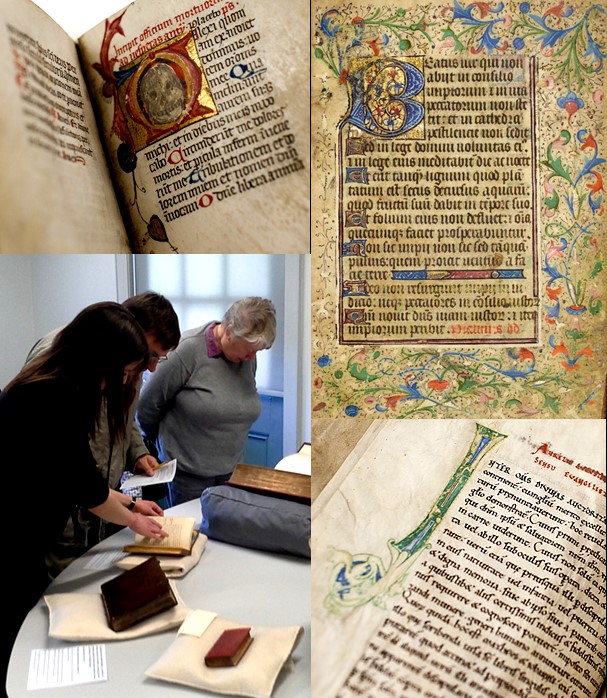
Clockwise from top left: – Illumination from 15thC Book of Hours. The skull begins The office of the dead [Officium Mortuorum, Officium Defunctorum or Vigiliae mortuorum] – Illuminated manuscript leaf from 15thC Fragment of Psalter and Kalender mss – Decorated letter from 12th century De consensu Evangelistarum by Saint Augustine, Bishop of Hippo – Josie talking about the collection at a public exhibition at Drill Hall Library in March 2016

Josie (Metadata Assistant and Rochester Cathedral Cataloguer):“Looking back at 2016 my fondest memory has been the opportunity I have had to catalogue the extraordinary collection from Rochester Cathedral Library.  My involvement with the project grew to be more than I imagined it could be, giving me the opportunity to build new relationships and  be part of the legacy of a beautiful, rare and culturally significant collection.”

Outreach posters, learning guides, feedback and groups

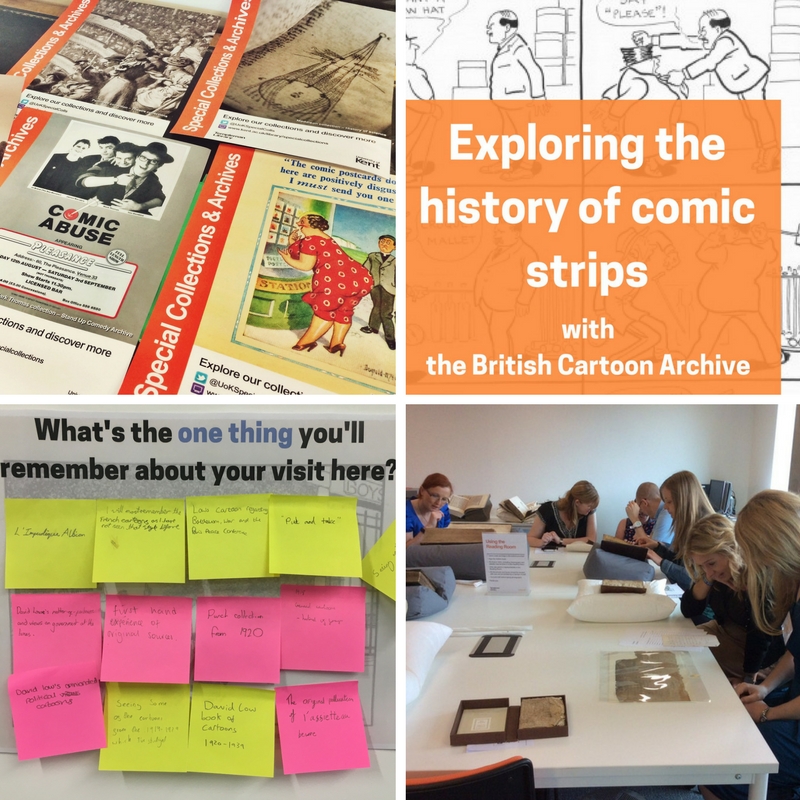
Clockwise from top left: Promotional posters, learning resource leaflets, group vists in action, and feedback post-its!

Joanna (Senior Library Assistant – Special Collections & Archives): “I’ve loved getting to know the wonderful collections we have here through running many teaching and outreach sessions. This year, we’ve hosted groups ranging from year 10 school students from Folkestone and Maidstone through to postgraduates at the University. The material we’ve used has spanned a huge variety of themes, including the First World War, Shakespeare and Early Modern playwrights, the history of comic strips, peace treaties, stand up comedy, Victorian theatre, local history and curation. We’ve been trying to integrate more material from the fantastic British Cartoon Archive into our sessions, and it’s always been a huge success! We’ve also been developing lesson guides so students have something to take away with them, and I hope we can develop our outreach even more next year.”

melissas-favourites

Clockwise from top left: Tavener Bible (1549, SC&A); illuminated leaf from Fragments of Psalter and Kalendar (c. 15th Century, Rochester Cathedral Library); A Display of Heraldry (1679, SC&A); Soliloquium de quatuor mentalibus exercitiis (c. 14th Century, Rochester Cathedral Library); Wingham and Chatham Dockyard indentures (c. 14th century, SC&A); A topographical map of the county of Kent (1769, Rochester Cathedral Library)

Melissa (Head of Academic Liaison): “Whilst it would be difficult to single one memory out, it would have to be viewing the collections themselves. Having the opportunity to engage with the wonderful, diverse and rich materials as part of the exhibitions and displays hosted by SC&A is a fabulously rewarding experience.

The collections do truly speak for themselves but this year, probably the stand out moment for me was when we were able to showcase some of the Rochester Cathedral collections alongside some of our own collections as part of the summer Centre for Medieval and Early Modern Studies Festival . This rare opportunity to engage with some of the highlights from the Rochester Cathedral collections, following our cataloguing project we have undertaken with them, was not to be missed. I am particularly drawn to old maps and rich imagery and I captured some of my favourite materials from the exhibition. I am therefore letting the photographs do the talking!”

Jane in her element – with rare books!

Jane (Humanities Liaison Libarian): “Although I have spent most of this year out of Special Collections, on a secondment as Liaison Librarian for Humanities, I’ve still been lucky enough to be involved. Back in January, I found myself starring (rather unexpectedly) alongside materials and academics in a promotional video for new modules running in the School of History and CompLit – my hands and skill at nodding are now out there on the web! It’s also been great to link up with the Marlowe Society and to be asked to take care of the two volume copy of Holinshed from the 16thC. This chronicle is believed to be the key source for both Shakespeare and Marlowe when they were writing their history plays, so an excellent addition to our Early Modern and theatre expertise.

Over in my new role, I’ve been delighted to help bring the wide range of collections to the notice of researchers and learners, particularly planning ahead for new courses and new interaction in the years to come. With such an array of exciting materials, I’ve no doubt that Special Collections & Archives will be engaging all kinds of researchers next year.”

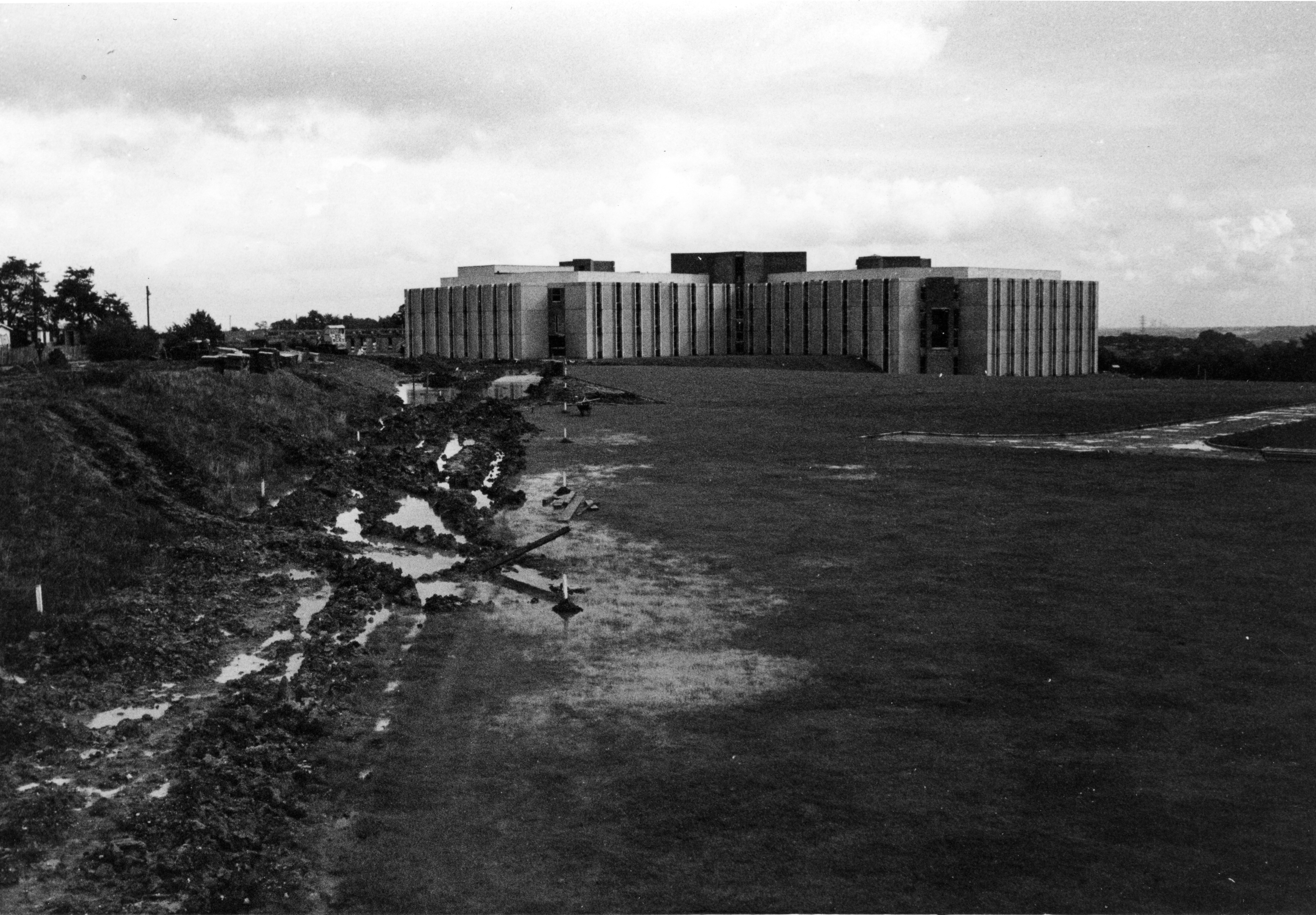
Building of Rutherford College, October 1966

Building of Rutherford College, October 1966

Ann (University Archivist): “I found 2016 a particularly exciting year, in which we celebrated 50 years since the opening of Rutherford college in 1966 and the second intake of University of Kent students. The history of the University of Kent, and the inspirational tales of some of Kent’s alumni, were celebrated in the BBC South East documentary ‘Living in ’66 – The Education Revolution’. Back to the present day, in 2016, I have been privileged to preserve the history of an institution that is so proud of its place within Europe, and still says very loudly that we are the UK’s European University. Special Collections & Archives serves both local and international communities, and in 2017 I will really look forward to seeing how we can engage new audiences in the fascinating pasts that we hold.”

We can’t wait to see what 2017 has in store for us! What are your favourite archival memories of this year?

From all the team in Special Collections & Archives, have a very merry festive season and we look forward to seeing you all in the new year!

Putting Faces to Names : Haselden’s Theatrical Cartoons

Recently I’ve been working on a collection of Punch cartoons by W.K. Haselden. The British Cartoon Archive has hundreds of cartoons by Haselden, and he is one of the most recognizable cartoonists of the early 20th century. His theatrical cartoons appeared in the ‘At the Play’ (or occasionally ‘At the Movies’ and ‘At the Revue’) section of Punch, and span a good twenty five years from the early 1910s. They feature many recognizable names and here I bring you a selection of my favourites.

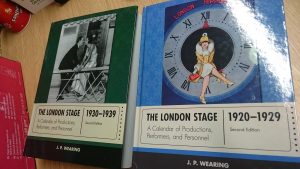
Some hefty tomes

Some hefty tomes

This work has required a lot of research on my part, as I try to identify and create records for the people portrayed in the cartoons. I have met hundreds of actors and actresses along the way, often with the help of the books you can see on the right. Some of my favourite names include Beppie de Vries, Norman V. Norman and Beatrice Appleyard. Here I present to you some more familiar names I came across as I catalogued the collection.

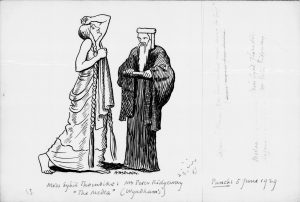
Dame Sybil Thorndike

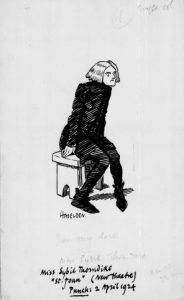
Sybil Thorndike was born in the late 19th century, and she’s a local girl. Whilst she was born in Lincolnshire, her brother (also an actor, although perhaps more well known as an author) Russell was born down the road in Rochester, where their father was a canon at the cathedral. Sybil attended Rochester Grammar School for Girls, and is probably their most well-known pupil. She was most famous as a theatre actress, and was so well known in her day that she was in the ‘Black Book’ of people to be arrested if the Nazis ever invaded Britain!

Sybil Thorndike in "St. Joan" - a role created for her by George Bernard Shaw

Sybil Thorndike in “St. Joan” – a role created for her by George Bernard Shaw


The Medea

The Medea


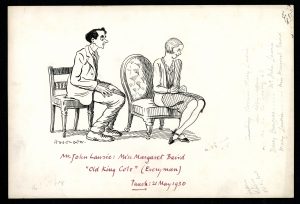
John Laurie

John Laurie is perhaps most remembered for his part in Dad’s Army, as my favourite character Frazer, but this was by no means his most significant role. He was also a part of hit Sixties shows The Avengers and The Ken Dodd Show, and appeared often on stage, particularly in Shakespeare, including Hamlet, Richard III and Macbeth. According to IMDB, he appeared in 161 acting roles on film and TV in his long career. He even appeared in a Disney movie, their 1950 rendition of Treasure Island.

Old King Cole

Old King Cole

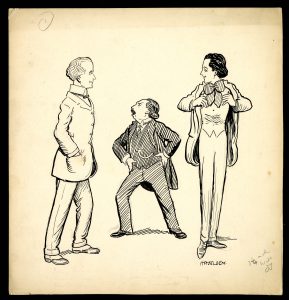
Dion Boucicault

It was particularly pleasing to come across cartoons of Dion Boucicault as I catalogued, as we hold a Boucicault Collection here at Kent. These are two different Dion Boucicaults, our collection being about the father of the man in the cartoons. This is quite confusing, and completely unnecessary, as in reality the two of them had completely different names! Whilst he was known as an actor, he was also a theatre manager, and had particular success with the premiere of a little known play, one Peter Pan by J.M. Barrie. It was Dion’s sister, Nina Boucicault, who was the first actress to ever play Peter Pan.

Nina Boucicault (Sister of Dion Jr.)

Nina Boucicault (Sister of Dion Jr.)

Dion Boucicault Jr. (centre)

Dion Boucicault Jr. (centre)


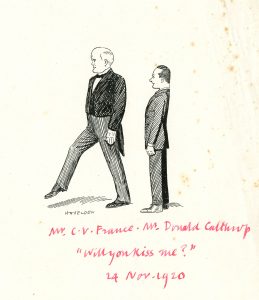
Donald Calthrop

Number two of three I’ve found related to collections we hold. It was the first Dion Boucicault’s great-grandson, another Calthrop, who donated some of our Boucicault material. Donald Calthrop was Boucicault’s nephew, and a significant actor in his own right. He appeared in no less than five early films directed by the great Alfred Hitchcock. Sadly, he died of a heart attack before he finished filming Major Barbara in 1941.

Donald Calthrop

Donald Calthrop

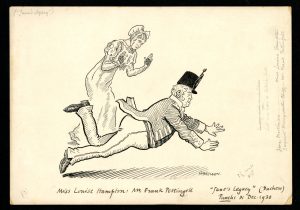
Frank Pettingell

And here’s the third. Frank Pettingell was the owner of our largest collection of playscript, both printed and manuscript, and he in his turn acquired them from the son of well-known comedy Arthur Williams, whose stamp can be seen on most of the items in the collection. Frank was a Lancashire man who served in the First World War. His film credits include the original version of Gaslight, and played the Bishop of York in the film Becket, which featured Richard Burton, Peter O’Toole and John Gielgud.

Frank Pettingell, taking a trip

Frank Pettingell, taking a trip

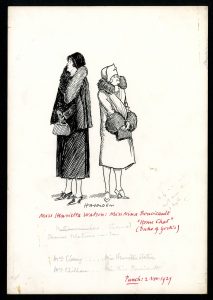
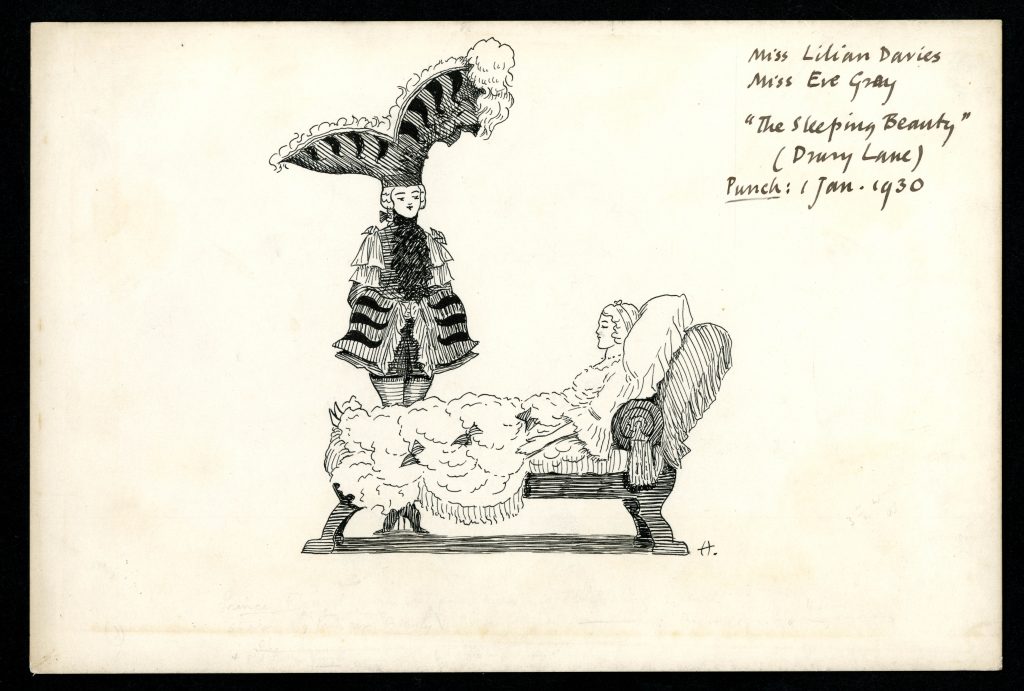
Princess Lilian, Duchess of Halland

Grace Kelly may be well known for marrying European Royalty, but she was not only one! Lilian Davies, an actress more known for her modelling, from Swansea, married into the Swedish royal family in 1976 at the age of 61. They’d been living together for almost 30 years after she and her first husband divorced, but did not marry as it was thought Prince Bertil may have to become Regent after the heir to throne died, leaving a son only a few months old. However, Carl XVI came of age before he came to the throne, and he approved Prince Bertil’s marriage to Lilian. She lived to be 97, and continued to attend official engagements well into her 90s.

A most impressive hat

A most impressive hat

Rachel.