New exhibitions – Harry Bloom and DocExplore

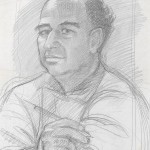
Harry Bloom (1913-1981)

Harry Bloom (1913-1981)

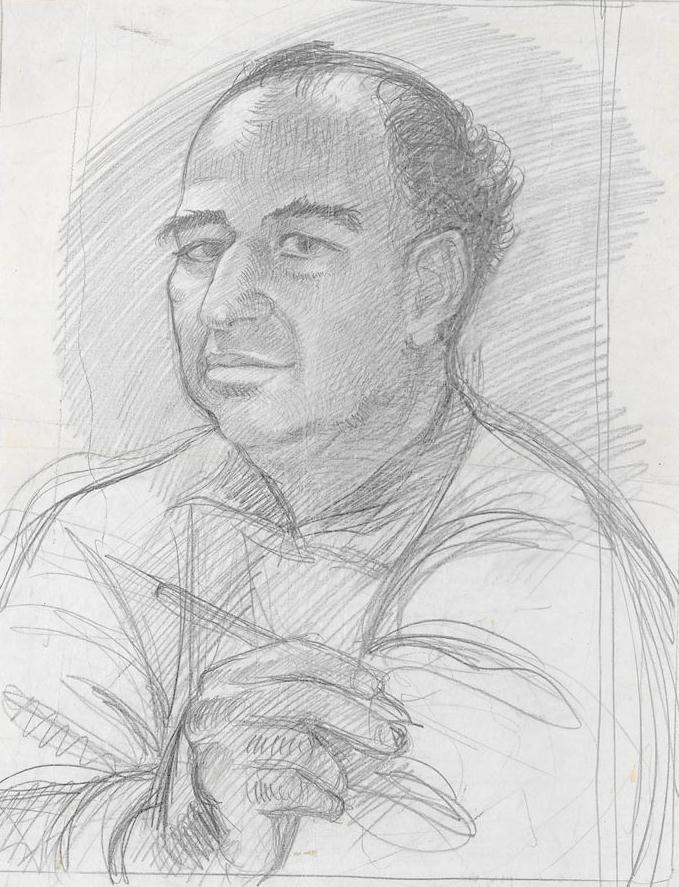
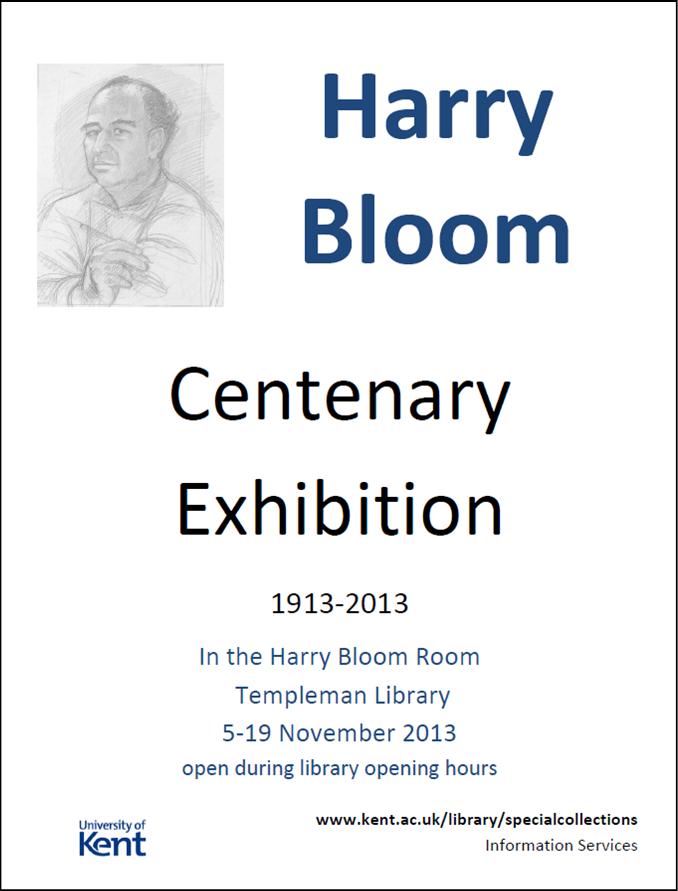
This year marks the centenary of human rights and anti-apartheid campaigner Harry Bloom’s birth. Harry was a founding member of the Law School at the University of Kent and a key part of the teaching staff. To celebrate his life and the service he gave to the University, Special Collections has put together a small exhibition in the Harry Bloom Room of the Templeman Library, which will be open until 19 November.

Harry was born in South Africa and graduated with a degree in law in 1937. He worked as an advocate in Johannesburg until emigrating to London with his first wife, Beryl, in 1940, where he worked as a war correspondent. After the war, the Blooms moved to Czechoslovakia until the increasing power of the Stalinist regime led them to return to South Africa. There, Harry campaigned against apartheid, advocating equal rights for all. He worked alongside Nelson Mandela during the 1950s. Because of his campaigns, Harry was detained without trial in 1962, after which he returned to London, to work as an academic and journalist. He joined the University in 1966 as a key part of the nascent Law Department.
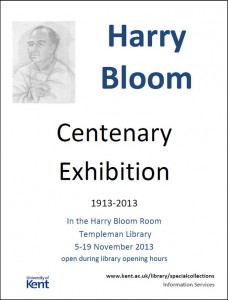
harrybloomposterOne of Harry’s key interests in the development of the interdisciplinary School of Law was the role of the media and of technology; indeed, he was a leader in this field long before the age of the internet brought the topic to prominence. His teaching also put an emphasis on practical experience as well as passive learning, through research projects. In 1973, Harry was integral in setting up the Unit for Legal Research on Computers and Communications at the University.
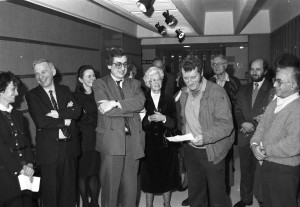
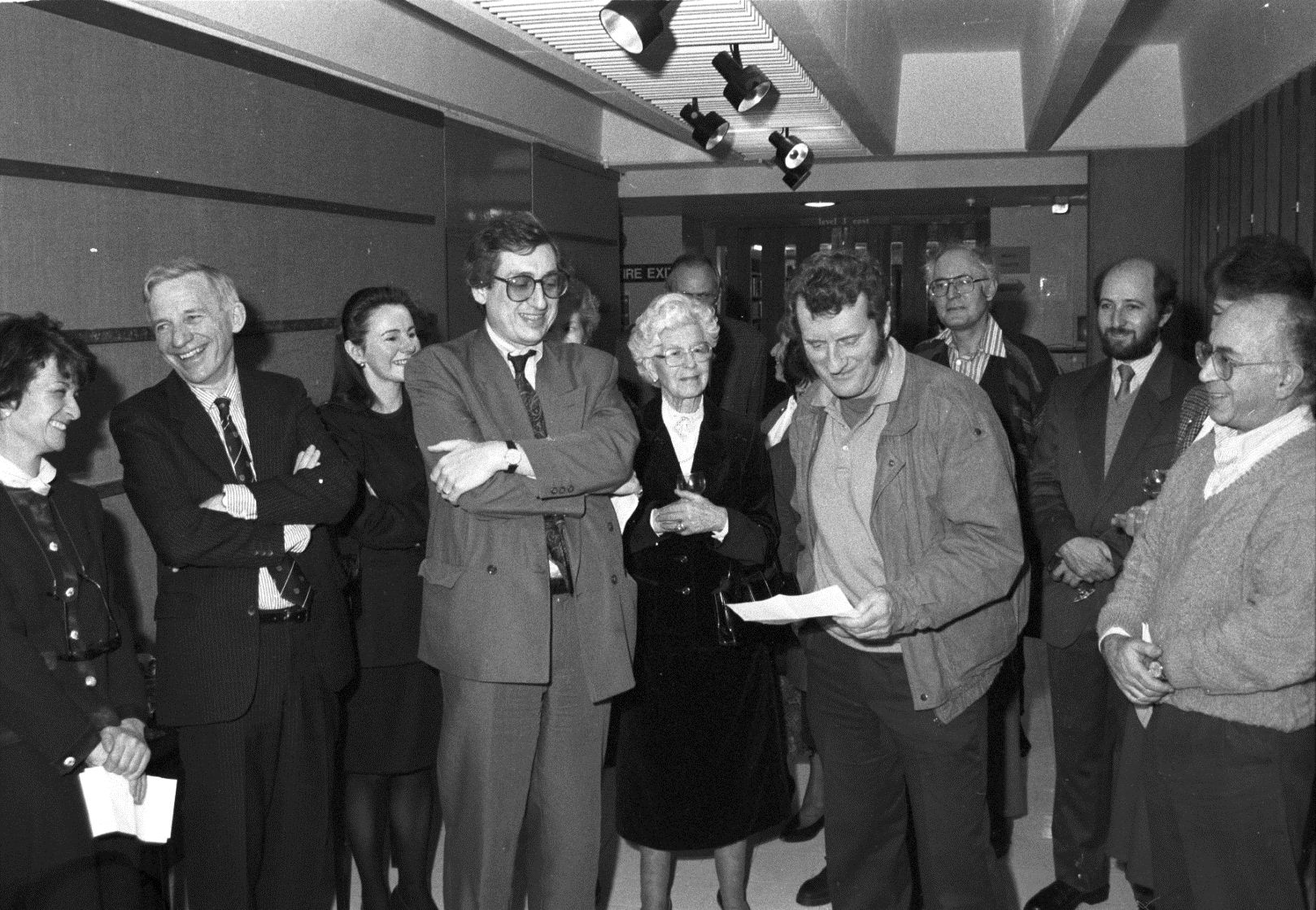
The opening of the Harry Bloom Room, 20 December 1991

The opening of the Harry Bloom Room, 20 December 1991

After a long illness, Harry Bloom died in 1981. To celebrates his contribution to Kent and to his uniquely advanced work on computers and communications, Harry’s widow, Mrs Sonia Bloom, gave a generous donation to the Library for the equipping of an IT Suite in the library for students.  The Harry Bloom Room no longer houses computers, but still offers a designated study space for students to work in and to be inspired.

The University organised a celebration to mark the Centenary of Harry Bloom’s birth on November 5th 2013 with a Seminar for his academic friends and colleagues who had worked with him at Kent. This was an opportunity for experts in the field and colleagues to discuss Harry’s work and celebrate his life.  Praise of his work was led by Professor Igor Aleksander, Emeritus Professor at Imperial College and holder of a lifetime achievement medal for contributions to informatics by the UK IEE in 2000.   We are delighted to be able to contribute to these celebrations with this small display. Do pop in to take a look at it if you can.

Not content with just the Harry Bloom display, we are also hosting a new exhibition for the DocExplore project, which has worked to bring digital versions of rare and fragile historical manuscripts to a wider audience. Combining expertise and materials from the University of Kent, the Universite de Rouen and Canterbury Cathedral Library and Archives, the project seeks to:

empower…citizens on both sides of the Channel to engage with, explore and study their cultural heritage, as embodied in written and printed documents, in meaningful, informative, accessible and entertaining ways

With interactive touch screen technology and a wealth of information, this exhibition is one not to be missed! Why not pop in when you’re in the Library – it’s in the Gallery, just to the left of the Templeman’s cafe.

And, of course, we do have more exhibitions and displays in the pipeline – but more on those as next time!

A melodramatic celebration

Can you believe it? We’ve just passed 100 posts on the blog! Over the last two and a half years, we’ve been bringing you all the exciting news and updates from our treasures in the Templeman; I hope you’ve been enjoying the posts so far. I am honestly surprised that it’s been quite so long, but they do say that time flies when you’re having fun.

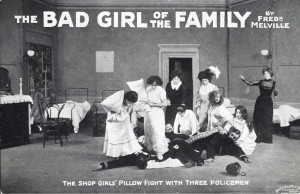
To mark this impressive milestone, I thought I’d tell you about some new additions to the archival materials we now have available online. The eagle-eyed amongst you may already have noticed (if you’ve happened to type ‘Melville’ into our Special Collections search), that it’s not just digital images of playbills which now accompany our catalogue records. Type ‘Bad Woman’ into the search box, and you will now be greeted by images of black and white publicity postcards from the melodramas of the Melville family.

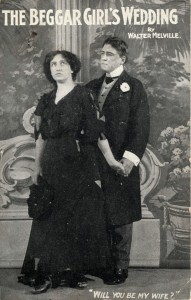
The Beggar Girl's Wedding publicity postcard

Publicity postcard, c.1908

You’ve probably read about the Bad Women dramas here before; they are one of the most popular parts of our Theatre Collections, but also sadly underresearched. Created by Frederick and Walter Melville, two brothers from the theatrical Melville dynasty, the Bad Women plays were stock melodramas, dealing with all kinds of concerns of their day, the early 1900s. The majority follow an upright hero and an innocent heroine (a ‘good’ woman) whose honourable intentions are usually impeded by a villain and the trademark villainess, the ‘bad woman’ of the title.

During my time in Special Collections, we have been able to purchase a number of these postcards which still survive, resulting in a gradual increase in our understanding of these unpublished plays. Every time we get a new delivery, it feels a little bit like Christmas to open the envelope and take a close look at the wonderfully posed and illustrative scenes from each individual play. Our latest acquisition increased the number of cards we have from ‘The Female Swindler’ from two to eight, opening up this little known play without reading the whole text.

I must confess that I haven’t read very many of the Bad Woman dramas (much as I would love to spend the time doing so!) Aside from the exciting theatrical read-through which we did with the Melodrama Research Group, to my knowledge these plays haven’t been performed for around 100 years, so the postcard images are a valuable insight into performance styles, set and costume at the turn of the century. It’s also always a bit of a challenge to look at our whole stock of cards for any given melodrama (the most we have for one play is currently eleven for ‘The Bad Girl of The Family’) and try to piece together the narrative. Of course, we don’t know whether we have a complete set of any of these, we can only build them up as we go, which means that the order in which the postcards are catalogued doesn’t necessarily reflect the story!

The Bad Girl of the Familt publicity postcard

Publicity postcard c.1909

We are also lucky enough to be involved in the Melodrama Research Group which specialises in cross-faculty research on this performance style and has broadened our understanding of where the Melville melodramas fit into the popular tastes of the time. Linking quite neatly with this, we do have some (non-Melville) filmic postcards available in the Templeman Gallery space advertising the Melodrama Group and its activities – do feel free to pop in and pick one up!

As for the Melville postcards, it’s a delight to be able to share them with you, and I hope that they will inspire some new interest in melodrama and the Melvilles, who have been sadly forgotten today.

New exhibition: Picture this…re-view

We’re delighted to be able to join celebrations marking the first anniversary of the inspirational series ‘Picture this…’, a collaborative project between Canterbury Cathedral Library and the University’s own Centre for Medieval and Early Modern Studies (MEMS).

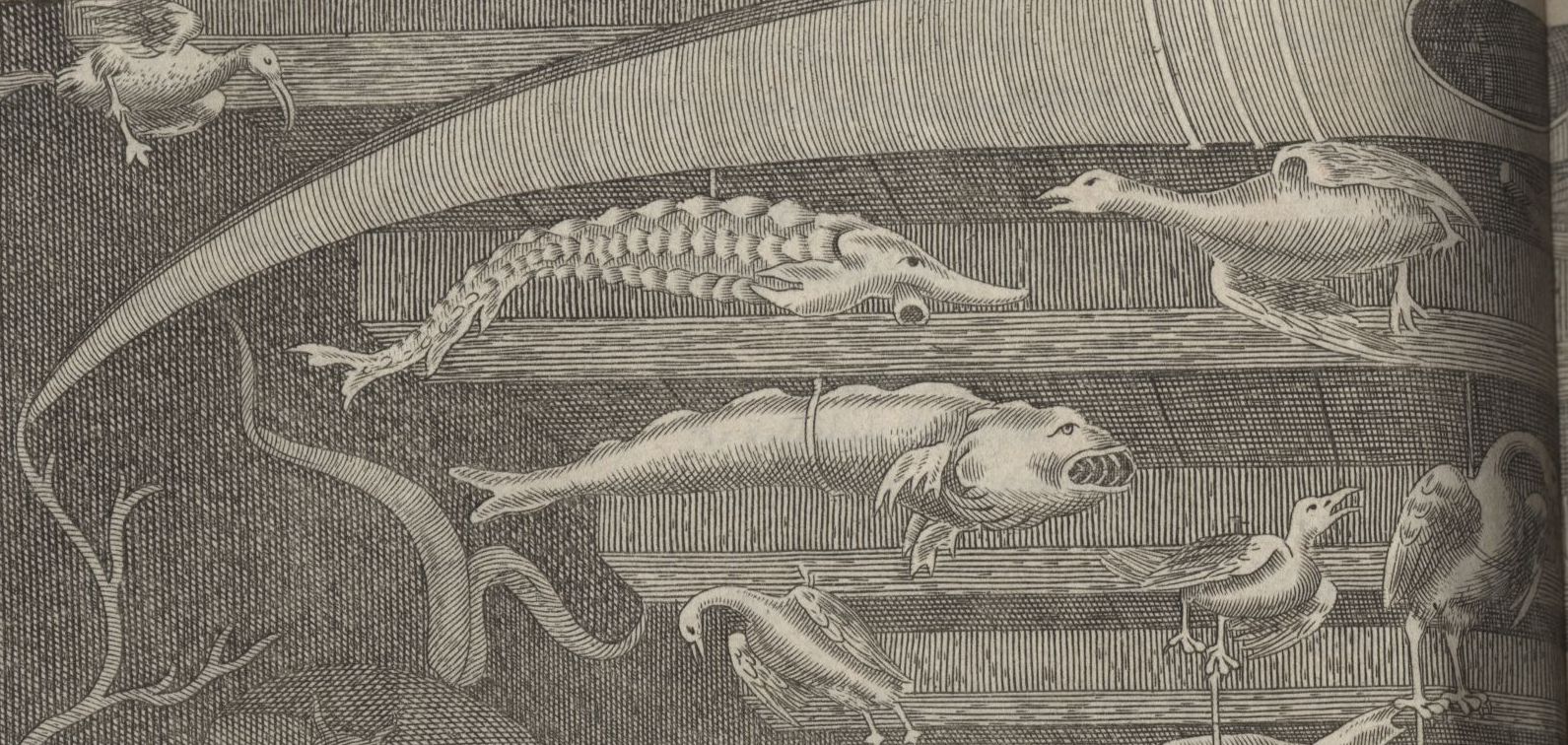
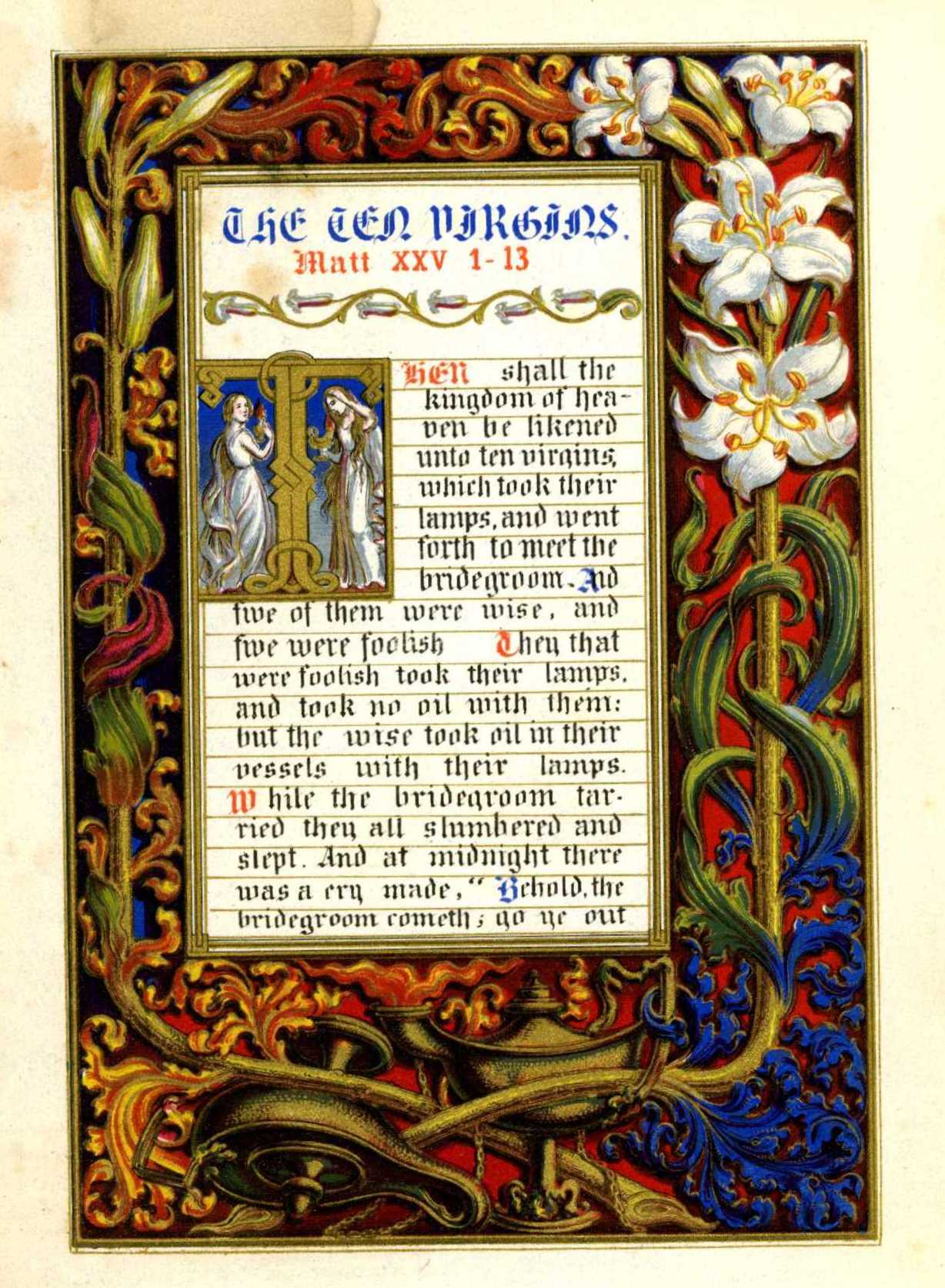
The Picture this…re-view exhibition in the Templeman Library offers a second chance to explore the discoveries made by MEMS in the Cathedral Library, combined with examples of Special Collections’ own historical book collections. Included are some insights into early modern natural science, the nineteenth century answer to medieval Books of Hours and the craft of sixteenth century map making.

Pop into the Gallery to learn what this intriguing illustration is all about.

Pop into the Gallery to learn what this intriguing illustration is all about.


'The Parables of Our Lord' published to mimic a medieval book of hours

‘The Parables of Our Lord’ published to mimic a medieval book of hours

Picture this… brings experts from MEMS together with historical books from the Cathedral Library in writing workshops. The results of these workshops are then made available on the Cathedral Library’s website each month, offering new insight into the collections. The aim of the project has been to make items in the Cathedral Library more accessible to a wider audience and to provide an awareness of some of symbolism and meaning within the images, as well as their historical significance. This year, we’ve been treated to explorations of heroism, piety, superstition and artistic techniques from a range of materials including manuscripts, printed books and objects.


Pop into the Templeman Gallery (Level 1 East, just inside the cafe area) during Welcome Week to take a look at some of our treasures and to celebrate the success of the series!

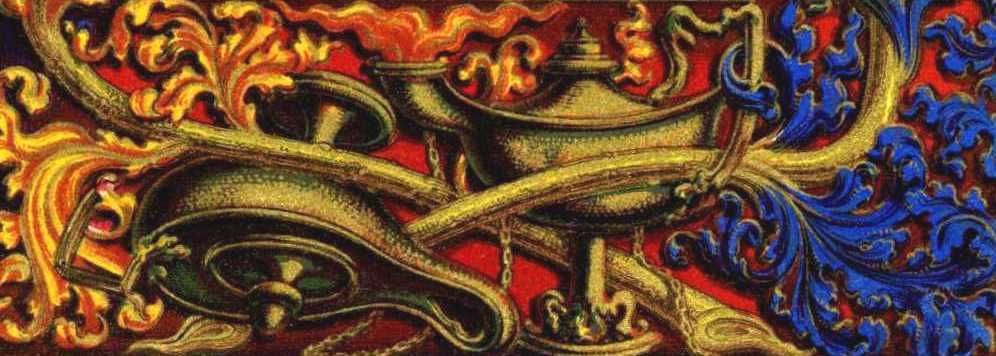
Detail from 'The Parable of the Ten Virgins'.

Detail from ‘The Parable of the Ten Virgins’.

Items in the Cathedral Library and in Special Collections are available for researchers. If you would like to know more about accessing materials, please contact specialcollections@kent.ac.uk or library@canterbury-cathedral.org.

Picture This: one year on

It’s amazing what can happen in just a year (not to mention how quickly one year can go!) This summer marks to first anniversary of the highly successful ‘Picture This’ series of monthly features on the Canterbury Cathedral Library website, the fruit of a partnership between the Cathedral Library and students from the Centre for Medieval and Early Modern Studies.

Picture thisTo celebrate this anniversary, there will be a half day symposium will be held at the Cathedral on Saturday the 17 August from 10am-1pm. During the symposium, an exhibition, including many of the items which featured in ‘Picture This’, will be launched. It will be open to the public from 19 – 30 August from 2-4pm. For more information about both of these events, and the series of features, take a look at the Cathedral’s webpages.

Over the past year, these brief features on the Cathedral’s webpages have informed, amused and stunned us with the wide variety and fascinating history of just a handful of rare books within the Cathedral Library’s collection. If you’ve been an avid follower of the series, you will know that they have taken in subjects as diverse as medieval heroism, early maps, scripture, Tudor prayer books and early modern frogs have all featured. If you’ve missed any of the posts, or would like to catch up on them, take a look at the full list of features.

We can’t wait to discover more in the next year of the series.

More Dickens Digitised!

After lots of hard work by a number of volunteers, I’m delighted to announce that we have now digitised almost all of our playbills for productions of works by Charles Dickens.

Although the bicentennial of Dickens’ birth was back in 2012, we have continued to work on this collection and, over the last few years, some very committed volunteers have made a wonderful contribution to this work.

Playbill advertising 'A Christmas Carol' at the Royal Victoria Theatre, December 1862

Playbill advertising ‘A Christmas Carol’ at the Royal Victoria Theatre, December 1862

Christopher Hall and Marjolijn Verbrugge spent a significant amount of time digitising all of our smaller playbills, which are now visible on our website. More recently, Elizabeth Grimshaw, who is completing an MA in Dickens Studies here at the University, has spent hours cataloguing our Dickens ephemera, and digitising the remaining (rather large) playbills as well as some illustrations. The digitisation involved Elizabeth painstakingly reconstructing the complete playbill in digital form from several digitised pieces, matching sections carefully to create an almost seamless effect. Matching up text and ensuring that the angles are correct is difficult at the best of times, and even more challenging with Victorian playbills and their miniscule text. Although a handful of the last playbills were digitised on the newly working oversize scanner, the majority of the credit for this work must go to our hard working volunteers!

The Dickens Collection has been assembled over many years and includes bibliographic gems, such as the nineteenth century part issues of Nicholas Nickleby (1838-1839), pieces of ephemera, such as some twentieth century ‘Pickwick’ playing cards, and illustrations. Amongst this assembly is a significant collection of Dickens theatrical material, particularly Victorian and Edwardian programmes, postcards and playbills.

Playbill for Oliver Twist, 1838

Playbill advertising ‘Oliver Twist’ at the City of London Theatre, 11 December 1838, staged while the serialisation was ongoing.

Dickens was something of a sensation in his day (to put it mildly) and it wasn’t long before theatre managers decided to cash in on the popularity of his serialised works. Borrowing heavily from the books, the unofficial productions of lengthy works such as Oliver Twist included tableaux taken from the published illustrations and adapted the stories to suit their needs. In fact, the craze for all things Dickens was so great that hack playwrights, such as Edward Stirling and William Moncrieff, would make up their own endings for serialisations which had not yet been completed. With a lack of copyright protection, or an ability to police every theatre in Britain (never mind the spin-offs put on stage in America), there was little which Dickens could do about these plagerised versions but rail against them in prose.

In any case, the risks paid off for the theatre managers in early years, with Dickens’ first full length works immensely popular on stage. Around the time of Martin Chuzzlewit’s appearance, appetites for Dickens on stage appear to have abated somewhat, perhaps due to the fact that productions of Oliver Twist, Nicholas Nickelby and The Old Curiosity Shop were all still being performed, as well as A Christmas Carol, which was published in December 1843, part way through Chuzzelwit’s serialisation. Of course, even limited success for performances of Dickens’ work on stage still proved profitable, with Dickens later cashing in to produce ‘official’ versions of his works in an attempt to limit plagerism. Even today, with television largely occupying the space which the Victorian Theatre filled, adaptations of Dickens’ works are widely popular.

We’re delighted that such an important section of the Dickens Theatrical Collection is now available on our website, with full zoom functionality, and would like to thank our volunteers for all their hard work.

If you’d like to learn more about performances of Dickens’ stories, take a look at our Dickens on Stage index.