Principal Players of the Long Eighteenth Century

In keeping with our Theatrical Thursdays theme on principal players, this post is dedicated to three eighteenth-century celebrities: Mary Robinson (1757-1800), Dorothea Jordan (1761-1816), and Sarah Siddons (1755-1831). All three make an appearance in our 1798 volume of The Lady’s Magazine which I’ve previously written about here as well as other theatrical works and women’s periodicals held in Special Collections and Archives. Women’s periodicals of this time are particularly fascinating for how they contributed to, and participated in, a growing consumer and celebrity culture. They were as much interested in what women did as what they wore – and we’re going to follow suit and explore both too.

By the time our copy of The Lady’s Magazine was published in 1798, Mary Robinson was destitute – financially and physically – having suffered a mysterious injury during a carriage ride that left her crippled. In her early twenties, she was an eighteenth-century Icarus, shooting to public attention as the Drury-Lane actress that captured the young Prince of Wales (later George IV), becoming his acknowledged mistress and taking her Shakespearean role of Perdita off-stage and off-script. She became a target for all sorts of media attention, from gossip columns to satirical prints. Also acknowledged, however, was her astonishing sense of style, which rivalled that of the Duchess of towering-plumes Devonshire – who was, incidentally, also her literary patron. Despite her tragically short life, her literary achievements number several novels, plays, poems and political tracts. In April 1798, The Lady’s Magazine printed ‘Farewell to Glenowen’ from the risqué novel Walsingham (1797), a story which charts the adventures of the cross-dressed heroine ‘Sir’ Sidney Aubrey. This deceit of dress was a popular plot device in the eighteenth century; irl, it was reserved principally for the stage, though aspersions were cast that Robinson assumed breeches during her dalliance with the Prince. She penned her own version of events in her Memoirs (1801), and Special Collections and Archives holds a late nineteenth-century copy filled with delicious details of her dresses, and illustrated with black and white plates (copies of portraits made during her lifetime). Fig. 1 gives a glimpse of early 1780s fashion, and Robinson is deliberately cultivating a domesticated look here with her pigeon-breasted fichu and mob-cap.
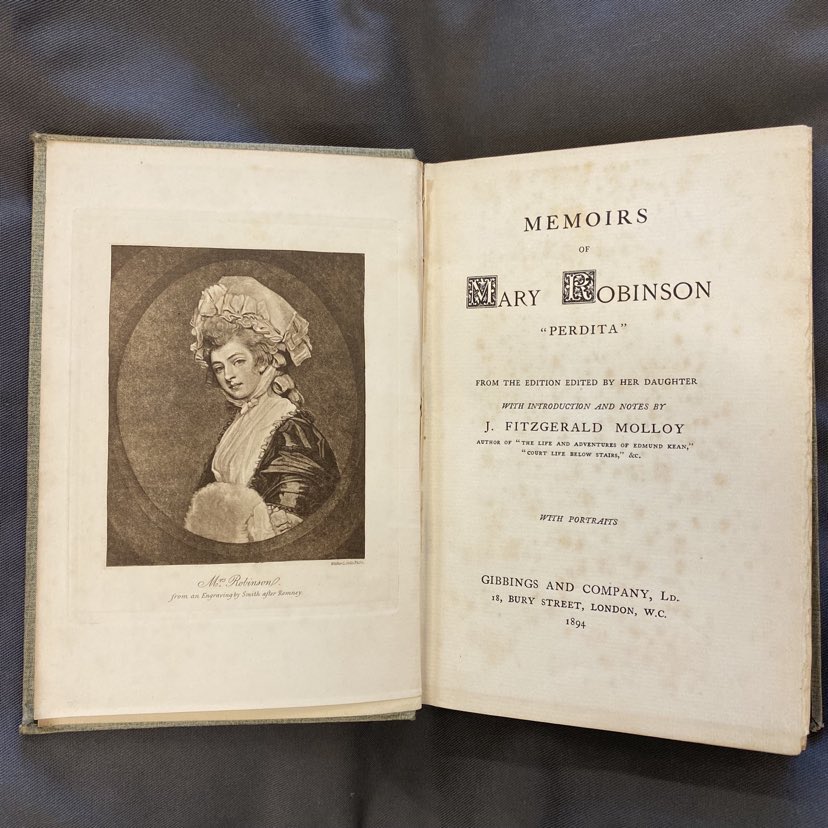
Image of Mary Robinson, the frontispiece to her Memoirs.

Fig. 1 Mary Robinson, Memoirs of Mary Robinson, “Perdita” (1894) – Reading-Rayner Theatre Collection (SPEC COLL SCRP 6.33)

Whilst Robinson is represented in The Lady’s Magazine principally as a poet, Dora Jordan and Sarah Siddons ranked amongst the most famous actresses of their day, and were respectively famed as the muses (aka queens) of Comedy and Tragedy. These lofty titles reflect the neo-classical flavour that came to characterise Regency culture, from the ionic columns in architecture to the elongated silhouettes of high-waisted muslins. Thalia (Comedy) and Melpomene (Tragedy) were, moreover,  positioned above the proscenium arch and thus part of the iconography of Drury Lane Theatre where Jordan and Siddons were seen to perform. What is interesting, however, is how these actresses’ titles became cemented through the press, and through women’s magazines in particular.

The Lady’s Magazine reported eagerly on London’s theatre scene throughout its run, giving regular accounts of new plays and comments on performers. The February issue for 1798 mentions Jordan in relation to Thomas Holcroft’s Knave or not, newly penned and produced at Drury Lane on 25th January that year. Unlike Mary Robinson, Dora Jordan survived the scandal of becoming a royal mistress – rather than a fling, she and the Duke of Clarence (later William IV) had a proper relationship; he became her protector, and by 1798 they’d had four children and were enjoying domestic harmony together at Bushy House. This stability perhaps enabled Jordan to keep up her industrious stagecraft and professional identity, and she never needed to pen memoirs to resuscitate a fallen reputation (despite the castigation she endured from the satirical press). Jordan was especially renowned for her singing voice and shapely legs, the latter discerned through her portfolio of breeches and travesty roles: Rosalind, Viola, Fidelia, Sir Harry Wildair, etc. The report of her performance in The Lady’s Magazine is complimentary in general, and emphasises the ‘commensurate applause’ she received. Jordan portrayed the character Susan Monrose, described as ‘an awkward but honest and sincere country girl.’ This part is designed to contrast with the ‘chaste, elegant, and pathetic’ part of sentimental heroine – Aurelia Rowland – played by Marie Thérèse Du Camp (who would, incidentally, become Sarah Siddons’ sister-in-law on marrying her actor-brother Charles Kemble in 1806).

The ‘country girl’ was a stock character of eighteenth-century comedy; she had a licence to flirt but stayed safely on the side of virtue – she was, in short, an incarnation of the comic muse. In the context of The Lady’s Magazine, ‘country girl’ is used as a shorthand that truncates Jordan’s theatrical repertoire into a single denomination – it ensures that this becomes the primary part-type for which she is known. Jordan made her London debut in 1785 playing the part of Miss Peggy, the titular heroine of David Garrick’s The Country Girl (1766) – an adaptation of William Wycherley’s The Country Wife, to whom copies are sometimes falsely ascribed (as is the case of the copy in Special Collections, see Fig. 2).
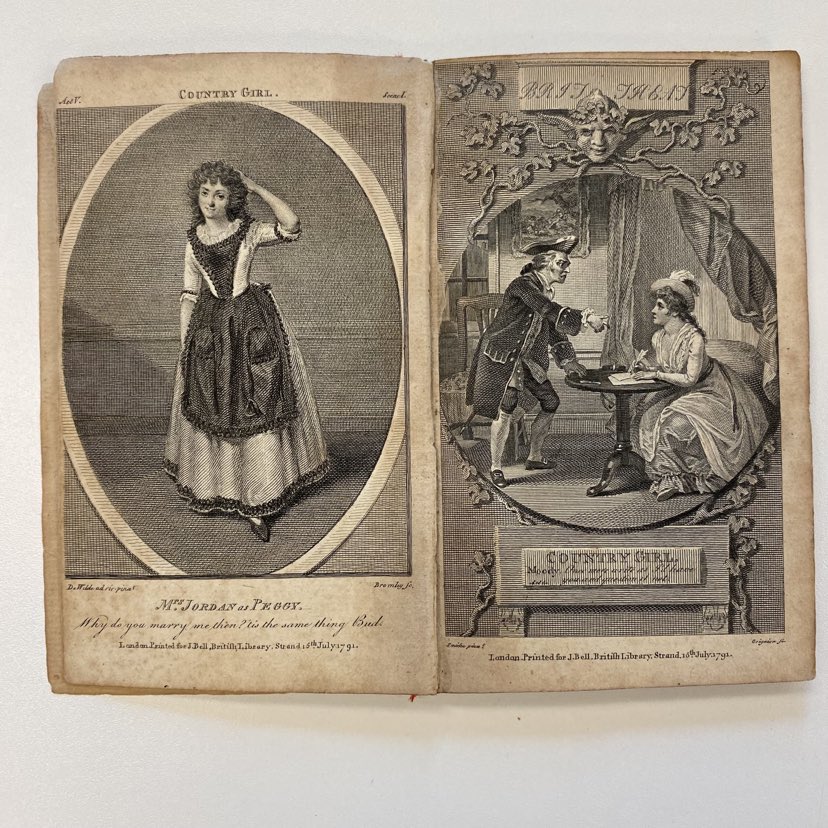
Frontispiece and title page of Wycherley's The country girl, featuring Dorothy Jordan as the country girl.

Fig. 2 William Wycherley, The country girl : a comedy (1791) – Classified Sequence (PR 3774.C6 WYC)

The image that graces this frontispiece is nearly identical to one that was published by The Lady’s Magazine which reported eagerly on Jordan’s first charismatic performance – omitting, in its imagery, the fact that this role, too, featured the adoption of breeches. Thirteen years later, the magazine uses the same terminology to describe the part Jordan plays as Susan Monrose. In doing so, The Lady’s Magazine self-consciously type-casts Jordan as a comedy actress and strengthens its own reputation for consistent and reliable journalism. When La Belle Assemblée published its own series of theatrical biographies in the early nineteenth century, it adapts a famous portrait by John Hoppner of Jordan in 1785 to accompany her memoir. (Fig. 3) The original painting depicted Jordan as the Comic Muse in company of Euphrosyne and a menacing satyr. La Belle Assemblée removes the accompanying characters and conflates Jordan with Euphrosyne in order to function as an illustration of her playing a theatrical part from John Milton’s Comus (1634). As the classical goddess of merriment, this is arguably another incarnation of the comic muse, simply the high-brow equivalent of the country girl. The magazine’s choice is therefore an act of editorial one-upmanship, supporting its own pretensions as much as securing Jordan’s status.
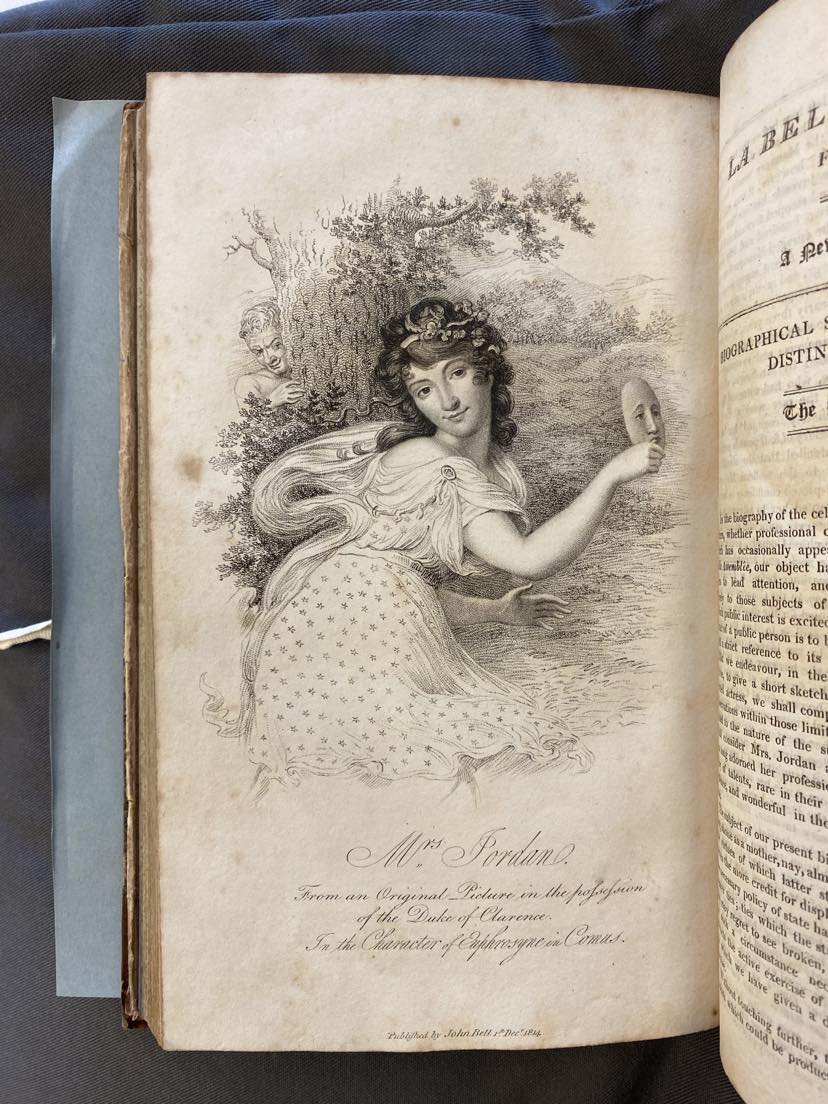
Plate from La belle assemblée, featuring Dora Jordan as Euphrosyne, and accompanying her biography..

Fig. 3 La Belle assemblée : being Bell’s court and fashionable magazine, addressed particularly to the ladies vol. 10 (Nov 1814) – Classified Sequence (PER AP 4.B31)
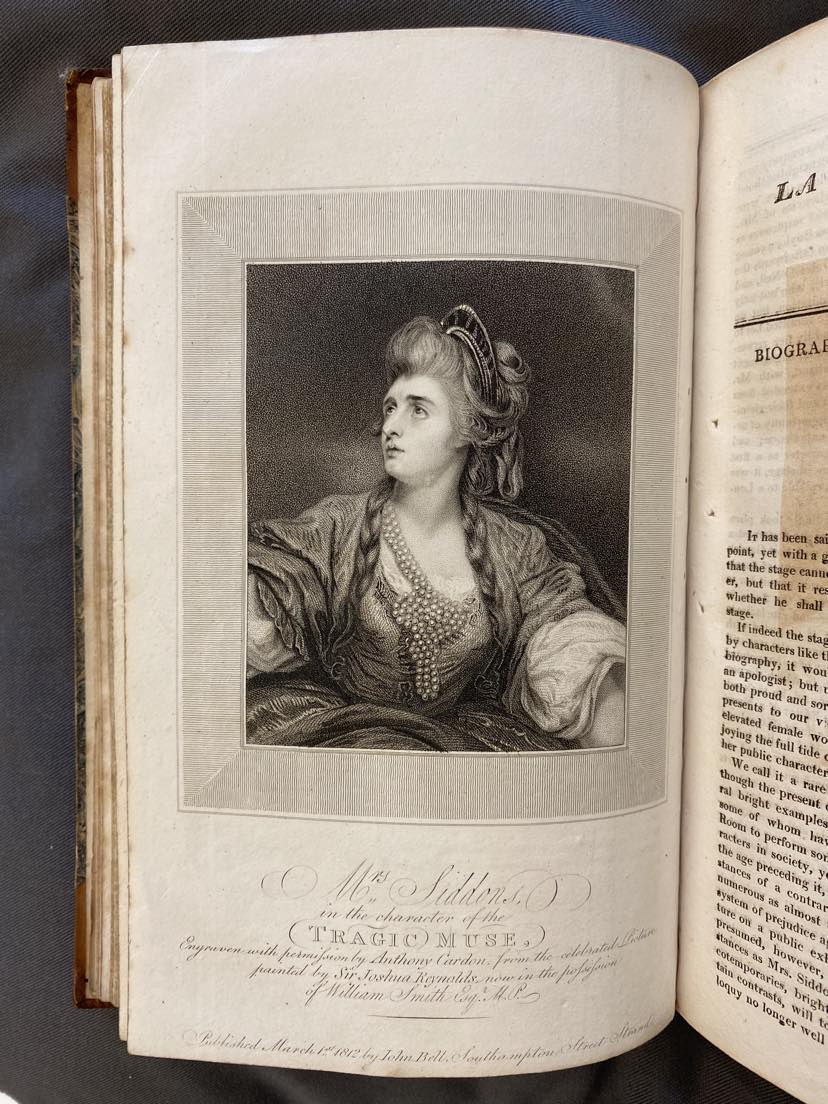
Plate from La belle assemblée featuring Sarah Siddons as the tragic muse, and accompanying her biography.

Fig. 4 La Belle assemblée : being Bell’s court and fashionable magazine, addressed particularly to the ladies vol. 5 (Feb 1812) – Classified Sequence (PER AP 4.B31)

In a neat fait accompli, La Belle Assemblée paired Siddons’ memoir with an engraving of Reynolds’ 1784 portrait of the actress as the tragic muse. (Fig. 4) It is an image designed entirely to evoke homage, and paeans to Siddons are common throughout the eighteenth- and nineteenth-century world of print. Siddons started her career on the provincial circuit before rising to fame in London in 1782 and cultivated a professional profile as maternal tragedienne. She was known to bring her children on stage with her, embodiments of her marital fidelity and mascots of virtue to stave off the satirical press. The Lady’s Magazine for 1798 offers an example of her extensive fandom, printing ‘Lines written on seeing Mrs. Siddons, as Mrs. Haller in “The Stranger,” Friday, 25th of May; and as Isabella, in “The Fatal Marriage,” Monday, 18th, 1798. By Capel Lofft, Esq.’ Mrs. Haller and Isabella were, indeed, two of Siddons’ most famous stage roles, both naturally tragic characters, and Special Collections holds theatrical works that give insight to Siddons’ performance of these parts and to Regency costuming as well. I want to finish this post with my favourite finds: Elizabeth Inchbald’s British Theatre (1806-8) and William Oxberry’s New English Drama (c. 1818-26). These series printed popular plays alongside illustrations and forewords that reflected contemporary productions, including those of The Stranger and Isabella; or, the fatal marriage. In comparing the two (Figs. 5-7) we can see an interesting contrast in theatrical wardrobes, from the white muslin of an unabashed Mrs. Haller to the Van-Dykd velvet of the swooning Isabella. The stage, of course, was (and always will be) a place where contemporary fashions and fanciful costumes vie with each other.
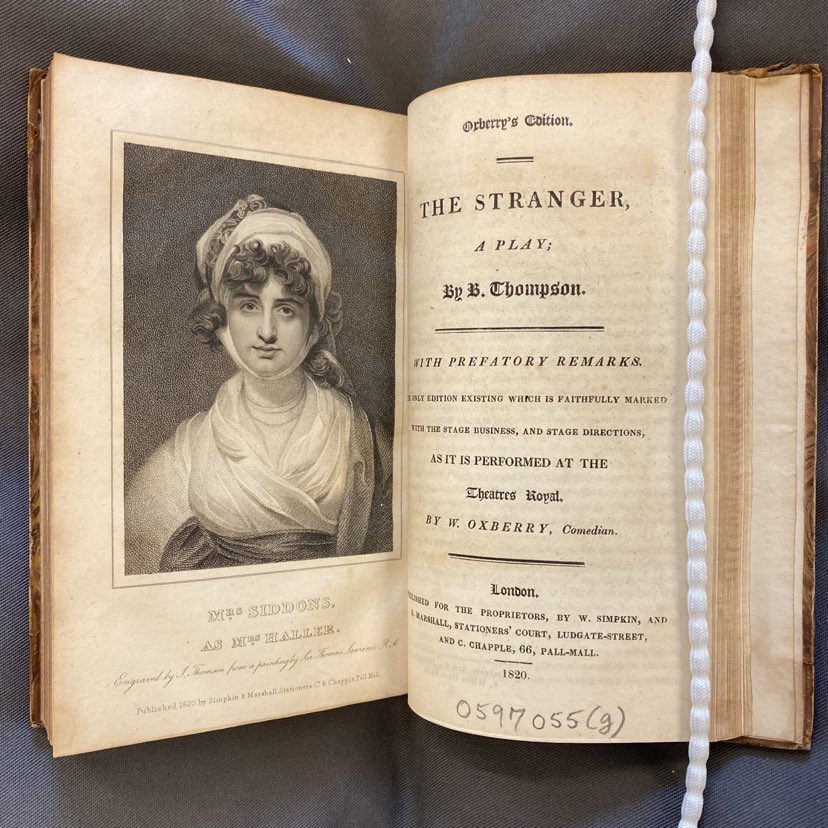
Plate of Sarah Siddons in the role of Mrs Haller, accompanying the play The Stranger, in Oxberry's edition of New English Drama.

Fig. 5 William Oxberry, ed. New English Drama (1806-1808) – Pettingell Collection (PETT BND.86(5))
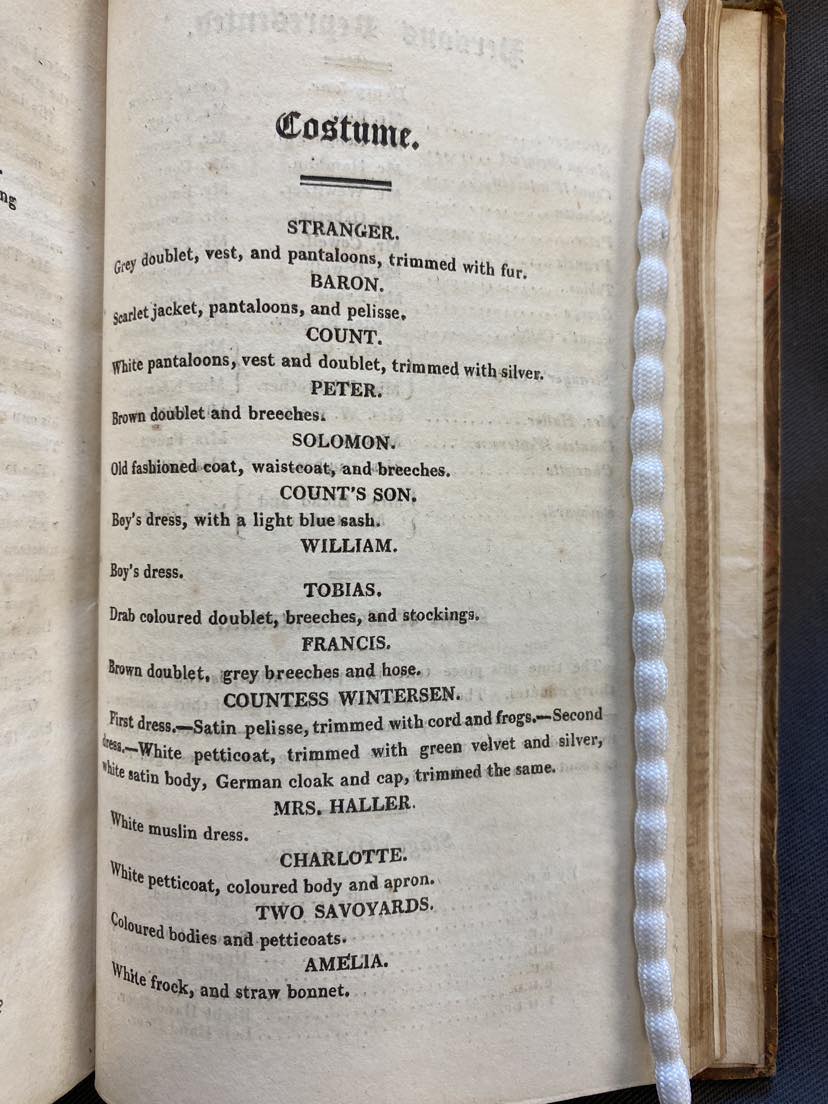
Page detailing costume designs for The stranger to accompany the play in Oxberry's edition of New English Drama.

Fig. 6 William Oxberry, ed. New English Drama (1806-1808) – Pettingell Collection (PETT BND.86(5))
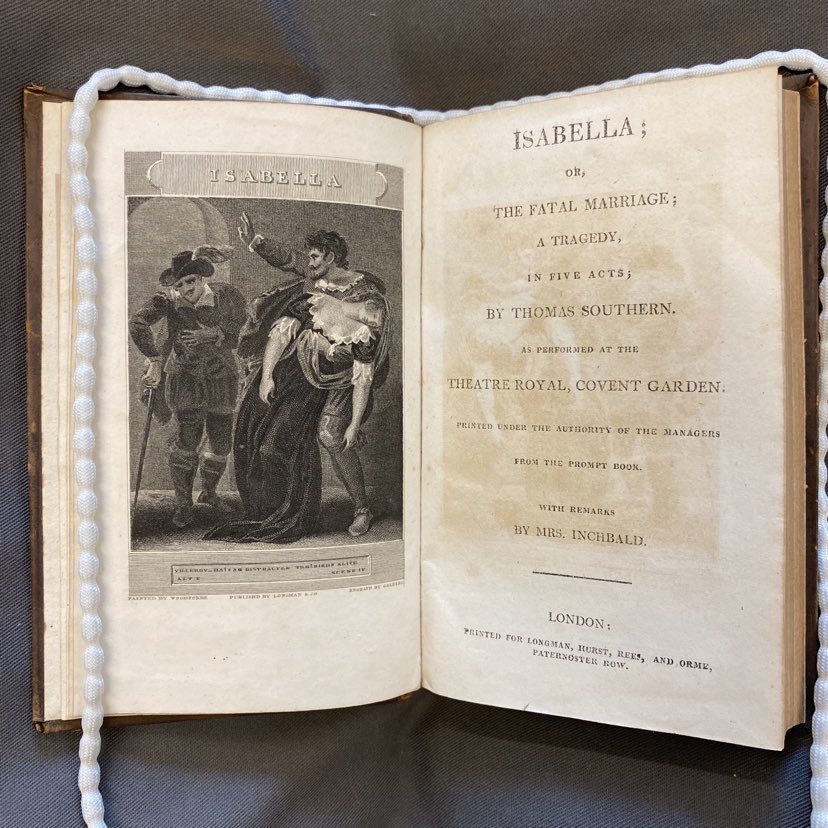
Frontispiece illustration to Isabella in Elizabeth Inchbald's The British theatre, volume 7.

Fig. 7 Elizabeth Inchbald, ed. The British theatre : or, A collection of plays, which are acted at the Theatres Royal, Drury Lane, Covent Garden, and Haymarket vol. 7 (1808) – Classified Sequence (PD 1269.B7)
The art of books continued…

When I was little, the favourite present I ever received, was a pretty pink diary, complete with lock and miniature key. Since this key doubled as a pendant one can easily see how such a gift appealed to my vanity. Nowadays, all my secret thoughts are worn on my sleeve; my diary just a scrapbook of places I’ve been. But the point of my rhyme is the lesson this taught me: that books are revered, treasured, and possessed materially.

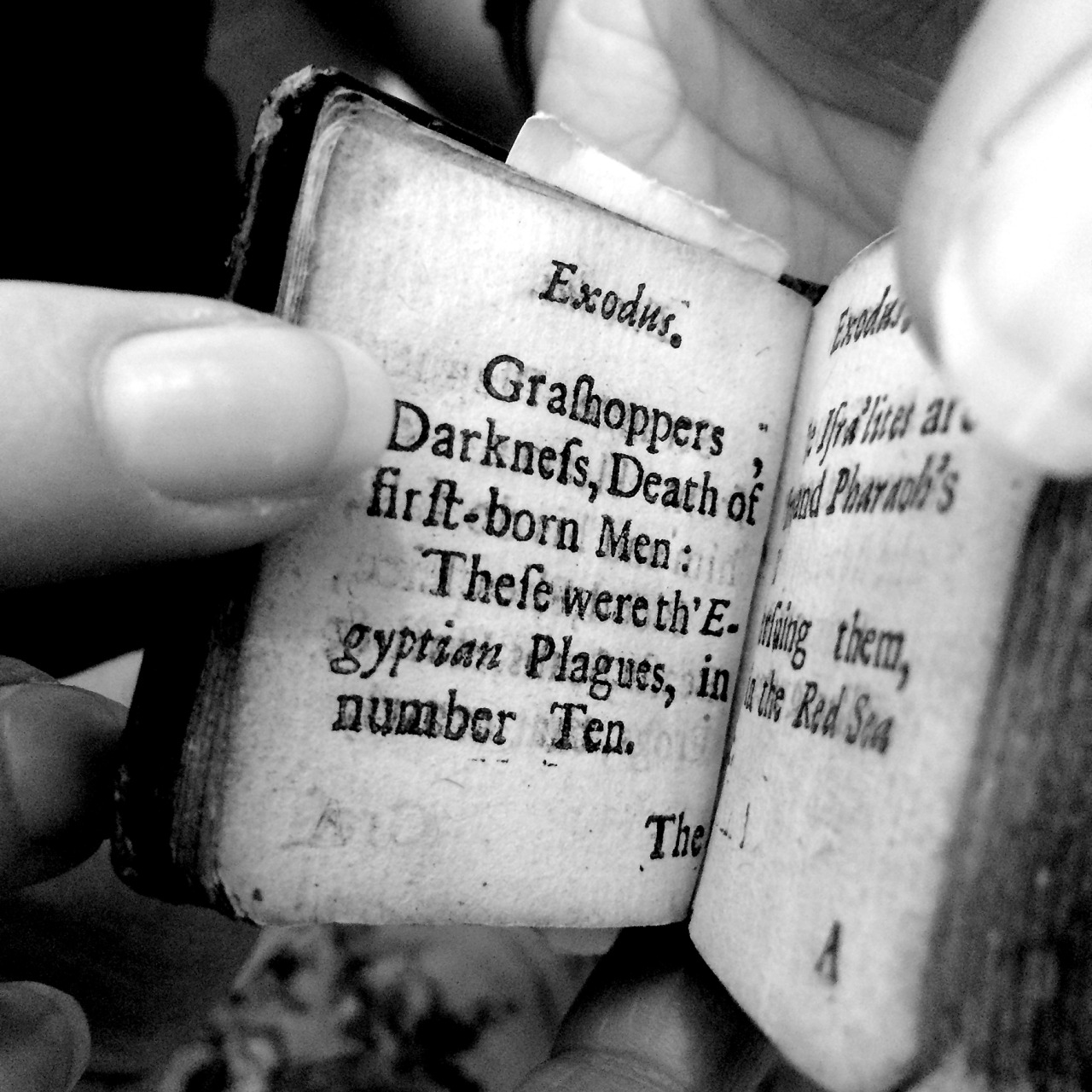
It is undoubtedly a privilege to conduct outreach with Special Collections, and of course this requires transportation of items and their weight alone makes one appreciate the physicality of the book anew. Thus, when we showcase our Pre-1700 folios, we draw attention to the scale of the book as a status symbol as well as an indicator of early modern print technologies. Of course, the miniature book can be as fascinating as the grandest of tomes, as – for instance – our much-loved tiny rhyming bible, Verbum sempiternum, abridged in couplets by the Water Poet, John Taylor. Whilst we can’t possibly know for certain, I like to conjecture how this well-thumbed book could have been intended for daily meditative use, to be carried on one’s person at all times. Certainly, the biblical text is followed by prayers for morning and evening as if to suggest the applicability of reading it over the course of one day.

Image of Verbum sempiternum, open at page from Exodus, reading 'Grasshoppers, darkness, death of first-born men: these were th'Egyptian plagues, in number ten.'

John Taylor, Verbum sempiternum [1693]

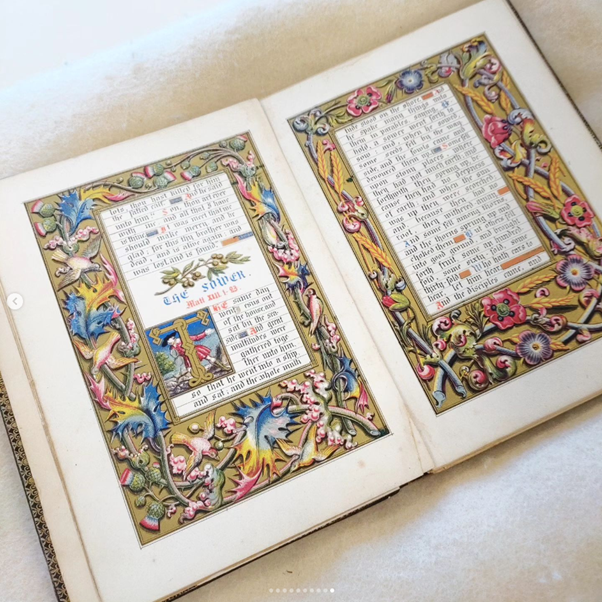
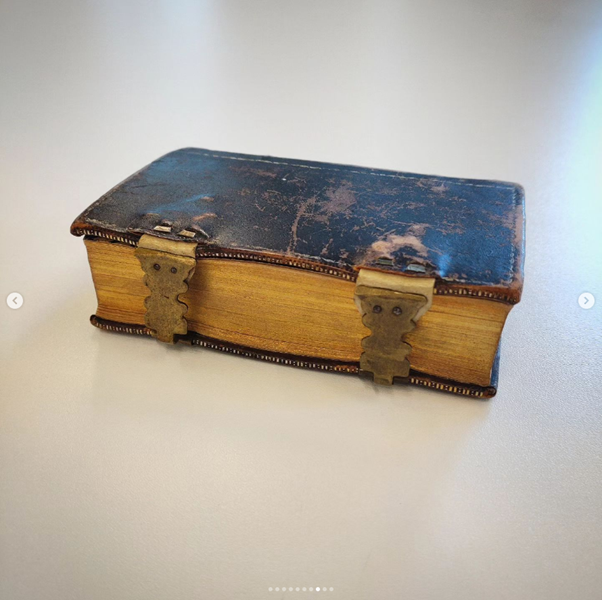
Religious texts dominate the landscape of early modern print, but our collections also reveal how these texts have been subjects for decorative book-making and manipulation well into the present day. As I mentioned in my previous post, we took Sophie Adams’ Book of common prayer (2016) with us to the Art of Books workshops in Ramsgate, into which she has folded the word ‘Prozac’. What I missed saying was that we also took two further examples of religious texts that epitomise the idea that a book is also a treasury. This edition of Wesley’s hymns still has its original early-nineteenth-century clasped binding, which (however) is so tight it’s warped the book’s covers. And this Victorian book, Parables of our Lord, is a replica of medieval manuscript with a beautiful papier-maché cover that resembles Italian church doors as if to invite the reader to open the book as a means of unlocking sacred knowledge.

image of Wesley's hymns, showing clasped binding.

John Wesley. A collection of hymns, for the use of the people called Methodists (1809)

image of Parables of our Lord, showing pages that imitate medieval manuscript and the parable of the sower.

Parables of our Lord (1847)

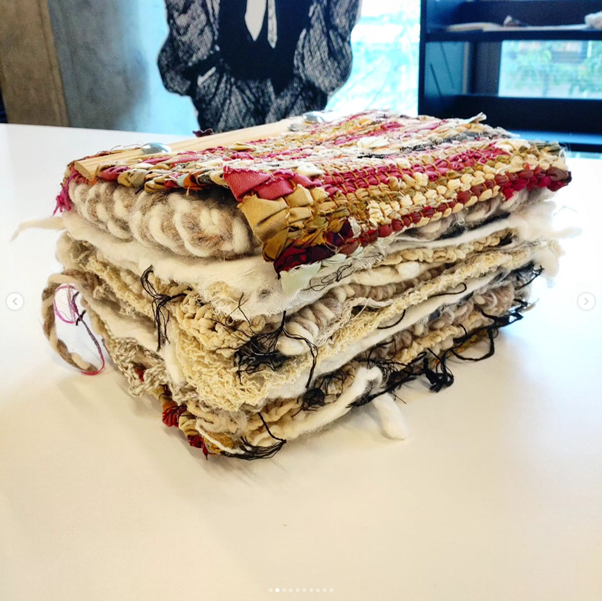
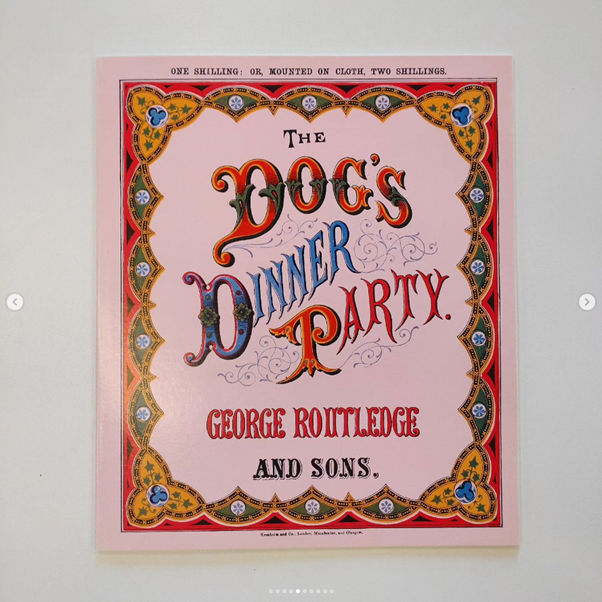
Other artist books we showcased deliberately conflate text and textile, notably Alison Stewart’s Fabricback novel (2010) in which each page has been uniquely crafted out of textiles to both reveal and remove the communication barrier text presents to the dyslexic individual. And if textiles can be read as texts, so too can texts feature textiles in their composition. The earliest paper in books was made of linen rag. And consider this example from our Osborne facsimiles collection: The dog’s dinner party, the cover of which truthfully announces how versions ‘mounted on cloth’ were available at a steeper price so as to resist tearing in the uncoordinated clumsy hands of small children. Such untearable editions were widely available from the 1850s, and stemmed from a growing market for picture and toy books at the time.

Image of Fabricback novel, each page uniquely made using different textile techniques.

Alison Stewart, Fabricback novel (2010)

Image of the front cover of The dog's dinner party.

Harrison Weir, The dog’s dinner party (1981, facsimile)

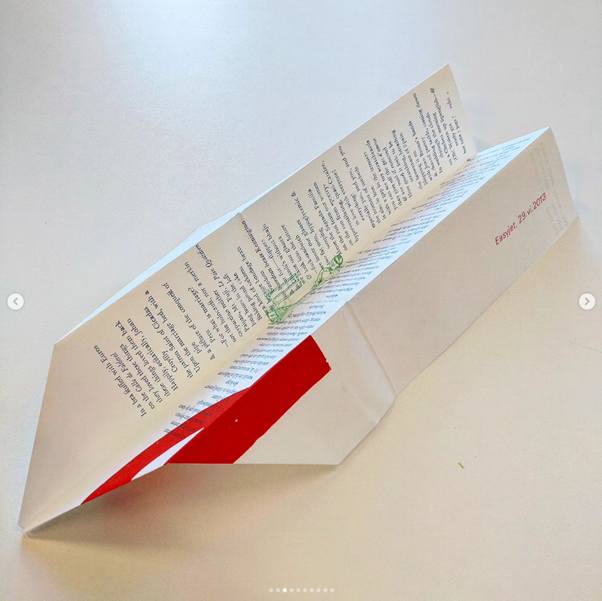
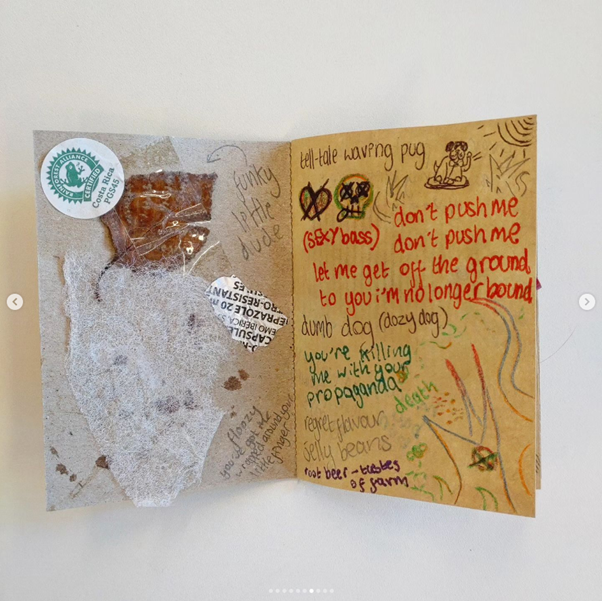
Since the objective of our workshop was to encourage children (and adults) to have a go at making books for themselves, we also showcased a variety of Special Collections items featuring multi-media or otherwise diverting forms. Ryanairpithiplanium, for instance, is a small press poem that has been deliberately, subversively, produced in the form of a paper aeroplane. And Welcome to heck is an anonymously, multi-authored scrapbook diarising events on Remembrance Day, 2018, to celebrate the Armistice Centenary. Both examples, one professional and the other amateur, play with notions of what a book is and – I hope – encourage you to play at making books too! Check out these ideas by artist Tina Lyon for some simple instructions on paper-folding and book-binding and show us what you create!

Image of Ryanairpithiplanium, single sheet poem folded into a paper aeroplane.

Jeff Hilson and Tim Atkins, Ryanairpithiplanium (2014)

Image of example pages from Welcome to heck, with leaf and other sensory pieces pasted in.

Anon. Welcome to heck (2018)

The art of books

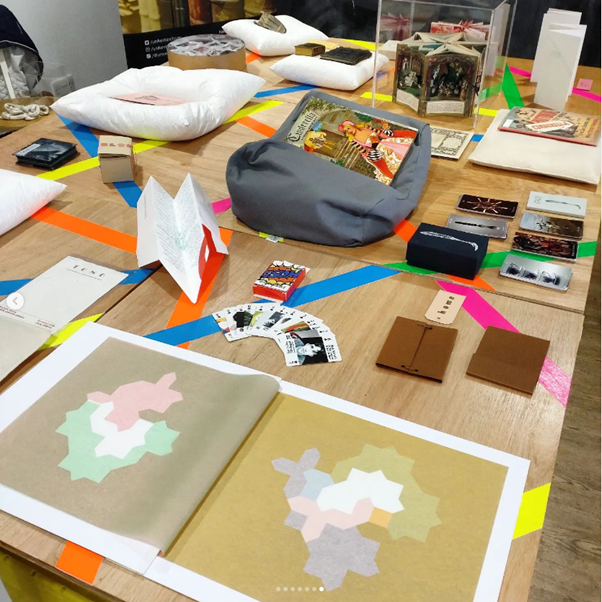
Display of artist books and other materials from Special Collections and Archives.

The art of the book (diverse examples from Special Collections and Archives).

For the book lover, the book is often comfort, adventure, escape, and home-coming all at once. There can be nothing as delicious as settling into a cosy armchair with a steaming mug of tea and lifting the book into one’s lap, opening the cover and absorbing oneself and one’s senses in turning, gazing, reading the pages and the words thereon. We would all likely recognise a book, we have grown up browsing the shelves in libraries and book shops, judging covers, considering blurbs, selecting the next read to suit our interests. Typically, we recognise a book as being a text-block of multiple pages, bound together, and protected by covers and sometimes dust-jackets. We know books can come in a variety of different shapes and sizes, and have different features such as illustrations, pull-outs, glossaries, or perhaps ribbons to serve as bookmarks. But it’s not often we realise the art of the book, the book as a work of art. Last week we visited Discovery Planet, Ramsgate, with Stella Bolaki from the School of English and Tina Lyons, a book artist, to explore this with our Prescriptions: Artist Books Collection and complementary items from the rest of Special Collections & Archives.

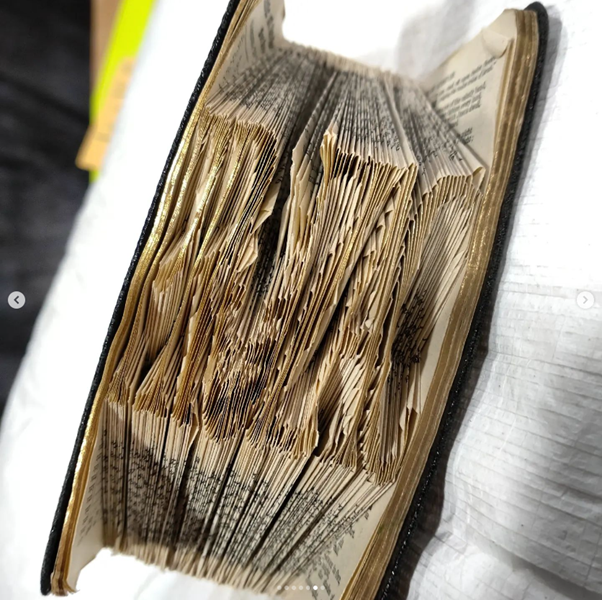
Image of The book of common prayer, the text-block folded to reveal the word 'Prozac'.

Sophia Adams, The book of common prayer (2016)

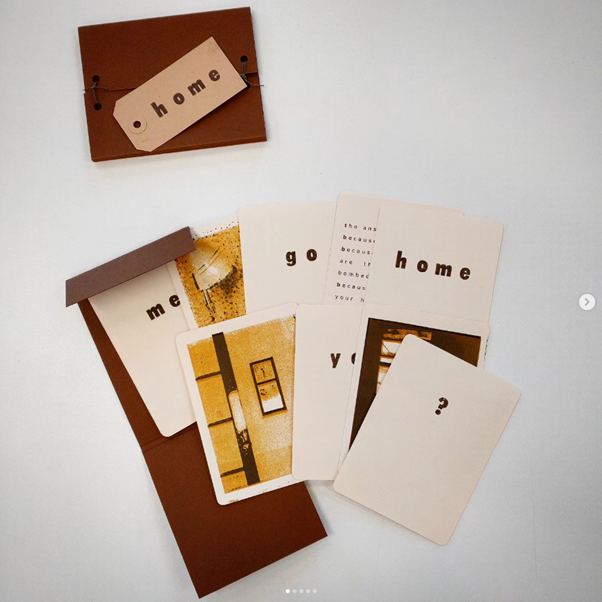
Image of Home, showing loose leaves of book in a random arrangement, revealing words 'me', 'go', home', 'you'.

Gemma Lacey, Home (2012)

Over the course of two workshops with a local Home Education Group and year 9s from The Royal Harbour Academy, as well as a free drop-in day for the public, we both engaged children and young people with questions of what makes a book, and helped them make one for themselves. It is always gratifying to find collections come to life in new conversations, and I was astounded by the intelligence and creativity with which these groups approached book forms never seen before. Sophie Adams’ Book of common prayer prompted conversations about the origins of print and the prevalence of religious literature during those early years when the technology was in its infancy, from the Gutenberg to the King James’ Bible. Besides that, it also showed how texts could be repurposed to have alternative meanings and highlighted how simple folds could change a book into something more sculptural and three-dimensional. Gemma Lacey’s Home fascinated people with its loose leaf format, for what happens to narrative linearity when a book is unbound?

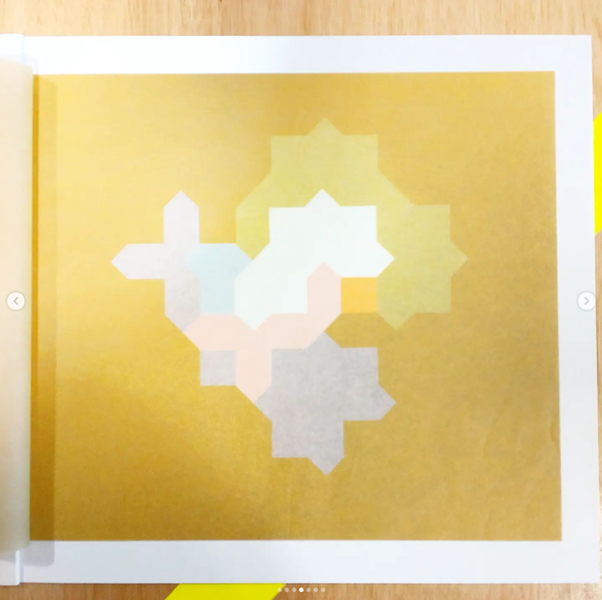
Page from Arabesque 3, showing abstract shapes on fine tissue paper.

Randi Annie Strand, Arabesque 3 (2014)

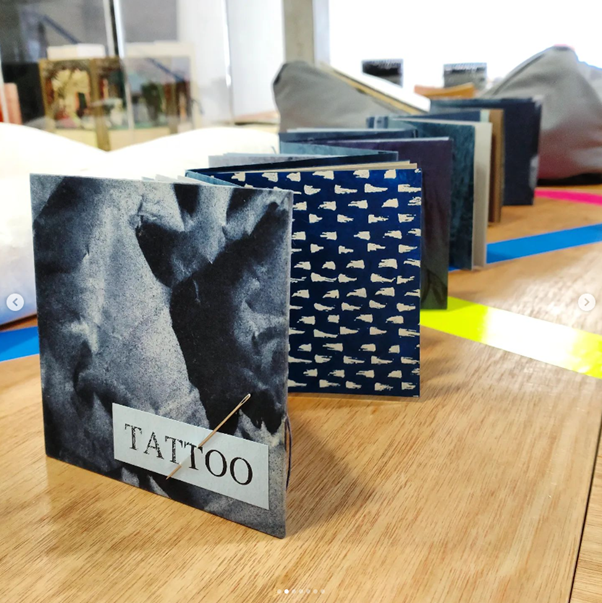
One highlight for me was simply having time to sit with and interpret two of my favourites from the collection for myself: Randi Annie Strand’s Arabesque 3 and Martha Hall’s Tattoo. Having recently visited an exhibition of Arabic and Islamic art in the Re-Orientations exhibition at the Kunsthaus Zürich, Switzerland, I was immediately drawn to Strand’s geometric patterns that alternate as one turns the fine tissue pages of Arabesque 3, and the encounter offers a tangible metaphor of how one would treat a patient: with care, patience, delicacy. Martha Hall’s concertina Tattoo features inserted stitched booklets that narrate the artist’s own revised perceptions of tattoos, from something signally naval occupation or corroborating stereotypes of hyper-masculinity to something that is necessitated by certain medical treatments, such as radiation for cancer, and even evocative of inner female strength, as sported by women over mastectomies.

Image showing the concertina length of Tattoo, with needle inserted into front cover.

Martha Hall, Tattoo (2001)

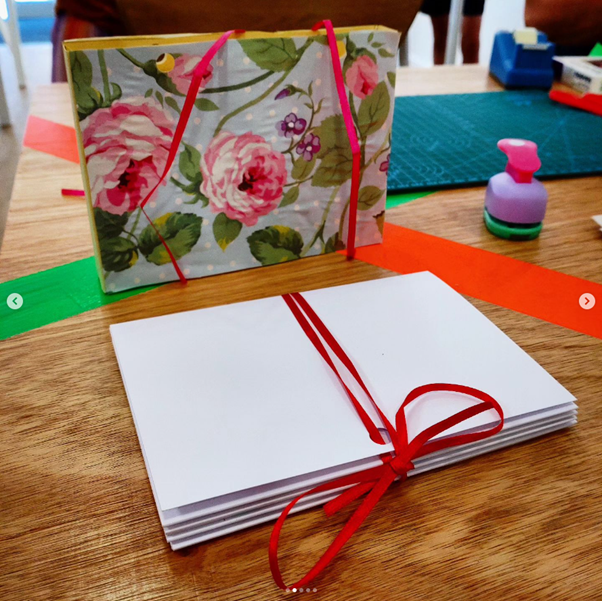
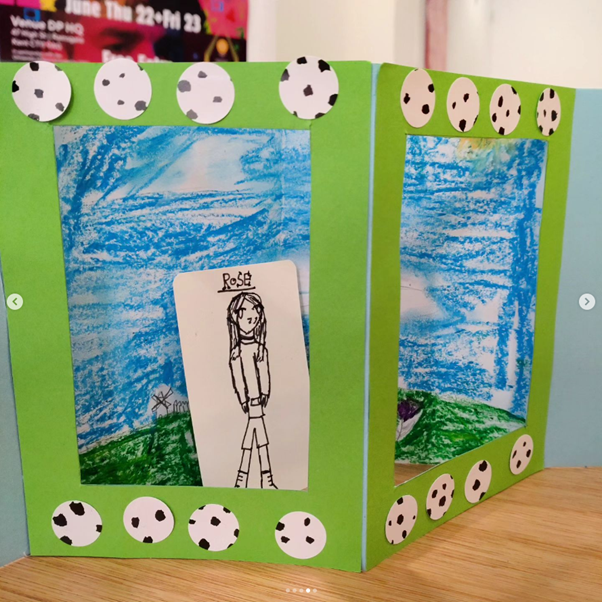
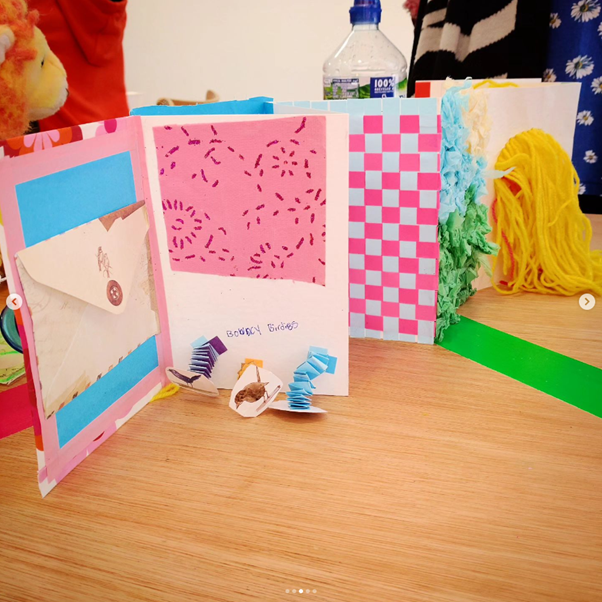
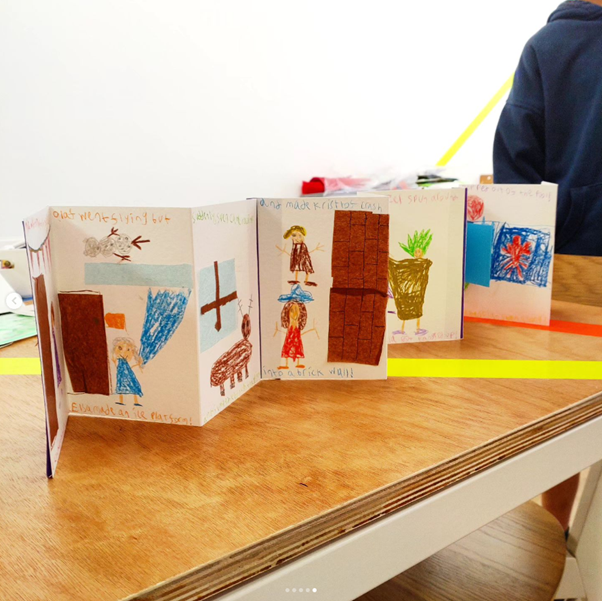
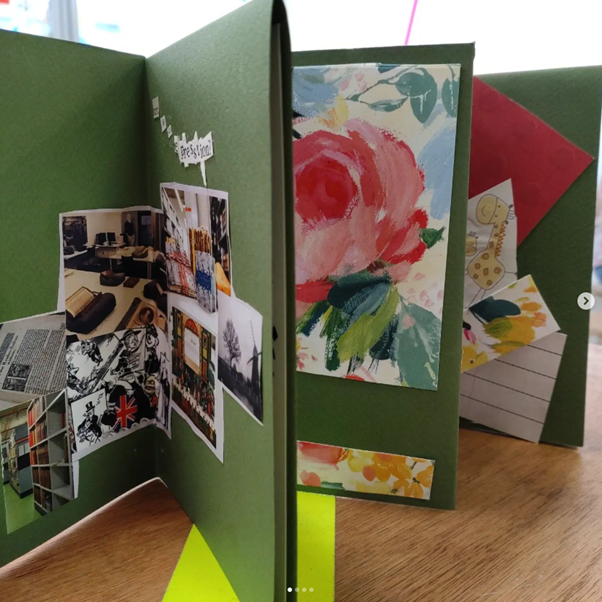
Having introduced Special Collections & Archives, and welcomed groups to encounter these artist books for themselves, the workshops turned to making books: encouraging our young people to reflect both on the collections and their own stories and emotions as they folded, cut out, manipulated paper to craft books for themselves. On the Friday we were lucky to have book artist, Tina Lyons, with us, and she took us step-by-step through making a T-fold booklet as well as extended concertinas. (Check out her videos to have a go yourself!) On Saturday, Stella Bolaki led the groups and it was astonishing to see the diversity of approaches and creations that stemmed from her instructions. I have to give a special commendation to Leo and Libby for their mutual dedication and inspiration. Leo’s Art is an expression for his dad (just in time for Father’s Day) featured multiple sensory pages to signify, for instance, the satisfaction and confusion art can evoke. Libby was inspired by the form of Allison Cooke Brown’s Core sample, and – prompted by conversations regarding the status of the book as something special, even a gift – made a beautiful slip-case for her concertina book. We also had a variety of big books, little books, pop-up books, stitched books, handbag books, every book you could imagine. To close, I can only showcase a sample of what was made – enjoy!

A hand-made book with be-ribboned slip-case decorated with roses.

A hand-made book with slip-case.

A hand-made pop-up book, showing a character in a landscape, with a decorative frame.

A hand-made pop-up book.

A hand-made concertina book, with varied sensory pages.

A hand-made concertina sensory book.

A hand-made concertina book revealing a story of a surprise birthday party and the arrival of different guests.

A hand-made concertina picture-book.

A hand-made T-cut book, with lots of different images pasted inside in scrapbook fashion.

A hand-made T-cut book, titled ‘Art is an expression’.