Students take over the Tate Exchange

Students from the School of Politics and International Relations took over Tate Exchange at Tate Modern, last weekend (March 16/17), with a series of inventive and inspiring projects aimed at engaging the public in the idea of movement and resistance.

Activities included transforming big business advertising into origami birds; film work on borders, mental health and how people have responded to racism in sport; interactive image work on media representations of gender and politics, body positivity, the meaning of change, the relationship between art, politics, education and Brexit, and the nature of disagreement and conflict; performance work on identity politics; and an immersive experience in a pod exploring the connection between choice and resistance. There were also 2,000 dominoes used to create some amazing constructions and, with some effort, the word ‘move’ in the form of a domino run.

This is the third year of the School’s involvement in the Tate Exchange project but the first time the whole floor – Level 5 of the Blavatnik Building – has been activated and animated entirely by the students. With over 1,000 visitors in two days, the students had a wonderful range of conversations with members of the public. As one visitor put it, ‘this is great, such amazing work!’

The students came from undergraduate module, How to a Start a Revolution, and the Postgraduate module, Resistance in Practice.  
Estates Customer Services Pop-up Stand Event – 26 March

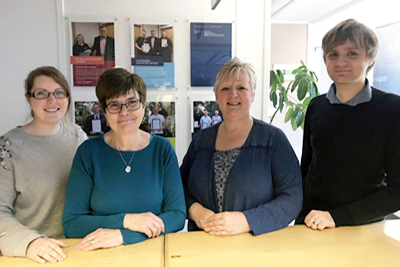
An Estates Customer Services Pop-up Stand Event is taking place on 26 March from 10.00-12.00 in Marlowe Foyer, Canterbury campus.

The Estates Customer Services Centre was launched in June 2018 in response to feedback received by the customer survey conducted in March 2018.  Comments indicated that customers felt the Estates Department wasn’t transparent enough in its operations and people didn’t really know who did what in the department.

We held an Estates Showcase event last June, which highlighted all of the areas of the department and gave customers the chance to meet the staff and gain a better insight into what we do.  It was at this event we launched the Estates Customer Services Centre.  The key objective of the Customer Services Centre is for the Customer Services Advisers to take ownership of each enquiry and act as a liaison point with the customer.

Since then, we have also published our ‘Who we are, what we do and where we are going’ booklet.  This is available to view on the Estates webpages, and we will also have copies available at our pop-up event.  This booklet outlines the sections of Estates and also includes our road to cultural change.

It is really important to us that we continue to engage with Schools and Departments, so we have decided to hold Customer Services pop-up events across campus.  This will give everyone the opportunity to come and meet some of the team and ask them anything Estates-related.  It may be that we can’t answer all of your questions at the time but we will take them forward on your behalf and update you afterwards.

Your feedback is extremely important to us and we aim to continuously improve our services.  Please come along and see us as it would be great to hear any suggestions you have.

Staff at Kent

Building a business case: Best practice

Need help building a business case for your project? A new business case template may be the answer.

A well-thought out business case document will help get you approval for your projects to go ahead and ensure you receive resources  to complete them successfully.

In formal projects, a business case is one of the key documents that senior managers review when deciding whether to give a project the funding it needs to go ahead. In the business case, you detail the benefits that the project will deliver, how they’ll be achieved, what it will cost, and how long it will take.

To help you develop your business case in a consistent way, a Business Case Template has been created as an integral part of the Kent Project Management Framework (KPMF).

This document will help you:

  • Provide justification for your investment to enable senior management decision making
  • Adequately capture the background, business need, scope, investment, risk, dependencies, and anticipated benefits so that the project/investment can be approved, funded and prioritised.
  • Introduce a review mechanism at certain points in the process to ensure work is proceeding as planned and decide whether it should continue

The template is simple to use, includes clear “how to” guidance prompts and has been tried-and-test on a number of major Kent projects. Additional online help is also provided in the form of a Business Case LinkedIn Learning pathway.

For further information about Projects, contact the BIPU team: BIPU@kent.ac.uk

Loretta Izod, Apprenticeships

Recognition for Employee Apprenticeships Manager at Kent

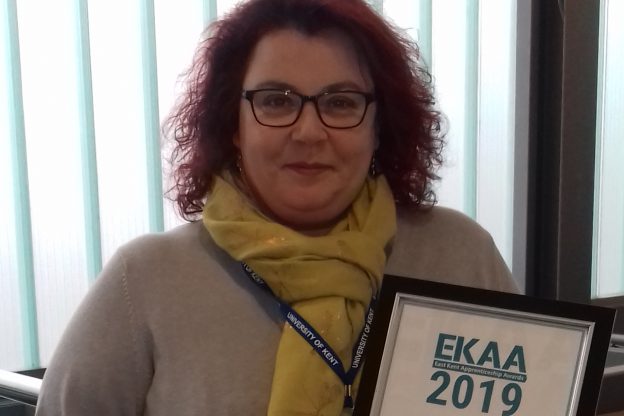
The work of our Employee Apprenticeships Manager, Loretta Izod, was recognised at the recent East Kent Apprenticeship Awards.

Loretta was a finalist in the award for the East Kent Apprenticeship Champion of the Year award. The inaugural awards took place during National Apprenticeship Week (4-8 March 2019) and celebrated the success of apprenticeships for both individuals and businesses.

Apprenticeships have been subject to a number of changes in recent years, including the way they are funded. Large employers like Kent now pay a monthly Apprenticeship Levy, meaning we can offer apprenticeships for  career development to existing staff, as well as new employees.

Loretta was nominated for the award by her colleagues in the HR Learning & Organisational Development team. Over the past year, she has been working with schools and departments to promote use of the levy and taking an apprenticeship to colleagues in any occupation, regardless of age, work experience or job level.

Across the University, there are now up to 50 staff who are being supported by the levy to develop their skills and knowledge in roles from Laboratory Scientist to Digital Marketer and Chartered Manager. A further 70 staff have expressed an interest in studying for an apprenticeship.

Loretta said: ‘I am really happy to be a finalist in these awards. My job is to ensure that employees understand the benefits of apprenticeships and that Kent is able to use its levy effectively – this type of recognition of my work makes all the hard work and effort worth it. This award is a really nice recommendation, but there’s still lots of work to do.’

To find out more about apprenticeship opportunities at Kent, contact Loretta Izod by phone (ext 16568), email: L.J.Izod@kent.ac.uk, or visit the Kent Apprenticeships webpage.

Don’t forget we also offer Higher and Degree Apprenticeships – you can find out on the  CHDA webpages.

Coffee and Cake De-Stress Breaks – Medway campus

Medway Campus Chaplaincy is holding weekly ‘Coffee & Cake De-Stress Breaks’ for staff  during April – Stress Awareness Month.

The breaks will take place between 10.00 and 12.00 in Drill Hall Library – DA015 on the following days:

  • Friday 5 April
  • Monday 8 April
  • Tuesday 16 April
  • Wednesday 24 April
  • Monday 29 April

All are welcome – sign up is not required but helpful for catering purposes.

Please tell your colleagues and plan to come along for ten minutes or two hours, as you are able.

Lynne Martin, Medway Campus Chaplain
medwaycampuschaplain@gre.ac.uk


UKC Student

UKC Student’s top tips for exam success!

UKC Student, Rowena reveals her top tips for exam success, with the help of Gandalf, the University of Kent, Woolf College cat.

1) Don’t leave revision to the last minute so you’re feline good for the exam. Give yourself enough time to cover each topic within the module. Factor in time to go through all the example questions, or even better if you can get your paws on them, the exam paper from the year before! Don’t try and cram everything last minute and get enough sleep the night before.

2. If you have a purrticular learning style, have a go at tailoring this to how you revise. There are online quizzes which can identify which type you are. I’m a visual learner so drawing ideas really helps for me! If you are an auditory learner, try reading your notes aloud and reciting them. If you are a physical learner, try and keep active whilst revising –  have a stress ball to hand or even some playdough! It may sound strange but give it a go, you might be surpurrised!


Gandalf’s preferred style is to stare at you with his big innocent eyes until you feed him his 7th dinner of the day… I can’t guarantee this will work well in your exams though…

3. Read the question slowly and carefurlly. Don’t be that guy who realises an hour in that you’ve misread the essay question. Read it several times and make sure you understand exactly what’s being asked before planning your answer. Keep refurring back to the question to see if you have addressed each part of it. If possible, underline or highlight the important words in the question to help you stay focused. Don’t get caught out by a simple mistake.


Meow-velous luck to you all. Ace your exams by giving it your best shot. Stay pawsitive, you can do it!

Modern Languages panel

Alumni reveal what life is like after your Modern Languages degree

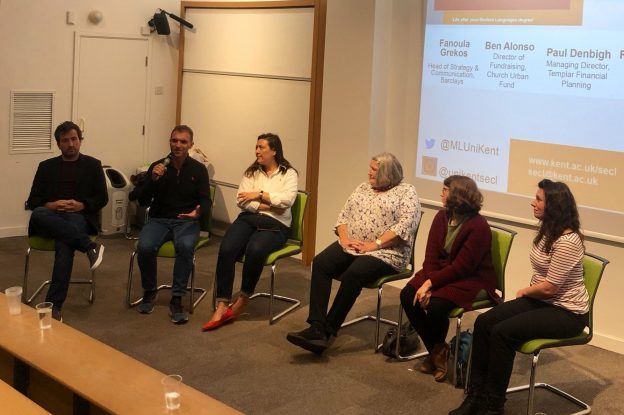
On Saturday 16 March, the Department of Modern Languages was delighted to welcome six former students to campus for “life after your Modern Languages degree” – an event designed to give students an opportunity to discover the wide range of career paths that alumni have taken.

The event also featured two video interviews, with graduates Greg Pioli – who graduated in 2004 with a BA in French and is now Director of the Online Language Academy – and Ruth Martin, who graduated in 1992 with a BA in European Studies (Italian) and is now a Freelance Translator.

The event was chaired by Tobias Heinrich, Lecturer in German, and Rebecca Ogden, Lecturer in Latin American Studies, with advice from the panel on how to tailor your application when applying for lots of different roles; how to make the most of your year abroad when applying for jobs; how to “sell yourself” as a languages graduate; and being aware of – and maintaining – your digital footprint. After the event, guests including students from all year groups as well as students from local schools and sixth form colleges, had the opportunity to speak to members of the panel and brush up on their networking skills.

Our alumni panellists:

Ben Alonso graduated in 2008 with a BA in Psychology with Studies in Europe 2008 and is now Director of Fundraising at Church Urban Fund, a charity focussing on community development.

Fanoula Grekos graduated in 2001 with a BA in French and Spanish and is now Head of Strategy and Comms at Barclays.

Paul Denbigh graduated in 1995 with a BA in European Studies (History) and is now Managing Director of Templar Financial Planning.

Ros Gregg graduated in 1968 with a BA in French (making her one of the University’s very first graduates!) and has taught at primary and secondary level.

Lucinda Smith graduated in 2016 with a BA in Hispanic Studies and is now a PR Assistant at Citigate Dewe Rogerson, a financial corporate communications company.

Julia Marques graduated in 2010 with BA in Drama and Spanish and is now Project Support Officer at the Gaia Foundation, an environmental charity.

Student Success Speaker Series

Meena Dhanda hosts Student Success lecture

As part of the Student Success Project’s Inspirational Speaker series, Professor of Philosophy and Cultural Politics at the University of Wolverhampton, Meena Dhanda, gave a talk on Wednesday 6 March entitled ‘Caste consciousness: the necessity of internal critique’.

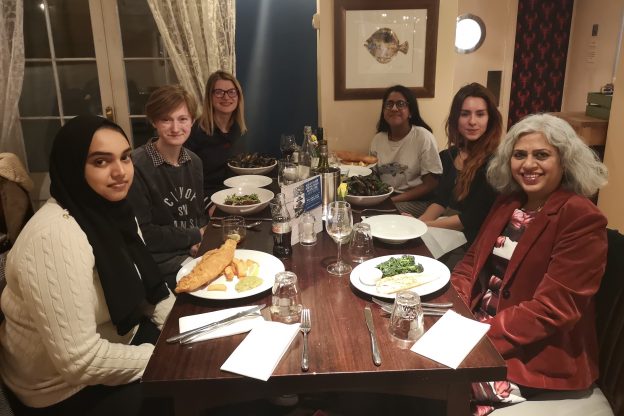
In her talk, Professor Dhanda shared the problems encountered in morally and politically confronting caste consciousness. Fear of ’emergent vulnerabilities’ closes discussion, but attention to internal critiques of inherited ways of life opens the path for truly decolonised ways of thinking. This talk was followed by a meal out with Meena.

Dr Laura Bailey, Lecturer in English Language and Linguistics and SECL Student Success Lecturer, said: “In a fascinating talk and a lively discussion over the course of the evening, Professor Dhanda gave us the benefit of her considerable expertise on the issues raised by campaigns to make caste discrimination illegal in the UK, like discrimination based on ethnicity or gender. Along the way, we also learnt the term ’emergent vulnerability’, which is a tactic of claiming victimhood in a way that is parasitic on real victims (at dinner afterwards, for instance, we drew parallels with the #MeToo movement and the way that certain men were portrayed as victims for losing their careers).”


Hong Kong

Hong Kong Partner Summer Schools Fund

Scholarship funding has recently become available for University of Kent students who would like to take part in one of our Hong Kong partner summer schools this year. The scholarship will cover a contribution towards tuition, travel and subsistence.

The Scholarship provides a contribution of up to £1,800 for a number of successful applicants to summer schools at our partner institutions in Hong Kong.  We are particularly promoting and seeking applications for HKBU, with a priority focus on WP students, although applications from all students are welcome.

Find out more about our partner institutions on our website. If you are interested, you can fill out an application form here.

Any questions? Please email studyabroad@kent.ac.uk.