Special Collections and Archives highlights: 2025 edition

Karen Brayshaw, Special Collections and Archives Manager

Welcome to the Special Collections and Archives annual highlights 2025. It’s always a pleasure to look back at what has taken place in the University’s Special Collections and Archives, and I’m always amazed at how much the team achieve – well done Team! This year some changes have taken place at the University and as a result Library Services (of which we are part) has now joined the Student Life Directorate. Don’t worry though – you can still find us in the same place. As a Team we said goodbye to Beth, our University Archivist. Beth joined us as Project Archivist for the UK Philanthropy Archive, before taking over the post of University Archivist. We wish Beth well in her new post. In September we also said goodbye to Sam Datlen, Project Digital Administrator.  Sam has worked with us on a part-time basis since 2023, digitising the original artworks of Lawrie Siggs, Geoff Laws, Ron McTrusty and some of the Donald McGill collection. Although we said goodbye to Sam as a colleague we are delighted he has agreed to continue to come on to work on some of our volunteer projects.
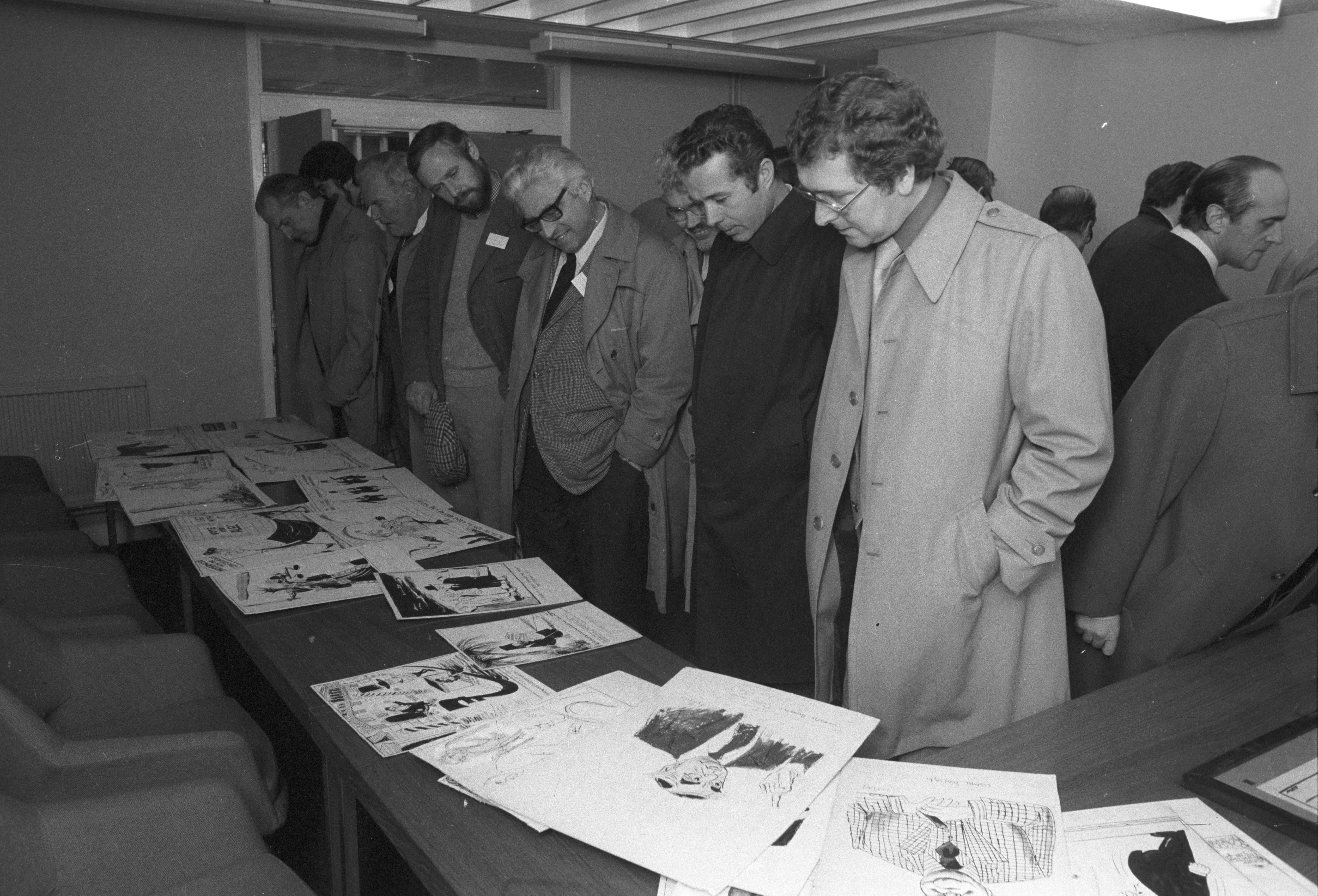
Photograph from c. 1978 – Early days of the Centre for Cartoons and Caricature, now the British Cartoon Archive (University Archive UKA/PHO/1/1039)

This year it was 50 years since the inaugural lecture took place to launch the Centre for the Study of Cartoons and Caricature. The collections have grown enormously since then and to celebrate we hosted an exhibition. It was amazing to work with Clair on this. The activity was funded by the Beaverbrook Foundation, which covered the cost of two scholars and three interns and they were a delight to work with. The exhibition has been a huge success and there is still time to see it if you missed it, as it will remain on view during the first two weeks of January.

I don’t know about you, but I enjoy a good podcast and what better time of year is there to do just that. Clair and Christine feature in two separate podcasts, you can read all about it below and do treat yourself and have a listen.

Clair and Jacqueline have been working on Dr. R.E.W. Maddison’s collection, which arrived at the University in 1985. The collection is fascinating and they’ve both discovered some treasures – more of which you can read below. The printed works are available to browse via our online catalogue. The archival material is also available but more detailed work is being undertaken in the new year.

Christine continues to deliver an array of excellent and diverse sessions for our engagement and education activities, using her best Miss Marple skills to uncover treasures for our participants – eat your heart out Poirot. Although she doesn’t mention it here Christine is also doing some brilliant work with volunteers to sort out and make available our extensive theatre programme collections and many more have been added to our catalogue for your perusal.

This year we welcomed Emily to our team. Emily is Project Archivist, working on the UK Philanthropy archives, which continues to grow. As I type this, we await the latest addition to the archives… watch this space for more news next year!

We’re very lucky that we have managed to secure funding to retain the services of Jacqueline, our Project cataloguer. Although Jacqueline is with us part-time, she has managed to catalogue at least six collections over the last few years, which equates to several thousand books! Her latest target is the Ronald Balwin collection, which is turning up some real treasures. I know I’m looking forward to seeing what she unearths in the new year.

Soon we will have all the John Jensen original artworks available online as Alex has almost completed digitising them. At the same time he is exploring the audio material in the Max Tyler collection – we hope to have more to share with you about that next year.

Mandy also continues to digitise our cartoon cuttings as well as supplying the images for the Giles Annual every December and January. Mandy also supports us with requests for digitised material from staff and readers – including interesting scripts (of one of my all-time favourite programmes!)

Stuart and Matthias, our Curation and Discovery colleagues have been working their way through a variety of material, including books about cartoons, literature and sheet music, as well as our digital cartoons. This means there is now more than ever available online for everyone to access through our online catalogues.

And finally we have the contribution made by our volunteer community – our volunteers bring so much to our team. By giving us their time we are able to progress the processing of our collections and ultimately, we can make them accessible to everyone. So it’s a HUGE thanks from me to them.

Clair Waller, Digital Archivist

British Cartoon Archive – 50 years

2025 marks 50 years since the formal opening of the Centre for the Study of Cartoons and Caricature (now known as the British Cartoon Archive) and it’s been a bumper year of activity.

Beaverbrook exhibition
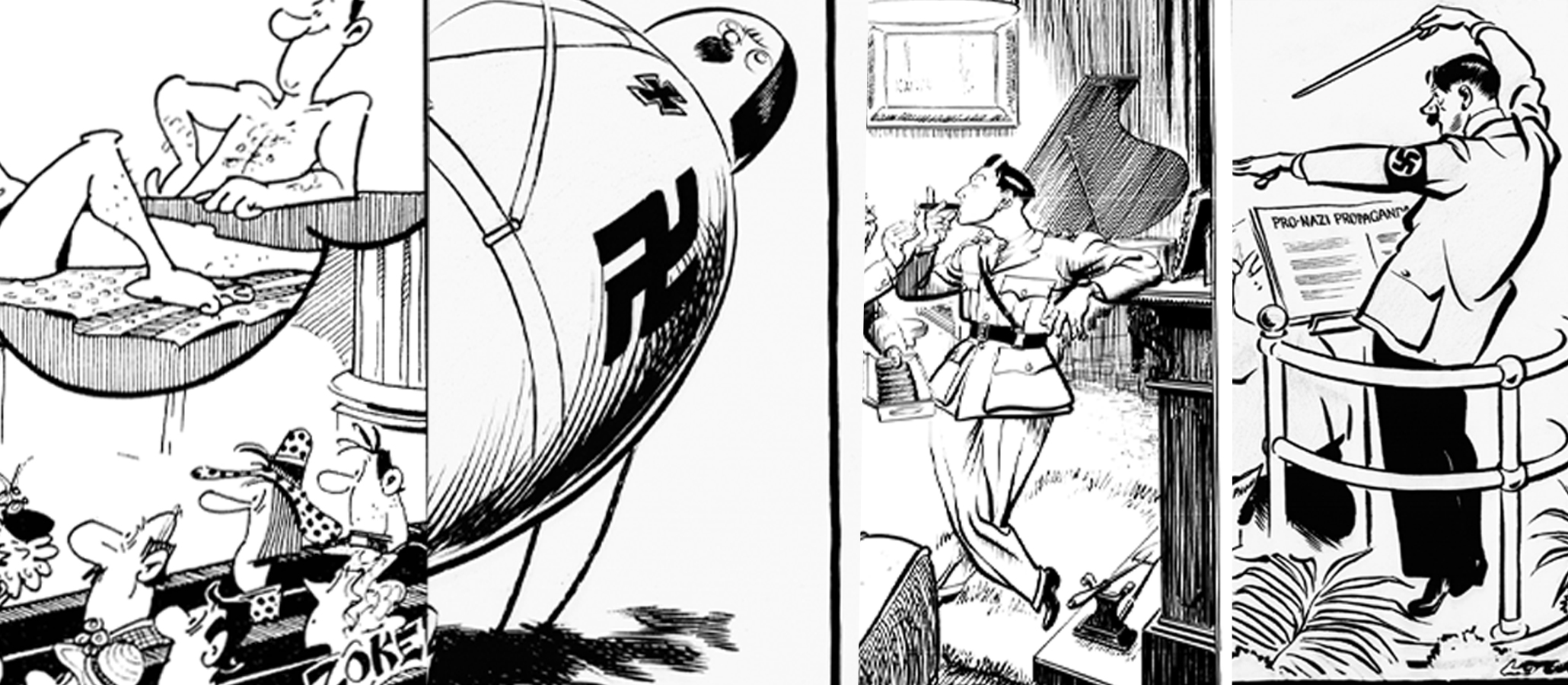
Images from the British Cartoon Archive left to right: Zoke [Michael Attwell], ‘Ah-men!’ [46886] ; David Low, ‘All blown up and nowere [sic] to go’ [DL0741a] ; Joseph Lee, ‘Smiling through: queer new world’ [JL 2539] ; David Low, [no caption] [DL1613].

This year saw us finish up our Beaverbrook Political Cartoon Collection Strategy project, and it finished with a bang. We invited two scholars (Amy Matthewson from the University of Birmingham and Dominic Janes from Keele University) to work with us to research and curate an exhibition using the Beaverbrook Collection and the British Cartoon Archive as inspiration. They could select any theme they wanted, and we were very fortunate to be able to employ three student interns (Isabel Walford, Freya Francis and Freja Dixon) to assist them in their research. The resulting exhibition was titled ‘Laughter in the Long Twentieth Century’ and explored the rise of fascism and the (in)visibility of LGBTQ+ people and communities since the 1960s through the lens of cartoons. Despite choosing two distinct topics to explore, Amy and Dominic were able to recognise and bring together a number of themes in the work, highlighting how humour acted both as a powerful tool of social control but also of resistance and defiance in the face of oppression and uncertainty. The exhibition was launched with an event on 1st July 2025, which featured guest speakers Dr Harriet Earle from Sheffield Hallam University and artist David Shenton. You can explore the exhibition online on our website and both Amy and Dominic will be exploring the topic further through a number of published articles, so keep your eyes peeled for more news on those!

[Update – see Amy’s article at https://doi.org/10.1080/14714787.2025.2576832]

new additions

The British Cartoon Archive has seen a number of additions to the collection this year. This included a collection of almost 100 originals of the cult satirical cartoon strip ‘Biff’, created by Mick Kidd and Chris Garratt, and a selection of original cartoons by Jeremy ‘Banx’ Banks. We were also very lucky to acquire a large collection of underground comics from Tony Bennet of long-standing alternative UK publisher, Knockabout. The collection not only spans over 50 years of underground and alternative comics from the UK and beyond, but also includes documentation and papers related to several legal cases brought against the company for breaches of the Obscene Publications Act.
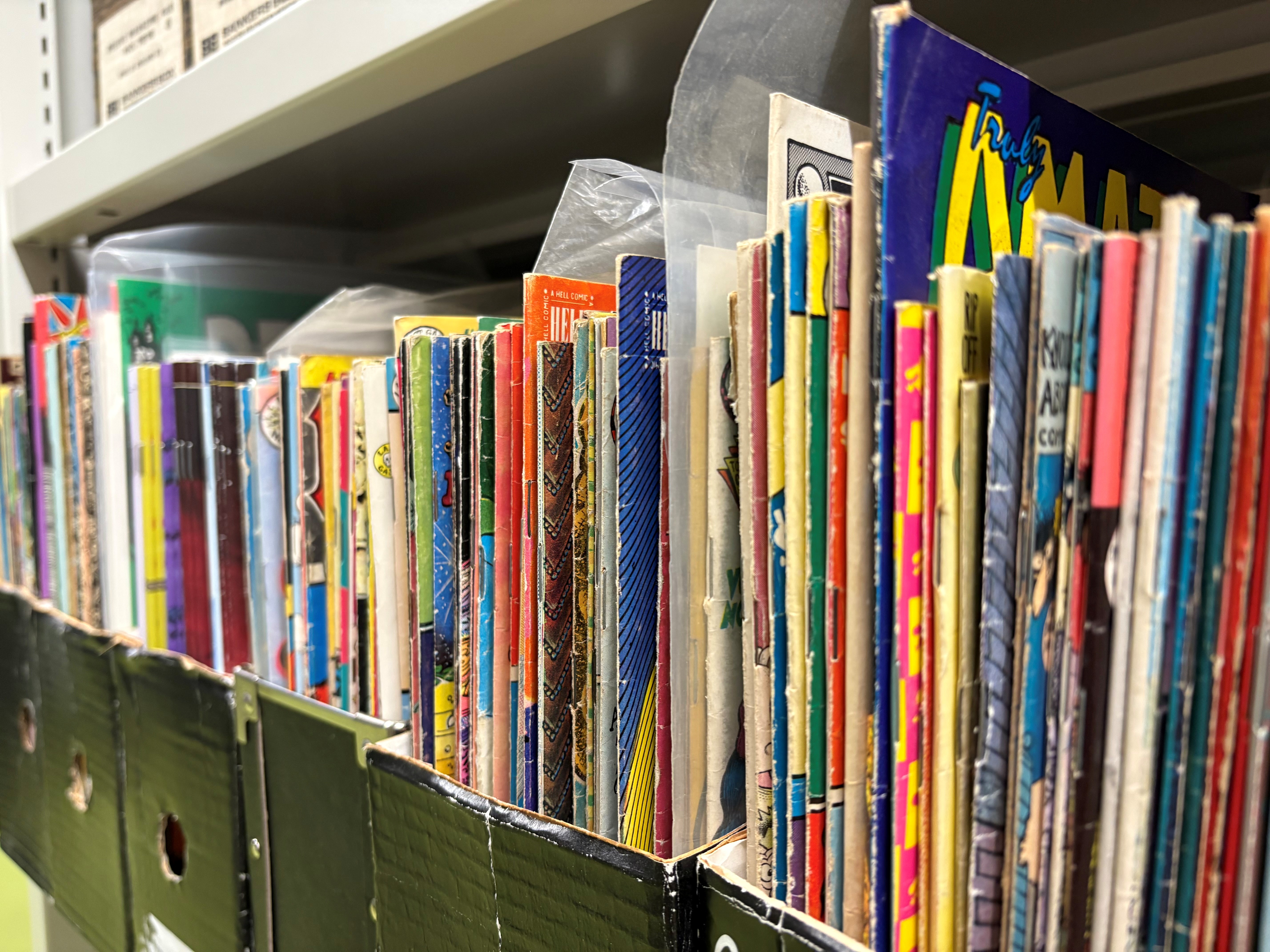
Comics from the Knockabout Underground Comics collection

cartoon county, brighton

In August 2025 the British Cartoon Archive was invited to talk at a meeting in Brighton run by Cartoon County, a community group of local artists and storytellers. These events are held on the last Monday of every month, with host Alex Fitch inviting different speakers to come along and share their current work, after which Alex broadcasts the talks on Resonance FM’s Panel Borders. I was delighted to attend and had a great time speaking to the group about the work we do at the BCA. I can highly recommend attending if you find yourself in Brighton on a Monday evening!

The R.E.W. Maddison Archive
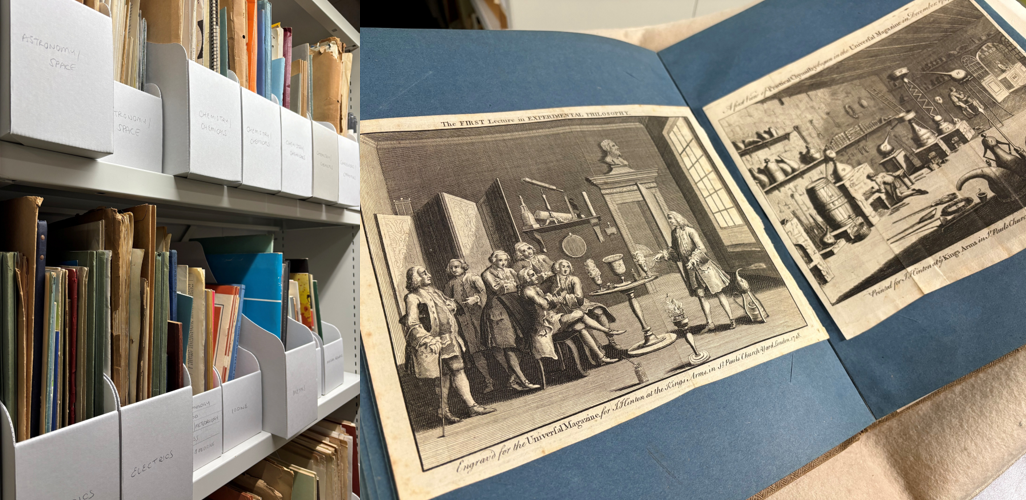
Images of items in the Maddison Archive

Dr. R.E.W. Maddison’s library has been a fixture of Special Collections and Archives, and the Templeman Library, since our university’s early days. Maddison was a personal friend of a fellow bibliophile, John Crow, whose own library constituted one of the University’s founding collections and who encouraged Maddison to deposit his with us too.  Maddison’s library was built up over a period of 40 years and was considered one of the finest private collections on the history of chemistry. Alongside his large collection of books (read more in Jacqueline’s entry below), we were also gifted a substantial archive of material from his career, which I have had the pleasure of cataloguing this year.

The archive contains many different aspects, including correspondence, research papers, scrapbooks, published pamphlets, prints, and Maddison’s own notebooks. Particularly exciting items I identified whilst working on the collection include some 18th century Gillray cartoon prints and many beautiful early-printed engravings depicting scientific instruments and diagrams. It’s been very satisfying to bring the collection to order and to make it accessible, so have a browse on our online catalogue.

Christine Davies, Special Collections and Archives Coordinator

One of the privileges of my role lies in the diversity of projects and groups of people I get to support with engagement and education activities. This year, one of the highlights was working with David Smith (Outreach & Widening Participation, University of Kent) in delivering two bespoke sessions for secondary school students about protest and activism, showcasing some of the wacky materials from the Mark Thomas Collection (including a toy Barbie car and hi-vis demonstration jackets) and crafting zines with which to empower their own civic voice.
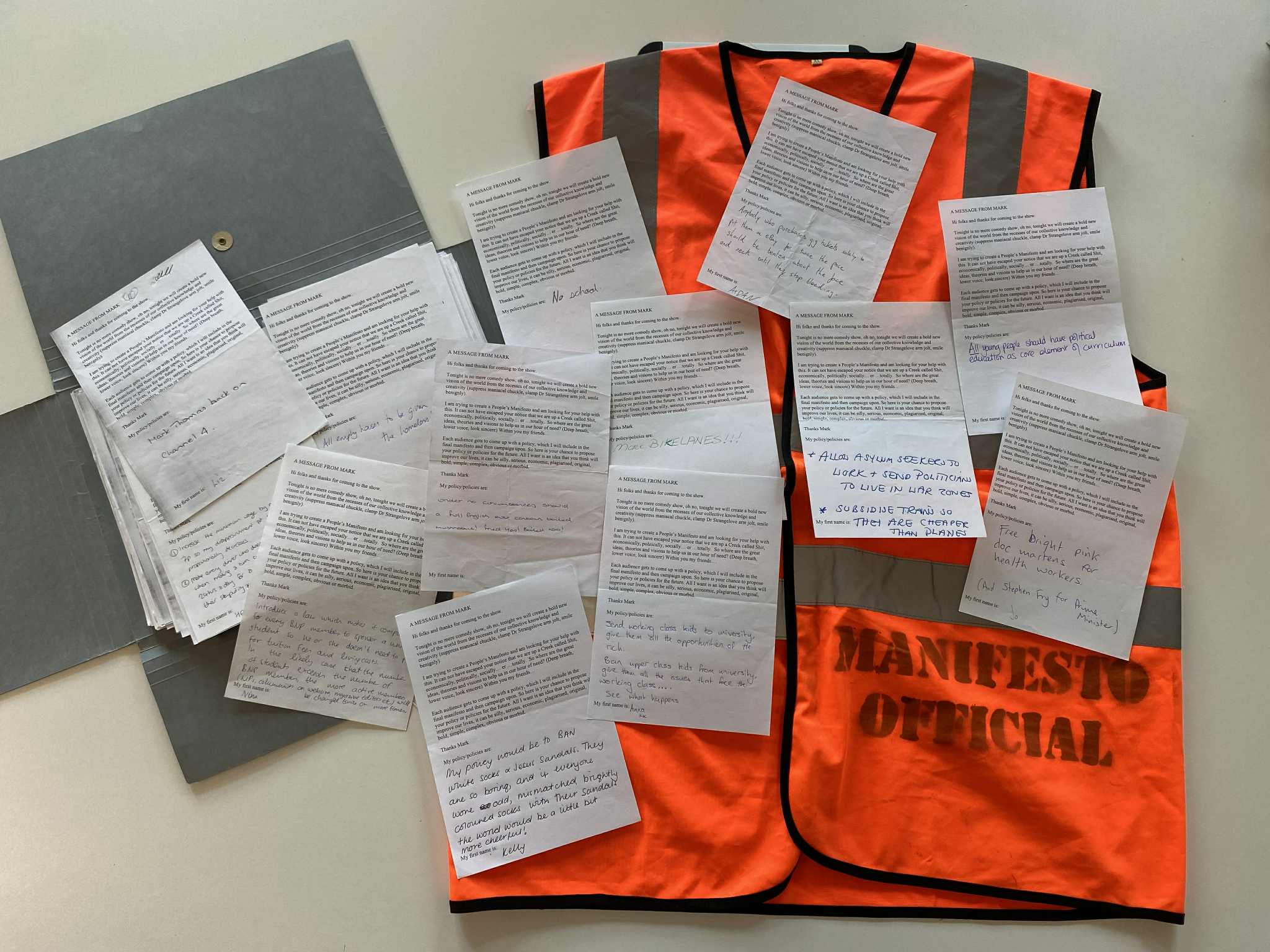
Audience contribution slips and hi-vis jacket from Mark Thomas’ It’s the stupid economy tour, 2009 (Mark Thomas Collection, BSUCA/MT/2/12/1 and BSUCA/MT/12)

Another highlight was in supporting the wider Library Events Group with a social media campaign to celebrate Shakespeare’s Birth Year; it was thrilling to uncover so much unique material in our collections testifying to both the literary and social contexts of Shakespeare’s lifetime and the enduring performance legacy of his plays. We also created a pop-up display of these materials to complement a talk given by Dr Rory Loughnane (School of English, University of Kent) in which he shared research for his upcoming book – favourites included a 1502 copy of Cicero’s Tullius de officiis, a text Shakespeare would have recognised from the school he attended, a copy having been bequeathed by local vicar John Bretchgirdle in 1564, and several 19th-century libretti that were used by Arthur Williams as prompt-copies in Victorian productions of Othello featuring his annotations and paste-ins as well as intriguing printed front-matter about contemporary casts and costume recommendations.
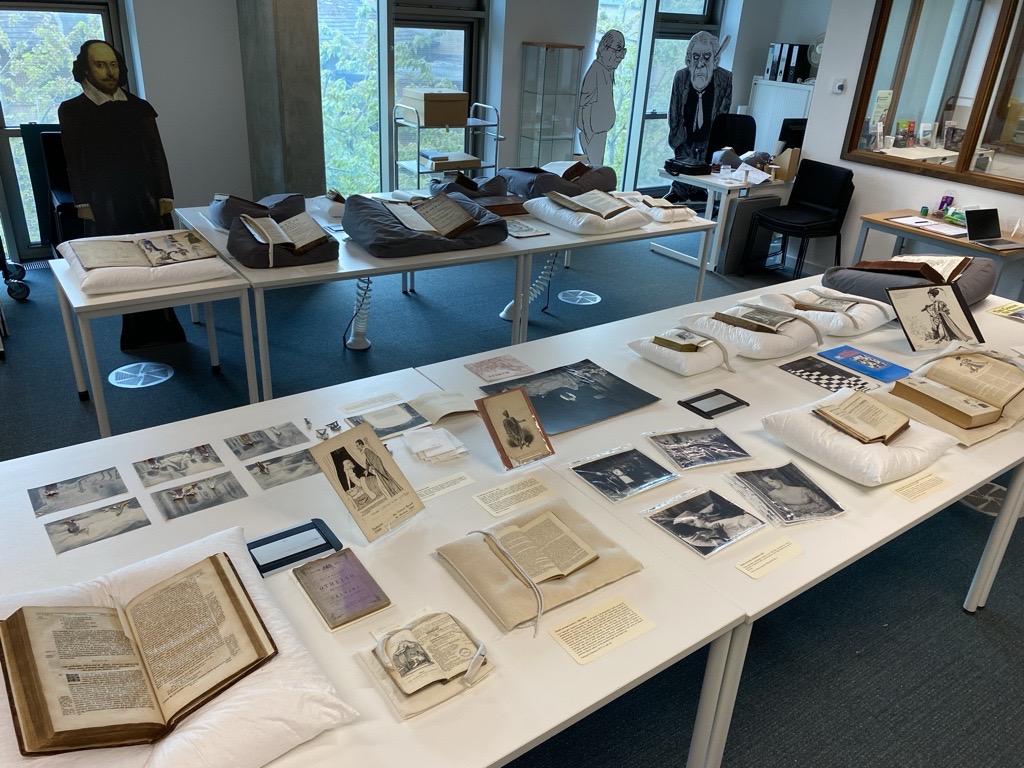
Shakespeare’s Birth Year (pop-up display of Special Collections and Archives materials)

Lasty, and most recently, I collaborated with Dr Bala Chandra (School of Advanced Study, University of London) in a series of activities to coincide with the Being Human Festival, engaging the wider public with prominent literary and cultural figures associated with Canterbury through a curated display of our materials and a radio podcast now on Spotify.

Emily Royston, Project Archivist

This year brought about an exciting change for me as I joined the team in April as Project Archivist! Since stepping into the role, I’ve been working closely with the UK Philanthropy Archive (UKPA), appraising, cataloguing, and rehousing our newest collections. These include major acquisitions such as the Craigmyle Fundraising Consultants Archive, the Wates Foundation Collection, the John Ellerman Foundation Collection, and the Hilden Charitable Fund Archive. Recently established in 2019 with the late Dame Stephanie Shirley’s founding collection, the UKPA will benefit enormously from these additions, opening up fresh avenues for research into UK philanthropy and fundraising.

I’ve really enjoyed diving into our newest collections from the Wates Foundation and the John Ellerman Foundation, which has revealed the distinct yet complementary stories of two family-endowed trusts. The Wates Foundation Collection traces the work of a trust set up in 1966 by brothers Allan, Norman, and Ronald Wates, who earned their wealth in the building industry. As generalist grant-makers, the Foundation has supported a wide range of causes from housing and homelessness to young people and education, women’s health and wellbeing, and criminal justice and prison reform. Its records, including grant files, correspondence, publications, photographs, and audiovisual materials, offer a vivid picture of family-driven, community-focused philanthropy.
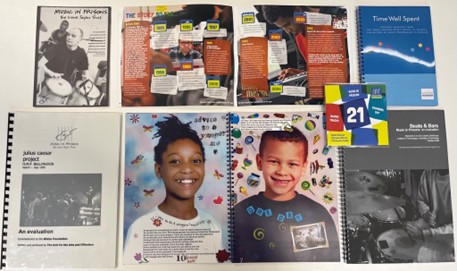
Arts and music projects supported by Wates Foundation and The Irene Taylor Trust, part of their work in prison reform and rehabilitation (UKPA/WATE/3/144)

The John Ellerman Foundation Collection, meanwhile, captures the legacy of a trust established in 1971 by John Ellerman II who inherited the fortune of his father, shipowner and investor Sir John Ellerman I. Its grant-making spans both UK-based charities and international projects, including support for disability organisations in South Africa. Also present in the collection are the Ellerman family’s personal photographs, records, and belongings, providing a rare insight into a family often described in the press as reserved and elusive. Together, these collections provide a rich and exciting resource for researchers, offering insight into how philanthropy and grant-making have shaped communities in the UK and beyond.
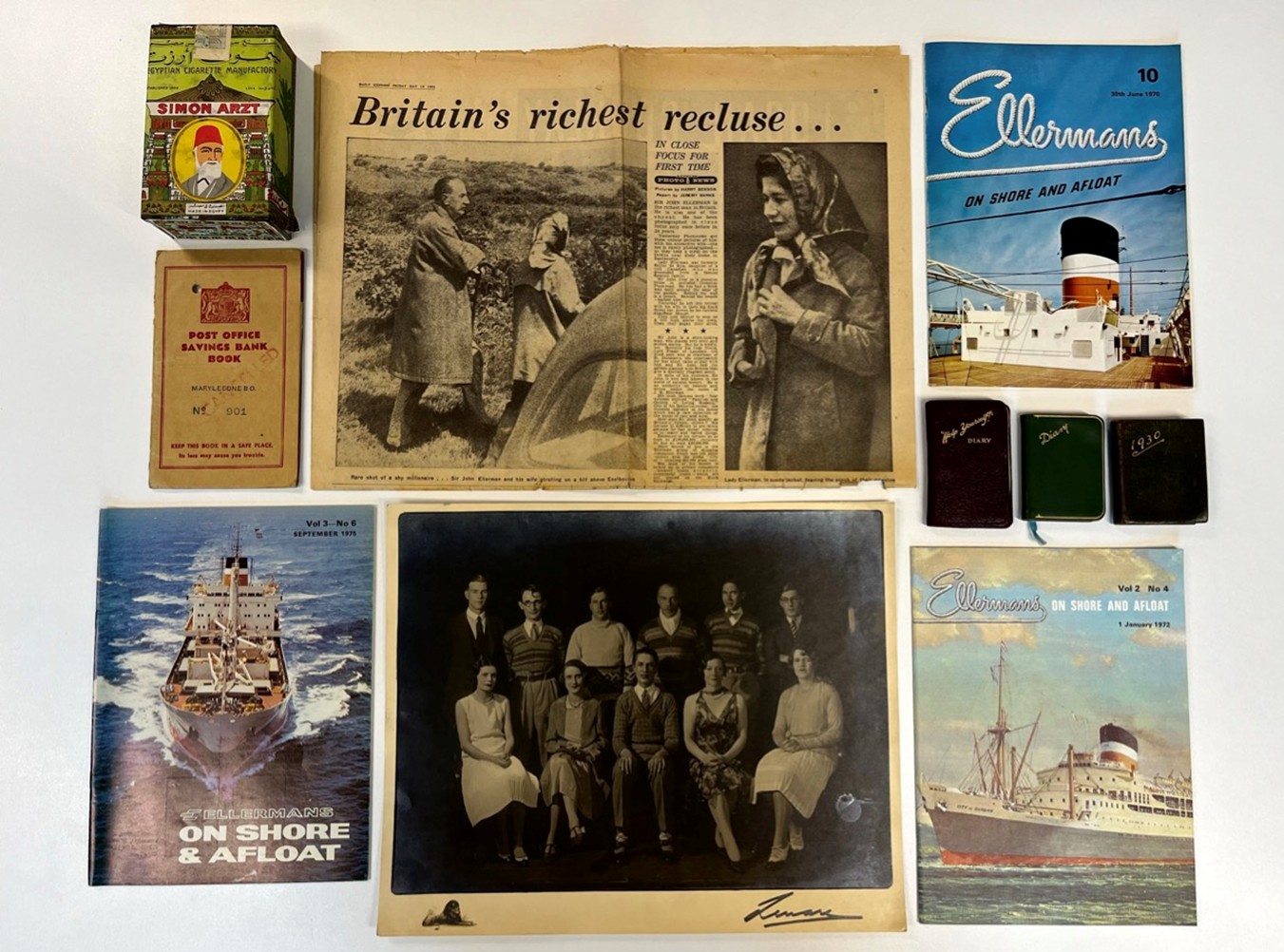
Newspaper clippings, publications, and personal belongings from the John Ellerman Foundation Collection (UKPA/JEF/1—4)

Making these collections accessible to researchers this year has been incredibly rewarding, with scholars traveling from as far afield as Japan and the United States to consult our UKPA materials. As our UKPA collections continue to grow, I’m excited to see the new research they inspire in 2026!

Jacqueline Spencer, Project Curation and Discovery Administrator

This year I have enjoyed working with the collections of two extraordinary book collectors, Dr. R.E.W. Maddison and Ronald A. Baldwin, Kent historian. Dr. R.E.W. Maddison was an academic and librarian of the Royal Astronomical Society who wrote the major work on Robert Boyle (1627-1691). His collection spans the history of sciences, particularly physics. In 2025 I completed the cataloguing of his later deposit of about 800 books including works on alchemy, astronomy and applied science. Dedications and notes in some of the books indicate Maddison’s personal connections with scholars across Europe. The older books include a four-volume set of the 1787 Paris edition of M. Sigaud de la Fond’s Eléméns de physique bound in block-printed pastepaper and John Dalton’s A descriptive poem addressed to two ladies at their return from viewing the mines near Whitehaven (1755) which indicate the range of his interests.
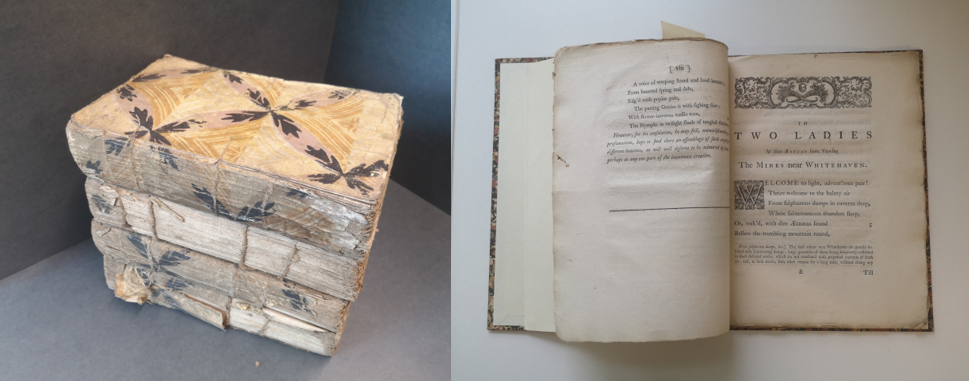
Élémens de Physique (Maddison Collection, QC 19 FON)
A descriptive poem [of…] the mines near Whitehaven (Maddison Collection, LRG PR 3395 DAL)
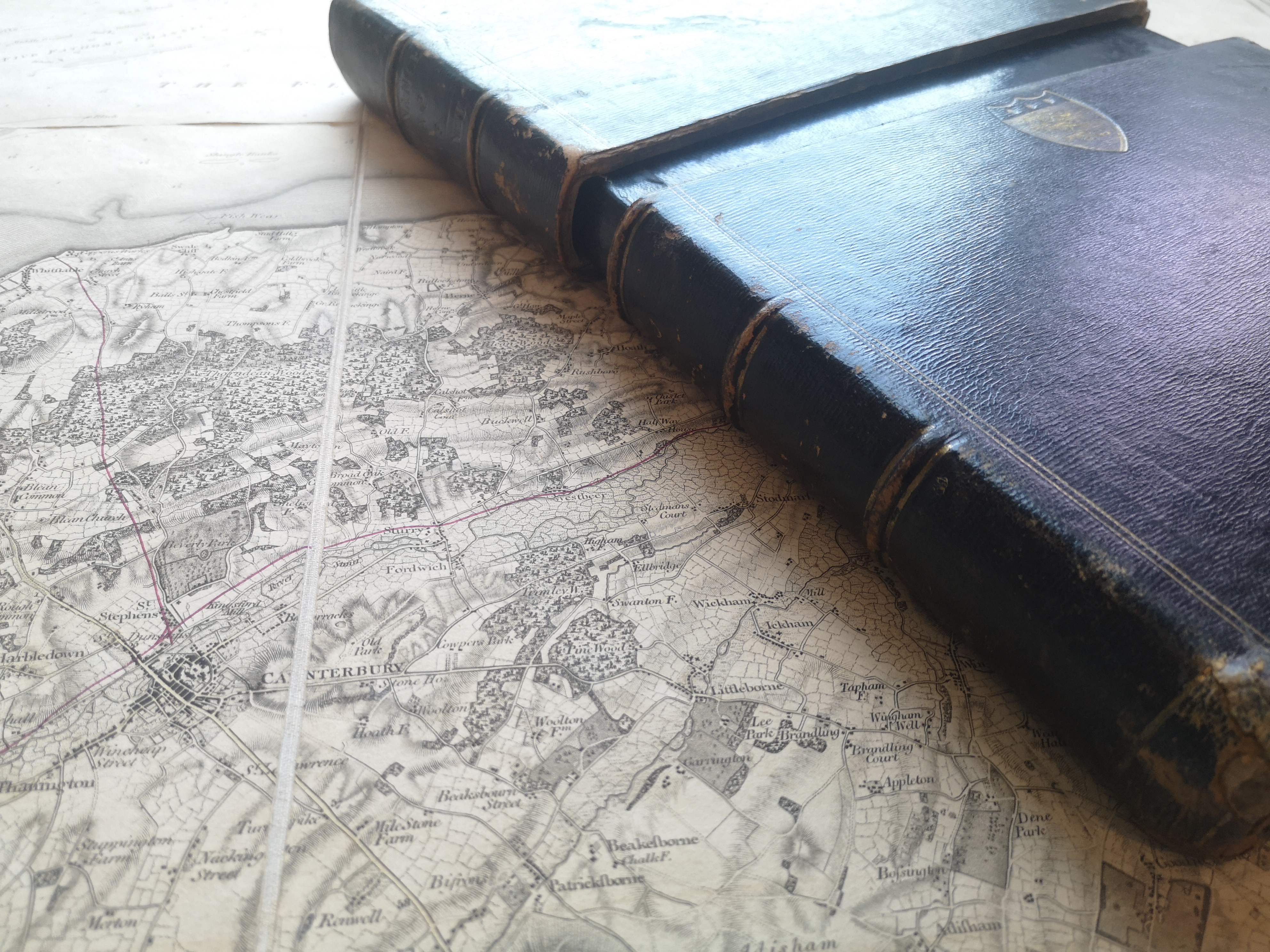
Ronald A. Baldwin was an indefatigable collector. The cataloguing project has revealed his interest in the quotidian history of Kent. Our collections have been enhanced by his material on hopping and farming of cherries and apples and the papermaking industry, on folklore, the natural history of the county and early practical medicine. The collection has added to the university’s holdings of older books on the history of the county including the first Ordnance Survey map of Kent from 1801, the General survey of England and Wales. : An entirely new & accurate survey of the County of Kent … surveyed by Capt. W. Mudge, at large scale, showing field boundaries, mounted on a single sheet and in its original box case.

An entirely new & accurate survey of the County of Kent (Ronald A. Baldwin Collection, G 5753.K4 1801)

Railway lines have been drawn on in red pen which, Baldwin notes, must have been before 1860 as the Crab and Winkle line is shown but not the line from Canterbury to Faversham. Baldwin assembled Acts of Parliament relating to the use of land and rivers in Kent and he sought out sources on local government and on crime. He was a Methodist and his interest in religious biographies may have helped him to acquire scarce pamphlets, amongst which is the rarest book I have ever catalogued, his pamphlet printed by James Abree in St. Margaret’s, Canterbury in 1745, A true and authentick confession of the many robberies committed by William Hook …the notorious house-breaker; our copy has now been added to the ESTC (English Short Title Catalogue) by Dr. David Shaw. I have been able to catalogue part of his collection this year; the biographies of people of Kent, of Kent authors and religious nonconformist groups are yet to be explored.
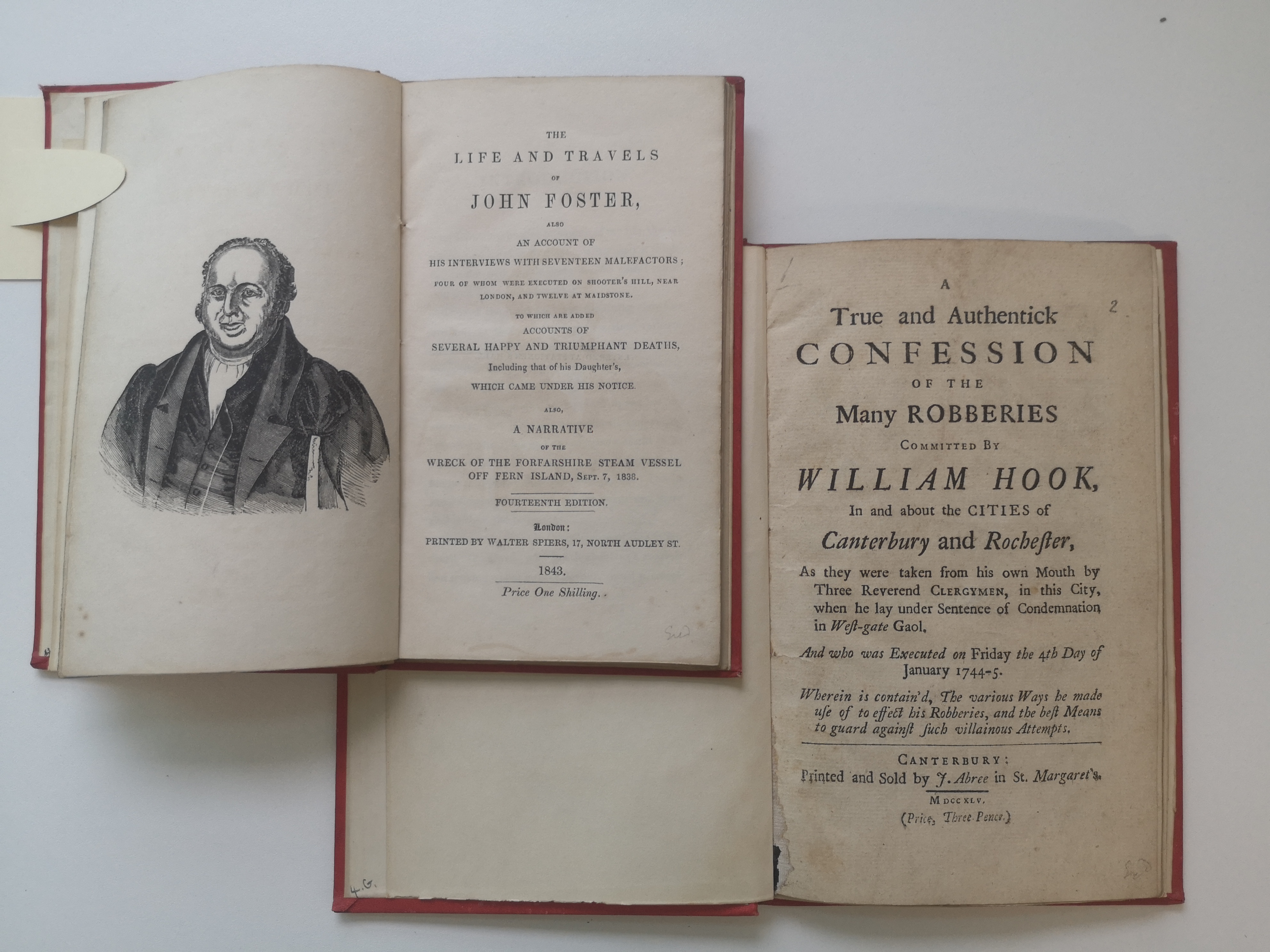
The life and travels of John Foster (Ronald A. Baldwin Collection, HV 28 FOS)
A true and authentick confession of the many robberies committed by William Hook (Ronald A. Baldwin Collection, HV 6653 HOO)

Alex Triggs, Digitisation Administrator

During 2025 I continued with the high resolution digitisation of the British Cartoon Archive collections. This year has been dominated by the original artworks of Jensen (John Jensen, 1930-2018), who drew for a wide range of publications; newspapers, books and magazines, but is perhaps most widely known for his work for Punch magazine and the Telegraph newspapers. Born in Australia Jensen came to Britain as a young man and began his career as a cartoonist and illustrator which went on to span six decades. He was a skilled artist who could draw with either hand and in a wide variety of styles. The Jensen collection contains circa 3000 artworks and is now almost entirely digitised. Personally it has been one of the most interesting collections I have worked on, largely due to Jensen’s artistic ability and stylistic diversity.
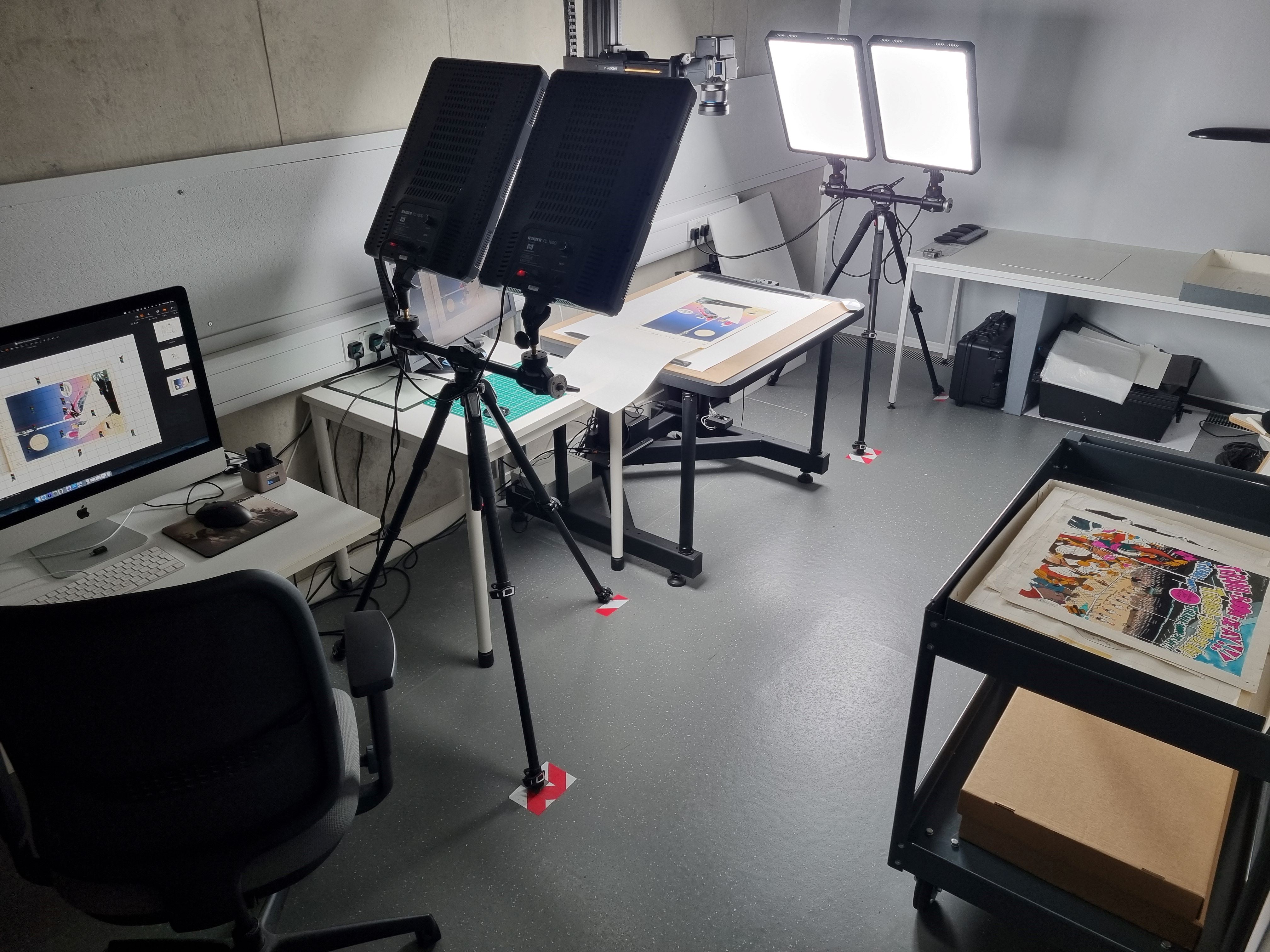
Digital Imaging Suite, Special Collections and Archives

The focus of my digitisation work on the audio visual collections has now moved on to the vast Max Tyler collection of Music Hall analogue magnetic audio cassette tape recordings. Max Tyler was the archivist and historian for the British Music Hall Society, and this substantial collection includes a wide variety of Music Hall memorabilia including sheet music, playbills, books and recordings. We are currently running an initial test digitisation of this eclectic collection of audio recordings to evaluate how we will approach the process as we move forward.
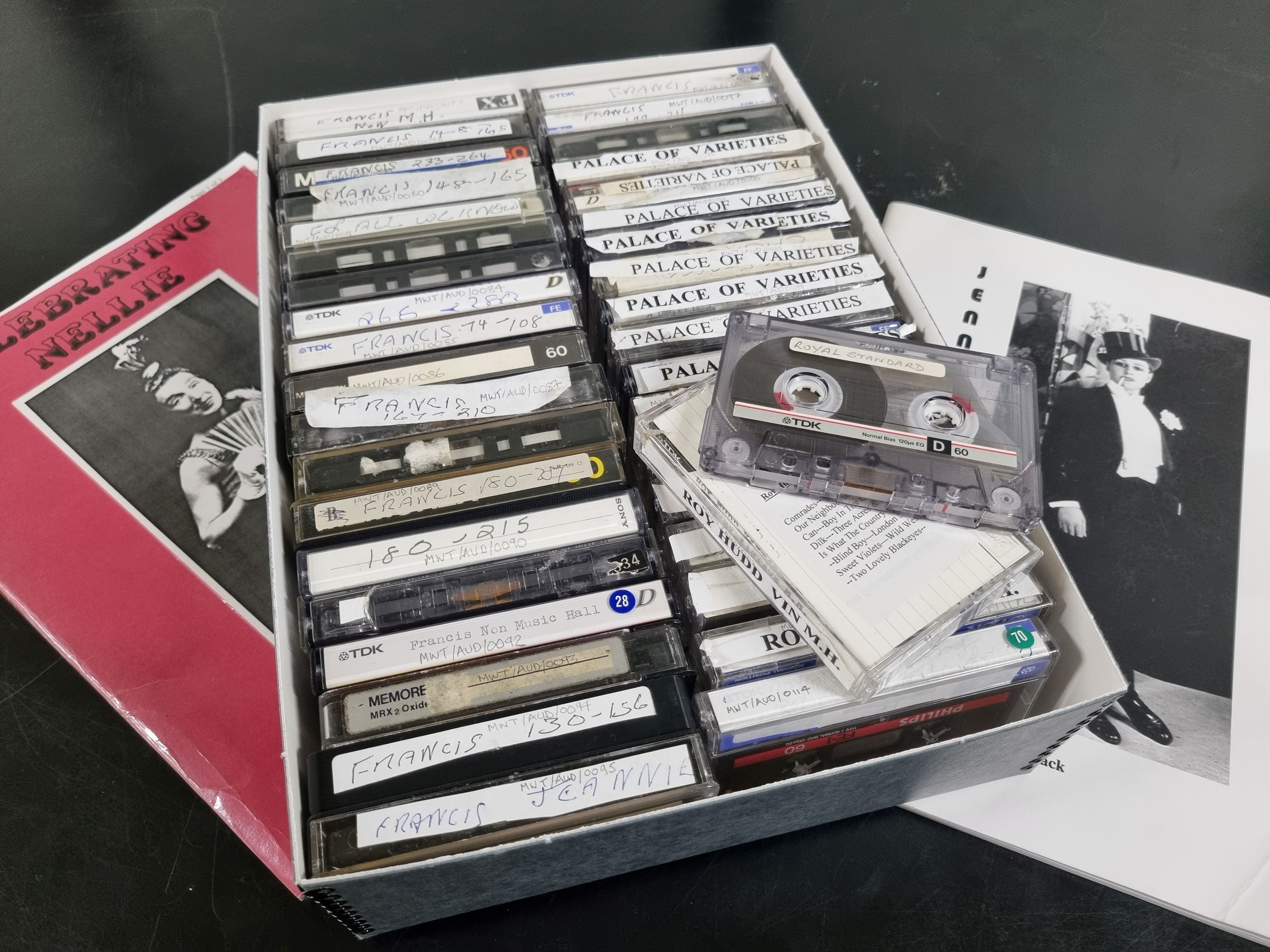
Box of cassettes (Max Tyler Collection)

Mandy Green, Special Collections and Archives Assistant

Back in January I completed scans from the Giles annuals that we receive every year, they are always so good to scan and the comedy element always funny. I’ve also been scanning the Donald McGill postcards which are particularly colourful and detailed. Most recently, I have scanned two of the Alexei Sayle scripts for the Young Ones, it was so interesting to see how the scripts are written.

Stuart Tombs, Curation and Discovery Administrator

This year, as well as cataloguing many more music hall song sheets from the Max Tyler collection, I have enjoyed cataloguing items for the Reading-Rayner Literature Collection. These have consisted mainly of twentieth century fiction and biographical works by authors including Charles Morgan, Evelyn Waugh, T. H. White, Jerome K. Jerome, and Gore Vidal (including a copy of his memoir, Palimpsest, signed by the author).

Many more interesting items have been added to the British Cartoon Archive of which the highlight for me has been “Drawing the curtain: the Cold War in cartoons”, a beautifully presented collection of Soviet cartoons from the Cold War era, published in 2012. Sergei Kruschev (Engineer, and son of Cold War Russian leader Nikita Kruschev), in his preface describes it as “a history of the second half of the twentieth century: from the gentle humour of the mid-1940s, when the world lived in a state of euphoric anticipation of peace and prosperity to come; through the mutual mistrust – not to say hatred – of the 1950s to 1970s; right up to the hopes of perestroika, and even the diplomatic ‘reboots’ of modern times.”
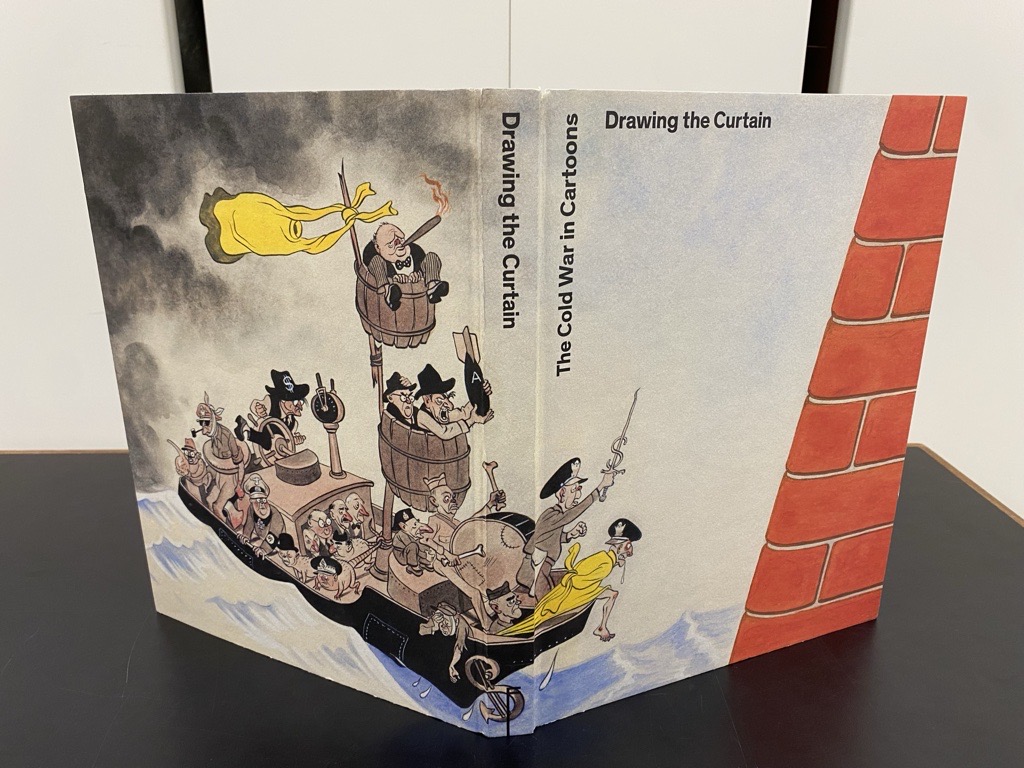
Drawing the curtain : the Cold War in cartoons (British Cartoon Archive Library, LRG NC 1763.W3 ALT)

Matthias Werner, Curation and Discovery Administrator

I have started to work on a collection of books and periodicals generously gifted to us by the late Graham Thomas, who sadly passed away in 2023. Dr Graham Thomas was a former Politics lecturer at the University of Kent and played an instrumental role in establishing the Centre for the Study of Cartoons and Caricature, now known as the British Cartoon Archive. He left us a substantial collection, comprising a large number of books and periodicals, an extensive postcard archive, and a significant assortment of ceramics. The Graham Thomas book and periodical collection includes works of cartoon and  caricature artists, but also books on humour, drawing and design. Among the highlights are a number of first editions by Fougasse, George Molnar and Francis Carruthers Gould.

In addition, I have continued to catalogue Steve Bell’s cartoons for the British Cartoon Archive, making them available to the public. Steve has very kindly sent us his published editorial cartoons from The Guardian. It has been fascinating to revisit the political scandals of 2021, which made me realise how quickly things in politics have moved, although the broader topics have largely remained the same as we continue to battle with the fallout from Covid, Brexit, and the (first) Trump presidency.

Volunteers

We couldn’t end our annual newsletter without a massive thank you to all our volunteers, who provide indispensable support to managing our collections and making them more discoverable. Collectively, they contributed 1031 hours over the last twelve months – equivalent to 186 full work days. Read on for some of their own insights.

Martha Pledge

I have been volunteering in Special Collections and Archives since the spring. Most of my time has been spent archiving theatre programmes gifted to the university by Seona McKinnon and I’ve made some fascinating finds. This Sylvia Plath programme features her poems, a timeline of her life, and a scene sequence of her poetry to the dance movements performed. It even folds out to become an amazing poster, revealing a creativity of production which reflects beautifully on the legacy of Plath’s life and work. As a Shakespeare lover, I also want to highlight this 1979 adaptation of Hamlet at the Half Moon Theatre, starring Frances de la Tour in the title role. A more traditionally-structured programme, it includes an article on the lesser-known performance history of Hamlet being played by female actors. These are just two of hundreds of programmes I’ve encountered whilst volunteering, all of which has reminded me of the importance of preserving literature for future academics and students.
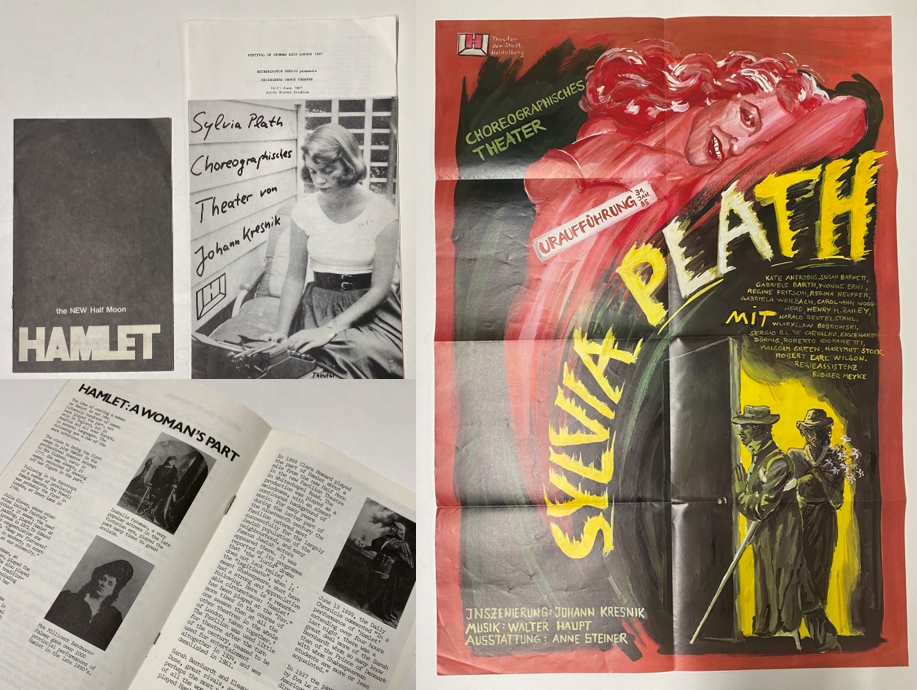
Programmes for productions of Hamlet (Half Moon Theatre, 1979) and Sylvia Plath (Heidelberg Dance Theatre at Jacob Street Studios, 1987). Seona McKinnon Collection

Emma Jeffree

As a Special Collections and Archives volunteer, I have been writing summaries and editing transcripts of interviews in the Winstanley Oral History Collection. These interviews were conducted by Michael Winstanley in the 1970s, looking at everyday life in Kent before 1914, and formed the basis for his book Life in Kent at the turn of the century [1978]. Listening to the original digitised recordings has given me the chance to hear the voices of people who lived at the time, and learn from them what their life was like, and how society worked 100 years before I was born. Having grown up in Kent myself, it is fascinating to hear of familiar places in very different lights. Volunteering at the archives is not only interesting and enjoyable, but it also provides me with good work experience vital for a student and the confidence and skill set necessary to embark on my future career.
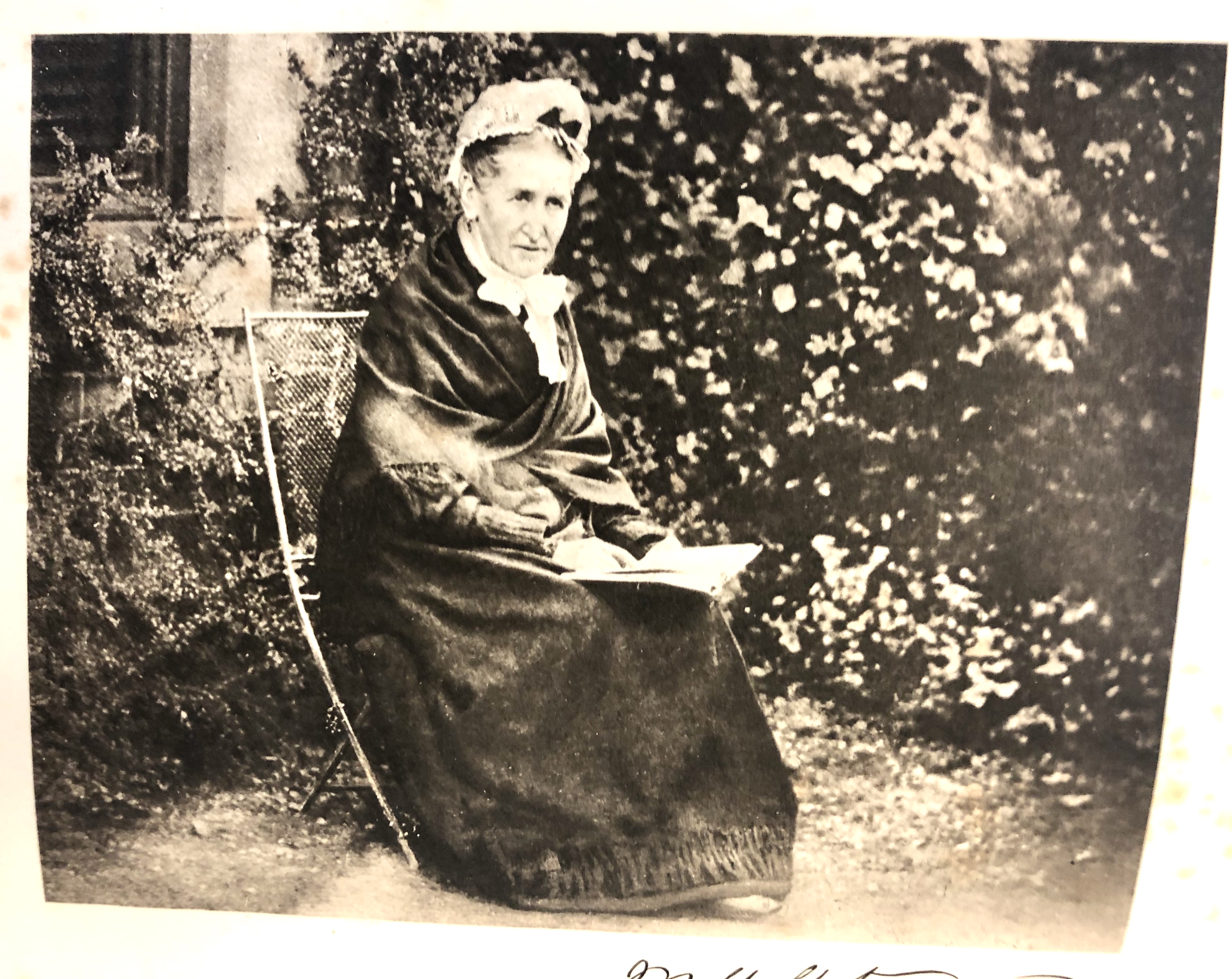
Women and Girls in Science: Mary Anne Atwood, alchemical thinker and spiritualist

February 11 is the International Day of Women and Girls in Science. To commemorate this occasion, we’re going to delve back into our Maddison collection to see how women have been involved in sciences from the very beginning. Today let’s take a look at Mary Anne Atwood, who was afraid she had revealed one scientific secret too many…

Photograph of alchemical researcher Mary Anne Atwood, undated.

Photograph of alchemical researcher Mary Anne Atwood, undated.

Who was she? Born in Dieppe in 1817, Mary Anne Atwood (nee South) grew up surrounded by her father’s books in Gosport, Hampshire. Like many women of the era Mary Anne received no formal education but learnt Latin, Greek, and the classics at home. Encouraged by her father Thomas South she joined a circle of theosophists; a religious group who believed that spiritual knowledge was held in a group of individuals known as the Masters. It was this circle that sparked her research in alchemy.

What did she write? In 1846 Mary Anne and her father released a book detailing their thoughts and research so far: Early Magnetism in its Higher Relations to Humanity as Veiled in the Poets and the Prophets, under the pseudonym Thuos Mathos. The work was well received and the praise encouraged the Souths to begin a much bigger project: a full explanation of the purpose and methods of the alchemical process.

What is alchemy anyway? Today, we know alchemy as the discipline of trying to turn lead into gold, practised between the 16th and 18th centuries. However during the 19th century, as it became more widely recognised that this was not possible, alchemy as a discipline took on a more spiritual slant. Researchers began to examine the relationship of mankind – and the soul – to the wider cosmos, exploring if it was possible to refine the soul away from the influences of the external world and society back to a state it would have been in when God created it. This branch of alchemy is known as Hermetism (or Hermetic writings) and it is this that Mary Anne Atwood and her father were interested in, rather than the Philosopher’s Stone story we know from J.K. Rowling’s world today.

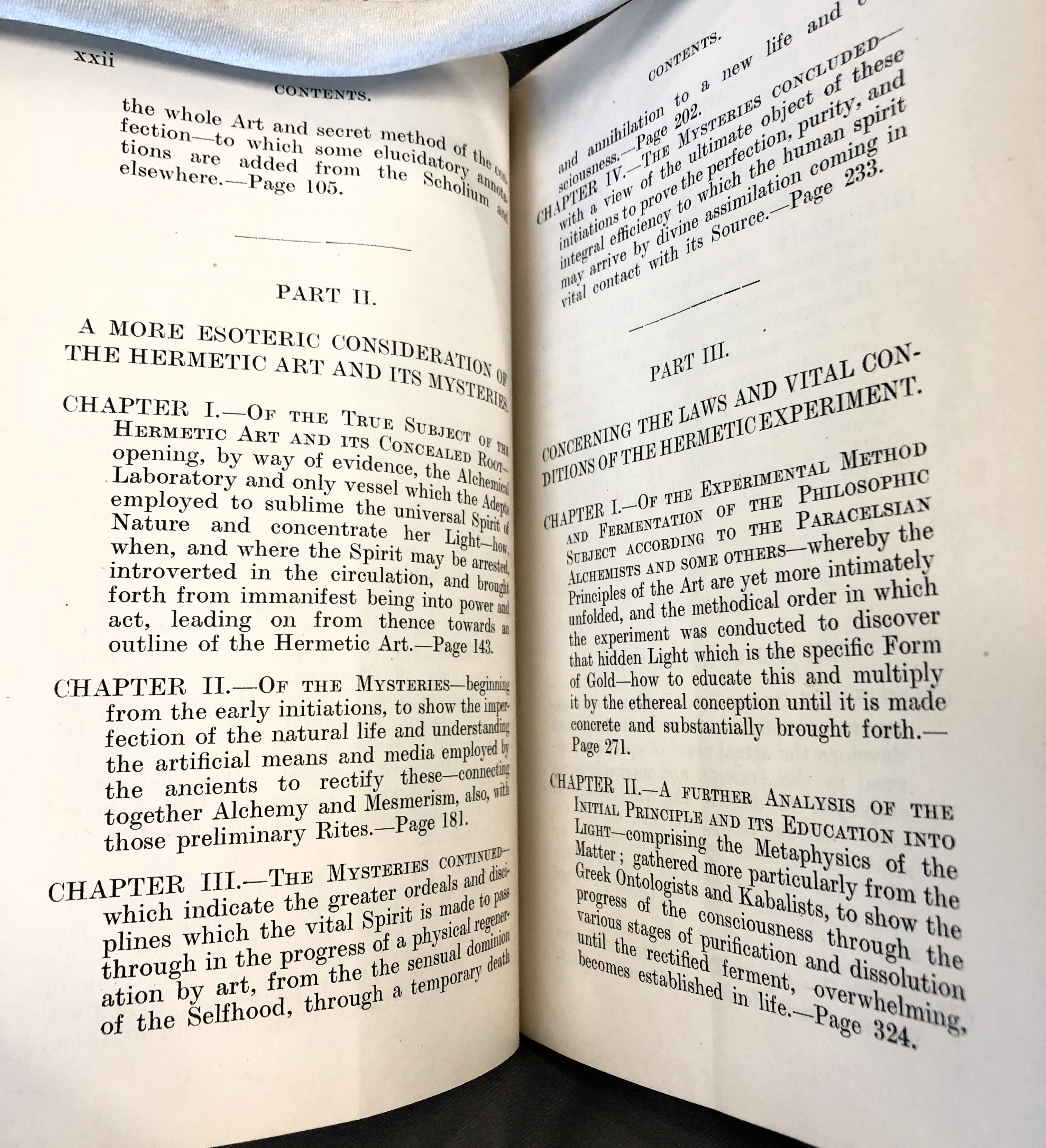
Contents page of Atwood's work ' A suggestive inquiry into the hermetic mystery : with a dissertation on the more celebratedof the alchemical philosophers, being an attempt towards the recovery of the ancient experiment of nature'

Contents page of Atwood’s work ‘ A suggestive inquiry into the hermetic mystery : with a dissertation on the more celebratedof the alchemical philosophers, being an attempt towards the recovery of the ancient experiment of nature’. Long title, fascinating book.

Why has she not become more famous? In 1850, Mary Anne published A Suggestive Inquiry into the Hermetic Mystery which was the culmination of years of research into spiritual alchemy. The work was supposed to be published alongside a poem written by her father, The Enigma of Alchemy. When A Suggestive Inquiry… was published it had not been read (or edited) by Thomas South, and shortly after its release to the world the Souths decided it was not fit for sale and withdrew the book along with most existing copies (to the ire of their publisher). The reasons for this withdrawal are twofold. Firstly (and most importantly) Mary Anne and her father believed that they had explicitly written about secrets that should have stayed hidden within allegorical texts, and that this knowledge could be dangerous if in the wrong hands. Secondly there is a suggestion that Thomas South became more devoutly religious between the writing of the texts and that this prompted a change of heart about the matter.

Following A Suggestive Inquiry…‘s withdrawal, Mary Anne retreated from alchemical society. In 1859 she married Reverend Alban Thomas Atwood and lived a very quiet life in Yorkshire. After her husband’s death in 1883, there is some evidence that Mary Anne was approached about a possible reprint of A Suggestive Inquiry… and whilst she did not wish to see it in print again – for fear of it being reproduced and sold without her consent – she gave a few copies to friends and made some minor amendments to the text itself before her death in 1910.

Why is she important? A Suggestive Inquiry into the Hermetic Mystery is the first work that gives a comprehensive insight into alchemy as a discipline, and consequently Mary Anne’s work is vital for establishing this particular area of historical scientific research. In 1918 it was republished by Mary Anne’s friend, the painter and thinker Isabelle de Steiger, for the first time since it was withdrawn from sale in 1850.

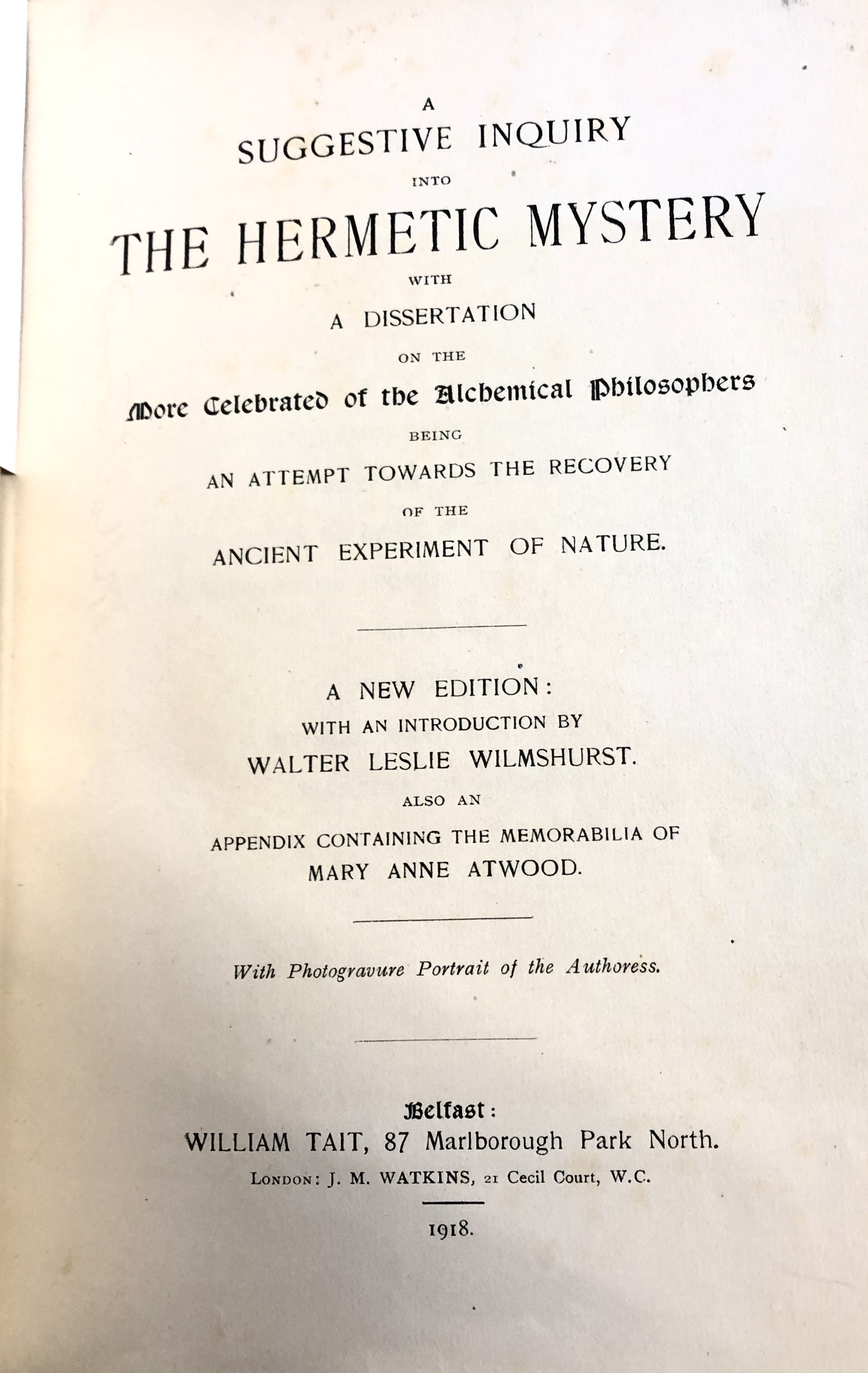
Title page of the new 1918 edition of Atwood's work 'A Suggestive Inquiry...'

Title page of the new 1918 edition of Atwood’s work ‘A Suggestive Inquiry…’

Freemason Walter Leslie Wilmshurst, who wrote an extensive introduction in the new edition, suggested that the societal and spiritual impact of the First World War led to increased interest in alchemy and Hermetic writings: 

“It was not, I think, the destiny of such a treatise as this to perish at its birth, but rather, when the time should be more ripe for it, to re-emerge from its obscurity and assert that influence which its great merits are capable of exercising. With that clear, sure prophetic vision with which its writer…penetrated the tendencies of modern world movements and conditions, she discerned the impending catastrophe to human society and institutions through which we are now passing.” (p.64)

The copy of Mary Anne’s work we hold is the 1918 edition, which contains additional quotes by the writer. It was collected by the writer and librarian R.E.W. Maddison for his ongoing collection of books relating to the history of chemistry and physics, within which there are many books about alchemy. Whilst the language of Hermetism appears somewhat obtuse by today’s standards, Atwood’s work is a fascinating summary of alchemical studies – and a solid testimony that there are many ways to discover the world beyond traditional education.

Bibliography and further reading:

Mary Anne Atwood, A suggestive inquiry into the hermetic mystery : with a dissertation on the more celebrated of the alchemical philosophers, being an attempt towards the recovery of the ancient experiment of nature. William Tait, 1918. University of Kent Special Collections & Archives: Maddison Collection 19A15.

R.A. Gilbert,  ‘Atwood [née South], Mary Anne’, Oxford Dictionary of National Biography, 2004. DOI: https://doi-org.chain.kent.ac.uk/10.1093/ref:odnb/53866

Robert P. Multhauf and R.A. Gilbert, ‘Alchemy’, Encyclopaedia Brittanica, 2019: https://www.britannica.com/topic/alchemy.

Brown University in Providence, Rhode Island holds the majority of material by Mary Anne Atwood in its Special Collections department.

As ever, more information about the Maddison collection and visiting us can be found on our website.

A brief history of alchemy; or, My Alchemical Romance

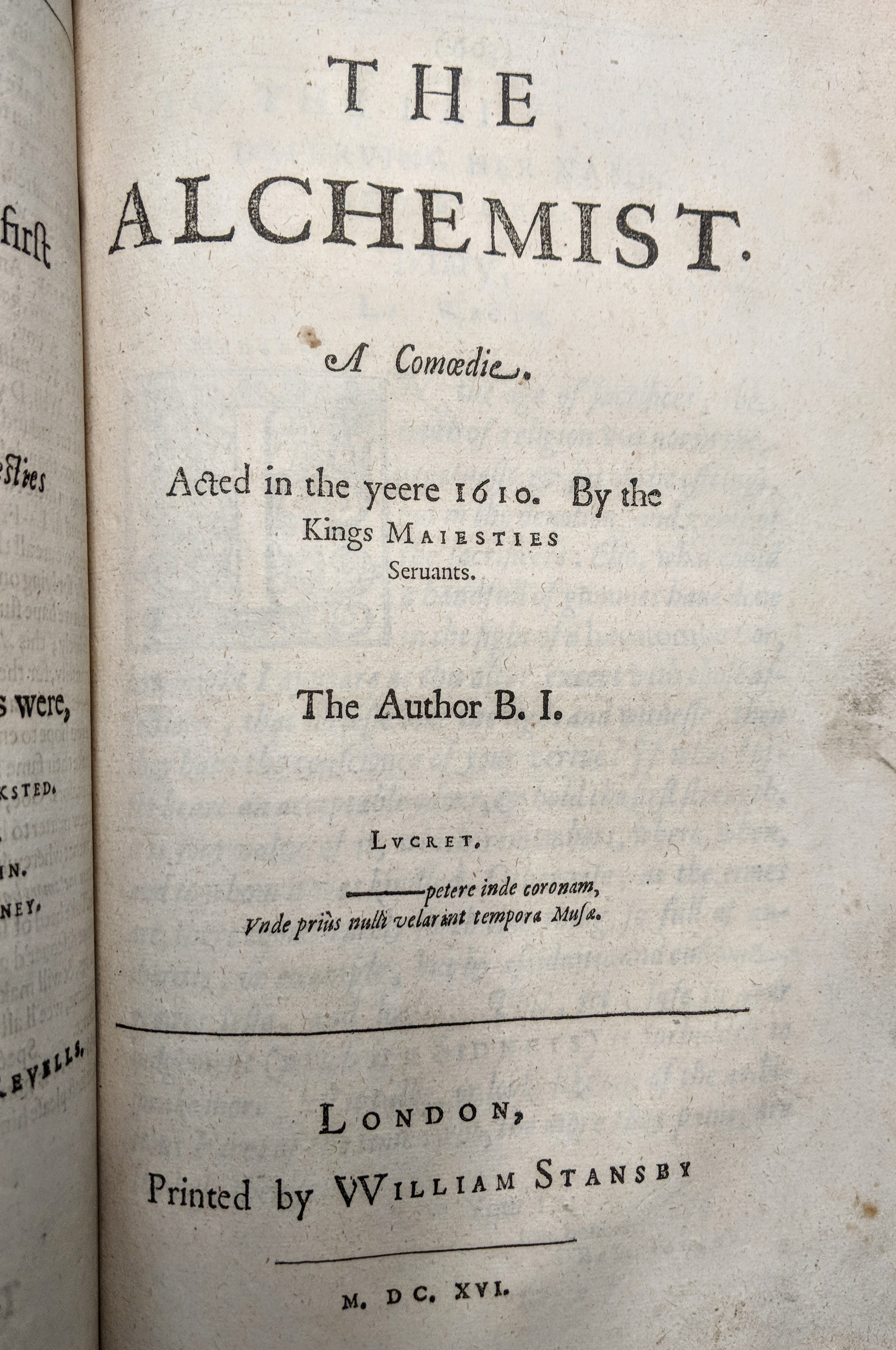
First performed in 1610 by the King’s Men, the acting company to which Shakespeare belonged, Ben Jonson’s The Alchemist is a satire centred around three con artists who use subterfuge, guile and wit to relieve targets of their belongings. Jonson makes no attempt to conceal his low opinion of alchemy and its practitioners, with the titular alchemist an obvious fraud and this makes it a useful springboard into thinking about alchemy in its historical context. The Templeman Special Collections and Archives holds a copy of Jonson’s First Folio from 1616 in its pre-1700 collection which contains the play and so in order to demonstrate how the Maddison collection could be useful for study and research beyond the history of science, we are going to use The Alchemist as a framing device for this week’s blog post.

Title page from 'The Alchemist' by Ben Jonson in Jonson's First Folio of 1616.

Jo says we are not allowed to have favourites because it makes the other books sad. The Jonson Folio (Q C 616 Jon) is Philip’s favourite. Don’t tell Jo. Or the other books.

‘Alchemy is a pretty kind of game, / Somewhat like tricks o’ the cards, to cheat a man / With charming.’ (2.3.180-182, The Alchemist)

To the uninitiated, alchemy can seem a vague art form that seems to cover a range of random topics. Whilst researching for this post we read about people trying to turn base metals into gold or silver, about some trying to create a source of eternal life and others searching for ways to raise the dead. Alchemy has spanned a large number of fields in its history from supernatural and spiritualism to medicine and early chemistry but what many fail to realise is that alchemy was in fact an early science intent on answering many of the same questions we strive to answer today. It was only in the 1700s that a strong distinction between ‘alchemy’ and ‘chemistry’ was established; prior to this time that the study of both subjects was much more fluid.

A pictorial diagram of the four base elements in a cross. Each element is represented by a creature. Clockwise from top: fire (ignis) is an angel; earth (terra) by a bear; water (aqua) by a dragon-looking creature; air (aer) is a long-necked bird.

The dragon-demon-sea monster thing is our spirit animal.


Alchemy has a long history, dating back to  antiquity and it is possible to track its early modern evolution through the Maddison Collection in the form of dedicated volumes, notes and annotations, and handwritten recipes.The roots of Western alchemy are founded in the classical idea of the basic elements – fire, water, wind and earth – and it is primarily this Eurocentric alchemy which is covered in the Maddison Collection. Variant forms of alchemy have been practiced across the globe, particularly in the Middle East, China, and India. It is the various cultural and religious influences which make each strain of alchemy unique.

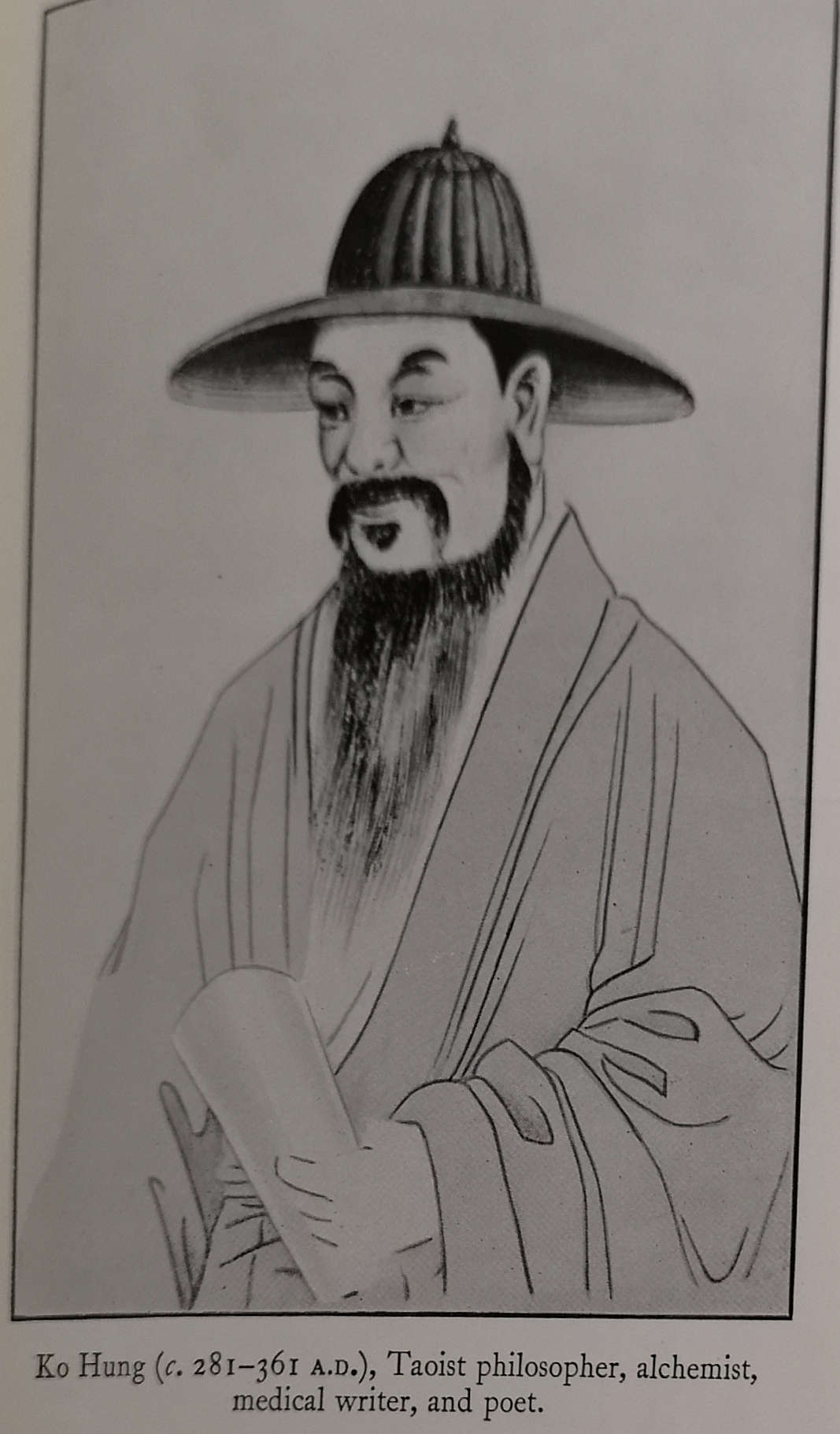
A taoist philosopher, alchemist, medical writer and poet, Ko Hung was the originator of first aid in traditional Chinese medicine.

A taoist philosopher, alchemist, medical writer and poet, Ko Hung was the originator of first aid in traditional Chinese medicine.

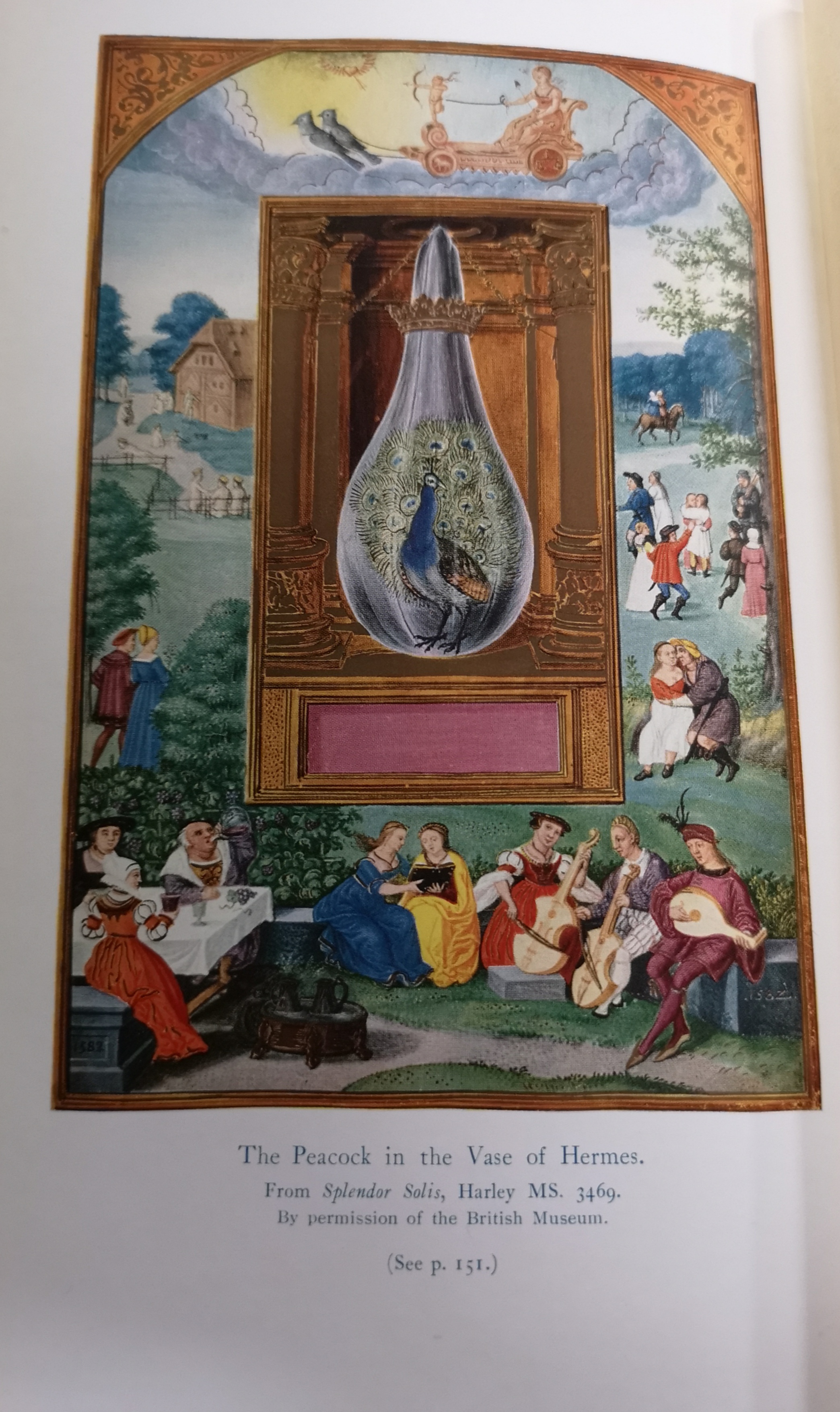
These aforementioned roots of alchemy are derived from the classical world and continued to evolve through the ages in Western Society by adopting and discarding knowledge from various influences. However, the core of alchemy always reflected its origins through its continued use of classical mythology as a communicative device. In multiple volumes within the collection the reader is able to see various illustrations utilised to express a concept or recipe in relation to alchemy, but to those unversed in identifying these alchemical signs these illustrations appear to be merely depictions of ancient myths and folklore.

Colour illustration of a peacock in the vase of Hermes

This peacock is serving all kinds of fabulous perfection.

‘Nature doth first beget the imperfect, then/ Proceeds she to the perfect.’ (2.3.158-9, The Alchemist)

There were alchemists working across Europe through the medieval period into the early modern. The collection’s earliest works on alchemy come from Agrippa, a German polymath, legal scholar, physician and theologian,who was an important alchemist in the early sixteenth century. He is an interesting man to study, as during his career he turned away from the occult and focused much more his theological work, rejecting magic in his later life.

Just look at all those instruments! Agrippa’s getting the band back together.

Just look at all those instruments! Agrippa’s getting the band back together.


Paracelsus is another influential figure in alchemical circles, also well represented. A respected physician, alchemist and astrologer during the German renaissance, Paracelsus is known as the father of toxicology, as well as being one of the first medical professors to use chemical and minerals in medicine. John Dee, Robert Boyle and Elias Ashmole were also important names in the history of alchemy and all of these alchemists have works related to them within the Maddison collection.


Guess who’s back, back, back. Back again, Boyle’s back! Tell a friend.

Guess who’s back, back, back. Back again, Boyle’s back! Tell a friend.


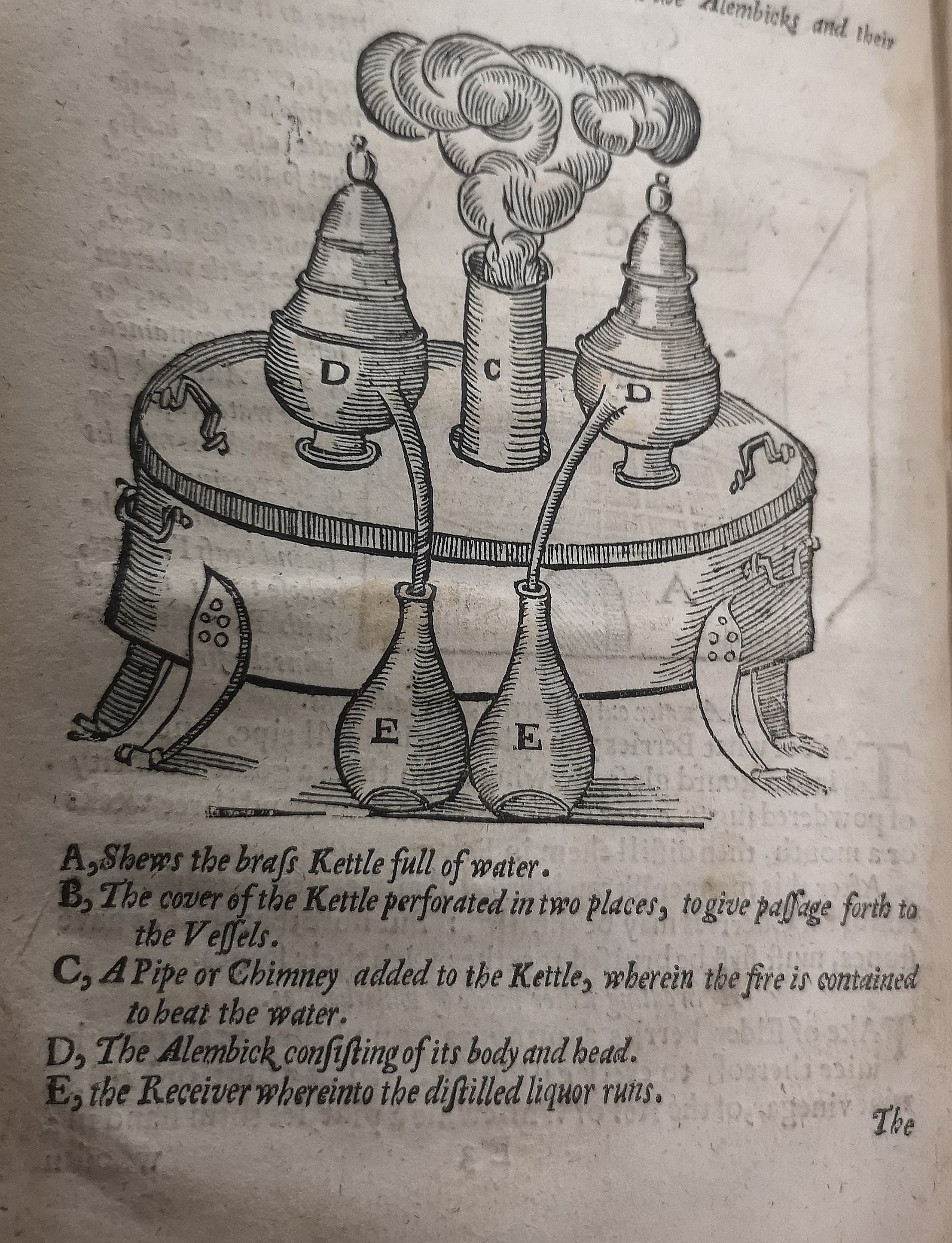
It is unsurprising that Boyle engaged in alchemy alongside his more conventional scientific research. Many regarded alchemists as great experimentalists, who engaged in complicated experiments, which they then documented and amended. Cleopatra the Alchemist was a Greek Egyptian alchemist from the 3rd century whom focused on practical alchemy and is considered to be the inventor of the Alembic, an early tool for analytical chemistry. She along with other alchemists such as Mary the Jewess focused on a school of alchemy which utilised complex apparatus for distillation and sublimation, important techniques still in use in the chemistry lab today. Cleopatra the Alchemist’s biggest claim to fame is as one of only four female alchemists who were supposedly able to produce the Philosopher’s Stone.

This was one method of distillation being utilised in 1653, which looks very similar to a modern day distillation technique! On a large drum sit 2 identical vessels, and in between them is a ventilation shaft allowing smoke to escape. The two vessels on the drum are connected by long thin spouts to two conical flasks,designed to receive the run off liquor.

This was one method of distillation being utilised in 1653, which looks very similar to a modern day distillation technique! On a large drum sit 2 identical vessels, and in between them is a ventilation shaft allowing smoke to escape. The two vessels on the drum are connected by long thin spouts to two conical flasks,designed to receive the run off liquor.

‘I am the lord of the philosopher’s stone.’ (4.1.156, The Alchemist)

Twenty-first century readers may be more aware of alchemy than they realise. Harry Potter and the Philosopher’s Stone placed alchemy front and centre in contemporary culture. Other references in popular culture include manga and anime Fullmetal Alchemist and fantasy video games, World of Warcraft and Final Fantasy, amongst countless more. F. Sherwood Taylor points out the misconception of alchemists as ‘magicians or wizards’ that is common to these modern representations, writing that ‘as far as we know the alchemists sought to accomplish their work by discovering and utilizing the laws of nature […] never […] by “magical processes”’ (p.1, The Alchemists: Founders of Modern Chemistry, F. Sherwood Taylor). The Philosopher’s Stone was one of the primary goals of alchemy. Supposedly the catalyst needed to turn base metals such as mercury, tin or iron into the noble metals, gold and silver, it was also theorised to cure illnesses and extend lifespan. Alchemists disagreed on just about every aspect of the stone; from what it symbolised to how it was created. What all alchemists did agree upon was that the Philosopher’s Stone was a tangible possibility and someone had managed to make and use it in the past. During our research we discovered a series of images related to transmutation that may be related to the Philosopher’s Stone. You can see those, with added captions, as part of the Adventures series here

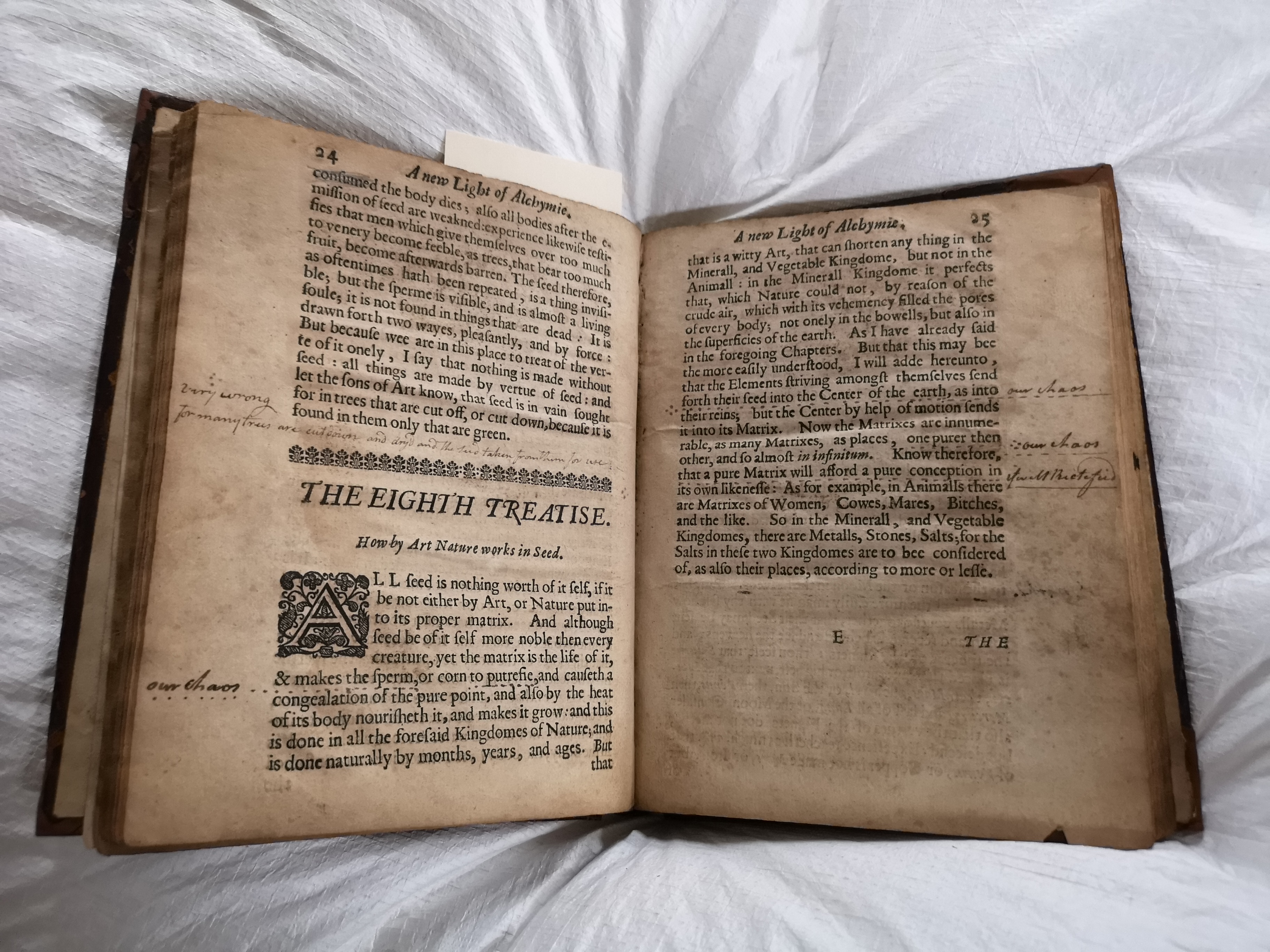
Image of A New Light of Alchymie book

J K Rowling’s Half Blood Prince anyone?

‘If all you boast of your great art be true; / Sure, willing poverty lives most in you.’

(1-2, Epigrams VI, “To Alchemists”, Jonson)

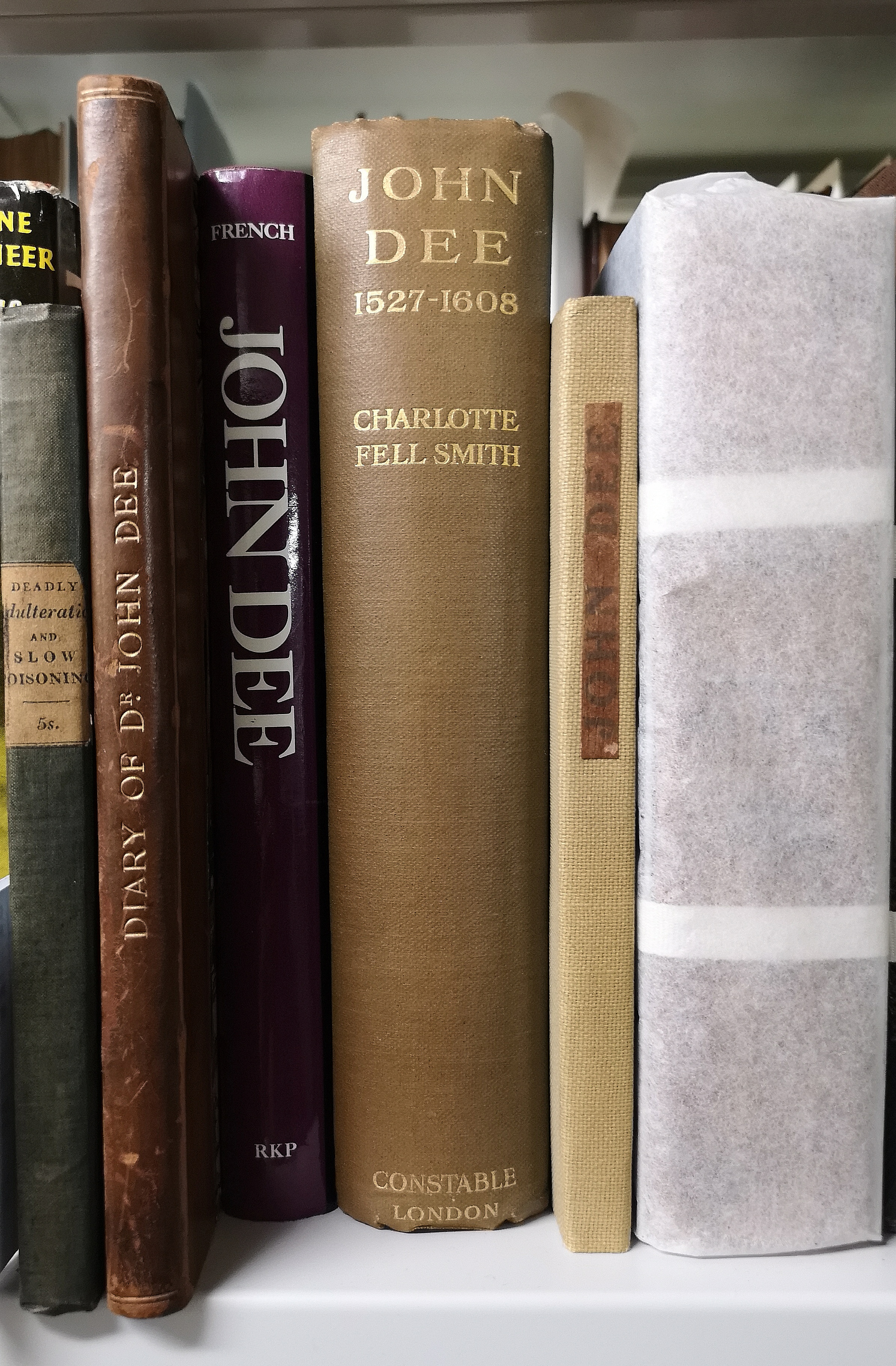
The fortunes of alchemy and its practitioners waxed and waned through the centuries. Renaissance alchemist and thinker, John Dee is a prime example. A key adviser to Elizabeth I, after James I succeeded the throne Dee was accused of being a ‘Conjurer, or Caller, or Invocator of Divels, or damned Spirites’ and died impoverished.

John Dee books in the Maddison Collection

Maddison Collection and it’s not Boyle! What a shock!

Most other alchemists did not suffer quite so dramatic a reversal of fortunes, but the legality of alchemy was dubious and throughout history it was often concealed in coded language or symbolic imagery. Renaissance legal scholar, Sir Edward Coke, wrote on its illegal status in The Third Part of the Institutes of the Laws of England (1644), citing the 1404 Act Against Multiplication, which forbade ‘multiplication […] That is, to change other metals into very Gold or Silver’ (Institutes, p.74). Robert Boyle campaigned to overturn this law and it was repealed in 1689.

As the eighteenth century wore on and the scientific method took hold, alchemy became increasingly discredited and chemists, wanting to distance themselves from alchemists, succeeded in separating the disciplines.The decline of alchemy in Europe was in conjunction with the rise of modern science, which placed a high significance on quantitative experimentation and which regarded the “ancient wisdom” so highly prized in alchemy as redundant and useless.

Starting with gold? I thought we were trying to make it! This is alchemy for the 1%.

Starting with gold? I thought we were trying to make it! This is alchemy for the 1%.

Did alchemy work? Mostly not, but it was the forerunner to modern chemistry. Advancements in technology have now made some alchemical feats possible. For instance, it is now possible to turn lead into gold. It takes a chemist who knows what he is doing and a lot of time, energy and money, but changing lead to gold has been done. The method of doing so is nothing like what is recommended in the various alchemy books within the collection but the once scoffed at dream is now a possibility.

The Alchemist may treat its subject matter as a joke and its practitioners as charlatans but the tangible contribution of alchemy to scientific knowledge should not be undersold. As  Sherwood Taylor notes, ‘the hopeless pursuit of the practical transmutation of metals was responsible for almost the whole of the development of chemical technique before the middle of the seventeenth century, and further led to the discovery of many important materials.’ (x, F. Sherwood Taylor) They may not have attained everlasting life or succeeded in transmuting lead to gold, but the alchemists did pave the way for their successors to develop modern scientific theory.

Tune in for the next blog post where we will be investigating the man behind the Maddison collection, R. E. W. Maddison!


Further reading

On Alchemy

John Read, Prelude to Chemistry (London: G. Bell and Sons Ltd., 1939) [Maddison 23B1]

J. S. Thompson, The Lure and Romance of Alchemy (London: George G. Harrap & Company Ltd., 1932) [Maddison 24A14]

Sherwood Taylor,The Alchemists: Founders of Modern Chemistry (London: William Heinemann Ltd, 1951) [Maddison 24A7]

Arthur Edward Waite, The Secret Tradition of Alchemy (London: Kegan Paul, Trench, Trubner & Co., 1926) [Maddison 24B20]

On John Dee

Charlotte Fell Smith, John Dee (1527-1608) (London: Constable, 1909) [Maddison 13C8]

Peter J. French, John Dee: The World of an Elizabethan Magus (London: Routledge & Kegan Paul, 1972) [Maddison 13C7]

Past exhibition at the Royal College of Physicians, 2016: ‘Scholar, Courtier, Magician: the lost library of John Dee’

On The Alchemist

Ben Jonson, The workes of Beniamin Jonson (London: W. Stansby, 1616) [Q C 616.JON]

Previously in Philip and Janee’s blog posts:

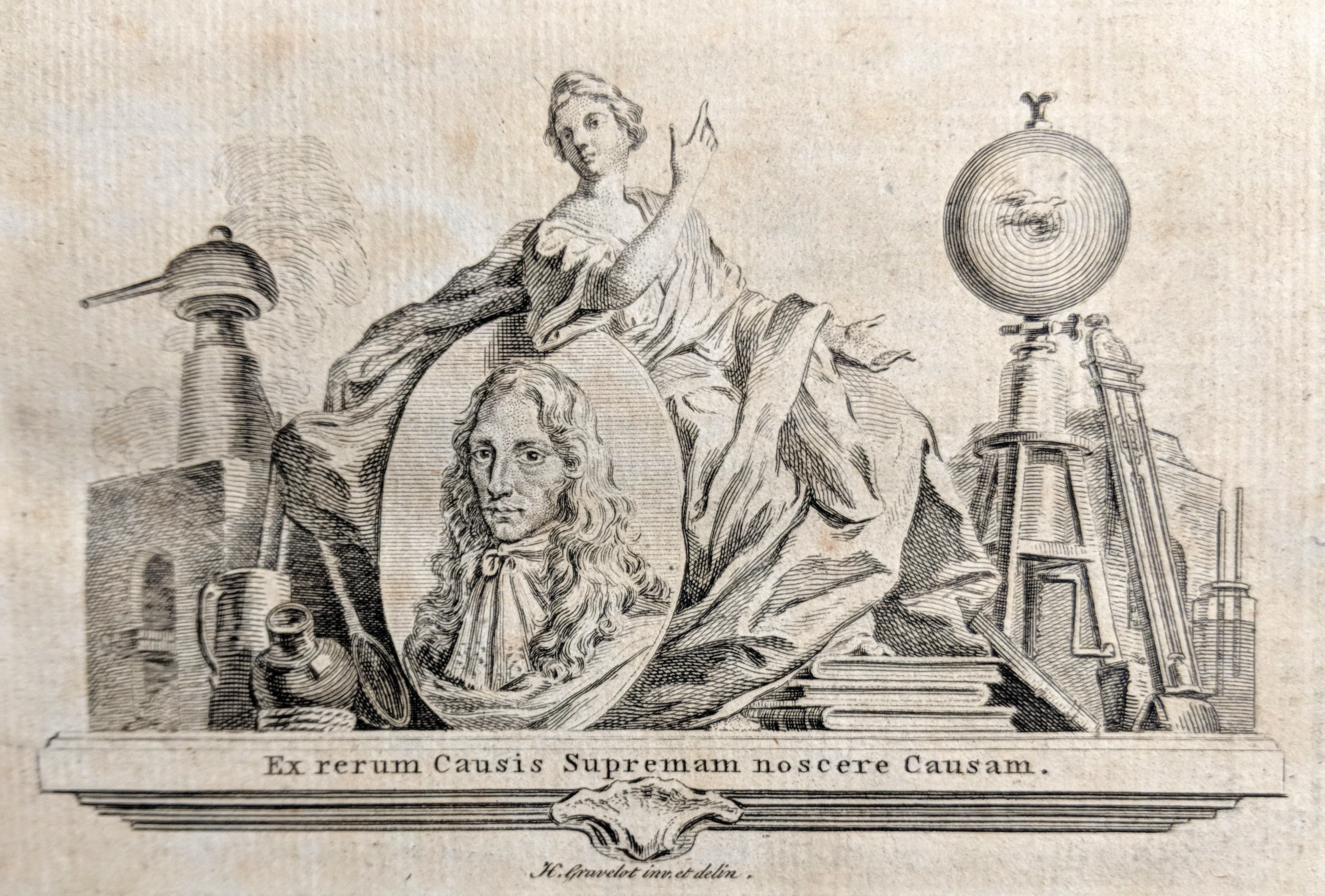
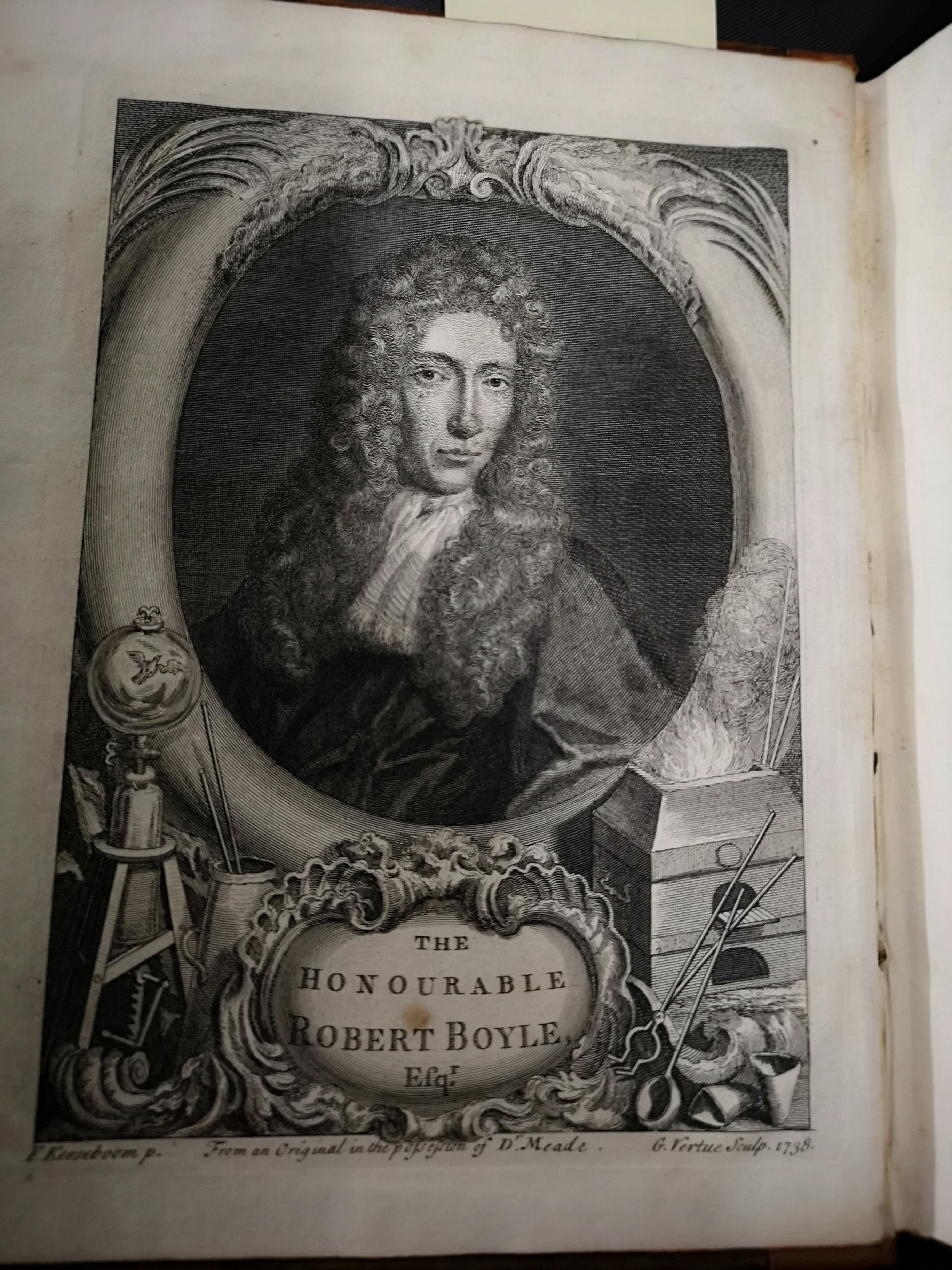
The honourable Robert Boyle; or, reaching Boyle-ing point? 

Introduction; or, how do you solve a problem like the Maddison Collection?

The Honourable Robert Boyle; or, Reaching Boyle-ing Point

Hello again! Welcome to the second post in the series of our foray into the Maddison Collection. This past week has seen temperatures skyrocket but we have been staying cool in the basement of the Templeman Library, researching and caring for the treasures of the collection. Read on as we turn up the heat on this week’s topic, The Honourable Robert Boyle F.R.S.

For the record, all puns are the fault of Philip and Jo. Janee relinquishes all responsibility for them.

For the record, all puns are the fault of Philip and Jo. Janee relinquishes all responsibility for them.

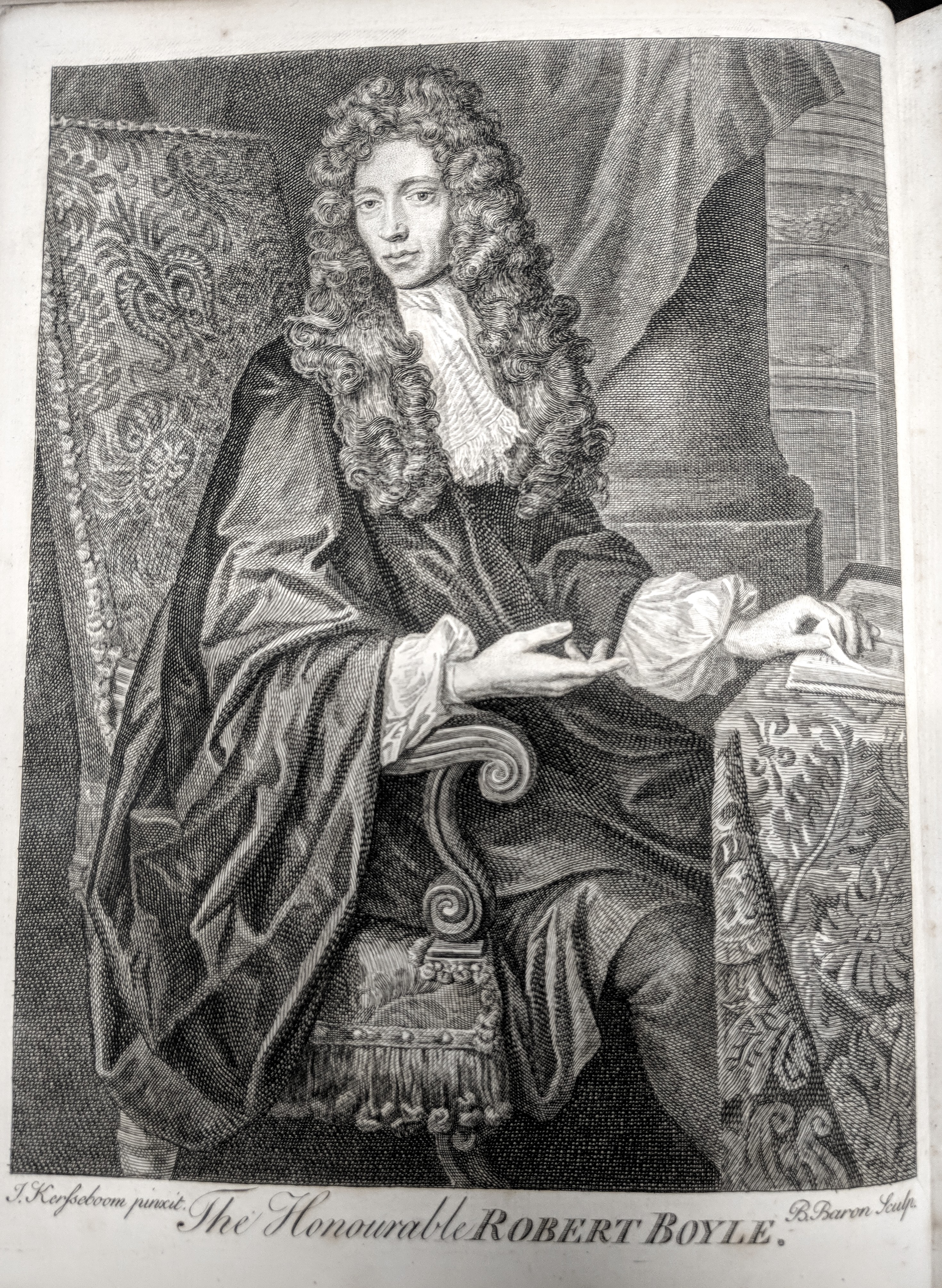
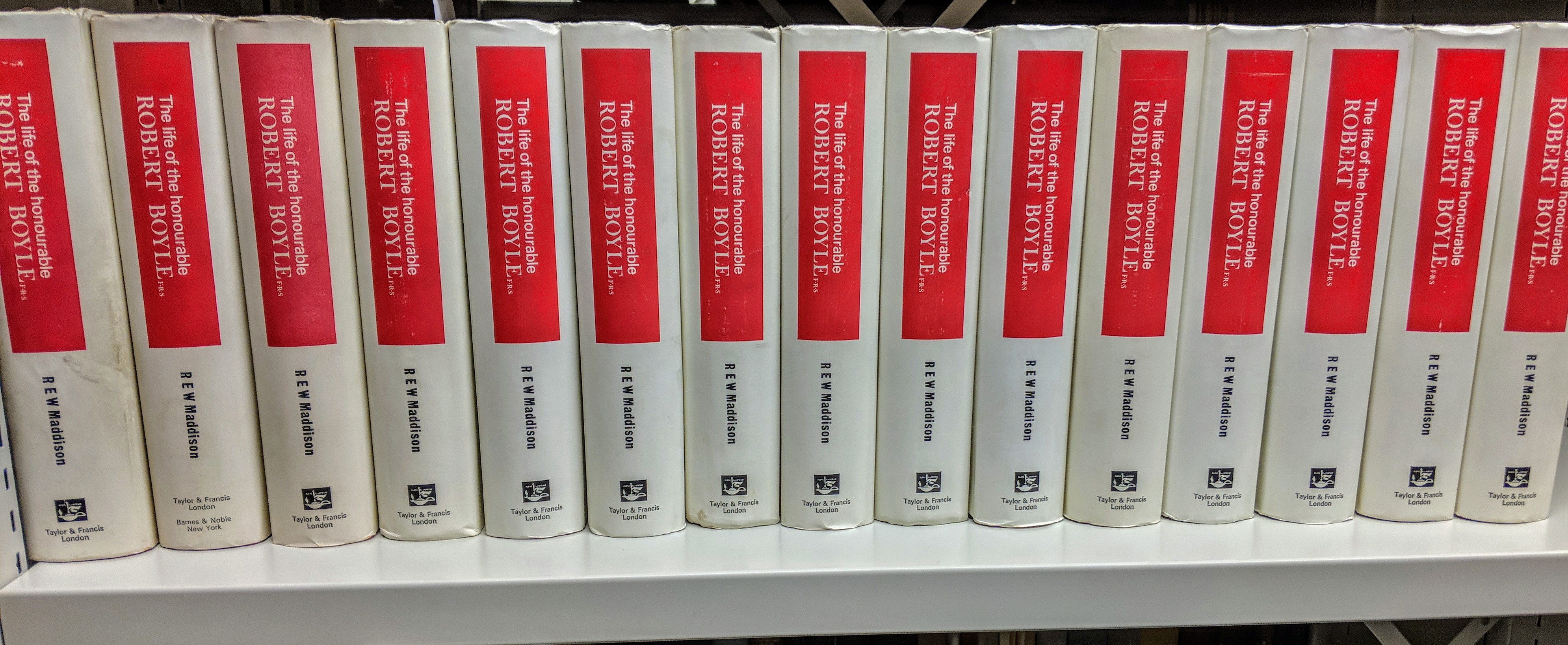
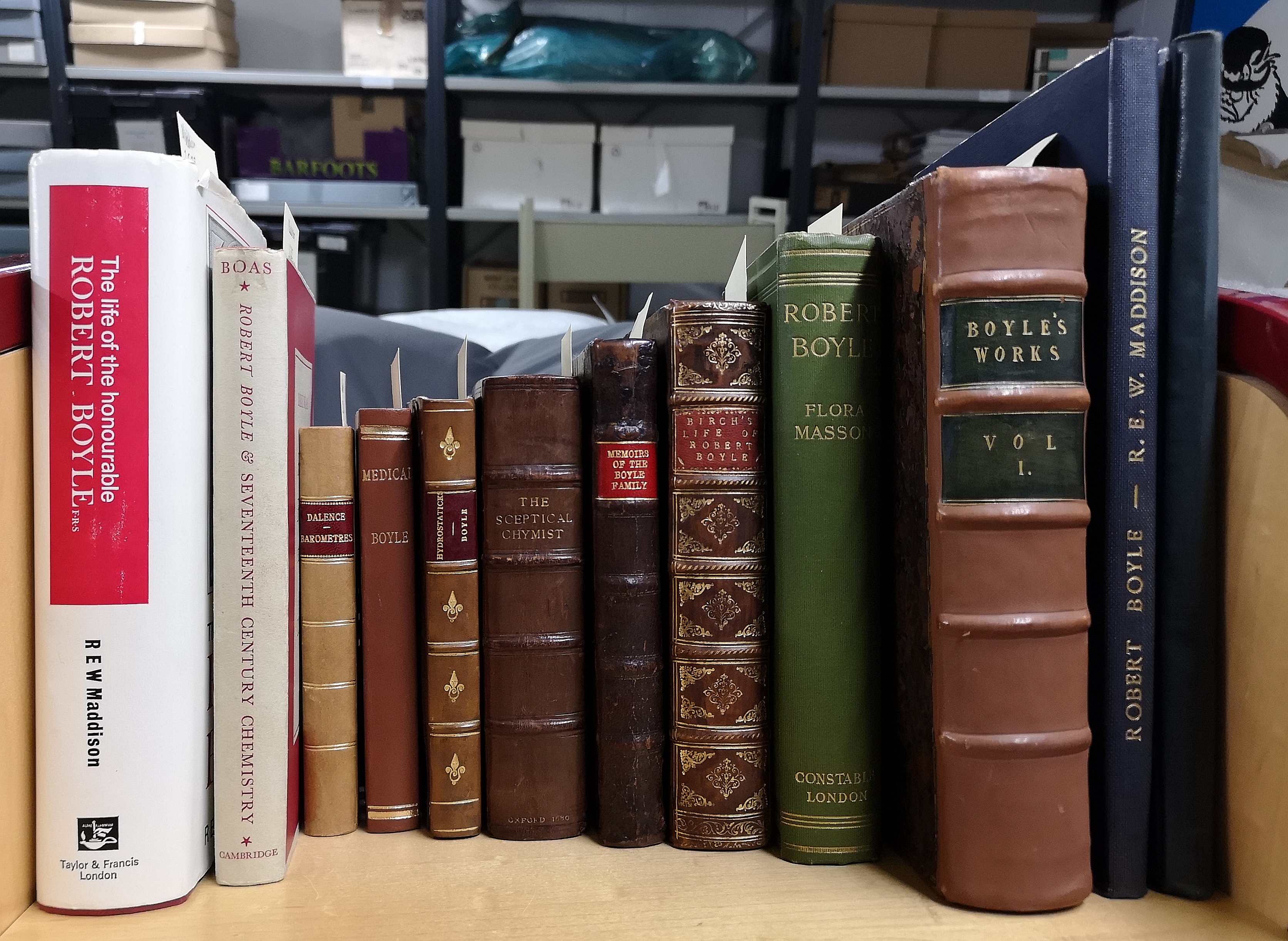
One of the first things we noticed when we began working on the Maddison Collection was the sheer volume of texts on Robert Boyle. He is perhaps the collection’s best represented topic. By the time we got to the fourth shelf, of the first bay we were working on, we discovered why Maddison had collected such an immense number of books focusing on Boyle: he had written his own book on the topic, one of the first full biographies on Robert Boyle! A little more research unveiled that Maddison had in fact also written around twenty articles on Boyle, as well as a second book on the subject and had been gathering material for over twenty-five years (Maddison, The life of the Honourable Robert Boyle, viii).

There are plenty of copies. Bring your friends.

There are plenty of copies. Bring your friends.

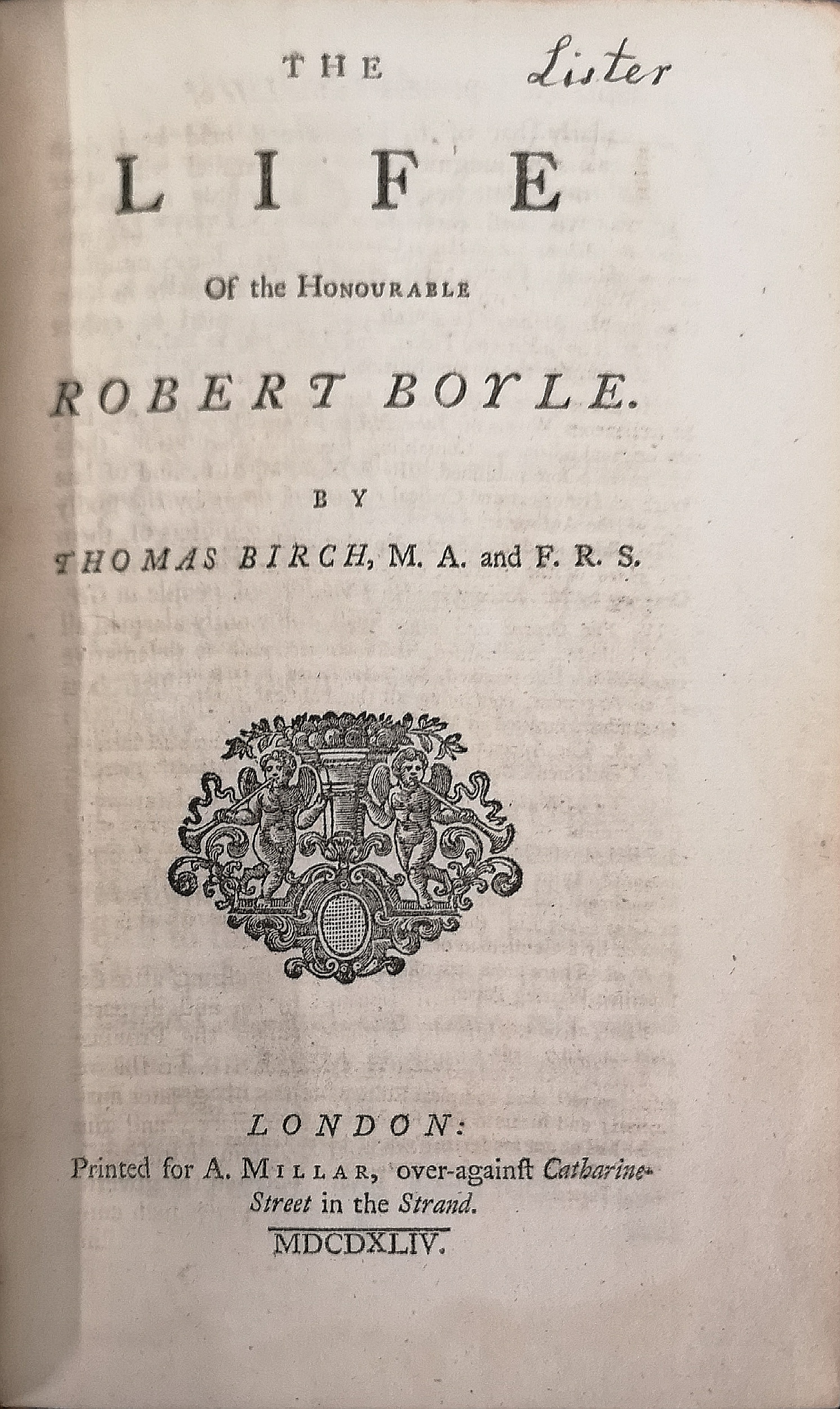
Boyle is often considered to be the ‘Father of Chemistry’ and is most well-known for the scientific principle named after him. Boyle’s Law states that the pressure of a given quantity of gas varies inversely with its volume at constant temperature. To this day we are taught about Boyle’s Law in science classes, and so it was a surprise to find that between the mid eighteenth- and early twentieth-century there was very little academic scholarship conducted on Boyle. As Maddison notes in the Preface to his book, Thomas Birch’s volumes on Boyle, written in the eighteenth century, have ‘served as the basis of all subsequent accounts of Robert Boyle, wherever they have been published, right down to the present day’ (Maddison, viii).

We should not make too many Boyle jokes, it might get too steamy.

We should not make too many Boyle jokes, it might get too steamy.

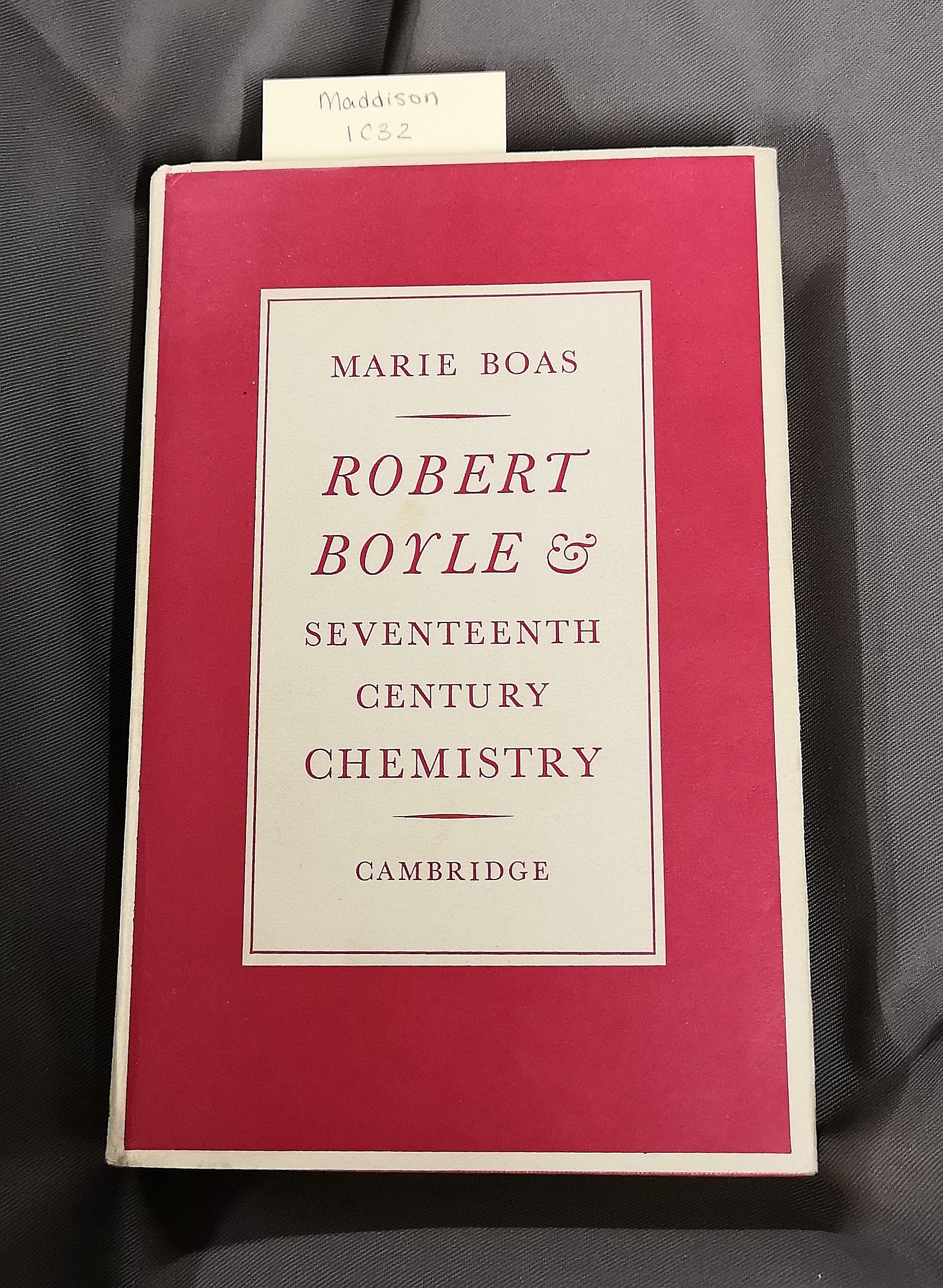
It was only after the Second World War that there was a major shift in Boyle scholarship. One such scholar, Marie Boas was particularly well known for her research during this time period, publishing two books and a series of articles about Boyle. Boas’ work provides a detailed analysis of Boyle’s aims and achievements and both of her books can be found within the Maddison collection.

A watched pot never Boyle-s.

A watched pot never Boyle-s.

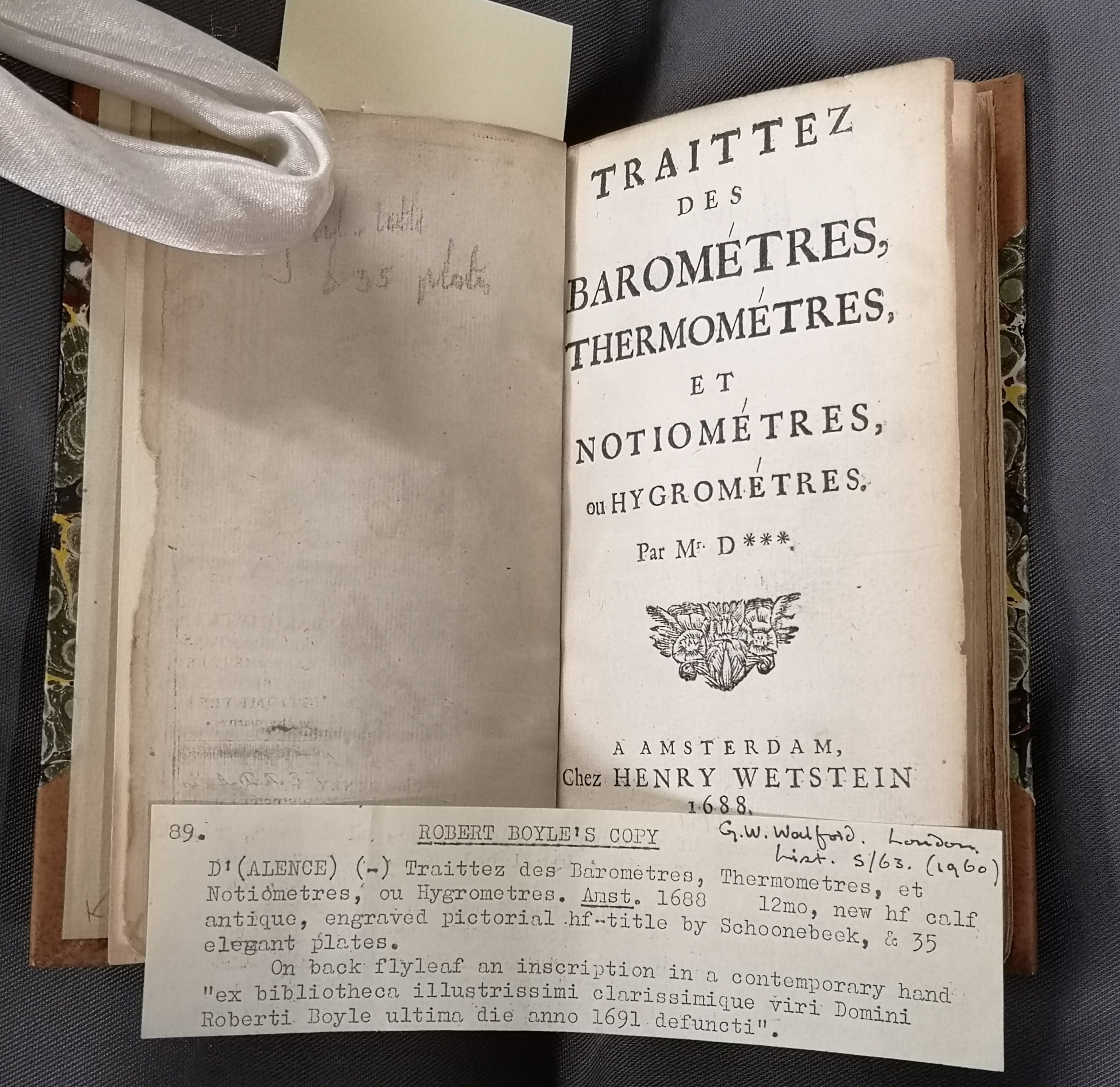
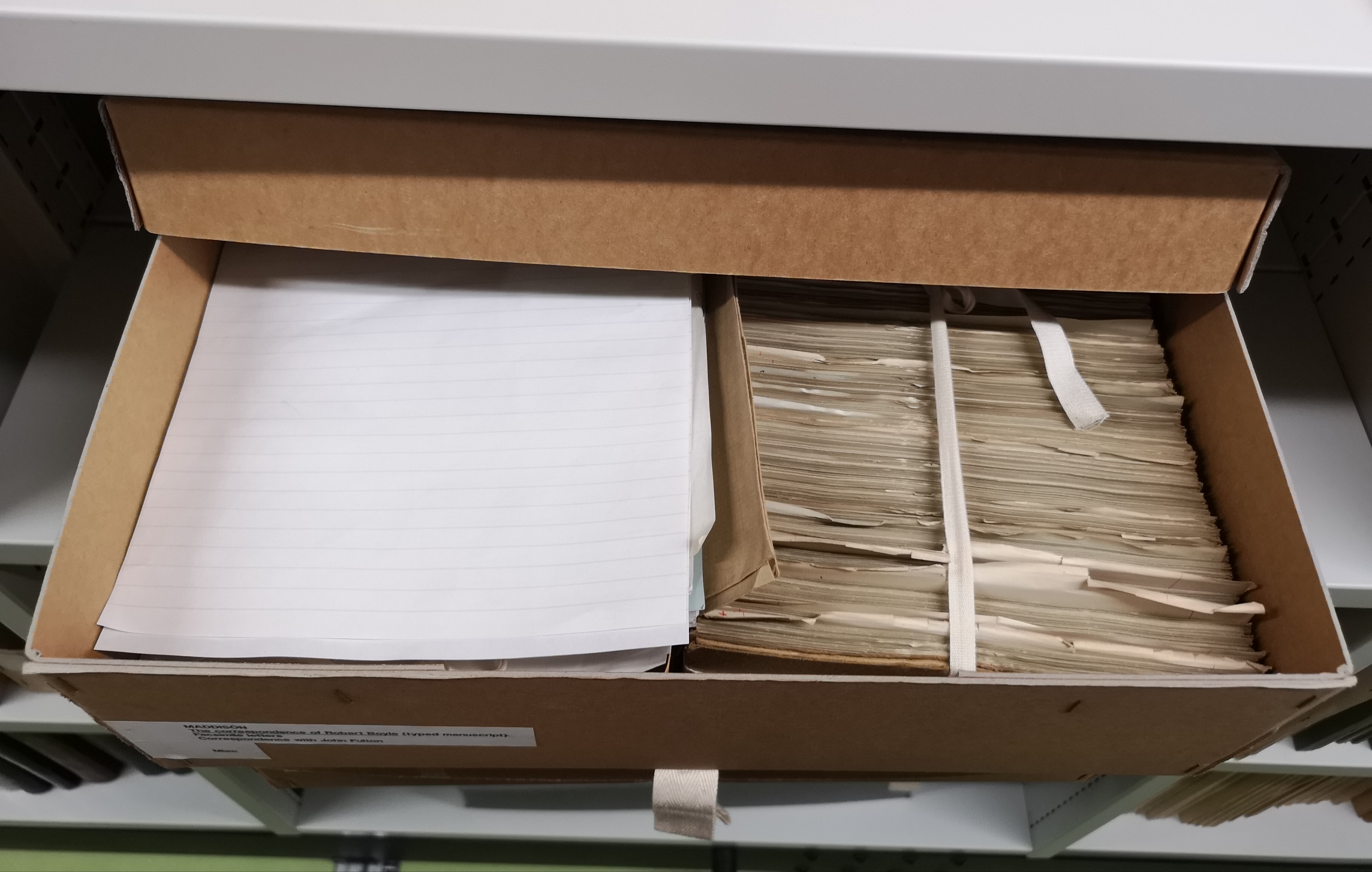
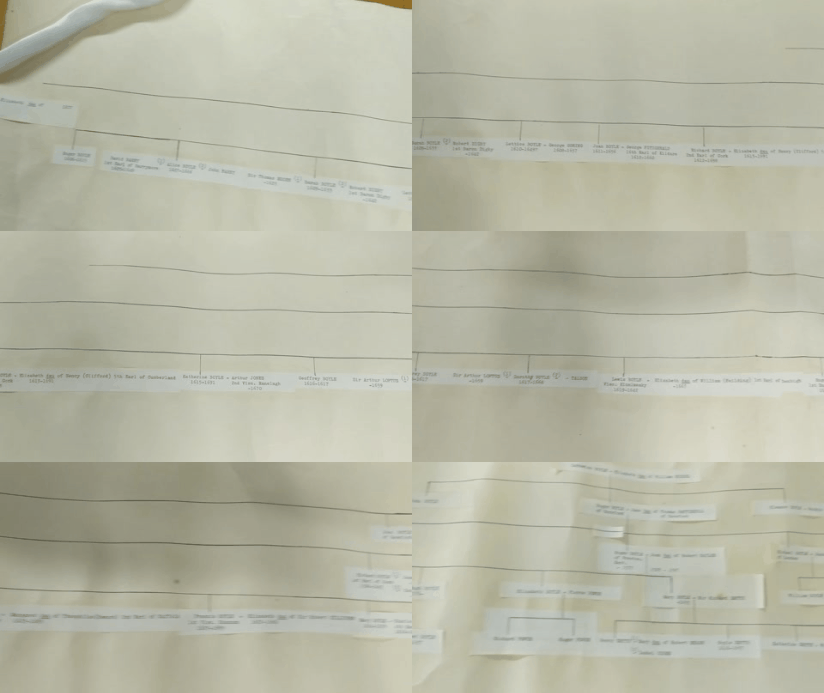
While Boas focused on Boyle’s academic achievements, Maddison had an all-encompassing interest in Boyle. Within Maddison’s biography he dedicates sections to discussing Boyle’s appearance, life and family, alongside his published writings and contributions to the scientific community. When looking through the collection it becomes clear that Maddison was able to discuss these things in depth due to his extensive research. Amongst books authored by Boyle and covering his interests, there are boxes of letter facsimiles copied from the Royal Society’s collection, an extensive, handmade Boyle family tree, and even a book that may have come from Boyle’s personal library.

Factoid: Maddison made his own miniature sundials and barometers.

Factoid: Maddison made his own miniature sundials and barometers.

The originals can be found largely in the Boyle Papers held by the Royal Society.

The originals can be found largely in the Boyle Papers held by the Royal Society.

It seems pertinent at this point to provide some brief biographical information about Boyle. More can of course be found in R. E. W. Maddison’s The Life of the honourable Robert Boyle.

Here’s your Boy-le.

Here’s your Boy-le.

Robert Boyle was born in Ireland on January 25th 1627 to one of the wealthiest families in Britain and died on December 31st 1691 in London, England. He never married, nor had any children, but he did have a number of siblings.

This was really hard to roll up again.

This was really hard to roll up again.

Of particular importance was his older sister, Katherine Jones, Viscountess of Ranelagh, with whom he lived from 1668 until her death in 1691.  Lady Ranelagh is fascinating, as her interests were similar to Boyle’s. In fact, she is thought to have encouraged him to work on questions of ethics and they would consult each other on chemistry and alchemical problems.

Lady Katherine Jones née Boyle, Viscountess of Ranelagh

Lady Katherine Jones née Boyle, Viscountess of Ranelagh.

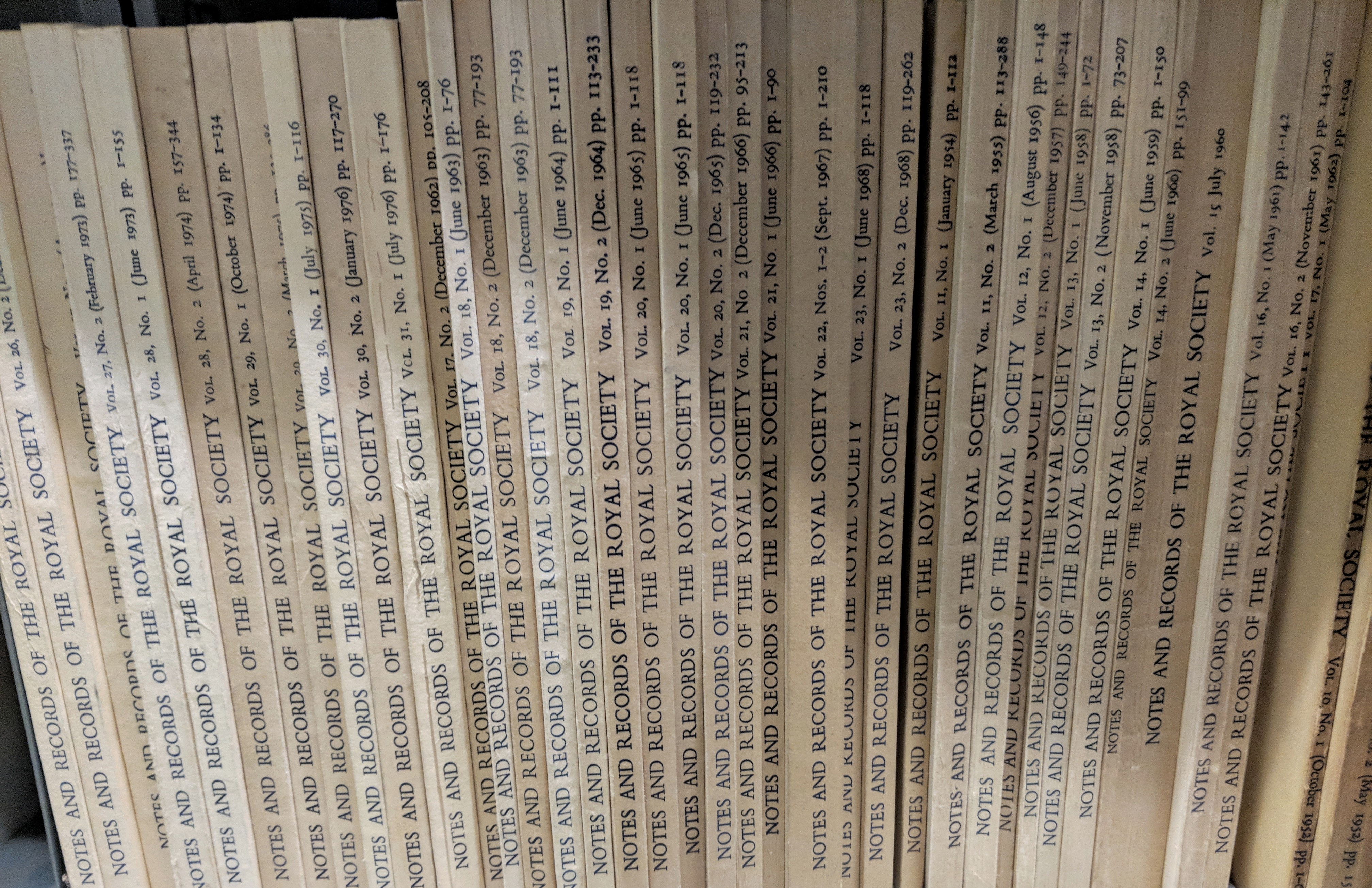
Boyle was a founding member of The Royal Society, although he never served as its president. The Maddison collection contains many books on the Society’s history and a significant number of holdings of ‘The Notes and Records of the Royal Society’.

The Maddison Collection a.k.a The Notes and Records of the Boyle Society.

The Maddison Collection a.k.a The Notes and Records of the Boyle Society.

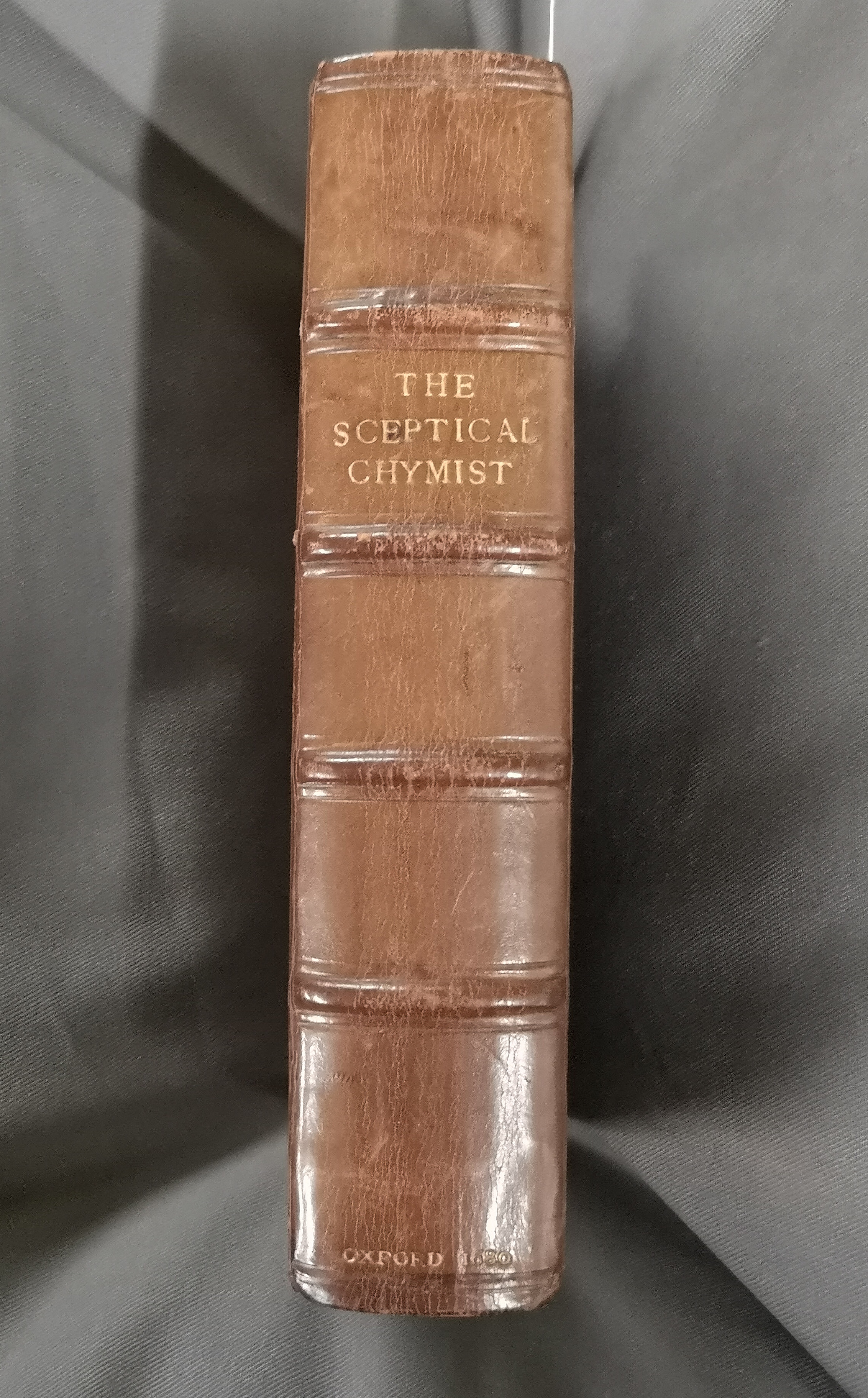
Boyle’s interests were far-reaching and varied. Whilst he is best known as a natural philosopher (mainly in chemistry), he diversified and covered hydrostatics, physics, medicine, earth science, natural history, Christian devotional and ethical essays, theological tracts on biblical passages and alchemy. He sponsored religious missions and the translation of the Scriptures into several languages. His most notable works include Touching the Spring of the Air and its Effects (1660), The Sceptical Chymist (1661), New Experiments Physico-Mechanical (1682) and The Christian Virtuosos (1690). This vast array of pursuits is marvellously reflected within the Maddison Collection.

RIP Robert Boyle, you will be mist.

RIP Robert Boyle, you will be mist.

Within the collection there are copies of Boyle’s most famous works, as listed above, as well as complete volumes containing some of his lesser known texts. Maddison collected books covering religious philosophy, chemistry and natural sciences, medicine, as well as alchemy and witchcraft, amongst other things. Maddison himself held a BSc in chemistry and a PhD in photochemistry and electrochemistry, but his collection shows that he, like Boyle, was capable of straddling the boundaries between disciplines. This variety results in the Maddison Collection being able to connect with subject matters beyond that of History of Science.

I guess you could say Maddison was a real fan Boy-le.

I guess you could say Maddison was a real fan Boy-le.

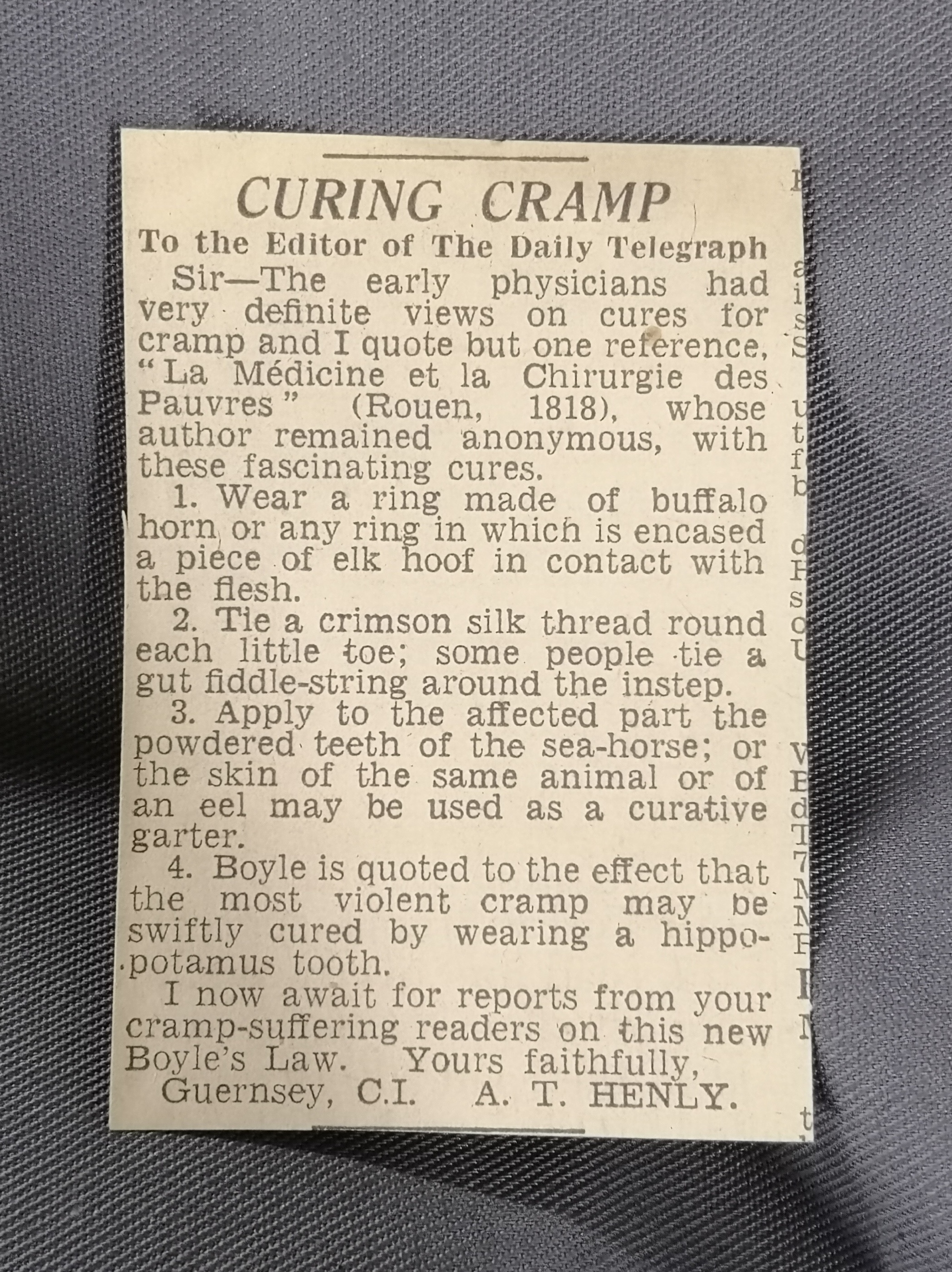
As a brief example, Boyle’s interest in medicine may be of interest to those studying the history of medicine or medical students joining Kent’s forthcoming medical school and wishing to know more about their predecessors. Maddison writes of Boyle’s ‘sickly constitution’ (Maddison, 219) and suggests that this prompted ‘[h]is interest in medico-chemistry [which] was further stimulated by the desire to alleviate pain and suffering of others, with the result that he was an ardent collector of recipes and seeker of new or improved remedies.’ (221)

We’re deffo going to try these.

We’re deffo going to try these.

There are ample books which could be of use to those studying early modern philosophy, history, medicine and herbalism. Others can be studied to learn more about the geography of the time, as well as the obvious link to early Chemistry and Physics. There is a strong collection of books written before 1700 within Maddison’s collection and a surprisingly large volume of books that would be of interest to religious studies scholars.

While we don’t have the time to explore all of these niches with the collection, we are able to focus on some of our personal favourites and so following in the footsteps of Maddison and Boyle, next week we will be exploring the world of alchemy. Stay tuned to learn about making your own personal philosopher’s stone!

Further Reading

Thomas Birch (1744), The life of the Honourable Robert Boyle (A. Millar), Maddison Collection (1C30)

Marie Boas (1958), Robert Boyle & Seventeenth Century Chemistry (Cambridge University Press), Maddison Collection (1C32)

Marie Boas (1962), The Scientific Renaissance 1450-1630 (Collins), Maddison Collection (19A31)

Robert Boyle (1680), The Sceptical Chymist (Henry Hall) Maddison Collection (1C1)

Mr. D*** (1688), Traittez des Barometres, Thermometres, et Notiometres ou Hygrometres (Henry Wetstein), Maddison Collection (2A5)

R. E. W. Maddison (1969), The Life of the Honourable Robert Boyle F.R.S (Taylor & Francis Ltd.), Maddison Collection (1D15)

Previously in Janee and Philip’s blog posts:

Introduction: or, how do you solve a problem like the Maddison Collection?

Adventures of our 2018 interns part two

Welcome back to our series of blog posts summarising some of the more eye-catching, fascinating and curious items found in our Maddison Collection, which is being carefully looked-after and researched this summer by our fantastic interns Philip and Janee.

Today, let’s take a look at one of the older items in the Maddison Collection: 1D1, which is a series of small astrological books bound together:

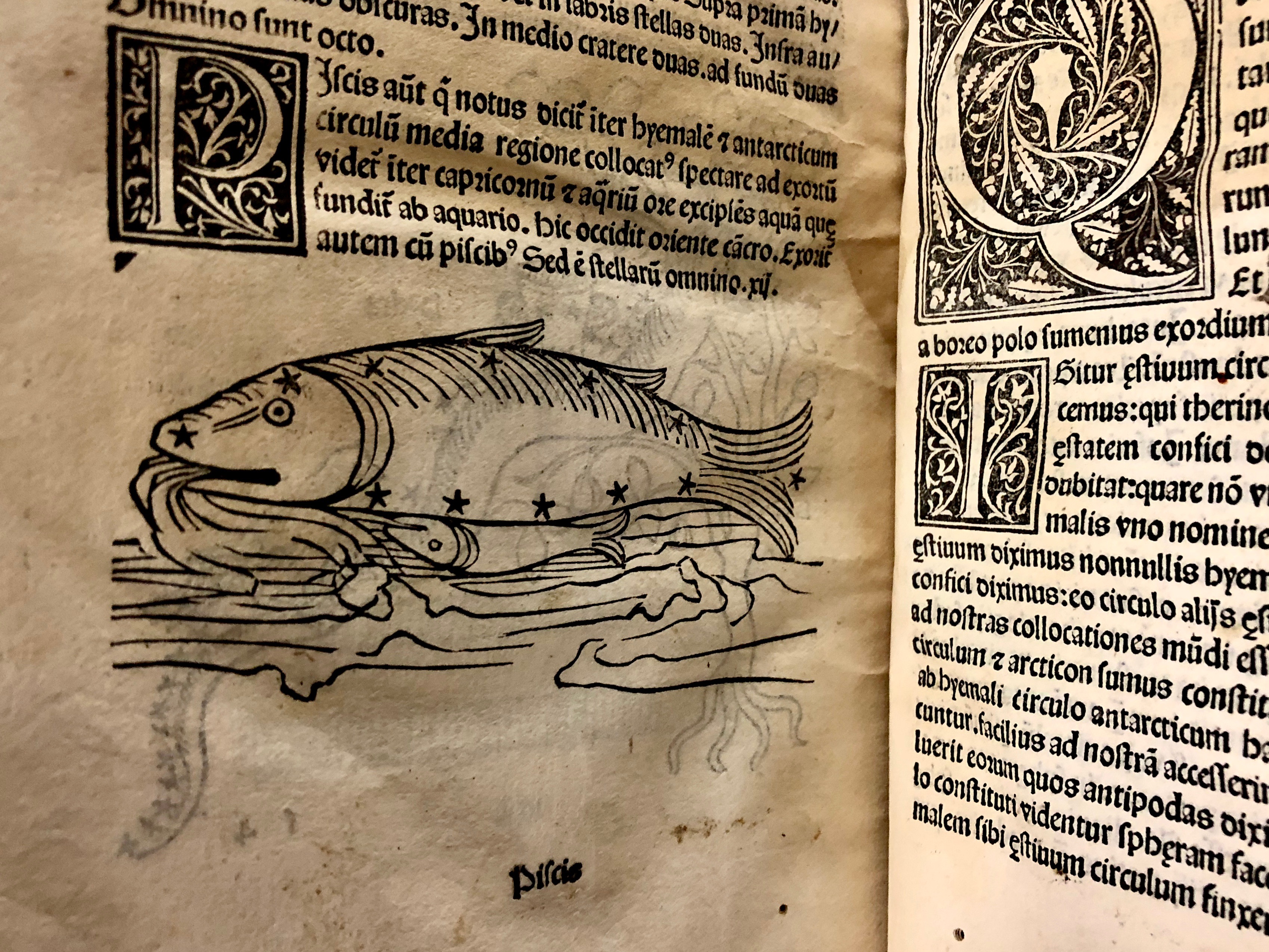
Starry fish in 'Nouicijs adolescetib': ad astronomica remp: capessenda aditu impenetratib' by Johannes de Sacro Bosco, 1482, Venice (Maddison Collection, 1D1)

Starry fish in ‘Nouicijs adolescetib’: ad astronomica remp: capessenda aditu impenetratib’ by Johannes de Sacro Bosco, 1482, Venice (Maddison Collection, 1D1)

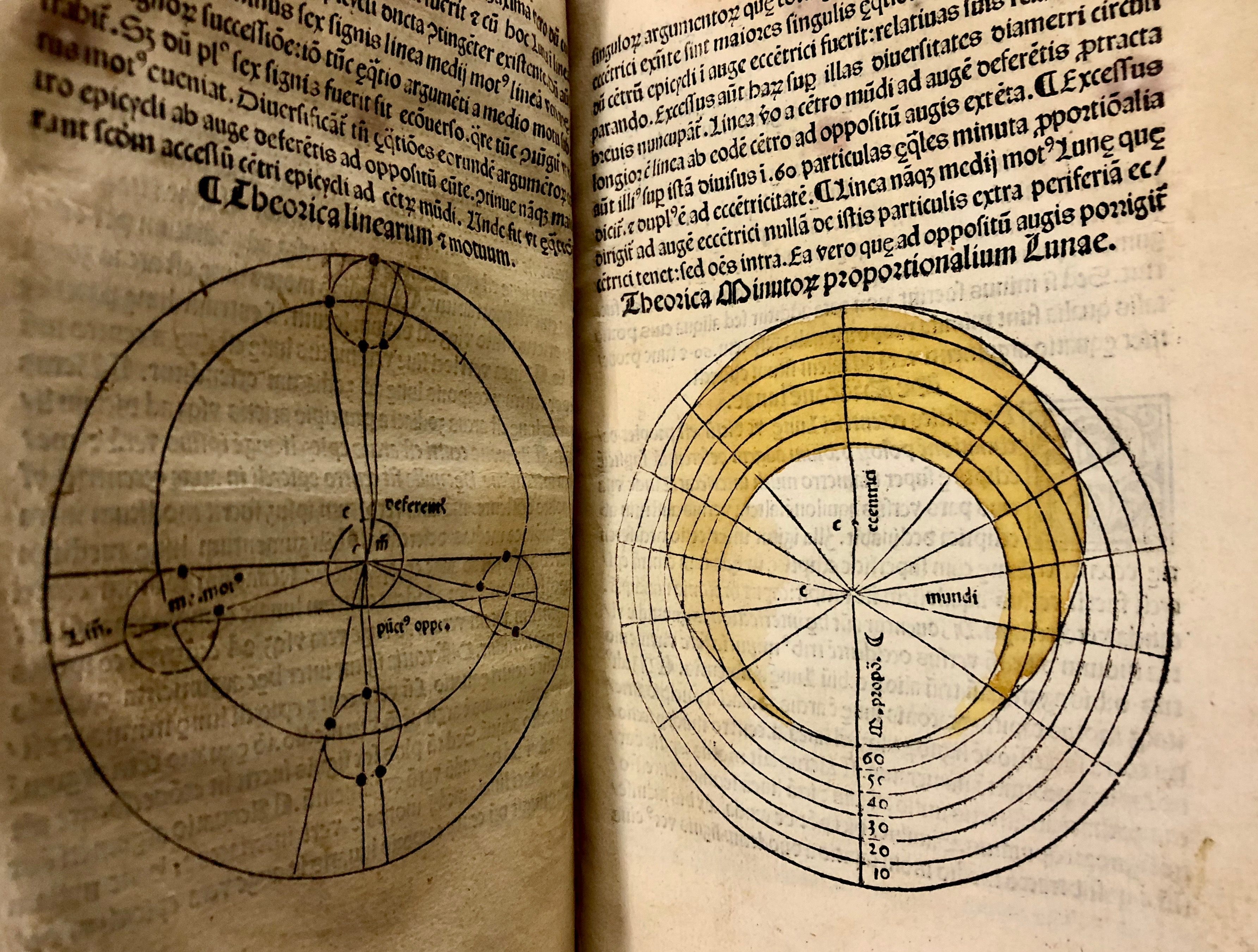
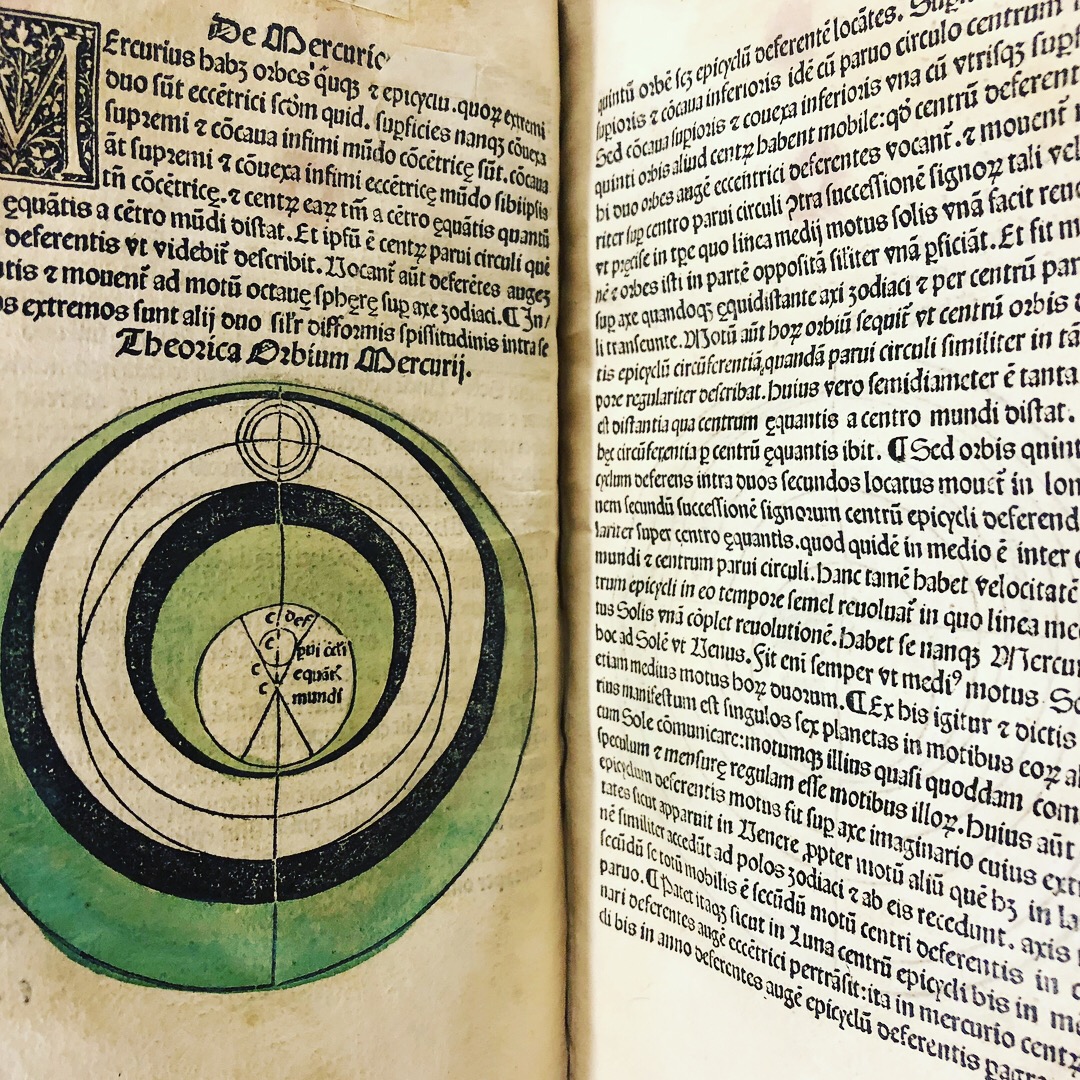
Lunar charts in 'Nouicijs adolescetib': ad astronomica remp: capessenda aditu impenetratib' by Johannes de Sacro Bosco, 1482, Venice (Maddison Collection, 1D1)

Lunar charts in ‘Nouicijs adolescetib’: ad astronomica remp: capessenda aditu impenetratib’ by Johannes de Sacro Bosco, 1482, Venice (Maddison Collection, 1D1)

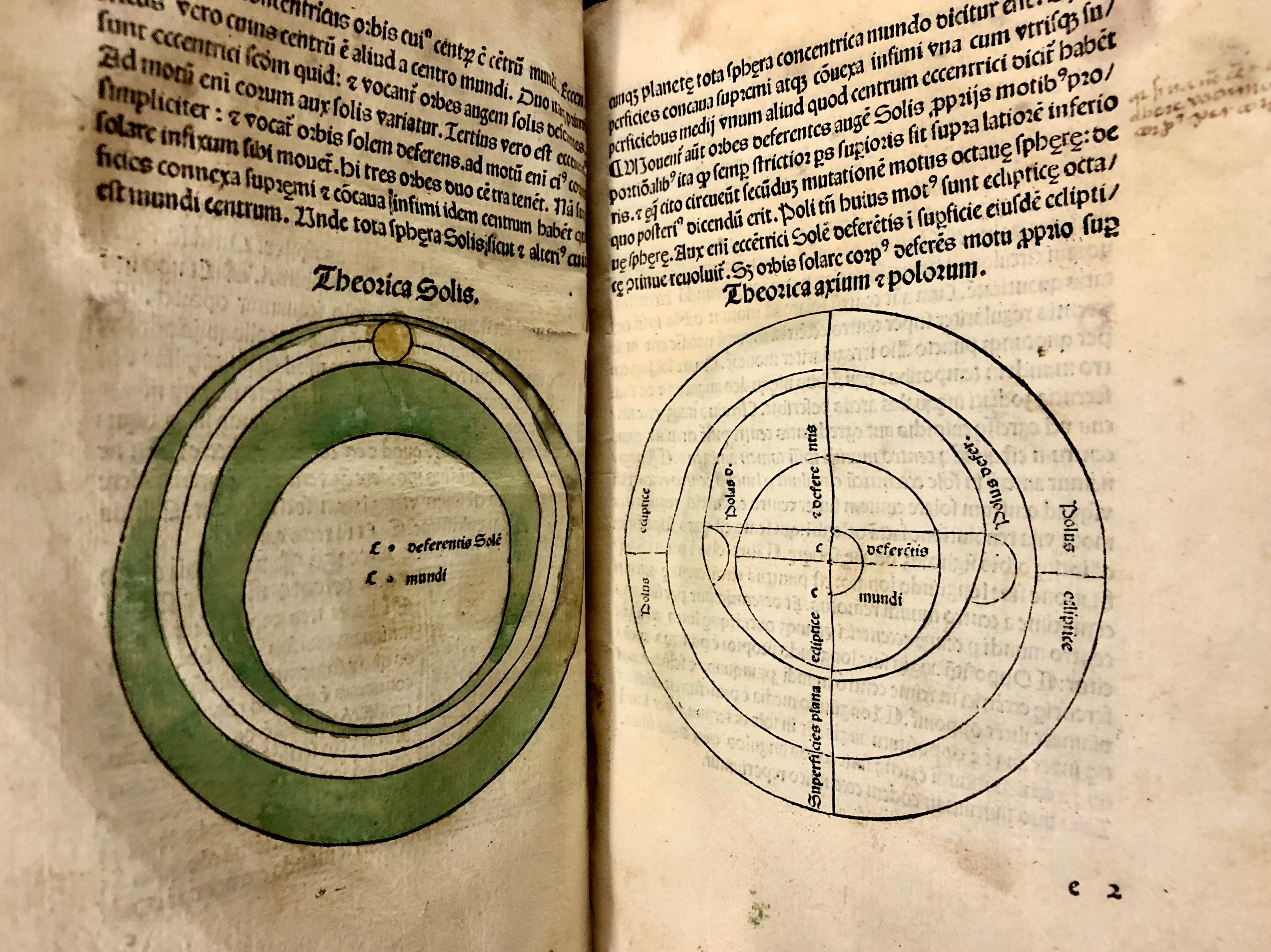
More hand-painted lunar charts in 'Nouicijs adolescetib': ad astronomica remp: capessenda aditu impenetratib' by Johannes de Sacro Bosco, 1482, Venice (Maddison Collection, 1D1)

More hand-painted lunar charts in ‘Nouicijs adolescetib’: ad astronomica remp: capessenda aditu impenetratib’ by Johannes de Sacro Bosco, 1482, Venice (Maddison Collection, 1D1)

Drawing of a heliocentric universe in 'Nouicijs adolescetib': ad astronomica remp: capessenda aditu impenetratib' by Johannes de Sacro Bosco, 1482, Venice (Maddison Collection, 1D1)

Drawing of a heliocentric universe in ‘Nouicijs adolescetib’: ad astronomica remp: capessenda aditu impenetratib’ by Johannes de Sacro Bosco, 1482, Venice (Maddison Collection, 1D1)

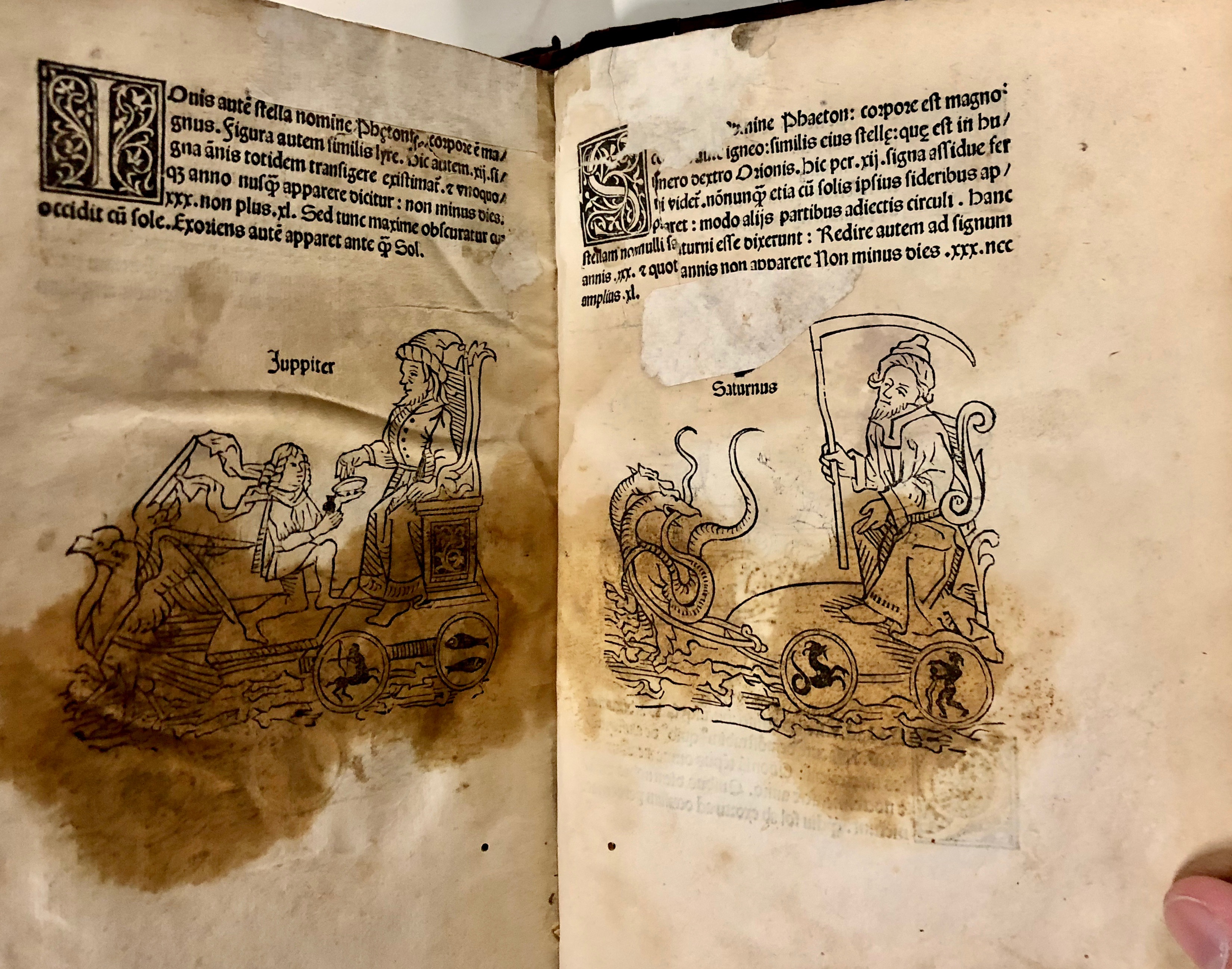
Illustrations of Roman gods in 'Nouicijs adolescetib': ad astronomica remp: capessenda aditu impenetratib' by Johannes de Sacro Bosco, 1482, Venice (Maddison Collection, 1D1)

Illustrations of Roman gods in ‘Nouicijs adolescetib’: ad astronomica remp: capessenda aditu impenetratib’ by Johannes de Sacro Bosco, 1482, Venice (Maddison Collection, 1D1)

Even more hand-painted lunar charts in 'Nouicijs adolescetib': ad astronomica remp: capessenda aditu impenetratib' by Johannes de Sacro Bosco, 1482, Venice (Maddison Collection, 1D1)

Even more hand-painted lunar charts in ‘Nouicijs adolescetib’: ad astronomica remp: capessenda aditu impenetratib’ by Johannes de Sacro Bosco, 1482, Venice (Maddison Collection, 1D1)

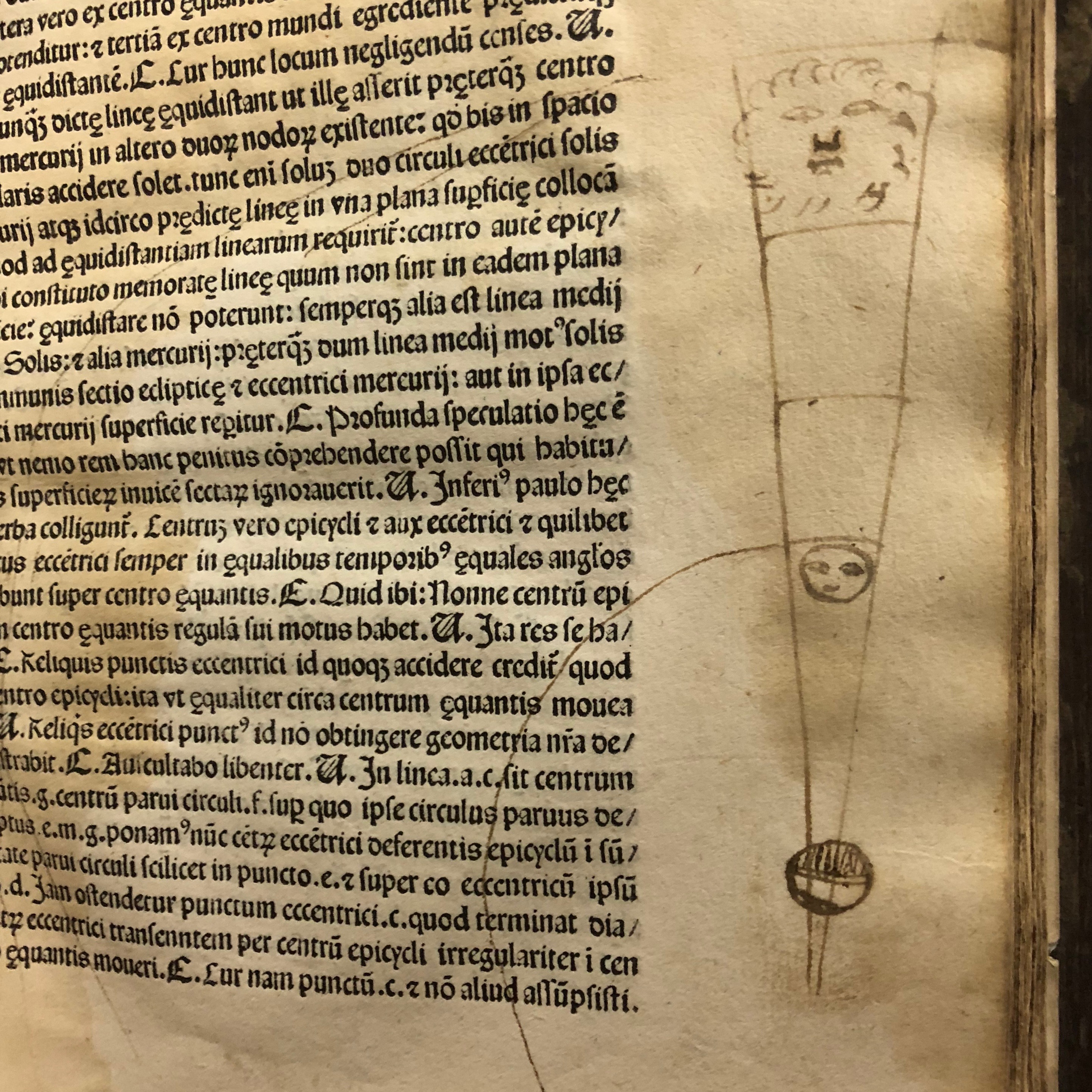
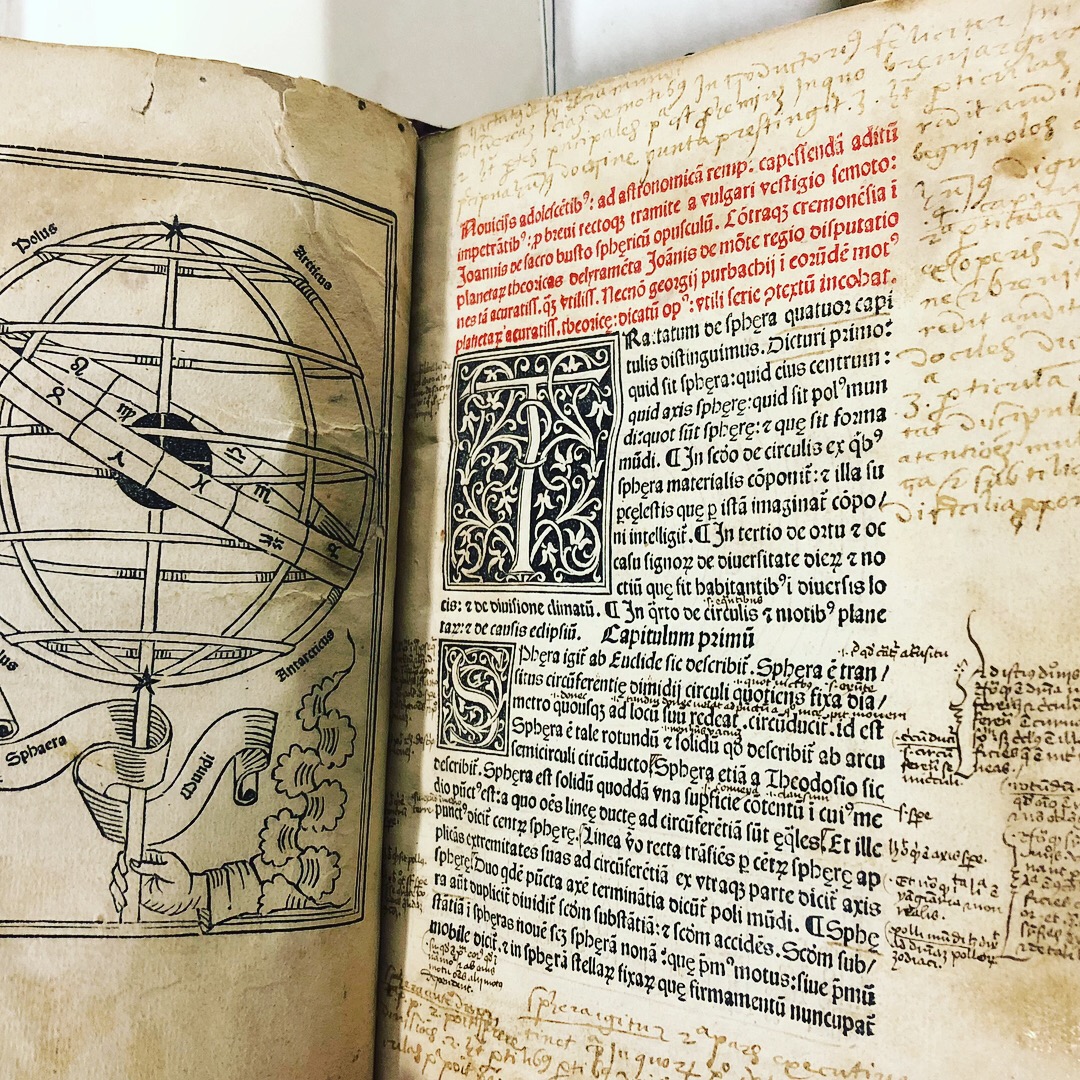
Manuscript annotations in 'Nouicijs adolescetib': ad astronomica remp: capessenda aditu impenetratib' by Johannes de Sacro Bosco, 1482, Venice (Maddison Collection, 1D1)

Manuscript annotations in ‘Nouicijs adolescetib’: ad astronomica remp: capessenda aditu impenetratib’ by Johannes de Sacro Bosco, 1482, Venice (Maddison Collection, 1D1)

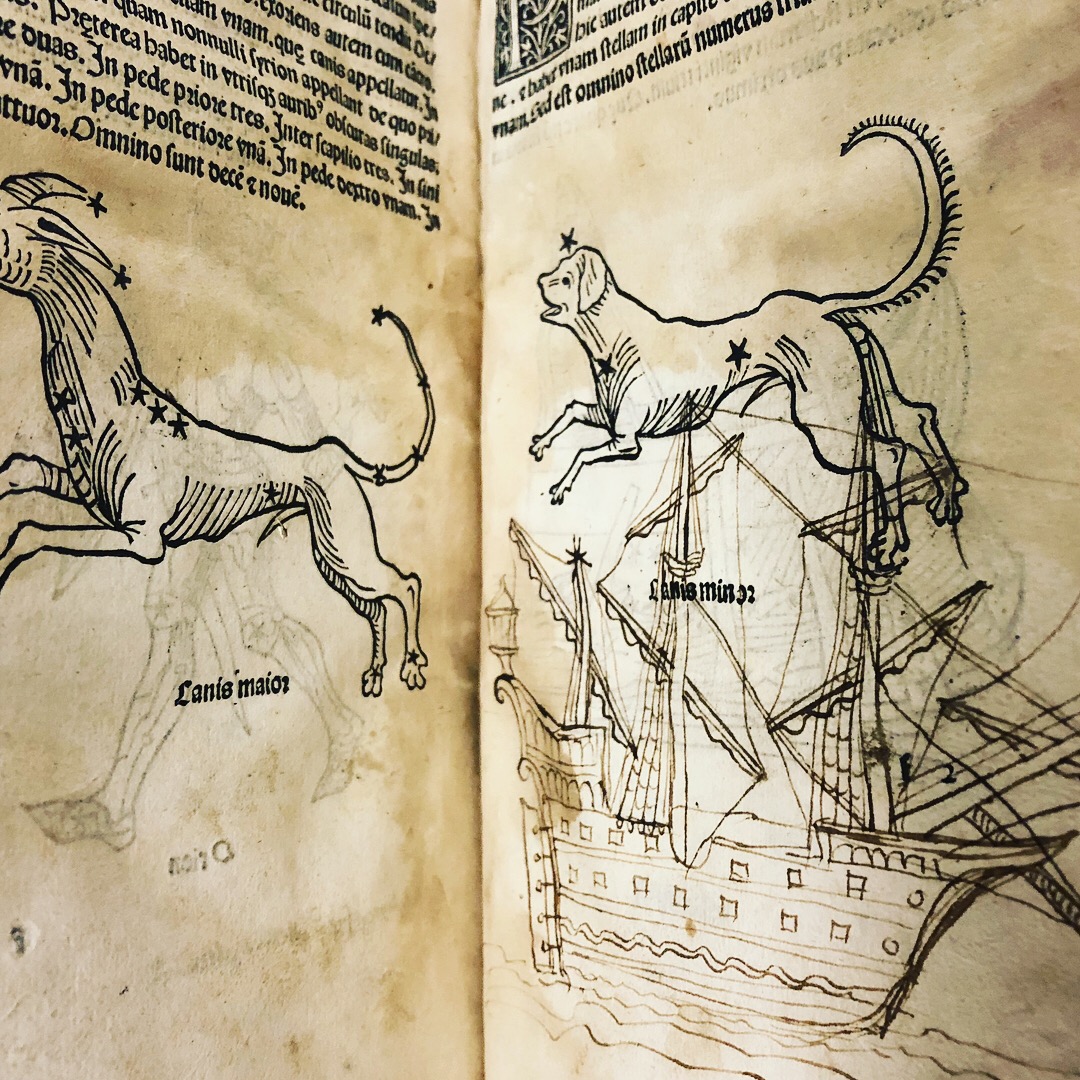
A dog on a ship in 'Nouicijs adolescetib': ad astronomica remp: capessenda aditu impenetratib' by Johannes de Sacro Bosco, 1482, Venice (Maddison Collection, 1D1)

A dog on a ship in ‘Nouicijs adolescetib’: ad astronomica remp: capessenda aditu impenetratib’ by Johannes de Sacro Bosco, 1482, Venice (Maddison Collection, 1D1)

Like what you see here? Books from the Maddison Collection can be requested through LibrarySearch (for internal University of Kent members only) or by contacting us (for everyone).

This blog post is part two of an ongoing summer series exploring our Maddison Collection; more in depth posts will be coming soon. For part one, please see here!