Special Collections and Archives highlights: 2025 edition

Karen Brayshaw, Special Collections and Archives Manager

Welcome to the Special Collections and Archives annual highlights 2025. It’s always a pleasure to look back at what has taken place in the University’s Special Collections and Archives, and I’m always amazed at how much the team achieve – well done Team! This year some changes have taken place at the University and as a result Library Services (of which we are part) has now joined the Student Life Directorate. Don’t worry though – you can still find us in the same place. As a Team we said goodbye to Beth, our University Archivist. Beth joined us as Project Archivist for the UK Philanthropy Archive, before taking over the post of University Archivist. We wish Beth well in her new post. In September we also said goodbye to Sam Datlen, Project Digital Administrator.  Sam has worked with us on a part-time basis since 2023, digitising the original artworks of Lawrie Siggs, Geoff Laws, Ron McTrusty and some of the Donald McGill collection. Although we said goodbye to Sam as a colleague we are delighted he has agreed to continue to come on to work on some of our volunteer projects.
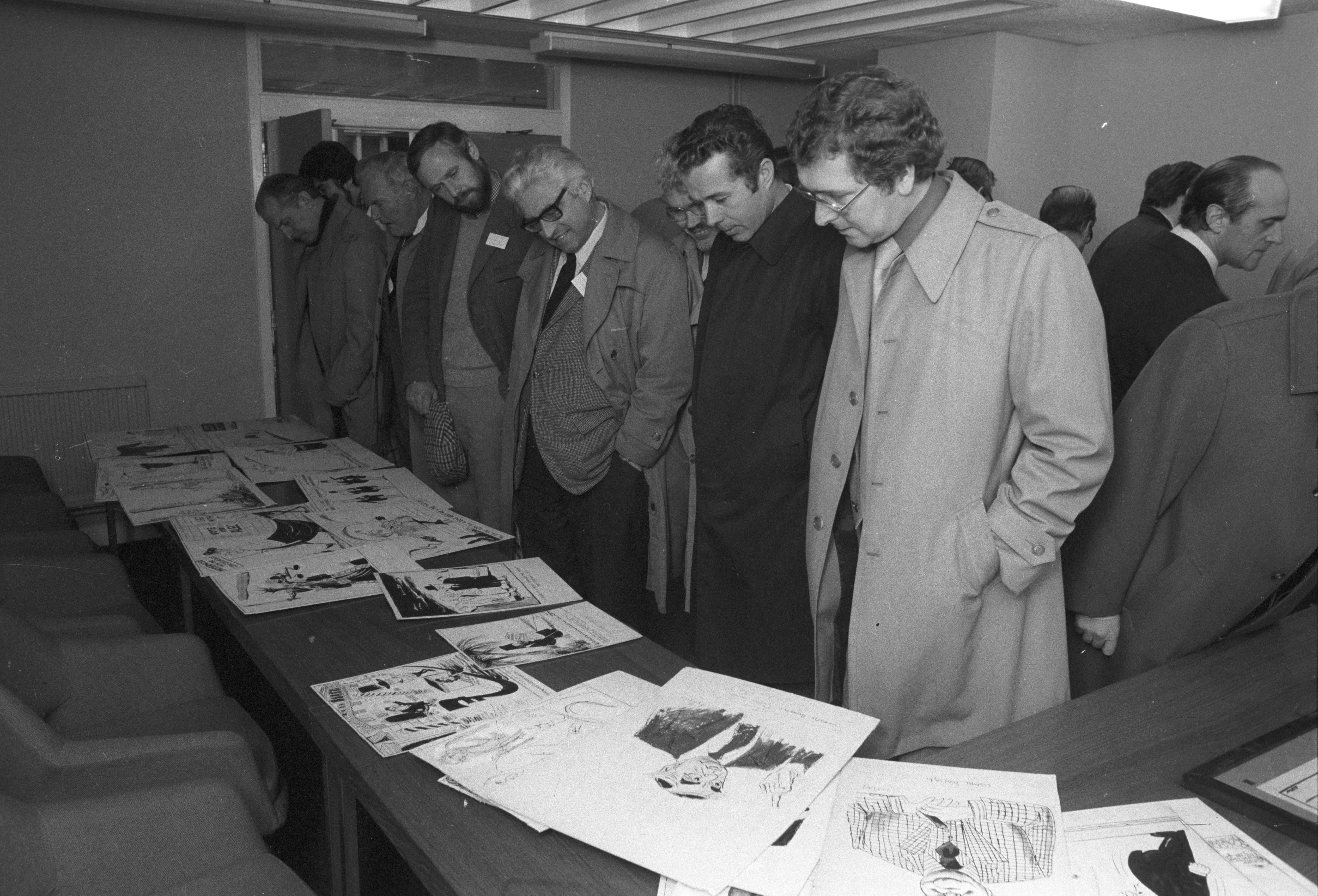
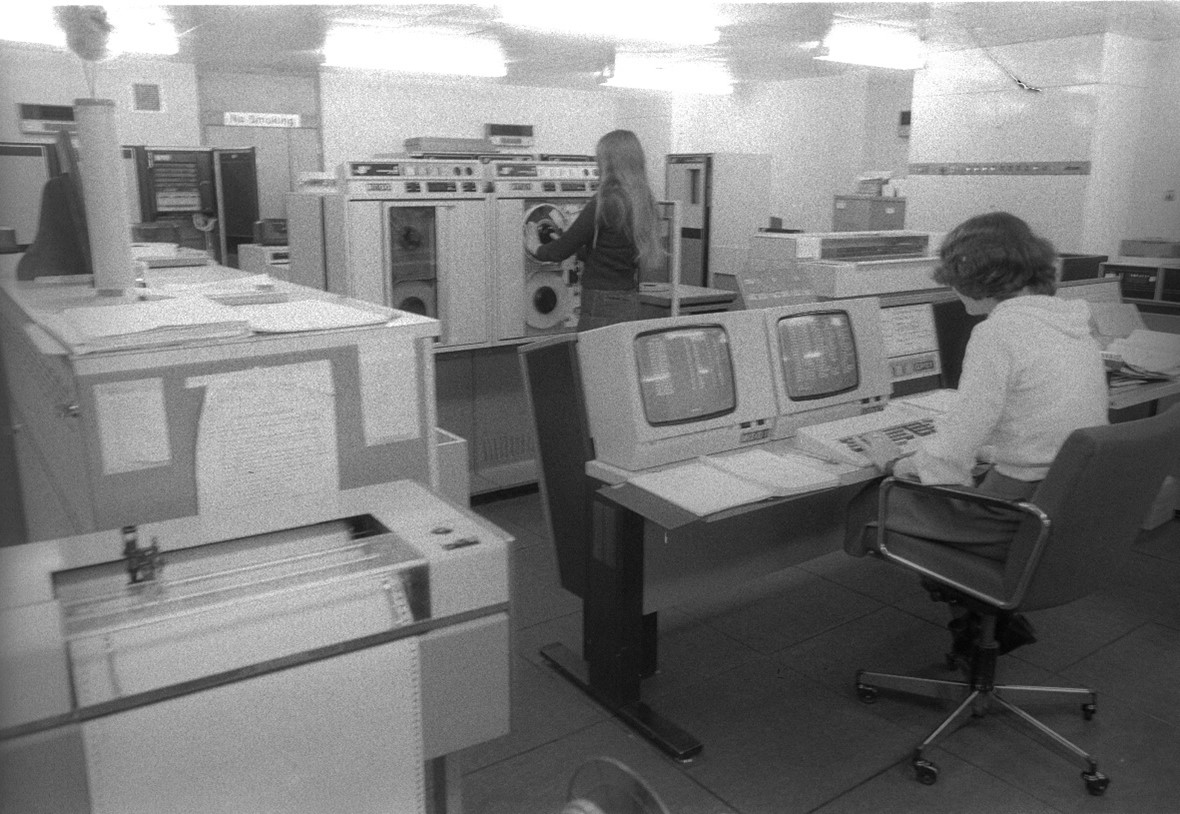
Photograph from c. 1978 – Early days of the Centre for Cartoons and Caricature, now the British Cartoon Archive (University Archive UKA/PHO/1/1039)

This year it was 50 years since the inaugural lecture took place to launch the Centre for the Study of Cartoons and Caricature. The collections have grown enormously since then and to celebrate we hosted an exhibition. It was amazing to work with Clair on this. The activity was funded by the Beaverbrook Foundation, which covered the cost of two scholars and three interns and they were a delight to work with. The exhibition has been a huge success and there is still time to see it if you missed it, as it will remain on view during the first two weeks of January.

I don’t know about you, but I enjoy a good podcast and what better time of year is there to do just that. Clair and Christine feature in two separate podcasts, you can read all about it below and do treat yourself and have a listen.

Clair and Jacqueline have been working on Dr. R.E.W. Maddison’s collection, which arrived at the University in 1985. The collection is fascinating and they’ve both discovered some treasures – more of which you can read below. The printed works are available to browse via our online catalogue. The archival material is also available but more detailed work is being undertaken in the new year.

Christine continues to deliver an array of excellent and diverse sessions for our engagement and education activities, using her best Miss Marple skills to uncover treasures for our participants – eat your heart out Poirot. Although she doesn’t mention it here Christine is also doing some brilliant work with volunteers to sort out and make available our extensive theatre programme collections and many more have been added to our catalogue for your perusal.

This year we welcomed Emily to our team. Emily is Project Archivist, working on the UK Philanthropy archives, which continues to grow. As I type this, we await the latest addition to the archives… watch this space for more news next year!

We’re very lucky that we have managed to secure funding to retain the services of Jacqueline, our Project cataloguer. Although Jacqueline is with us part-time, she has managed to catalogue at least six collections over the last few years, which equates to several thousand books! Her latest target is the Ronald Balwin collection, which is turning up some real treasures. I know I’m looking forward to seeing what she unearths in the new year.

Soon we will have all the John Jensen original artworks available online as Alex has almost completed digitising them. At the same time he is exploring the audio material in the Max Tyler collection – we hope to have more to share with you about that next year.

Mandy also continues to digitise our cartoon cuttings as well as supplying the images for the Giles Annual every December and January. Mandy also supports us with requests for digitised material from staff and readers – including interesting scripts (of one of my all-time favourite programmes!)

Stuart and Matthias, our Curation and Discovery colleagues have been working their way through a variety of material, including books about cartoons, literature and sheet music, as well as our digital cartoons. This means there is now more than ever available online for everyone to access through our online catalogues.

And finally we have the contribution made by our volunteer community – our volunteers bring so much to our team. By giving us their time we are able to progress the processing of our collections and ultimately, we can make them accessible to everyone. So it’s a HUGE thanks from me to them.

Clair Waller, Digital Archivist

British Cartoon Archive – 50 years

2025 marks 50 years since the formal opening of the Centre for the Study of Cartoons and Caricature (now known as the British Cartoon Archive) and it’s been a bumper year of activity.

Beaverbrook exhibition
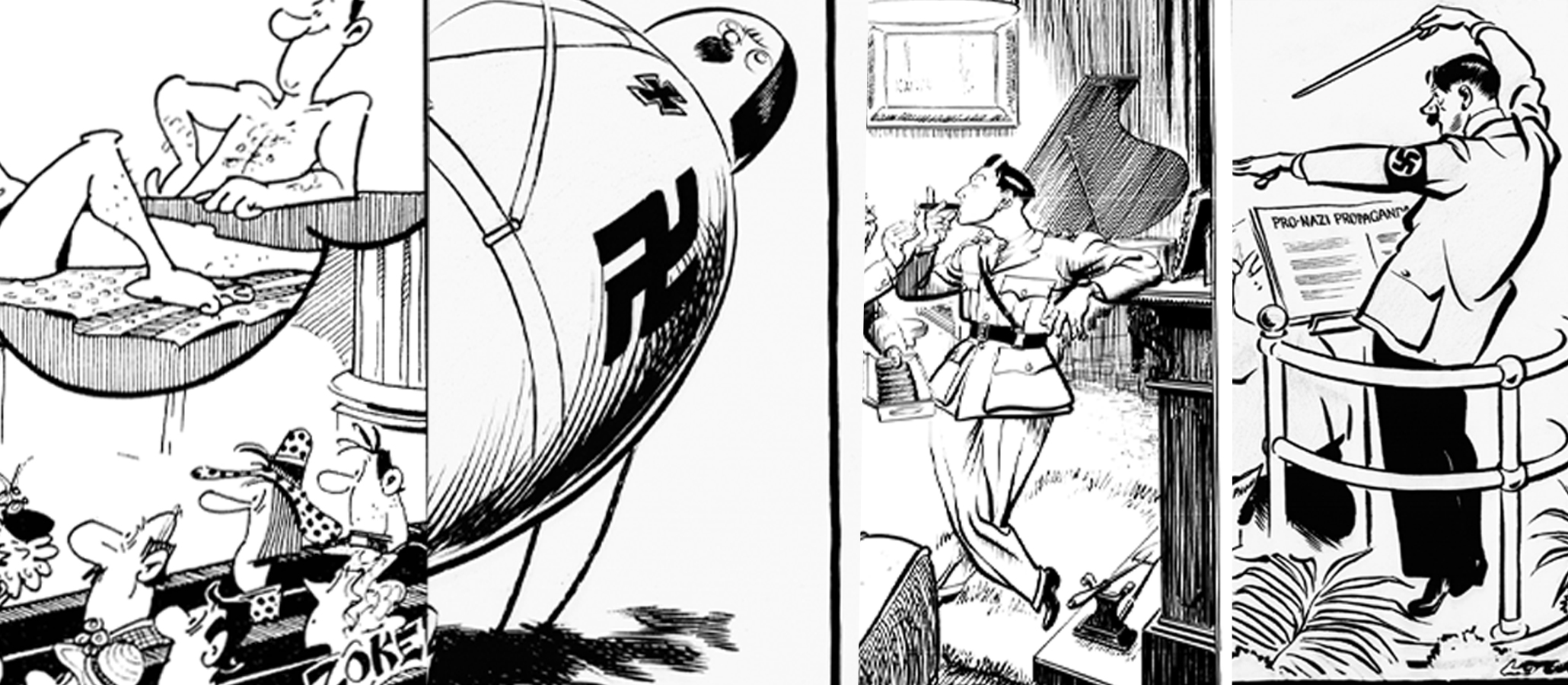
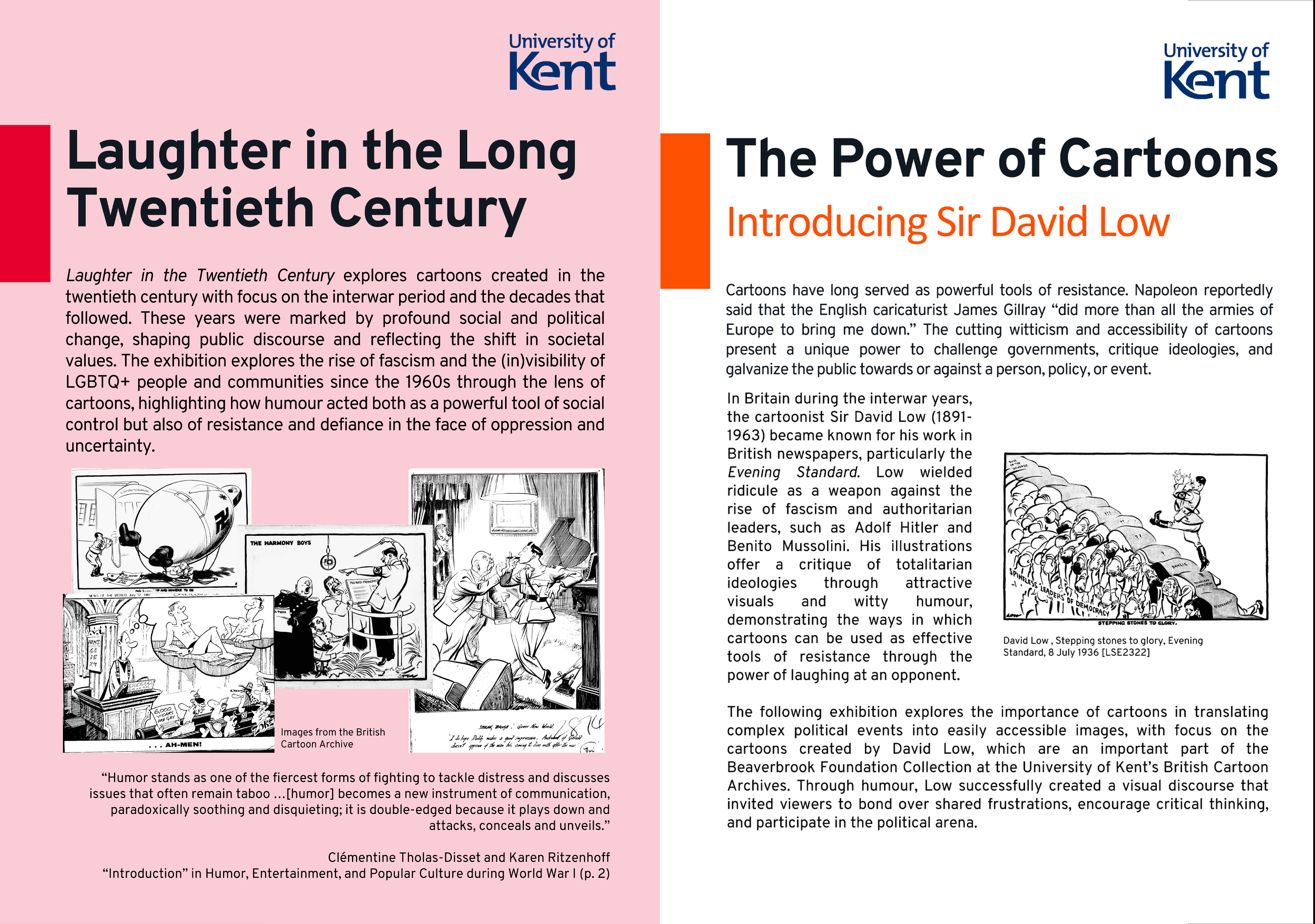
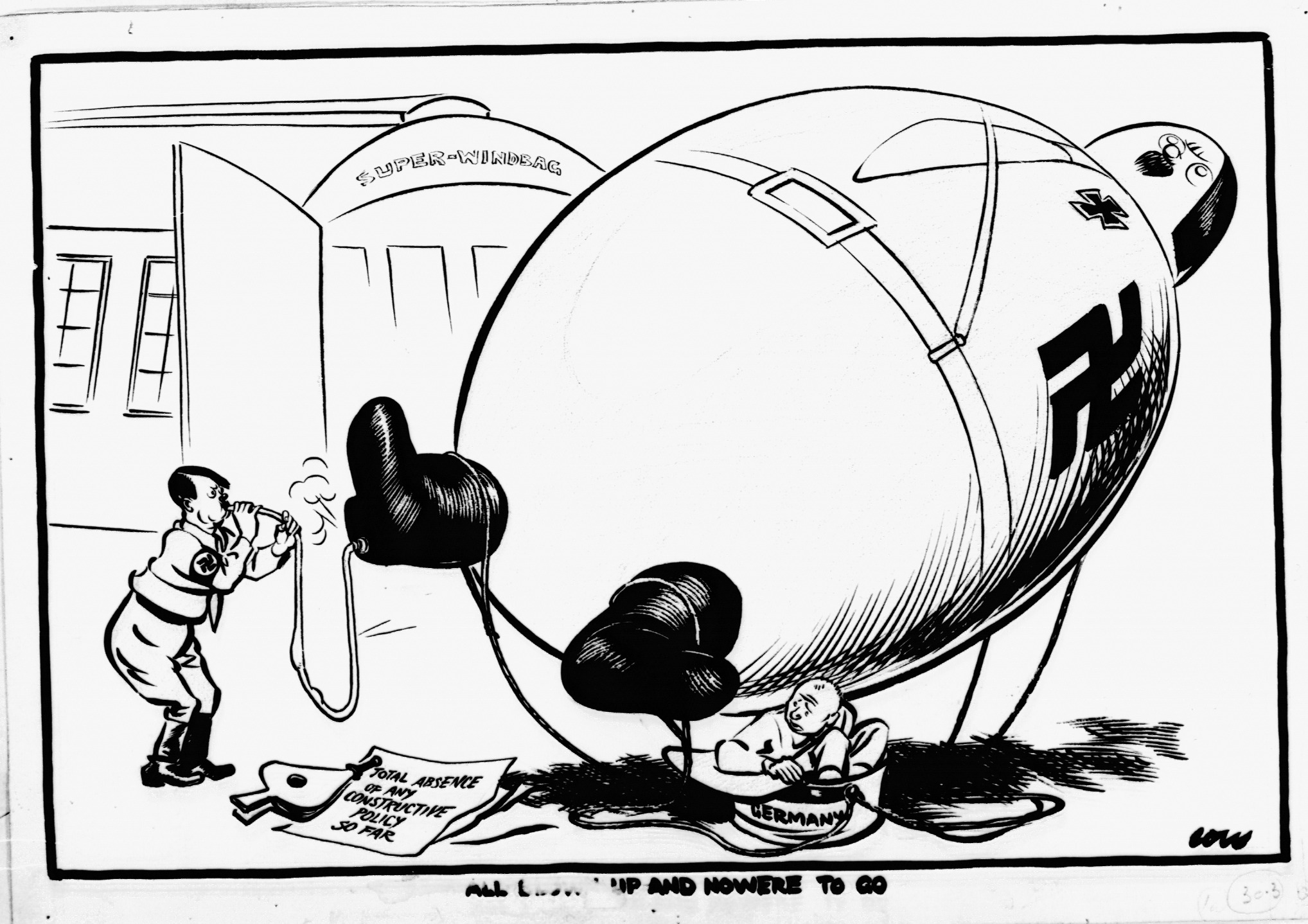
Images from the British Cartoon Archive left to right: Zoke [Michael Attwell], ‘Ah-men!’ [46886] ; David Low, ‘All blown up and nowere [sic] to go’ [DL0741a] ; Joseph Lee, ‘Smiling through: queer new world’ [JL 2539] ; David Low, [no caption] [DL1613].

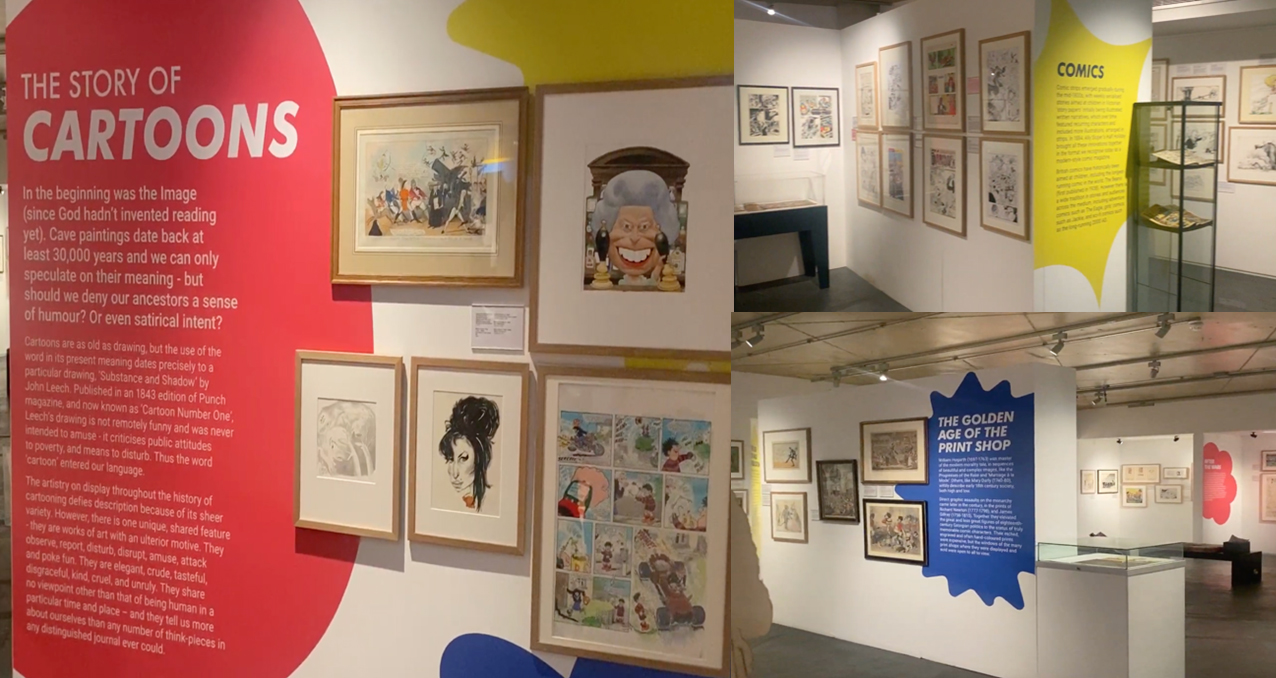
This year saw us finish up our Beaverbrook Political Cartoon Collection Strategy project, and it finished with a bang. We invited two scholars (Amy Matthewson from the University of Birmingham and Dominic Janes from Keele University) to work with us to research and curate an exhibition using the Beaverbrook Collection and the British Cartoon Archive as inspiration. They could select any theme they wanted, and we were very fortunate to be able to employ three student interns (Isabel Walford, Freya Francis and Freja Dixon) to assist them in their research. The resulting exhibition was titled ‘Laughter in the Long Twentieth Century’ and explored the rise of fascism and the (in)visibility of LGBTQ+ people and communities since the 1960s through the lens of cartoons. Despite choosing two distinct topics to explore, Amy and Dominic were able to recognise and bring together a number of themes in the work, highlighting how humour acted both as a powerful tool of social control but also of resistance and defiance in the face of oppression and uncertainty. The exhibition was launched with an event on 1st July 2025, which featured guest speakers Dr Harriet Earle from Sheffield Hallam University and artist David Shenton. You can explore the exhibition online on our website and both Amy and Dominic will be exploring the topic further through a number of published articles, so keep your eyes peeled for more news on those!

[Update – see Amy’s article at https://doi.org/10.1080/14714787.2025.2576832]

new additions

The British Cartoon Archive has seen a number of additions to the collection this year. This included a collection of almost 100 originals of the cult satirical cartoon strip ‘Biff’, created by Mick Kidd and Chris Garratt, and a selection of original cartoons by Jeremy ‘Banx’ Banks. We were also very lucky to acquire a large collection of underground comics from Tony Bennet of long-standing alternative UK publisher, Knockabout. The collection not only spans over 50 years of underground and alternative comics from the UK and beyond, but also includes documentation and papers related to several legal cases brought against the company for breaches of the Obscene Publications Act.
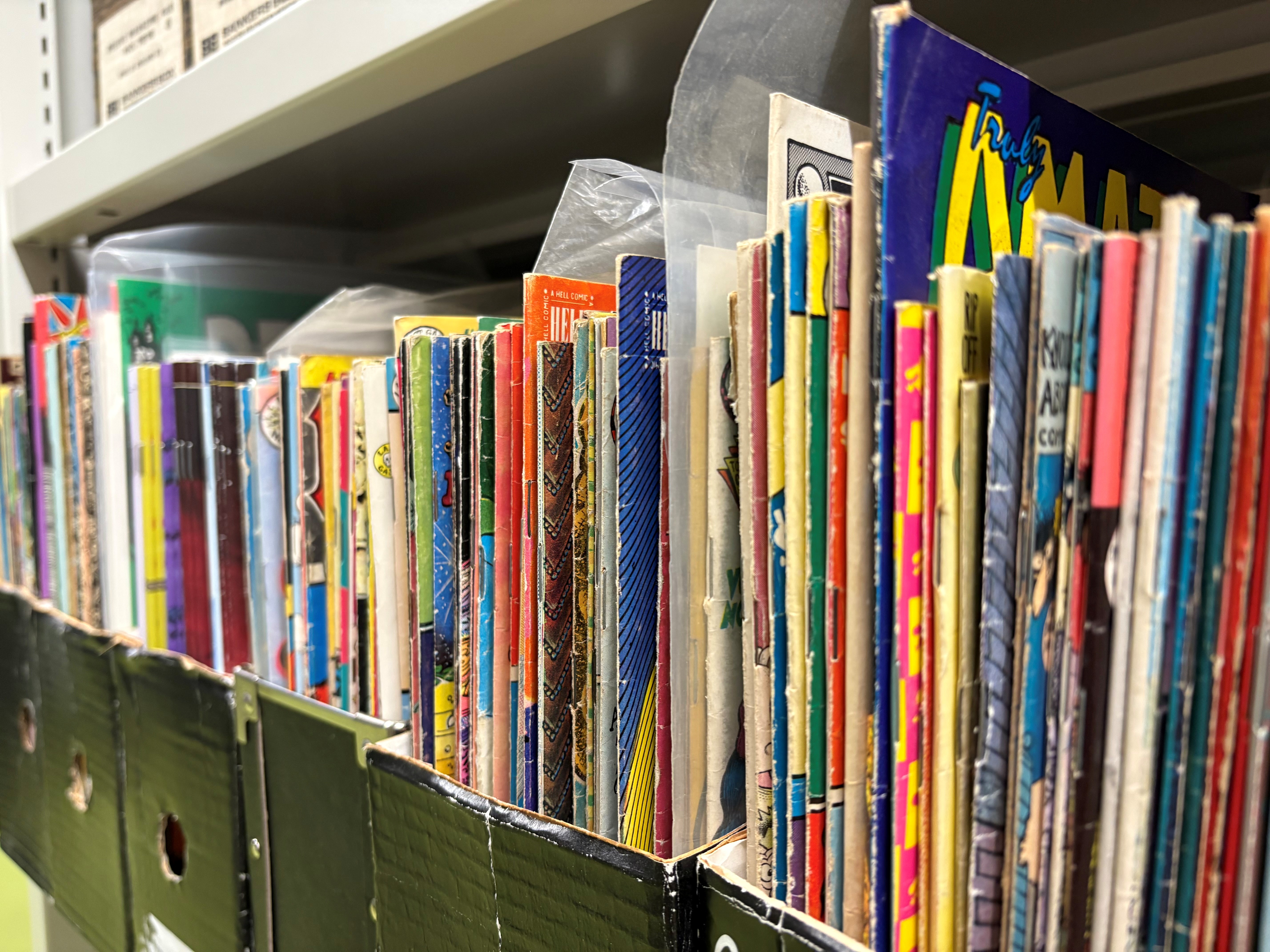
Comics from the Knockabout Underground Comics collection

cartoon county, brighton

In August 2025 the British Cartoon Archive was invited to talk at a meeting in Brighton run by Cartoon County, a community group of local artists and storytellers. These events are held on the last Monday of every month, with host Alex Fitch inviting different speakers to come along and share their current work, after which Alex broadcasts the talks on Resonance FM’s Panel Borders. I was delighted to attend and had a great time speaking to the group about the work we do at the BCA. I can highly recommend attending if you find yourself in Brighton on a Monday evening!

The R.E.W. Maddison Archive
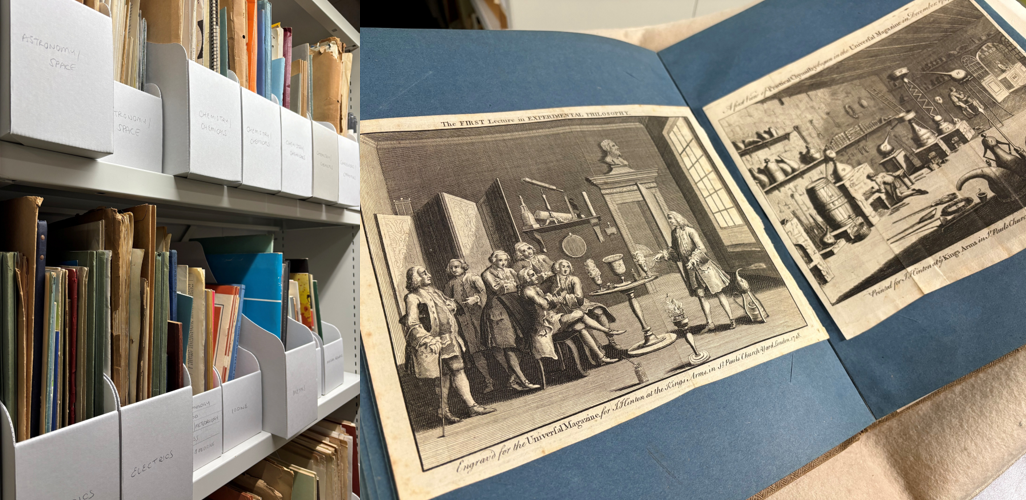
Images of items in the Maddison Archive

Dr. R.E.W. Maddison’s library has been a fixture of Special Collections and Archives, and the Templeman Library, since our university’s early days. Maddison was a personal friend of a fellow bibliophile, John Crow, whose own library constituted one of the University’s founding collections and who encouraged Maddison to deposit his with us too.  Maddison’s library was built up over a period of 40 years and was considered one of the finest private collections on the history of chemistry. Alongside his large collection of books (read more in Jacqueline’s entry below), we were also gifted a substantial archive of material from his career, which I have had the pleasure of cataloguing this year.

The archive contains many different aspects, including correspondence, research papers, scrapbooks, published pamphlets, prints, and Maddison’s own notebooks. Particularly exciting items I identified whilst working on the collection include some 18th century Gillray cartoon prints and many beautiful early-printed engravings depicting scientific instruments and diagrams. It’s been very satisfying to bring the collection to order and to make it accessible, so have a browse on our online catalogue.

Christine Davies, Special Collections and Archives Coordinator

One of the privileges of my role lies in the diversity of projects and groups of people I get to support with engagement and education activities. This year, one of the highlights was working with David Smith (Outreach & Widening Participation, University of Kent) in delivering two bespoke sessions for secondary school students about protest and activism, showcasing some of the wacky materials from the Mark Thomas Collection (including a toy Barbie car and hi-vis demonstration jackets) and crafting zines with which to empower their own civic voice.
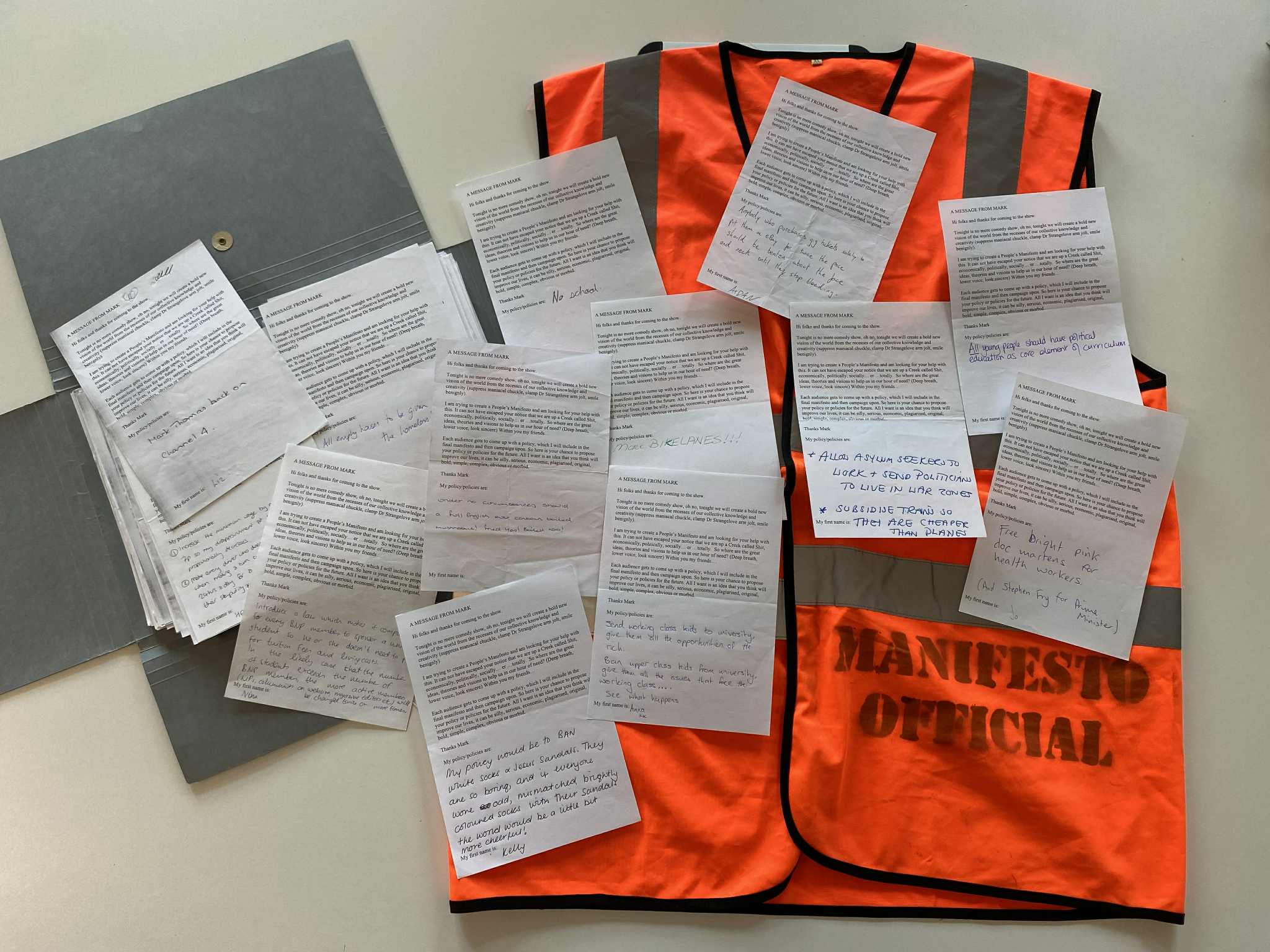
Audience contribution slips and hi-vis jacket from Mark Thomas’ It’s the stupid economy tour, 2009 (Mark Thomas Collection, BSUCA/MT/2/12/1 and BSUCA/MT/12)

Another highlight was in supporting the wider Library Events Group with a social media campaign to celebrate Shakespeare’s Birth Year; it was thrilling to uncover so much unique material in our collections testifying to both the literary and social contexts of Shakespeare’s lifetime and the enduring performance legacy of his plays. We also created a pop-up display of these materials to complement a talk given by Dr Rory Loughnane (School of English, University of Kent) in which he shared research for his upcoming book – favourites included a 1502 copy of Cicero’s Tullius de officiis, a text Shakespeare would have recognised from the school he attended, a copy having been bequeathed by local vicar John Bretchgirdle in 1564, and several 19th-century libretti that were used by Arthur Williams as prompt-copies in Victorian productions of Othello featuring his annotations and paste-ins as well as intriguing printed front-matter about contemporary casts and costume recommendations.
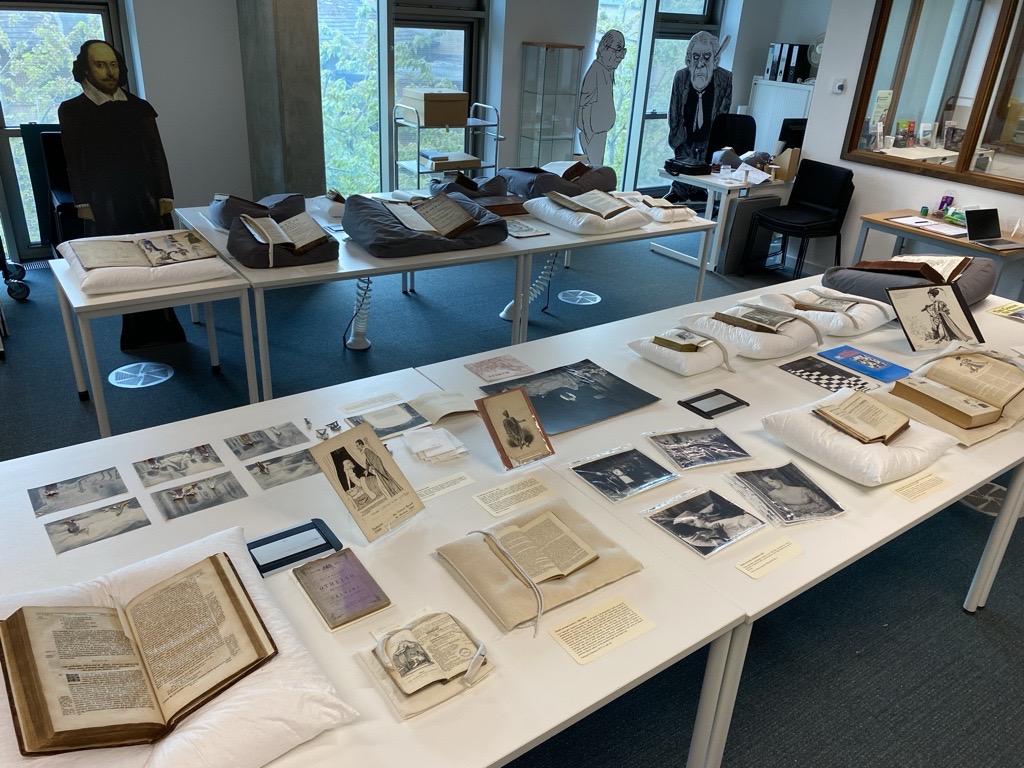
Shakespeare’s Birth Year (pop-up display of Special Collections and Archives materials)

Lasty, and most recently, I collaborated with Dr Bala Chandra (School of Advanced Study, University of London) in a series of activities to coincide with the Being Human Festival, engaging the wider public with prominent literary and cultural figures associated with Canterbury through a curated display of our materials and a radio podcast now on Spotify.

Emily Royston, Project Archivist

This year brought about an exciting change for me as I joined the team in April as Project Archivist! Since stepping into the role, I’ve been working closely with the UK Philanthropy Archive (UKPA), appraising, cataloguing, and rehousing our newest collections. These include major acquisitions such as the Craigmyle Fundraising Consultants Archive, the Wates Foundation Collection, the John Ellerman Foundation Collection, and the Hilden Charitable Fund Archive. Recently established in 2019 with the late Dame Stephanie Shirley’s founding collection, the UKPA will benefit enormously from these additions, opening up fresh avenues for research into UK philanthropy and fundraising.

I’ve really enjoyed diving into our newest collections from the Wates Foundation and the John Ellerman Foundation, which has revealed the distinct yet complementary stories of two family-endowed trusts. The Wates Foundation Collection traces the work of a trust set up in 1966 by brothers Allan, Norman, and Ronald Wates, who earned their wealth in the building industry. As generalist grant-makers, the Foundation has supported a wide range of causes from housing and homelessness to young people and education, women’s health and wellbeing, and criminal justice and prison reform. Its records, including grant files, correspondence, publications, photographs, and audiovisual materials, offer a vivid picture of family-driven, community-focused philanthropy.
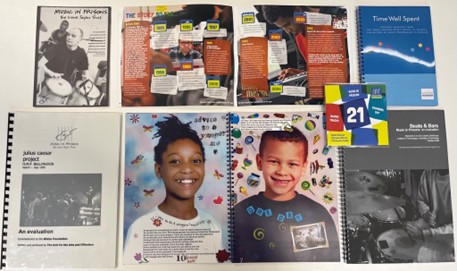
Arts and music projects supported by Wates Foundation and The Irene Taylor Trust, part of their work in prison reform and rehabilitation (UKPA/WATE/3/144)

The John Ellerman Foundation Collection, meanwhile, captures the legacy of a trust established in 1971 by John Ellerman II who inherited the fortune of his father, shipowner and investor Sir John Ellerman I. Its grant-making spans both UK-based charities and international projects, including support for disability organisations in South Africa. Also present in the collection are the Ellerman family’s personal photographs, records, and belongings, providing a rare insight into a family often described in the press as reserved and elusive. Together, these collections provide a rich and exciting resource for researchers, offering insight into how philanthropy and grant-making have shaped communities in the UK and beyond.
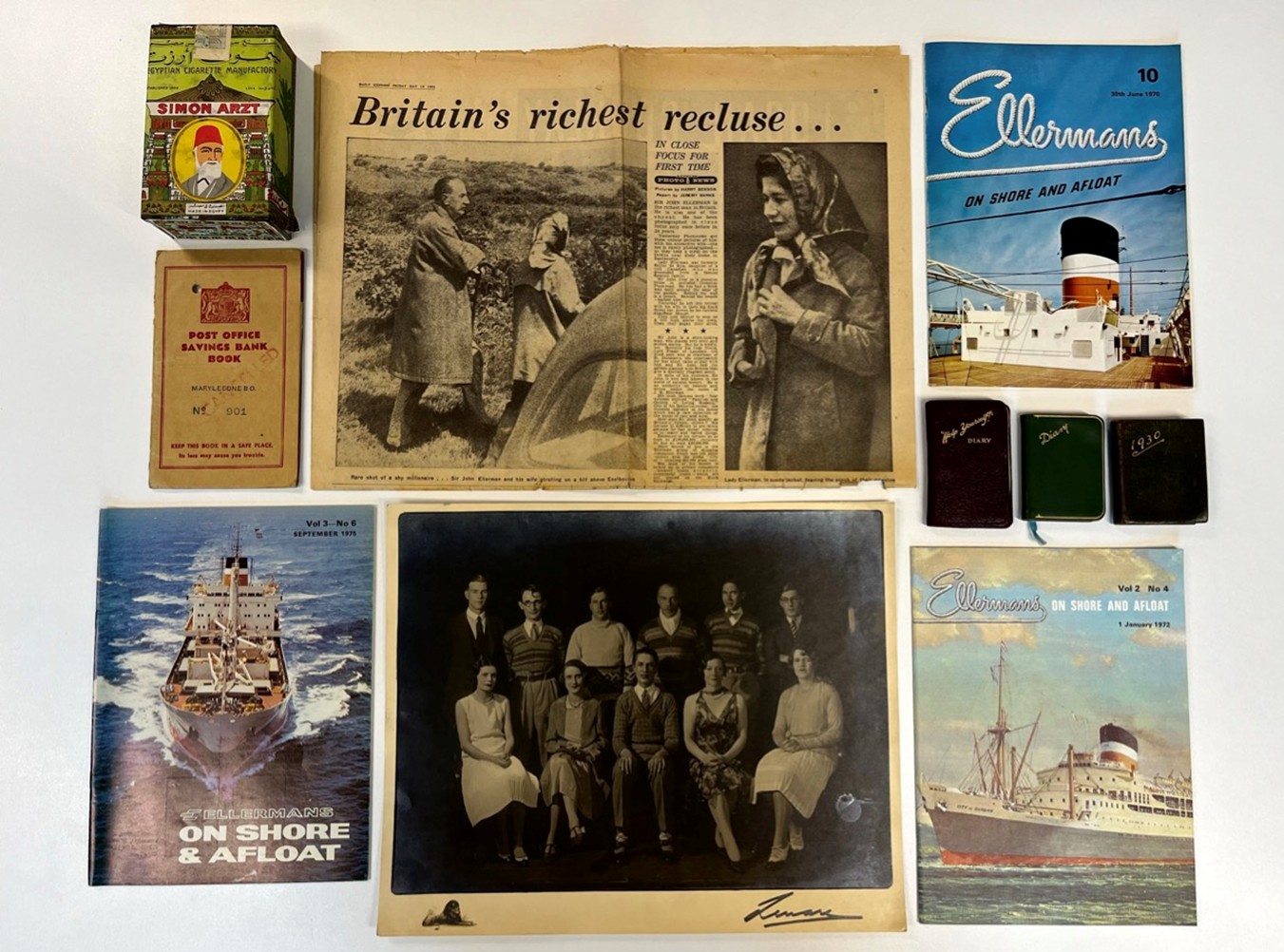
Newspaper clippings, publications, and personal belongings from the John Ellerman Foundation Collection (UKPA/JEF/1—4)

Making these collections accessible to researchers this year has been incredibly rewarding, with scholars traveling from as far afield as Japan and the United States to consult our UKPA materials. As our UKPA collections continue to grow, I’m excited to see the new research they inspire in 2026!

Jacqueline Spencer, Project Curation and Discovery Administrator

This year I have enjoyed working with the collections of two extraordinary book collectors, Dr. R.E.W. Maddison and Ronald A. Baldwin, Kent historian. Dr. R.E.W. Maddison was an academic and librarian of the Royal Astronomical Society who wrote the major work on Robert Boyle (1627-1691). His collection spans the history of sciences, particularly physics. In 2025 I completed the cataloguing of his later deposit of about 800 books including works on alchemy, astronomy and applied science. Dedications and notes in some of the books indicate Maddison’s personal connections with scholars across Europe. The older books include a four-volume set of the 1787 Paris edition of M. Sigaud de la Fond’s Eléméns de physique bound in block-printed pastepaper and John Dalton’s A descriptive poem addressed to two ladies at their return from viewing the mines near Whitehaven (1755) which indicate the range of his interests.
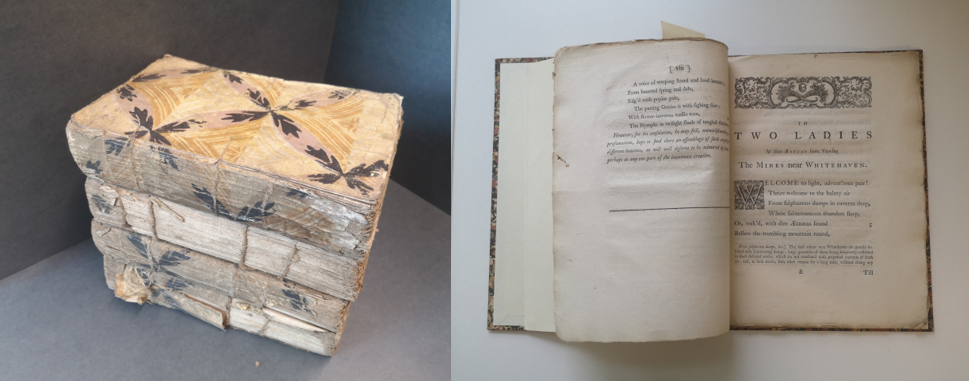
Élémens de Physique (Maddison Collection, QC 19 FON)
A descriptive poem [of…] the mines near Whitehaven (Maddison Collection, LRG PR 3395 DAL)
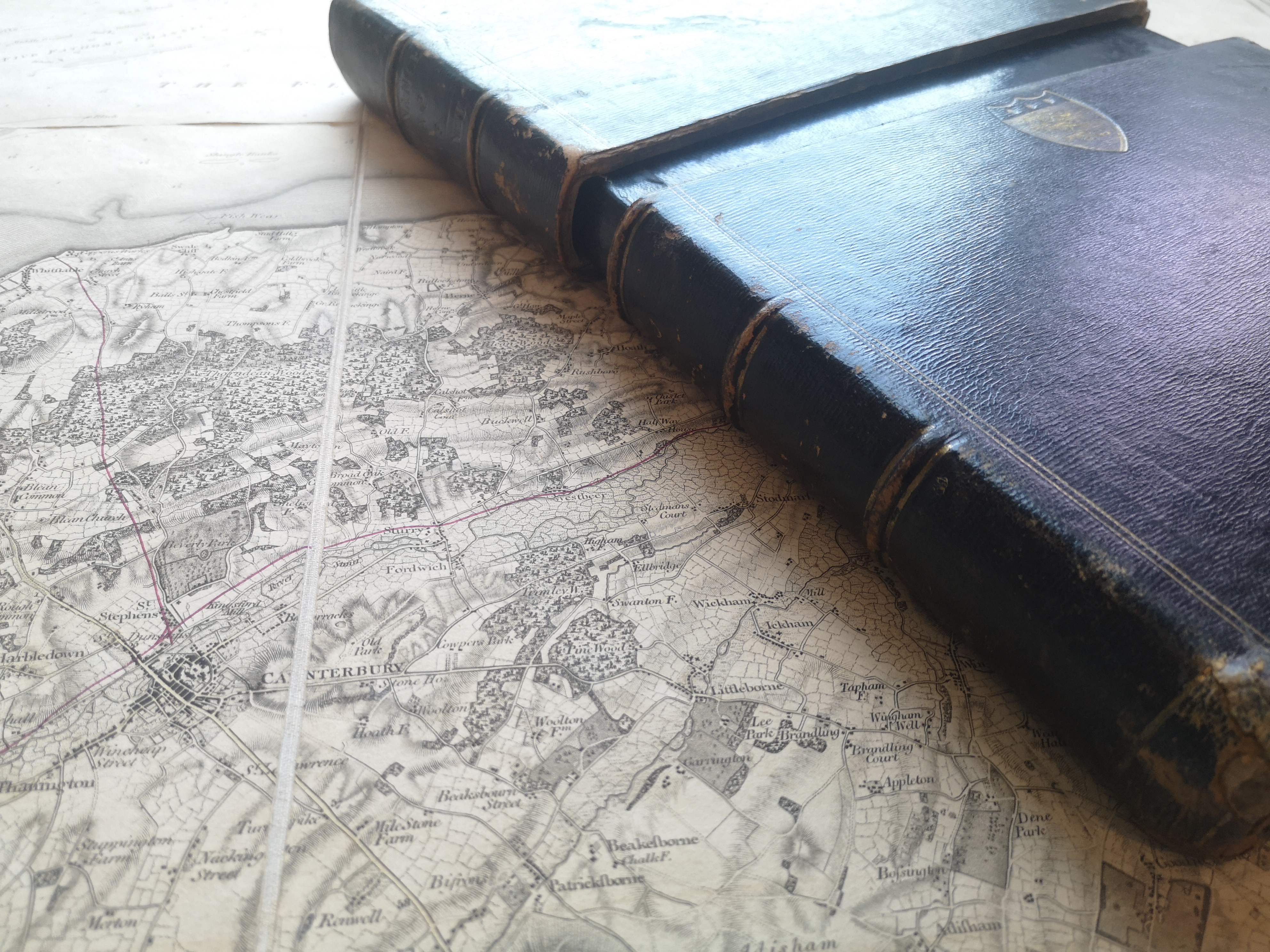
Ronald A. Baldwin was an indefatigable collector. The cataloguing project has revealed his interest in the quotidian history of Kent. Our collections have been enhanced by his material on hopping and farming of cherries and apples and the papermaking industry, on folklore, the natural history of the county and early practical medicine. The collection has added to the university’s holdings of older books on the history of the county including the first Ordnance Survey map of Kent from 1801, the General survey of England and Wales. : An entirely new & accurate survey of the County of Kent … surveyed by Capt. W. Mudge, at large scale, showing field boundaries, mounted on a single sheet and in its original box case.

An entirely new & accurate survey of the County of Kent (Ronald A. Baldwin Collection, G 5753.K4 1801)

Railway lines have been drawn on in red pen which, Baldwin notes, must have been before 1860 as the Crab and Winkle line is shown but not the line from Canterbury to Faversham. Baldwin assembled Acts of Parliament relating to the use of land and rivers in Kent and he sought out sources on local government and on crime. He was a Methodist and his interest in religious biographies may have helped him to acquire scarce pamphlets, amongst which is the rarest book I have ever catalogued, his pamphlet printed by James Abree in St. Margaret’s, Canterbury in 1745, A true and authentick confession of the many robberies committed by William Hook …the notorious house-breaker; our copy has now been added to the ESTC (English Short Title Catalogue) by Dr. David Shaw. I have been able to catalogue part of his collection this year; the biographies of people of Kent, of Kent authors and religious nonconformist groups are yet to be explored.
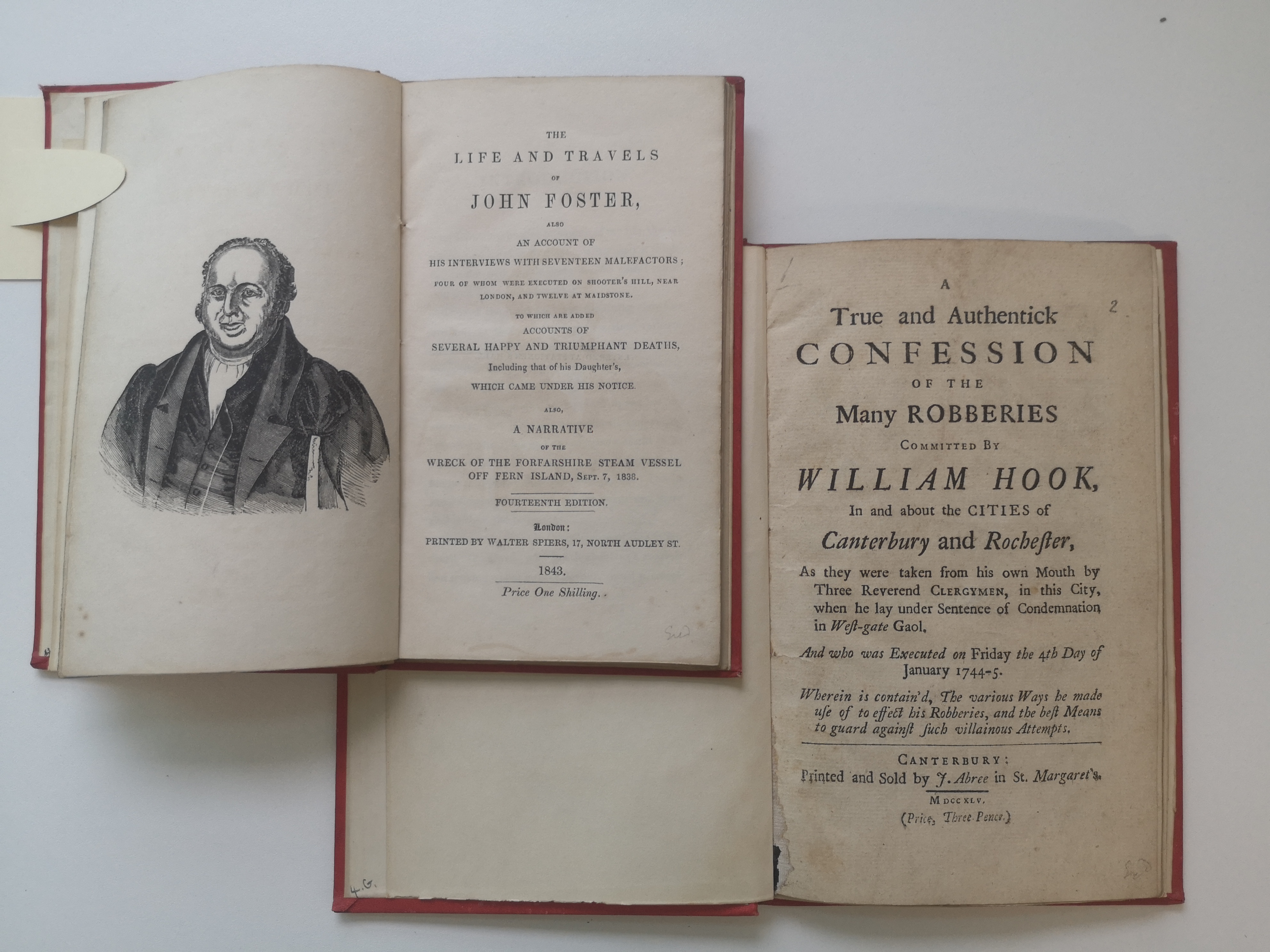
The life and travels of John Foster (Ronald A. Baldwin Collection, HV 28 FOS)
A true and authentick confession of the many robberies committed by William Hook (Ronald A. Baldwin Collection, HV 6653 HOO)

Alex Triggs, Digitisation Administrator

During 2025 I continued with the high resolution digitisation of the British Cartoon Archive collections. This year has been dominated by the original artworks of Jensen (John Jensen, 1930-2018), who drew for a wide range of publications; newspapers, books and magazines, but is perhaps most widely known for his work for Punch magazine and the Telegraph newspapers. Born in Australia Jensen came to Britain as a young man and began his career as a cartoonist and illustrator which went on to span six decades. He was a skilled artist who could draw with either hand and in a wide variety of styles. The Jensen collection contains circa 3000 artworks and is now almost entirely digitised. Personally it has been one of the most interesting collections I have worked on, largely due to Jensen’s artistic ability and stylistic diversity.
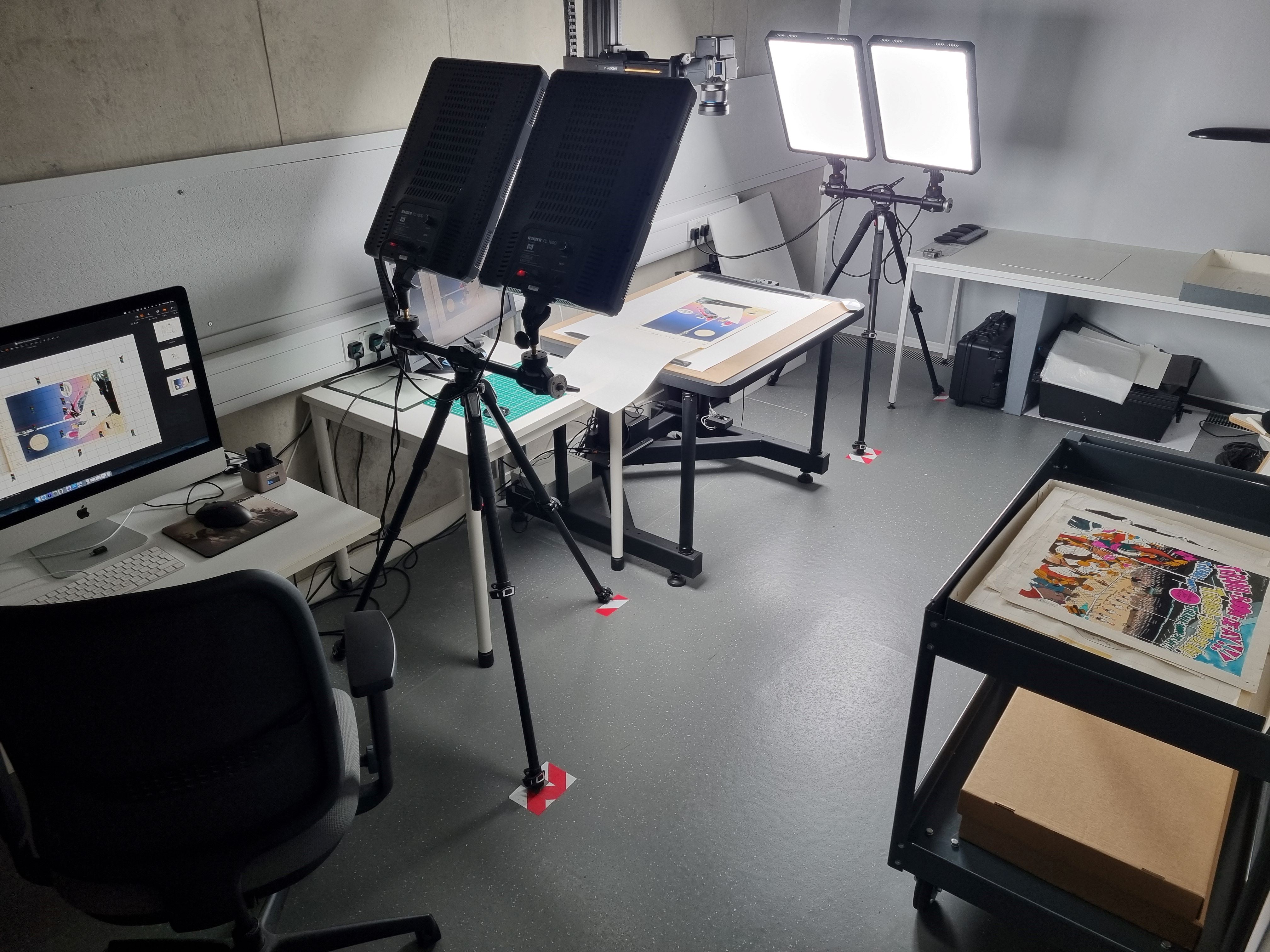
Digital Imaging Suite, Special Collections and Archives

The focus of my digitisation work on the audio visual collections has now moved on to the vast Max Tyler collection of Music Hall analogue magnetic audio cassette tape recordings. Max Tyler was the archivist and historian for the British Music Hall Society, and this substantial collection includes a wide variety of Music Hall memorabilia including sheet music, playbills, books and recordings. We are currently running an initial test digitisation of this eclectic collection of audio recordings to evaluate how we will approach the process as we move forward.
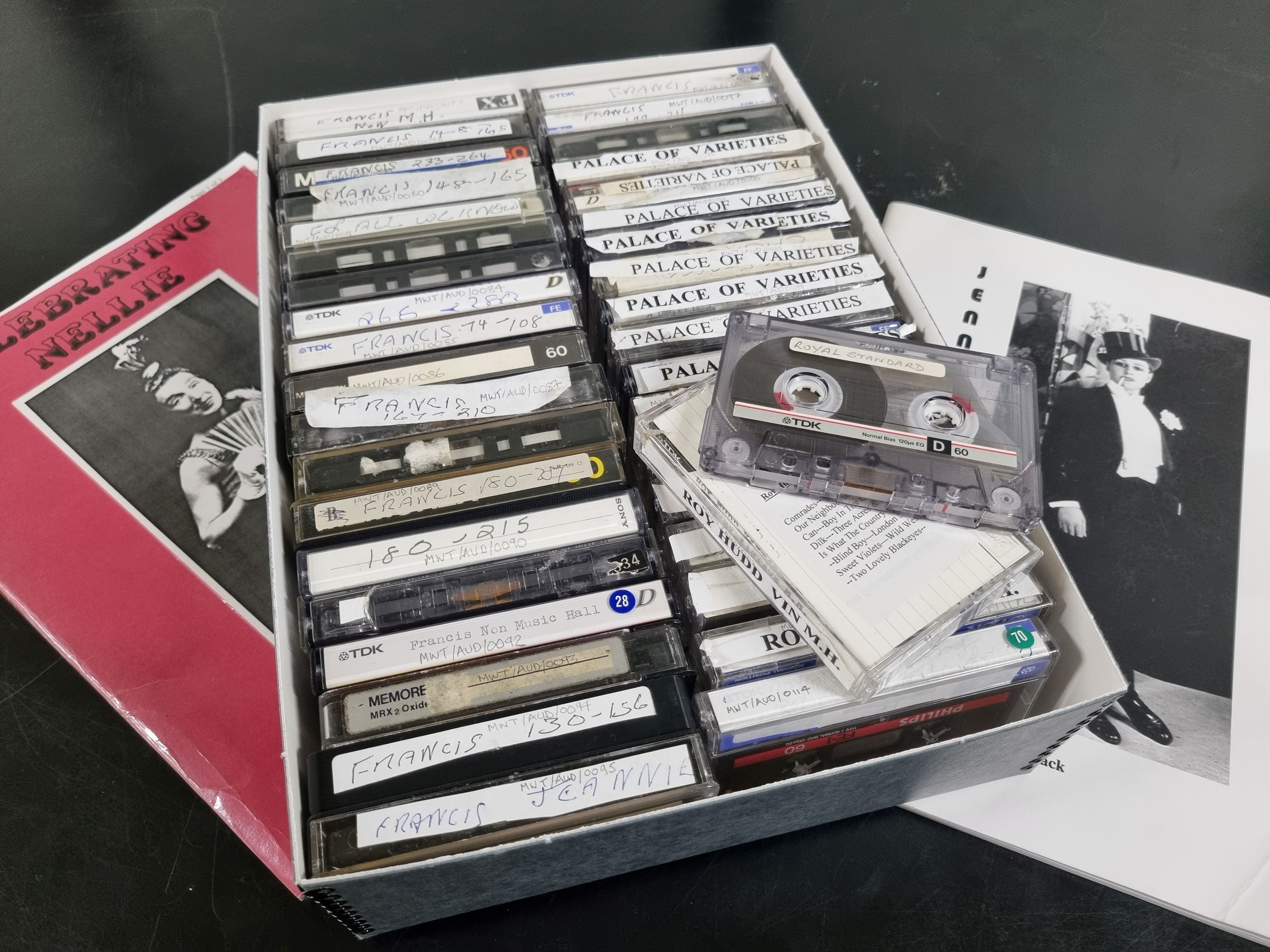
Box of cassettes (Max Tyler Collection)

Mandy Green, Special Collections and Archives Assistant

Back in January I completed scans from the Giles annuals that we receive every year, they are always so good to scan and the comedy element always funny. I’ve also been scanning the Donald McGill postcards which are particularly colourful and detailed. Most recently, I have scanned two of the Alexei Sayle scripts for the Young Ones, it was so interesting to see how the scripts are written.

Stuart Tombs, Curation and Discovery Administrator

This year, as well as cataloguing many more music hall song sheets from the Max Tyler collection, I have enjoyed cataloguing items for the Reading-Rayner Literature Collection. These have consisted mainly of twentieth century fiction and biographical works by authors including Charles Morgan, Evelyn Waugh, T. H. White, Jerome K. Jerome, and Gore Vidal (including a copy of his memoir, Palimpsest, signed by the author).

Many more interesting items have been added to the British Cartoon Archive of which the highlight for me has been “Drawing the curtain: the Cold War in cartoons”, a beautifully presented collection of Soviet cartoons from the Cold War era, published in 2012. Sergei Kruschev (Engineer, and son of Cold War Russian leader Nikita Kruschev), in his preface describes it as “a history of the second half of the twentieth century: from the gentle humour of the mid-1940s, when the world lived in a state of euphoric anticipation of peace and prosperity to come; through the mutual mistrust – not to say hatred – of the 1950s to 1970s; right up to the hopes of perestroika, and even the diplomatic ‘reboots’ of modern times.”
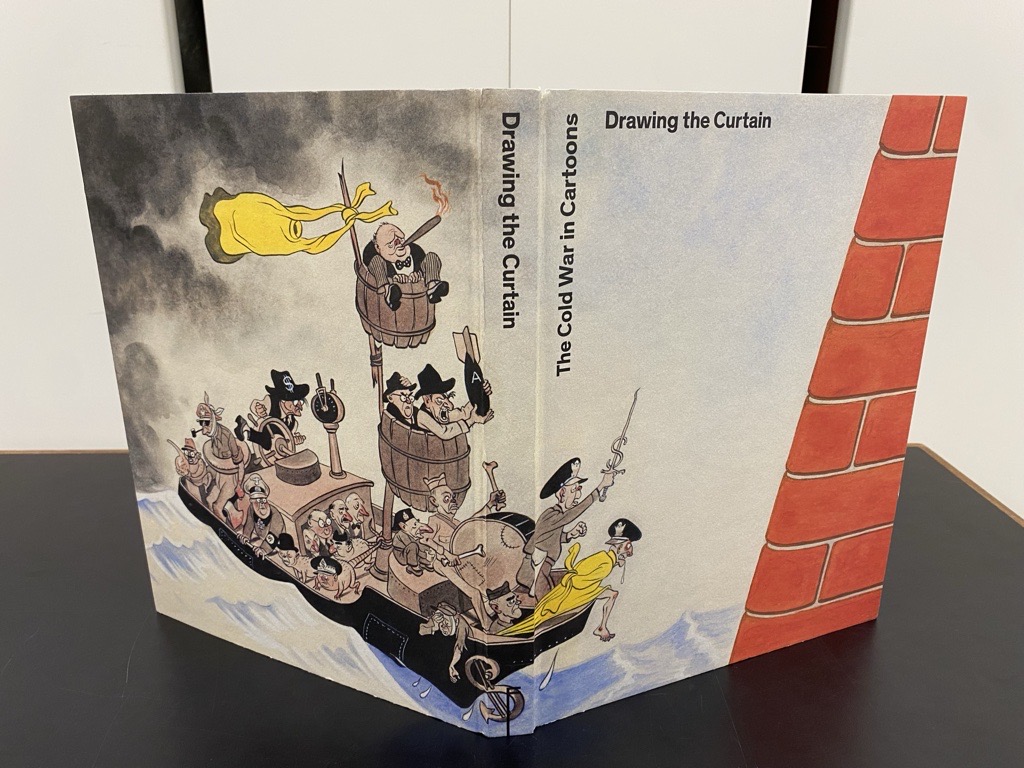
Drawing the curtain : the Cold War in cartoons (British Cartoon Archive Library, LRG NC 1763.W3 ALT)

Matthias Werner, Curation and Discovery Administrator

I have started to work on a collection of books and periodicals generously gifted to us by the late Graham Thomas, who sadly passed away in 2023. Dr Graham Thomas was a former Politics lecturer at the University of Kent and played an instrumental role in establishing the Centre for the Study of Cartoons and Caricature, now known as the British Cartoon Archive. He left us a substantial collection, comprising a large number of books and periodicals, an extensive postcard archive, and a significant assortment of ceramics. The Graham Thomas book and periodical collection includes works of cartoon and  caricature artists, but also books on humour, drawing and design. Among the highlights are a number of first editions by Fougasse, George Molnar and Francis Carruthers Gould.

In addition, I have continued to catalogue Steve Bell’s cartoons for the British Cartoon Archive, making them available to the public. Steve has very kindly sent us his published editorial cartoons from The Guardian. It has been fascinating to revisit the political scandals of 2021, which made me realise how quickly things in politics have moved, although the broader topics have largely remained the same as we continue to battle with the fallout from Covid, Brexit, and the (first) Trump presidency.

Volunteers

We couldn’t end our annual newsletter without a massive thank you to all our volunteers, who provide indispensable support to managing our collections and making them more discoverable. Collectively, they contributed 1031 hours over the last twelve months – equivalent to 186 full work days. Read on for some of their own insights.

Martha Pledge

I have been volunteering in Special Collections and Archives since the spring. Most of my time has been spent archiving theatre programmes gifted to the university by Seona McKinnon and I’ve made some fascinating finds. This Sylvia Plath programme features her poems, a timeline of her life, and a scene sequence of her poetry to the dance movements performed. It even folds out to become an amazing poster, revealing a creativity of production which reflects beautifully on the legacy of Plath’s life and work. As a Shakespeare lover, I also want to highlight this 1979 adaptation of Hamlet at the Half Moon Theatre, starring Frances de la Tour in the title role. A more traditionally-structured programme, it includes an article on the lesser-known performance history of Hamlet being played by female actors. These are just two of hundreds of programmes I’ve encountered whilst volunteering, all of which has reminded me of the importance of preserving literature for future academics and students.
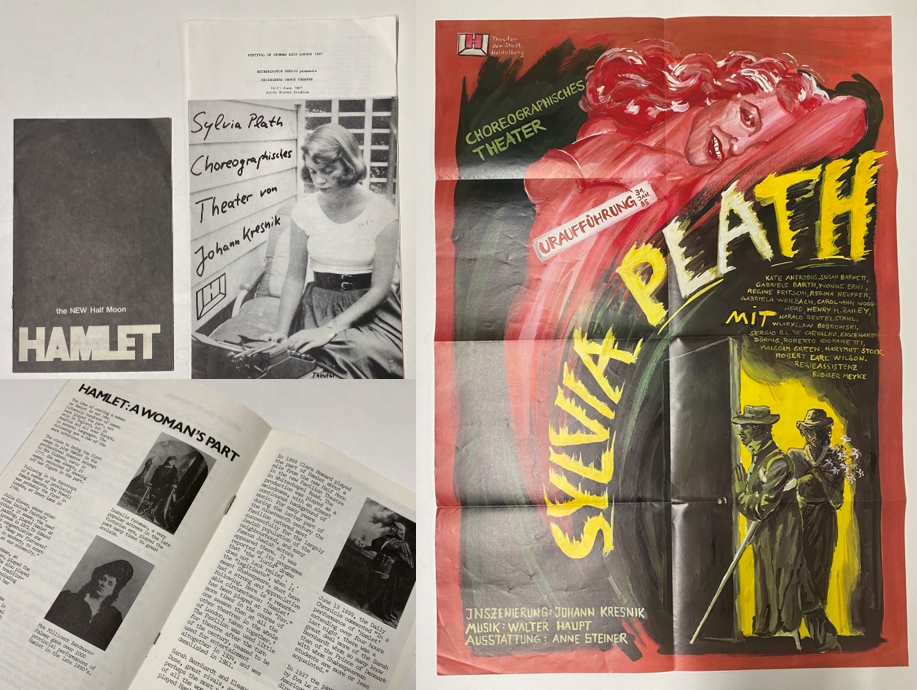
Programmes for productions of Hamlet (Half Moon Theatre, 1979) and Sylvia Plath (Heidelberg Dance Theatre at Jacob Street Studios, 1987). Seona McKinnon Collection

Emma Jeffree

As a Special Collections and Archives volunteer, I have been writing summaries and editing transcripts of interviews in the Winstanley Oral History Collection. These interviews were conducted by Michael Winstanley in the 1970s, looking at everyday life in Kent before 1914, and formed the basis for his book Life in Kent at the turn of the century [1978]. Listening to the original digitised recordings has given me the chance to hear the voices of people who lived at the time, and learn from them what their life was like, and how society worked 100 years before I was born. Having grown up in Kent myself, it is fascinating to hear of familiar places in very different lights. Volunteering at the archives is not only interesting and enjoyable, but it also provides me with good work experience vital for a student and the confidence and skill set necessary to embark on my future career.

Laughter in the Long Twentieth Century: David Low & Cartooning Fascism

This blog post is written by Dr Amy Matthewson about her experience working on the Beaverbrook Engagement project and exhibition, funded by the Beaverbrook Foundation.

The Vision

It all began with a Call for Proposals from the British Cartoon Archive at the University of Kent. It was for a Visiting Scholar Grant from the Beaverbrook Foundation putting out a call for proposals to do an exhibition based on their cartoons that form part of the British Cartoon Archive’s collection.

Most of the Beaverbrook cartoons are available to view online and as I scrolled through, I was delighted to see that David Low formed a big part of the collection. Low is, arguably, one of the most celebrated political cartoonists of the 20th century and I have always wanted to take a closer look at his work. This grant, if successful, would give me the perfect opportunity to get to know Low, the cartoonist, as well as his work.

I proposed an exhibition exploring the use of humour during the interwar period in Britain. This was a time of uncertainty with a nation only just recovering from the horrors of the First World War, mass unemployment, global economic depression, and the rise of fascism. David Low’s cartoons would form the basis of the study.

The aim was to analyse the role of humour through satirical cartoons during a period of increased social and political tensions. How did Low’s cartoons function as a means of dissipating anxieties while simultaneously lampooning dictators’ and their fascist ideologies?

After waiting (with eager anticipation) for a few weeks, I had an interview and the proposal was a success! I was to spend the next few months researching and organising the exhibition, to be displayed at the Templeman Gallery at the University of Kent.

What is the Story?

Where to begin? I didn’t expect the David Low collection at the British Cartoon Archive to be so extensive and I found myself overwhelmed. Faced with a wealth of cartoons, personal correspondence, and books, the challenge was how to narrow the scope and select materials that will offer a cohesive narrative. What ‘story’ does this exhibition want to tell and how to tell it in a comprehensible way?

The first step was to immerse myself in the collection and I did this with great pleasure (I am a bit of a research geek…ok, a big research geek…). I spent a week going through the collection organising cartoons and correspondence into “Yes, Definitely,” “Maybe” and “No” categories. I didn’t manage to get through everything but felt satisfied with the dent I made in going through as much as I could.

Thankfully, this was not a solo venture. Karen Brayshaw, Special Collections and Archives Manager, and Clair Waller, Digital Archivist, offered valuable curatorial advice with extensive knowledge of their collection. There was also another Visiting Scholar, Dominic Janes, who brought another layer of support and encouragement as he worked through his own exhibition, a fascinating exploration of the LGBTQ+ community through the lens of cartoons. His exhibition was planned to run alongside mine.

Another key pillar to the project was three student interns, Isabel Walford, Freya Francis, and Freja Dixon, recruited through a competitive application process. Their involvement was central to the development and success of the project. And with this incredible team in place, I was well-supported.

When I got home and reviewed the pictures I took as a memory aid, a question kept coming up: What is the story here? Yes, there were many witty cartoons (one of my favourites is Hitler blown up as balloon with the caption, “All Blown up and Nowhere to go”) but I couldn’t simply have an exhibition of randomly compiled cartoons thrown up for viewers to decipher. Or could I?
David Low, All blown up and nowere [sic] to go, Evening Standard, 26 Jun 1933 [DL0741a]

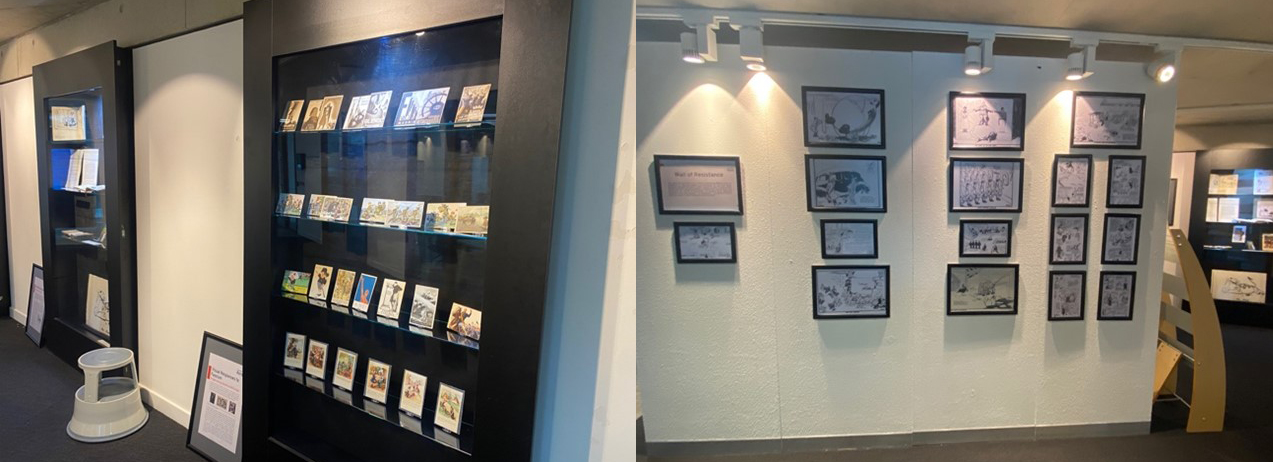
I decided to have a Wall of Resistance as part of the exhibition – a blank wall covered with Low’s cartoons demonstrating his resistance to fascism. But is this enough of a story to tell for the exhibition?

Low… cartoons… fascism… satire… resistance… caricature… blown-up Hitler… so what? Again, the question: What is the story? As I sorted through the cartoons, a story started to fall into place. It’s simple – the cartoons themselves are the story. Far from being merely ‘funny pictures,’ they were sharp criticisms. Severe enough to irritate their satirical targets (Low’s cartoons were eventually banned in Nazi Germany as they annoyed Hitler), powerful enough to communicate complex messages, and effective enough to have editors scrambling to write to Low and ask him to tone things down in order to maintain peace in Europe.

Herein lies the story.

The Cartoon Museum

We planned a trip to Disneyland.

Well, not quite but for those who are enthusiastic about cartoons, the Cartoon Museum in London is as good as Disneyland. Karen arranged our outing to include a private tour led by Hannah Whyte, the Collections Curator, along with a lively discussion with Steve Marchant, the Learning Officer and Comic Art Curator.
However, as often happens, things did not go according to plan. There were severe delays on the train from Canterbury to London and so the student interns were not able to make their way to the museum. The day, however, was not completely lost. Dominic, Karen, Clair, and myself were able to go and we made the best of the situation by taking lots of pictures to share with the interns later.
The day ended the way all really good days end: with coffee and cake and a chance to share our thoughts and ideas. The project was really starting to take shape.

Photos of the Cartoon Museum in London.


Coming Together

The next few weeks were a blur of activity. With the framework of the exhibition in place, we turned our attention to translating our ideas into an engaging and coherent visitor experience. We needed to finalise the narrative boards – the storytelling foundation of the exhibition, as well as select and arrange the cartoons, objects, and supplementary materials in a way that would resonate with our audience.

There was much thought put into the narrative boards. Each board needed to draw out the historical and political contexts without losing the interest of the visitor. The boards needed to provide enough information without being too dense while also conveying complex ideas – the rise of fascism, the power of cartooning, the socio-political function of satire, as well as a reflection on what it is that makes people laugh (or makes people angry).

Panels from the exhibition


Isabel, Freya, and Freja played a crucial role in bringing the exhibition to life; Isabel’s keen eye worked to match images with key themes and narratives on the boards; Freya did research in selecting cartoons, interviews, and music for the listening pod; Freja dove into the archives, selecting books, objects, and other materials of visual interest to add to the exhibition.

Once the material was finalised, we sent everything to Clair for printing. Her technical expertise and familiarity with the Archives were invaluable. Clair meticulously checked every file, making sure everything was ready for installation.

And then… we waited.

Installation and Improvisation

While much of the groundwork had been done before the installation process, the final execution brought a set of challenges. The transition from concept to physical space required flexibility, creative problem-solving, and improvisation. Despite having detailed layouts and measurements, some of the materials did not fit quite where we had imagined, while other areas felt too sparse or too cramped.

There were empty frames waiting to be filled and hung; glass surfaces needed to be cleaned; books were queued for display; objects sat carefully arranged on trolleys; cartoon artwork was laid out across tables. And with every … “oh wouldn’t be great to have this over here…?” and “didn’t I see something that would be the perfect fit…?” there was running back and forth to the archives, deep in the basement (sorry Clair!).

Dominic and I worked closely on the sequencing of exhibits, paying attention to how the narrative would unfold for the visitor. We wanted to make sure our two exhibitions had a connecting thread. We moved shelves in cabinets around allowing for the materials to be better (and more clearly) displayed. Karen and Clair were right there to offer their expertise; Freja, Freya, and Isabel were a constant source of energy and support. They were everywhere: lifting, adjusting, dusting, and arranging and beyond their physical contributions, they offered ideas and suggested reconfigurations to improve the overall feel of the display cases.

Photos of the exhibtion being installed


With the exhibition complete, we then turned our attention on an afternoon workshop that invited two guest speakers: Dr. Harriet Earle, Senior Lecturer at Sheffield Hallam University and David Shenton, cartoonist specialising in queer comics. (details here: https://shorturl.at/fKcgZ)

This installation process was perhaps the best experience during my time with the British Cartoon Archive. While the research is always enjoyable, it tends to be a solitary pursuit whereas the installation process required cooperation and collaboration. This was an excellent example of what an exceptional and supportive group of people can do when working together.

The Story

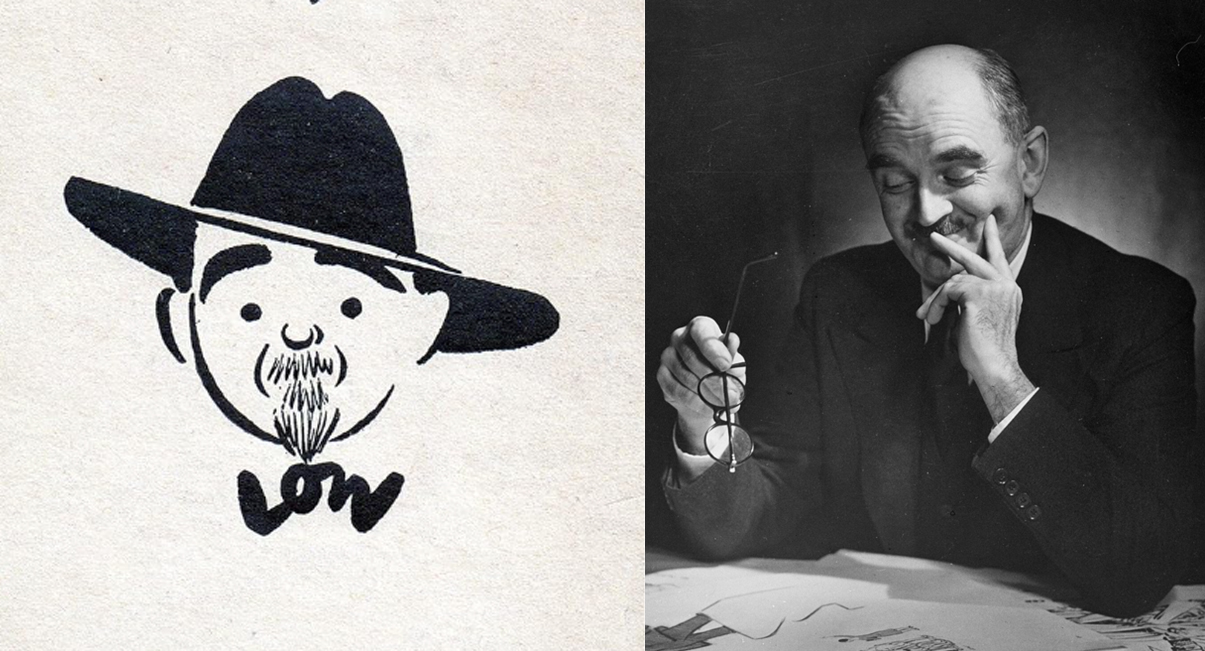
Born in New Zealand in 1891, Low rose to prominence as an artist in Australia during his twenties and in 1919, he arrived in London to begin his career at The Star, a newspaper aligned with Liberal values. A committed Liberal himself, Low once described democracy, despite its flaws, as offering “the best blend of stability and dignity.” In 1924, media tycoon Lord Beaverbrook, invited Low to join his Conservative newspaper the Evening Standard. Low declined but when, four years later in 1927, Beaverbrook asked him again, Low agreed but with some reluctance. The decision drew sharp criticism and aware of these perceptions, Low insisted on maintaining editorial independence, a stance formalised in a contractual clause that distanced himself from the paper’s Conservative political view.


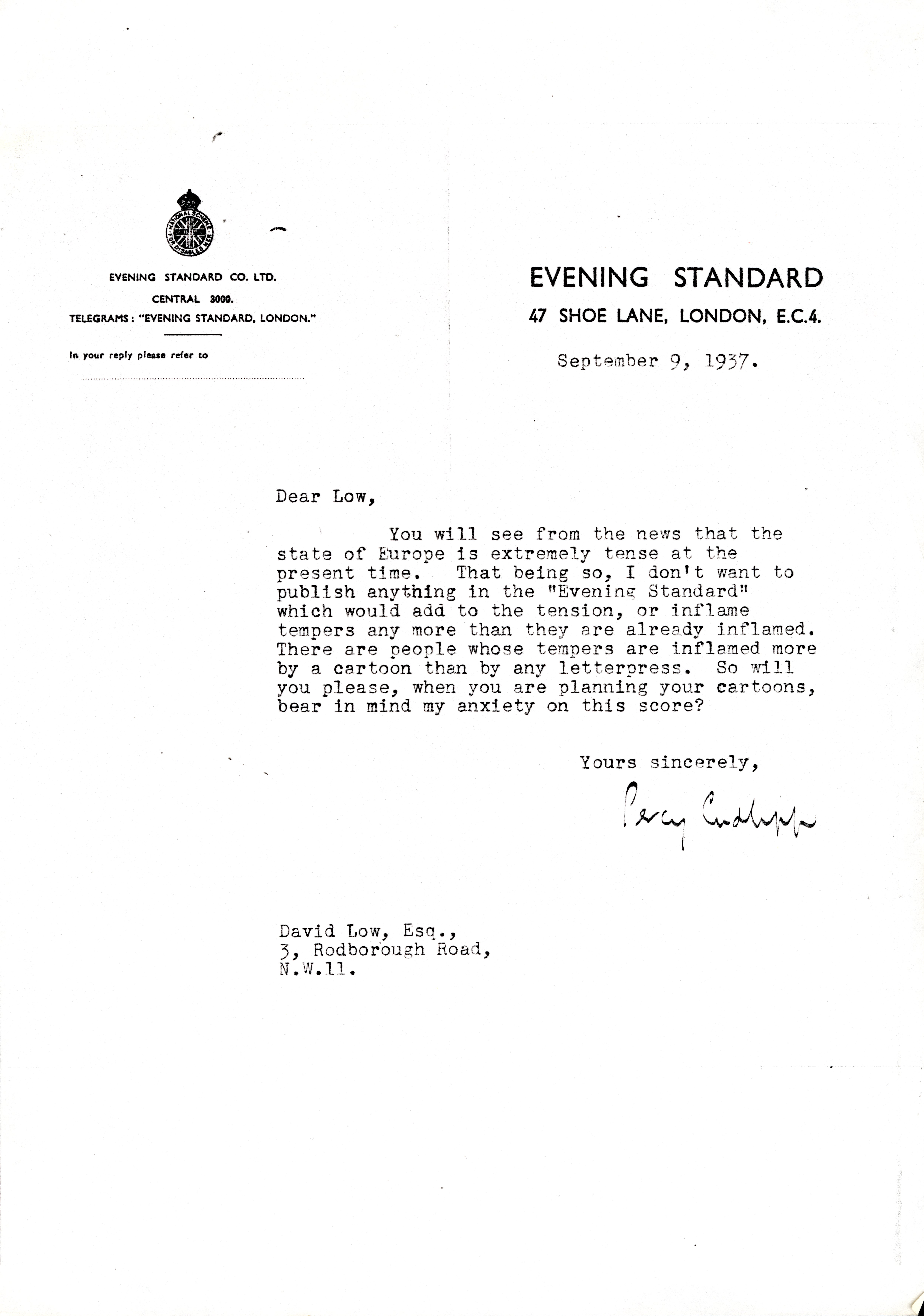
During the 1930s, Low waged a visual war against the rise of dictators’ and their fascist ideology. So much so, that in 1936, Percy Cudlipp, editor to the Evening Standard wrote to Low suggesting “that for the present [Low] avoid the dictators altogether” as was reluctant “to run what will seem to be a cartoonist’s campaign against the dictators.” About a year later in September 1937, Cudlipp wrote again:

You will see from the news that the state of Europe is extremely tense at the present time. That being so, I don’t want to publish anything in the “Evening Standard” which would add to the tension, or inflame tempers any more than they are already inflamed. There are people whose tempers are inflamed more by a cartoon than by any letterpress. So will you please, when you are planning your cartoons, bear in mind my anxiety on this score?

Did Low know the effects his cartoons were having? In May 1942, Low wrote:

Some American cartoonists draw H. [Hitler] and M. [Mussolini] as monsters of brutality eight feet high with big hairy arms covered with whiskers, hands dropping with blood, etc., I’m sure no one is more pleased at this then H. and M. themselves, for that is just the effect they have always striven, with all the arts of propaganda, to create among people just before they go out to defeat them.

That kind of thing no doubt had the effect of building up the idea that Hitler was too, too, too powerful to resist, and contributed to the beating down of the moral front. Personally, I know that the cartoons of mine that got under their skins most were those which made them look like damned fools…

Letter from Percy Cudlipp, editor to the Evening Standard, to David Low

Both the above citations highlight the power of seemingly simple ‘funny’ pictures. Cudlipp was genuinely concerned about the potential of political cartoons in disrupting the fragile peace in Europe. Low was aware of the effectiveness of his cartoons and took great pains to ensure his art was doing exactly what he intended it to do. And it was. The Nazis eventually banned Low’s cartoons in Germany, a move that only amplified his reputation. Empowered with the knowledge that he was hitting his target where it hurt most, Low continued his relentless visual assault on the dictators and their ideologies. Far from silly pictures, cartoons wield considerable power.


Laughter in the Long Twentieth Century is on display at the Templeman Gallery at the University of Kent – on now until early September 2025.

Special Collections and Archives highlights: 2023 edition

2023 has been a year of challenges and delights, we’ve amassed new collections, colleagues and knowledge, and – as is tradition – we want to use this post to share some of our highlights with you.

Karen (Special Collections and Archives Manager)

2023 has been another exciting, as well as challenging, year in Special Collections and Archives. We’ve seen a number of changes in our team. In the summer we said goodbye to two members of our team, Rachel who worked with us as a part-time project archivist for the UK Philanthropy Archive and Matt who was our Digital Lead. While in May we welcomed Daniella to the role of Project Archivist – Daniella’s post is externally funded and she is working to make two of our collections accessible and discoverable. If you follow us on our social media channels you’ll already know something of what she gets up to but there is more in her section below. In July we also welcomed Sam to the team. Sam is working on the Laurie Siggs Archive, purchased earlier this year with support from the Arts Council England/V&A Purchase Grant Fund and Friends of National Libraries. The collection includes, original artworks, rough sketches and sketchbooks as well as notebooks and correspondence. 

Beth has had an amazingly busy year; working with me on funding applications, completing a survey of artworks around campus as well as all the things she mentions in her piece. One of the highlights for me was the amazing exhibition commemorating 100 years since the publication of T. S. Eliot’s Wasteland.  It was a great example of collaborative working with our academic colleagues. It proved to be a great attraction and we had many visitors to the gallery. Beth and I were delighted when Faustin Charles contacted us about his archive. Beth shares more about Faustin below but what you may not know is that he is the author of The Selfish Crocodile – a fantastic book for children. Clair has had great fun working on some of our collections and I know she especially enjoyed working on the Mark Thomas collection. Thanks to her excellent efforts you can now enjoy it too through our online catalogue or by visiting our collections. 

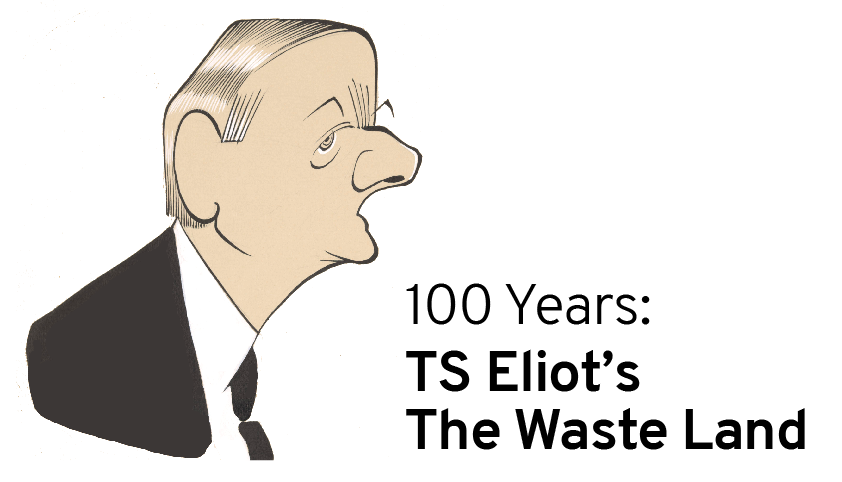
Exhibition poster for 100 Years: TS Eliot’s The Waste Land.

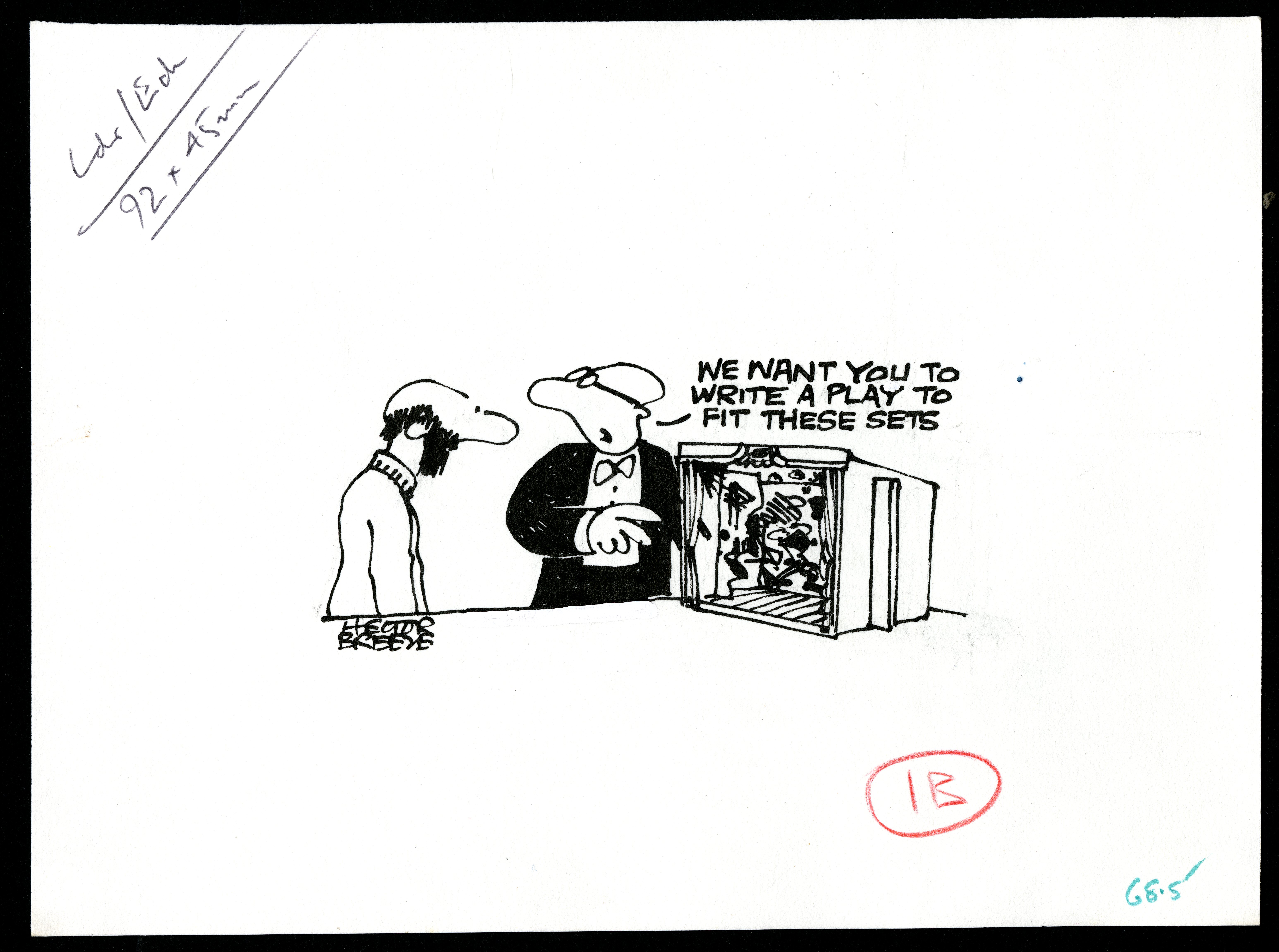
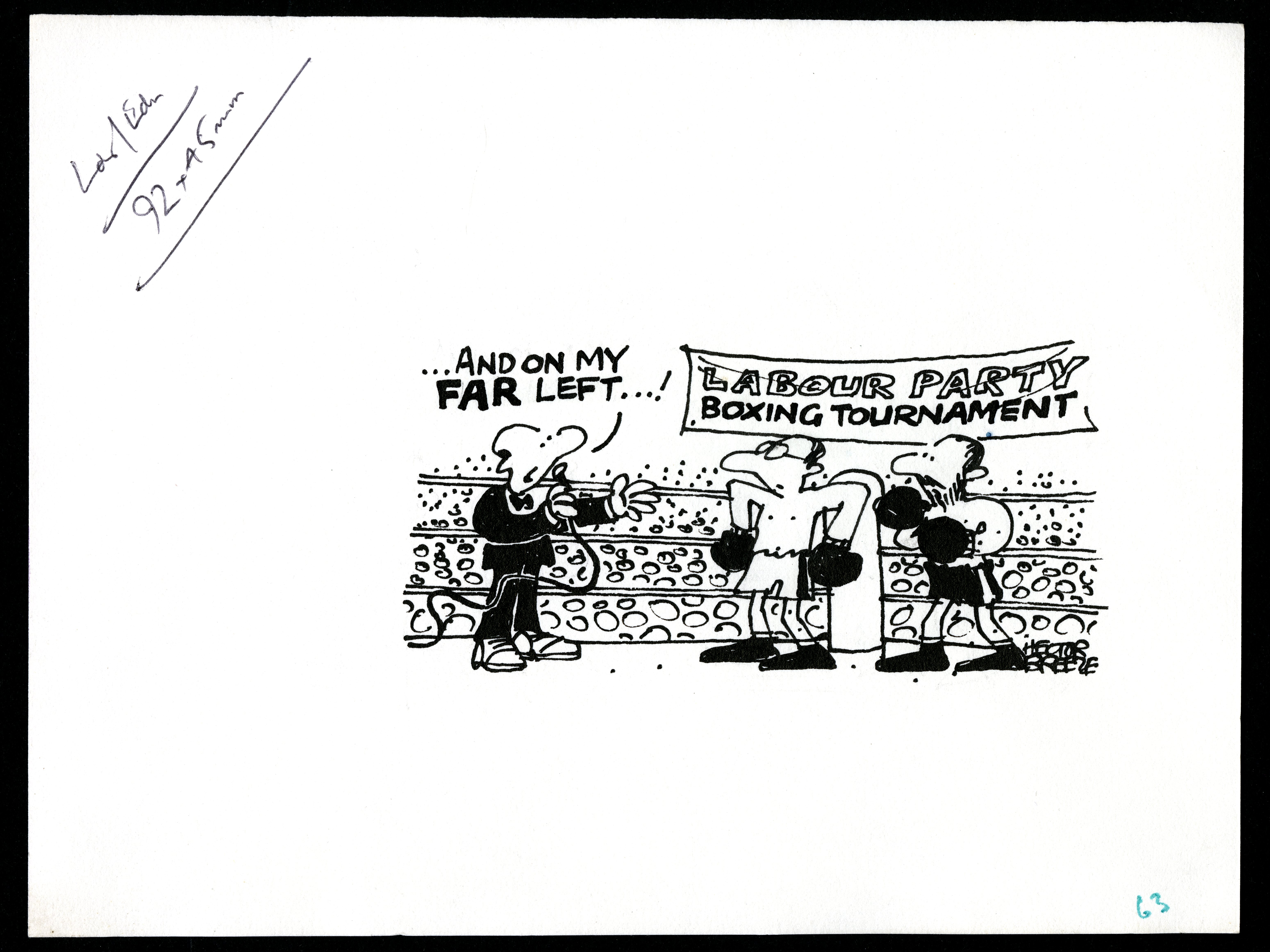
Christine has gone from strength to strength in developing her skills and talents as our Coordinator. She has finished cataloguing her first book collection, of which you can learn more about below and the Childrens Book Collection has so many lovely books for us all to enjoy. Christine also helped to develop the sessions for Discovery Planet in Ramsgate, working with our academic colleague Stella, and our whole team. I hope we can do more to these amazing sessions in the coming year. Mandy continues to beaver away making sure our cuttings collection is kept up to date. At the same time she has been working on digitising the original art works of Hector Breeze. Hector’s cartoons were published in Private Eye, Punch, Evening Standard, and other popular Daily newspapers. Jacqueline completed cataloguing the Carl Giles books, and moved on to catalogue Arnold Rood’s collection (he had a very attractive bookplate) and Jack Reading and Colin Rayner’s collection. Jacqueline has uncovered some real treasures, which I’ve enjoyed seeing. We’re looking forward to seeing what she uncovers next year! Our colleagues Stu and Matthias have been working with us one day per week and have made great progress in dealing with our British Cartoon Library backlog as well as our Shirley Toulson Poetry Collection, making them available to everyone.  

Display of Special Collections and Archives materials at Discovery Planet, Ramsgate.

Our volunteer projects this year have been hugely successful, and we continue to be amazed by the talented people that come to support us in our work.  

Looking forwards to 2024, we have some recently acquired collections that will be announced very soon. One I can mention though is a beautiful collection of Caribbean literature, donated by one of our former academics. We plan to start work on this collection in 2024 alongside some work to process a collection of African literature including works in the African Writers Series. Keep an eye on our social media channels for updates. And if you are not already following us do have a look at the Special Collections and Archives Advent Calendar – it’s on X (formerly Twitter) and Instagram @UniKentArchives. 

Beth (University Archivist)

2023 has been full of highlights and it is hard to pick out a few special things to represent such a busy year!

With the University Archive collections this year I focussed on the archives of the Colleges. At the beginning of the year I started a huge (and still ongoing) project to sort and catalogue the enormous Eliot College archive. This has now been un-boxed and arranged in a logical way, and cataloguing is on-going. This is a huge step forward in preserving the history of these important institutions within the University, and there are many fascinating records coming out of this.

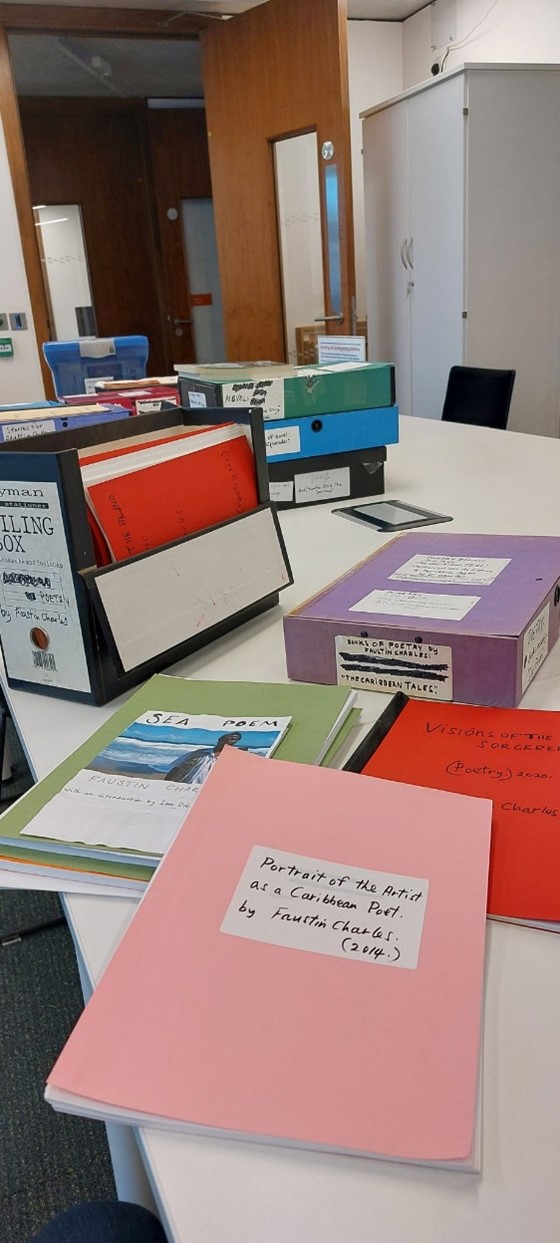
We also received a brilliant collection of literary manuscripts from alumnus Faustin Charles, a storyteller and poet, originally from Trinidad and who studied at the University of Kent from 1977-1981. Faustin is an important voice in Caribbean poetry and storytelling, and his collection of manuscripts and correspondence will provide a fascinating insight into his work.

The archive collection of Faustin Charles, Caribbean storyteller and poet, being catalogued at the University of Kent Special Collections and Archives.

With the UK Philanthropy Archive collections we have continued to build and expand this growing collection receiving a new collection from the Hilden Charitable Trust in the last few weeks! We have been involved with two great events to showcase the wider philanthropy collections and begin to share information about the content and its importance for research. In April we held a mini-display of material at the Understanding Philanthropy conference, and then later in November we helped organise the 15th Anniversary Colloquium for the Centre for Philanthropy, Philanthropy: Past, Present and Future, which included our 3rd annual Shirley Lecture. This year we were delighted to welcome Orlando Fraser KC, the Chair of Charity Commission of England and Wales, who delivered an interesting lecture of the role of philanthropy in the charity sector. We were able to showcase the UK Philanthropy Archive collections at this event, giving tours of the collections talking to participants about their value for research.

Display of philanthropy related items for the Centre for Philanthropy’s 15th Anniversary Colloquium in November 2023.

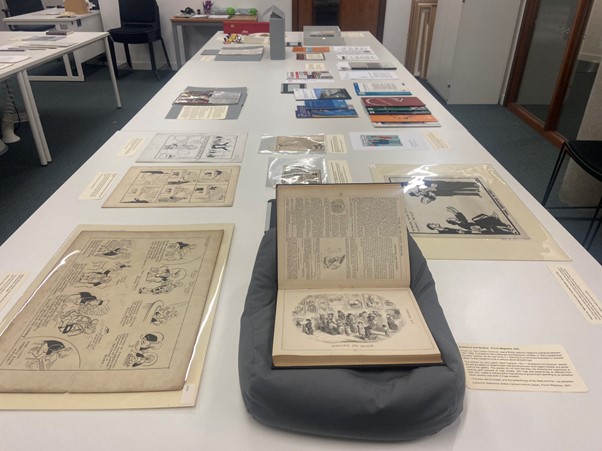
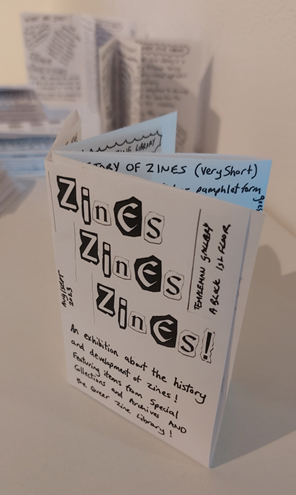
Our exhibition schedule has been jam packed this year beginning with the 100 Years: TS Eliot’s The Wasteland which was on until April, after which we installed the Migrating Materia Medica exhibition in collaboration with colleagues in the Schools of English.  In August we added a fabulous short term exhibition on zines and zine making, called “Zines Zines Zines!” which explored the history of this popular genre of self-publishing and allowed us to display some of our zine collections, modern poetry and artist books, and also a loaned collection of zines from the Queer Zine Library.

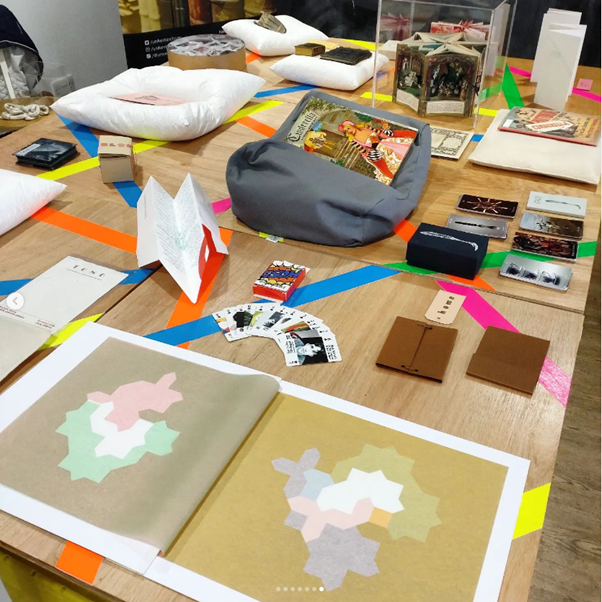
The zine we made to support the Zines Zines Zines exhibition this year.

We have ended the year by installing our new exhibition – which has been curated by a fab team of volunteers to kick off our celebrations of the 50th anniversary of the British Cartoon Archive at the University. The first cartoons arrived at Kent in 1973 and the Centre for the Study of Cartoons and Caricature opened in 1975 – which later developed into the British Cartoon Archive. Between 2023 and 2025 we are running a programme of events and activities to mark this significant anniversary. The 50/50 Project, where our volunteers have selected 50 cartoons reflecting the 50 years of the British Cartoon Archive, was the first of our celebratory activities and was launched in October. The exhibition will be on display until the end of February so do come along and see it if you can.

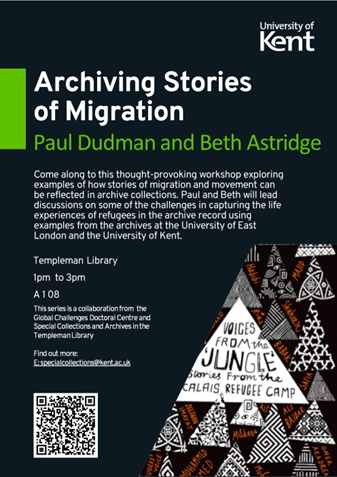
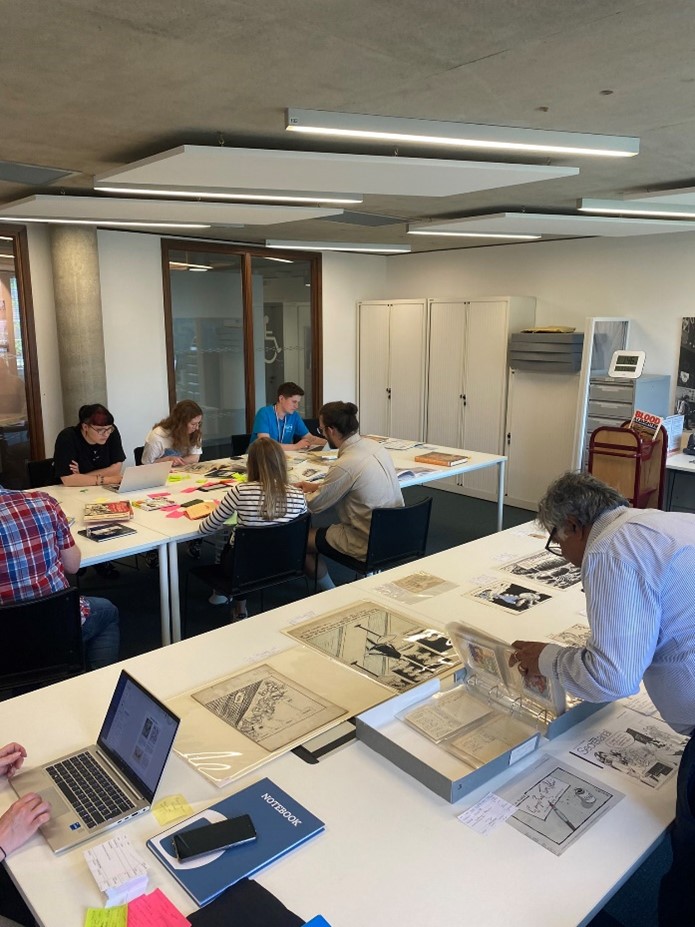
In addition to all of this – a particular highlight for me this year was in organising and delivering our Telling Our Tales series of workshops, held in June, in the run up to Refugee Week. This series of creative workshops related to our project and exhibition in 2022, Reflections on the Great British Fish and Chips. The workshops explored the ways in which we tell, share and preserve stories of migration and movement. Working alongside our amazing colleague Basma El Doukhi, we invited speakers to run artist-led workshops where participants learned about sharing migration stories and how these can be expressed and recorded through portraiture and photography. We held an In Conversation event between Basma and Rania Saadalah, a Palestinian Refugee, who shared her photography work where she lives in the refugee camps in Lebanon. Our final workshop was with Paul Dudman from the Living Refugee Archive at the University of East London, who talked about how to preserve stories of migration and the lived experiences of migrants living in Britain.

The workshops were all thoughtful and impactful events, that encouraged us to challenge stereotypes, build better relationships with people in our communities, and foster a spirit of understanding and compassion for others. This sentiment seems particularly important to highlight at this time of devastation and suffering in the ongoing war between the Israeli and Palestinian people. It remains vital that the stories and experiences of refugees and those with lived experience of migration are heard, shared and preserved to ensure their voices do not go unrecorded.

Poster for one of the Telling our Tales workshops, held by Paul Dudman and Beth Astridge.

Clair (Digital Archivist)

Once again, it’s been an incredibly busy year for Special Collections and Archives, and if you can excuse the cliché, it has really flown by! There’s been lots of enjoyable projects along the way, but I’ve chosen just three to talk about in this year’s round-up.

Firstly, we’ve had a bumper year for volunteering! Volunteers bring so much to our service, and help us achieve more than we could ever do alone with our small team. We’ve had the pleasure of working with over 20 individual volunteers this year on various tasks and projects. In particular, we’ve run two volunteer projects related to the British Cartoon Archive (BCA) this year. The first was the 50/50 project where volunteers were asked to research, select and curate an exhibition of 50 items from the BCA to celebrate 50 years since the founding of the collection. The second was the Cartooning Covid-19 project, where volunteers supported us in making over 400 cartoons published during the Covid-19 pandemic available to the public via our catalogue. It’s been such a pleasure working with all of our fantastic volunteers this year, and we hope to continue to work with some of them again in the next.

Our 50/50 volunteers.

In terms of cataloguing, I had a blast sorting and cataloguing material from our Mark Thomas Collection in the British Stand-Up Comedy Archive (BSUCA) this year. The Mark Thomas Collection has been part of BSUCA since its very beginnings, with the earliest set of records being deposited in 2013, and we were delighted to receive an accrual to his collection in 2020/21. This new batch of records contained notebooks, publicity, audiovisual material, and material related to his radio and TV work. In addition to this cataloguing, I also had the help of two work experience students in sorting and cataloguing the significant ‘100 Acts of Minor Dissent’ series. Records can be viewed on our catalogue now: https://archive.kent.ac.uk/Record.aspx?src=CalmView.Catalog&id=BSUCA%2fMT

100 Acts of Minor Dissent: Act 61-63 – the BASTARDTRADE logo (designed by Greg Matthews) is trade marked and was created as a symbol of bad corporate behaviour (BSUCA/MT/3/8/26).

Finally, in the first half of this year I was lucky enough to take part in the National Archives’ peer mentoring scheme. I really enjoyed the experience of being a mentee and benefited from having a very knowledgeable, kind and supportive mentor. The scheme was the perfect opportunity for me to take the leap in creating a Digital Asset Register for our digital collections. Having a Digital Asset Register in place is important as it enables us to have control over our digital objects (both born-digital and digitised) and helps keep us informed of the file formats we hold so that we can make decisions about any preservation actions we may wish to take. It’s a huge step forward in improving our digital preservation maturity, so that’s definitely something to celebrate!

Computer Laboratory, Nov 1977 (UKA/PHO/1/1014)

Daniella (Project Archivist)

2023 has been an exciting year for me as I joined Special Collections & Archives as a Project Archivist, working on two cataloguing projects – Craigmyle Consultants UK Ltd’s archive and the “Oh Yes It Is!”: Cataloguing the David Drummond Pantomime Collection project, funded by Archives Revealed a partnership programme between The National Archives, The Pilgrim Trust and the Wolfson Foundation.

Donated by the collector David Drummond, the collection contains materials relating to a range of pantomimes, such as Cinderella, Puss in Boots, and Sleeping Beauty, as well as ephemera and photographic materials showcasing Principal Boys and Principal Dames. There are also gorgeous costume designers by prolific costumer designers, such as Wilhelm and Archibald Chasemore. Positive steps have been made with the cataloguing and, so far, I have catalogued in draft materials relating to Florrie Forde, Albert Chevalier, Godfrey Tearle, and David Wood. My latest cataloguing work package has focused on items relating to the pantomime Aladdin, started to coincide with this year’s pantomime performance at the Marlowe Theatre in Canterbury. Watch this space to see these be added to our catalogue! Fantastic work is also being done by a wonderful group of volunteers who sorted and have been listing programmes and flyers for the pantomime Cinderella – they have made amazing progress and we can’t wait to share this with researchers.

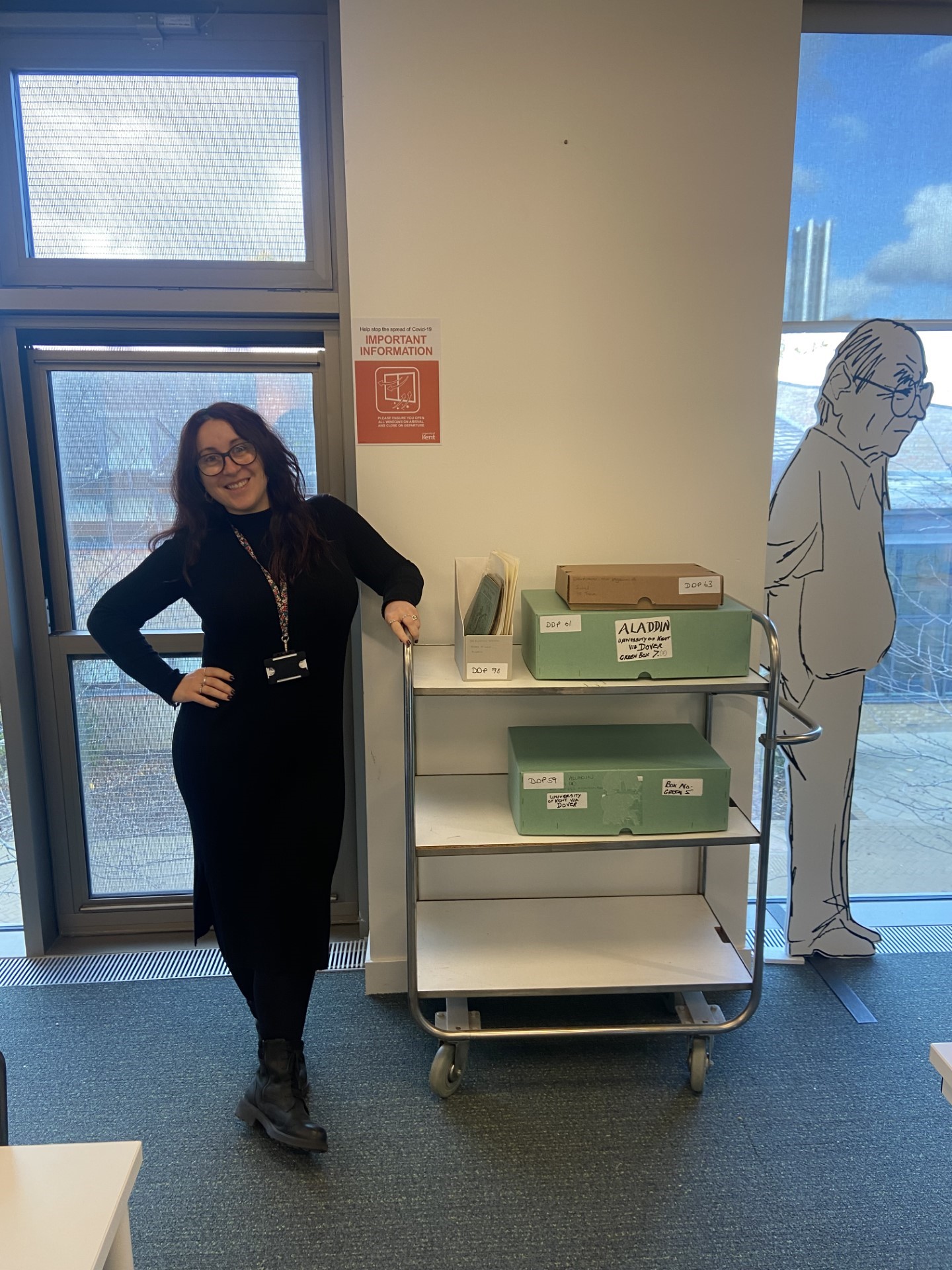
Aladdin materials in the David Drummond Pantomime Collection.

Linked to the above, an absolute highlight of working on the David Drummond Pantomime Collection was going to the local pantomime at the Marlowe Theatre to watch Aladdin with my colleagues. We had an absolute blast watching the Dame strut her stuff whilst dodging the oncoming water guns!

Craigmyle’s archive is very different to the David Drummond Pantomime Collection and provides a different perspective to fundraising. It is interesting because the collection shows how this organisation, which was set up in 1959, helped charities across the United Kingdom fundraise. They work with a variety of clients ranging from Cancer Relief Macmillan to cathedrals and parish churches. Schools and education fundraising is of particular importance to Craigmyle. In fact, the company’s earliest focus was on this sector, with initial clients including The King’s School Ely, Tonbridge School, St John’s College Durham and Wycombe School. The project is well underway, and I have scoped what there is and begun to appraise and weed to select what we will be keeping for permanent preservation.

Working on Craigmyle’s archive has also given me the chance to meet staff in the Centre for Philanthropy, and Beth and I had the exciting opportunity to work with Professor Beth Breeze and Dr Karl Wilding to organise the Philanthropy Past, Present and Future colloquium. We had over 80 people register and attend, and has fantastic talks from Michael Seberich and Orlando Fraser, Chair of the Charity Commission for England and Wales. It was also a great chance to get the Craigmyle collection out and engage participants with what research can be done with this archive.

We’ve had an exciting end to the year by appointing two Archive Assistants, Cassie and Farradeh, who have joined me on the project to catalogue Craigmyle’s archive. We’re thrilled for Cassie and Farradeh to be a part of the team and they are sorting, listing, and repackaging appeal literature that forms a part of this collection. They have made an amazing start and have the following to say about their experience on this project so far:

Cassie: “I’ve only been working on the project for a couple of weeks so far but I already feel like I’ve learned so many new things about working in archives, and about the philanthropy sector. It’s been fascinating working through the new Craigmyle collection and I can’t wait to see what else we find and discover the ways in which this material can contribute to the UK Philanthropy Archive”.

Farradeh: “It’s really exciting to see what goes on behind the scenes at an archive, and have an active part in the formation of a new collection. It has made me see archives in a different light, understanding the thought and care archivists put into their craft, and appreciating the level of nuance that goes into executive decisions”.

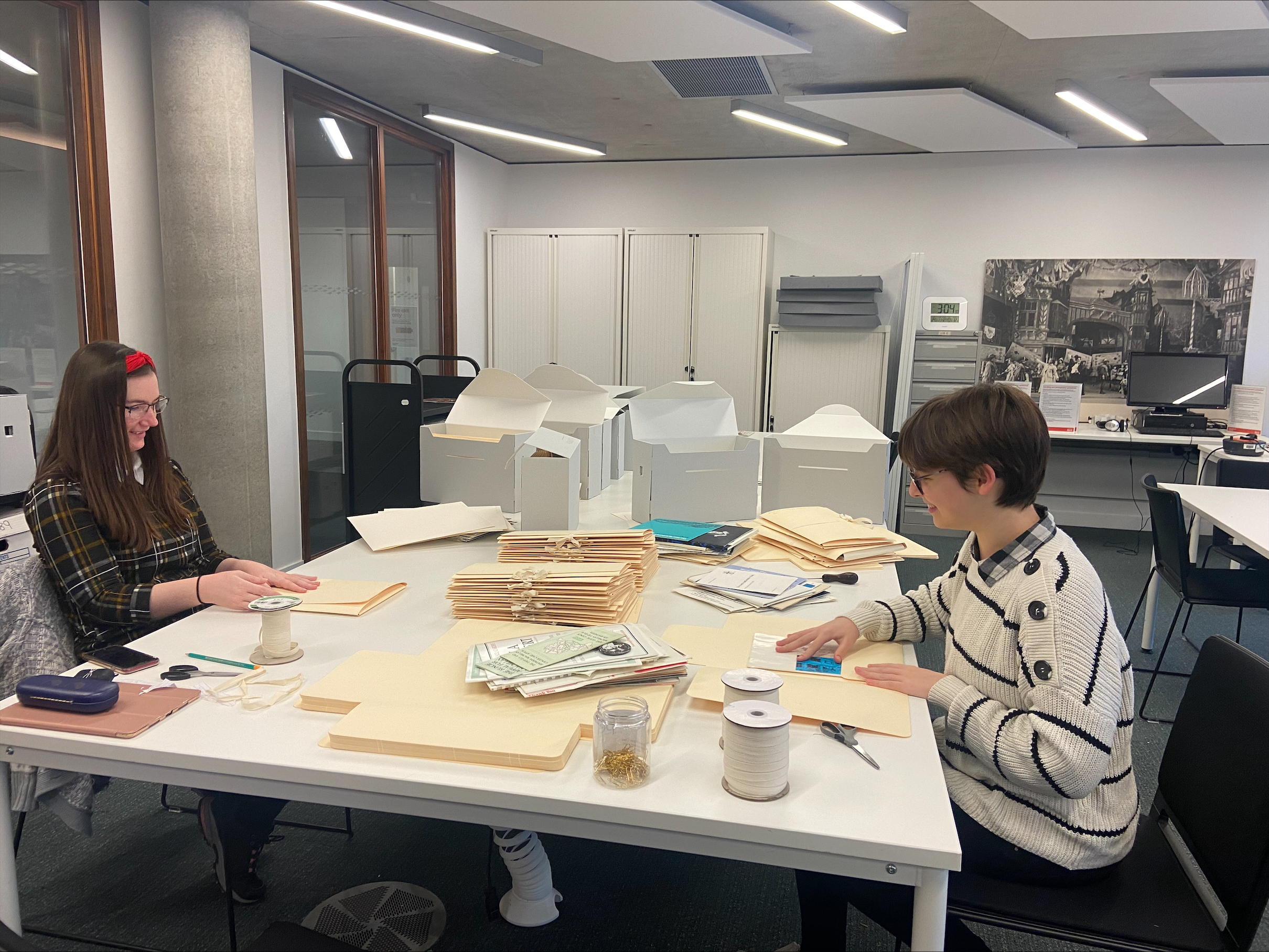
Cassie and Farraday working on the Craigmyle Archive.

Outside of my collections work, Karen and I contributed to Dr Suzanna Ivanic’s module The Early Modern World: Conflict & Culture, 1450-1750. I gave a lecture about the recordkeeping revolution and archives between the sixteenth century and mid-eighteenth century. I also supported Karen and Christine in delivering the seminars for this module, during which students were able to examine and handle some of the spectacular early modern printed texts in the collection, including editions of William Lambarde’s Perambulation of Kent, William Somner’s Antiquities of Canterbury, and indentures ranging from the reigns of Henry VI to Elizabeth I that are found within the Ronald Baldwin collection.

Christine (Special Collections and Archives Coordinator)

This has been my first full year working as the Special Collections and Archives Coordinator, and it’s been a real opportunity to increase my knowledge of our collections and support a variety of digital and in person engagement activity – in the Autumn term alone, we engaged 177 UG and PG students through seminars, not to mention individual readers, school groups and prospective open day students.

Earlier this year I did a #FacsimileFridays series on Instagram to shine a spotlight on what is often underprized and overlooked – for facsimiles are copies, not originals. However, they increase the circulation potential of unique items and thereby fulfil an important place in telling the history of the book. The knowledge I gleaned from many of these items also became pertinent to my teaching of a seminar on Chaucer this December for third year School of English students, in which we were considering very early manuscripts and print technology.

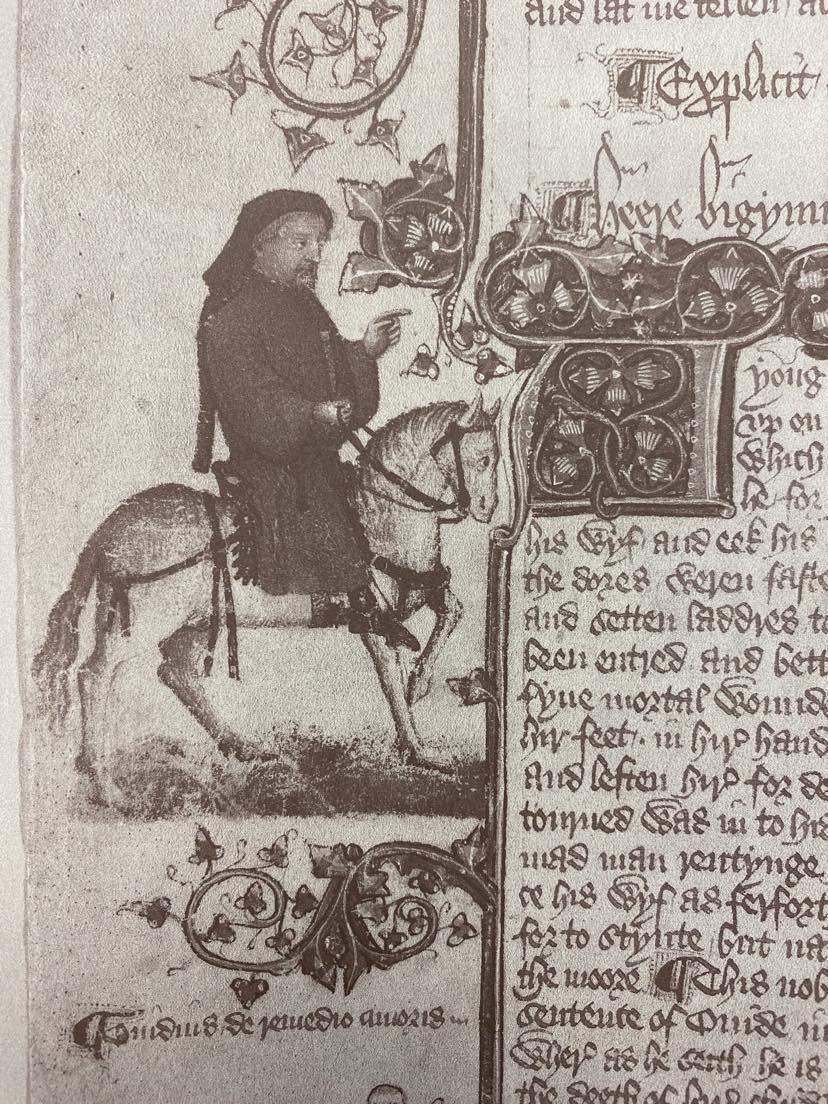
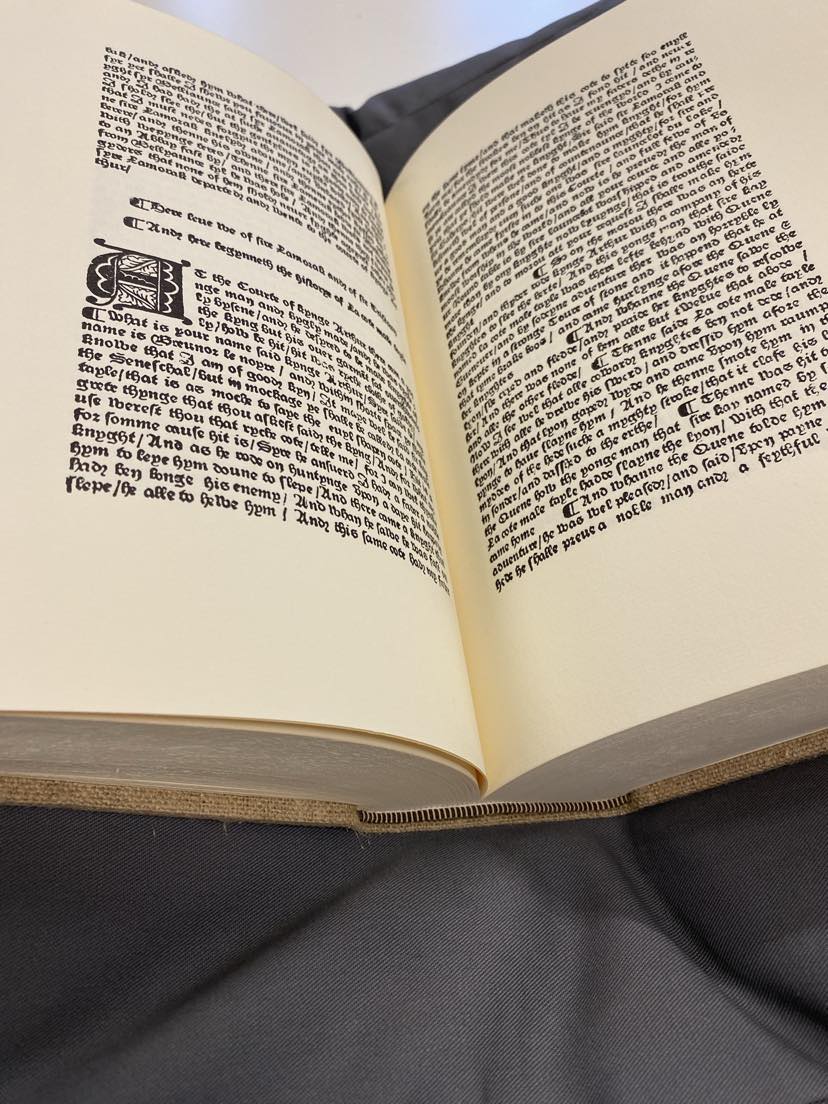
Produced between 1330-40, the Auchinleck manuscript gives an idea of reading practices pre-Chaucer: it consists principally of romances (think Arthuriana) along with other secular tales and religious pieces. Chaucer died in 1400, just before the advent of the printing press, and no copies of his works survive from his lifetime. The most famous of 15th-century manuscript versions of his work is undoubtedly the Ellesmere Chaucer, which became the authoritative example for organizing the Canterbury Tales. It’s written in the hand of a single scribe, and is incredibly grand both in its use of blank space and famous miniature illustrations of the Canterbury pilgrims. You may even be familiar with one of these, for its portrait of Chaucer is blown up on the side of the former Nasons building in the Canterbury high street! Now in the Huntington Library, our monochromatic facsimile still gives us access to the scale and content of the original. The first printing of the Canterbury Tales was William Caxton’s 1476 version, and the earliest printed version of Chaucer that we hold dates to 1598. With ‘Dorothy Smallwood’ inscribed on the title page, we know this copy once had female readership and it is also fascinating for its marginalia showing just how much its readers relied on a glossary to make sense of Chaucer’s language just 200 years after it was first circulated. William Caxton was also responsible for bringing Mallory’s Morte D’Arthur to an English audience, and we are really lucky to have a facsimile of this work because only one and a half of Caxton’s original version survive to date. Given the depth of the book, and the pressure reading puts on the spine, this is not surprising – original copies would literally have been read to pieces.

The Ellesmere Chaucer (F PD 1865 Classified sequence).

Le morte d’Arthur (Q PD 2040 Classified sequence).

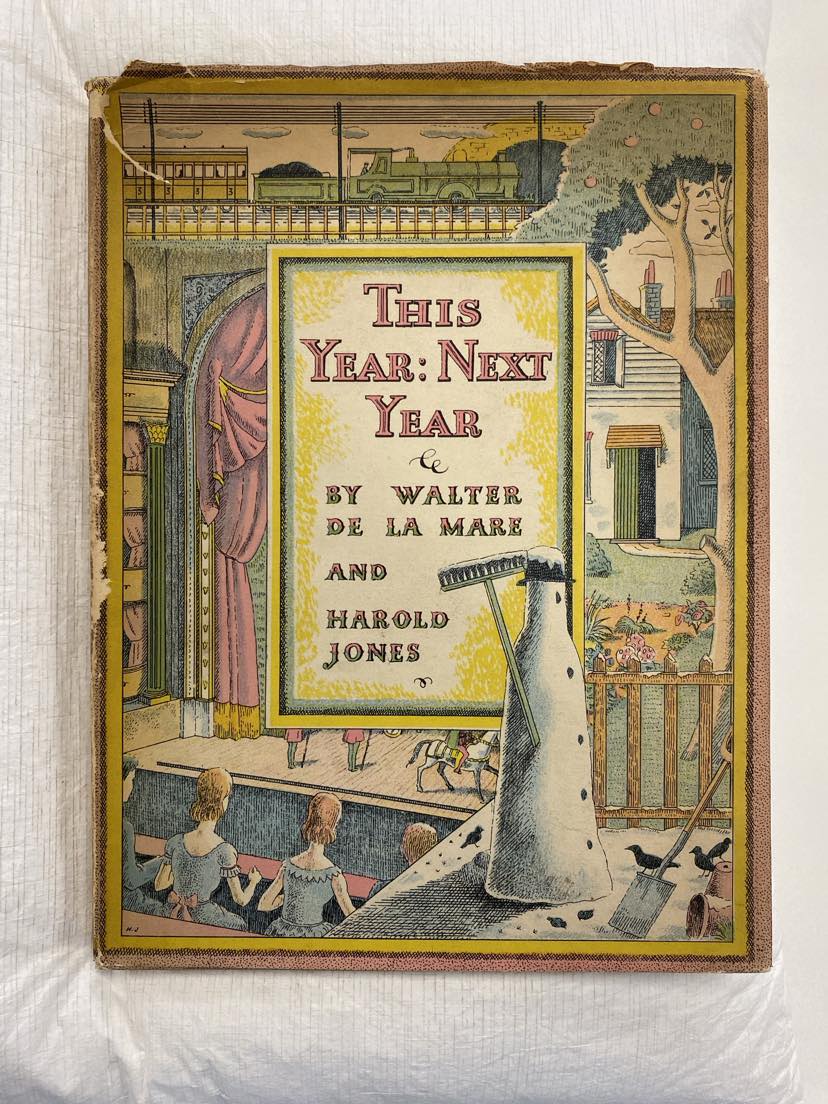
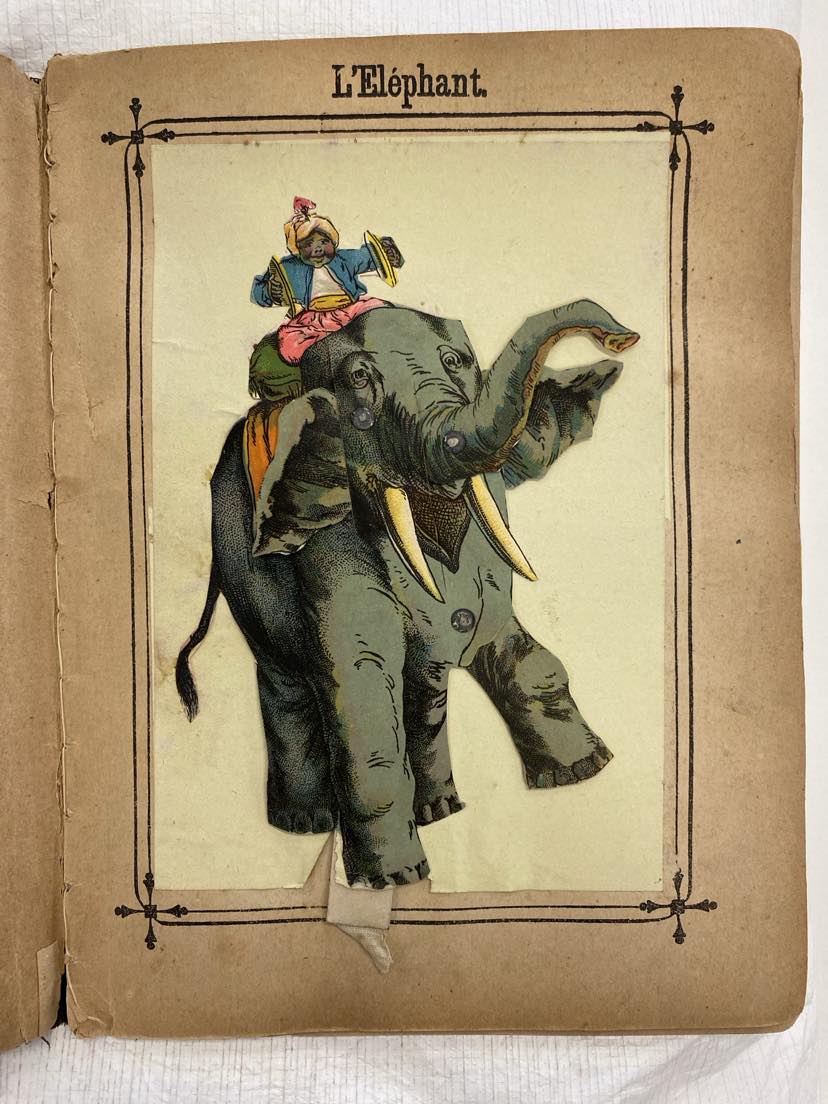
From the history of books to the art of books, I have had several opportunities this year to appreciate the variety of forms books can take and really get to grips with the non-textual components of books which is crucial to special collections cataloguing. In cataloguing our Children’s Literature Collection, I had to give condition and provenance notes as well as a physical description of each book, noting such varied features as illustrated fly-leaves, dust jackets, fold-out maps, pages of publisher’s advertisements, volvelle frontispieces and pop-up engineering. Children’s books are a joy to handle because they are so self-conscious of being tactile interactive objects, and they have proved inspirational – alongside our artist books – when displayed at book-making workshops led by Dr Stella Bolaki at Discovery Planet, Ramsgate. It has been a particular privilege for me to accompany our collections to a different venue off campus and engage different audiences, notably children, and witness them transpose their awe for special collections into creative responses.

This year : next year (PZ 8.3 DEL Children’s Literature Collection).

Les grotesques : en quatre tableaux (PZ 8 Children’s Literature Collection).

Mandy (Special Collections and Archives Assistant)

Over this past year I have been digitalizing our Hector Breeze collection, they are very interesting to scan and the way that they have been drawn.

HB0005, Hector Breeze Collection.

HB0011, Hector Breeze Collection.

I have also been scanning our cartoons collection, to see how they have changed over the last few years is so interesting, changes in the government also.

Sam (Project Digitisation Administrator)

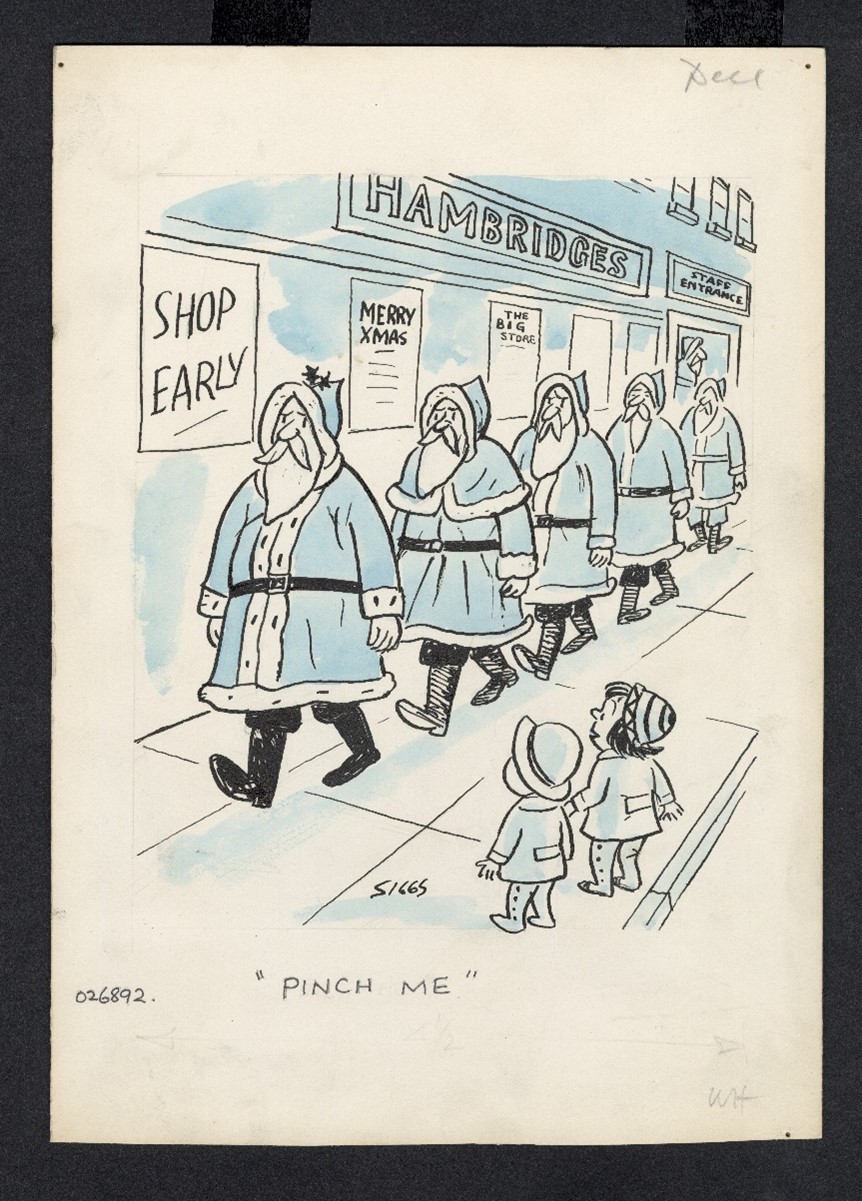
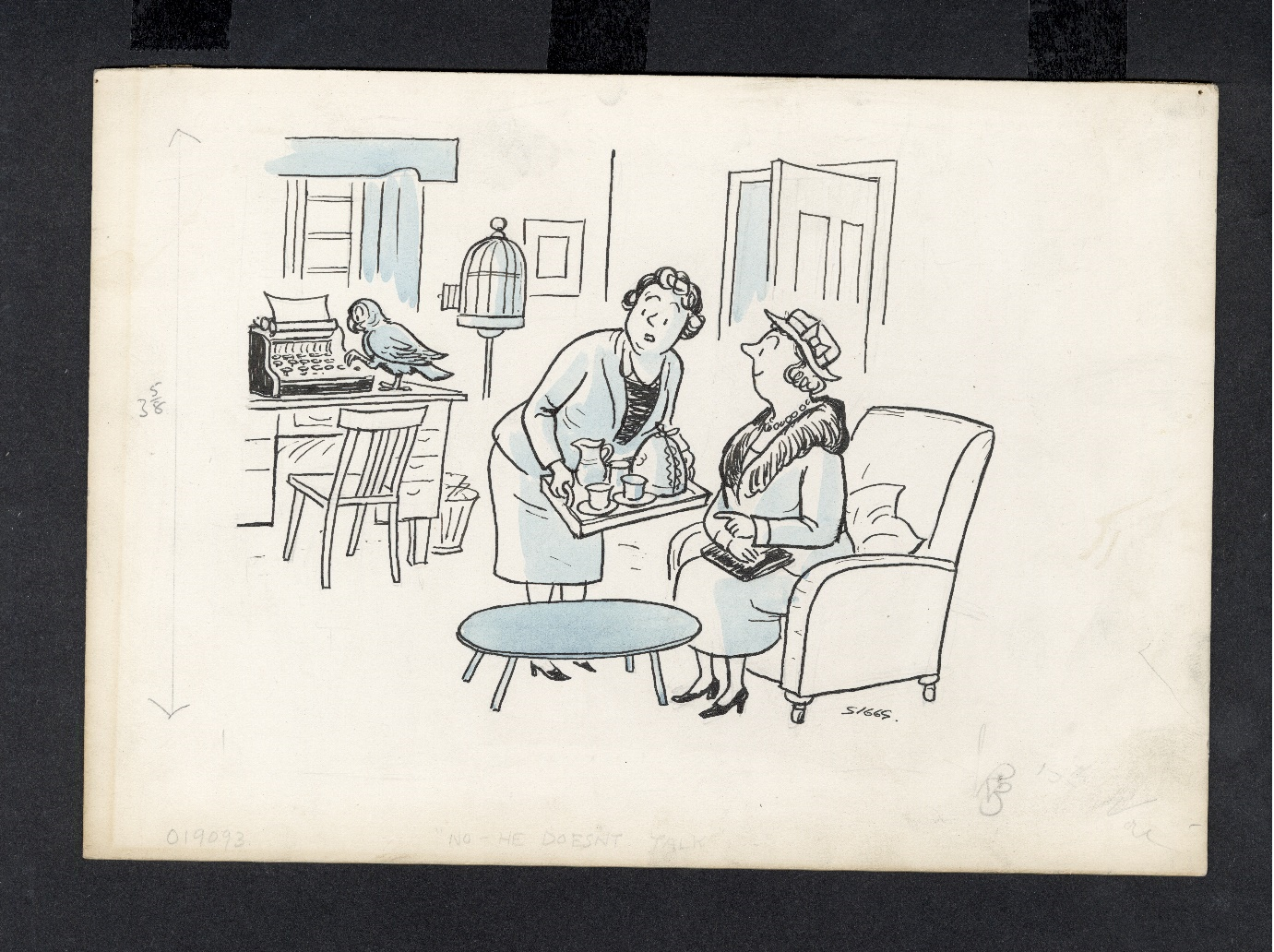
In my first year as an official member of the Special Collections team, I have been cataloguing and digitising the charmingly offbeat world of Lawrie Siggs (1900-1972), a cartoonist who worked for various publications (including Punch, John Bull and Lilliput) for 35 years.

Here are a few examples to set the tone.

Pinch Me, SIG0307.

No He Doesn’t Talk, SIG0319.

Jacqueline (Curation and Discovery Administrator)

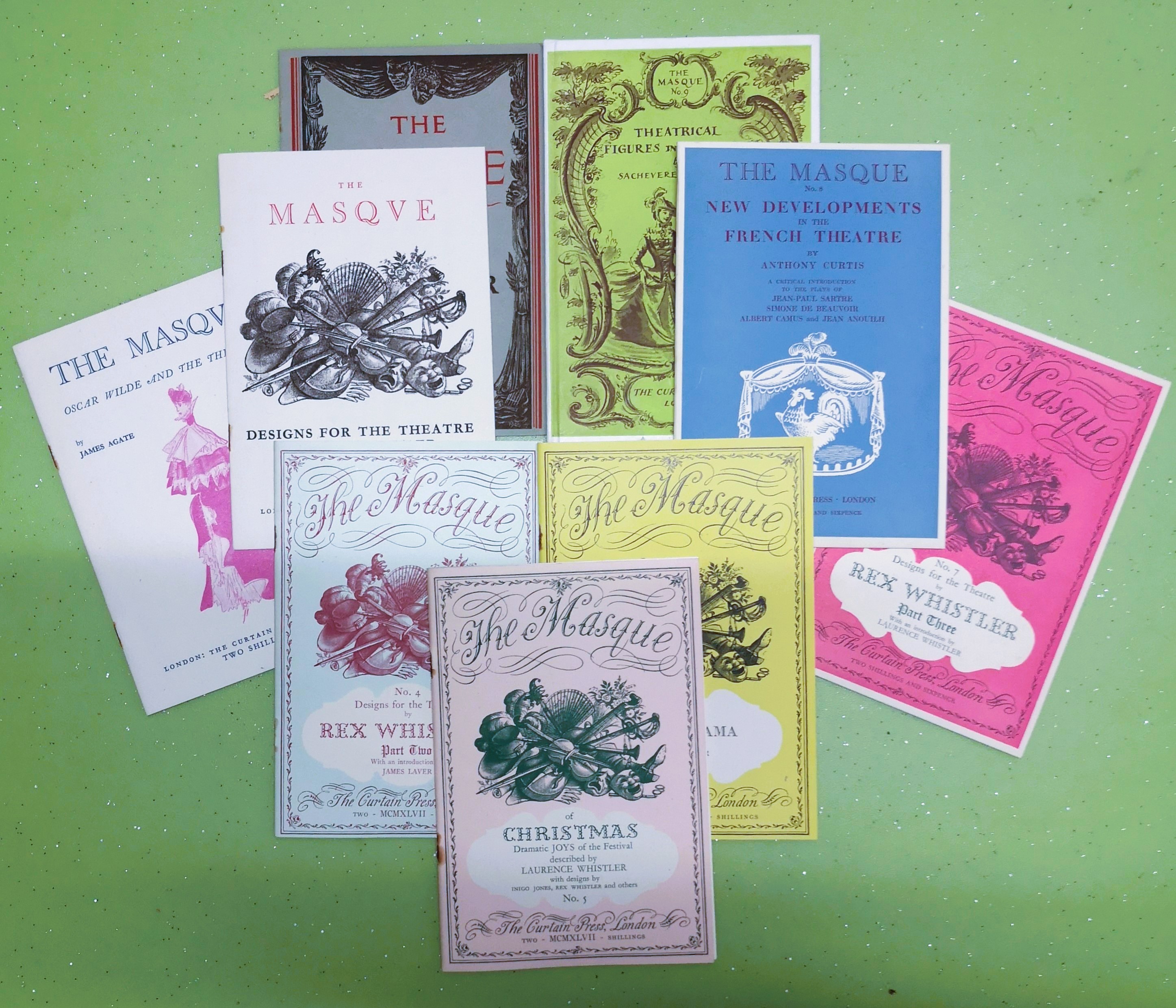
The theatre designer Edward Gordon Craig described himself as “fond of print.” His designs for theatre stage sets and scenery surpassed possibility in his time and he turned to typography and woodcuts. I have spent this year with the collections of three men who can all be described as fond of print. Arnold Rood’s collection is centred around Gordon Craig and his circle. It includes Craig’s woodcuts in print. I began the year at the end of Carl Giles’ collection (the cartoonist Giles) where I found a set of Puffin Picture Books from the 1940s-50s, their design and illustrations redolent of a return to delight in books after austerity. After Rood, I’ve been cataloguing the periodicals in Jack Reading and Colin Rayner’s collection; they were thorough collectors who focussed on theatre and literature. Last week amongst odd issues I came across a complete set of The Masque, a small and pretty journal of 9 issues each one on a theme. Issue 5 is The Masque of Christmas, presenting dramatic JOYS of the season to you.

The Masque, Reading-Rayner Literature Collection.

Stu (Curation and Discovery Administrator)

Over 90 titles added to British Cartoon Archive Library this year. Most memorable was probably the stunning cold war era illustrations in, Drawing the curtain : the Cold War in cartoons / Althaus, Frank.

Also Daily Mirror reflections : being 100 cartoons (and a few more) culled from the pages of the Daily Mirror. [Vol. I] / Haselden, W. K. (William Kerridge), 1872-1953, formerly owned by prime minister Stanley Baldwin.

Quite moving and of current topical interest, A child in Palestine : the cartoons of Naji al-Ali / ʻAlī, Nājī.- This collection of drawings chronicles the Israeli occupation, the corruption of the regimes in the region, and the plight of the Palestinian people. The images have bold symbolism and starkness to them.

The bottle / Cruikshank, George, 1792-1878, – This is a really interesting little pamphlet promoting temperance through a cautionary tale of the downfall of a family brought about by the evils of drink. No publication date but probably late 19th century.

Matthias (Curation and Discovery Administrator)

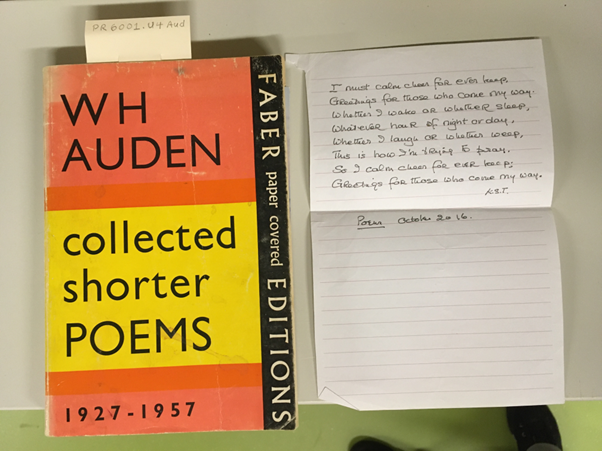
I have been working on the Shirley Toulson Collection this year, a collection of over 400 poetry books from the estate of the late author and poet Shirley Toulson. Handling a writer’s private library felt very special and personal. The books, many of them rare editions by small presses, often had personal notes and handwritten dedications by the authors. Often I found postcards or letters inserted between the pages. My personal highlight was a handwritten, seemingly unpublished poem by Shirley Toulson I found inside a W.H. Auden poetry volume.

Collected shorter poems 1927-1957, PR 6001.U4 AUD Shirley Toulson Poetry Collection.

Our reading room will be closed from 16th December 2023 and will reopen 16th January 2024 – we hope you all have a very happy and peaceful break.

50/50 Exhibition – The 50 Selected Cartoons

The 50/50 Project: Celebrating 50 Years of the British Cartoon Archive

In October 2023 we launched our new co-curated exhibition highlighting 50 cartoons representing 50 years of the British Cartoon Archive. The cartoons were selected and researched by a fabulous team of volunteers and we are extremely grateful to them for their participation in this project. So thank you to Angel Robson, Dr Balasubramanyam Chandramohan, Cameron Matthews, Elizabeth Grimshaw, Hannah Robson, Irene Szmelter, Nadia Davies, and Peter McCullen! 

The full list of the selected cartoons can be found here in this blog – but do remember to come and see the exhibition in person between October 2023 and February 2024!

The 50 cartoons selected represent the vast breadth of artists, subjects and formats found in the British Cartoon Archive. Together they provide a fascinating introduction to the history of cartooning and tell the stories of political events and people discovered by the volunteers throughout their research.  

Themes that emerged in the volunteer research included the history of cartoons, the beginnings of satire, the space race, political events and crises, strikes, the commonwealth, and the cartoons of Carl Giles.

Introduction Panels – Cartoons selected by the British Cartoon Archive staff 

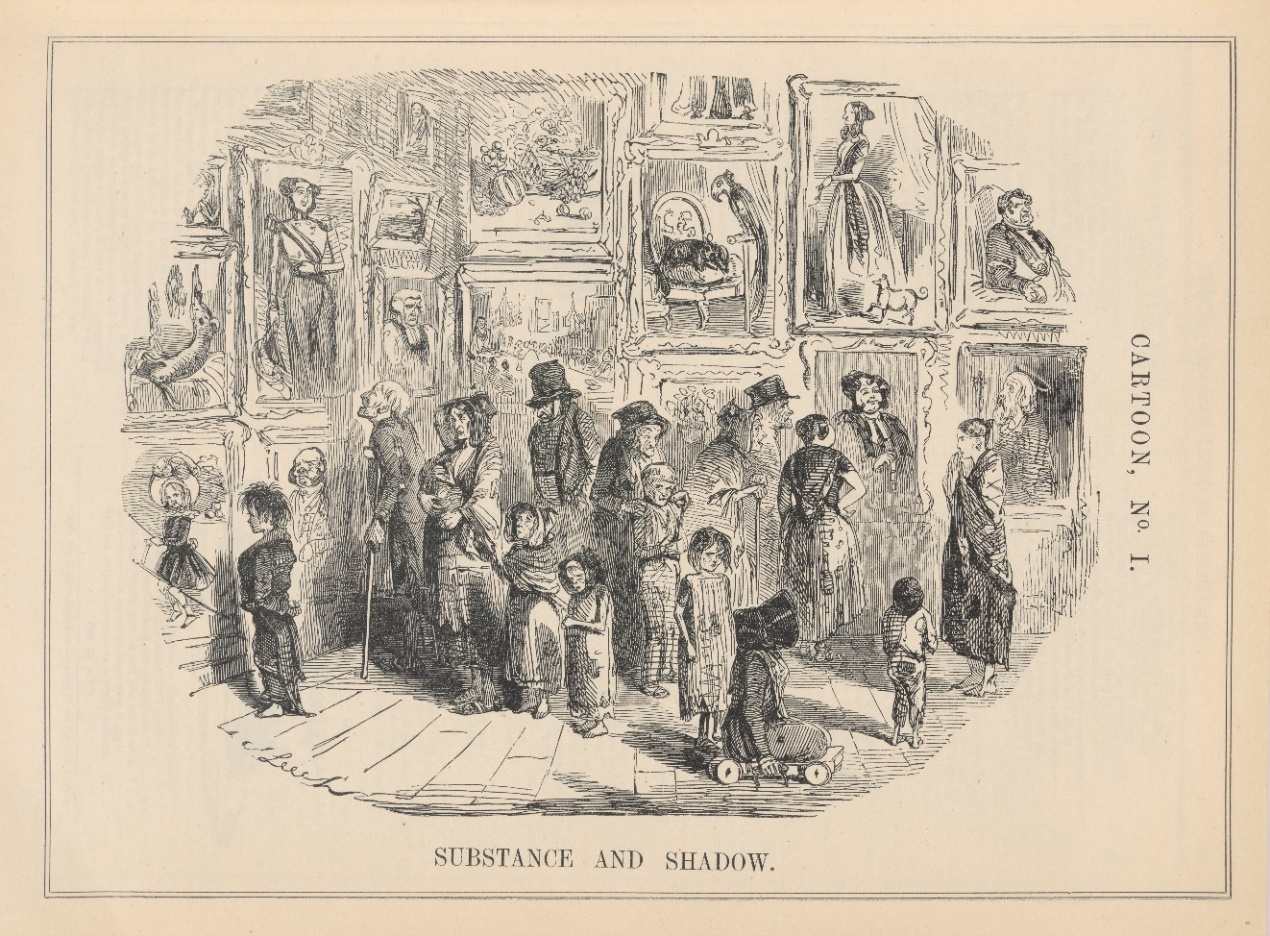
  1. “Cartoon No 1: Substance and Shadow”, Punch, Or, The London Charivari, 1843. Reference: Punch, 15th July 1843

    Cartoon titled Cartoon No 1 Substance and Shadow showing a scene in an art gallery where a group of poor and ragged children and adults are looking at the opulent artworks on the walls which show portraits of people in more wealthy clothing

    Substance and Shadow, Cartoon No. 1, Punch Magazine, 15th July 1843.

  2. Rendezvous, David Low, Evening Standard, 20 September 1939. Reference: LSE2692


Satirical Ceramics in Late Georgian Britain and beyond ;The Emergence of Satirical Print; Historians start to take cartoons seriously

The cartoons for this theme were selected and described by Irene Szmelter:

  1. Pink jug with transfer-prints, Doctor Syntax drawing after nature; Doctor Syntax Disputing his Bill with the Landlady, c.1914-1930s. Reference: Doctor Syntax collection, [uncatalogued]  
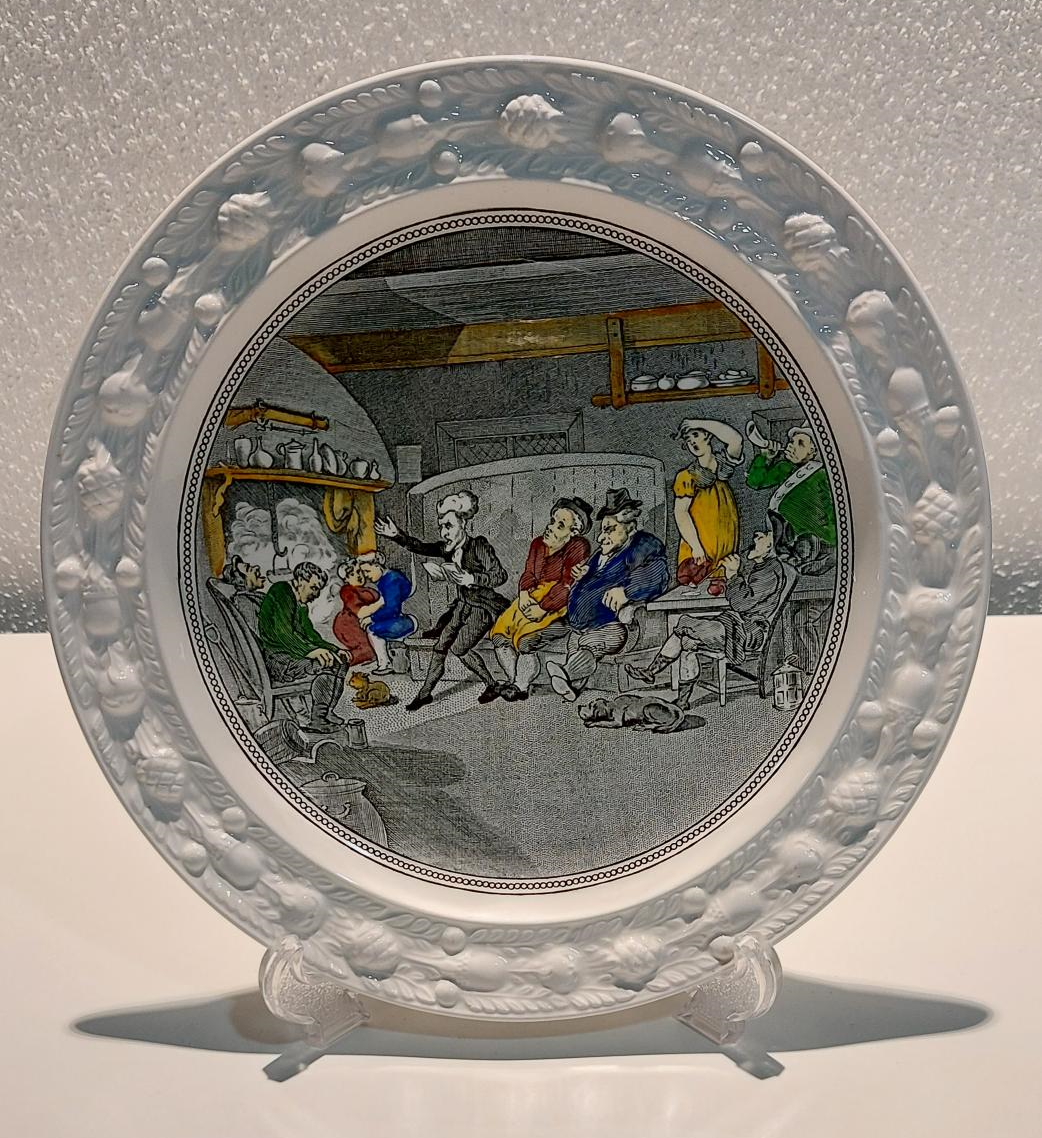
  2. Plate with transfer-print, Doctor Syntax reading his tour, c.1920-1980s. Reference: Doctor Syntax collection, [uncatalogued]
    Ceramic plate on a plate stand showing an image of Dr Syntax, a character created by Thomas Rowlandson as a satire of William Gilpin, who was a supporter of the Picturesque movement. In the image Dr Syntax is reading his book to others in a tavern and they look bored and even asleep.

    Plate with transfer-print, Doctor Syntax reading his tour, c.1920-1980s. Reference: Dr Syntax collection, [uncatalogued]

  3. William Combe, The tour of Doctor Syntax, in search of the picturesque : a poem (5th edition, London, 1813) Reference: Derek Schartau Collection PR 3359.C5 
  4. Steve Bell, Fashionable Contrasts in Washington D.C (after James Gillray), 2017 Reference: Steve Bell Digital Collection SBD1772 
  5. Richard T. Godfrey, James Gillray: the art of caricature (London, 2001) Reference: British Cartoon Archive Library LRG NC 1479.G5 GOD
  6. Martin Rowson, The Contrast 2018 (after Thomas Rowlandson), 2018. Reference: Martin Rowson Digital Collection MRD1228 
  7. Dorothy George, English political caricature, 1793-1832 : a study of opinion and propaganda, 1959. Reference: British Cartoon Archive Library, NC 1763.P66 M 
  8. McCreery, The satirical gaze: prints of women in late eighteenth- century England, 2004. Reference: British Cartoon Archive Library NE962.W65

Strikes!

The cartoons for this theme were selected and described by Angel Robson:

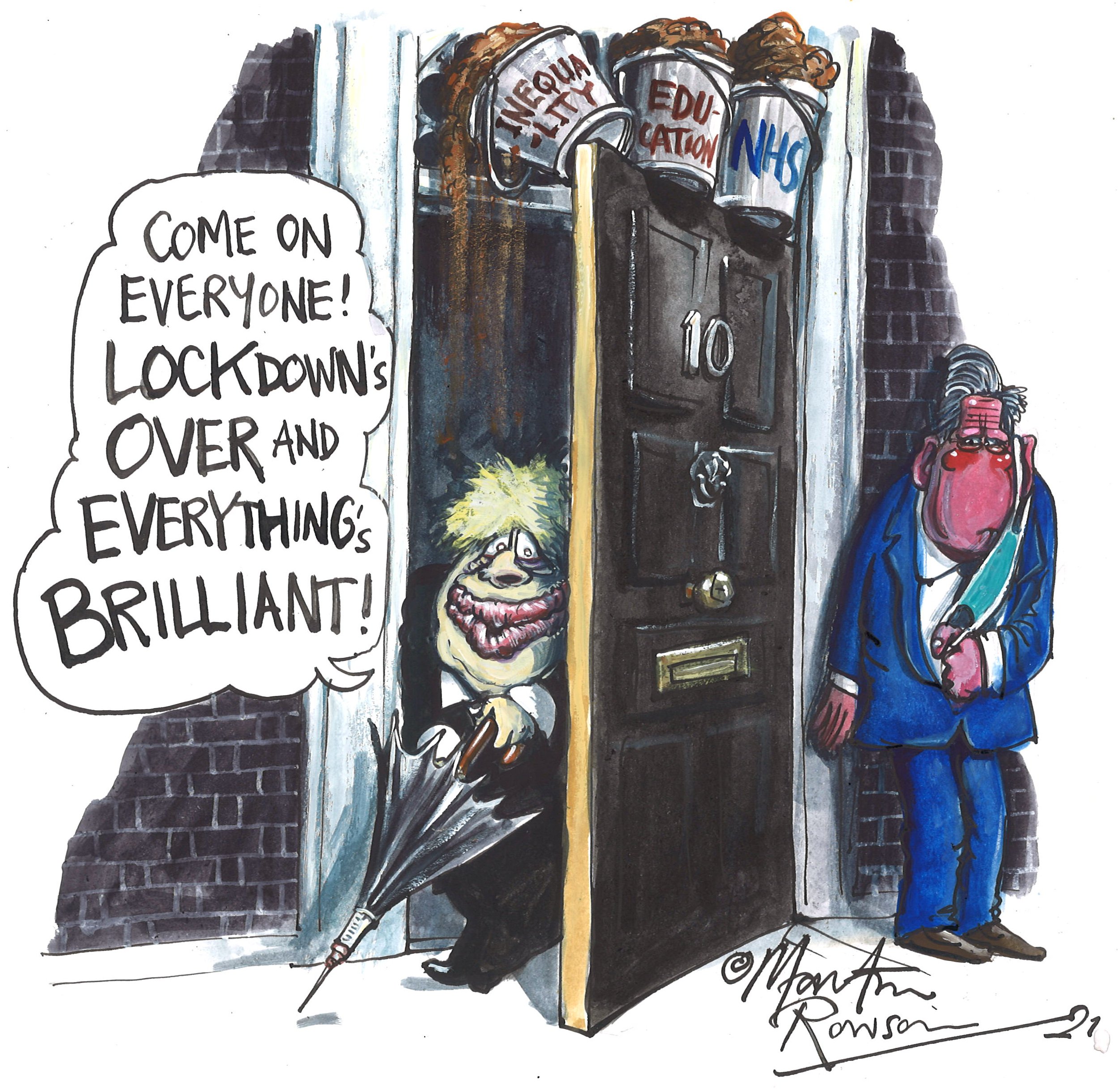
Cartoon showing the door to Number 10, being opened by Boris Johnson holding an umbrella, with buckets of excrement balanced on the top and about to come down on his head. The buckets are labelled 'Inequality', 'Education' and 'NHS'. Keir Starmer is shown hiding just beyond the opening door and is pulling his mask down.

13: “Come on Everyone! Lockdown’s over and everything’s brilliant!” Martin Rowson Digital Collection, MRD 1634, Daily Mirror, 5th April 2021.

  1. Sidney Strube, – And we’re on our way, Daily Express, Undated. Reference: Sidney ‘George’ Strube Collection, Beaverbrook Foundation GS0070 
  2. Jonathon Pugh, “It’s not another eclipse. They’re our rubbish bags”, Daily Mail, 05 September 2017. Reference: Cuttings Collection 106199 
  3. Martin Rowson, [Lockdown’s over and everything’s brilliant], Daily Mirror, 05 April 2021. Reference: Martin Rowson Digital Collection MRD1634 
  4. Peter Brookes, Hoot if You Support Junior Doctors, The Times, 02 September 2016. Reference: Cuttings Collection 104446 
  5. Martin Rowson, [Boris tramples over workers], Daily Mirror, 08 March 2021. Reference: Martin Rowson Digital Collection MRD1622 
  6. Michael Cummings, “It’s the Silly Season and the Loch N.U.M. Monster arrives, as usual, on time!”, Sunday Express, 06 September 1987. Reference: Michael Cummings Collection, Beaverbrook Foundation CU1813 
  7. Deep Digs! Cartoons of the Miners’ Strike, (London, 1985). Reference: British Cartoon Archive Library NC 1763.S87 


Censorship and Saucy Postcards

The cartoons for this theme were selected and described by Nadia Davies: 

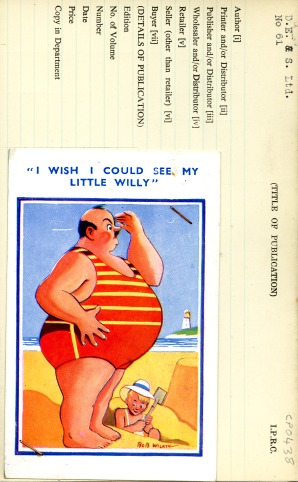
Typed card with a postcard stapled to it. The postcard shows a man with a large protruding stomach looking out across a beach. There is a lighthouse in the distance. There is a sandcastle on the sand in front of him, and a small boy ('Willy') sitting in a hole digging in the sand at his feet. He cannot see him over his stomach.

Postcard designed by Bob Wilkin, I wish I could see my little willy?, D E & S Ltd.

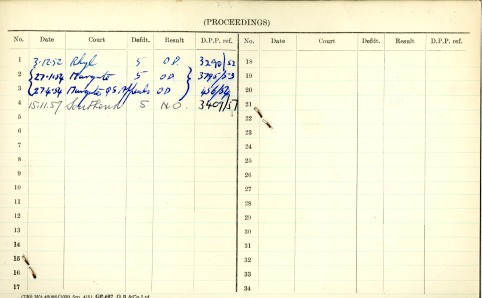
Typed card titled 'Proceedings' with hand written entries for several rows and columns. Reads - No 1 Date 3.12.52. Court Rhyl. Defendant 5. Result OD. DPP Ref 3290/52; No 2 Date 27.10.54. Court Margate. Defendant 5. Result OD. DPP Ref 3795/53; No 3 Date 27.4.54. Court Margate QS. Defendant 5. Result OD. DPP Ref 456/54; No 4 Date 15.11.57. Court Southwell. Defendant 5. Result NO. DPP Ref 3409/57.

Typed Card from the Crown Prosecution Service recording the prosecutions for obscene postcards that took place for the card on the reverse – I wish I could see my little willy. Prosecutions took place in Rhyl, Margate and Southwell.

  1. Donald McGill, A stick of rock, cock?, Constance Ltd, Undated. Reference: Crown Prosecution Service Collection CP/0363 
  2. What rosy cheeks you have my dear, Leslie Lester Ltd, Undated. Reference: Crown Prosecution Service Collection CP/0649 
  3. Have you got two big bouncy balls please?, Leslie Lester Ltd, Undated. Reference: Crown Prosecution Service Collection CP/0700 
  4. Bob Wilkin, I wish I could see my little willy?, E & S Ltd, Undated. Reference: Crown Prosecution Service Collection CP/0438  
  5. Dave Brown, Has anyone seen my little willy?, The Independent, 05 Oct 1999. Reference: Cuttings Collection 52292 

Political Events and Crises

The cartoons for this theme were selected and described by Hannah Robson: 

  1. Brian Adcock, “So you know the so-called “Special Relationship,” well you are gonna love this!”, The Independent, 6 November 2017. Reference: Brian Adcock Digital Collection BAD0485 
  2. Victor Weisz, “McCarthy is dead! Long live McCarthyism!”, Daily Mirror, 7 May 1957. Reference: Vicky [Victor Weisz] Collection, Beaverbrook Foundation VY0890 
  3. Michael Cummings, [no caption], Daily Express, 14 November 1986. Reference: Cuttings Collection 44500 
  4. Christian Adams, Signed in Blood, Daily Telegraph, 19 October 2015. Reference: Cuttings Collection 103278 
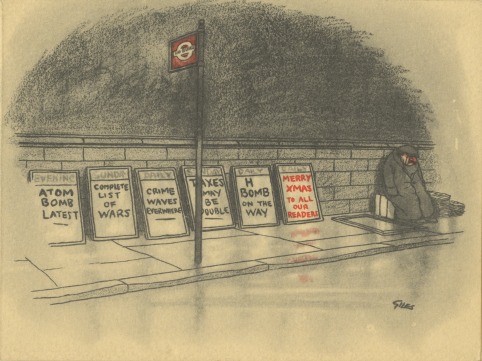
  5. Carl Giles, Daily Express Christmas card, c.1947. Reference: Carl Giles Trust Collection CG/1/4/1/4/1 (GAC0098) 
Cartoon for a Christmas Card - of a newspaper seller, sitting near a London bus stop looking serious and downcast, with signs propped against a wall showing the headlines of the newspapers including: Evening Atom bomb latest Sunday Complete list of wars Daily Crime waves everywhere Sunday Taxes may be double Daily H bomb on the way Daily Merry Xmas to all our readers

Carl Giles, Daily Express Christmas card, c.1947. Reference – Carl Giles Trust Collection – CG/1/4/1/4/1 (GAC0098)


Viewing both England and the University of Kent through an Irish lens

The cartoons for this theme were selected and described by Peter McCullen: 

  1. Martin Rowson, Backwards, The Guardian, 25 May 2015. Reference: Martin Rowson Digital Collection MRD0654 
  2. Ben Jennings, [no caption], Independent, 01 March 2014. Reference: Ben Jennings Digital Collection BJD0121 
  3. Ben Jennings, [no caption], Independent, 01 March 2014. Reference: Ben Jennings Digital Collection BJD0200 
  4. Carl Giles, “Talking of cheque book journalism, do you think the editor would object to us taking that cab?”, Daily Express, 07 May 1981. Reference: Carl Giles Trust Collection CG/1/1/1/3002 (GA4259)  
  5. Carl Giles, [no caption], Daily Express, 11 November 1958. Reference: Carl Giles Trust Collection CG/1/1/1/3824 (GA5503) 
  6. Wally Fawkes, [no caption], Observer, 14 June 1987. Reference: Cuttings Collection 42646 
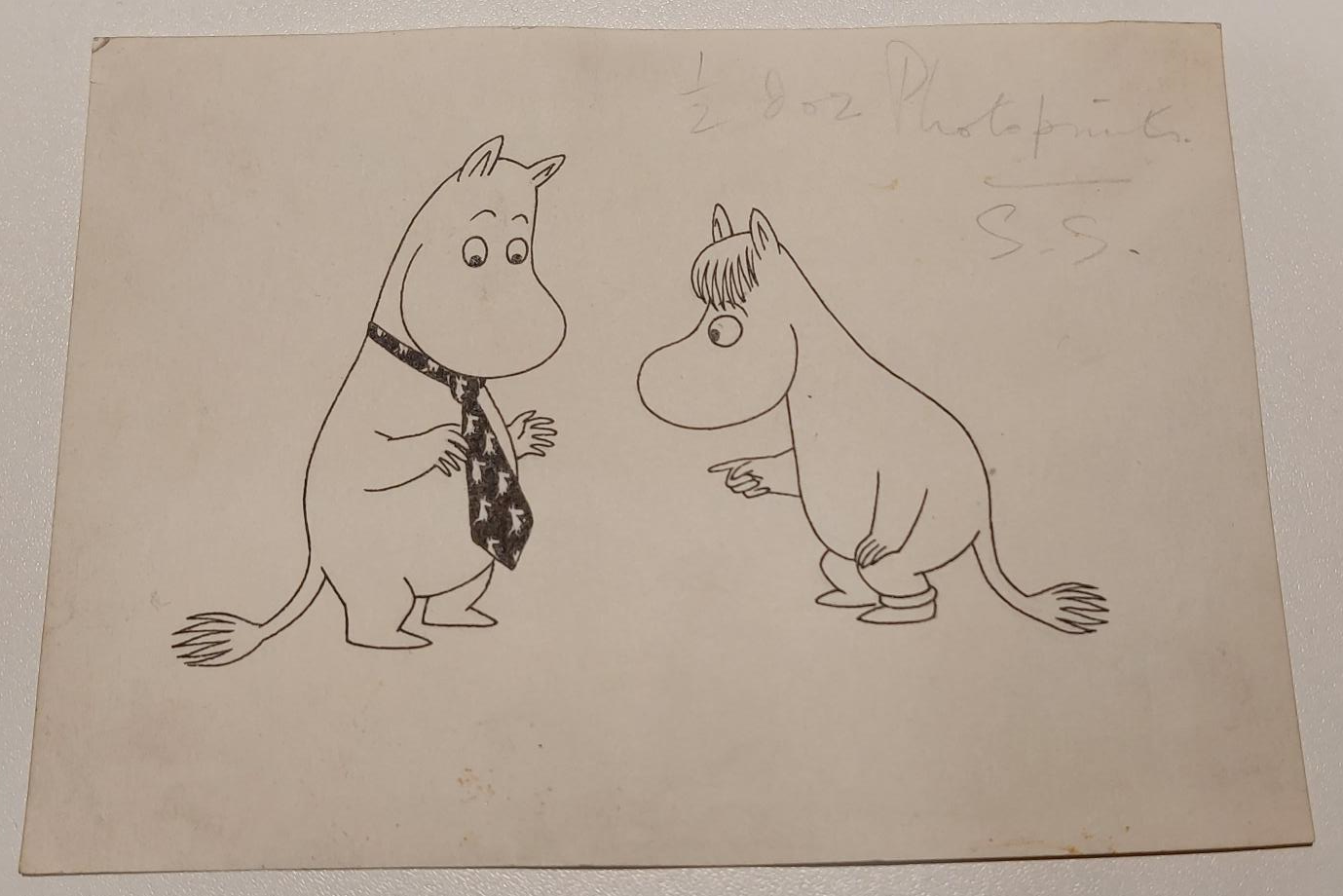
  7. Tove Jansson, Moomin and Snorkmaiden, Undated. Reference: Tove Jansson Collection TV0002 (Uncatalogued) 
Drawing of two moomins by Tove Janssen. Moomintroll is standing wearing a neck tie with moomins on it, facing Snorkmaiden who is looking and pointing at the tie.

Tove Jansson, Moomin and Snorkmaiden, Undated. Reference: Tove Jansson Collection TV0002 (Uncatalogued)


The Space Race 

The cartoons for this theme were selected and described by Elizabeth Grimshaw 

28. Michael Cummings, Increase of Fares Between London – Mars –Venus – Moon, Daily Express, 27 Jan 1953. Reference: Cummings Collection CU0522

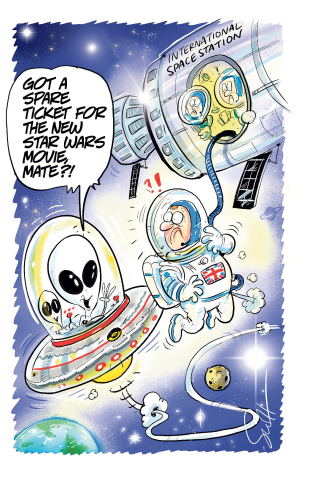
36. Scott Clissold, “Got a spare ticket for the new Star Wars movie, mate?!”, Daily Star, 16 December 2015. Reference: Scott Clissold Digital Collection CLD0549

Colour cartoon of two aliens in a space ship talking to an astronaut on a space walk outside the International Space Station. One of the aliens speaks to the astronaut and says 'Got a spare ticket for the new Star Wars Movie, Mate?!' The astronaut looks confused.

Scott Clissold, “Got a spare ticket for the new Star Wars movie, mate?!”, Daily Star, 16 December 2015. Reference: Scott Clissold Digital Collection CLD0549

37. Osbert Lancaster, “Just think, Gretchen! Halfway to the moon! One day, perhaps, science will be able to tell us how to reach West Berlin!”, Daily Express, 14 Aug 1962. Reference: Cuttings Collection 02019

38. Carl Giles, “Be funny if the Moon Men thought she was an Earth Man and made her their ruler”, Daily Express, 05 Nov 1957. Reference: Carl Giles Trust collection CG/1/4/1/3/12/3 (GAA121419) 

The Commonwealth

The cartoons for this theme were selected and described by Dr Balasubramanyam Chandramohan:

  1. Margaret Belsky, “After all why shouldn’t the Queen protest – I expect she gets fed up with the rest of the Commonwealth criticising Britain all the time”, The Sun, 08 January 1969. Reference: Cuttings Collection 14577 
  2. Jak [Raymond Jackson], “Je demande que la Grande Bretagne soit chassee du Commonwealth si elle vend des armes a l’Afrique du sud”, Evening Standard, 20 October 1970. Reference: Cuttings Collection 18825 
  3. Michael Cummings , “Really, Mr. Stewart, it might come as a merciful release if Britain could be expelled from the Commonwealth”, Daily Express, 25 June 1965. Reference: Cuttings Collection 07292 
  4. Carl Giles, “And Rajah – be a good chap and control those long rumbling tummy noises during the Commonwealth speeches.”, Daily Express, 24 November 1983. Reference: Carl Giles Trust Collection CG/1/1/1/3239 (GA4603) 
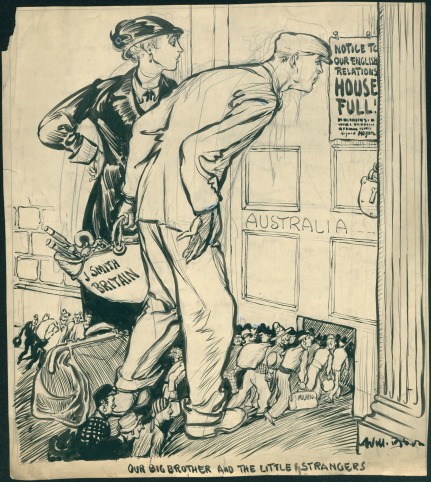
  5. Will Dyson, Our big brother and the little strangers, Daily Herald, Undated. Reference: Will Dyson Collection WD0597 

Will Dyson, Our big brother and the little strangers, Daily Herald, Undated. Reference: Will Dyson Collection WD0597

Ronald ‘Carl’ Giles

The cartoons for this theme were selected and described by Cam Matthews: 

44. Carl Ronald Giles, “An appeal has been made for every nurse to be off duty during the inquiry into the Nurses v. Hospital Authorities dispute in Guernsey.” Daily Express, 16th July 1957. Reference: Carl Giles Trust Collection CG/1/1/1/973 (GA1328) 

45. Carl Ronald Giles, “We’ve been thinking about your parrot, Grandma. Supposing we can’t get a turkey for Christmas…” Daily Express, 25th November 1947. Reference: Carl Giles Trust Collection CG/1/1/1/3787 (GA5454) 

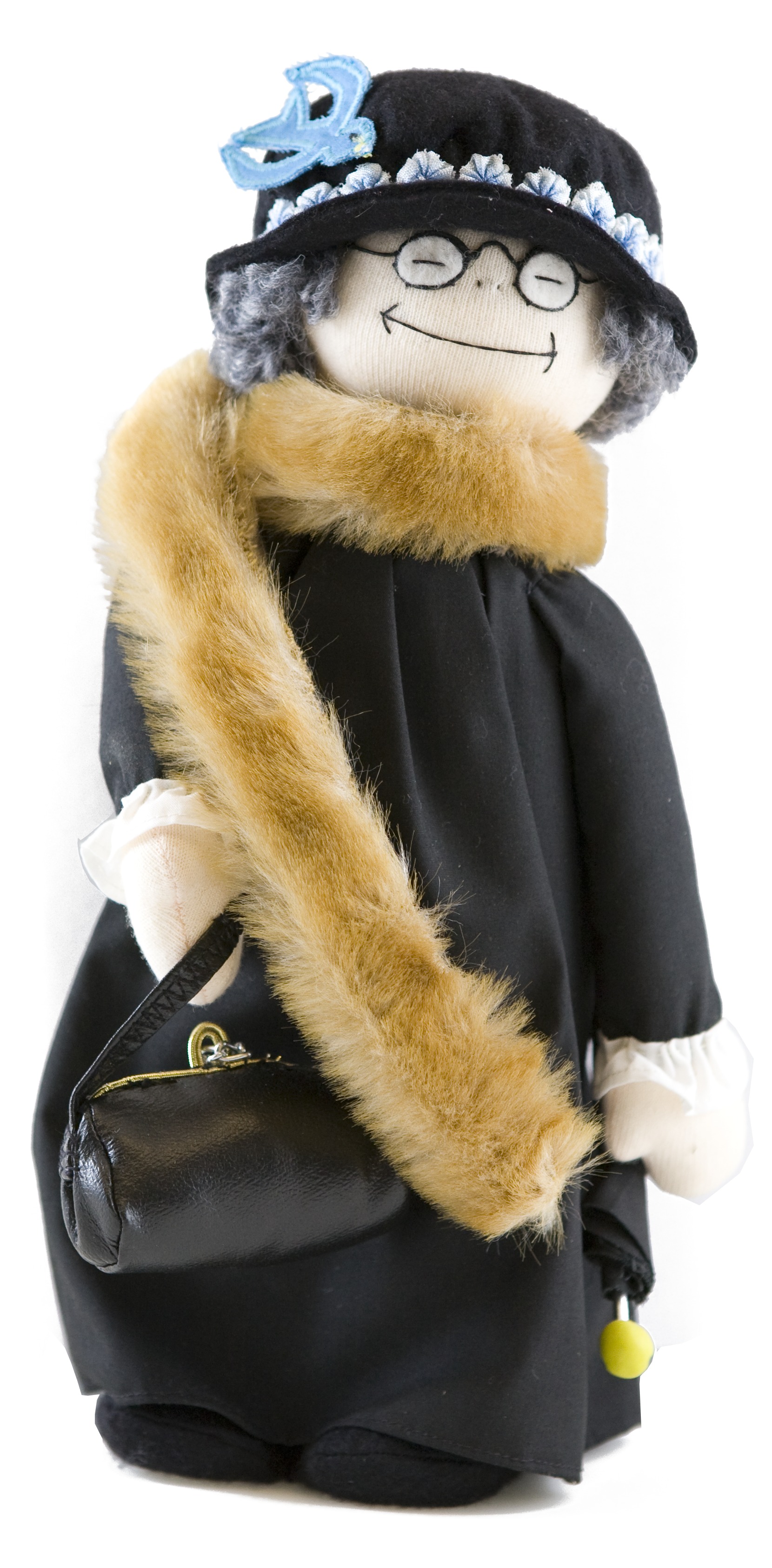
46. Grandma Giles doll made by Dorothy Read, Undated. Reference: Carl Giles Trust Collection CG/5/3/39 (GAX00058)  

Image of a doll of the character Grandma created by Carl Giles. Grandma is wearing a black hat with a blue trim, and a black dress. She carries a black handbag with a clasp, and an umbrella with a duck head handle, and is also wearing a brown fur stole.

Grandma Giles doll made by Dorothy Read, Undated. Reference: Carl Giles Trust Collection CG/5/3/39 (GAX00058)

47. Carl Ronald Giles, “I’m jotting down a list of all the ones who aren’t laughing their heads off.” Daily Express, 17th February 1987. Reference: Carl Giles Trust Collection CG/1/1/1/3532 (GA5027) 

48. Police Helmet, Undated. Reference: Carl Giles Trust Collection CG/4/1/45 (GAX00085) 

49. Ink, paint and paintbrushes from Giles’ studio, Undated. Reference: Carl Giles Trust Collection (uncatalogued) 

50. Carl Ronald Giles, “Well, well, well, well, well! Man have they got your number!” Sunday Express, 1st March 1970. Reference: Carl Giles Trust Collection CG/1/1/2/802 (GA2779) 

Cartooning Covid-19 – call for volunteer participants

About the project 

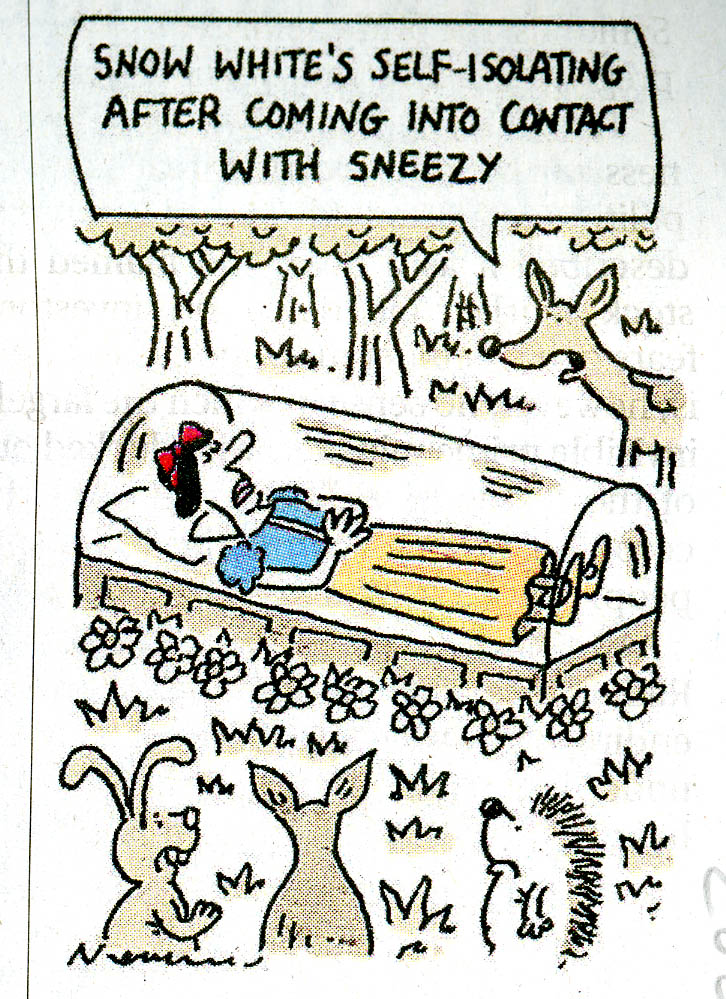
Nicholas Newman, The Sunday Times, 01 Mar 2020. ©
Nick Newman (ref: 109242)

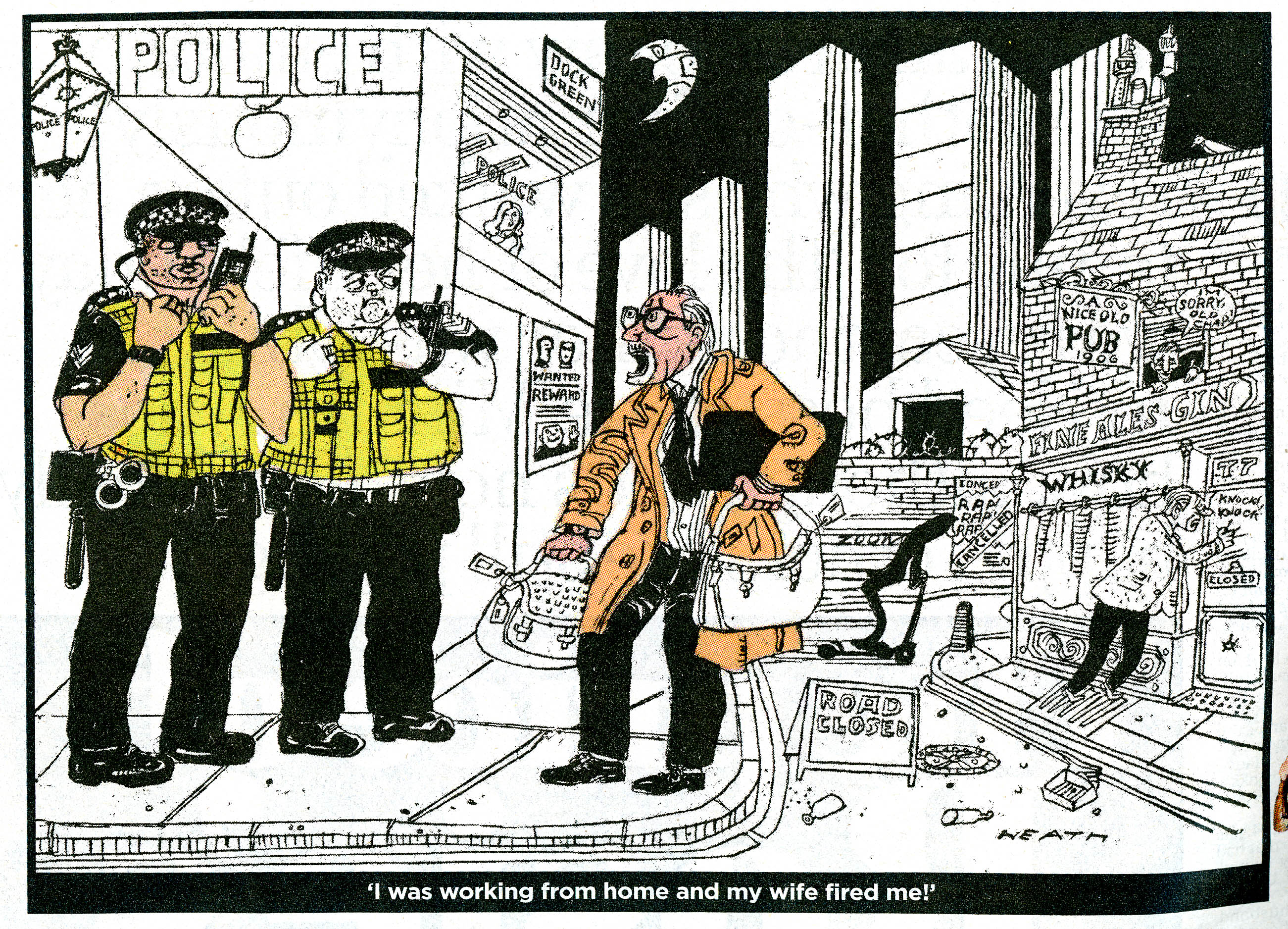
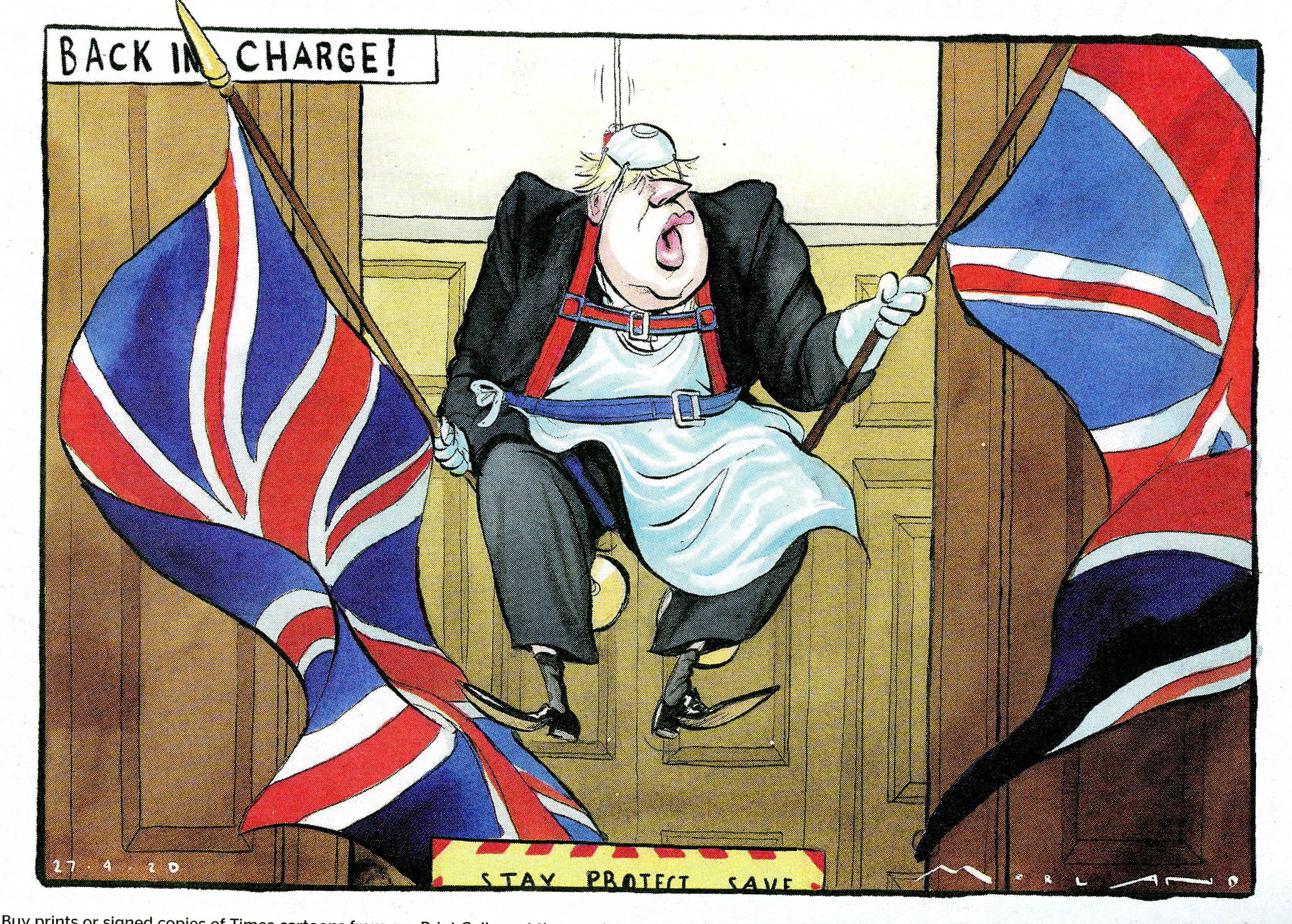
‘Cartooning Covid-19’ will be a 10-week volunteering project which aims to make available cartoons published in national papers during the Covid 19 pandemic between March and December 2020. Through cataloguing these cartoons, we ensure that this important period in recent history is captured in the cartoon catalogue of the British Cartoon Archive for use in learning, teaching and research.

The British Cartoon Archive collects the cartoons published each week in national newspapers (The Times, Daily Telegraph, Daily Mail, The Guardian and The Independent). This encapsulates work by artists such as Bob Moran, Nicholas Newman, Peter Schrank, Morten Morland, Peter Brookes and more. 


To participate in this project please email cartoons@kent.ac.uk. 

Practicalities 

The project will be carried out using a hybrid model of in-person group sessions and remote virtual cataloguing. However, this opportunity is open to all, so if you do not live locally to Canterbury, you are welcome to join as a fully remote participant. Similarly, if you would prefer to participate in person only, that’s ok too. 

Volunteers will be provided with full training as part of the project, including sessions from the archive team about the BCA and the work they carry out to preserve it and make it available, and they will be given access to library resources where possible, such as newspaper archives and both physical and digital cartoon collections. 

Volunteers will be given a set of cartoons published between March and December 2020, which they will be asked to catalogue by listing details about the cartoons into a spreadsheet with supervision from the Special Collections and Archives team. At the end of the project the resulting spreadsheets of data will be uploaded to the British Cartoon Archive catalogue alongside digital cartoon copies, making these resources available to the public.  

Special Collections and Archives will provide refreshments at in-person events (lunch will not be provided). 

Michael Heath, The Mail on sunday, 05 April 2020. ©Associated Newspapers Ltd. (ref: 109333)

Schedule 

  • In-person sessions will be held fortnightly on Tuesdays from 3rd October through to 5th December 2023 (10 weeks). Sessions will run from 10:30-16:00 with an hour break for lunch. For online only participants, you would be invited to attend the welcome day sessions virtually on Tuesday October 3rd, after which you will be provided with digital copies to describe and catalogue. 
  • Optional online drop-in sessions will be scheduled virtually (via Microsoft Teams) for one hour every other week from Thursday 12th October. These sessions will enable Special Collections and Archives to provide virtual support for volunteers between in-person sessions, while also providing an opportunity for socialising and peer support. 
  • Volunteers are encouraged to participate remotely between in-person sessions. Resources will be made available online through Google Drive.   

Requirements 

There are no specific prerequisites for participating volunteers, however this project will likely suit those with an interest in political satire, art and graphic design, UK politics, or those wishing to learn more about archives.  

Volunteers should be comfortable with using websites and online catalogues, and in using spreadsheets. 

A laptop will be needed for participation during in-person sessions.  These can be supplied by Special Collections and Archives on request, but numbers are very limited so please indicate in advance if this is required. Volunteers are encouraged to provide their own devices where available.  

For remote participation, volunteers will need to have their own laptop or personal computer with internet connection, as well as access to a Google account.  

To participate in this project please email cartoons@kent.ac.uk. 

Morten Morland, The Times 27 April 2020. ©News UK (ref: 109373)