Coronavirus: collecting your experiences

SCA wants your experiences of the coronavirus pandemic - in any form you'd like

SCA wants your experiences of the coronavirus pandemic – in any form you’d like


All of us are experiencing an exceptional time in our lives, where the COVID-19 coronavirus has had an impact on how we live, how we work, and how we interact with each other. Archives have an important role in recording these extraordinary times. In Special Collections & Archives we preserve the history of the University of Kent and the history of the regions and communities of which the University is a part, and we would like to create an archive collection that records the experiences of people in Kent in relation to the COVID-19 coronavirus pandemic.

We would like to collect records of your experiences of – and responses to – the pandemic. Your record of your experience can be anything – including diaries or journals, artistic responses, poetry, short videos, and photographs. This can be in digital or physical form and we invite responses from all members of the community – whether you are juggling working at home with caring responsibilities, trying to carry on studying, volunteering in your community to shop or chat to others, or working on the front line as a keyworker.

Your contribution to the archive will be kept by Special Collections & Archives as a donated item and we will catalogue and preserve it alongside our other archive collections. It will also be made accessible to others in our reading room, contributing to research and engaging people with this important part of history.

If you would like to contribute something, then please start to make your record in whichever form you choose. We’ll provide more information about how to send your responses in at a later date. If you have any questions about this project, then please contact specialcollections@kent.ac.uk

For information about Templeman Library resources during this period please click here. If you’d like to know about how Special Collections & Archives can support your research digitally please click here

Print Works: Part One – Forgotten Industry on the Isle of Thanet

Special Collections & Archives has been working with Appletye – an artists’-led organisation based in Margate – to support their mission to record the Isle of Thanet’s rich printing heritage. In lieu of a physical display in Spring 2020 these guest blogs by Dan Thompson and Dawn Cole are our virtual equivalent – we hope you enjoy!
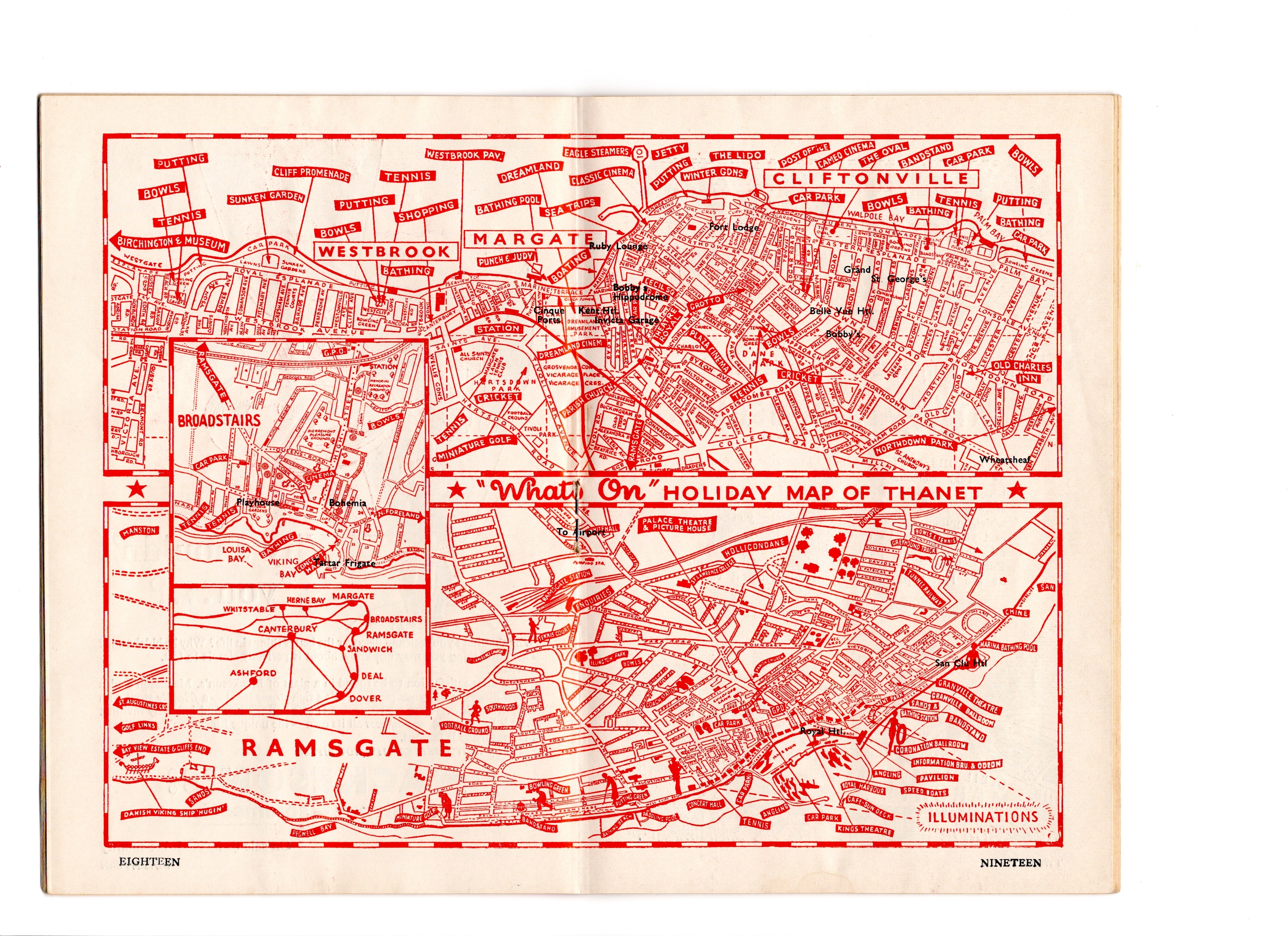
Map of the Isle of Thanet from a tourism magazine printed at Thanet Press

Map of the Isle of Thanet from a tourism magazine printed at Thanet Press

Each town on the Isle of Thanet is distinct. Ramsgate has its Royal Harbour, and is still an active port for pleasure craft, and the rugged boats that service the offshore windfarms north of Margate. Broadstairs is the quintessential seaside town, a curve of beach at the break in the chalk cliffs, with the town piled up picturesque behind it. 

Margate is brash, East London come to the seaside, proud of its egalitarian spirit and reinventing itself through art and culture. Turner Contemporary opened just shy of ten years ago, and the Old Town is now a jumble of small galleries, vintage shops, and quirky cafes. 

While the story told about the Isle of Thanet over the last twenty or so years has been one of tourism (Margate rebranded itself in 2011 as ‘The Original Seaside Resort’), there’s an untold history of the island. From the 1920s onwards, it became a centre for a set of light industries, based mainly on former farmland around Westwood, in between Margate, Broadstairs and Ramsgate. 

After the Second World War, the government recognised this and gave it assistance as an industrial area. 

Hornby made their model trains and Airfix soldiers at Westwood for 50 years. 

The UK’s first cable television was piped from the Isle of Thanet to homes across England by Rediffusion, who were at the sharp edge of innovation until the 1990s – they invented a precursor to the internet in the 1980s. 

In 1954, Pfizer opened research laboratories at Sandwich, at the edge of Thanet, inventing a way to mass produce penicillin and winning numerous awards over the next 60 years. 

Until the turn of the millennium, industry employed more people on the Isle of Thanet than tourism ever did.

And with both industry and tourism to service, the Isle of Thanet became home to a concentration of printing companies, employing hundreds in skilled, secure, well-paid jobs – some of the best printers in the country. 


About the Print Works project:

Print Works is a year-long project from Appletye, an arts and heritage organisation. The project explores the history of the print industry on the Isle of Thanet, taking inspiration from two former companies and the heritage of the sites they occupied at Thanet Press, Union Crescent, Margate and Martell Press, Northdown Road, Cliftonville. At the heart of the project are archives from the two Margate firms, recording the stories of the people who worked there and the work they did. 

Using the Print Works archive:

The Print Works archives include hundreds of examples of material printed in a pre-digital age, including much related to Margate, Broadstairs, and Ramsgate. It includes print for seaside hotels, entertainment venues, and tourism businesses.

The archive also includes documents relating to working in the print industry in the 20th century, from apprenticeship indentures to certificates from a print factory’s Horticultural Club. There are documents relating to design, typography, and the move from analogue processes like typography to digital design and print.

The archive is new, so includes primary material not used before in academic research. It is held at a studio in Margate. For more information email dawn@appletye.org

Print Works is supported by a grant from the National Lottery Heritage Fund.

Templeman Library Closure: SC&A digital resources

In light of recent Government announcements, the Templeman Library closed at 5pm on Tuesday 24th March and will remain so until further notice. This includes Special Collections & Archives; our team is working remotely away from campus.

The Templeman Library is closed from 5pm on Tuesday 24th March until further notice.

The Templeman Library is closed from 5pm on Tuesday 24th March until further notice.

Our Reading Room may be closed, but many of our collections can still be accessed remotely! Here’s a list that we’ll keep updating throughout this period, curated in roughly alphabetical order:

  • Our archive catalogue contains details of the collections we hold along with images for some collections
  • The British Cartoon Archive’s catalogue has thousands of images of artwork along with publication details – click on the image in the record to view it full screen
  • Some of the Buffs (Royal East Kent regiment) collection – namely the ‘Dragon’ journal – is available to view through LibrarySearch. This includes the Dragon’s issues from the First World War.
  • If you’re interested in Local History, we have many images of mills from Kent (and beyond) for your perusal
  • The wonderful Prescriptions: Artists’ Books collection has been catalogued through LibrarySearch and there are images of every item we hold
  • Our next Templeman Gallery exhibition, Printworks, will be explored in this blog over the next few weeks so you don’t miss out

If you’d like to access any other material digitally – or have any other queries – please do get in touch with us. We hope you’re all safe and well and look forward to welcoming you back to the Library soon.


Women and Girls in Science: Mary Anne Atwood, alchemical thinker and spiritualist

February 11 is the International Day of Women and Girls in Science. To commemorate this occasion, we’re going to delve back into our Maddison collection to see how women have been involved in sciences from the very beginning. Today let’s take a look at Mary Anne Atwood, who was afraid she had revealed one scientific secret too many…
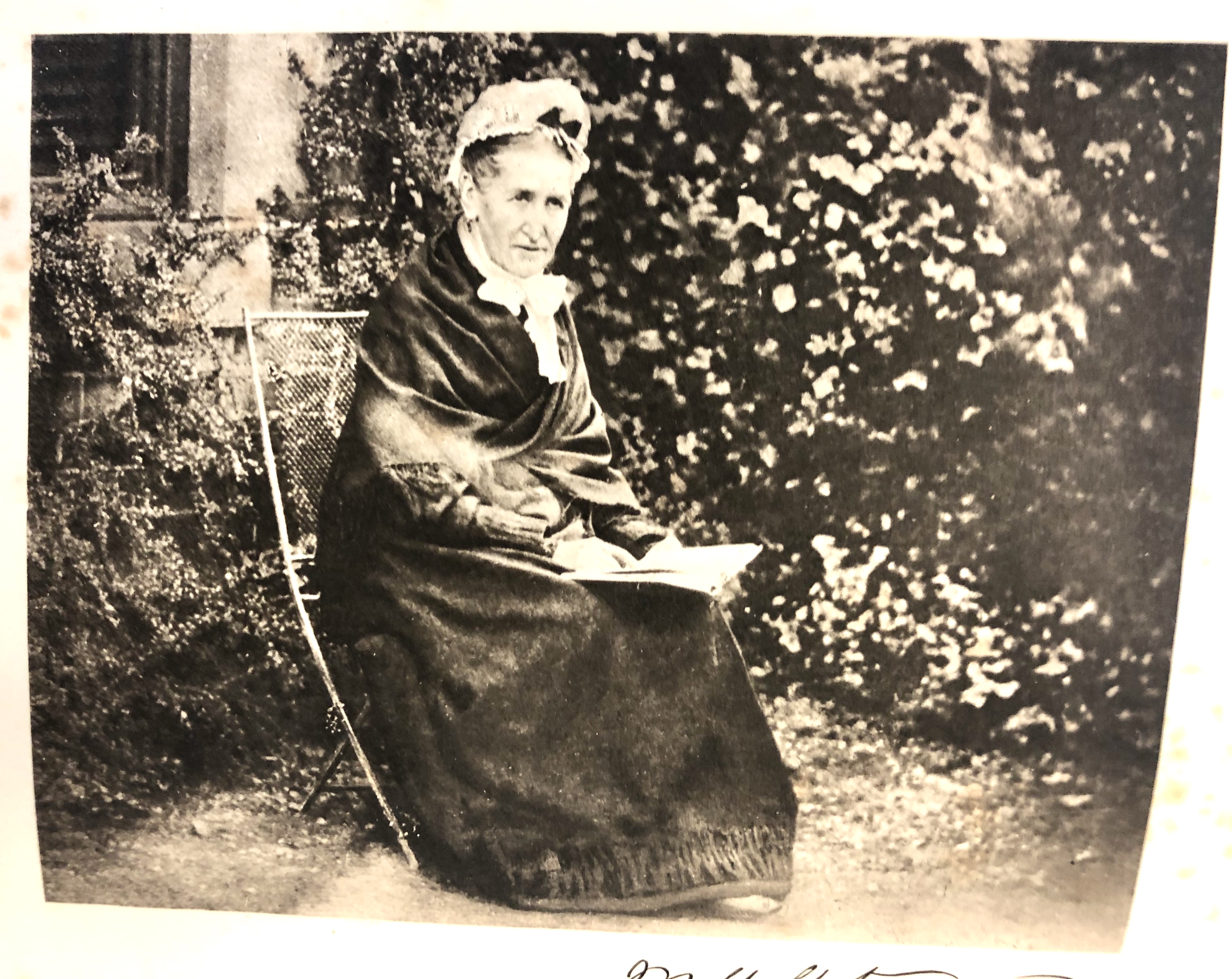
Photograph of alchemical researcher Mary Anne Atwood, undated.

Photograph of alchemical researcher Mary Anne Atwood, undated.

Who was she? Born in Dieppe in 1817, Mary Anne Atwood (nee South) grew up surrounded by her father’s books in Gosport, Hampshire. Like many women of the era Mary Anne received no formal education but learnt Latin, Greek, and the classics at home. Encouraged by her father Thomas South she joined a circle of theosophists; a religious group who believed that spiritual knowledge was held in a group of individuals known as the Masters. It was this circle that sparked her research in alchemy.

What did she write? In 1846 Mary Anne and her father released a book detailing their thoughts and research so far: Early Magnetism in its Higher Relations to Humanity as Veiled in the Poets and the Prophets, under the pseudonym Thuos Mathos. The work was well received and the praise encouraged the Souths to begin a much bigger project: a full explanation of the purpose and methods of the alchemical process.

What is alchemy anyway? Today, we know alchemy as the discipline of trying to turn lead into gold, practised between the 16th and 18th centuries. However during the 19th century, as it became more widely recognised that this was not possible, alchemy as a discipline took on a more spiritual slant. Researchers began to examine the relationship of mankind – and the soul – to the wider cosmos, exploring if it was possible to refine the soul away from the influences of the external world and society back to a state it would have been in when God created it. This branch of alchemy is known as Hermetism (or Hermetic writings) and it is this that Mary Anne Atwood and her father were interested in, rather than the Philosopher’s Stone story we know from J.K. Rowling’s world today.
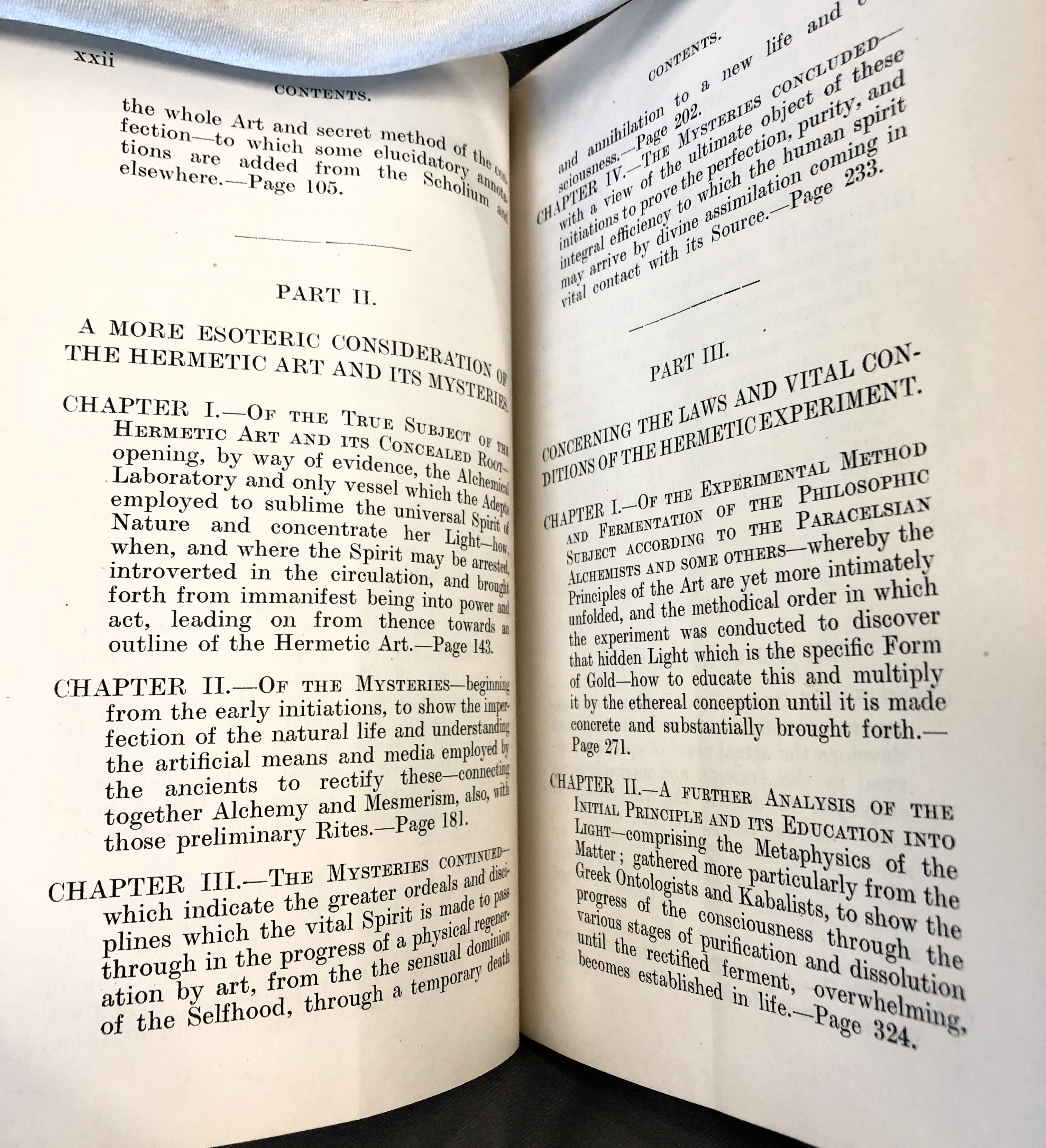
Contents page of Atwood's work ' A suggestive inquiry into the hermetic mystery : with a dissertation on the more celebratedof the alchemical philosophers, being an attempt towards the recovery of the ancient experiment of nature'

Contents page of Atwood’s work ‘ A suggestive inquiry into the hermetic mystery : with a dissertation on the more celebratedof the alchemical philosophers, being an attempt towards the recovery of the ancient experiment of nature’. Long title, fascinating book.

Why has she not become more famous? In 1850, Mary Anne published A Suggestive Inquiry into the Hermetic Mystery which was the culmination of years of research into spiritual alchemy. The work was supposed to be published alongside a poem written by her father, The Enigma of Alchemy. When A Suggestive Inquiry… was published it had not been read (or edited) by Thomas South, and shortly after its release to the world the Souths decided it was not fit for sale and withdrew the book along with most existing copies (to the ire of their publisher). The reasons for this withdrawal are twofold. Firstly (and most importantly) Mary Anne and her father believed that they had explicitly written about secrets that should have stayed hidden within allegorical texts, and that this knowledge could be dangerous if in the wrong hands. Secondly there is a suggestion that Thomas South became more devoutly religious between the writing of the texts and that this prompted a change of heart about the matter.

Following A Suggestive Inquiry…‘s withdrawal, Mary Anne retreated from alchemical society. In 1859 she married Reverend Alban Thomas Atwood and lived a very quiet life in Yorkshire. After her husband’s death in 1883, there is some evidence that Mary Anne was approached about a possible reprint of A Suggestive Inquiry… and whilst she did not wish to see it in print again – for fear of it being reproduced and sold without her consent – she gave a few copies to friends and made some minor amendments to the text itself before her death in 1910.

Why is she important? A Suggestive Inquiry into the Hermetic Mystery is the first work that gives a comprehensive insight into alchemy as a discipline, and consequently Mary Anne’s work is vital for establishing this particular area of historical scientific research. In 1918 it was republished by Mary Anne’s friend, the painter and thinker Isabelle de Steiger, for the first time since it was withdrawn from sale in 1850.
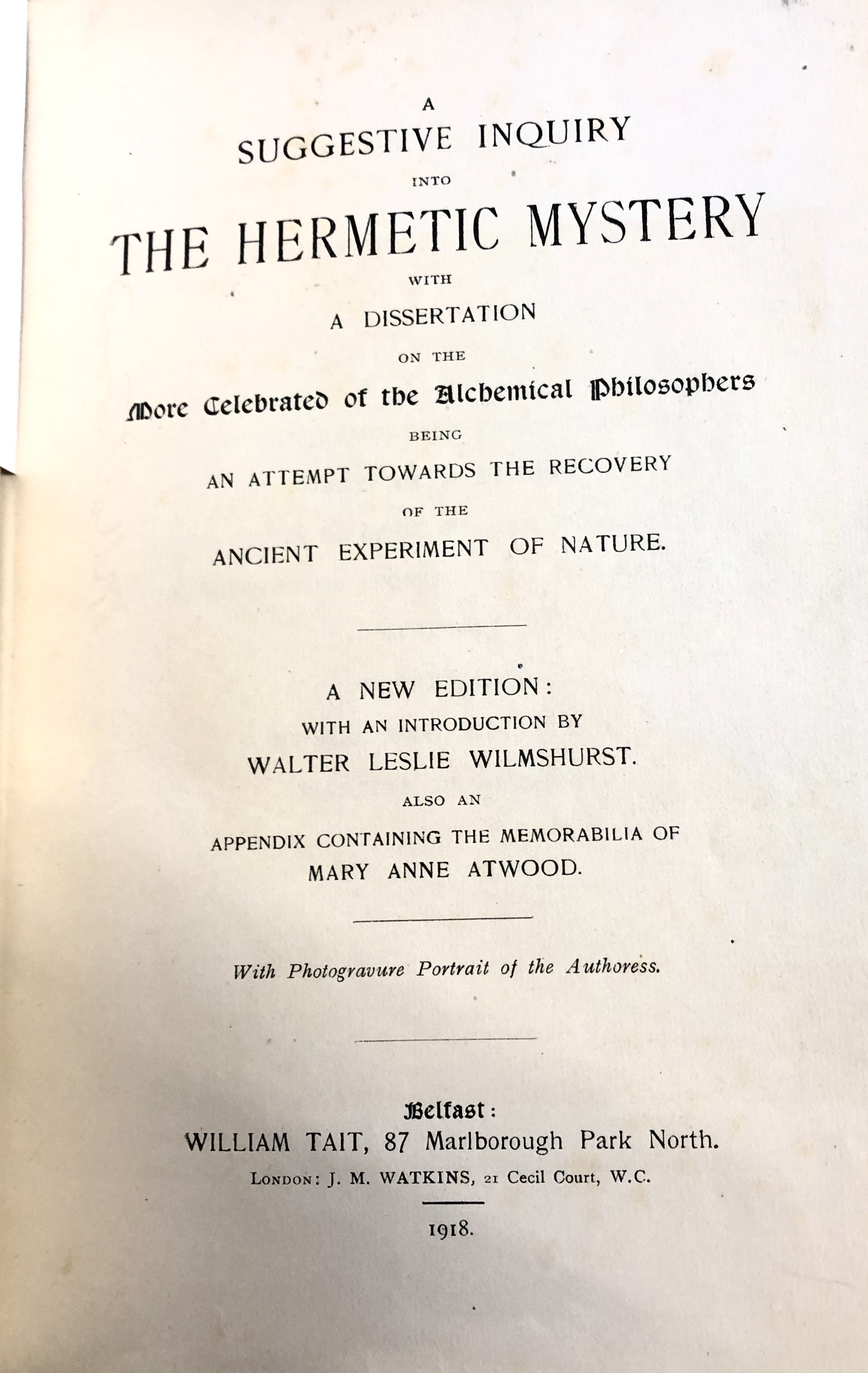
Title page of the new 1918 edition of Atwood's work 'A Suggestive Inquiry...'

Title page of the new 1918 edition of Atwood’s work ‘A Suggestive Inquiry…’

Freemason Walter Leslie Wilmshurst, who wrote an extensive introduction in the new edition, suggested that the societal and spiritual impact of the First World War led to increased interest in alchemy and Hermetic writings: 

“It was not, I think, the destiny of such a treatise as this to perish at its birth, but rather, when the time should be more ripe for it, to re-emerge from its obscurity and assert that influence which its great merits are capable of exercising. With that clear, sure prophetic vision with which its writer…penetrated the tendencies of modern world movements and conditions, she discerned the impending catastrophe to human society and institutions through which we are now passing.” (p.64)

The copy of Mary Anne’s work we hold is the 1918 edition, which contains additional quotes by the writer. It was collected by the writer and librarian R.E.W. Maddison for his ongoing collection of books relating to the history of chemistry and physics, within which there are many books about alchemy. Whilst the language of Hermetism appears somewhat obtuse by today’s standards, Atwood’s work is a fascinating summary of alchemical studies – and a solid testimony that there are many ways to discover the world beyond traditional education.

Bibliography and further reading:

Mary Anne Atwood, A suggestive inquiry into the hermetic mystery : with a dissertation on the more celebrated of the alchemical philosophers, being an attempt towards the recovery of the ancient experiment of nature. William Tait, 1918. University of Kent Special Collections & Archives: Maddison Collection 19A15.

R.A. Gilbert,  ‘Atwood [née South], Mary Anne’, Oxford Dictionary of National Biography, 2004. DOI: https://doi-org.chain.kent.ac.uk/10.1093/ref:odnb/53866

Robert P. Multhauf and R.A. Gilbert, ‘Alchemy’, Encyclopaedia Brittanica, 2019: https://www.britannica.com/topic/alchemy.

Brown University in Providence, Rhode Island holds the majority of material by Mary Anne Atwood in its Special Collections department.

As ever, more information about the Maddison collection and visiting us can be found on our website.