Category Archives: Student Guide

Eastern ARC training

Funding opportunity for Essex Summer School course

The Eastern ARC and the Graduate School will fund an opportunity for one Social Science PhD student working on a project with applied quantitative methods to attend an Essex summer school training session.

This includes the fees for one course, accommodation during the training period as well as travel. To apply, please email EARCpgmobility@kent.ac.uk with the title of the course you wish to attend, and up to 500 words addressing the following points:

  • Background summary of your PhD project
  • How the method proposed will advance your PhD project
  • How attending the course will advance your skill set as a PhD candidate
  • Why you wish/need to attend the course this year

You will also need to include a half page supporting statement from your supervisor, and a short CV outlining training courses you have already attended and indicating your current level of statistics training.

The deadline for applications is 5pm on Friday 20th April 2018, and the award will be announced by the end of April.  If you have any queries please email Hannah Swift and/or EARCpgmobility@kent.ac.uk.

Please note that applications from first and second year full-time PhD students (up to the fourth year for part-time PhD students) will be prioritised.

PRIDE Awards poster

Submit your PRIDE Awards Nominations

The PRIDE (‘Personal Responsibility In Delivering Excellence’) Award recognises members of Kent Hospitality staff who go out of their way to deliver excellent customer service.

Any Kent Hospitality staff member (permanent or casual) may be nominated from Canterbury and Medway campuses. The award is given out four times a year with each winner receiving £100 of shopping vouchers, a certificate and a badge.

Nominations can be made online by any member of University staff, students and visitors. Alternatively you can pick up a paper form next to the red nomination boxes located in all Kent Hospitality’s catering outlets in Canterbury and Medway, as well as College reception areas.

Please make your nominations detailed, providing as much information as possible on why the nominee is being put forward for a Pride Award. The panel are looking for staff who achieve more than just what is expected in their role (i.e. hardworking, professional, positive and friendly attitude).

Congratulations to December’s Pride Award winners – Fay Allen, Student Accommodation Co-ordinator and Christine Nottage, Keynes Day Cleaner.

For further information or for guidance on submitting nominations please contact pride@kent.ac.uk

Medway Service of Remembering

Medway Service of Remembering

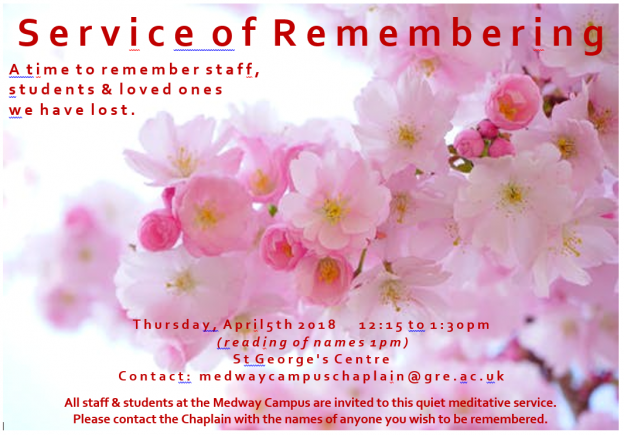
Our annual Service of Remembering will be held on 5 April 2018 from 12.15-1.30pm.

The service will be held in the St George’s Centre and is a time for us to honour members of staff, students and loved ones who have passed away in this previous year.

Whether or not you are able to attend the service please feel free to contact Lynne Martin, the Medway Campus Chaplain, with names of those you wish to be remembered.


Global Hangout Cafe

Global Hangout: ‘The theme of Travel’

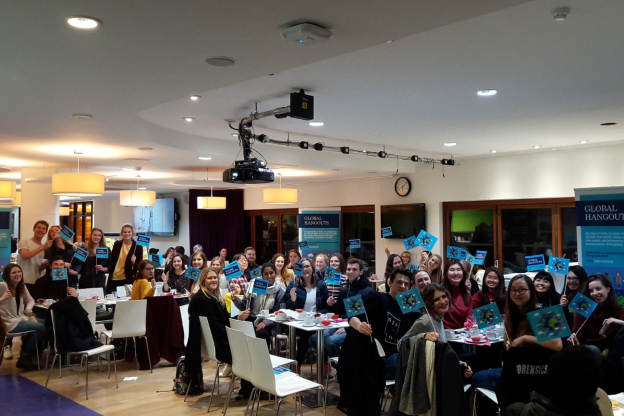
International Partnerships is hosting the next Global Hangout of the series on Wednesday 14 March from 17.00-19.00.

The event will be themed around ‘Travel’, encouraging students to share their experiences of both short and long-term travel around the world.

All Canterbury students are welcome to attend and we are inviting everyone to book their places online now following this link. Places are limited and tend to go quickly – so please get booking asap!

Global Hangouts is a series of free global networking events arranged throughout the academic year. With a fun and relaxed atmosphere, the hangouts include interactive activities, refreshments and live music and performances.

If students or staff wish to find out more information, they can visit our webpage.

We look forward to seeing you there!

International Partnerships

Silke Grygier

Survivors’ Forum: Supporting survivors of sexual abuse

Silke Grygier, founder of the Not The Only One Project, will be facilitating five Survivor Forums. The forums will take place from 18.30-20.30 on:

  • 16 March (Rutherford Ext 12)
  • 20 April (Rutherford Ext 12)
  • 18 May (Rutherford Ext 12)
  • 15 June (Rutherford Ext 12)
  • 20 July (Grimond Seminar 2)

The main aim of this format is to create a safe space for survivors of sexual abuse to come together, meet others, share experiences, and discuss the issues and themes which affect them. The experience of being in a space with other survivors, can be hugely empowering for survivors and can alleviate common feelings of shame, stigma, and isolation, and foster experiences of connection and feeling understood.

The first one or two forums are usually open in topic, to allow for participants to explore and bring themes they find important. Subsequently, forums might focus on a particular theme which seemed important, or include workshops on specific issues.

In the Survivors’ Collective, Silke has facilitated forums on themes such as ‘access to healthcare’, ‘media representation’, ‘our experience in education & the workplace’, and workshops such as ‘speaking out’, ‘connecting to our body’, as well as a ‘giving testimony session’ where survivors had the opportunity to tell their story.

Not The Only One​ is a project designed to reach out to university students who have experienced childhood sexual abuse (CSA). As a group, CSA survivors are often invisible, not only to society, but also to each other, and suffer stigma and isolation. At the same time, survivors tend to experience great difficulties especially in young adulthood, and are often left with a lack of understanding and support. Through workshops, presentations, info-stalls, support groups, open forums, and therapeutic support this project aims to raise awareness, create spaces for survivors to come together, and offer specialist support.

You can find out more about Not The Only One here. You can also contact Debbie Worthington, Student EDI Officer for further information.

kent bunny

Kent Bunny’s Epic Easter Egg Hunt is back!

Take part in the egg-citement for the chance to win one of over 100 prizes!

From 19-23 March there are over 100 eggs to find, and over 100 prizes to be won!

To join the fun, and be in with a chance to win cracking prizes, you need to find the eggs that Kent Bunny has hidden across the Canterbury and Medway campuses, as well as at the University’s centres in Paris and Brussels. He has also hidden some ‘onscreen’ – take a selfie in front of them and submit to Twitter, Instagram or post to the Facebook event using #KentBunny.

At the end of the week, everyone who has found an egg or taken a selfie with them will then be entered into the grand prize draw for the chance to win a very fancy camera or an iPad mini.

The competition is open to all who want to play. Get involved on twitter @unikentevents, Facebook @UniversityofKent, Instagram @unikentlive and online www.kent.ac.uk/events/

#KentBunny

UNI

U.N.I (You and I) Protect: See something? Say something. Do something! Make a difference.

Places are now available on U.N.I (You and I) Protect workshops running in March 2018.

All of us can take action to protect each other and the wider University community to help promote a culture of dignity and respect at Kent. This programme will help you recognise and challenge problematic and harmful behaviour, such as abuse or sexual harassment.

On completion of the course participants will understand what a ‘bystander’ is and be empowered to be able to intervene in situations safely and with confidence.

The workshops will run on Friday mornings from 10.00 to 11.30 during weeks 20, 21 and 22. All students who complete the course will receive 15 Employability Points.

If you want to take part or simply want to find out more please visit the Study Plus website. The module code is KE148. Places are limited so please sign up as soon as you can.

Further information about the course can also be found on the Student Services website.

Kent logo

Pay policy on industrial action update

In response to a number of queries being received (including feedback from Kent Union), the industrial action FAQ’s and Kent’s pay policy have been updated to provide clarification relating to the treatment of those striking members of staff who are employed on GTA, HPL and part-time contracts.

Please review the updated information: https://www.kent.ac.uk/human-resources/pensions/uss-industrial-action2018/

If you have any further questions please direct them to the Employee Relations Business Partnering team at: ERBP@kent.ac.uk

LGBT+ flags on campus

[Featured image – Rainbow by Benson Kua CC BY-SA 2.0]

As LGBT History Month draws to a close you may have been wondering what the flags flying all over campus represent. Here is a quick guide…

GAY PRIDE FLAG: Medway and Registry (Canterbury)

The pride flag originally held eight colours with pink placed on top of the red, symbolising sexuality and indigo placed below purple, symbolising spirit. When the flag became popular and widespread it demanded production; pink had to be dropped because it was not commercially available, later seven became six so as to keep the colours even.

“The rainbow is a symbol and celebration of the diversity of genders and sexual orientations. It’s beautiful, all of the colours, even the colours you can’t see. That really fit us as a people because we are all of the colours. Our sexuality is all of the colours. We are all the genders, races and ages.” ~ Gilbert Baker


BISEXUAL PRIDE FLAG: Woolf

Designed by Michael Page in 1998, the bisexual flag gave the underrepresented bisexual community its own symbol comparable to the gay pride. It had the aim to increase the visibility of bisexuals both among society and within the LGBT community. The colours signify the romantic and/or sexual attraction to multiply genders, your own gender and others.


ASEXUAL FLAG: Darwin

The four colours all have meanings:

  • Black:  Asexuality
  • Grey: Asexuality and Demisexuality
  • White: Non-asexual partners and allies
  • Purple: Community

The flag was created in 2010 and was driven primarily by the desire to have a symbol that belongs to the asexual community. It was agreed upon through a multi-stage vote.


LESBIAN FLAG: Keynes

The lesbian flag features a “labrys,” a double-headed axe associated with early matriarchal Minoan societies and favoured by tribes of Amazon warriors who roamed the area that is now Kazakhstan. The labrys became popular with lesbian culture in the 1970s, but has fallen out of common use since.

The black triangle is a throwback to nazi Germany, similar to the pink triangle used by the general gay movement. The black triangle denoted “anti-social” behaviour, which included lesbianism.

Although the flag was created fairly recently (1999 by Sean Campbell) it’s not as popular now as it once was, possibly because of the relative unknown of the symbols.


TRANSGENDER FLAG: Eliot

The transgender pride flag was created by Monica Helms, a transgender woman, in 1999. The two coloured stripes represent the traditional colours for baby boys and girls and white is for those of intersex, neutral, or other genders.

The flag is intentionally symmetric so that however you hang it, it is in the ‘correct’ orientation. Helms says this was to represent transgender people finding “correctness” in their lives.


PANSEXUAL FLAG: Rutherford

Pansexuality is a recently new categorisation of sexual attraction. The difference between bisexual and pansexual is that pansexuality is an attraction regardless of gender. The colours symbolising blue for male, pink for women and yellow for all.


GENDERQUEER FLAG: Turing

The Genderqueer Pride flag was created by Marilyn Roxie in 2010 with help from the Genderqueer internet community. The lavender is a mix of the traditional blue and pink gender colours for people who are a little of both, the green is meant to be the “inverse” of lavender for those outside the binary and the white represents gender neutrality.