Author Archives: Miriam Sandiford

Protecting your information

Consent in the digital age: protecting your information

As part of Safer Internet Day 2022, Kent academics share their expertise and tips on keeping ourselves and each other safe in the digital sphere

It has been said that in 2020 the world moved online. Two years on and, although we are no longer confined to digital spaces, our digital presence is ever increasing. 

When you visit a website, what do you want the organisation running the website to know about you, and to share with other organisations? What do you feel comfortable having others – friends, family or others – share about you online? These are questions of consent. Digital consent is one of the most important considerations of using the Internet: what do you want to share about yourself online? 

We recognise that giving genuine and informed consent is increasingly difficult in a world where requests to ‘accept Terms and Conditions’ and ‘Privacy Policies’ are constantly showing up on our screens, so we asked the experts for tips to help us protect our information… 

Who can see it? 

If you have social media profiles, think about how they are set up: who can see them? Are they public, or private? If you want a public profile, consider what you post: what would future employers, friends or colleagues think?  What information can people take from your profile about you and use elsewhere? 

What do they want to know and why? 

Consider what types of information you are prepared to give to websites and services. Terms and conditions and privacy notices can be overwhelming and opaque, but it’s worth trying to think: what information might they be collecting about me? Why? What can they do with it? If you’re not comfortable with sharing the information, don’t. You can limit information collection by rejecting cookies (small pieces of code on websites that track your website usage), or go further by moving to more privacy preserving technologies: Duck Duck Go for web searches, Signal for instant messaging, or Brave, or a VPN to limit the amount of information you are providing about your activities online. 

Sharing about others – ask first! 

Do you have boundaries for online sharing? Do your friends and family know what they are? People who have information about you – photos, videos, stories – may feel very differently about how widely these should be shared. You won’t be able to find this out if you don’t talk about it, and it is harder to try and take down something that has already been shared online than to stop it being posted in the first place.

Online information – have you thought about… 

  • Your personal information can be used to infer details about your family members and friends which they might prefer not to share.
  • When posting an image or a video that you took on social media, how will the people (e.g., friends, others) shown in the image or video feel about it being online? Will they like being seen there? Does it present them in a way they will be unhappy with? 
  • Does sharing that photo/ quote/ video in the online world benefit you? For instance, if you don’t want people to recognise you in the real world, don’t use your photo as your profile image – even if the app asks for it! 
  • You don’t need to keep all your posts online forever. Consider deleting old posts especially those containing personal information, or switch on privacy options that help you do it. 
  • Do you need to let the whole word know all your opinions and deepest thoughts? When discussing things that are more personal, you could use private messages or discuss them in a closed group. Remember, others could always screenshot your posts, which means that they may be available even after you delete them.  
  • Many service providers will ask you to create a new account – instead of giving your personal information, you could create a secondary email account without giving extensive information for example. 

Worried you may have already over-shared online? Take back control! 

You can’t take back control if you don’t know where your personal information is; make a note of your online accounts and delete them when you don’t need them anymore. All online platforms have privacy controls for you to use. Study them and use them. You’ll also find that some platforms even provide the ability to do privacy or security ‘check-ups’ – do take this opportunity! You can choose to use more privacy-friendly alternative tools, using Brave, for instance, as your default web browser. 

Want to know more about safe digital sharing? How to share with consent and be mindful of future use, what to do if you’re a victim of revengeporn and more; check out our blogpost on Consent in the Digital Age: Sharing Images and Media. [ADD LINK]

With contributions from: Sarah Turner, PhD Researcher in Cyber Security, School of Computing; Dr Virginia Franqueira, Lecturer in Cyber Security, School of Computing; Dr Paraskevi Triantafyllopoulou, Lecturer in Intellectual & Developmental Disabilities, Tizard centre; Dr Gareth Mott, Lecturer in Security and Intelligence, School of Politics and International Relations; Dr Mu Yang, Senior Lecturer in Digital Marketing Analytics, Kent Business School; Professor Shujun Li, Professor of Cyber Security, School of Computing; Dr Jason Nurse, Senior Lecturer in Cyber Security, School of Computing 

Written by Filipa Paes, third year student, 28.01.22
Sharing images and media

Consent in the digital age: sharing images and media

As part of Safer Internet Day 2022, Kent academics share their expertise and tips on consensual sharing of digital media

These days we all have devices with cameras at our fingertips to share photos and videos in various platforms with a few clicks – but do we think about what might happen to those images or media once we’ve hit the send button?

nationwide survey found that 51% of young people think their friends should ask for permission before tagging them or sharing a photo or video of them, and yet over half of people surveyed said someone they knew had shared a photo or video of them without asking over the last year.

Sharing pictures of others

Images can be obtained without consent, for example, a photo taken on a night out when you weren’t aware someone was pointing a camera at you – or you might be aware of a photo being taken but not have given consent for it being shared publicly. Consent is required both when an image or video is taken, and again when someone intends to share it.  

Unless the image is of yourself, you cannot be sure whether an image/video was obtained or shared with consent, so think about how the person in the image/ video might feel about you sharing it further – it may just look like a funny photo or video to you, but if you were the protagonist, how would you feel about it being publicised without your knowledge and agreement?

Sharing explicit images

This is even more important in the case of private, sensitive or explicit images or videos. One should never share such images, unless they have the explicit and informed consent from the person(s) appearing in those images/videos. Even if the media was obtained with consent, for example, sent with agreement between two people in a sexual relationship, images must never be shared further without the consent of the person/ people appearing in them.

What is revenge porn? 

It may seem natural to let someone you trust, and have a relationship with, take photos or record videos of intimate moments. This becomes part of your history together, right? The problem is that you cannot predict how such content may be used in the future, and once you’ve shared that content you could lose control of how it’s subsequently shared, for example after a breakup or a disagreement.  

Image-based sexual abuse (also known as revenge porn) is a crime with far reaching consequences for its victims. It entails the sharing (or threatening to share), taking, and making of sexually explicit images or videos of another person without their consent. This can include digitally altered material (for example, through photoshop) and material known as “deepfakes” which are synthetic media where a person’s image is superimposed or stitched onto someone else’s image or video.  

What should I do if someone shares photos of me without my consent? 

  • Do not argue with the person who did this. 
  • Get help: if you are under 18, let your parents or school authorities know. If you are over 18, get expert help such as from The Revenge Porn Helpline UKThe Cyber Helpline or Victim Support, they can offer you advice, support and help with content removal and evidence gathering. 
  • Seek support from friends and family: what has happened to you is not your fault, you are a victim of an internet crime and you deserve support and comfort. 
  • Contact the police by dialling 101, if you are in an emergency and immediate danger dial 999. 
  • Record details of how you found out that your intimate media has been shared and gather as much evidence of that as possible. This can help if the police need to get involved. 
  • If you find one of your images on a social media platform, you can use the platforms’ own reporting mechanisms.

When it comes to the sharing of intimate images, it is not the sharing and getting nudes/ explicit images (when there’s consent) that is the problem. It is the further sharing of the media with other people without consent that is a crime. If you want to know more about how you can protect your information and privacy in the digital age and take back control of what is shared about you online, check out our other article for Safer Internet Day, Consent in the Digital Age: Protecting Your Information [to link here].

Thanks to Dr Afroditi Pina from the School of Psychology and to the following academics from the Institute of Cyber Security for Society (iCSS) at the University of Kent, for providing this information. 

With contributions from: Sarah Turner, PhD Researcher in Cyber Security, School of Computing; Dr Virginia Franqueira, Lecturer in Cyber Security, School of Computing; Dr Paraskevi Triantafyllopoulou, Lecturer in Intellectual & Developmental Disabilities, Tizard centre; Dr Gareth Mott, Lecturer in Security and Intelligence, School of Politics and International Relations; Dr Mu Yang, Senior Lecturer in Digital Marketing Analytics, Kent Business School; Professor Shujun Li, Professor of Cyber Security, School of Computing; Dr Jason Nurse, Senior Lecturer in Cyber Security, School of Computing 

Written by Filipa Paes, third year student, 28.01.22
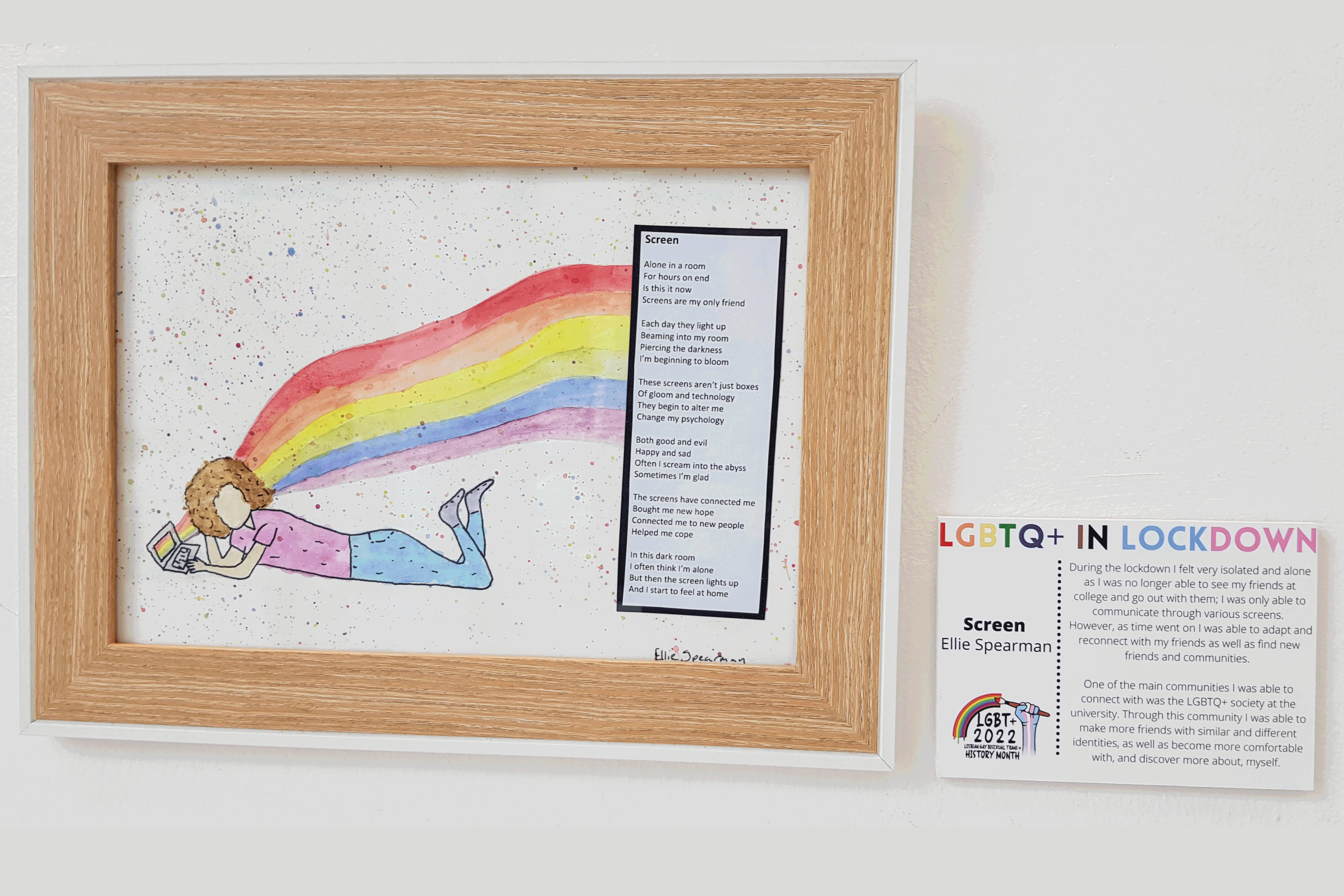
Art piece showing student on laptop with rainbow coming out of it. By student Ellie Spearman

LGBTQ+ in Lockdown student art exhibition

Our talented LGBTQ+ students have created a range of art pieces based on their experiences of ‘LGBTQ+ In Lockdown’. You can view the display in Keynes Atrium all month.

For millions of people across the UK, and the world, the Covid-19 lockdowns were a turbulent, emotional and difficult time that placed intense pressure on an individuals’ mental health. Many are still living, and struggling, with the aftereffects.

This exhibition showcases the creative talents of LGBTQ+ students at the University as they reflect on their experiences during the Covid-19 pandemic, and in particular the lockdowns throughout 2020 and into 2021.

For LGBTQ+ students, alongside the pressure of trying to juggle studies, work and the anxiety caused by the global pandemic, there was the additional pressure of being away from their university support networks, potentially being forced to live in a hostile environment, or having to pause or further delay treatment or medical processes for an unknown period of time. For many, lockdown was incredibly traumatic.

For other members of the community, the lockdowns represented an opportunity for deep self-reflection and discovery; a chance to explore their identities.

This collection of art and poetry, commissioned from over 20 student artists from the LGBTQ+ community, reflects the diverse range of feelings and experiences that are reflective of our wider community, both at Kent and beyond and offers a window into the different meanings that the word ‘lockdown’ had for students.

The artists were encouraged to reflect upon what lockdown meant for them as a member of the LGBTQ+ community, both the positives and the negatives. For some, lockdown was an experience that they hoped would never be repeated. For others, it was a period of contemplation and enlightenment. For many, it was both.

Thanks to Student Services and Kent County Council who funded this project.

Support for LGBTQ+ students

Student Support and Wellbeing will be offering a special wellbeing workshop focused on building resilience for student members of the LGBTQ+ community, particularly in light of the challenges faced in light of Covid-19. You can book your place via Target Connect. 

Further support is available via Student Support and Wellbeing. This includes mental health support, counselling and peer support groups as well as workshops. For further support resources please see the LGBTQ+ section of the University Self-help Guide.


Art piece showing student on laptop with rainbow coming out of it. By student Ellie Spearman

LGBTQ+ in Lockdown art exhibition

Our talented LGBTQ+ students have created a range of art pieces based on their experiences of ‘LGBTQ+ In Lockdown’. You can view the display in Keynes Atrium all month.

For millions of people across the UK, and the world, the Covid-19 lockdowns were a turbulent, emotional and difficult time that placed intense pressure on an individuals’ mental health. Many are still living, and struggling, with the aftereffects.

This exhibition showcases the creative talents of LGBTQ+ students at the University as they reflect on their experiences during the Covid-19 pandemic, and in particular the lockdowns throughout 2020 and into 2021.

For LGBTQ+ students, alongside the pressure of trying to juggle studies, work and the anxiety caused by the global pandemic, there was the additional pressure of being away from their university support networks, potentially being forced to live in a hostile environment, or having to pause or further delay treatment or medical processes for an unknown period of time. For many, lockdown was incredibly traumatic.

For other members of the community, the lockdowns represented an opportunity for deep self-reflection and discovery; a chance to explore their identities.

This collection of art and poetry, commissioned from over 20 student artists from the LGBTQ+ community, reflects the diverse range of feelings and experiences that are reflective of our wider community, both at Kent and beyond and offers a window into the different meanings that the word ‘lockdown’ had for students.

The artists were encouraged to reflect upon what lockdown meant for them as a member of the LGBTQ+ community, both the positives and the negatives. For some, lockdown was an experience that they hoped would never be repeated. For others, it was a period of contemplation and enlightenment. For many, it was both.

Thanks to Student Services and Kent County Council who funded this project. 

See more LGBT+ History Month events

love heart sweets

Valentine’s Global Hangout, 10 Feb

All students are welcome to join this fun and informal, Global Hangout to celebrate Valentine’s Day in the Colyer-Fergusson Foyer. Meet new students, take part in fun activities and create your own Valentine’s Day card for someone special in your life. Don’t miss out on our sweet treat selection too!

This Hangout will be taking place on Thursday 10 February from 12.00-13.30.

All students are very welcome, from the UK or overseas.

We look forward to seeing you there!

Register online now.

Back of camera

Get a free professional LinkedIn headshot – Tuesday 8 Feb

A professional looking LinkedIn profile is an essential aspect of enhancing your chances of securing graduate employment.

On Tuesday 8 February, 9.30-16.00, the Careers & Employability Service is offering students the chance to have a professional portrait taken by Matt Cook Photography, free of charge, which can be used for their profile.

On the day:

  • This is being run as a drop-in session, whereby you turn up, add your name to the list and are seen in turn. This enables the photographer to see as many students as possible. Please allow time to wait, if necessary.
  • Whilst we will endeavour to see all students that attend, this will be dependent on attendance numbers. We therefore cannot guarantee that you will be seen on the day.
  • It is recommended you attend in business/smart attire.

Terms of Service

The photographer will be responsible for selecting the most suitable image during the session and undertaking the necessary editing work to ensure the image is suitable. No further editing of images supplied by Matt Cook Photography is permitted. Matt Cook Photography retains the entire copyright of the image and these may be displayed online for the purposes of advertising his work.

If you do not wish for your image to be used for promotional purposes, please ensure this is clearly communicated to the photographer.

The final images will be supplied to the students via a password protected online gallery and this will be made available within 1-4 weeks following the completion of the session.

More information.

Industrial action

Industrial Action at Kent

From Professor Richard Reece | DVC Education and Student Experience

On Thursday 27 January we received notification that the University and College Union (UCU) have announced further strike days as part of the national disputes over the proposed changes to the USS Pension Scheme and over pay and conditions. This will take the form of two periods of action at Kent:   

  • 14 to 18 and 21 to 22 February   
  • 28 February to 2 March  

The UCU’s mandate for its members to take part in Action Short of a Strike (ASOS) – which includes members working strictly to contract, and not rescheduling any missed classes – remains in place until 3 May.  

As a university we regret UCU’s decision, particularly as it comes so soon after the December strike, but we do have our mitigation plans in place so that any disruption to your studies is kept to a minimum and, as we did in December, we will be keeping you updated with any developments. We will also provide you with guidance and information about what the strikes might mean for you, as well as the support available to you.  

While this is a national strike, we are continuing our talks with our local UCU colleagues to try and reach agreement on addressing what we all agree are important issues. You can read more about this on our webpages.  

With all good wishes, 

Richard 

Professor Richard Reece | DVC Education and Student Experience

Glowing globe floating above hand

Are you looking for a unique global learning experience?

We have partnered with Sharing Perspectives Foundation and Soliya to offer Kent students the opportunity to engage with peers around the world in small groups and gain practical experience in constructive communication and cross-cultural collaboration, through virtual exchange.

Opportunities Available

Climate Movements – 14 March – 13 May 2022

Explore themes around climate change, movement of people, climate refugees and politics of un/sustainability in this 9-week course.  You will have weekly 2-hr sessions where participants can exchange ideas and perspectives in their intercultural, online group, stimulated by video lectures and audio-visual materials. Apply by 14 February 2022.

Connect Collaborate – 4 April – 6 May 2022

During this 5-week course, you will engage with peers around the world in small groups, exploring the themes of Inequality or Technology (you can choose). You will meet online for weekly 2hrs meetings and in your groups, create a social media awareness campaign, and an infographic that will accompany the campaign. 

Global Circles, various dates

These 2 week facilitated dialogue sessions are ideal for those who are unable to commit to a longer course.  Availability is limited and attributed on a first come, first served basis. Learn more about the topics, dates and how to apply.  

Why join a virtual exchange?

Virtual exchange allows students to engage in meaningful, cross-cultural experiences as part of their education. It can broaden access to international learning for every student, regardless of their circumstances, background or ability. These projects provide the framework for you to develop their cross-cultural attitudes, skills, and communication in addition to improving your digital literacy skills valued by employers.

More information about these exciting new opportunities and how to apply.

Intersex progression flag

LGBT+ History Month at Kent

What is LGBT+ History Month?

LGBT+ Month is an annual nationwide celebration throughout February, which was started in 1994 to celebrate the history of the gay rights and related civil rights movements. The history month gives a focus to raise awareness of the prejudice that can still exist, but also to raise up role models, celebrate achievements, and build a more just community. This year, the national theme is Politics in Art: ‘The Arc is Long’, and we at Kent also aim to ‘educate out prejudice’ and open doors for more dialogue and visibility for everyone in our diverse university community.

Kent Celebrations

You can find the Kent LGBT+ History month programme of events on the Kent Union website, featuring both online and in person activities open to all. Look out for exhibitions in the Library and the ‘LGBTQ+ In Lockdown’ exhibition in Keynes Atrium featuring student artists reflecting on what lockdown meant for them, both positive and negative. You might like to take part in a new book club, or try some hands-on activities such as tie dye t-shirt printingpronoun badge making or Zine creating.

There are also educational webinars and seminars on ‘The Experiences of Transgender Students in Higher Education’, a series of highly exciting sessions as part of our ‘Celebrating Consent Day’, Student Support workshops on building resilience, film screenings, a Woody’s Quiz, and the chance to get tickets for the Queer Prom in March. LGBTQ+ flags will also be flying across both the Canterbury and the Medway campus. Learn about the meaning behind each of the unique colours and designs.

Support at Kent

Some of the discussions about LGBTQ+ experiences in lockdown may be challenging to engage with, or provoke feelings that you might benefit from working through in a therapeutic setting. Student Support and Wellbeing are running a therapeutic ‘Reflect, Recover and Empower’ workshop for LGBTQ+ students on 21 February, 19.00-20.30 with a particular focus on the personal impact of Covid-19 and coping with future change.

Student Support and Wellbeing offer mental health support, counselling and peer support groups to all students. You can also check out our LGBTQ+ self-help resource section online.

We have a number of ways to help and support staff, including through our EAP programme and Mental Health Allies. You can find all the information on support available to staff on our SharePoint site.

Networks and Societies

Kent operates networks and societies for its staff and student Rainbow communities. The Staff Network is open to all staff, regardless of sexual orientation, gender identity or expression. It runs a confidential mailing list as well as organising different events throughout the year to promote equality and diversity and to raise awareness of LGBTQ+ people and issues. It also organises social events so that staff can network and seek advice and support from fellow colleagues. Please email the staff network if you are interested in joining.

The LGBTQ+ Student Network acts as a voice for LGBTQ+ students to both the University and the Union and helps to ensure informed decisions are made on a practical and strategic level as well as planning events and networking opportunities for new and returning students. Email the Student Network if you are interested in joining.

You can also join the student LGBTQ+ Society at Canterbury and the Medway LGBTQ Society, whose primary function is to facilitate a safe space for students of marginalised gender identities and sexualities to socialise and meet other like-minded individuals, helping to develop friendships and support networks. 

Allyship

LGBT+ History Month is for LGBTQ+ people and their allies as well. If you want to learn more about being an effective ally and using your power and influence to magnify the voices of underrepresented or marginalised groups, then our online Ally resources are an excellent place to start.

Follow #KentLGBTQHM22 on social media for the latest information on what’s on, and if you would like to contribute your experience and perspective to conversations, podcasts or articles on this theme during the month, please email StudentServicesWeb@kent.ac.uk.

Written by Natalia Crisanti, Student Engagement and Communications Officer, Student Services  and Becky Lamyman, Student Equality, Diversity and Inclusivity Officer, Student Services. 31.01.22


Make your words count. Review your uni and win a £2k voucher. whatuni.com/reviews

What uni feedback – chance to win £2,000 voucher

Words have power. They can incite, or they can inspire.

And your words could literally change the course of someone’s life, by making them think differently about their future, or inspiring them to consider a city, uni or course they never previously thought of.

Whatuni is the UK’s largest source of real, honest student reviews. Reviews which give current students a voice, and help future students make really important decisions about their future.

They also give institutions insights into what students think about their experiences – what they love about where they study, and what could be improved.

Write your review for your chance to win a £2,000 voucher.