Giles Family at 75: The Characters

GA5720: Front cover artwork for the 42nd Giles annual, 1988.

This is the second in our series of blog posts celebrating the 75th anniversary of the Giles Family, drawing on the riches of the Carl Giles Archive, which has been part of the British Cartoon Archive since 2005. This series is in lieu of a physical exhibition in our Gallery space, owing to the Covid-19 pandemic.

In this post we’re going to tell you “Who’s Who” in the Giles Family! We’ve included lots of images here to give you a real taste of the characters. If it leaves you wanting more, just take a look through our archive online!!
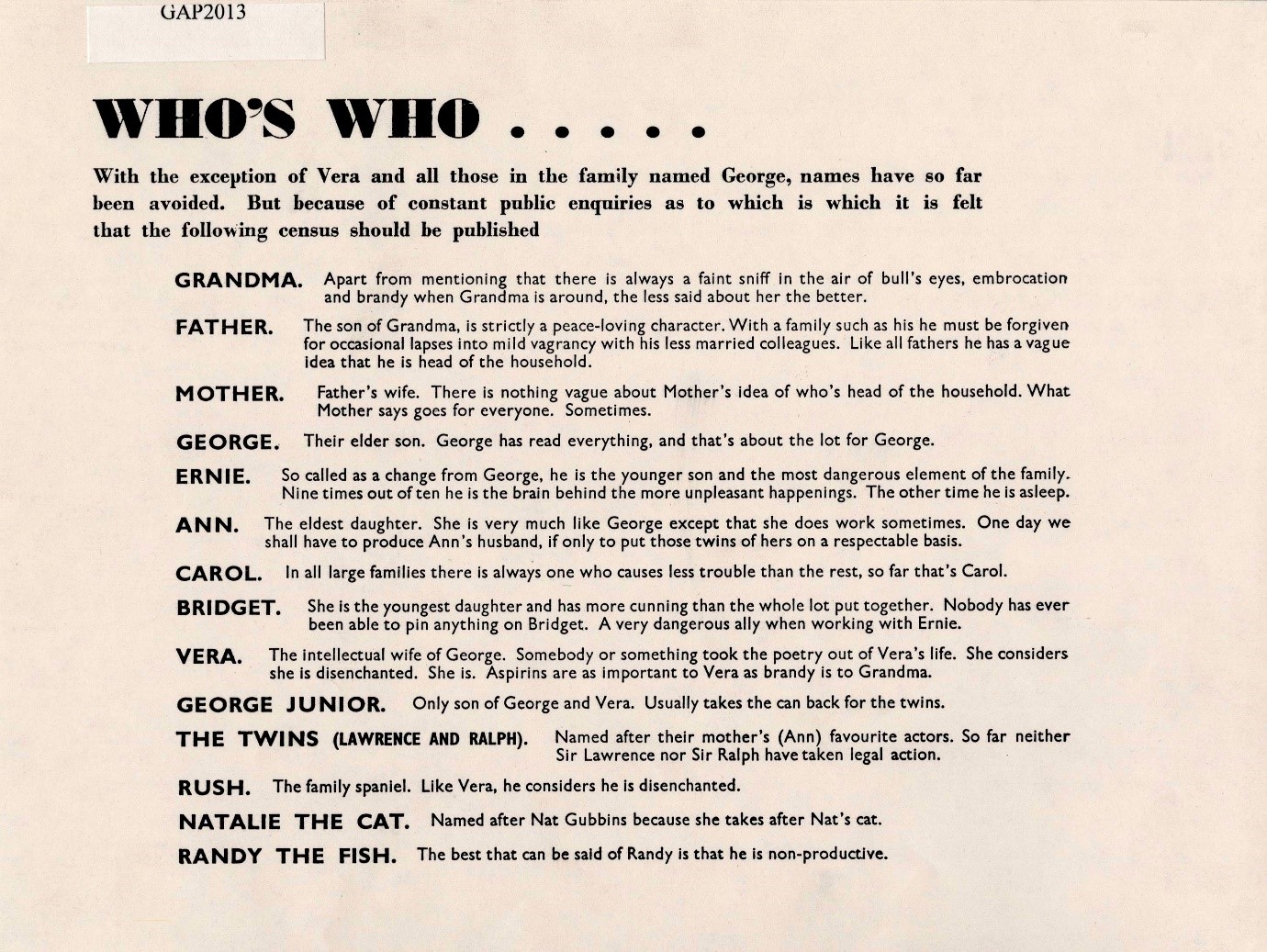
GAP2013: The Giles Family Tree, Daily Express, 23 Nov 1951.

Grandma

Probably the most famous and prolific character, Grandma Giles is the hard-drinking, bet-placing, grumpy-looking star of the family.
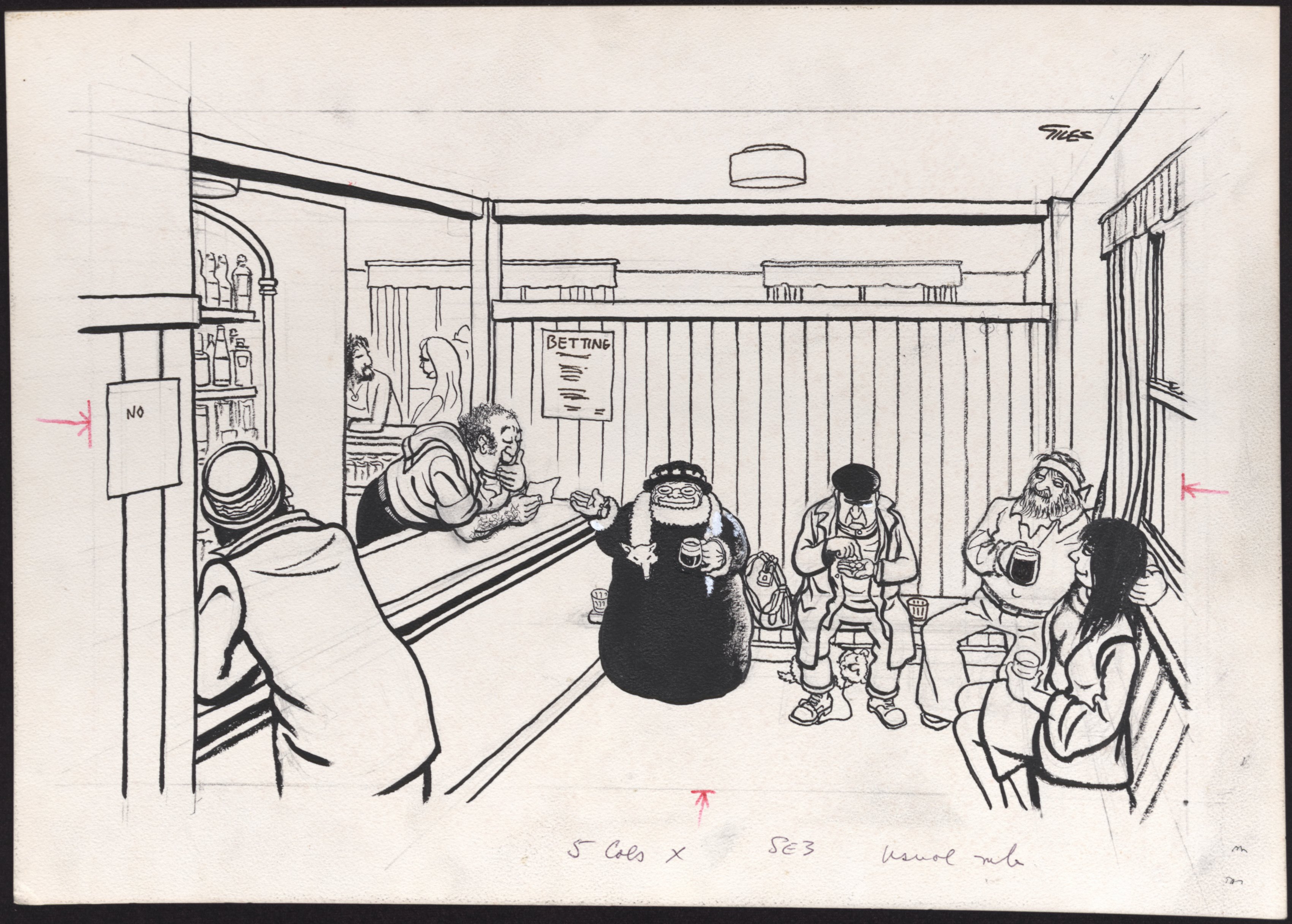
GA3715: Published caption: “Know why I think this betting slip is a forgery? Because I can’t
remember giving anyone 500-1 against Manchester United and I don’t spell Cup Final with a K”, published by Sunday Express, 22 May 1977.

Grandma can usually be found wearing her trademark black coat up to the neck, fox stole, with her hat pulled down over her head and her trusty umbrella and handbag in hand. She was rarely given a voice in cartoons, but appeared in over 1400 of them over the years.
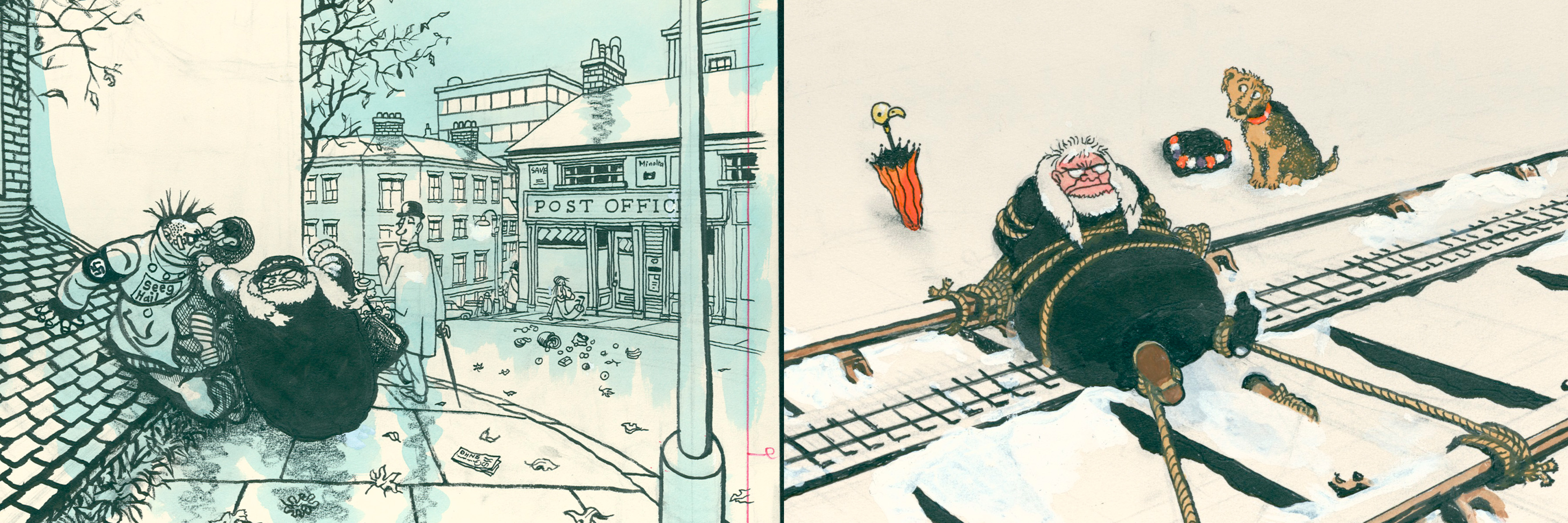
Left – GA5567: “Watch it! I can get you 2 1/2 years inside if you hit me just because I nicked your pension book”, published Sunday Express, 15 Nov 1987.
Right – GA5721: Back cover artwork for the 44th Giles annual, 1990.

Imagined to have been born as early as 1886, Grandma was a strict disciplinarian with extreme opinions; from being a royalist, to supporting hanging, to having a portrait of Lenin on her bedroom wall! Despite these… interesting… quirks of character, she is well-loved by fans of Giles’ work, and Giles was also incredibly fond of her. In fact, you could say there is some resemblance of Giles himself in Grandma…
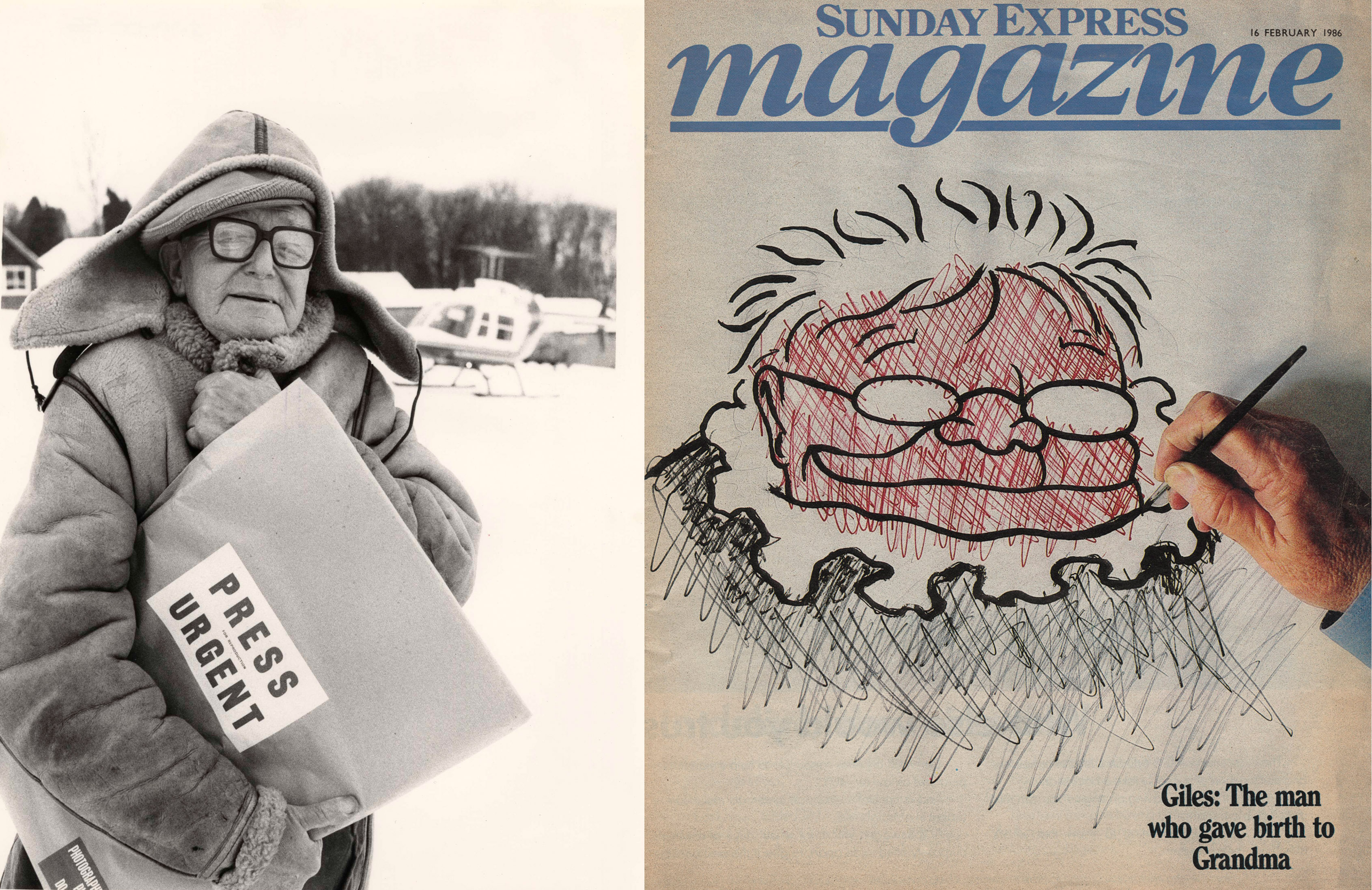
Left – GAPH00136: Black and white photo of Giles in the snow at Hillbrow Farm holding packaged artwork being collected by helicopter, 1987.
Right – GAPA0004: Front cover of ‘Sunday Express Magazine’ advertising article ‘Giles: The man who gave birth to Grandma’, published by Sunday Express, 16 Feb 1986.

Giles did admit that he occasionally considered killing off Grandma over the years, but found that if he left her out of the cartoons for a few days he would receive complaints from Daily Express readers asking when she was going to reappear!

The last cartoon featuring Grandma that we have in the archive was published in the Sunday Express, on 2nd June, 1991. In this cartoon she is uncharacteristically dressed in a winter fur coat, scarf and woolly hat, a comment on the cold June of 1991.
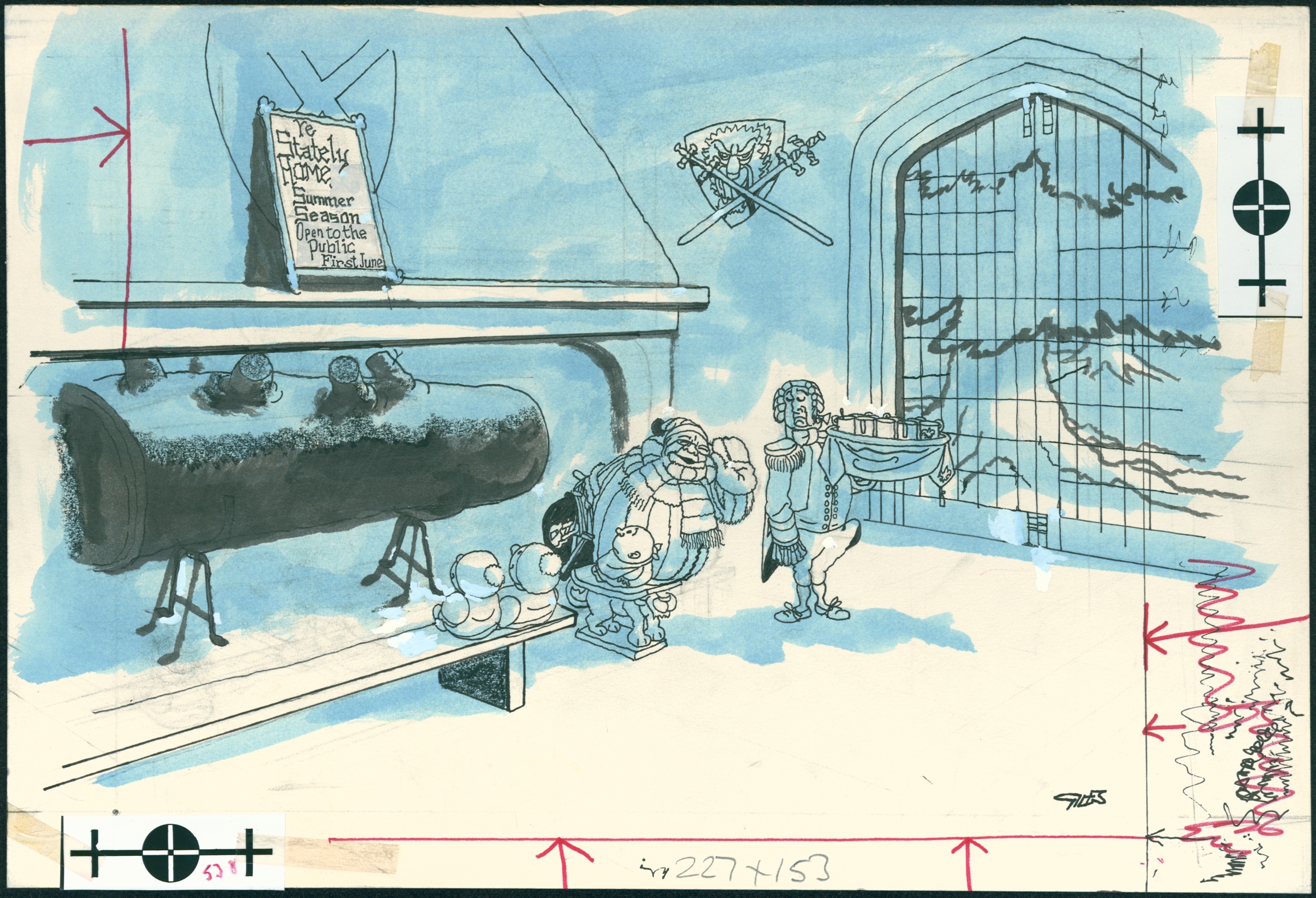
GA5382: “Do you think his Lordship would mind if we put a match to it?”, published by Sunday Express, 02 Jun 1991.

Father

Considering himself the Head of the family (when we all know it’s actually Grandma!), Father was a mild and philosophical character.
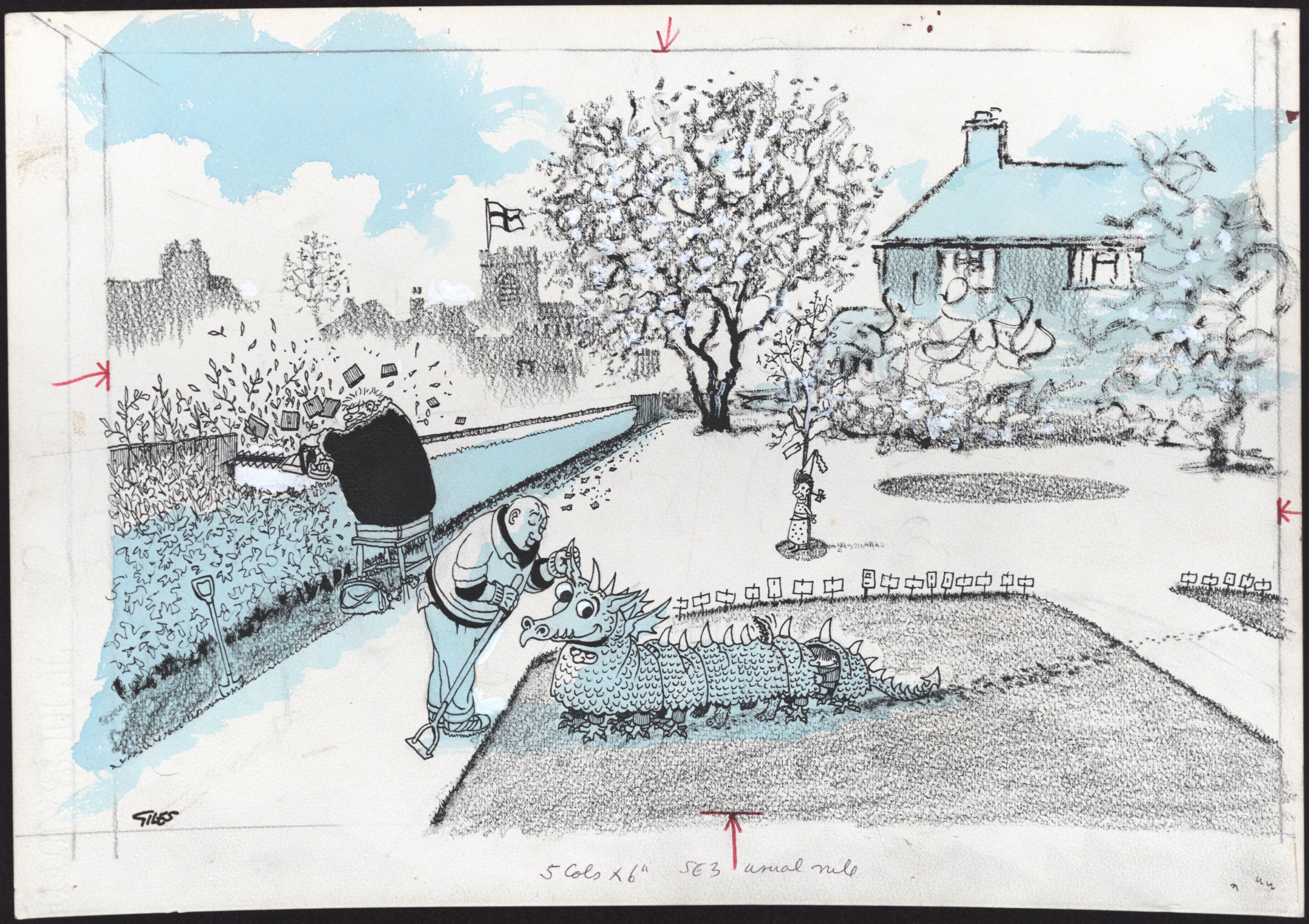
GA3862: “St. George to Dragon – I give you ten seconds to get off my new
flower bed – over and out”, published by Sunday Express, 23 Apr 1978.

A firm favourite, appearing in over 1100 cartoons, Father had served in both World Wars and just wanted a quiet life where he could enjoy sports and relax. He was a working Dad, although we were never given an explanation of what exactly he did for a living!  His given name was also George Giles, but being that there are two other George’s in the family, he was always referred to as Father. He was imagined to be 60 years old, and was also, of course, a Grandfather.
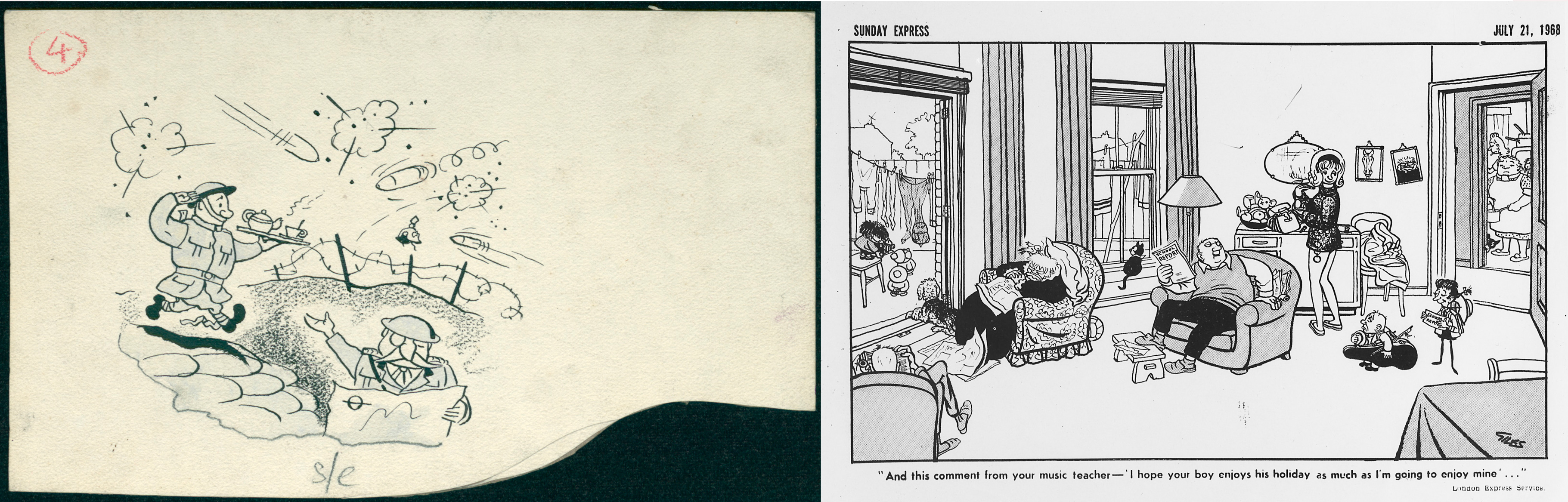
Left – GA5389: “1914-18 found him winning his first war”, published by Daily Express, 05 Jan 1950.
Right – GAN1798: “And this comment from your music teacher – ‘I hope your boy enjoys his holiday as much as I’m going to enjoy mine’…”, published by Sunday Express, 21 Jul 1968.

In the early days of the Family cartoons Father was depicted wearing the typically working class garb of belt and braces. In later years though this changed with the times to a jumper and slacks.
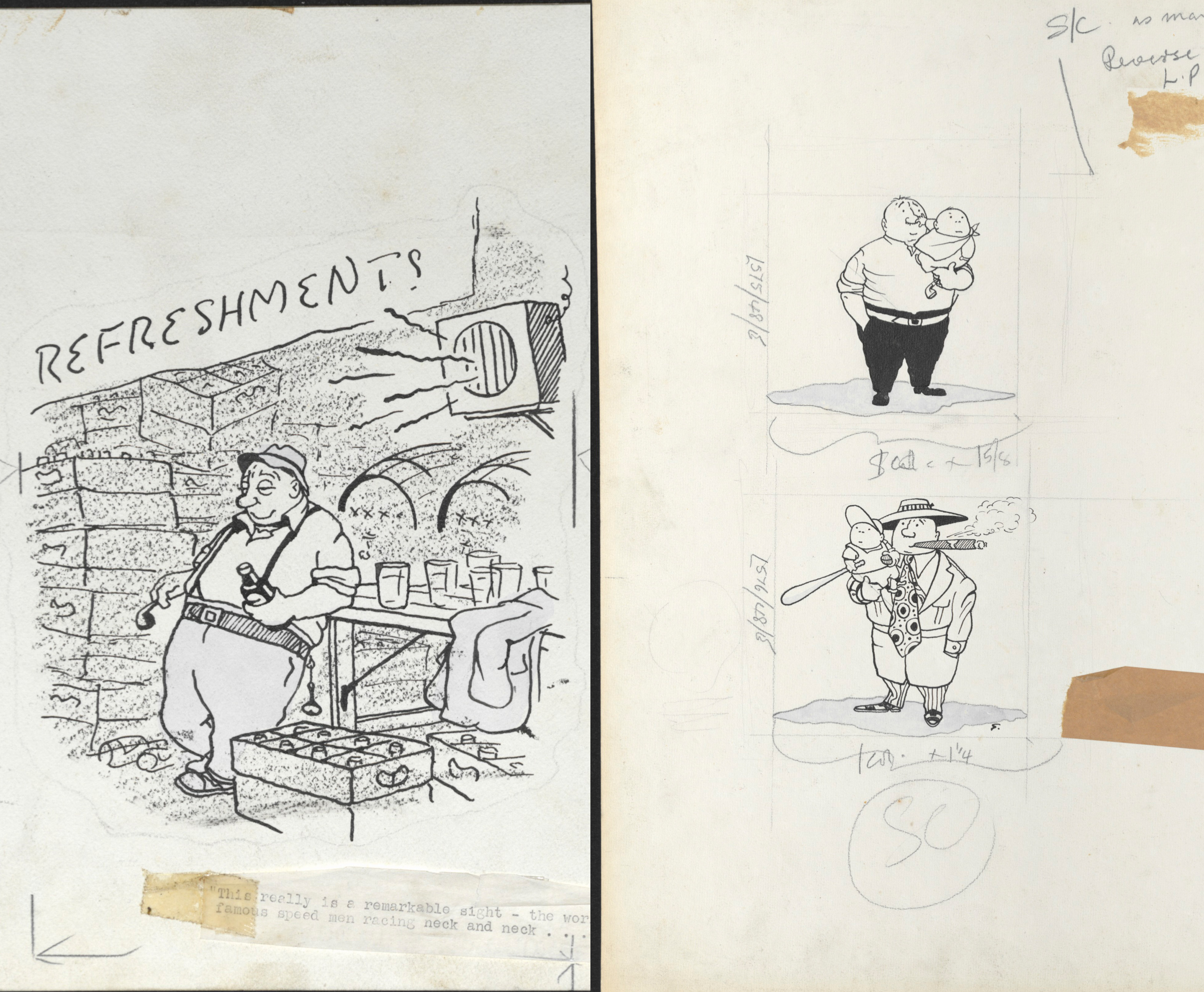
Left – GA0420: “This really is a remarkable sight – the world’s most famous speed men racing neck and neck ……”, published by Daily Express, 20 Aug 1949.
Right – GA0282: [No caption], published by Daily Express, 31 May 1948.

The final cartoon featuring Father in the archive shows him in bed, barely visible, being woken up by Ernie. Ernie is breaking it to him that “Some people are here who say Grandma has rented the house to them for Wimbledon fortnight”. Alas, a quiet life was not to be had!

GA5383: “Some people are here who say Grandma has rented the house to them for Wimbledon fortnight”, published by Sunday Express, 23 Jun 1991.

Mother

Mother is the organised, cheerful, authoritative member of the family who appeared in over 950 of the Family cartoons.

GA5395: “and Mum -“, published by Daily Express, 28 Aug 1947.

We don’t know much about her, except that she should be considered as head of the family. She is matronly, but with a kind face, and can often be found doing the housework, herding the children or serving the tea.
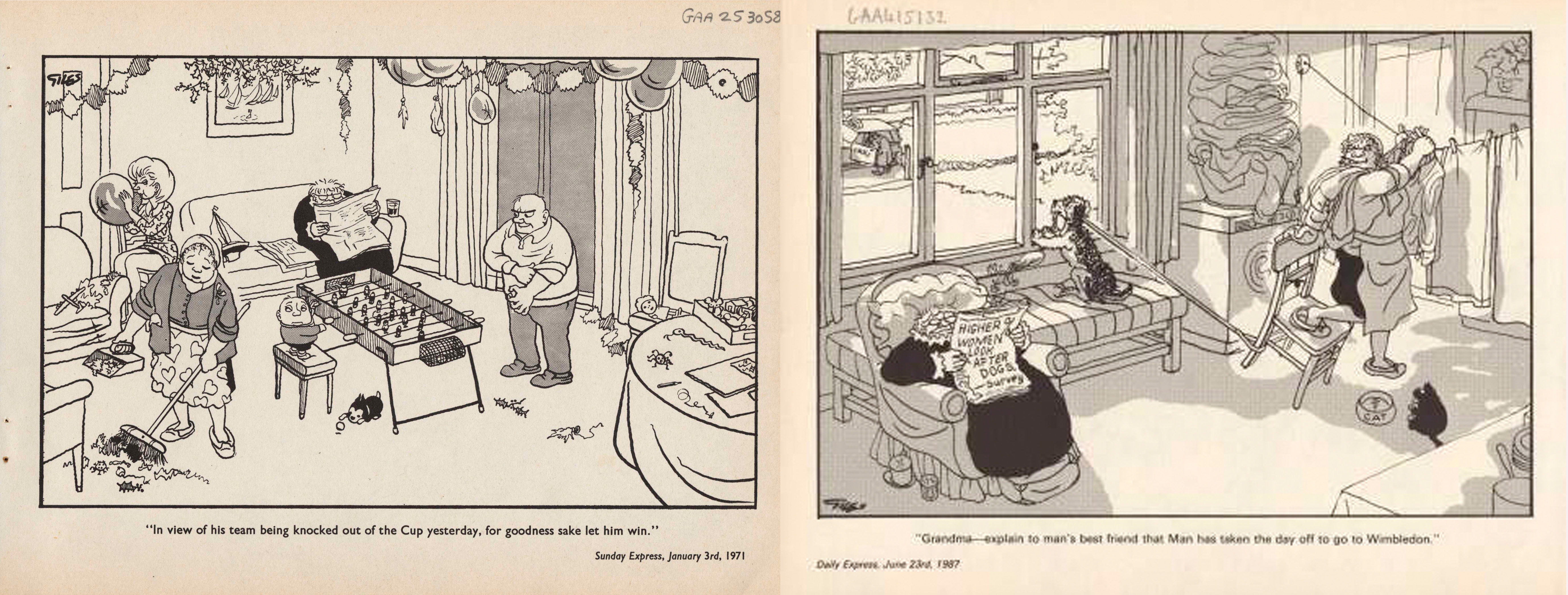
Left – GAA253058: “In view of his team being knocked out of the Cup yesterday, for goodness sake let him win”, published by Sunday Express, 03 Jan 1971.
Right – GAA415132: “Grandma – explain to man’s best friend that Man has taken the day off to go to Wimbledon”, published by Daily Express, 23 Jun 1987.


Vera & George

George, the eldest son of Mother and Father, was married to Vera, and together they had a son, George Jr. In the early Family cartoons there was elder son, illustrated with an Eton collar and bowtie (seen behind Vera in the image below), but he had disappeared by the time the Family canon was established.
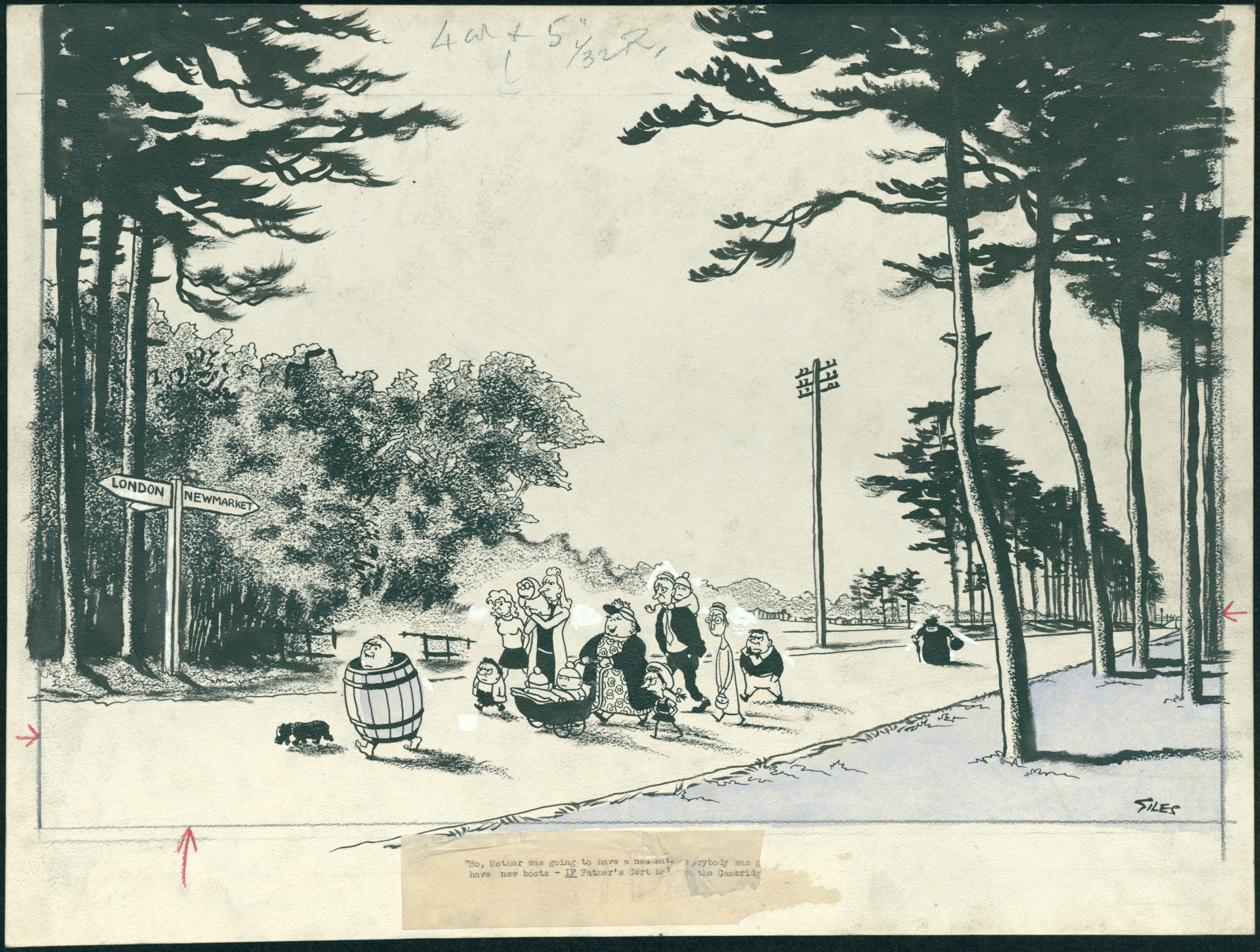
GA0226: “Ho! Mother was going to have a new hat, everybody was going to have new boots – if father’s cert had won the Cambridgeshire”, published by Daily Express, 26 Oct 1947.

George could usually be found smoking a pipe and reading a book. He rarely spoke, and was quite absent in the later Family cartoons, only featuring in around 400 in total. He could often be spotted in the background hunched over in a chair, dawdling behind the rest of the family, or with his back to the viewer not noticing the chaos around him.
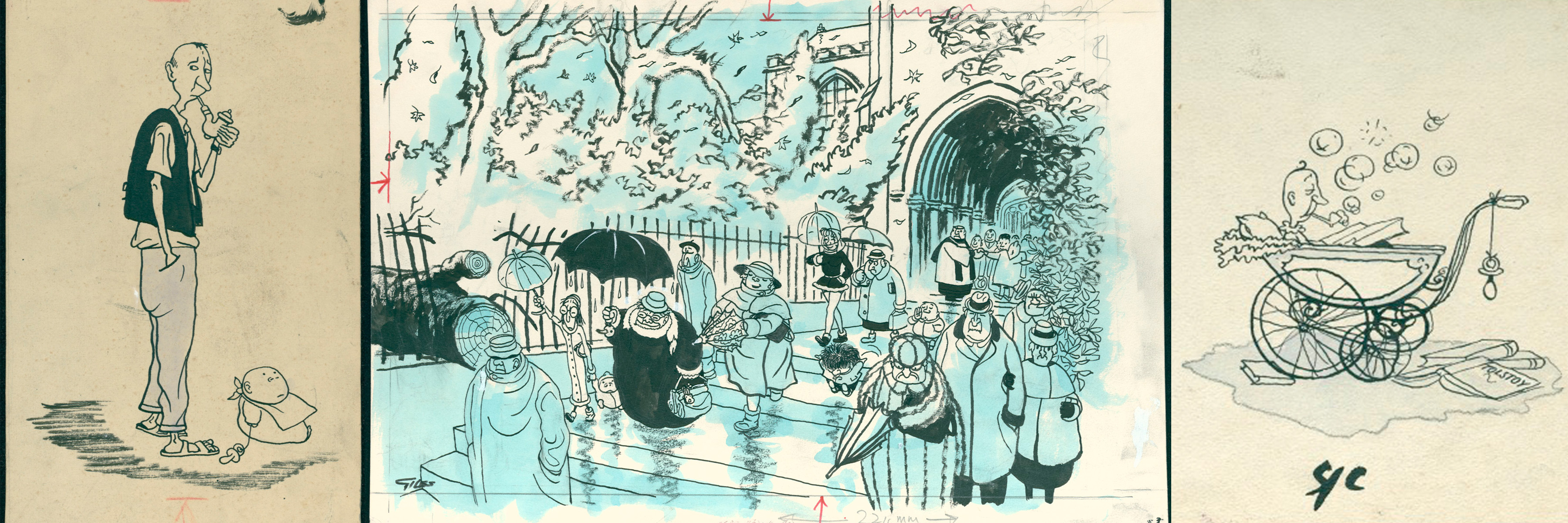
Left – GA5398: “and our eldest son George and his baby”, published by Daily Express, 28 Aug 1947.
Middle – GA5118: [no caption], published by Sunday Express, 01 Nov 1987.
Right – GA5388: ” Before long a beautiful thing came into his life – his first son, George”, published by Daily Express, 05 Jan 1950.
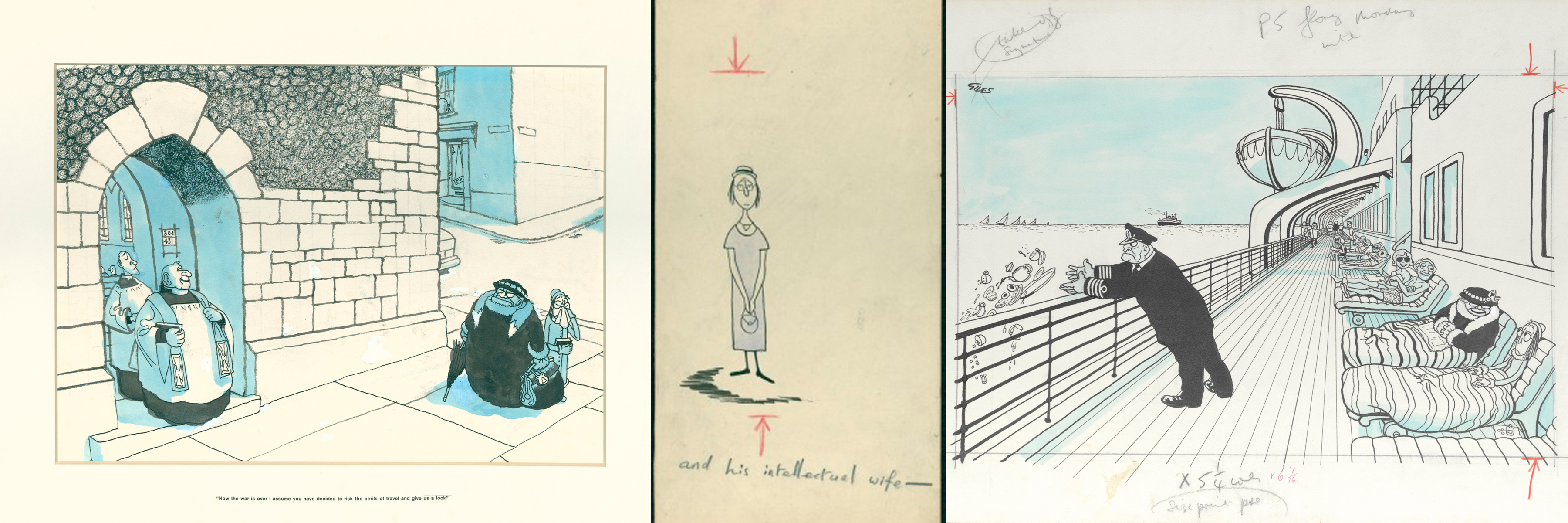
Vera on the other hand, appearing in over 750 cartoons, was often found at Grandma’s side, looking rather ill and put upon. She was originally depicted as a bit of an intellectual, reading poetry alongside George, but as time wore on she became more meek and frail, frequently ill with a cold, constantly worrying, or clutching a bottle of aspirin!

Left – GA5778: “Now the war is over I assume you have decided to risk the perils of travel and give us a look”, published by Sunday Express, 03 Mar 1991.
Middle – GA5399: ” and his intellectual wife”, published by Daily Express, 28 Aug 1947.
Right – GA2070: “I’ve told you before not to give your tray to anyone in a uniform. They’re not all stewards”, published by Daily Express, 15 Jan 1964.

The kids: George Jr, the Twins and Ernie (and Stinker!)

It’s not tricky to spot the kids in the cartoons of the Giles Family; after all they appeared in over 900 of them! Miniscule in stature, the kids were the often chaotic, and always cheeky, element of the Family.
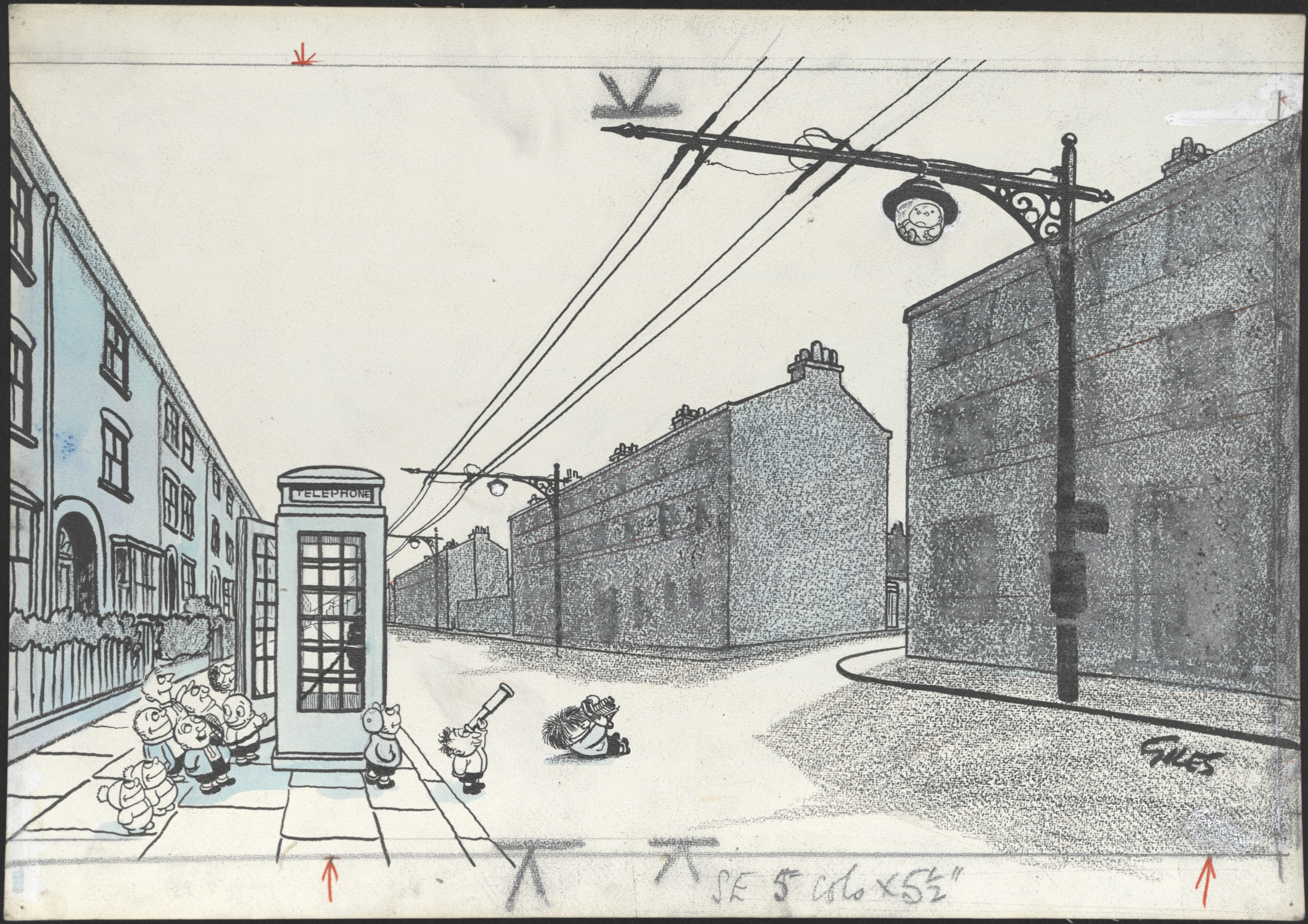
GA1378: “Fire Brigade? We wish to report we’ve just launched Sputnik 3”, published by Sunday Express, 10 Nov 1957.

The youngest child of Mother and Father, Ernie, was referred to by Giles as “the most dangerous element of the family”! He was often the centre of the chaos, with a weapon of some sort in his hand, and followed by his gang of tiny troublemakers. He was a reincarnation of an earlier Giles character of the same name, who appeared in a comic strip in the early 1940s. In looks, he is a miniature version of Father and he became less anarchic over time, with the chaotic torch being handed to his friend, Stinker, in later years.
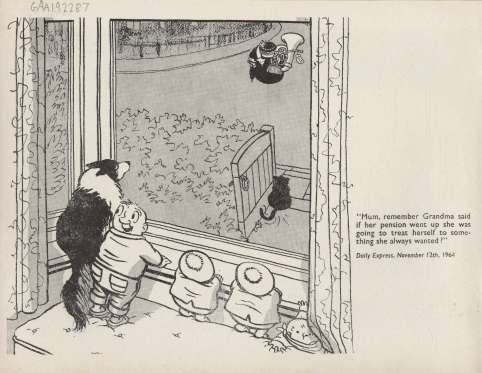
GAA192287: “Mum, remember Grandma said if her pension went up she was going
to treat herself to something she always wanted?”, published by Daily Express, 12 Nov 1964.

Talking of Stinker…

With his trademark black hair, Stinker was not a relative of the family but was a strong presence, appearing in over 800 cartoons, even going on holiday with the family. Stinker was of course a nickname, his actual name being Larry Wilmott. He never spoke but was well loved by many fans, with even Giles speaking of him as “a favourite in a way”.

Left – GAPC0355: Giles cartoon on the cover of the Ipswich Sixth Form rag magazine (Volume 1, 1980), with caption: “We care – do you?”, published by Ipswich Sixth Form, 1980.
Right – GAPC0244: Part of cover cartoon in booklet ‘Safe hands on the Land’, published by The Royal Society for the Prevention of Accidents, published by Royal Society for the Prevention of Accidents, 1956.

The smallest of the grandchildren is George Jnr. Baby George often looks bewildered, is usually wearing a bib around his neck, and is seemingly without legs, having only little feet. In a number of images he appears to be staring out at the viewer, breaking “the 4th wall” of the cartoons. Perhaps he is pleading for aid, or maybe it’s his way of saying “Really?!?!”
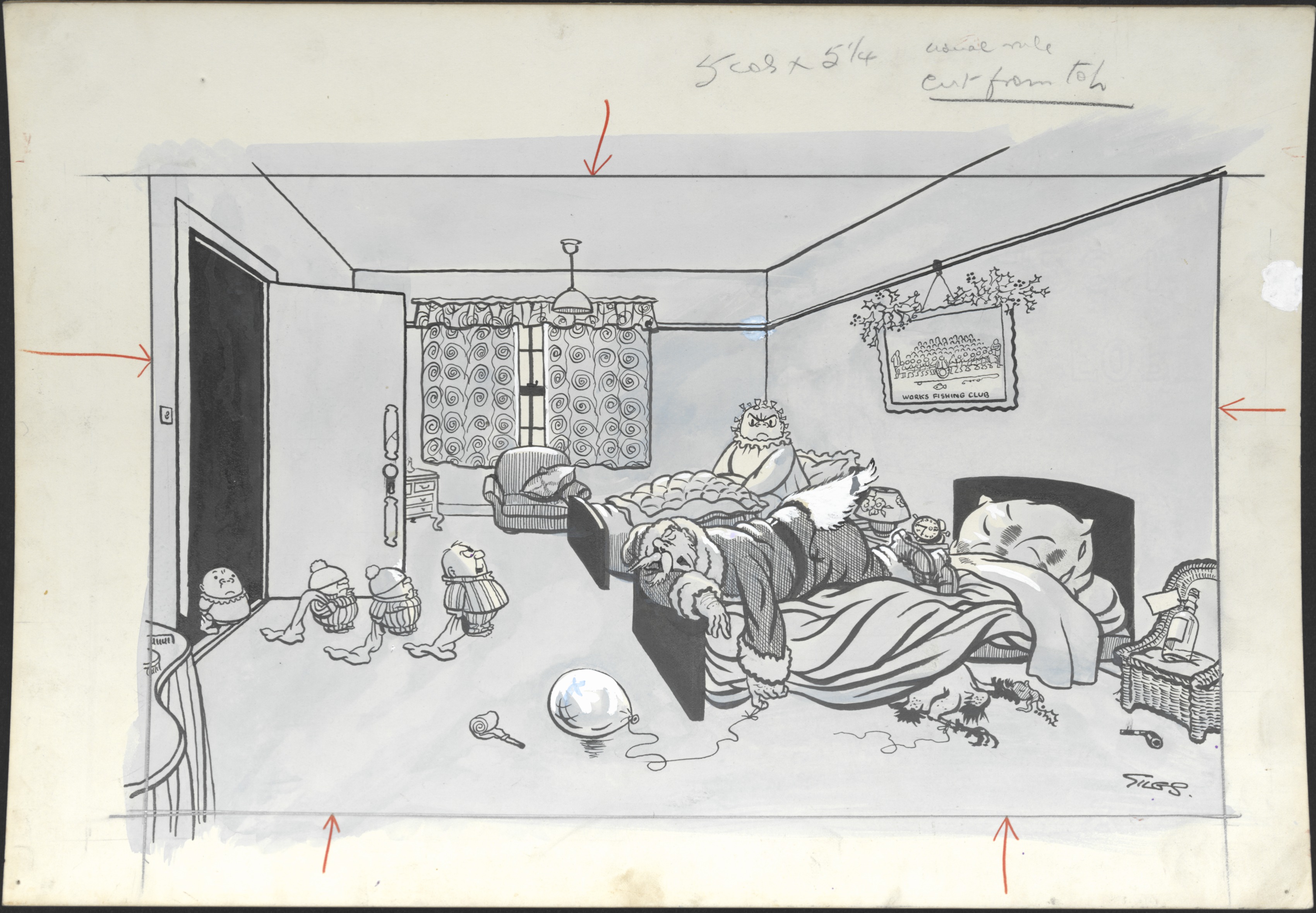
GA1147: “This delegation wishes to register a strong protest about Father Christmases who come home late and forget to fill our socks”, published by Sunday Express, 25 Dec 1955.

The twins, Laurence and Ralph (arguably the cutest of the group), are always found together in their matching outfits, and were named after their mother Ann’s favourite actors, Sir Laurence Olivier and Sir Ralph Richardson.
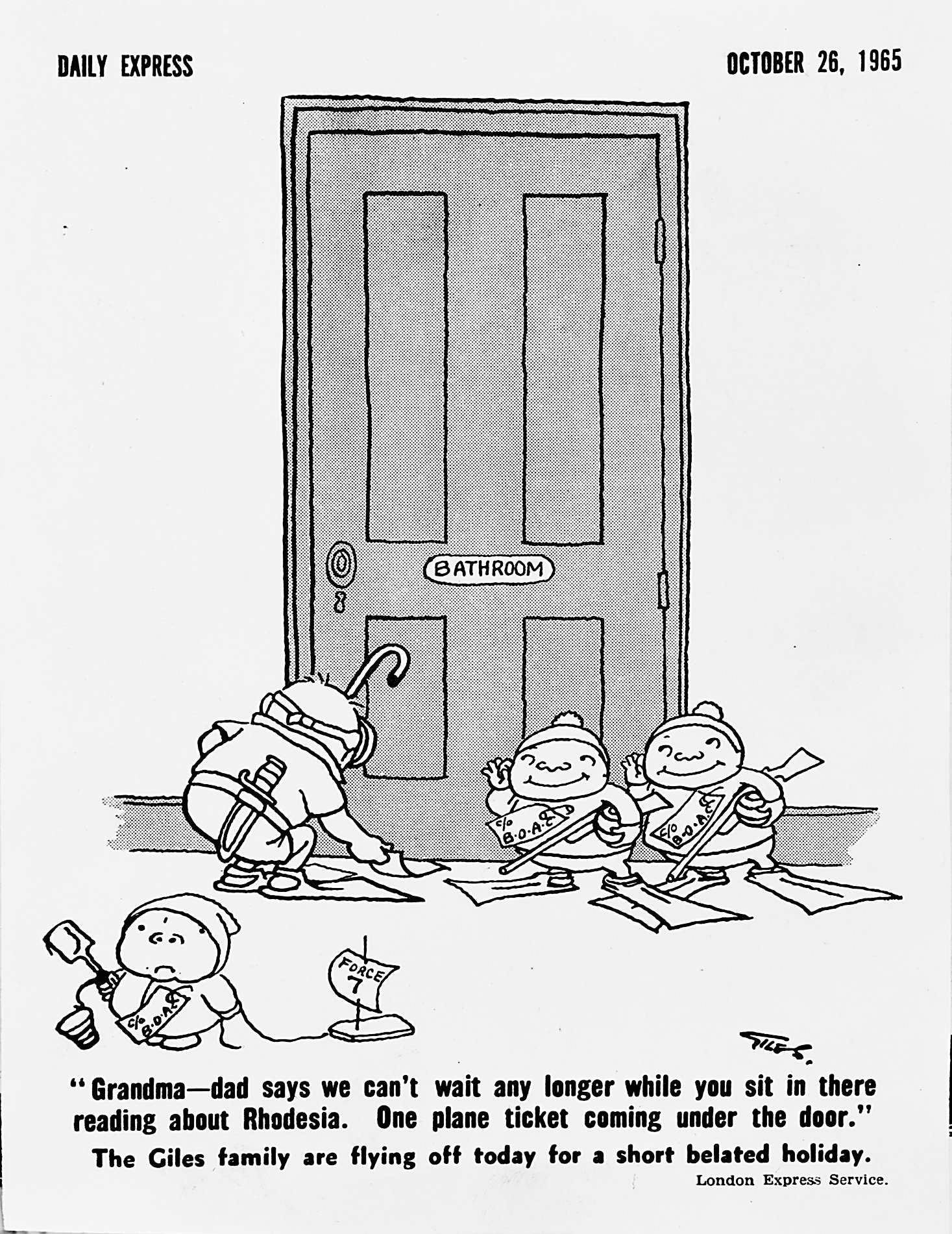
GAN1411: “Grandma – dad says we can’t wait any longer while you sit in there reading about Rhodesia. One plane ticket coming under the door”, published by Daily Express, 26 Oct 1965.

Other characters

The sisters

Ann (occasionally spelled ‘Anne’) is the eldest daughter of Mother and Father. Appearing in over 450 cartoons, she is mother to the twins, Laurence and Ralph. Being the eldest, Ann is the tallest of the daughters and can usually be spotted by her distinctive quaffed fringe.
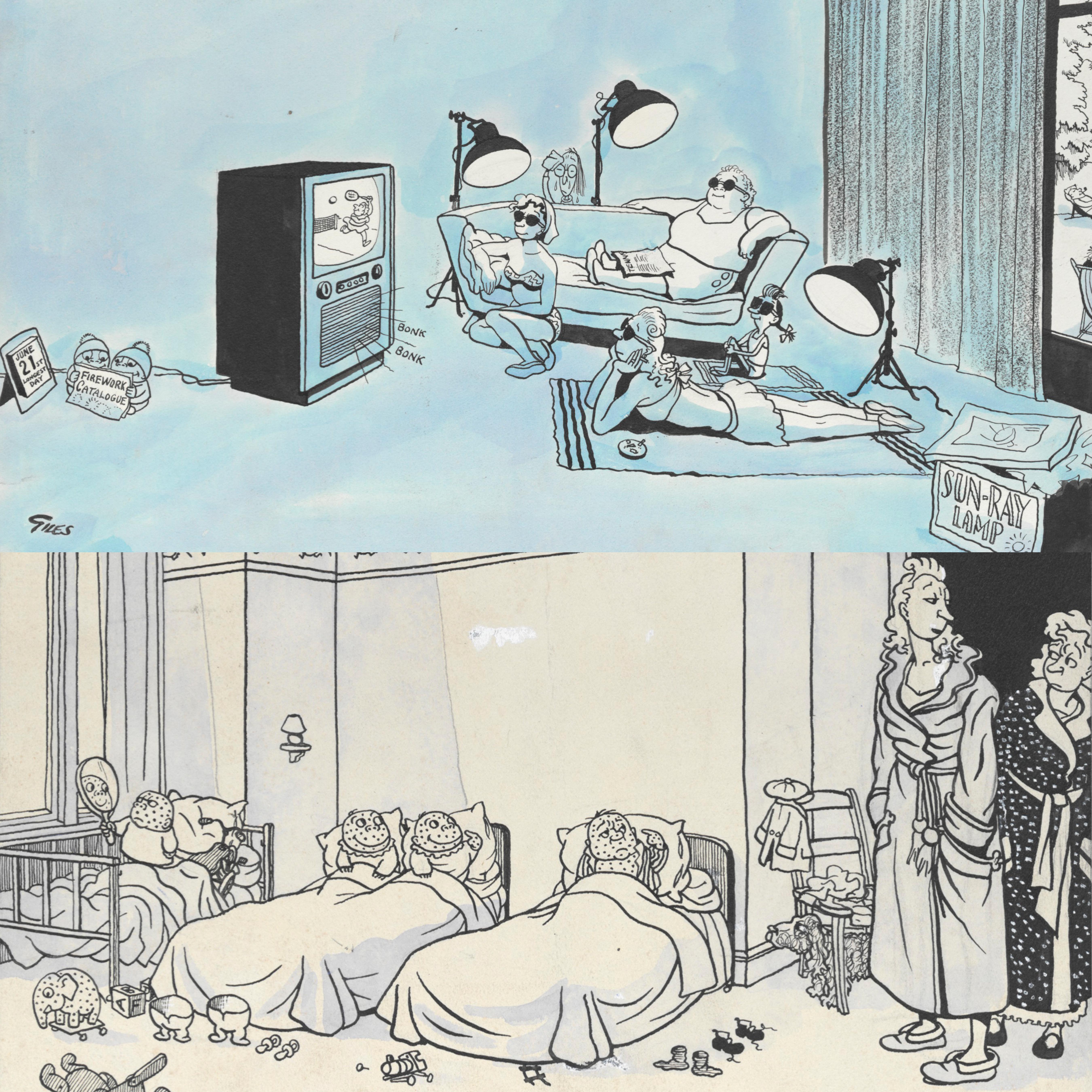
Top – GA1668: “Flaming June”, published by Daily Express, 21 Jun 1960.
Bottom – GA0718: “And only last night Dad was saying whatever the Budget result things couldn’t get much worse”, published by Daily Express, 11 Mar 1952.

The father of Ann’s twins is absent, and also could be considered in dispute! A number of the Family cartoons suggest that he may have been an American G.I., however in the very early cartoons of 1947 we see what we could presume to be him, a tall man covering his eyes on the stairs…
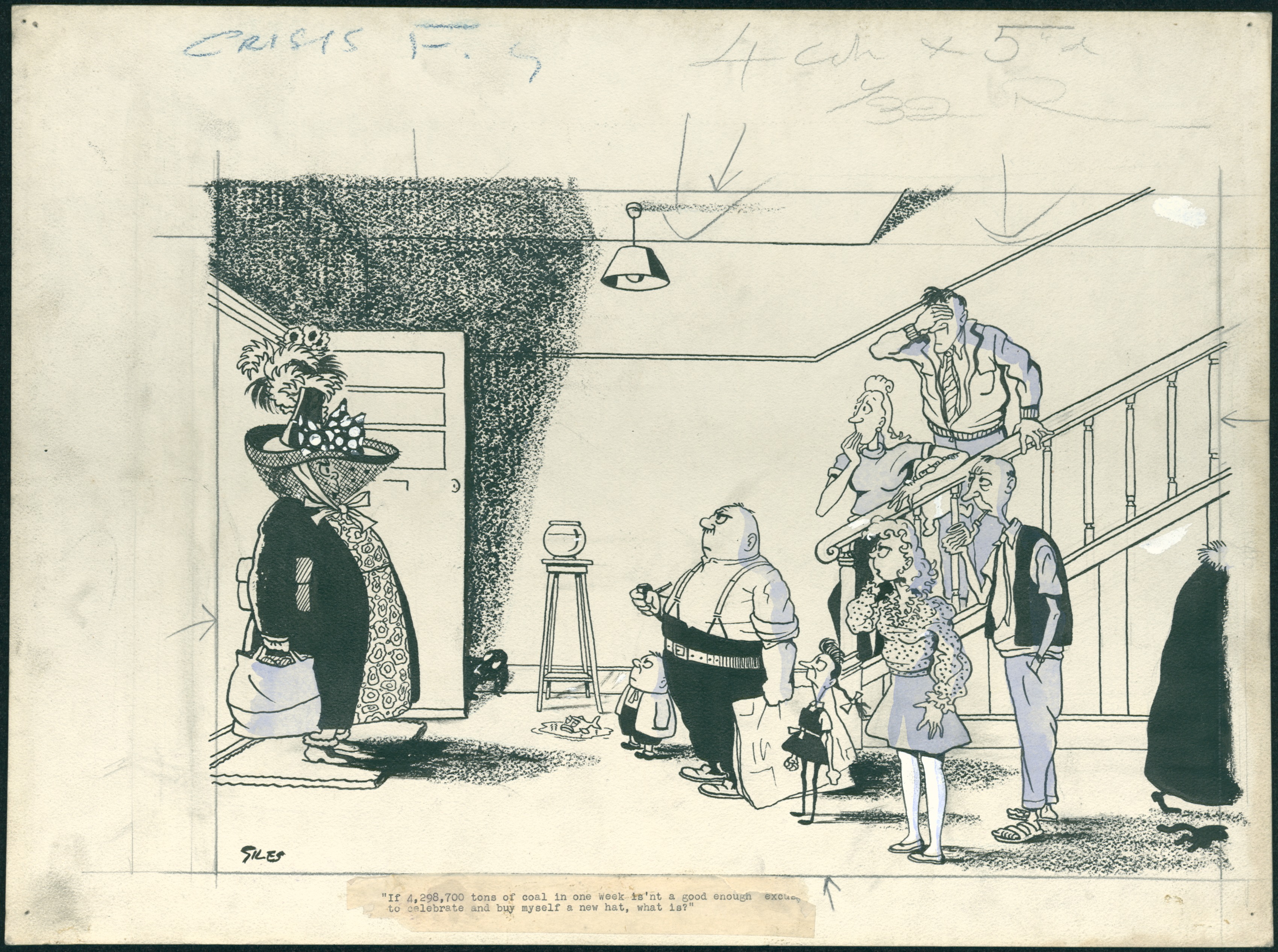
GA0235: “If 4,298,700 tons of coal in one week isn’t a good enough exuse to celebrate and buy myself a new hat, what is?”, published by Daily Express, 11 Dec 1947.

Carol is the well behaved, often relaxed and smiling, middle daughter. She can usually be seen reading a magazine or lounging about the house.

Bridget is the youngest daughter of Mother and Father. Often wearing a gymslip or school uniform with her dark hair in a plait, she appeared in less than 600 cartoons. She is only slightly taller than her young nephews, but in comparison is incredibly gangly, as opposed to their bouncier, rounded stature.

Left – “Get in the queue if you want to take advantage of the new reduced telephone charges to the United States”, published by Daily Express, 02 Feb 1967.
Middle – GA5396: “the girls”, published by Daily Express, 28 Aug 1947.
Right – GA3602: “Thank goodness he didn’t win – we’d never have got him up on the top one”, published by Sunday Express, 25 Jul 1976.

It’s been noted that on at least two occasions Giles switched the names of Carol and Bridget, presumably accidentally, in the cartoons, such as in this example…

GA5777: “You’d better agree to a ‘cooling-off’ period before you meet Bridget’s latest boyfriend”, published by Sunday Express, 23 Apr 1972.

In the early days of the Family cartoons there was an appearance of an American daughter, seen in the cartoon below. It’s been suggested that she married an American GI and moved to America with him after the war.
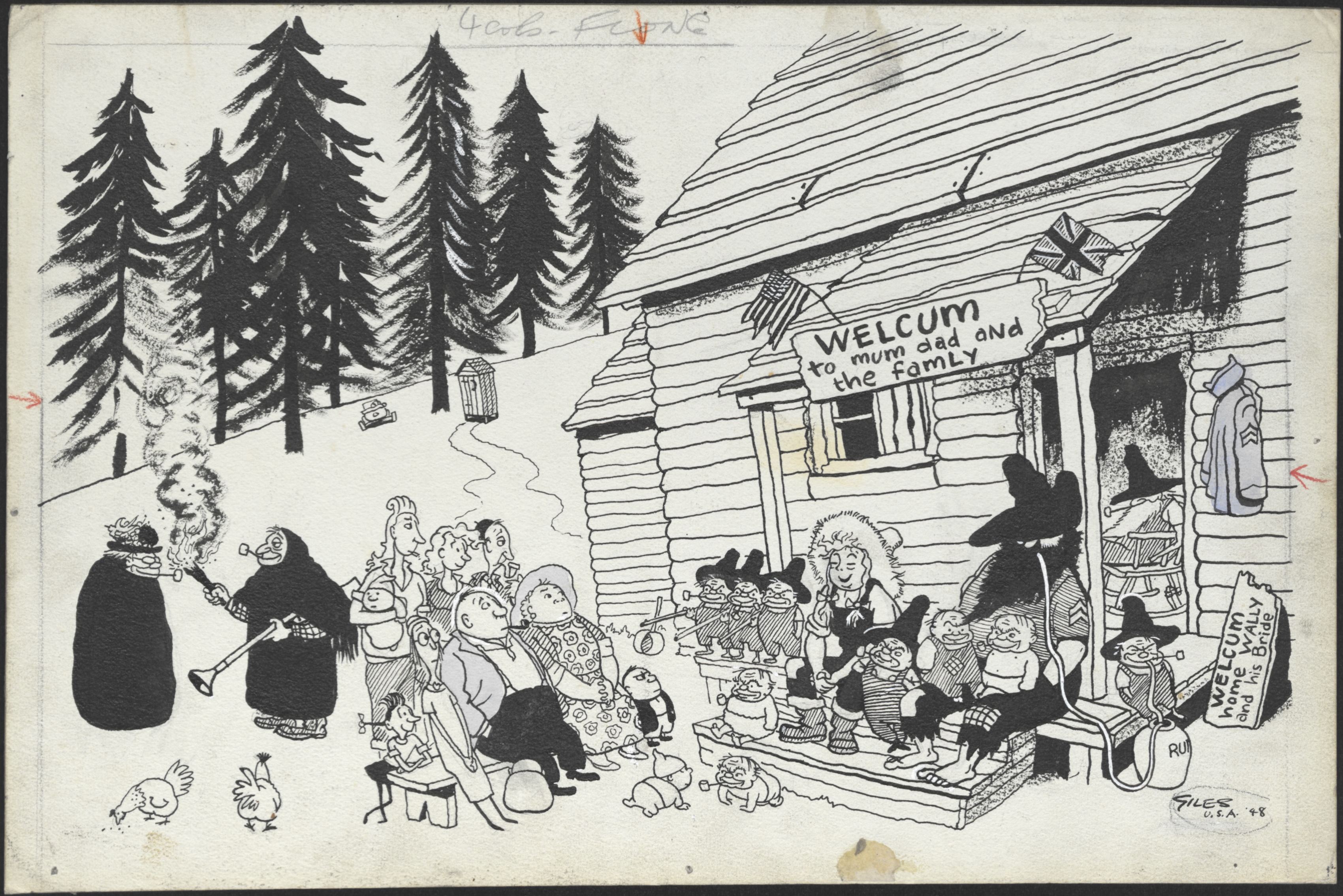
GA0302: “Well, folks – when we arrived from England, Wally pointed out that there were other things in America besides skyscrapers”, published by Daily Express, 03 Aug 1948.

Chalkie

Chalkie the schoolmaster appeared in c.400 cartoons and was a sarcastic, skeletal looking figure. He was inspired by Giles’ real life school teacher, Mr Chalk, who Giles harassed along with his gang of friends whilst at Barnsbury Park School in London.

Left – GA2046: “Any Prime Minister who looks that much like Chalkie’s had my vote”, published by Daily Express, 24 Oct 1963.
Right – GA1742: “All this fuss about schoolchildren being compelled to wear uniforms would surely be solved if only the head and teachers had to wear the uniform as well.” – Reader’s letter, published by Daily Express, 09 Mar 1961.

The pets

The Giles Family had a number of pets over the years, there was Attila the Hun (the parrot), Butch and Rush (the dogs, an Airedale Terrier and Border Collie respectively), Natalie (the cat), and Randy (the fish).
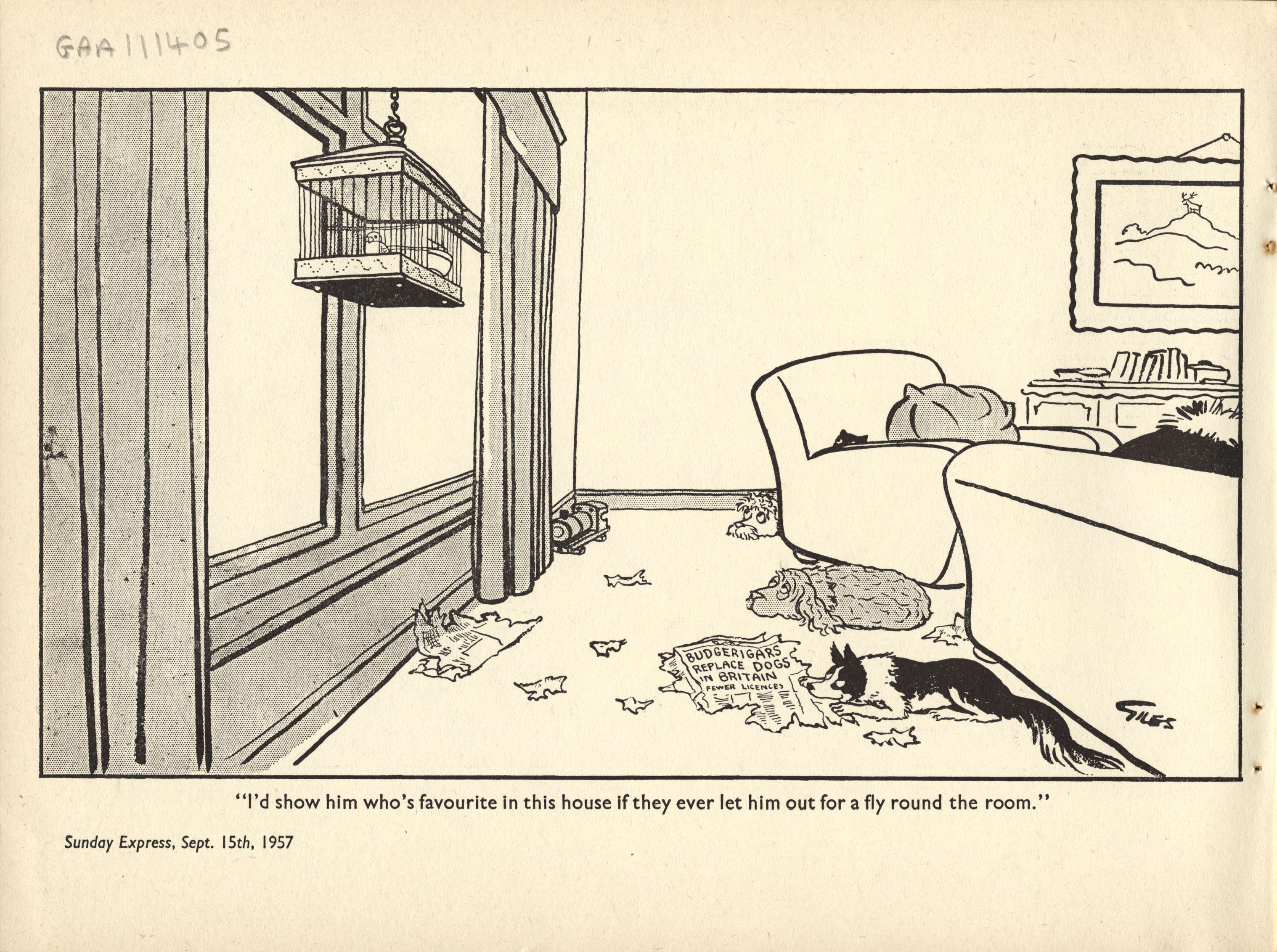
GAA111405: “I’d show him who’s favourite in this house if they ever let him out for a fly round the room”, published by Daily Express, 15 Sep 1957.
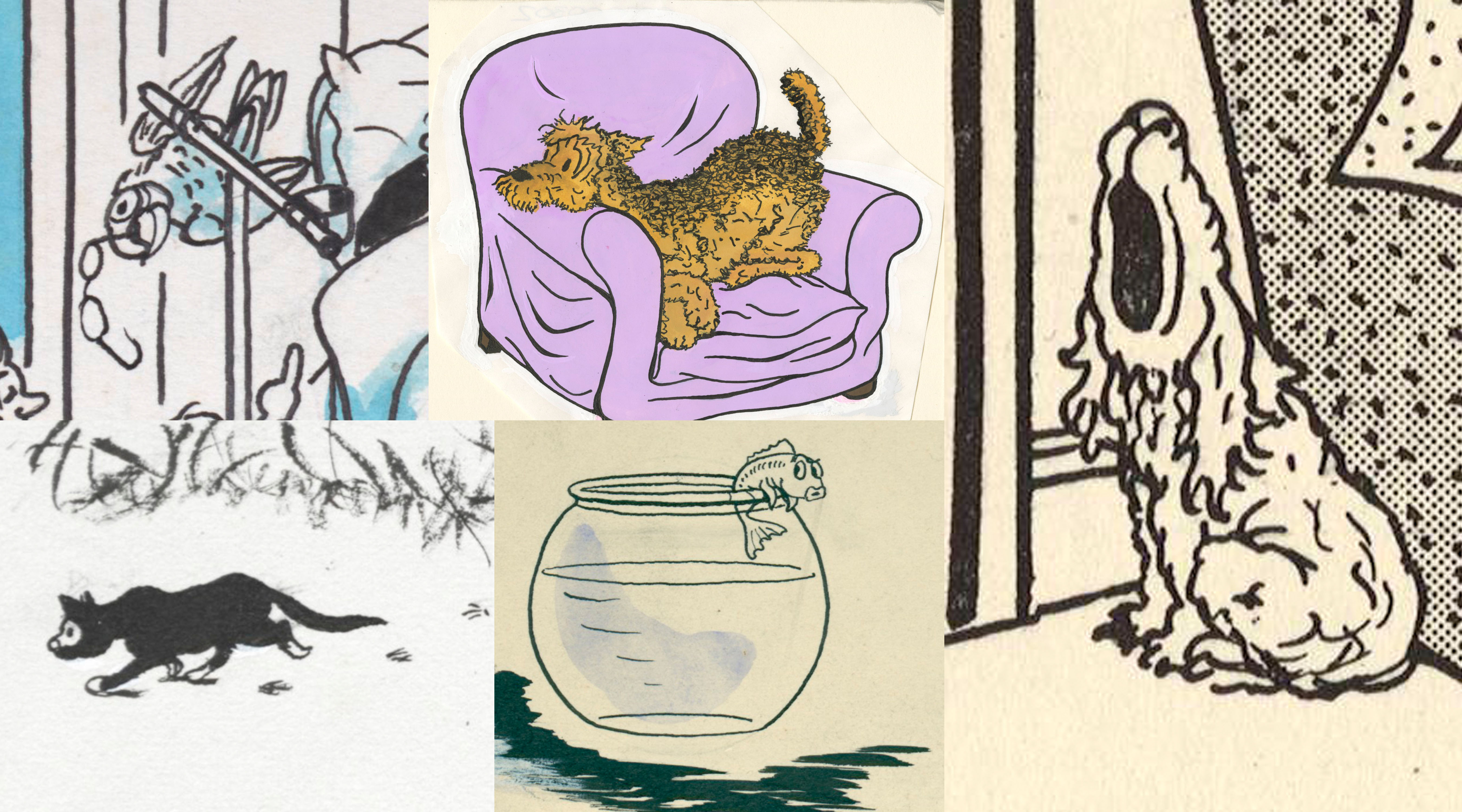
Various crops from images refs GA3134, GA4247, GA5405, GAA091103, GACE00302, published by Express Newspapers.


Some images in this blog post have been cropped. Please see archive.cartoons.ac.uk and search for the reference number cited for the full image.

A little of what you fancy..!

To celebrate the inaugural #musichallvarietyday on Saturday 16th May, 2020, we thought we’d tell you a bit about one of our magnificent theatre collections, the Max Tyler Music Hall Collection!

In June 2018 Special Collections & Archives were lucky enough to receive the personal music hall memorabilia collection of Max Tyler.

Who was Max Tyler?

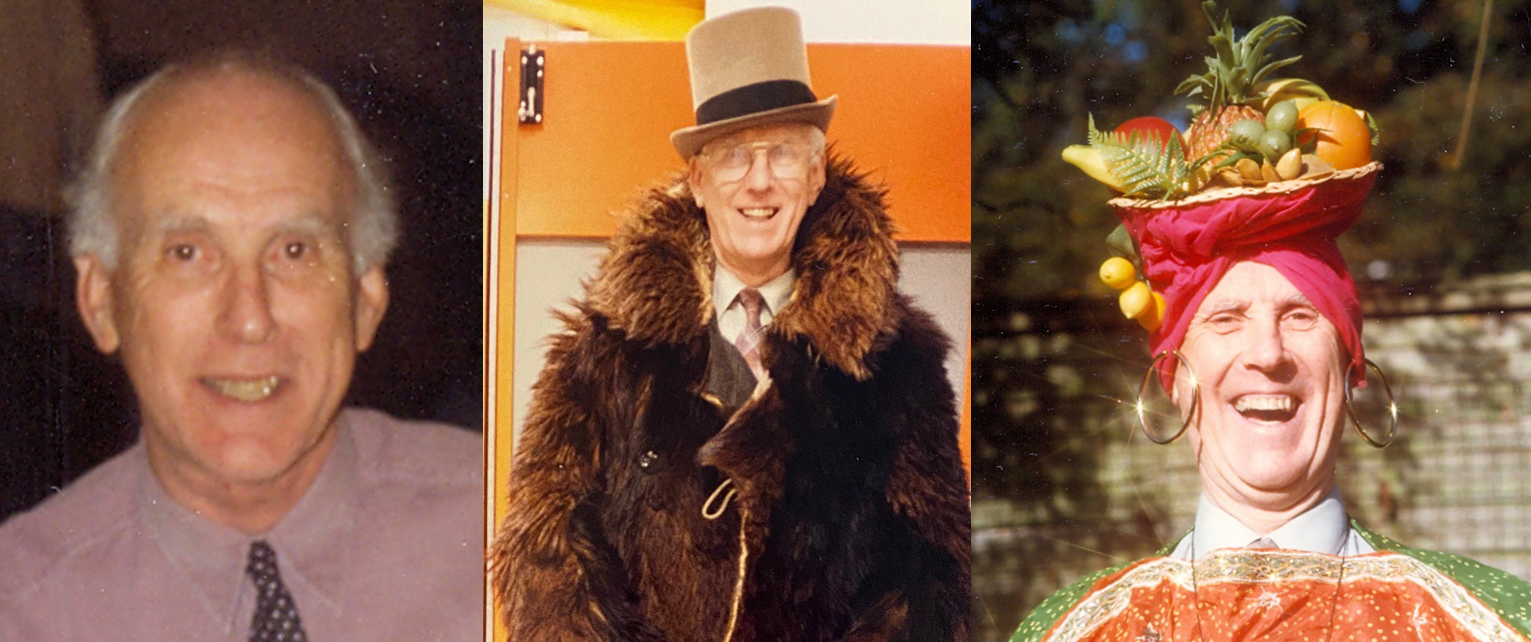
Max was the historian and archivist of the British Music Hall Society. A retired bank manager, Max looked after the society’s theatrical memorabilia and was an expert in the field, particularly in the subject of seaside entertainment and obscure music hall tunes!

­­

Photographs of Max Tyler. Left and right images courtesy of Alison Young, middle image from the Max Tyler Music Hall collection.

Max was often invited to speak at events all across the UK and frequently wrote articles for publications such as The Call Boy and The Stage, and was the editor of the journal Music Hall Studies. According to the Music Hall Studies website, it was Max’s belief that “if there were no other source relating to British social history for a long period around the turn of the nineteenth century, a study of music hall song would provide everything researchers were seeking”.

Max had been in talks with us for many years about his personal collection of music hall memorabilia and research, with him ultimately bequeathing it to the University. Sadly, Max passed away on 5th January 2018 after being in poor health for some time. In his obituary in The Call Boy, Roy Hudd said of Max, “Max Tyler, an old fashioned gentleman and an old fashioned gentle man”.

After his death we worked closely with the British Music Hall Society to transfer the collection to our archive.

Music Hall? What’s that!?

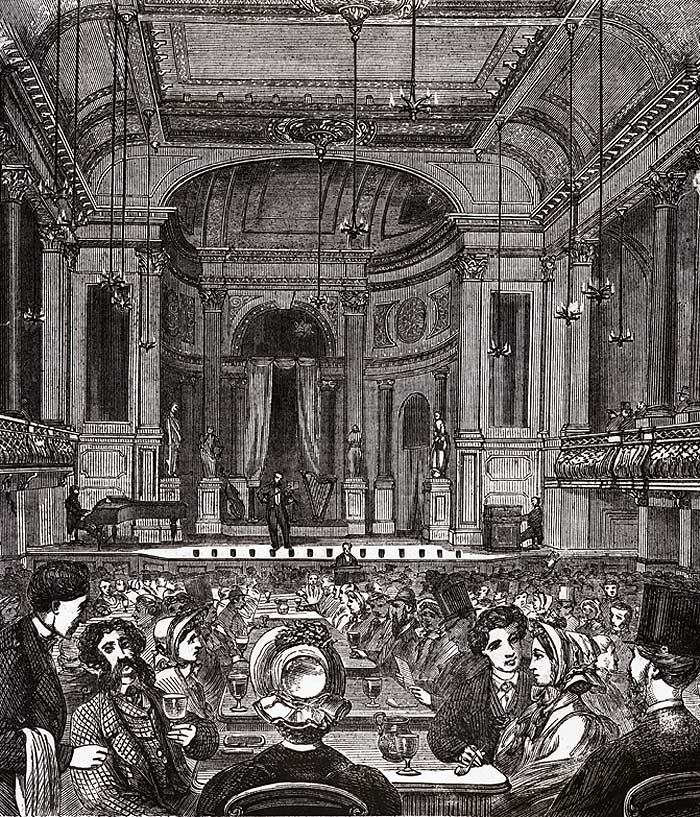
Music hall was an incredibly popular form of entertainment from the mid-19th through to the early 20th century. Originating in bars and public houses, it was a heady mixture of popular songs, comedy and variety entertainment.

Oxford Music Hall, 1875

From around 1850 specialist music halls began springing up all across the country as the genre became more and more popular. The patrons would smoke, eat and drink whilst enjoying the humorous (and often cheeky) performances from that night’s entertainers. These entertainers were the celebrities of the day, with the most successful ones, such as Marie Lloyd, performing both nationally and internationally. The songs they sang were often a comment on the working class social issues of the time, such as money troubles, overcrowded living, unfaithful or nagging spouses, and sometimes even true love!

As the 20th century progressed and World War loomed, music hall popularity dwindled. Then came radio, cinema, and later, television, firmly putting an end to its ubiquitous popularity.

The collection

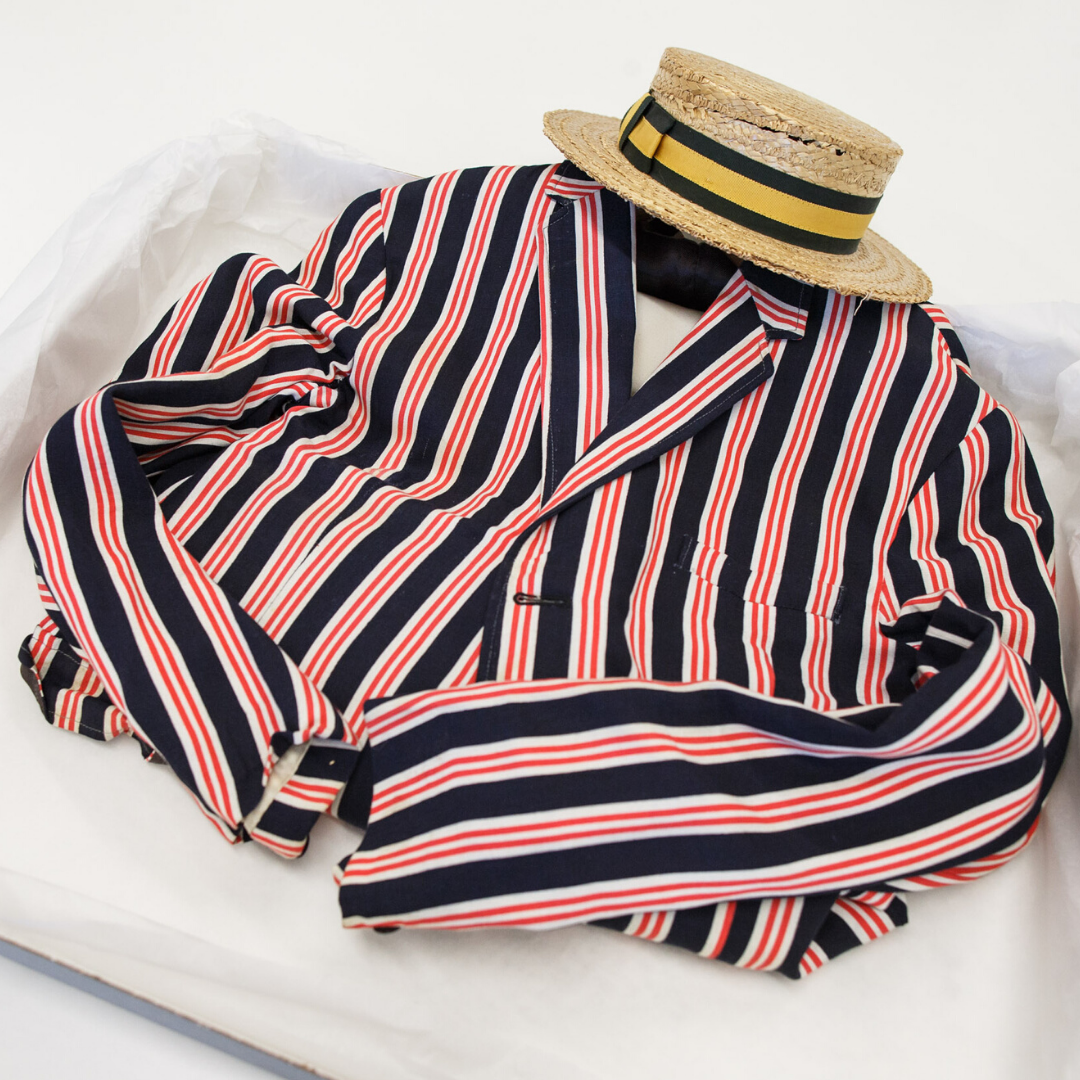
The Max Tyler Music Hall Collection is chock-full of music hall material, spanning from the late 19th century through to the early 21st century. It includes original and copies of Music Hall song sheets, sheet music and scripts for musical comedies, music hall programmes, playbills, 20th century music hall and vaudeville magazines and periodicals, music hall audio recordings on cassette, CD, shellac discs, and reel-to-reel tapes, published books on music hall, and music hall performers, Max’s research notes, and even Max’s very own stage blazer and hat!

Max’s striped blazer and straw boater hat, from the Max Tyler Music Hall Collection.

We couldn’t possibly fit information about everything in the collection in to one blog post, so for today’s post we will focus on a couple of the larger elements of the collection.

Songsheets

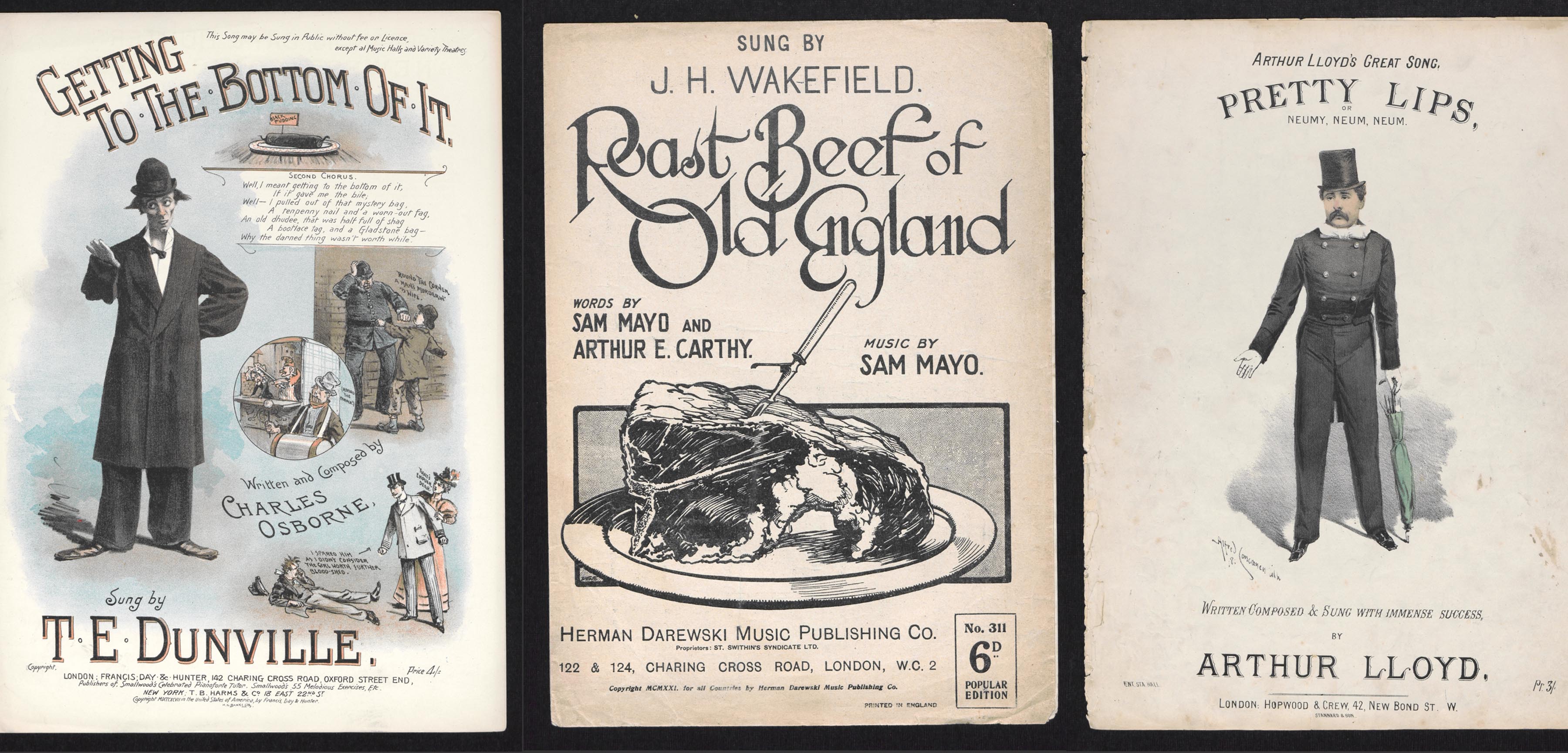
There are at least 1500 songsheets in the Max Tyler collection. With elaborately illustrated covers, and whimsical titles such as “I wasn’t so drunk as all that” and “La-Didily-Idily-Umti-Umti-Ay!” these songsheets are an incredible glimpse in to the working classes of the day (albeit a satirised, playful one!) Performers such as T.E. Dunville, Vesta Tilley, Marie Lloyd and Gus Elen, amongst many others, are represented, as well as prolific composers such as Joseph Tabrar, Arthur Lloyd and George Le Brunn.

Just a few of the 1500+ songsheets in the collection.

Programmes

The collection boasts beautifully illustrated late 19th and early 20th century programmes from variety theatres of the day, through to bold and photographic programmes of the later 20th century. It includes examples from provincial towns as well as the larger cities. This part of the collection is incredibly complimentary to our other theatre collections, which you can find out more about on our website!

A selection of the earlier programmes available in the collection.

Research Notes

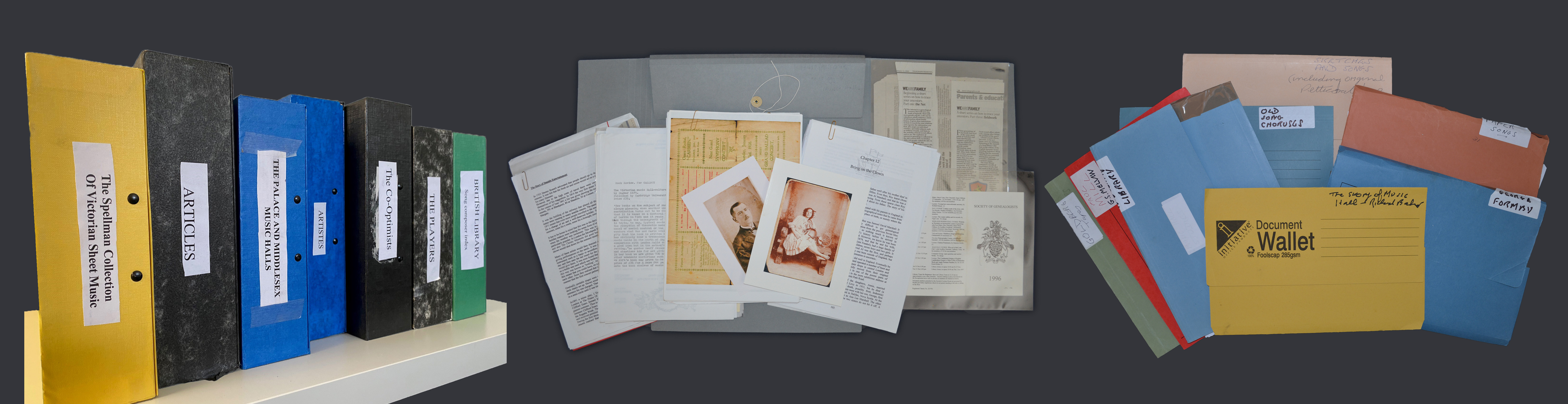
Max was a diligent organiser and avid researcher of music hall, the benefits of which can be seen in his collection. He would always go the extra mile when researching on behalf of the society or members of the public and seemed to have a knack for knowing where to look for the most elusive of details. There are over a hundred files in the collection, on topics from individual performers, composers and historic events, through to animals and trains; it if it was a theme in music hall then Max was bound to have researched it in some way!

Examples of the research files in Max’s collection.

Book collection

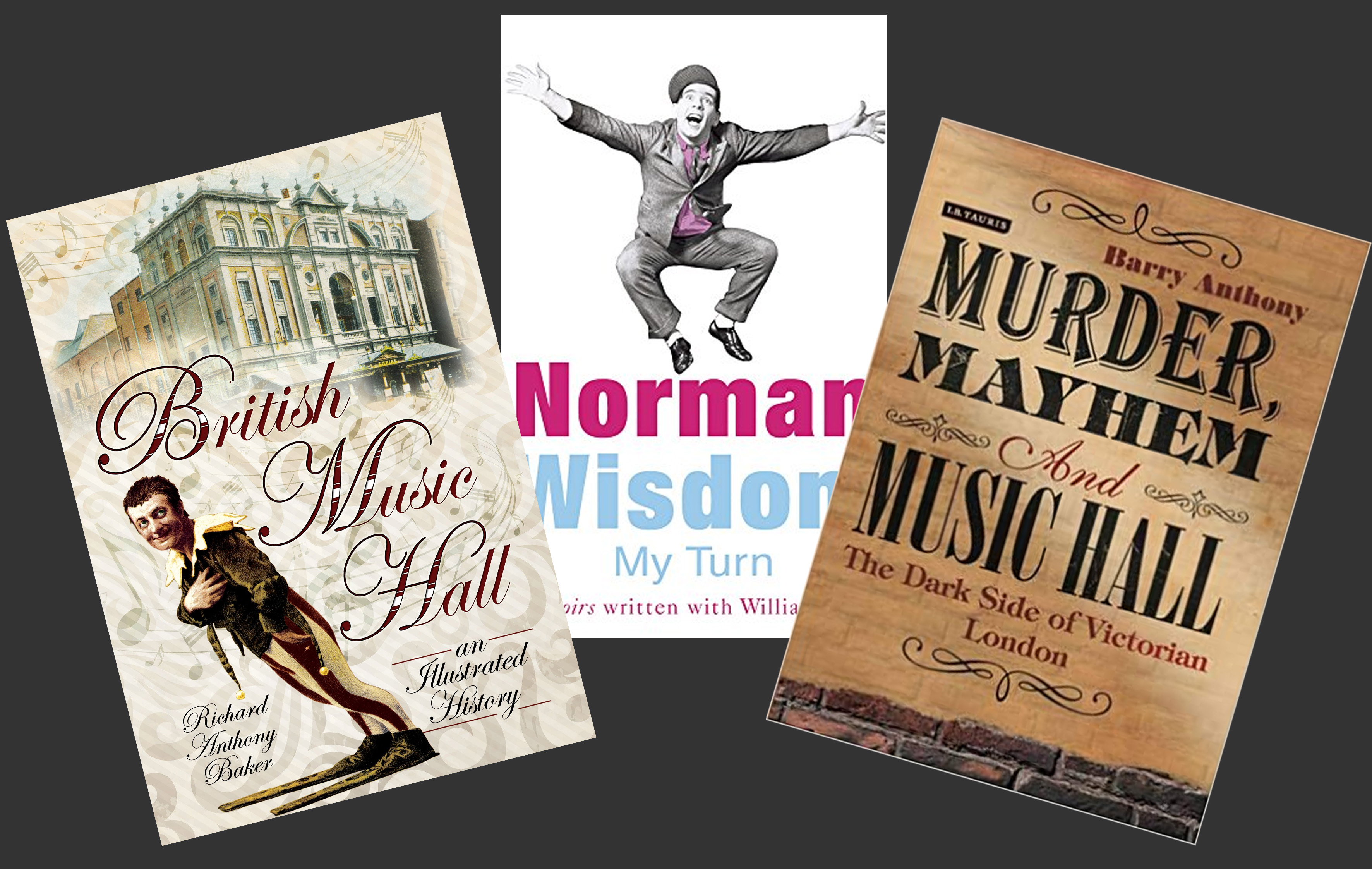
There are just under 550 books in Max’s collection. Again, the topics of these books vary from the specific to the peripheral when it comes to music hall. There are titles written by or about music hall performers, encyclopaedias and compendiums of music hall songs, stars and theatres, through to historical and literary texts.

Books in the Max Tyler Music Hall Collection

We are currently working on organising and cataloguing the collection. Material which has been catalogued can be found here if you’re looking for archival material, or here if you’re looking for items from Max’s book collection.

If you are interested in researching or simply viewing any material from this stunning collection, please do get in touch with us via specialcollections@kent.ac.uk.

World Digital Preservation Day 2019

Thursday 7th November is World Digital Preservation Day, an initiative launched by the Digital Preservation Coalition in 2017 with the aim to “create greater awareness of digital preservation that will translate into a wider understanding which permeates all aspects of society”.

Digital preservation in simple terms can be defined as a series of activities that are carried out in order to ensure objects (such as datasets, analogue and digital audio/video, images, text documents, etc) remain accessible and usable now and in future.

To celebrate this year we’ve decided to focus on the work we’ve been doing with the University Archive’s Open Lectures collection.

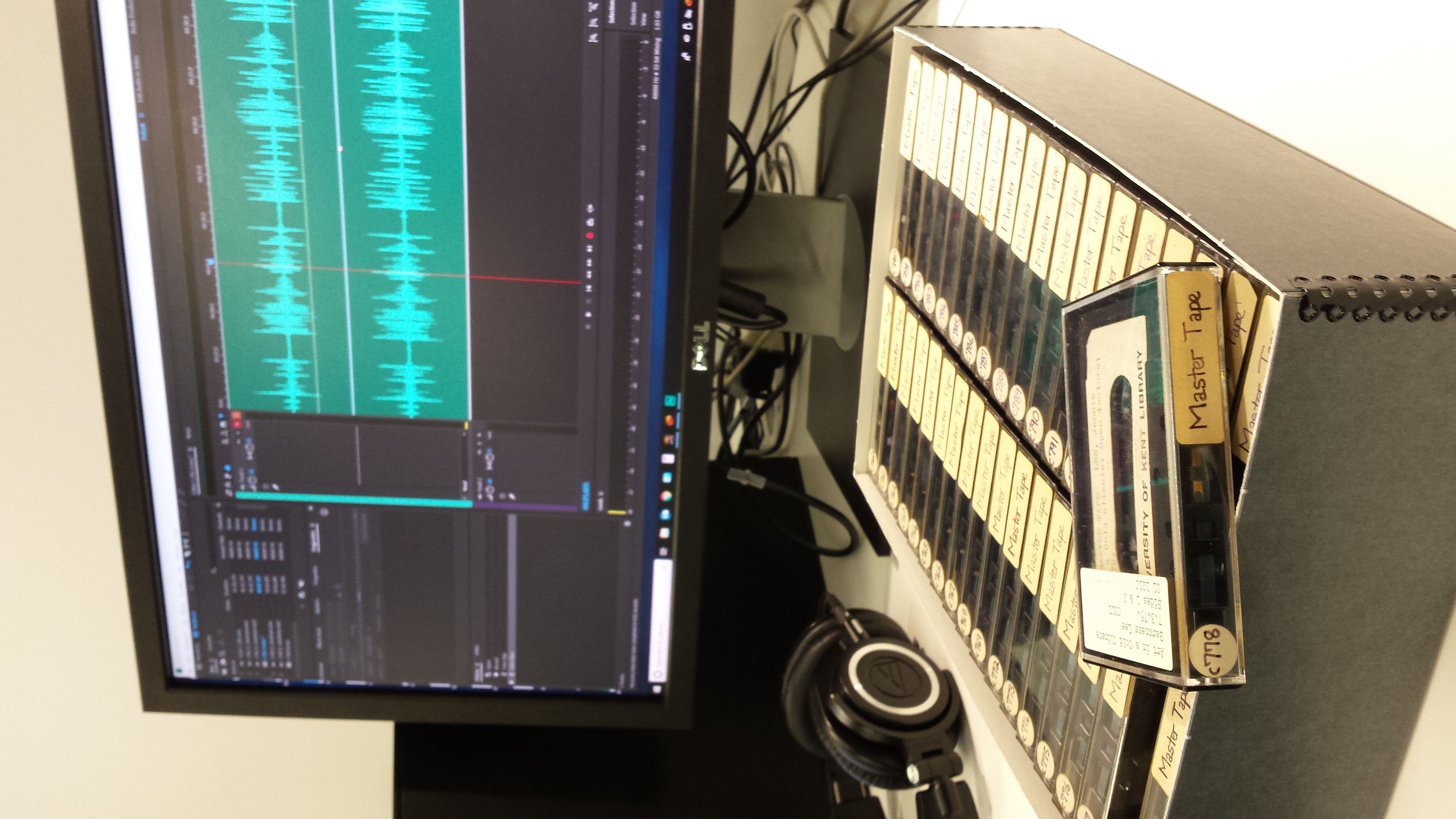
The Open Lectures were an early initiative of the University, first starting in 1967 as part of its commitment to the local community, and are still going strong today. To date there have been over 850 lectures. Lectures were (and remain) free to attend and covered a wide range of subjects, everything from the literature of the First World War to the Neapolitan mafia. The lectures have attracted many of the leading figures of politics, literature, journalism, philosophy and the arts as speakers, including Edmund Blunden, William Golding, Patrick Moore, Shirley Williams, Kate Adie and Antony Beevor. Up until recently these analogue audio recordings have only been available on cassette tape and are at risk of becoming inaccessible due to this format’s likelihood of obsolescence.

Over the last few months our Digital Imaging Assistant, Alex, has been busy digitising these tapes and has so far digitised 160 tapes from the collection. Digitisation can be a complicated process and involves a number of stages to complete.

Pre-digitisation the tapes must be inspected and evaluated to:

  • Check there are no signs of damage or degradation
  • Ensure the pressure pad within the cassette housing is present and positioned correctly
  • Determine if the tape winds slow or appears to be problematic in any way by ‘exercising’ it. This is done by fast forwarding/rewinding the tape several times.

Any issues discovered during this stage of the process will be addressed wherever possible before moving on to the next stage. Once we are satisfied that the tape is fit to process, we can move on to the actual digitisation. We use a specific combination of hardware and software to carry out the audio digitisation process. This is carried out in ‘real time’, meaning that it takes the same amount of time to digitise the tape as it would do to listen through it at normal speed. The digital recording is captured in a Broadcast Wave format (.wav) and metadata is embedded in to the resulting file. This metadata records information about the recorded content itself as well as the digitisation process and how it was performed.

Once the digitisation process is complete and we have a digital master copy of the recording, the cassette tape is returned to our archival storage facilities where it will remain. The digital master copy, alongside an mp3 access copy, will be saved in our secure digital storage space, and will be preserved to ensure that it can be accessed for information and research purposes for our future users.

This is a clip from “Art and politics: Picasso’s ‘Guernica’, a lecture given by Toni Del Renzio at the University of Kent in 1987. Toni was an artist and writer of Italian and Russian descent, who was also leader of the British Surrealist Group for some time. He met Picasso in 1938 whilst he was in Paris, and speaks about one of Picasso’s best known works, ‘Guernica’, in this lecture.

If you would like to have a look at what we have in our open lectures collection, just search for ‘open lecture’ on Librarysearch. To listen to any of the recordings please get in touch at specialcollections@kent.ac.uk.

Our thanks go to the Del Renzio family for granting permission to share this audio recording.

‘Nothing Changes, Nothing Ever Will’

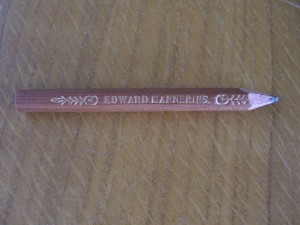
While volunteering at the University of Kent’s special collections, I was cataloguing the C. P. Davies Collection of Mill Memorabilia and the collection threw up many surprises. One, which I was not prepared for was how some of the documents were earlier versions of things that we often think of as exclusively modern. By modern I mean post-war. However, it was genuinely surprising to see a personalised pencil from the late 19th century, recorded post, a picture from a sport’s work day, letters about everyday life as a tenant and the fascination with family history. These things, I believed, were quite modern creations (especially the personalized pencil) but by finding them in this 19th/ early 20th century collection, it made think how different are we really to people of just over 100 years ago? How different are our priorities, our cares, our worries? Obviously, we are so unlike in many ways: technology, general attitudes, work, shopping… There are so many developments to name! However, sometimes, we get a glimpse into how similar we are to past generations. A chance to take people from the past and make them more than just a memory, but empathise and understand their world that little bit more. It is this idea that makes me love history. I have called this piece after a lyric in Les Misérables as I thought that not only does it show the closeness between ourselves and a past generation, but also I hope that people in the future will be able to look back at us and seem the similarities of our everyday life to theirs.

Dover Mills, Box 1, Item 75

The first and perhaps one of my favourite items in the collection is this personalised pencil of the owner of Buckland Mill, Edward Mannering. I remember having personalised pencils (both drawing and colouring) when I was younger and I suppose that I had always thought of these as an invention on the post war era. But to find one which could be traced to the late 19th early 20th century was a pleasant surprise. I loved the little flourished design either sides of his name. Moreover, you can see where the owner has sharpened the pencil with a knife. Perhaps the owner stopped in order to preserve the name and thus shows us the care people could have for their belongings, just as we have today.

Dover Mills, Box 1, Item 21

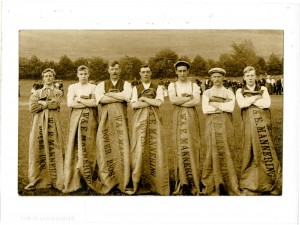
This next photo I found fascinating because it gave a face to the ordinary men that worked in the Mannering Mill’s in 1908. A chance to see the faces of those from less well-off backgrounds in history is rare until the development and spread of the camera. This looks like a type of sports day as you can see that the spectators in the backgrounds have a rope to separate them from what could be the track. These men, stood all in flour sacks could have been taking part in a sack race. There is no hint as to whether these men worked in the mill but it could be a safe conclusion to draw. It is also unclear as to whether the mill owners would have organised this type of sports day or whether it was a general community day for all those close to the Dover mills. But again like the pencil, I had long thought that this idea of a community/work sports day was a modern invention, like dress down Fridays. However, this picture sparks many questions and ideas as to how Edwardian communities would come together, what they would do and why? It is a nostalgic ideal of a community all coming together and one of the few things in this blog that I found has unfortunately depleted throughout the years.

Dover Mills, Box 1, Item 36D

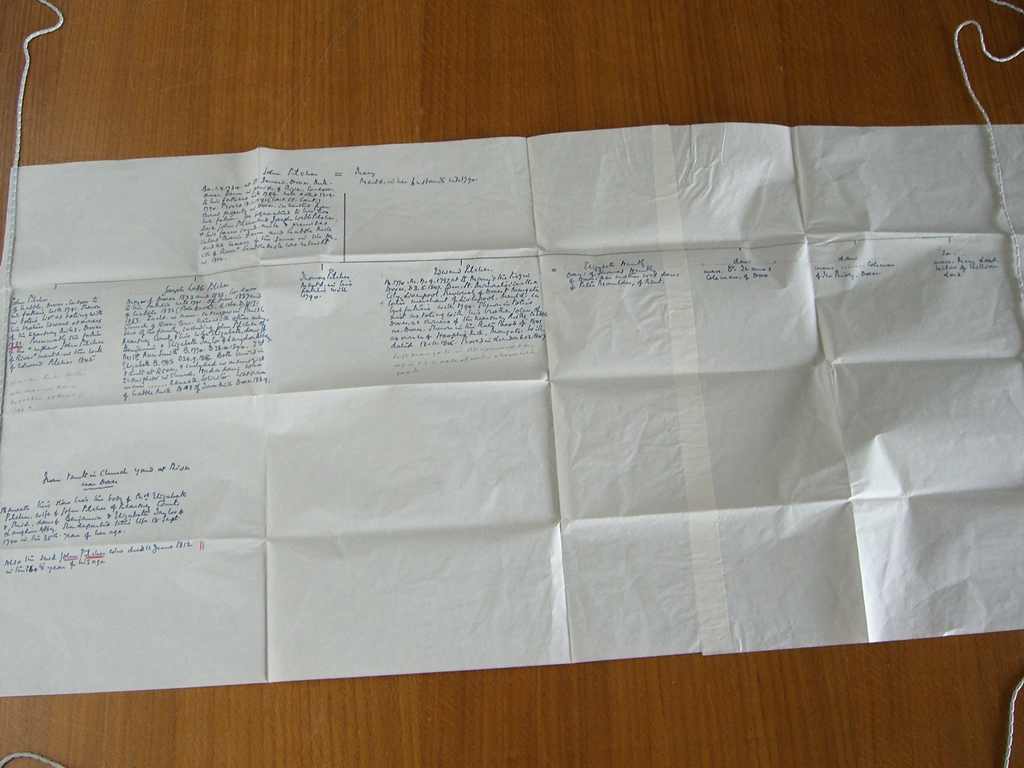
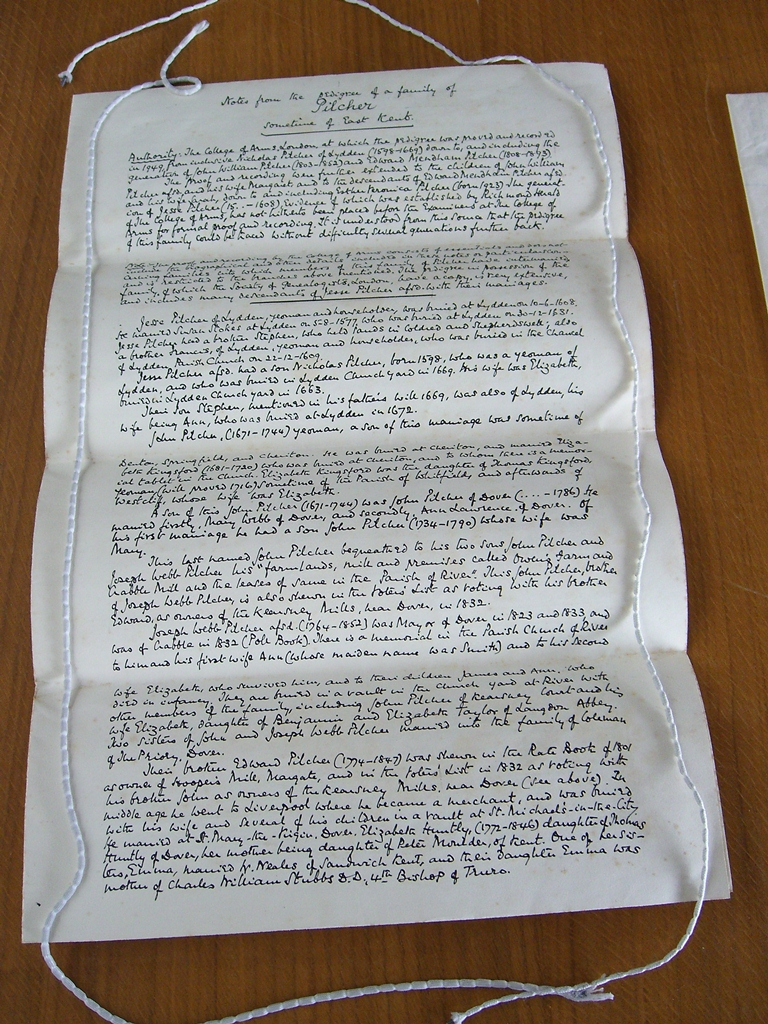
The recent upsurge in the interest in family history has been shown with the many adverts for genealogy history by sites like Ancestory.com. The idea of researching and presenting you past is not new (Noblemen of the Middle Ages would have wanted to show off their illustrious family tree). But some historians have criticised the idea of ordinary people collecting their family history as not really helpful for the bigger study of history – but some highlight the chance for new angles of research[1].  However, by having this research done on the Pilcher family, we have a lot of background information as to who owned various mills in Kent and their life story. Niche areas of history are becoming ever more popular and it is this type of research that is invaluable to people interested in the topic.  Moreover, the ability to trace a family from 1598 to 1952 can help in so many other regions of history. So I included this document because of its vast usefulness as a source but also to show the enduring appeal of genealogy and the continuing importance, despite some historians protests, of its use to general history.

Dover Mills, Box 1, Item 36 E

Dover Mills, Box 1, Item 36 E

Chegworth Mill,Box 2, Item 31T

Chegworth Mill,Box 2, Item 31T

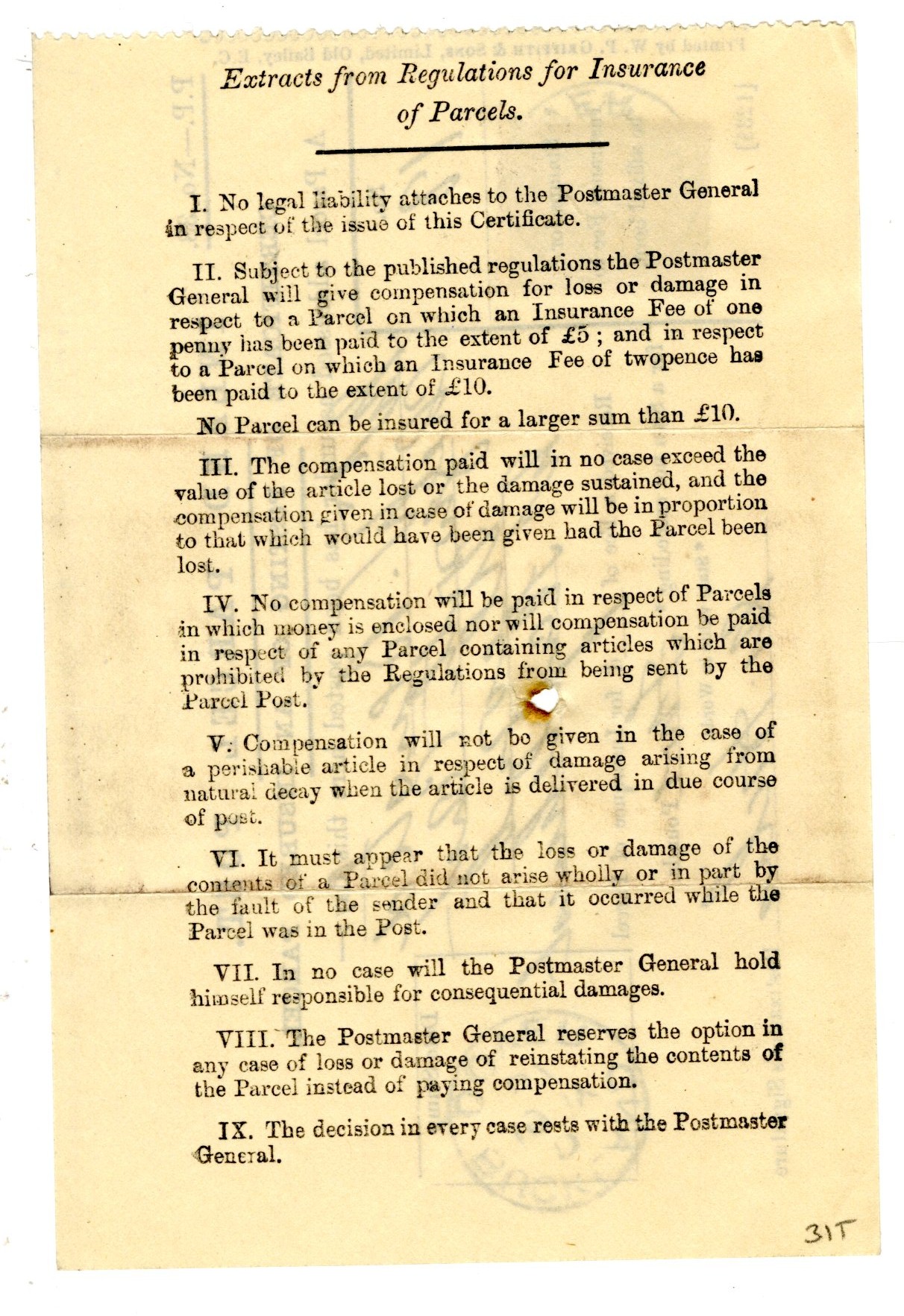
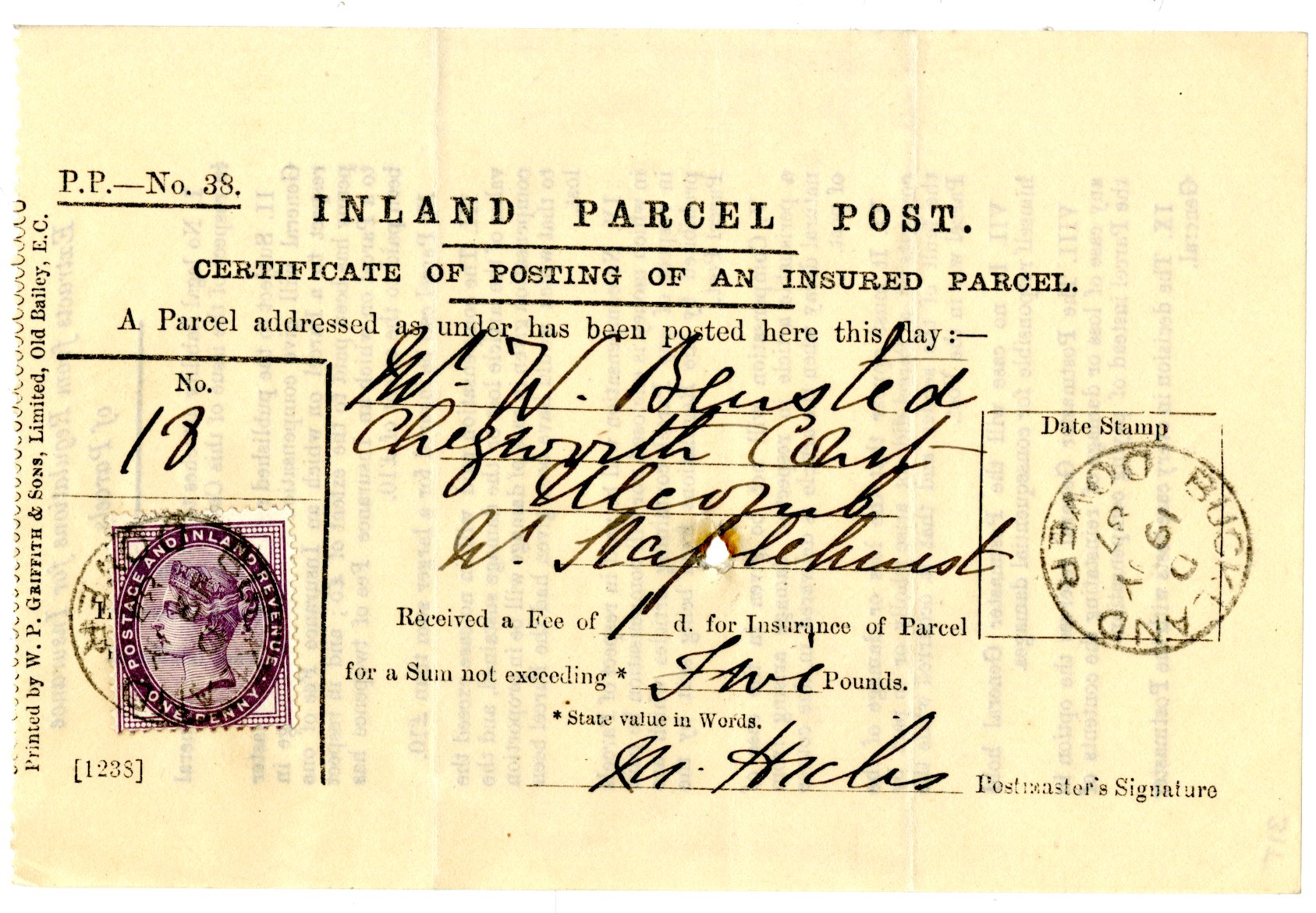
The postal service has been an important part of the country for many generations and although we all have our modern gripes with the system,we still rely on it regularly to transport our letters and parcels. But for special items, we would usually get a recorded delivery so as to ensure the safe deliverance of the item. Like many, I presumed that it was only in recent years, as the country expanded and long distant relationships became more normal, did the invention of recorded post come about. But my opinion was soon changed when I perceived this ‘certificate of posting of an insured parcel’ with in the C. P. Davies Collection. I loved seeing all of the terms and conditions on the back of the note explain who was responsible for what and what would be done in case of loss or damage (and to be honest, the terms and conditions are a step that we all skip over from time to time). However, unlike today’s jargon-busting maze of terms, the sheer simplicity and openness of the regulations was something that I wish had continued from this period!

Chegworth Mills, Box 2, Item 31T

Chegworth Mills, Box 2, Item 31T

What this small slip of paper also reveals to us is that people must have cared about what they were sending and, similar to the pencil, the attachment we see to object is much like our own. Moreover, the want to ensure that something personal or important has arrived at its destination is the exact same mind-set that we have today, whether it be a birthday cheque or a return for student finance! Thus, I included this small note because of the charm I found in the regulations but furthermore, because I could identify why we would want certain things we post to be protected.

Chegworth Mill, Box 2, Item 20Y

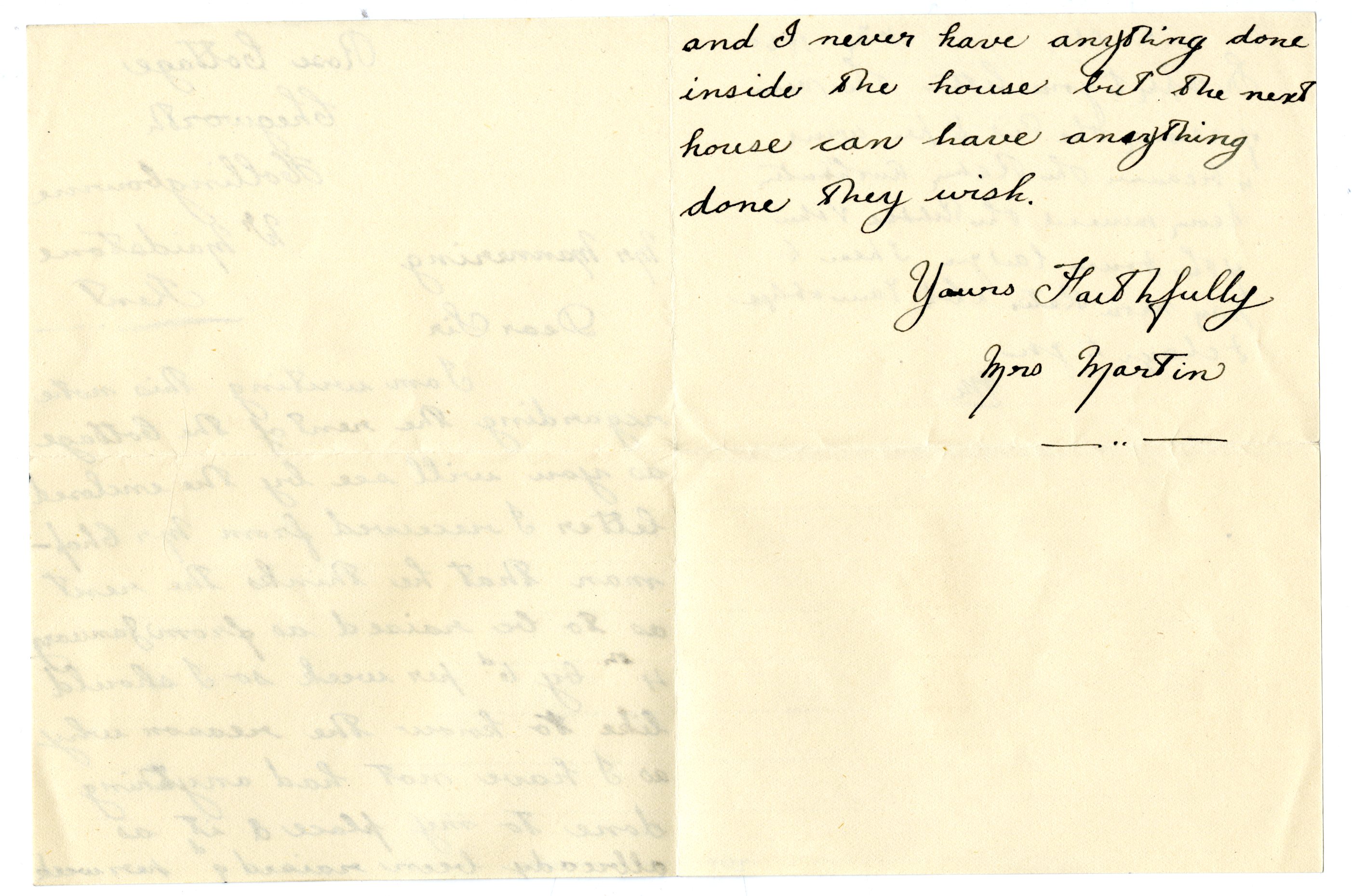
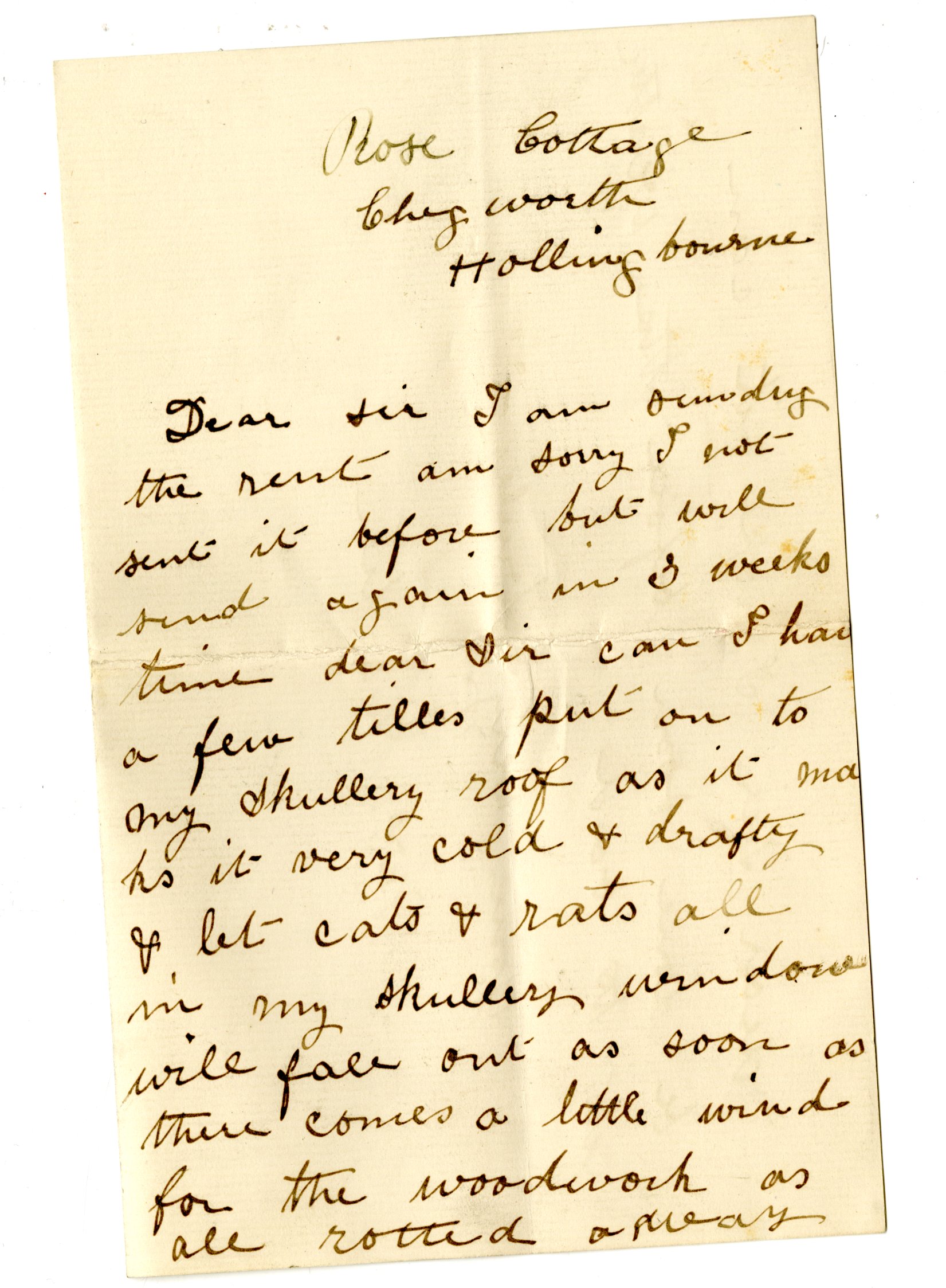
The next item I chose was because of its simple ability of letting us see someone’s everyday life from the earl part of the 20th century. The letters from Mrs Martin to her landlord, Mr Mannering, were among my favourite documents in the collection and reading them always put a smile on my face. From her letter, I could really paint a picture in my mind’s eye of this lady and what she was like (all from the expression of her words, the tone, and the phrases that she uses in the letters). The first picture is the end part of a letter in which she questions the rise in her rent (although in other letters, despite her protests, she does seem to have shortcoming with regards to the rent). What I found interesting was the final sentence of: “I never have anything done inside my house but the next house can have anything done they wish”. To me, not only is there a bitter jealous tone, but I sense

Chegworth Mill, Box 2, Item 7

Chegworth Mill, Box 2, Item 7

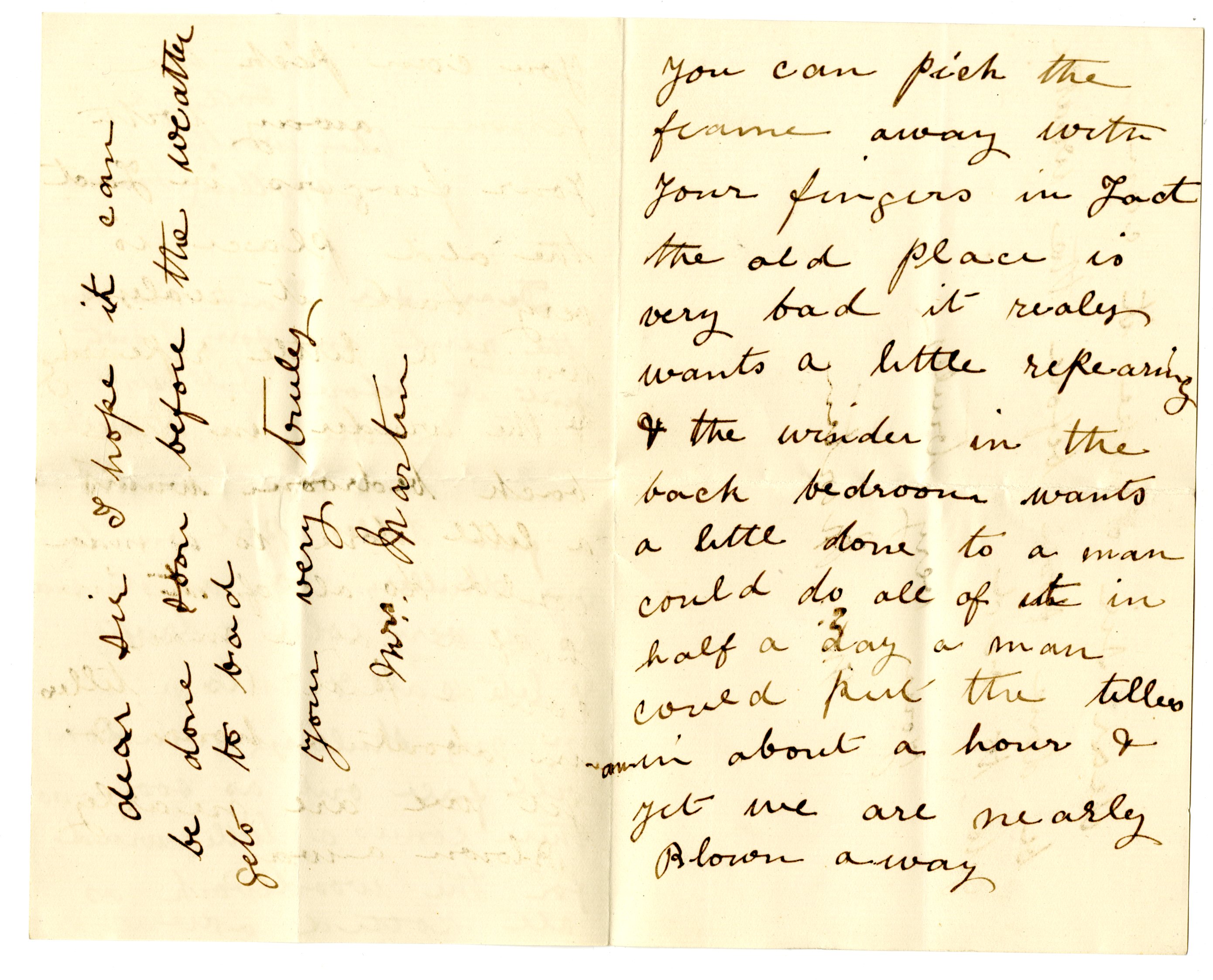
that there is a massive hint that she would like improvements done to her house, but she does not wish to out rightly say. I could empathise with this as I started to think that we all, at some point, out of politeness try to ask or hint at things that we would like in an indirect way. The next letter I picked out follows this trend of wishing for work to be done, but has less of the jealous tone, more of the ‘woe-is-me’ feel about the letter. She starts off asking for some new tiles on the roof as it is “cold and drafty” but this then snowballs into the idea that it lets “cats and rats” into her scullery. Furthermore, it has resulted in the rotting away of the woodwork of her window as ”you can pick the frame away with your fingers” (which to me suggests that she has been occupied with this problem for some time). Finally she concludes by saying that “the old place is very bad it really wants a little repairing”. The endless list of issues with the house that all seem to stem from one another gives a sense of hyperbole which made me smile while reading it. The problems she had can be so easily transferable onto our modern world, that we can really see the startling similarities to our modern reliance on councils or landlords to help fix and maintain our houses.

Chegworth Mills, Box 2, Item 7

Chegworth Mills, Box 2, Item 7

In conclusion, I hope you have enjoyed looking at some of the unique and interesting items that I found within the C. P. Davies Collection and that, just as they have done for me, they have shown you how many similarities we still have with the past (despite the general consensus that we have changed and that we are so different from our ancestors 100 years ago). These little items can reveal to us so much about everyday life, a topic which is only just being revealed to us in the past few decades. Some may not see a past generation’s everyday life as particularly exciting or interesting compared with big events like the Reformation or World War One; however these are big events that radically changed society (hence why we all have this perception of drastic change). It was nice to discover these artefacts and documents and see that, below the surface, the themes and attitudes to everyday life such as community, care of belongings, up keep of a house etc. can be seen as relatively the same as over a century ago. Of course there are some small differences between us (a shown in some of these documents) however, as the title suggests, our basic cares and worries in the world, regardless of the mass changes that happen, seem to always continue on a steady course.

By Charlotte Daynton


Please comment below with your thoughts on the items featured or if you have any more information about the materials covered.


[1] Tim Brennan, ‘History, Family, History.’, in Hilda Kean, Paul Martin and Sally J.Morgan (eds.), Seeing History: Public History in Britain Now, (London: Francis Boutle Publishers, 2000), p.44.