Snow in the archives: exploring the big freeze throughout our collections

Hello from a very wintery Canterbury! The SC&A team have been battling up the hill this week as 2018’s infamous ‘Beast From The East’ lands upon Kent.

Inevitably, this cold weather got us thinking about how snow has been represented throughout history, and it’s almost no surprise that the British fascination with bad weather spreads its icy tendrils through our collections (not literally, though!)…

Special Collections & Archives is known for our extensive archives of windmill photos from the 20th century, particularly the collections of the Muggeridges and C.P. Davies. Here, Muggeridge finds the ideal winter shot: a model of a post mill in Sussex that’s mostly buried by the white stuff…
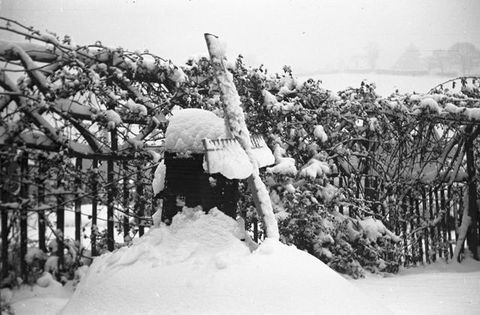
UKC-MIL-MUG-BW.540246, ‘Black and white negative and print made from it of a model of a post mill with roundhouse in Outwood, Surrey, in Camelsdale, Sussex, taken on 22nd December 1938, showing a side view covered with snow’, Muggeridge Collections

Our Modern Firsts collection of poetry contains verses in almost every format and theme imaginable, and it’s there that some of the most interesting ideas about weather come to light. In his 1997 work ‘Snow has settled (…) bury me here’, Peter Riley explores memories of place from a starting point of cold weather. The way that snow changes landscapes so completely is simulataneously refreshing, exciting and alien. Snow is also (in Britain at least) a hugely memorable event: we can all recall snow days, which are increasingly rare, particularly when we were young.
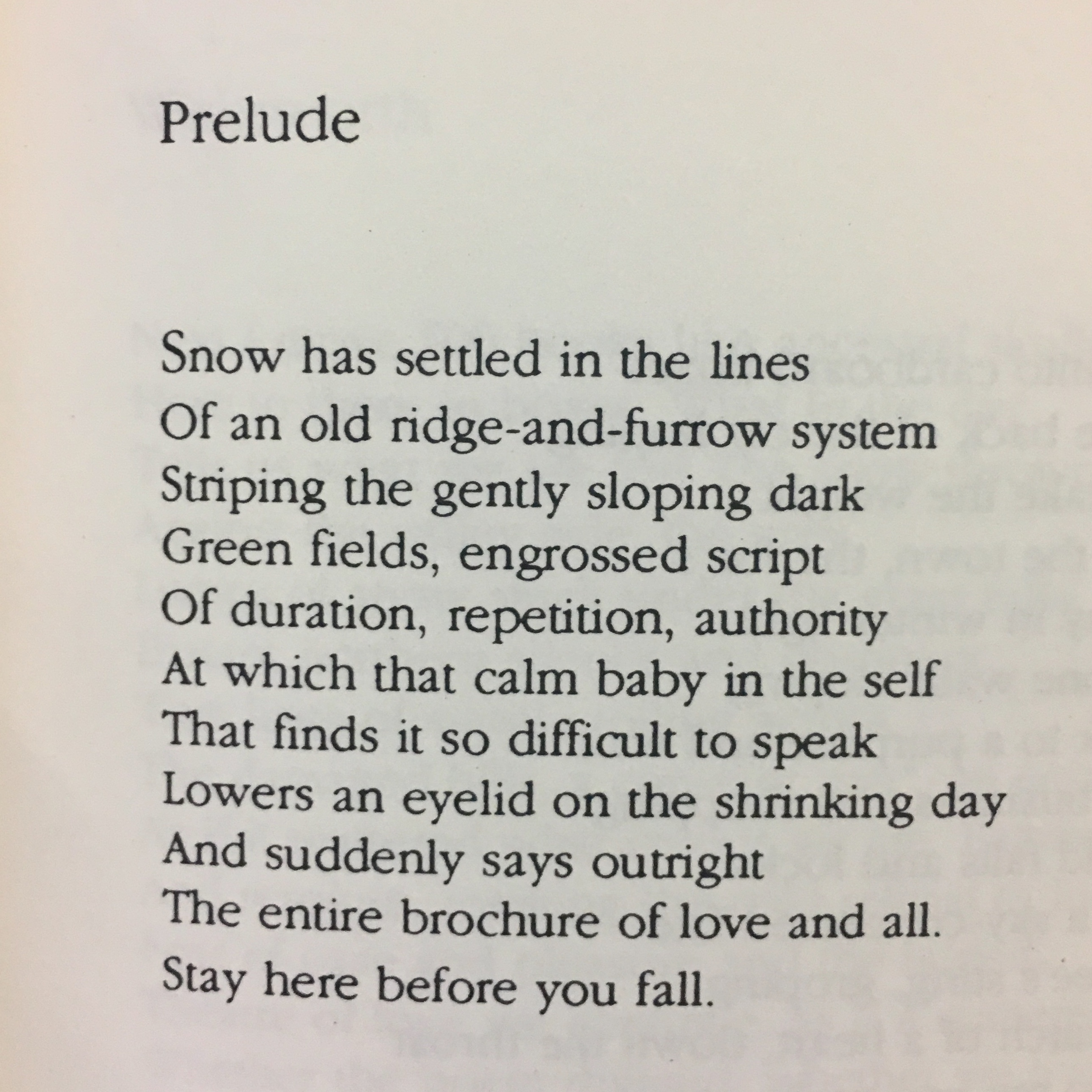
MOR.I526 POETRY (057119600), Peter Riley: ‘Snow has settled (…) bury me here’, 1997, Shearsman Books
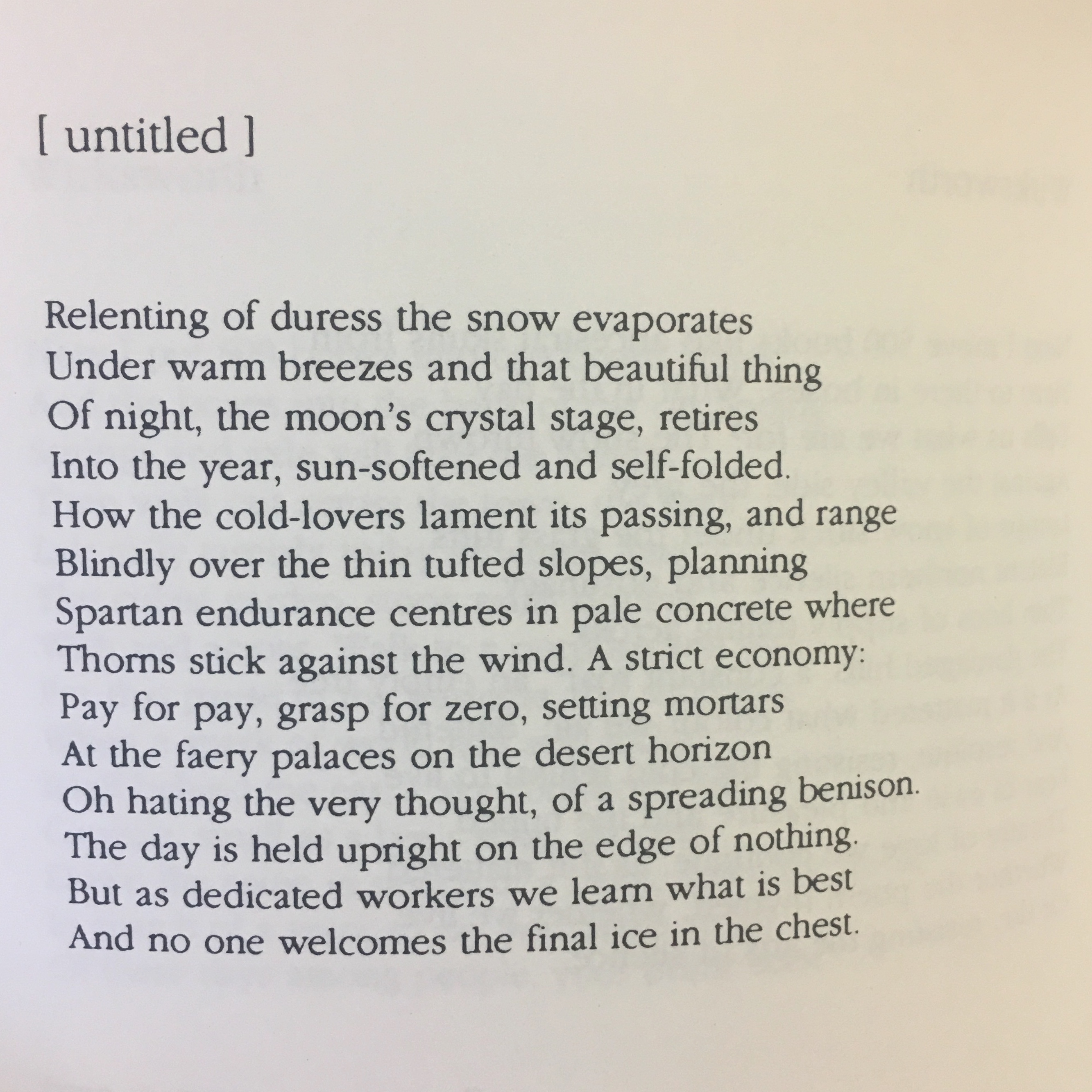
MOR.I526 POETRY (057119600), Peter Riley: 'Snow has settled (...) bury me here', 1997, Shearsman Books

MOR.I526 POETRY (057119600), Peter Riley: ‘Snow has settled (…) bury me here’, 1997, Shearsman Books

The dramatic elements of cold are frequently used in fiction to express mood, so it’s no surprise that the shock of the snow is also popular for playwrights. In 1862, Bristol’s Theatre Royal put on a multi-show performance that included an entertainment called ‘The Angel of Midnight, or, the Duel in the Snow’ set in Munich in 1750:
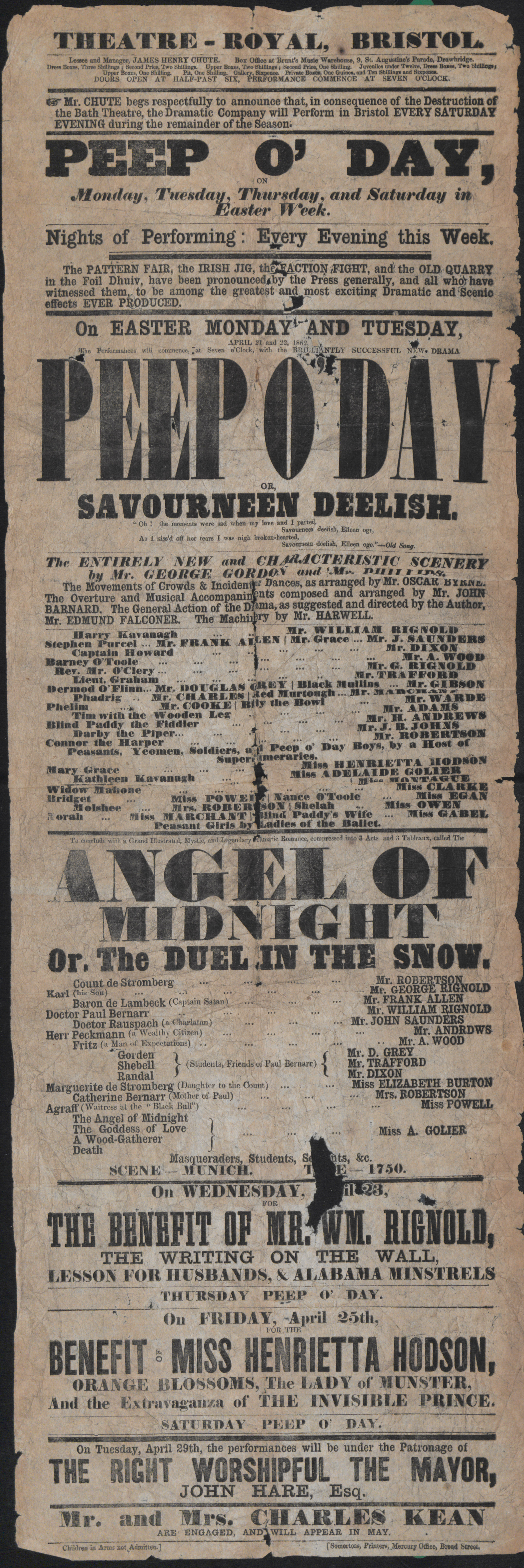
UKC-POS-BRSROY.0592650: Playbill advertising PEEP O’DAY and THE ANGEL OF MIDNIGHT at the Theatre Royal, Bristol, 21 April 1862

Our Pettingell collection is full of popular entertainments and melodramas from the Victorian era – you can see from the scripts why winter weather was a popular theme for audiences. Through the magic of scenery, audiences could be transported to far-off places like Russia or the Alps, where the characters were less familiar but the villains remained the same:
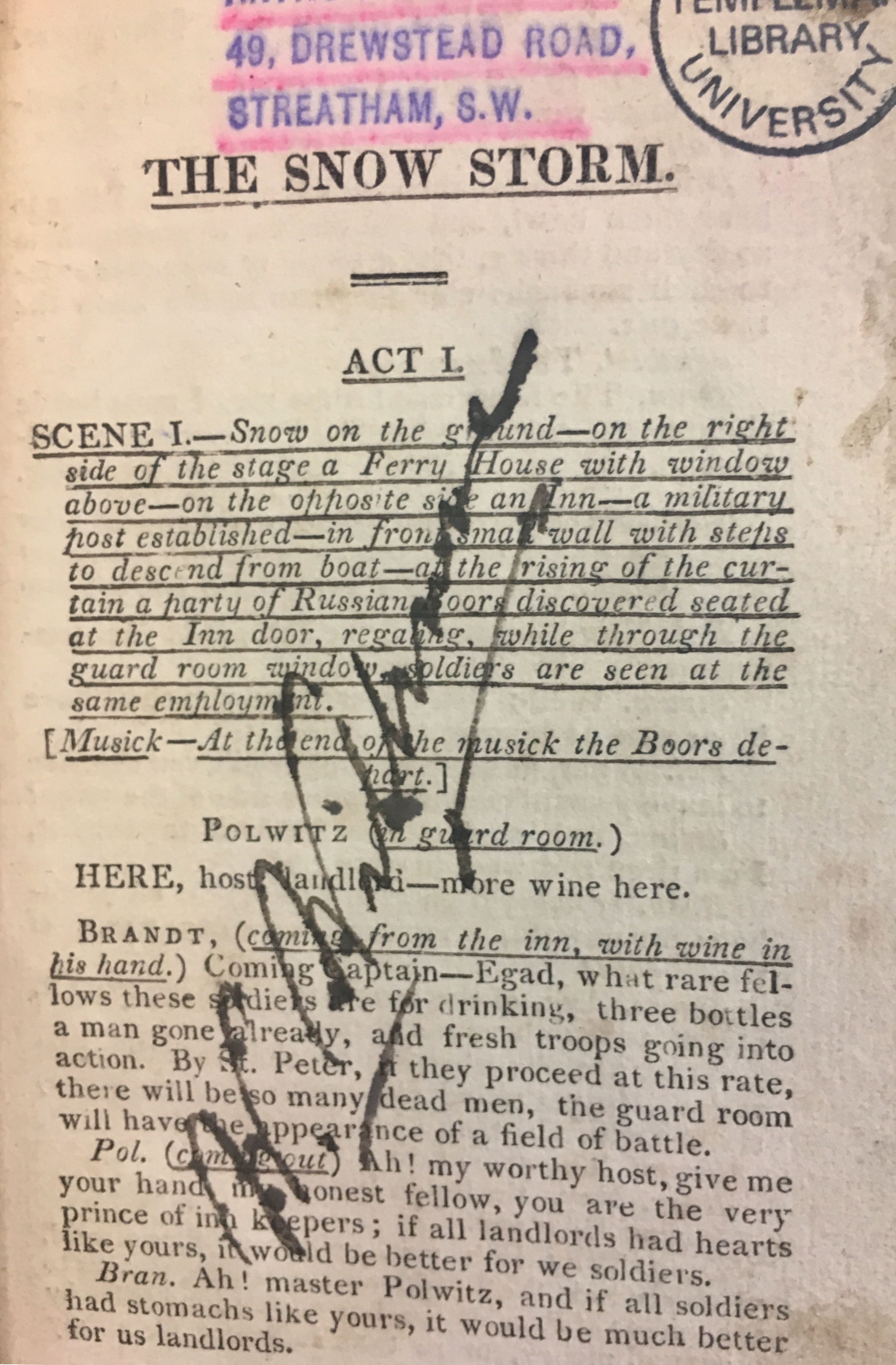
PETT B.53 SPEC COLL (059016100), 'The snow storm; or, Lowina of Tobolskow : a melodramatick romance', W. Barrymore, 1818

PETT B.53 SPEC COLL (059016100), ‘The snow storm; or, Lowina of Tobolskow : a melodramatick romance’, W. Barrymore, 1818

The Victorians were well known for developing stage effects. The lure of seeing spectacles frequently drew crowds to theatres long before movies, TV and the internet. What could be more exciting than seeing an avalanche live on stage?
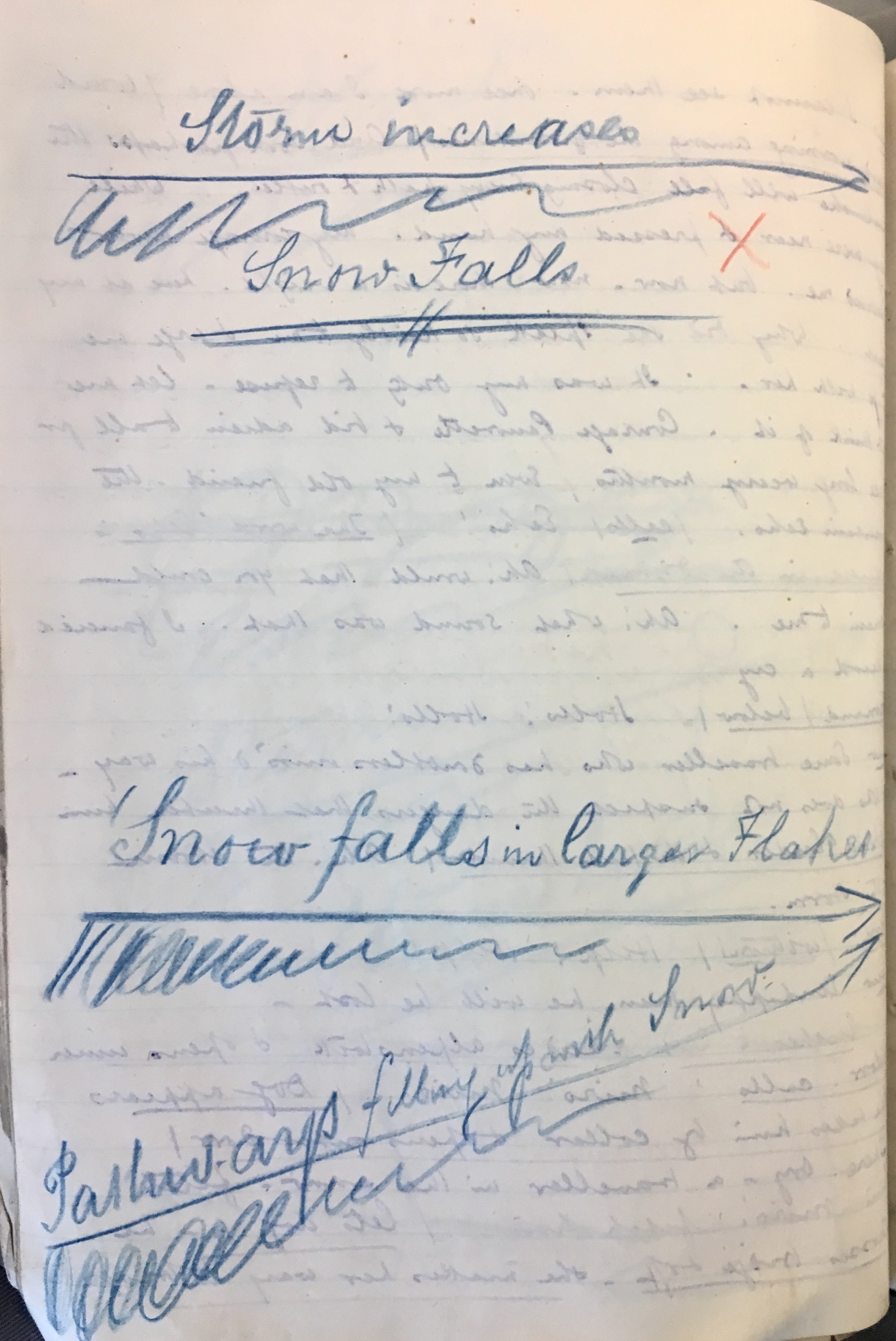
PETT MSS.U.10 SPEC COLL (059872400), ‘Under the snow: in three acts’, J.C. Griffiths, 1877
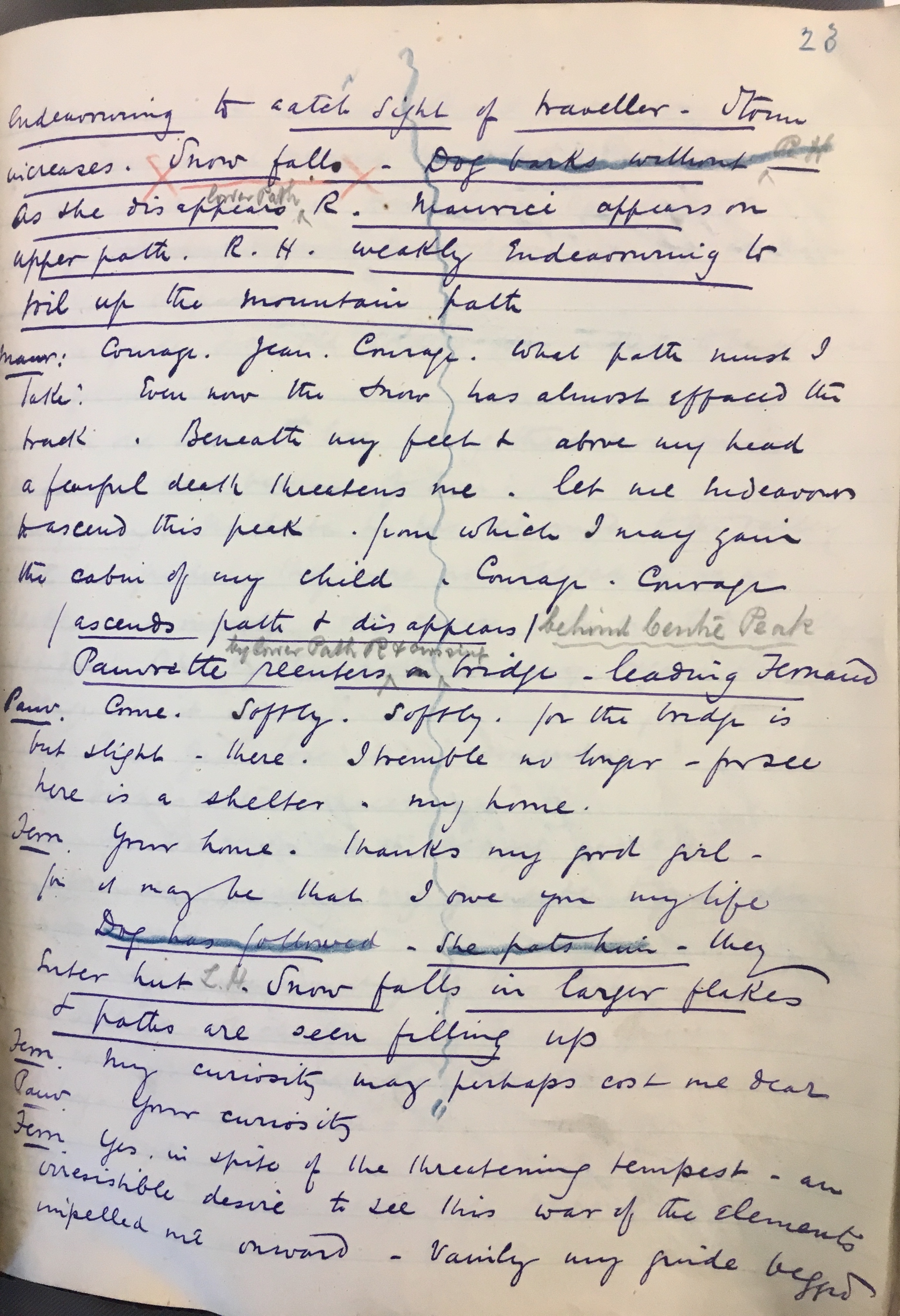
PETT MSS.U.10 SPEC COLL (059872400), 'Under the snow: in three acts', J.C. Griffiths, 1877

PETT MSS.U.10 SPEC COLL (059872400), ‘Under the snow: in three acts’, J.C. Griffiths, 1877
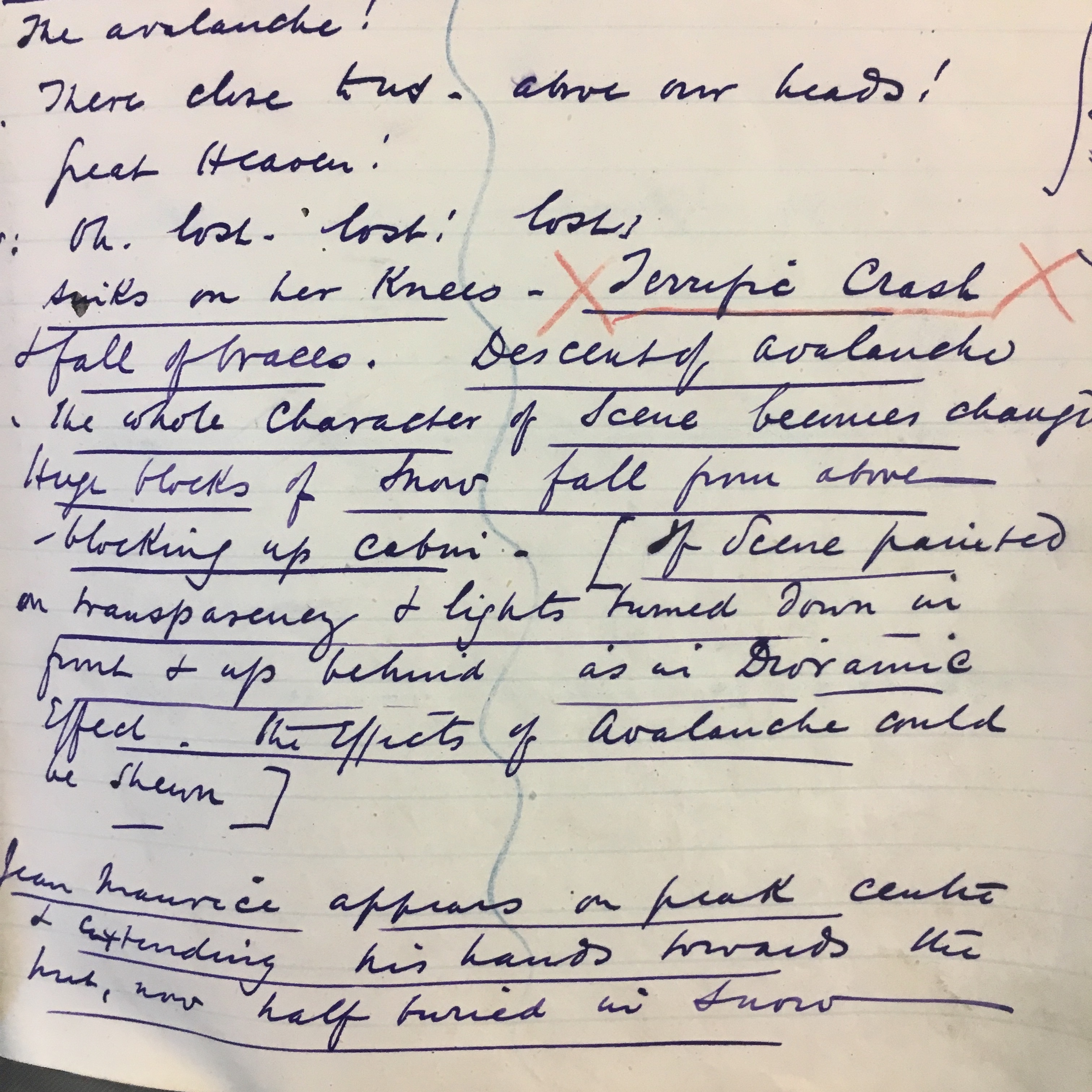
PETT MSS.U.10 SPEC COLL (059872400), ‘Under the snow: in three acts’, J.C. Griffiths, 1877

Cartoonists, too, can use the weather to reflect goings-on in society. In 2016, Brian Adcock imagined what a certain blonde Republican presidential candidate would have to say…

BAD0244, ‘”If I was president I would have a total and compete shutdown of snow entering the United States”‘, 25 Jan 2016, The Independent

Because we all need a laugh more than ever when struggling with leaving the house, the job of a cartoonist becomes vital during the winter months. In the digital age, it’s probably easier for artists to email scans of their work in, but before that – spare a thought for Carl Giles:
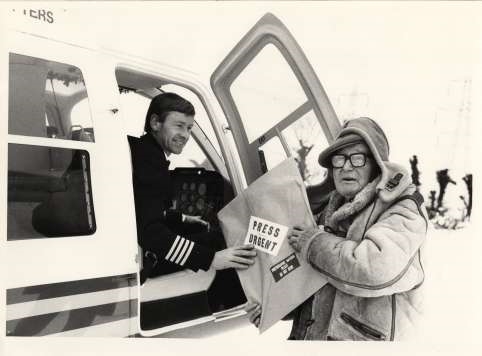
GAPH00137, Black and white photo of Giles in the snow at Hillbrow Farm handing packaged artwork to helicopter pilot [Rob Flexman of Aeromega Helicopters], 17 Jan 1987, Express Newspapers

Perhaps unsurprisingly, we leave the job of summing up our feelings towards snow to the early 20th century cartoonist W.K. Haselden: it’s mighty pretty to look at but perhaps slightly less fun when we get stuck in it – literally…

WH2559: ‘Snow in poetry and reality’, 18 Jan 1926, Daily Mirror

All snow-related material described here can be found through either LibrarySearch, the Special Collections & Archives website or the British Cartoon Archive catalogue; all are welcome to come and explore weather-related adventures in our snow-free Reading Room.
Tiffin Scrapbooks

Jon Shepherd, Assistant Archivist in Special Collections & Archives until December 2017, writes:

The Tiffin Scrapbooks is a small collection of scrapbooks containing several hundred black and white and coloured images of windmills and cuttings mainly from around the county of Kent but also elsewhere in the UK and even from further afield in Europe.

The first scrapbook is titled ‘Windmills In Kent-past and present’ including photographs from the villages of Aldington in Mid Kent to Worthin East Kent.

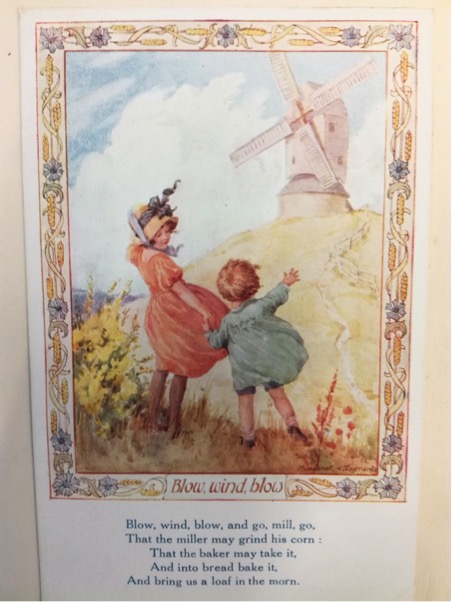
This card is pasted into the front of MILL/TIFF/2


Secondly there is a miscellaneous scrapbook which contains newspaper and magazine cuttings and postcards dating from the 1930s and covering the following English counties; Kent, Sussex, Essex, Yorkshire, Surrey, Cambridgeshire, Lincolnshire, Norfolk, Nottinghamshire, Buckinghamshire, Warwickshire, Leicestershire, Northamptonshire, Yorkshire, Bedfordshire, Suffolk, Oxfordshire as well as Anglesey, Holland, Belgium, Spain, Germany, USA and Mykonos.

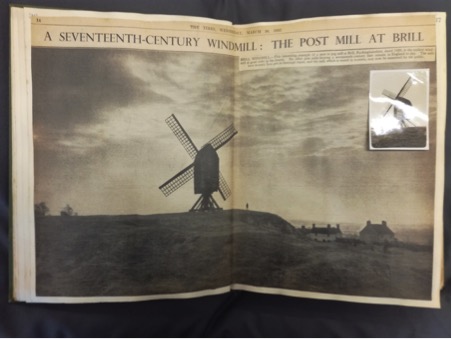
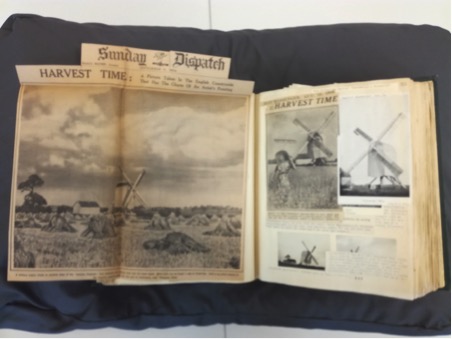
Articles from Tiffin scrapbook MILL/TIFF/3

Scrapbook three again covers the Windmills of Kent and was assembled in around 1935. It includes cuttings, photographs, maps, poems, lists, postcards, typescript text and cartoons. It includes items on windmills from the villages of Acrise in South Kent to Yalding in West Kent, as well as images of some other subjects.

This image is pasted into Tiffin Scrapbook MILL/TIFF/3

The fourth scrapbook contains a photographic record of all of the windmills in Kent that remained standing in the year 1931 taken by A. W. Tiffin This includes examples from the Kent villages of Ash in East Kent through to Woodchurch in South Kent.

The last scrapbook is known as the Lancaster Burne Album and includes 261 pages of cuttings, postcards, adverts, photos and manuscript notes regarding windmills that can be found from Argos Hill to Zoandam. It includes windmills in Kent, West Sussex, East Sussex, Surrey, Holland, Belgium and France.

The collection can be browsed via the online catalogue via https://archive.kent.ac.uk/TreeBrowse.aspx?src=CalmView.Catalog&field=RefNo&key=MILL%2fTIFF.

If you would like to take a closer look at any of these five items and their fascinating images of windmills then please get in contact with us on specialcollections@kent.ac.uk or +44 (0)1227 82 3127.

Vote 100: W.K. Haselden and women’s changing role in early 20th century society

This week (6th February, to be exact) marks 100 years since women first gained the right to vote in the United Kingdom. This anniversary is being celebrated across the country and online using #Vote100. Of course, this also gives those of us lucky enough to work with historical collections a chance to explore women’s history in our holdings, so we’re going to be highlighting some of our favourite stories and figures over the next month.

Today, our attention turns to the British Cartoon Archive and a somewhat unexpected supporter of women’s rights – the artist W.K. Haselden…

W.K. Haselden (1872 – 1953) spent most of his career as a cartoonist at the Daily Mirror newspaper, as well as drawing theatrical caricatures for Punch magazine. Haselden is most well known for his art during the First World War – his characters ‘Big and Little Willie’, which mocked Kaiser Wilhelm and his son, were tremendously popular.

Haselden is also famed for shifting his cartooning style from political satire to social commentary. The Daily Mirror, which Haselden joined in its founding year of 1903, was created as a newspaper for women – it focused on human interest stories and had a visual format filled with photographs and images. It is no surprise, then, that women feature heavily in Haselden’s cartoons as the Edwardian era progressed and gender roles were debated extensively in a changing society.

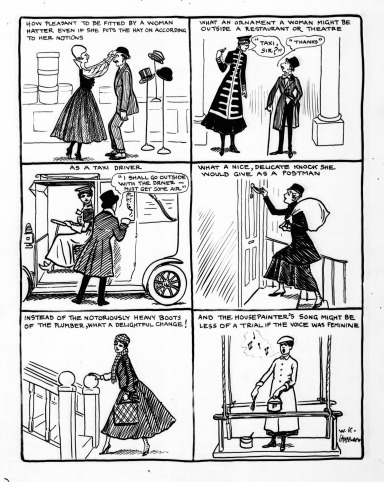
Haselden was broadly flattering towards women, and much of his work suggests that society might be a more pleasant place if women were involved in men’s work, as this cartoon from 1915 shows:

WH1451: ‘Some Trades In Which Women Are Replacing Men’, 12 March 1915, Daily Mirror

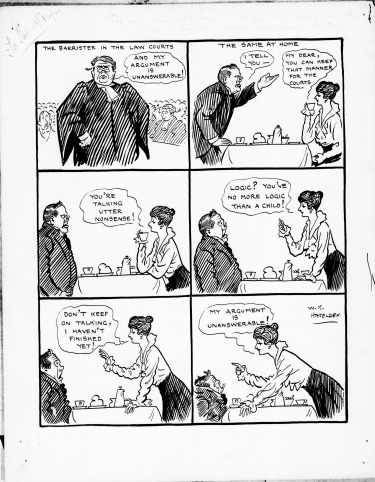
Haselden drew on domestic life to highlight the increasing blurring lines between the private and public realms. In 1916’s cartoon ‘Why women may not be lawyers’, ladies’ ability to have the last word proves frustrating in a judicial context:

WH3827, ‘Why women may not be lawyers’, 20th January 1916, Daily Mirror

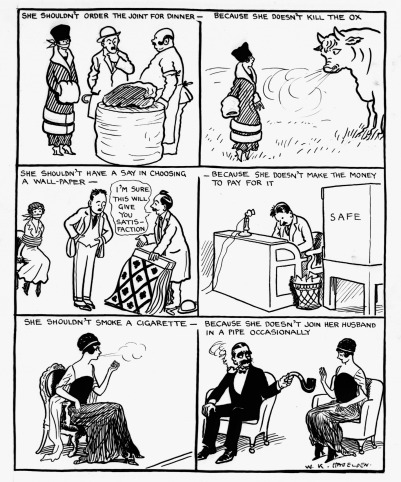
Haselden was critical of some of the hypocrisy in Edwardian society, particularly around what women were and were not allowed to do. The pencil notes at the top of the following cartoon (‘What women mustn’t do – and why’) begin with ‘If a woman shouldn’t vote because she doesn’t fight…’, alluding to the argument that suffrage should not be granted to women because they could not join the British Army:

WH1217, ‘What Women mustn’t do – and Why’, 17 January 1918, Daily Mirror

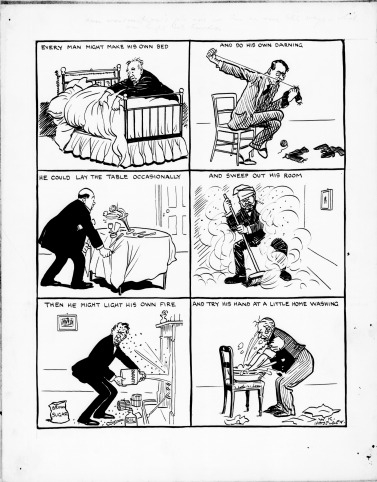
Interestingly, Haselden explores areas where men cannot match women’s skill in certain roles, particularly anything relating to domestic labour. During the First World War, women began working in roles which traditionally employed men, but were now empty as soldiers were needed on the Western Front. This led to discussions around men filling women’s roles in return (often with comical consequences):

WH3817, ‘Now that women are doing men’s jobs’, 17 January 1917, Daily Mirror

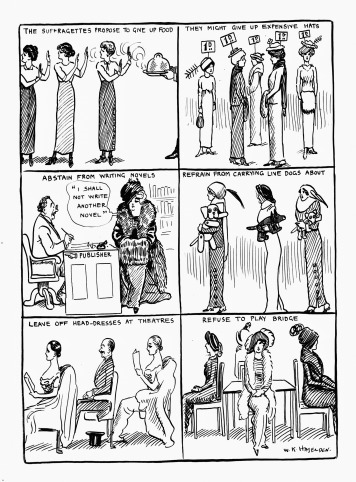
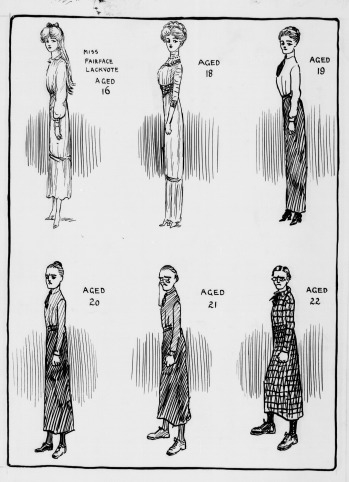
Haselden wasn’t entirely supportive of women’s involvement in politics, being particularly critical of the suffragette campaigns. His cartoons suggest that the suffragettes’ methods were silly and ineffective, and that getting involved with politics was a look most women would wish to avoid:

WH0827, ‘Some useful strikes that women might adopt’. 12 October 1912, Daily Mirror

WH0522 – ‘Effects of “votes for women” – upon Women’s faces’, 15 December 1910. Daily Mirror

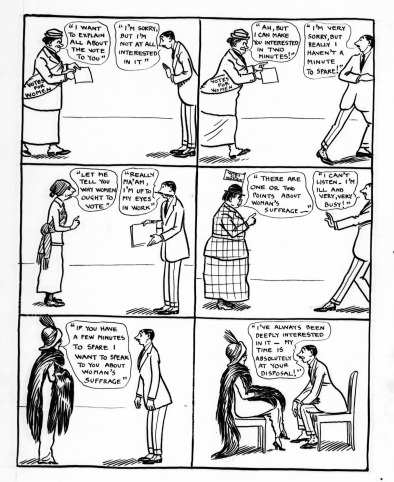
Men were not exempted from criticism of the suffragettes’ cause. In 1912, Haselden jokingly suggested that male responsiveness to women getting the vote depended primarily on the attractiveness of the campaigner in question:

WH1750, ‘His interest in Votes for Women?’, 30 October 1912, Daily Mirror

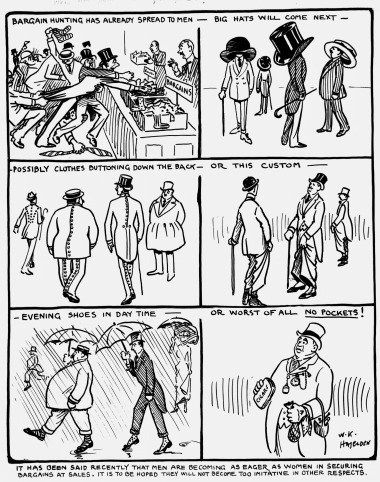
Haselden’s commentary is one of the joys of exploring the British Cartoon Archive; it’s nuanced but surprisingly light-hearted. Haselden highlights the frivolities of both men and women during the early 20th century, but also points out that a more equal society might not be a bad thing for anyone. And, of course, who can disagree with his point that women’s dresses should have more pockets?! A thoroughly modern man, indeed.

WH4765, ‘When men imitate women’, 30 June 1909, Daily Mirror

Our collection of Haselden cartoons can be explored through the British Cartoon Archive catalogue online, and his books are catalogued on LibrarySearch. To view any of Haselden’s original artworks held in the British Cartoon Archive, please do get in touch with us. 


Sources:

Little, D. (2004-09-23). Haselden, William Kerridge (1872–1953), cartoonist and caricaturist. Oxford Dictionary of National Biography. Retrieved 5 Feb. 2018, from http://www.oxforddnb.com.chain.kent.ac.uk/view/10.1093/ref:odnb/9780198614128.001.0001/odnb-9780198614128-e-66122

W.K. Haselden biography at the British Cartoon Archive

https://www.britannica.com/topic/The-Mirror-British-newspaper