Author Archives: Wendy Raeside

Baby

Updated policy on Shared Parental Leave

The University has updated its Shared Parental Leave policy.

The uptake of shared parental leave is very low both at the University and nationally (about 2%). One reason for this may be financial in that shared parental pay entitlements are currently based on statutory pay, rather than contractual pay.

In response, our Vice-Chancellor, Karen Cox, has approved a change in policy to change shared parental pay to match contractual maternity/adoption pay. These amendments are reflected in the revised Shared Parental Leave policy and are with immediate effect.

Phillip Blond: The Future of Post-Liberal Politics – 21 November

In a timely talk this Wednesday (21 November), Phillip Blond will reflect on the emergence, rise and future of ‘post-liberal’ politics.

Phillip Blond is an internationally recognised political thinker and social and economic commentator. The author of the widely-acclaimed ‘Red Tory: How Left and Right Have Broken Britain and How We Can Fix It’, Phillip went on to establish the think-tank ResPublica in 2009 and has since had considerable influence over the direction of Conservative and British politics, including the David Cameron government. In particular, he has sought to redefine the centre ground of British politics around the ideas of civil association, mutual ownership and shared enterprise. Prior to entering politics and public policy, he was senior lecturer in theology and philosophy at the universities of Exeter and Cumbria.

Philip Blond’s talk  will take place in Grimond Lecture Theatre 3 (GLT3), Canterbury campus, on Wednesday 21 November at 17.00 and will be followed by a reception.

The talk – which is free and open to all – is part of a new series of public talks on Britain, Brexit and the Future of British Politics, organised by the School of Politics and International Relations.

Leadership Bulletin 14.11.18

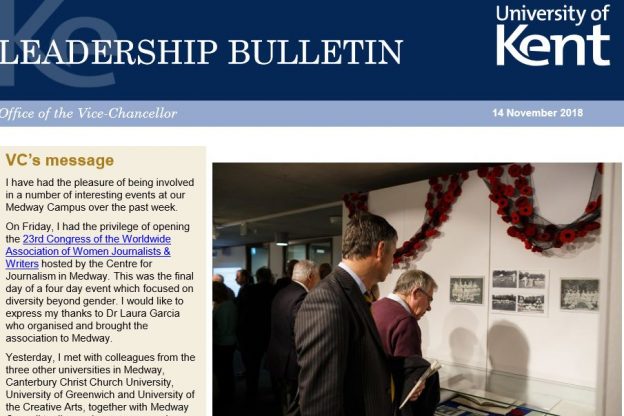
Read the latest Leadership Bulletin (14 November 2018)

The latest issue of the Leadership Bulletin, designed to give an overview of key developments at Kent, is now available.

The latest issue (14 November 2018) includes a summary of discussions held at the latest Senior Leadership Forum including the University’s ‘Cyber Essentials’ certification, the Wellbeing Zone app which staff can now sign up to, and the return of Pint of Science next year.

There is also an update on Executive Group meetings, including KentVision, a continued focus on recruitment and a discussion around the impact of Europe and Brexit on staff, students and University business. The “long read” by Deputy Vice-Chancellor – Education, Professor April McMahon, focuses on the next steps for TEF (Teaching Excellence Framework).

The Bulletin is distributed fortnightly to all members of the Leadership Forum to cascade to staff in schools and professional service departments. If you haven’t received your copy yet, you can read the bulletin online.

Find out more about the Leadership Bulletin and see previous issues on the OVC webpages.

Take part in an innovative new Yoga research study

We would like to invite members of staff at the University to participate in a six-week Hatha Yoga course starting in January 2019.

The yoga course is intended to improve wellbeing among members of staff who feel anxious and/or stressed or burnt out. The classes are suitable for beginners and we would like to recruit staff who have not attended a regular yoga class or practised yoga regularly in the last six months.

During the study, participants will attend a one-hour yoga lunchtime class each week at the Canterbury Campus.

Two different groups will receive slightly different interventions. This will allow us to compare improvements to wellbeing under each approach. We are hoping to recruit 40 members of staff in total and participants will be randomly allocated to each group. There will be about ten members of staff in each yoga class.

To evaluate the yoga course, we will measure participants’ wellbeing at the start of the course, at the end of the six-week course, and at a follow-up three months after the start of the course.  Information will also be collected when you register for the study to check that you are eligible to join the study and fit to practise yoga.

The weekly one-hour yoga classes will take place on Monday and Tuesday lunchtimes between 14 January 2019 and 5 March 2019 (excluding half-term week).

To register interest and to join this study, or for more information, email: Whysper@kent.ac.uk.

If you have any questions contact: Tracy Pellatt-Higgins, Centre for Health Services Studies, telephone 01227 827963.

Axel Stähler

Axel Stähler publishes book on Zionism, the German Empire, and Africa

Dr Axel Stähler, Reader in Comparative Literature for the Department of Comparative Literature, has recently published a book titled Zionism, the German Empire, and Africa (De Gruyter, November 2018).

Zionism, the German Empire, and Africa explores the impact on the self-perception and culture of early Zionism of contemporary constructions of racial difference and of the experience of colonialism in imperial Germany. More specifically, interrogating in a comparative analysis material that draws from a range of cultural sources, the book situates the short-lived but influential Zionist satirical magazine Schlemiel (1903–07) in an extensive network of nodal clusters of varying and shifting significance and with differently developed strains of cohesion or juncture that roughly encompasses the three decades from 1890 to 1920.

To find out more, please see click here

Sophia Labadi

Sophia Labadi announced as new AHRC Leadership Fellow

Dr Sophia Labadi, Senior Lecturer in Heritage and Archaeology for the Department of Classical and Archaeological Studies, has recently been awarded an AHRC Leadership Fellows grant of £247,947 for a project entitled ‘Rethinking Heritage for Development: International Framework, Local Impacts’.

Heritage is marginalised from the Sustainable Development Goals (SDGs) and such marginalisation is problematic. Heritage can provide new models of development that cannot be realised with such exclusion. This marginalisation will continue, unless issues preventing the recognition of heritage are understood and addressed.

Dr Labadi’s research aims to understand why heritage has been marginalised from the SDGs and innovative models addressing the identified shortcomings will then be proposed. To address this aim, this project assesses international narratives on heritage for development, highlighting their strengths and weaknesses. It then analyses the successes and failures of all projects on heritage for development funded through the Millennium Development Goals (that preceded the SDGs) in Africa.

Congratulations to Dr Labadi on her achievement.

For more information on the AHRC Leadership Fellow grant, please see here.

Canterbury Food Bank

We need food – make a Christmas donation now

The Development Office would like to invite you to help those in need this Christmas by donating to Canterbury Food Bank. Please donate by Friday 14 December. Thank you!

Items required are:

  • Breakfast cereal
  • *Whole milk (long life and semi skimmed)
  • Pasta (tinned)
  • Ham (tinned)
  • *Carrots/Peas (tinned)
  • Corned beef (tinned)
  • Tuna/Fish (tinned)
  • Fruit (tinned)
  • Sponge pudding (tinned)
  • Custard (tinned or carton)
  • *Smash instant potato or tinned
  • Tea bags
  • *Coffee (small jar)
  • Fruit juice (long life)
  • Fruit squash
  • Soup (tinned)
  • Cup-A-Soups
  • Dried rice (500g)
  • Dried pasta (500g)
  • *Pasta sauce
  • Baked beans (tinned)
  • Rice pudding (tinned)
  • Pies (tinned)
  • *Jam
  • *Biscuits, plus individually wrapped biscuits
  • High factor sun screen
  • Tomatoes (tinned)
  • Disposable nappies/wipes
  • Baby food
  • Cat/Dog food
  • Gents deodorant
  • *Washing powder and household cleaning items
  • *Washing up liquid
  • Shaving foam
  • Multi-purpose cleaning spray
  • Loo cleaner
  • Cleaning cloths
  • Kitchen roll
  • Toilet roll
  • Sanitary items
  • Toiletries

*Items that are urgently needed.

If you would like to be involved, please come along and donate to our Food Bank bin in Rutherford Annexe or if you have any questions please contact L.A.Saada@kent.ac.uk.

FLAG

Session to explore impact of changes to legal gender recognition process

A session reflecting on the tensions emerging from a debate about proposed changes to the legal gender recognition process will be co-hosted by Kent Law School’s Centre for Law, Gender and Sexuality (CLGS) on Saturday 24 November.

Beyond the Gender Agenda will be co-hosted jointly with the Future of Legal Gender (FLaG) project from 14.00 to 16.00 in the CLGS Common Room in Eliot College on Kent’s Canterbury campus. The session takes place within the context of conflict over the meaning and value of gender and in the wake of the Government’s consultation process on how best to reform the Gender Recognition Act (GRA) 2004.

FLaG’s Principal Investigator, Professor Davina Cooper (King’s College London) and Kent Law School Lecturer Dr Flora Renz, a Co-Investigator for FLaG, will begin the session with a short introduction to the GRA consultation and the FLaG project. They will also address key legal issues and wider gender politics. This will be followed by a moderated discussion with all attendees.

The session is free to attend, but anyone interested in coming is asked to register via Eventbrite.

FLaG is a three-year project, funded by the Economic and Social Research Council, that aims to critically explore different ways of reforming legal gender. In addition to Dr Renz, Co-Investigators include Kent Law School Professor Emily Grabham and Professor Elizabeth Peel (Loughborough University).

As well as exploring whether people should have a female/male legal status assigned at birth, FLaG also seeks to determine how the way that female/male and other gender categories used in UK law could be changed. People interested in expressing their views are invited to contribute to a FLaG project survey on ‘Attitudes to Gender’.

Etty Hillesum

Interfaith Week 2018 events

A series of events are taking place on the Canterbury Campus, to which all are welcome.

These begin, on Monday 12 November, with a presentation about the ‘spiritual’ diarist and Holocaust victim Etty Hillesum by visiting speaker Dr Philip Knight (17.30, KLT 2) and continue on Wednesday 14 November with an invitation to visit Canterbury Mosque (14.00-16.00, Giles Lane) and, later on, an evening Symposium led by a variety of speakers on the theme of ‘Knowing God’ (KLT5, 18.00-19.00 and followed by vegetarian buffet).

On Wednesday 21 November a paper ‘Luke’s Gospel and The Qur’an: an Inter-textual Study’ will be given by Revd Dr Stephen Laird, Anglican Chaplain (CNWsr2, 13.00-14.00).

Contact chaplaincy@kent.ac.uk for further details.

Professor Ekaterini Panopoulou

Promotions celebrate our academics’ excellence

The University’s academic staff continue to lead the way in outstanding research and teaching, and this has been recognised in our latest promotions.

Over 90 members of Kent’s academic staff are celebrating promotion to professor, reader, senior lecturer or senior research fellow across our Faculties of Humanities, Sciences and Social Sciences, with effect from 1 October 2018.

The new professors include: Professor Mattias Frey, from the School of Arts; Professor Simon Kirchin, School of European Culture and Languages; Professor Barbara Bombi, School of History; Professor Dan Lloyd , School of Biosciences; Professor Peter Rodgers, School of Computing; Professor Anna Corrias, and Professor Stephen Lowry, School of Physical Sciences; Professor Fragkiskos Filippaios, Professor Zaheer Khan, Professor Ekaterini Panopoulou, Professor Maria Paola Scaparra and Professor Shaomin Wu, Kent Business School; Professor Emilie Cloatre, Kent Law School; Professor Heather Ferguson and Professor Jane Wood, School of Psychology.

Alison Ross-Green, Director of HR and Organisational Development, said: ‘The University is dependent upon the personal growth and career attainment of its academic staff to refresh, develop and strengthen our organisation for the future. Congratulations to all those promoted in 2018, your outstanding performance, hard work and dedication form the bedrock of the University, and the outstanding student experience and research achievement that is so important to our success going forward.’

Taken collectively and individually, these academic promotions give us a great deal to celebrate.

Further information on all the newly-promoted academics is available.