Another term over…

It feels like time is rushing by more and more quickly: suddenly we’ve come to the end of another term! In some ways, it’s been a long time since Christmas – one exhibition, one lecture, several seminars, a new microfilm service and new plans hatching for the next academic year. Looking back on it all, as ever, I begin to wonder how we managed to fit it all in!
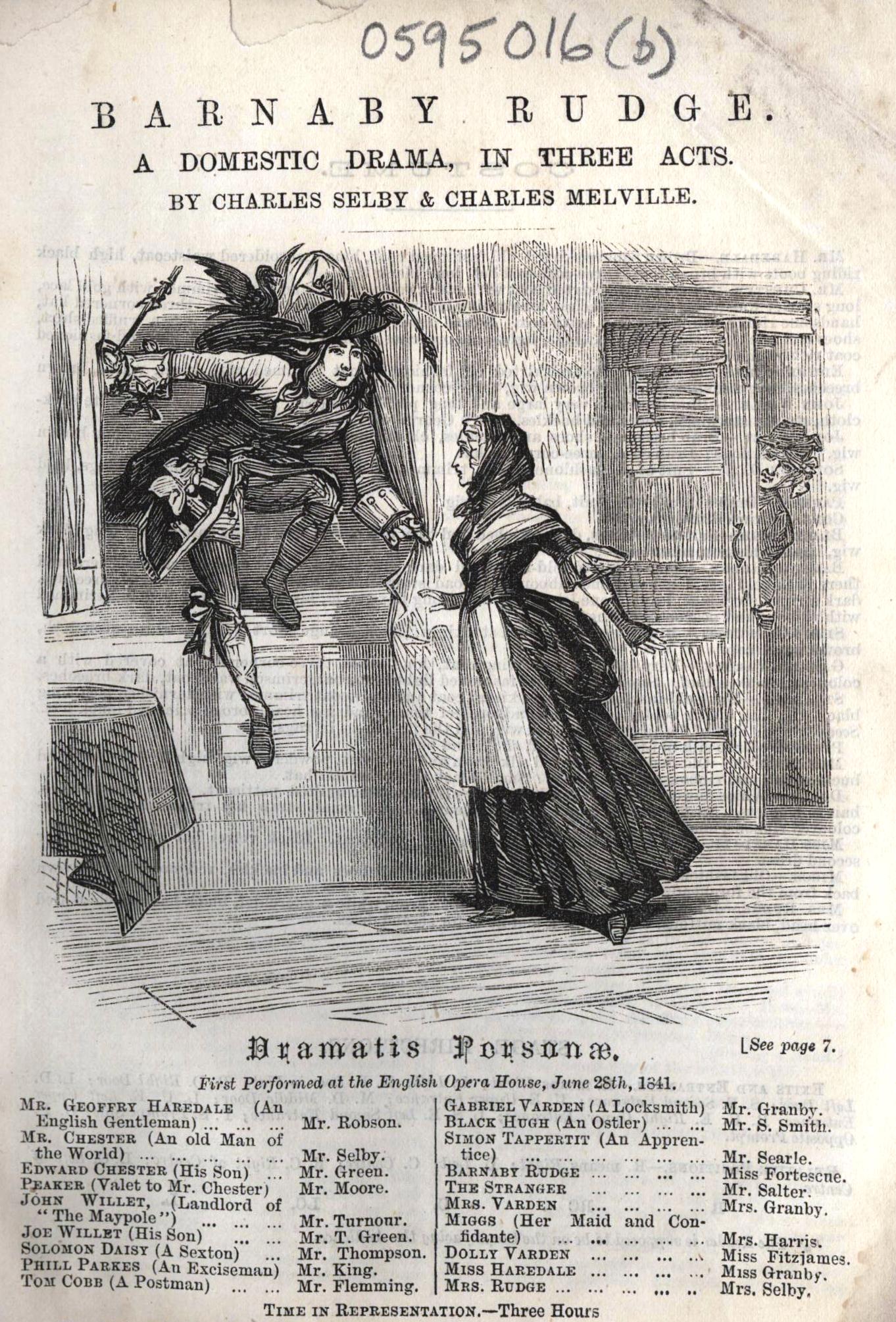
Title page of a script for Barnaby Rudge by Charles Selby, 1841

Title page of a script for Barnaby Rudge by Charles Selby, 1841

Well, we’re very proud of the Dickens exhibition – if you haven’t been do make the effort and let us know what you think by writing in the comments book. Webpages for the Dickens Collection are still under construction – their progress is being slowed a little by other commitments, but they’re getting there! The Dickens display case in the entrance hall has now been refilled with Rudyard Kipling materials; do take a look at this if you get the chance. We have several first editions of Kipling’s work in our Modern First Editions Collection, including the pamphlet containing two previously unpublished Christmas letters from Kipling to young readers, generously donated by David Alan Richards through Dr. Kaori Nagai.

It was a great pleasure to welcome the University’s Melodrama Research Group into Special Collections this term and to discuss the possibilities of future research projects based on the Melville and Boucicault Collections. Lecture two in our three part series, given by Dr. Charlotte Sleigh at the Cathedral, was well attended and thoroughly enjoyed by all – we hope to purchase Dr. Sleigh’s new book ‘Frog‘ for the collection.
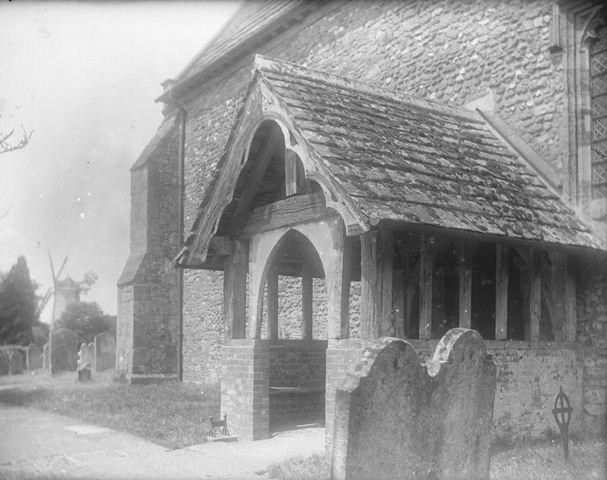
Image of a church porch from the W.B. Muggeridge Collection

Image of a church porch from the W.B. Muggeridge Collection

Of course, the day-to-day work is continuing apace, with the invaluable support of our small team of volunteers who are investigating various collections in our care. One of these is the Hendrie Collection, research notes by Andrew Hendrie, who completed his PhD ‘Coastal Command, 1939-1945 : the Cinderella service‘ at the University in 2004 and later published this as a book. The collection is full of interesting and moving anecdotes from Second World War pilots across the world, and we have just begun to catalogue it. More news on this soon, we hope! Work on the Renfrew Collection is gradually edging towards public access, too and we hope to complete some cataloguing on the Donald Muggeridge Rural Collection in the next few months.

On top of that, there are some germs of ideas including colloqia, Twitter feeds and online payments which we will be investigating throughout the next year. Still to come, of course, are two more Dickens exhibitions and no doubt a summer getting involved in research while hopefully carrying on with our cataloguing and digitisation plans.

So that’s all for the next term, and the next year. For the time being, as we await the launch (in our very own reading room) of sixteen books self-published by the sixteen students of The Book Project module, we would like to wish you all a very happy, peaceful and relaxing Easter.

As ever, if you have any queries, please do get in touch.
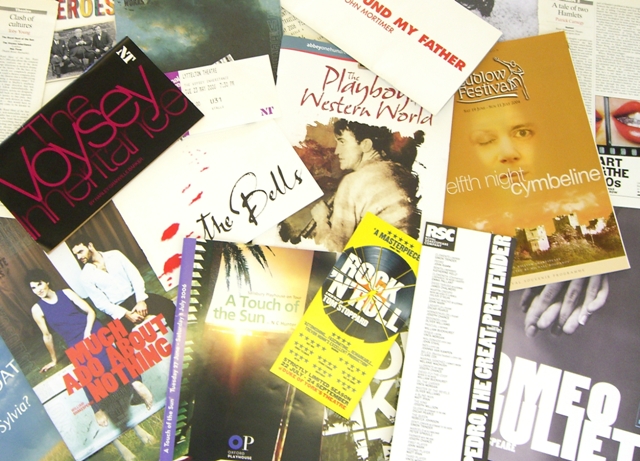
 

New theatre programme collection

A selection of programmes from the Foulkes Collection

Foulkes programmes

In Special Collections, we’re not just custodians of dusty books and archives which have been in the University’s possession for decades. In fact, the biggest part of our collections are the Theatre Collections, and we constantly try to update and renew all of the collections in our care. The latest addition to our constantly evolving holdings is the Foulkes Collection, programmes donated to Special Collections by drama historian Professor Richard Foulkes.

Professor Foulkes is an Emeritus Professor at the University of Leicester, where he is also a member of the Centre for Victorian Studies. His specialisms are Shakespearean and 19th and 20th Century theatre. He has also been involved in the ‘Victoria and Albert, Art and Love‘ project, which ran a major exhibition at Buckingham Palace during 2010. Professor Foulkes is chairman for the Society for Theatre Research and has donated programmes dating from the 1960s up to 2008.

The Foulkes Collection provides an excellent companion to our existing theatre collections, particularly the Reading Rayner Collection. Jack Reading, who donated the Reading Rayner Collection to the University, was a founder member, chairman and then vice president of the Society for Theatre Research. The majority of Professor Foulkes’ programmes focus on provincial theatre, particularly in the midlands, while also containing material from London and America. Donated in two batches between 2009 and 2010, work has now begun on cataloguing all of these programmes.

Because the majority of our programmes cover the period from the 1940s to the 1980s extensively, but provide less coverage of more recent decades, the decision has been taken to catalogue the materials in reverse chronological order. If you have a look at the search feature on the website, you will see that Professor Foulkes’ programmes for 2008 have already been catalogued. We’re working on a webpage about the collection to stand alongside information about other collections which you can find on the site.

Another major advantage of this collection is that some of the programmes contain cuttings and reviews of the productions. Considering how frequently we are asked for reviews of specific productions, I’m sure that this will be extrememly useful to all of our researchers. If the programme includes reviews, this will be noted on the catalogue record.

It’s still a work in progress, of course, and the complete cataloguing of the collection will take a considerable time, but I will be uploading records to our website for each year as it is completed. I hope that you will find these new resources useful for your research and we would like to thank Professor Foulkes for his donation to our evolving theatre archive.

If you would like any more information on any of the materials in our collections, or if you would like to book an appointment to view specific items, please email us to ask.

Canterbury Cathedral library

Here at Special Collections, we’ve recently been taking an extra special interest in the work of Canterbury Cathedral Library. The University of Kent’s Templeman Library is linked to the Cathedral’s library through the acquisition of the Mendham Collection but unfortunately in recent years there has been little opportunity to further this link.

However, all that is about to change. Over the next few months, we’ll be undertaking staff working exchange visits between Special Collections and the Cathedral library, to get to know the work and collections involved and how we can help each other. The Cathedral Library and its team have already proved invaluable to us, offering conservation, advice and, when it comes to disasters, immediate assistance! We hope that we can now build up a co-operative service for researchers and lecturers from the University, to make the most of our combined collections.

In keeping with this spirit of shared information and expertise, we hope to be able to publicise Cathedral library events and news on this blog from time to time. The first of these announcements is the Cathedral library’s programme of events for 2011 – including the launch of the newly refurbished library building, at which Dr David Starkey will give a talk on his favourite books from the library. Do have a look at these and come along to discover the history and heritage which the Cathedral and its library has preserved for centuries.

The Red Dean – another milestone

The pamphlets from the Hewlett Johnson Collection have now been fully catalogued. The items can be searched via the main library catalogue.

Hewlett Johnson was Dean of Canterbury from 1931 to 1963 and became infamous for his outspoken support of socialism. His life (1874-1966) saw turbulent times, experiencing the end of the Victorian era, two world wars and the heightening of tensions in the Cold War. Controversy dogged his public and private life, but unlike many of his contemporaries, Johnson never became disilussioned with Communism as the twentieth century progressed. Dean of Manchester, then Canterbury, he worked for social change in Britain as well as writing books and pamphlets to support the cause of a global socialism. He saw his deeply held Christian beliefs as complimentary to the Communist cause, rather than at odds with it. With critics and supporters in equal numbers, Johnson saw Canterbury through the Second World War, although his wife, Nowell, and children were evacuated to Harlech in North Wales.

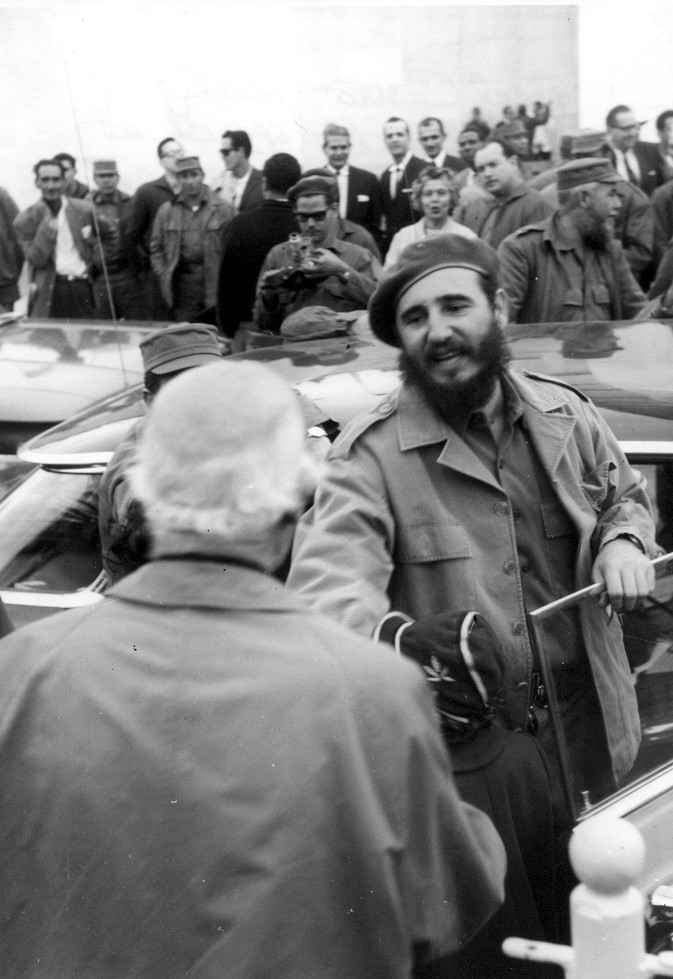
Fidel Castro talking to Hewlett Johnson

Fidel Castro talking to Hewlett Johnson

During his lifetime, Hewlett Johnson became a global star for Communism, travelling to Russia and China several times and publishing books and articles about his journeys. The material for his later visits was largely drawn from his wife’s diaries. At the age of 90, he visited Cuba for the first time: one spur-of-the-moment photograph in the collection shows Johnson talking to Fidel Castro. In 1951, Johnson became the second person to be awarded the Stalin Peace Prize and, despite the hostility from the Canterbury Cathedral Chapter, continued to advocate socialism throughout his tenure.

Some of the pamphlets were written by Johnson, for example I Appeal, which Nowell illustrated, about germ warfare allegedly carried out on China by America during the Second World War. There is also an obituary for Joseph Stalin, in the form of a memorial address to the British Soviet Friendship Society in 1953. Other topics related to socialism include social credit and the distribution of food during the Second World War. There are numerous pamphlets from and about Johnson’s tours to Communist countries. It is also clear that Johnson’s unsuccessful attempts to become a missionary did not stop his interest in the global development of Christianity; there is a pamphlet about Ugandan Christians, a copy of a sermon in support of the observance of the Sabbath, a short article on Christian fellowship and an exhaustive pamphlet supporting the theory of divinecreation, rather than evolution.

While these pamphlets are only a small part of the Hewlett Johnson Collection, they do display the wide variety of interests and influences of the extraordinary man who became known as the Red Dean of Canterbury.

For more information about Hewlett Johnson, and the collection, please visit the Special Collections Website.

Coming up next, the continuing cataloguing of the Bigwood wartime cinema and theatre programmes, and more entries on Archives Hub. Watch this space!

Newly Catalogued Collection

I am pleased to announce that the Jack Johns Darwin Collection is now fully catalogued and available for consultation in Special Collections.

Donated in 2008, Mr. Johns’ Darwin Collection is the result of over 30 years of collecting books by and about Charles Darwin. Following a boyhood fascination with evolutionary theory, Mr. Johns’ interest in Charles Darwin also led him to acquire items relating to members of the Darwin family and members of the scientific community in which Charles Darwin worked. Charles’ paternal grandfather, Erasmus Darwin (1731-1802), published volumes about biology and of poetry, including Zoonomia (1794) and The loves of the plants : a poem, with philosophical notes (1791). Josiah Wedgwood was Charles Darwin’s maternal grandfather, so there are also items relating to the Wedgwood dynasty in this collection.

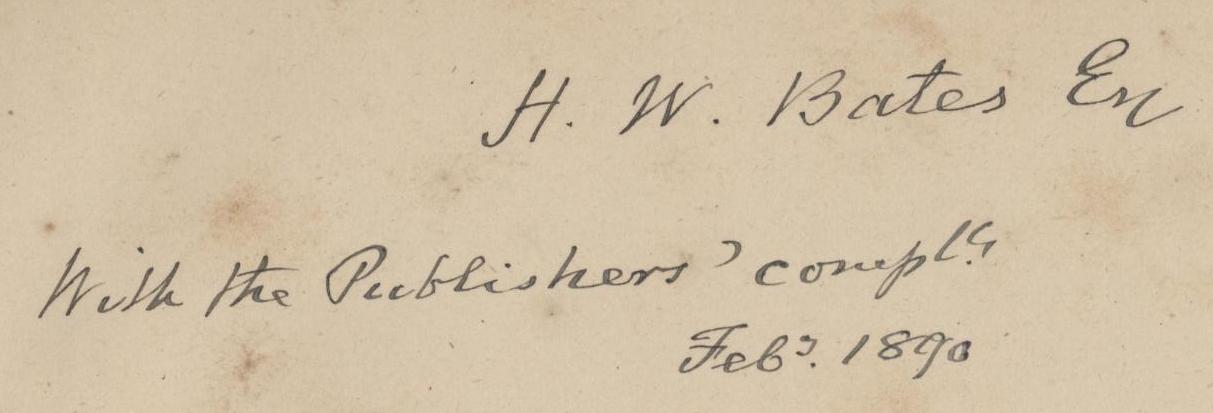
Items relating to other scientists include various works by Joseph Dalton Hooker and Thomas Huxley, Charles Lyell on elements of geology, and two nineteenth century books of the natural theologian William Paley. In addition, Mr Johns collected a small number of works relating to Alfred Russel Wallace, a naturalist and explorer who arrived at his own theory of evolution by natural selection independent of Darwin. On the Tendency of Species to Form Varieties; and on the Perpetuation of Varieties and Species by Natural Means of Selection (republished in Evolution by Natural Selection, 1958) was the long title by which the two men publically announced their theories jointly in July 1858. Another interesting item in this collection is an 1890 edition of Voyage of the H.M.S. Beagle, published by John Murray, containing the presentation note: ‘H. W. Bates Esq. With the Publishers’ compli[iments] Feb[uary] 1890′. Henry Walter Bates was an explorer and naturalist who joined Alfred Russel Wallace on an expedition to the Amazon in 1848.

Publisher's note to H.W. Bates

Handwritten presentation note to H.W. Bates.

The central section of Mr Johns’ collection is based around his endeavour to acquire every edition of Darwin’s most important works, the vast majority of which were published by John Murray in London. These provide an insight into the editing and corrections of each successive edition, and prove the popularity of Darwin’s works.

For more information about this collection and Mr Jack Johns, see our collections information pages or search the library catalogue.

This collection also compliments the Maddison Collection, which focuses on natural theology and early science of the  seventeenth, eighteenth and nineteenth centuries.

If you would like to look at any of the items in these, or any of our collections, please email specialcollections@kent.ac.uk to make an appointment.