Do you know KJV?

Or perhaps it should be: do you know the KJV?

There’s been a lot of talk, in certain circles, about KJV this year; not least down at Canterbury Cathedral Library, where the acronym had me thoroughly confused for a while. KJV is one of the best known items in the world, and has had its followers for 400 years. Still the topic of debate, praise and criticism, it’s provided the English language with many of its well-known phrases and sayings, in some cases even resurrecting words which had gone out of use at the time it was first printed.

Have you guessed what it is yet? Yes, that’s right: the King James Version (or Authorised Version) of the Bible.

The KJV translation was begun in 1604, by six committees of academics and clergymen, each taking a section of the vast text. It took seven years to complete and was printed by the King’s printer, Robert Barker, in 1611. This was only the third authorised English translation of the Bible; the first was the Great Bible of 1539 and the second the Bishops Bible, thirty years later. Translations of the Bible into English had taken place as early as the late 14th century, with the work of John Wycliffe and his followers, whose Bible was translated from the 4th century Latin Vulgate version of St. Jerome. William Tyndale’s translation of the New Testament, the first printed in English, was taken from the Hebrew and Greek texts. Both Tyndale and Wycliffe were executed for their roles in translating the Bible and copies of their banned translations were burned.
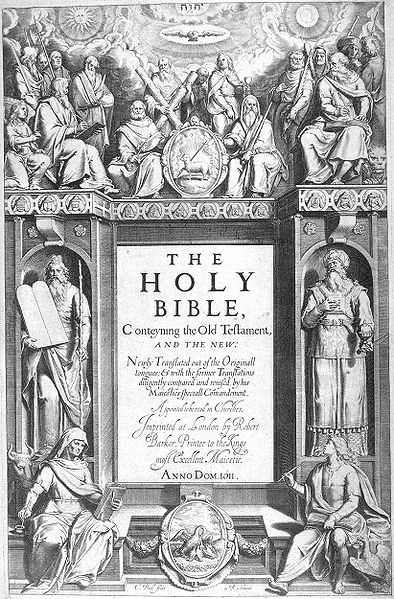
Title page to the King James Bible, 1611

Title page to the King James Bible, 1611

It was only with the Reformation and the creation of the Church of England under Henry VIII that English translations of the Bible were permitted into the mainstream. The KJV is the descendant of various translations, from Wycliffe through to the Bishop’s Bible, but none of its predecessors is so commonly used and clearly valued as much as the KJV itself. Phrases such as ‘Let there be light’ (Gen. 1:3) and ‘In the beginning was the word’ (John 1:1) have become an instantly recognisable part of the Christian Bible, and of the English language. Some have suggested that the KJV is more important than Shakespeare in terms of the development of the English language.

So why not join the celebrations to mark the 400th anniversary of this remarkable book? We have a copy of the first quarto edition (1612) on display in the library foyer. The Cathedral Library‘s exhibition The Bible in English is open all next week, from 2-4pm, where you can learn more and see the original editions of the KJV, Bishop’s Bible, Coverdale and many more. Even writing a blog is educational: in the process I’ve discovered the website of the King James Bible Trust, which includes digitised images of the whole 1611 edition of KJV.

Who’d have thought there could be so much significance and interest in three letters?
Cathedral Open Evening

As some of you may know, on Wednesday 5th October Canterbury Cathedral will hold its annual Open Evening, including displays, a concert and an opportunity to learn about the historic building and its traditions.

One of the most important aspects of the Cathedral’s history can be found in its Library, which will be open to the public for a rare glimpse of the collections and the newly restored Howley Library. The communities of the University of Kent and the Cathedral are closely linked, especially through their emphasis on and exchange of learning. Special Collections and the Cathedral Library maintain a close relationship: I’ve been lucky enough to spend time in the Howley Library and would strongly recommend a visit.

Rebuilt in 1655, the Library has recently been restored to its 19th century decor. Some of the rare, historic and beautiful items which the Cathedral Library holds will be on display, so don’t miss this opportunity to have a look behind the ordinarily closed door of the Howley Library and to explore the trasures of its magnificent collections.

Information about the Open Evening and timings can be found online.


Melodrama and Silliness

Some of you may have noticed that, in the last couple of days, images have been appearing on some of the theatre records on the Special Collections website. This initial digitisation has allowed us to put up all of the smaller sized playbills from the Britannia Theatre which are held in the Bigwood Collection. This is all thanks to Chris Hall, who has been volunteering with Special Collections two and a half days a week. Not only has he made a start on this long-awaited digitisation, but he even agreed to write a blog post to keep us up to date.

A few months ago, I was speaking with my friends on the subject of great British playwrights. We came up with the usual names, Marlowe, Shakespeare and Jonson for the Elizabethan and Jacobean theatre, Sheridan, Shelley and Coleridge for the Romantics. Then we skipped roughly 80 years and listed Wilde and Shaw as the major figures of the late 19th Century stage. But what of the mid Victorians, who were their great playwrights? To be honest, I still can’t think of one, but there is a reason for that, because in the mid-Victorian age, something rather bizarre, yet very entertaining, happened to British theatre, and it is codified by the Bigwood collection of playbills from the Britannia Theatre.

Front page for 'After Dark Galop'

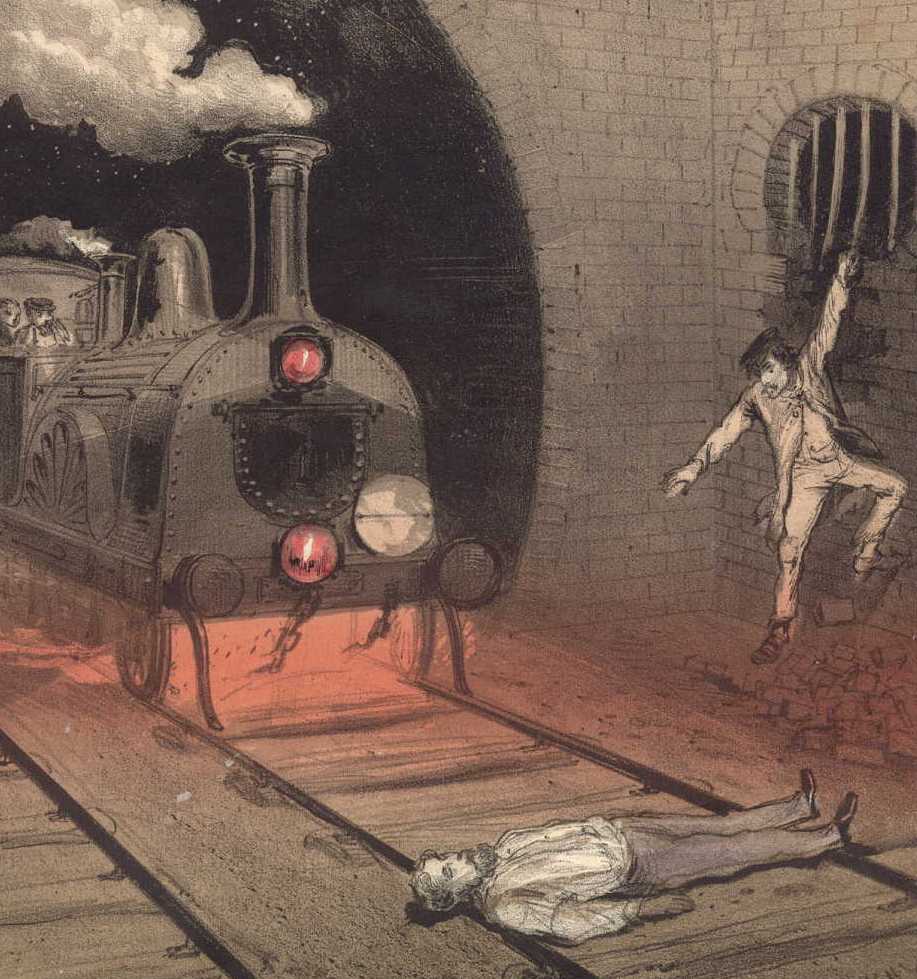
Scene from Boucicault's 'After Dark'

Most people would have heard of melodrama, but probably in a different context. When we think of melodrama, we think of melodramatic actors delivering their lines with overemotional abandon – think Brian Blessed playing Hamlet. However, the root of melodrama is slightly different to how we know it now. The root of the word is simply melos from the Greek for music, and the French drame, which needs little explanation. Essentially then, melodrama is musical drama. Not in the sense of it being a musical, instead music was often used to underscore the dialogue in order to raise the emotions, a technique used so much in modern film and theatre that we barely even notice it. It is this style of theatre which dominated with mid 19th Century, as well as high and low comedies and adaptations of Shakespeare. These were big productions, with full scale orchestras, evil villains, courageous heroes and fainting damsels, who were probably tied to railway tracks on a fairly regular basis. With this conception of melodrama in mind, we can begin to picture the spectacle of a play performed in the 1860s.

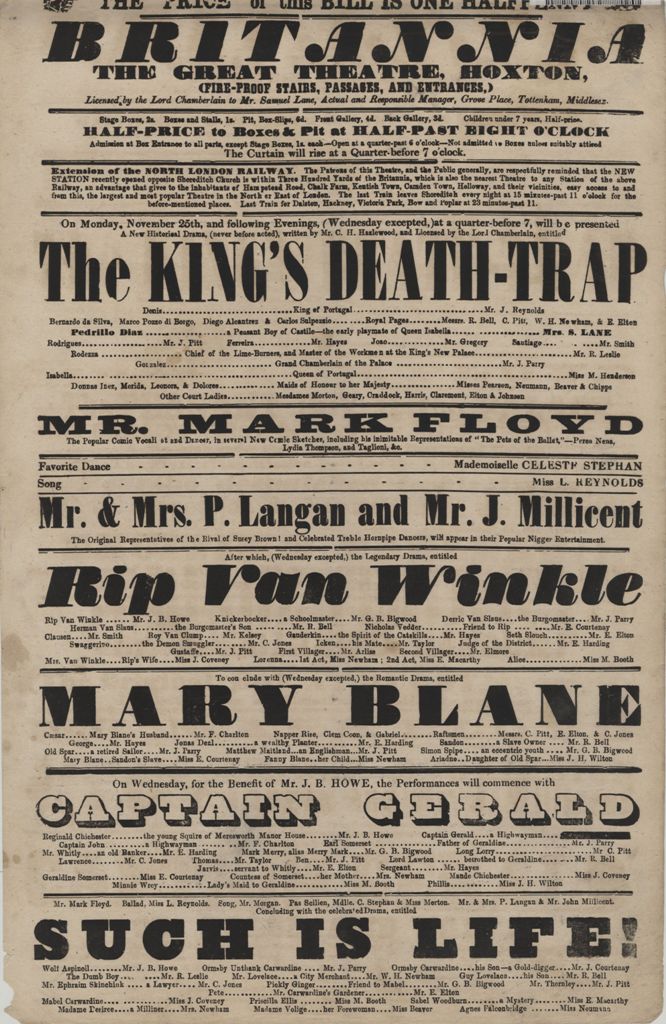
Playbill from Britannia Theatre, 25th November 1867

Playbill from Britannia Theatre, 25th November 1867

The Britannia Theatre in Hoxton, London, was one of the most glamorous and capacious theatres in the city at that time. The most famous version was constructed in 1858, with the previous building being classified as a saloon, rather than a theatre. Unlike many theatres of that time, The Britannia took the relatively modern approach of providing drinks and food in the auditorium, possibly setting a standard for what we now take for granted when we go to the theatre. Sarah Lane, wife of the theatre’s founder, Samuel Haycraft Lane, was the manager and also performed in many productions as a dancer. However, the collection that this blog entry is about was amassed by George Bigwood, who gathered the playbills, largely from the 1860s. The playbill is a valuable resource in researching theatre culture in the 19th Century. Many of them display a melodrama of their own; the print is large and bold, not too far removed from the typography seen in modern tabloids. One bill alone promises such titles as ‘THE KING’S DEATH-TRAP’ described as: ‘A New Historical Drama (never before acted)’ and the familiar name of ‘RIP VAN WINKLE’.

These playbills are a vital part in the study of the history of British theatre, and helps fill a gap between the plays of the late 18th Century and the fin de siècle. While this was not theatre designed to be great art, it does not lessen the importance of the plays in 19th Century culture. The writers of this era were not the jobbing playwrights of Shakespeare’s time, who were immersed in, or possibly constrained by, classical education. Indeed, they were men of the people, writing for the people. Of course, with Sarah Lane as manager, it wasn’t just men delivering this entertainment. As such, this collection represents a vibrant, if a little silly, period of theatre. But there’s nothing too wrong with a bit of melodrama and silliness from time to time.

Chris Hall

Larger playbills from the Britannia in this collection need to be scanned on a large overhead scanner which is currently experiencing some technical problems, so we’re awaiting developments there. Next, we intend to digitise the Britannia playbills in our general playbill collection, so keep watching the website!

One Day Conference

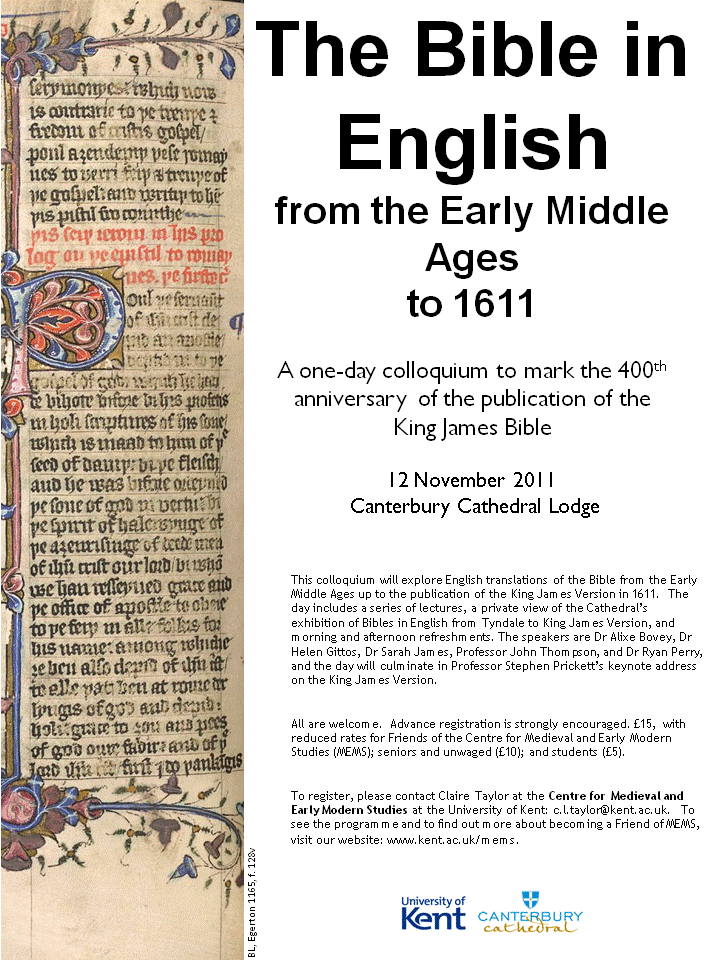
Bible in EnglishAs part of the ongoing partnership between Canterbury Cathedral Library and the University of Kent, I’m pleased to be able to publicise this one day conference being run by the University’s Centre for Medieval and Early Modern Studies (MEMS). The day’s sessions will take place in the Cathedral Lodge and there will also be opportunities to view some of the Cathedral Library’s extensive selection of bibles and other materials.

For more information or to book a place on this exciting conference, please contact Claire Taylor at MEMS.

Ron Baldwin

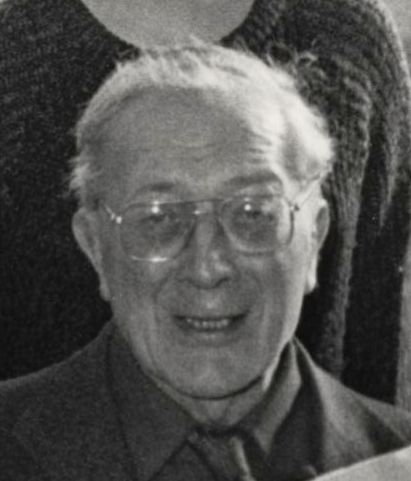
I thought I would share with you another find which came out of the Baldwin archive last week. It was a chance find; I spotted it as I was flicking through one of the many black folders to list the types of materials enclosed. Having said that, I think it’s one of the most important, since most of us working on this collection had no idea what the collection’s tireless collater actually looked like. So, here he is: Mr Ronald Baldwin.

Ron Baldwin in 1986

Ron Baldwin in 1986

Mr Baldwin was a keen local historian and produced The Gillingham Chronicles : a history of Gillingham, Kent as well as teaching on the subject. He was also a keen collector of ephemera, a Bible Christian (a sect which sprang out of Methodism) and his interests ranged across many disciplines from brickmaking to elections, and trains to trade tokens. In starting the work on the remaining uncatalogued material in the Baldwin collection, we have only begun to get a sense of the sheer scope of his interests.

What was really nice about finding this photograph was to finally put some kind of identity to the collection. The sheer range of collections which we hold makes it difficult to keep track of the individuals who dedicated significant time, often a lifetime, to their collecting. Some, for example the Melville family or Hewlett Johnson, were larger than life and more than a trace of their exceptional personalities has come across in the work which they have left us. Others, like Jack Johns, Jack Reading and Colin Rayner, are almost anonymous in their own collections now that the majority of the staff who knew them have moved on. Of course, those collections are the ones which were collected for their own sake, rather than about a particular individual. It’s interesting to reflect, when it comes to our work with archives, about the reasons behind its creation and the uses to which the collator wanted their collection to be put.

Once the  collection is passed to any institution, of course, the needs and abilities of that institution play a role in the archive’s evolution and uses. UoK’s Special Collections is no different to other museums and archives in this; when we accept collections, we do so on the understanding that the materials will be used in order to make an important contribution to the learning and teaching at the University, and will benefit the wider community. In this way, I think that Mr Baldwin’s collection may be one of the most difficult to ‘pigeonhole’: his collection is so varied that I hope the materials will, when available, be of use to many people both inside and outside the University.

So, the work we’re currently carrying out on Mr Baldwin’s collection is focussed on the materials which weren’t put straight into Special Collections’ Local History section. This section consists of around 800 ringbinders full of notes, cuttings, photographs and ephemera, over 4000 published volumes and some postcard albums. There are also some more indentures and legal documents, later than those which caused a lot of excitement when they were discovered to date from 1424 up to the reign of Charles II. The current process is to pull the ringbinders out of their (slightly disordered) storage space in order to try to recreate Mr Baldwin’s sequence. Due to constraints on time and space, we’re pulling out small groups of folders on related disciplines, boxing them up and listing them. Once our lists are complete, we’ll be able to pull together the themes and subjects to create manageable sections to continue our work. It’s only a preliminary stage and it will probably be some time before work on the archive is completed, but the sheer amount of information which Mr Baldwin collated means that this will be a worthwhile task.

So while we see countless photographs of countless people in our day to day lives, it’s nice to have Mr Baldwin looking on over ‘Baldwin Corner’ as it fills up with organised boxes containing just a fraction of his life’s impressive collection.