Looking at Lanquet: A Closer Look at An Epitome of Chronicles

Written by Bex Norris, student on HI6062: Dynasty, Death and Diplomacy – England, Scotland & France 1503 – 1603

Little is actually known about Thomas Lanquet’s life, except that he began writing his Epitome of Chronicles, but he died before it was finished. The Chronicles werefinished by Thomas Cooper and published in 1549, with the book later being known as the Coopers Chronicle. Lanquet died in 1545 after writing about the accession of Tiberius, with the rest of the book being written by Cooper. Despite the fact that very little is known about Lanquet himself, it is known that he was a historian and a humanist, which would suggest that he would have styled his work to mimic Classical literature, something seen as contemporarily popular.

Title Page of An Epitome of Chronicles

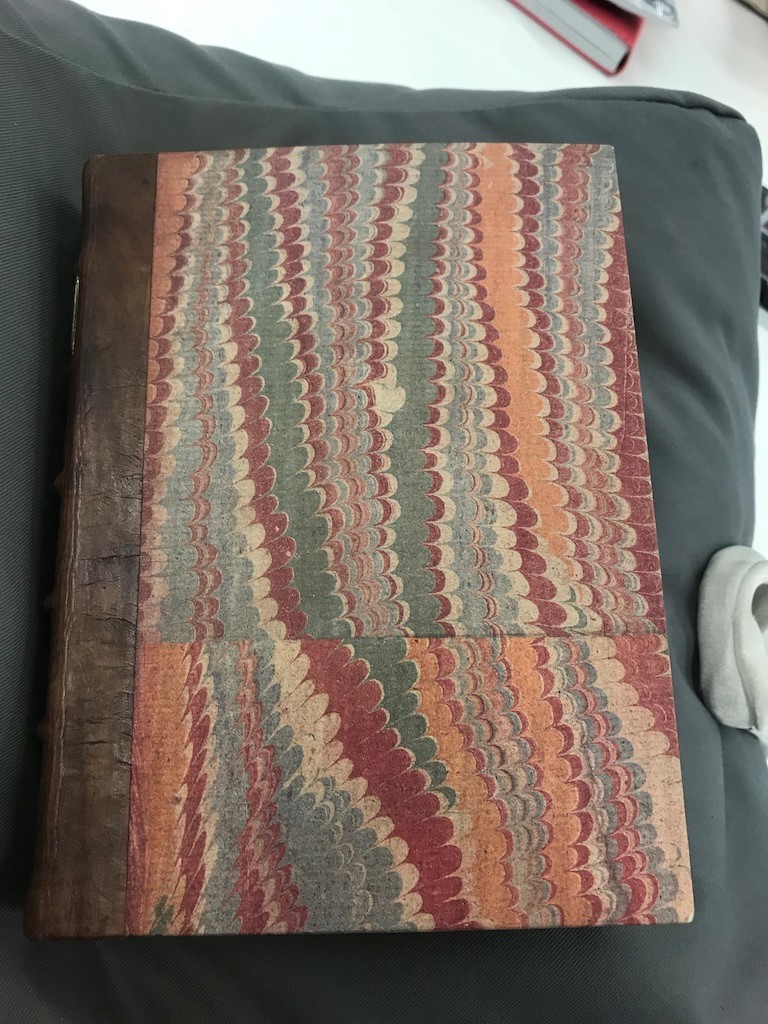
The copy of An Epitome of Chronicles held at Special Collections & Archives at the Templeman Library is interesting for several reasons. The book has been rebound and several pages of the beginning on the book have been replaced, most likely due to water damage, as seen in the images below. The newer elements of the book seem to have been replaced in the nineteenth or twentieth century. This is also seen with some pages where the original paper has remained partially intact, with the damaged elements being replaced with newer paper, as seen in the images below. This is something that is therefore unique to this copy of An Epitome of Chronicles and gives a clear idea that the book was not left in the best condition, potentially being left in a damp storage area that would have degraded these elements of the book to the point of needing replacing. [Editor’s note: this damage did not occur in the book’s current home!]
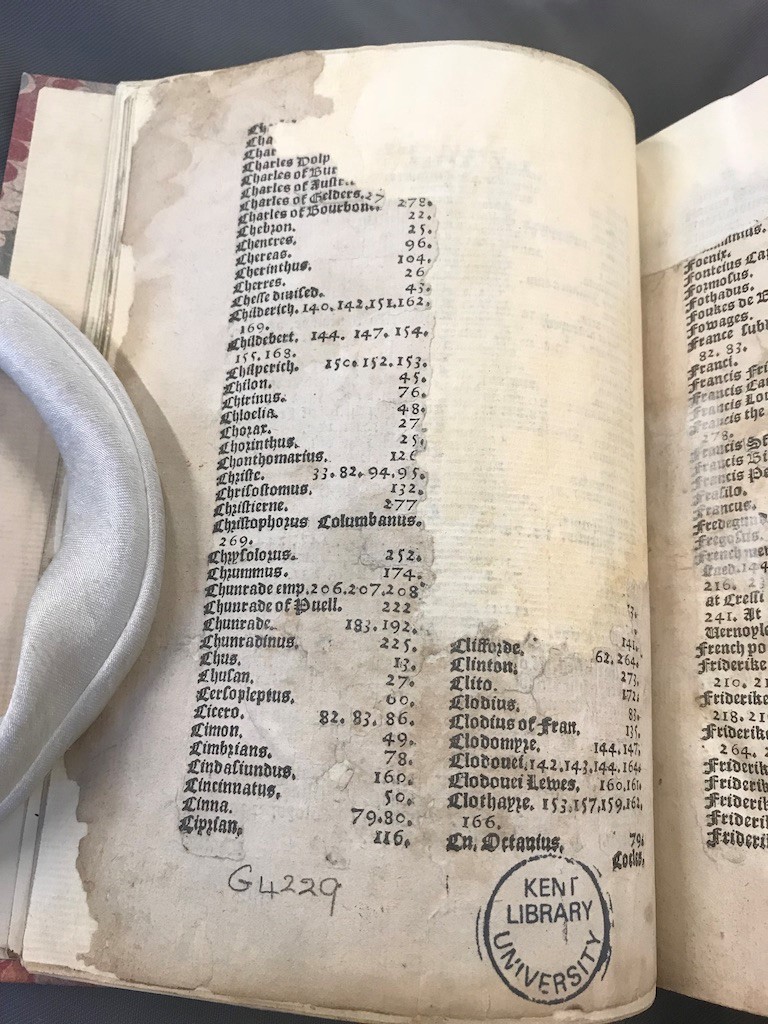
One of the damaged pages
One of the damaged pages


Cover of An Epitome of Chronicles

Cover of An Epitome of Chronicles

Another interesting feature that is unique to this copy of Epitome of Chronicles is the fact it has been annotated. This is indicative that a previous owner of the book did not feel that it was important enough to remain unmarked, with one page containing a sum, which appears to be to do with the chronology of the history. This highlights the use and engagement with the book, as they were able to read well enough that they felt that they were able to annotate certain sections and to add their own thoughts. This suggests that the book was owned by a literate person who was able to write down what they thought of particular passages, giving an insight in to their responses from when they read the book.
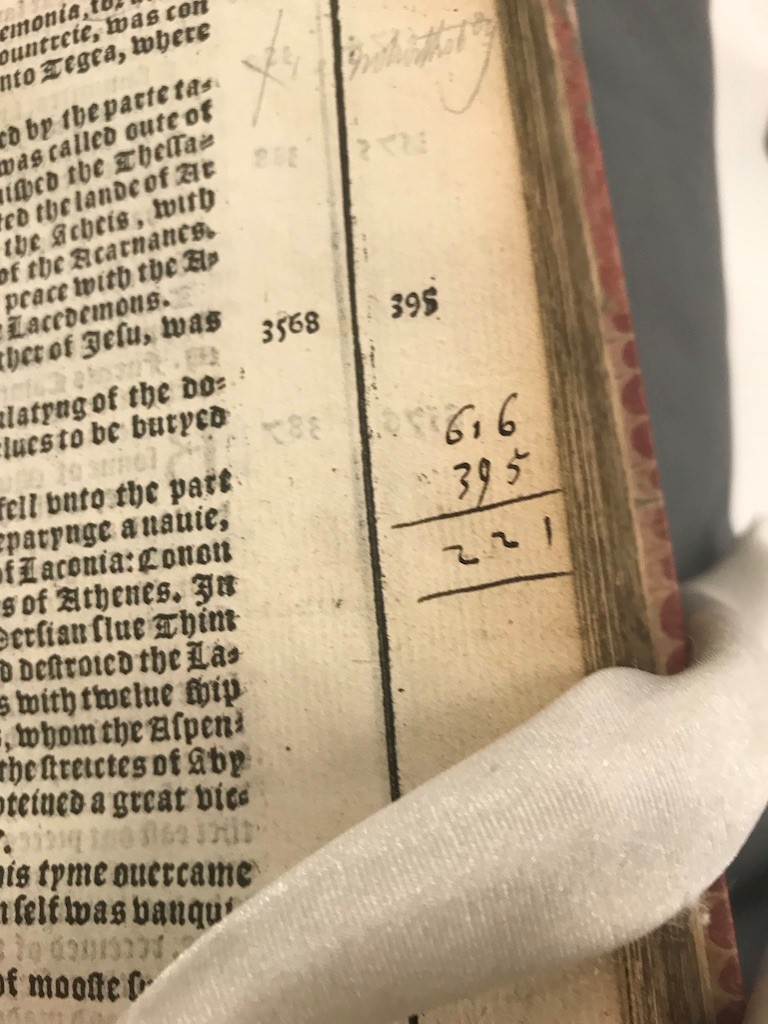
Annotations

Annotations


The work of Lanquet, and subsequently Cooper was to educate readers on the history of England as they saw it, with references to what was happening in the wider world. This would include who was ruling in other countries and if there were any plagues within countries, such as a pestilence in 491 B.C. in Rome. It is accepted within the writing that the Bible and Arthurian legend are history, and this is used to emphasise the chronology he was writing. Cooper, however, changes Arthurian legends to suit the history he wanted to tell, removing magic from his chronicles and replacing it with the power of the ‘common voice of the people’. Magic being removed when writing the histories would have been not only to make them a realistic part of history, but also because Cooper, who finished the chronicle, was a bishop, and the use of magic would not have fallen in line with his religious views. The histories therefore would have been adapted to suit the narrative that the authors would have believed in, as well as any political leanings that they may have had, which is shown with how the book is dedicated to Prince Edward and the Duke of Somerset. This highlights how Cooper would have been attempting to praise the prince, while affirming Protestant beliefs, with Cooper stating in the preface, ‘the holy scriptures […] teaches us politicall administracion, and let forth many notable examples, which in rulying a publike weal be necessary to bee knowen, and whereby the myndes of princis may bee stiered to the study of true nobilitee and vertue’. This explains why not only the biblical history is accepted as fact and dated within the chronicle, but also why it is so supportive towards the Tudors and how they are favoured by God. The fact that the book is also written in English, in a Gothic font, further highlights the break from Rome, as Lanquet and Cooper did not write in Latin, with English books being more common following the Reformation.

The preface not only gives an idea of the setting in which the book was written in, but also the type of person it was written for. As ‘the readyng of histories doth indifferently avayle all men’ and ‘Princis, yea and all other, that have auctoritee in great affaires and high matters, ought those examples and actes chiefly to consider’ suggest that Lanquet and Cooper believed that the main audience of their book would be those in a position of political power, and that history would be useful in knowing where previous leaders have failed and how they have succeeded.

Even though little is known about Thomas Lanquet, quite a lot can be discerned about England during his time from this single copy of An Epitome of Chronicles, with language choices giving an indication of the context that the book was written in, and additions to the book with owners’ notes giving a sense of the history of this particular copy of An Epitome of Chronicles. The book is unique to other copies because of its treatment since its publication in 1549, making it an interesting centrepiece for research, seen even in the past with different copies of the book. The way in which the book has been treated, such as the rebinding of the book because of its damage makes this copy unique to any others. The copy of Lanquet’s Epitome of Chronicles held in the Templeman Library is therefore interesting based on not only the history of England that it gives, but also in how it differs from other copies

Bibliography

Primary Sources

Lanquet, Thomas and Thomas Cooper, An Epitome of Chronicles [London: Thomas Berthelet, 1549] Special Collections & Archives: Pre-1700 Collection, C 549 LAN

Lanquet, Thomas and Thomas Cooper, ‘An Epitome of Chronicles’, Early English Books Online, <http://gateway.proquest.com/openurl?ctx_ver=Z39.88-2003&res_id=xri:eebo&rft_id=xri:eebo:image:176476> [accessed 31 October 2018]

Secondary Sources

Fletcher, Robert Huntington, The Arthurian Material in the Chronicles Especially Those of Great Britain and France (New York, NY: Haskell House, 1965)

H., C. W., ‘Queries with Answers’, Notes and Queries, 3rd ser., 11 (1867), 332-333

Pearson, David, John Mumford and Alison Walker, ‘Understanding and caring for bookbindings’, British Library Preservation Advisory Centre, <https://www.bl.uk/aboutus/stratpolprog/collectioncare/publications/booklets/caring_for_bookbindings.pdf> [accessed 30 October 2018]

Starnes, D. T., ‘Sir Thomas Elysot and the Lanquet-Cooper “Chronicle”’, The University of Texas Studies on English, 34 (1955), 35-42

Summerson, Henry, ‘Lanquet, Thomas’, Oxford Dictionary of National Biography, <http://www.oxforddnb.com/view/10.1093/ref:odnb/9780198614128.001.0001/odnb-9780198614128-e-16056?rskey=e3o07u&result=1> [accessed 29 October 2018]

Wheatley, Chloe, Epic, Epitome, and the Early Modern Historical Imagination (Farnham: Ashgate, 2011)
Holinshed’s Holistic Histories of Britain

Written by Daniel Quirk, student on HI6062: Dynasty, Death and Diplomacy – England, Scotland & France 1503 – 1603

The Templeman Library’s Special Collections & Archives Department holds a rare 1587 edition of Holinshed’s Chronicles; a book that collates the works of some of the most influential pre-seventeenth-century writers of early English, Scottish and Irish history in a single place. Printed in gothic English font, the book’s characteristics imply a lot about its intended use as an object, which will be explored in this blog. This blog will also demonstrate that the book was the product of a growing late sixteenth-century belief that Scotland and England were becoming a shared space and that Holinshed believed it was important for the national histories of both nations to be understood within a single book.

Holinshed’s Chronicles were collated by Raphael Holinshed (1529-1580) with the first edition published in 1577, and this particular book at the Templeman Library published as the second edition in 1587 under the supervision of Holinshed’s successor, Abraham Fleming. Holinshed and his successor brought together works by authors that dominated the contemporary understanding of England’s and Scotland’s respective histories, such as Hector Boece whose ‘Scotorum Historiae’ was translated and used in the ‘Historie of Scotland’ section for Holinshed’s book along with works by other authors on Scotland’s history.

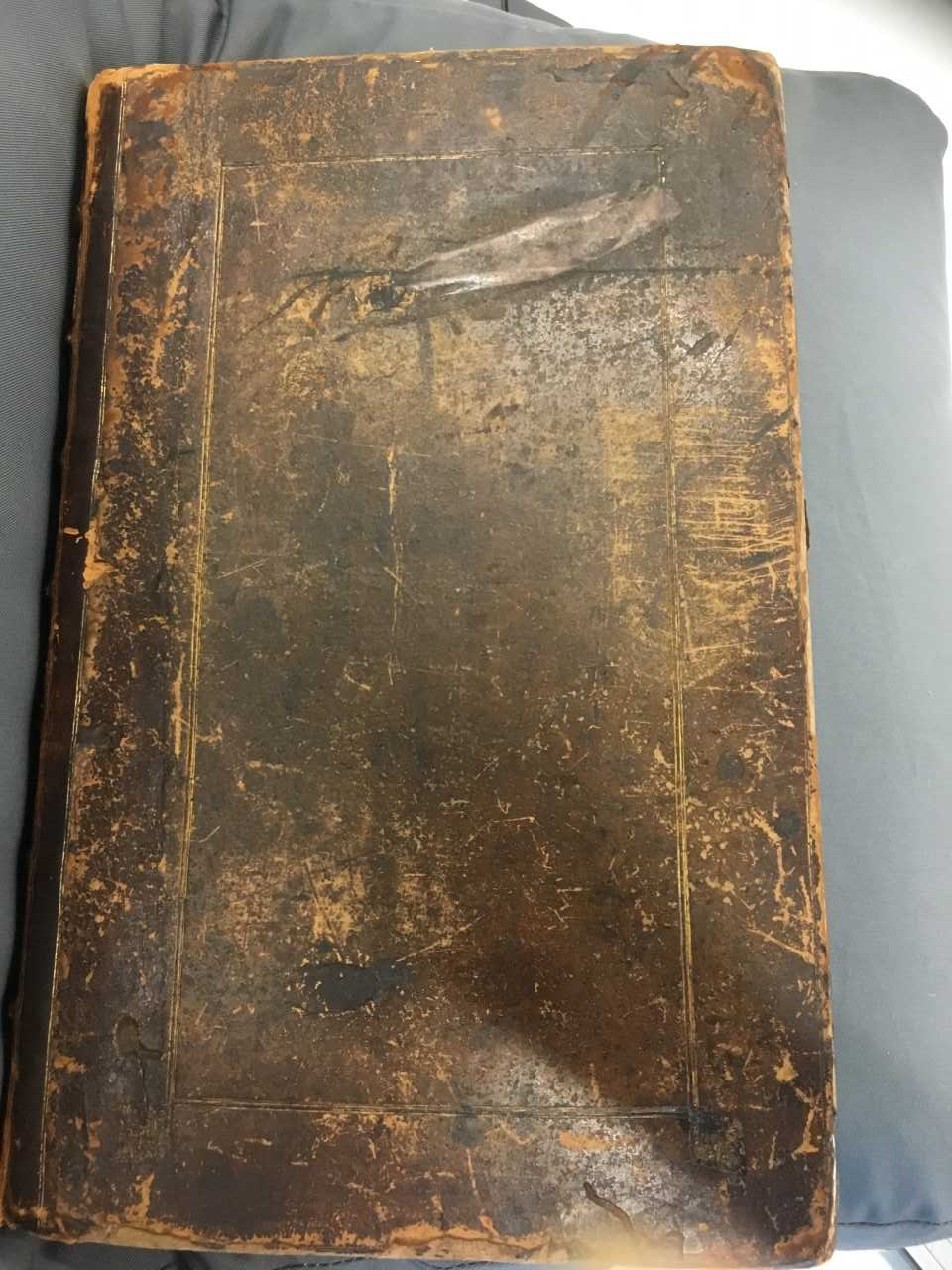
External view of the 1587 Holinshed Chronicles Volume II in the Templeman Library’s Special Collections & Archives

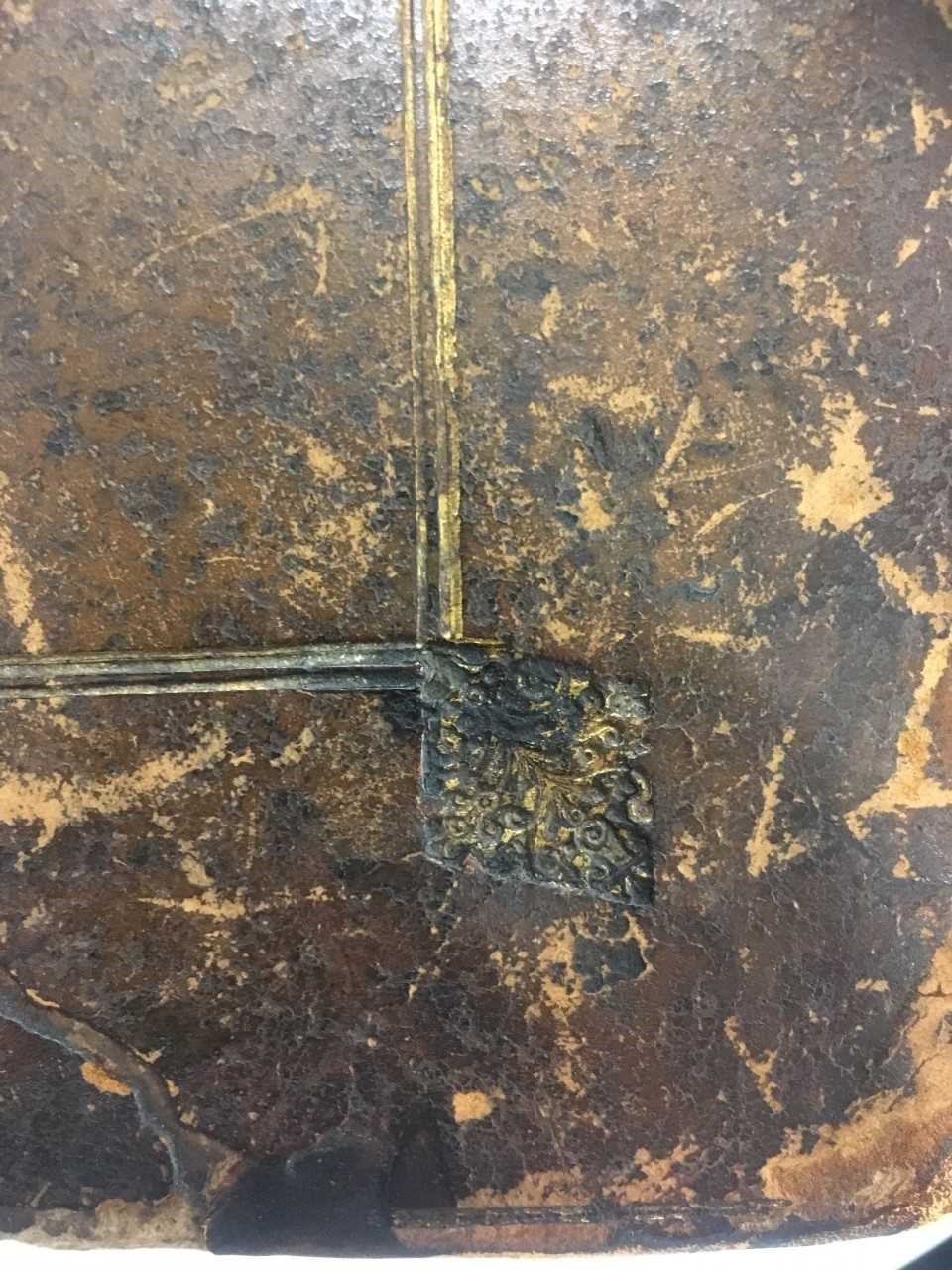
The first obvious feature of the book is that it is very large, measuring 36cm x 23cm x 8cm. The size suggests that this book was not designed to be an easily portable book but was most likely intended for personal educational use as part of someone’s collection. The use of English translations instead of Latin suggests that the intent of the book was primarily educational, bringing about greater awareness of the ancient origins and histories of the British Isles by using a more widely understood language. Furthermore, as paper was an expensive material to use in the sixteenth-century, the impressive size of the book and its pages also implies that the book was materially valuable to its owner as well as an important educational resource. Evidence of intricate gold-leaf patterns on the cover reinforces this argument that this book was produced with expense to impress.

Evidence of elaborate gold-leaf decoration on the cover and binding of the book.

Conversely, a surprising observation of this book is the lack of internal decoration with very few woodcuts used. The same few woodcuts are repetitively used, suggesting that although this book was impressive externally the expense was spared internally. This contrasts with the 1577 edition of Holinshed’s Chronicles at the British Library which has many elaborate woodcuts depicting important monarchs and historical events that are not evident in the Templeman Library’s edition. The reason for this could be the lack of financial support behind the 1587 edition. After Holinshed’s death in 1580, his successors had difficulty establishing financial support for continuing with the new edition. Woodcuts were expensive additions to a book and were often reused instead of new ones being commissioned to keep costs down. This lack of financial means may explain the sparse use and recycling of a few styles of woodcuts in this copy of The Chronicles.

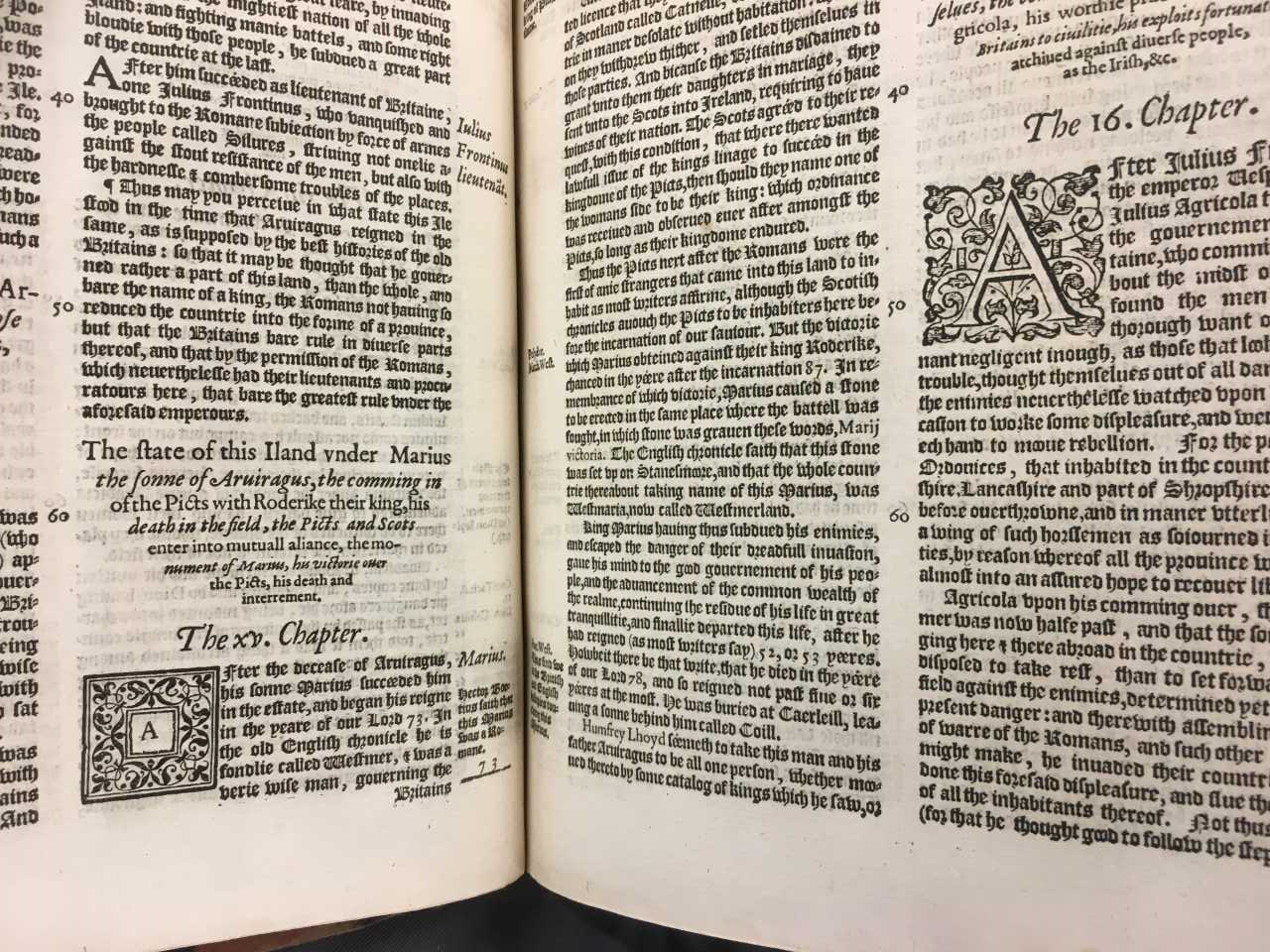
Example of the recycling and inconsistent use of letter woodcuts in the 1587 edition of The Holinshed Chronicles

Example of the recycling and inconsistent use of letter woodcuts in the 1587 edition of The Holinshed Chronicles.


Example of the intricate woodcuts present in the 1577 edition of The Holinshed Chronicles which are absent in the 1587 edition (British Library)

From studying the ‘Historie of Scotland’ section, it is interesting that the story of Gathelus and Scota is present followed by detailed descriptions of the early Scottish kings. This mythical tale of the origins of Scotland contrasts with the section on England’s history, where the tale of Brutus explains the ancient history of the British Isles by stating Brutus’ son Albanactus was the first king of Scotland. However, the Albanactus and Brutus tale does not appear in the Scottish history section, demonstrating one of the many contradictions which exist within the book.

There is a general lack of public awareness of the Holinshed’s Chronicles despite its importance in detailing the history and mythology of the British Isles. However, the book remains a significant example of the emergence of a shared ‘British’ history and identity at the end of the sixteenth-century. The sixteenth century was a time of ‘British’ mythological history being used as propaganda in both England and Scotland, with competing national claims on ‘owning’ historical heroes. The inclusion of aspects of this mythological history in the collection suggests the importance of these stories in Scottish and English national identities and that Holinshed’s Chronicles allowed readers to explore these ‘histories’ in combination.

The Chronicles was also published in the context of growing awareness in England that a Scottish king may inherit the English throne. This possibility first appeared with the marriage of James IV and Margaret Tudor in 1503 and persisted throughout the sixteenth-century, especially during Elizabeth I’s reign, possibly explaining why Holinshed decided to collate works on England and Scotland together in his first edition in 1577. By 1587, it was believed that James VI would inherit the English throne after Elizabeth, and so both kingdoms and their histories would become one. Perhaps the inclusion of both England and Scotland in this collection is therefore significant in showing the growing belief in the late sixteenth-century that the island of Britain as we know it today was becoming a shared space and that therefore a single collation of their histories was necessary. If so, this book is important in showing how these ideas of Britain were viewed at the time.

To conclude, Holinshed’s Chronicles is an important book in illustrating how national histories and identities were perceived in the sixteenth-century. The decision to include both Scottish and English histories in one book demonstrates a broader thematic emergence of a shared British history and identity in the sixteenth-century which arose from the possibility of both realms falling under a single monarch. Therefore, this book as an object has wider significance for early British history than just what is written inside. Further analysis of this book should consider the reason why the elaborate woodcuts of 1577 do not appear in this edition; was it due to cost efficiencies or instead a consequence of the censorship which occurred in the late 1580s? Regardless of the lack of woodcuts, this copy of Holinshed’s Chronicles is a beautiful example of sixteenth-century literature which deserves wider awareness amongst the British public.

The copies of Holinshed’s Chronicles held in Special Collections & Archives are on loan to us via the Marlowe Society.

Bibliography: