Summary of Discussion on the Melodrama Research Group’s Plans

Posted by Sarah

As always, do log in and comment or email me on sp458@kent.ac.uk to leave your thoughts. I’m sure the outline below will take shape and be added to very soon!

Discussion of the Group’s activities mostly centred on our plans for Spring 2014. It was thought that a symposium with invited speakers might be the best way to stage an event. The idea of a festival which did not focus on film screenings, but rather melodrama in other media or indeed archive material relating to film melodrama, was suggested.  This might well focus on several different areas, which is especially apt given the variety and pervasiveness of melodrama.  For both of these it was agreed that the involvement of practitioners in melodrama would be very worthwhile.

A possible trip to the New Amsterdam Film Museum was also mentioned which would be very exciting!

Links to Early Film Melodrama Shorts

Posted by Sarah

Below are links to videos on archive.org and youtube.com of the films we watched, as well as some other Griffith films. Do watch (or rewatch!) and feel free to log in and comment, or email me on sp458@kent.ac.uk


Barbe-bleue: http://archive.org/details/Barbe-bleue

Suspense: http://www.youtube.com/watch?v=zfgiUvBaosg

The Mothering Heart: http://archive.org/details/TheMotheringHeard

What Shall we Do with Our Old? http://archive.org/details/WhatShallWeDoWithOurOld

An Unseen Enemy: http://archive.org/details/TheUnseenEnemy

Lonely Villa: http://archive.org/details/LonelyVilla

Summary of Discussion on Early Film Melodrama Shorts

Posted by Sarah

This week we had the opportunity to compare some varied short film melodramas: Barbe-bleue (Bluebeard, 1901, 10 mins) directed by and starring George Melies, The Mothering Heart (1913, 22 mins) directed by D.W. Griffith and starring his frequent collaborator Lillian Gish and Suspense (1913, 10 mins) co-directed by, and starring, Lois Weber. I have summarised the discussion below, but do log in to comment or email me on sp458@kent.ac.uk to add your thoughts.

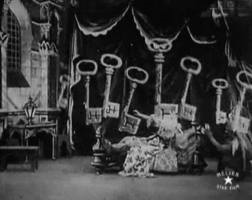
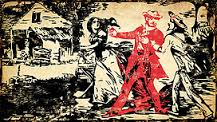
Barbe bleueDiscussion on the earliest of these film shorts, Barbe-bleue, noted that, in keeping with other films produced at the time, it was filmed by a static camera. However, the fairly frequent set changes and constant on-screen action (including some of Melies’ trademark trick shots of a character – a taunting imp –  appearing and disappearing accompanied by a puff of smoke) added impetus to the already melodramatic story. This story was closely related to the gothic with some powerful imagery involving a secret room, keys, Bluebeard’s dead wives hanging from nooses and the latter characters invading his current wife’s dreams.  Significantly the narrative centred on a woman (or perhaps more correctly women) in peril, which has been a constant theme in the films the Melodrama Research Group has screened. Appropriately for Melies, known for his magic, Bluebeard’s dead wives inexplicably become reanimated, just in time to be rescued by men who had rather magically appeared.


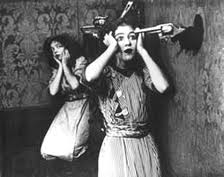
suspenseLike Barbe-bleue, Suspense bore close relation to the gothic since they both focus on a woman in jeopardy. The threat to the woman in Suspense is explicitly sexual, however. Tom Gunning’s article on the use of telephone in early film “Heard over the phone: The Lonely Villa and the de Lorde tradition of the terrors of technology.” Screen 32.2 (1991): 184-196 was referenced. In this, Gunning notes the fact that both telephonic and cinematic technology manage to bring us near to, but at the same time keep us at a distance from, the subject (either the person at the other end of the telephone, or the characters in the film). We are not in a position to affect what occurs onscreen, while the husband in Suspense is similarly hamstrung by his physical distance from his home and wife whilst they are under attack. It was noted that Gunning mentions D.W. Griffith’s Lonely Villa (1909) which also uses a telephone in the narrative.

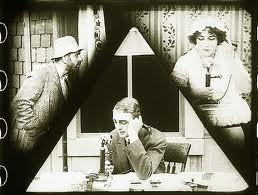
As well as an exciting narrative, Suspense included some stunning shots. Especially striking were those from a character’s point of view. One of these was a shot from above of the tramp looking up and threatening the woman, supposedly from the woman’s point of view out of an upstairs window. In addition, the tramp was shown to be particularly menacing as he ascend the stairs and looms large in the frame. The split screen which sectioned the tramp, the husband and the wife into separate areas was also very effective.  The car chase afforded some great opportunities for inventive camerawork.  There was a point-of-view shot from the second car of the first, while the wing mirror of the first car neatly showed those pursuing it several times.

mothering

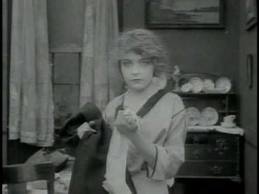
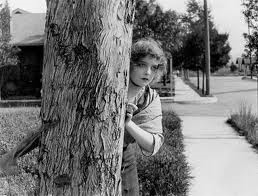
D.W. Griffith’s The Mothering Heart was very different to both Barbe-bleue and Suspense. The melodrama focused on the less fantastical, and arguably less suspenseful, issues of marriage and infidelity.  It was preoccupied, as were other films of the time, with the split of the woman into virgin (as represented by Lillian Gish) and the vamp (Viola Barry). Both of whom were interested in the same man (Walter Miller). Discussion of Griffith’s film focused mainly on the presence of Lillian Gish and the similarity of her role to the one she played in Griffith’s Way Down East (1920) in which she also appeared as a mother who tragically lost her baby. While Gish’s character here appeared to act more progressively than in Way Down East – she leaves her husband while she is pregnant due to his infidelity – the reconciliation at the end over their dead baby’s body felt very contrived. Griffith’s inclusion of Apache dancing taking place in the background of the club where the husband meets the vamp was also commented upon. A comparison was drawn between the Apache woman following her man and the foregrounding of suffering Woman – a common theme of melodrama.

It was also especially interesting to compare the work of two often-referenced male film pioneers (Melies and Griffith) with a lesser known, though hugely important, female director of the silent era.

Melodrama Screening and Discussion, 15th May, Jarman 7, 5-7pm

Posted by Sarah

All are welcome to attend the second of the Summer Term’s screening and discussion sessions which will take place on the 15th of May in Jarman 7,                from 5pm to 7pm.

We plan to screen some short melodramas, which will probably centre on the early works of American Cinema pioneer DW Griffith.  As well as influencing editing techniques, Griffith was well known for his melodramas such as Broken Blossoms (1919), Way Down East (1920) and Orphans of the Storm (1921).

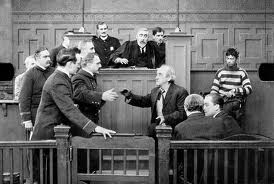
The films we may show include What Shall we Do with Our Old? (1911), An Unseen Enemy (1912, starring Lillian and Dorothy Gish) and The Mothering Heart (1913, starring Lillian Gish).
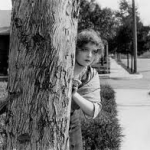
unseenwhat shallThe Mothering Heart


Frances also has some film shorts to share. She has kindly provided the following information:

Suspense (1913) is an early narrative film about a woman and child threatened by an intruder in their home. One of the film’s directors, Lois Weber, was a prominent female director in early cinema and she also wrote, produced and starred in many of her films.  Weber’s films often featured social problems and tackled controversial issues, as with Hypocrites (1915), Where Are My Children? (1916) and Shoes (1916). This latter film – which tells the story of a woman who sells her body for much-needed work shoes – bears a striking resemblance to the themes discussed with last week’s Love on the Dole.

Suspense’s narrative centres on the representation of the telephone – a fairly new addition to domestic homes at the beginning of the twentieth century – and, as Tom Gunning notes, the film features one the earliest elaborate uses of the split-screen device. (Gunning, 1991)

Barbe-bleue (Bluebeard, 1901) is one of the earlier works of French filmmaker and magician Georges Méliès. Popularly described as the grandfather of special effects cinema, Méliès makes use of his trademark trick shots, superimpositions and dissolves in the construction of his “artificially arranged scenes” (Méliès, 1907) in Barbe-bleue. The film is based on the folktale of the same name which tells the story of a villainous nobleman who murders his wives. Melies’ film shows the latest young wife who is left alone in Bluebeard’s castle and forbidden by her new husband from entering a locked room. Inevitably, the temptation becomes too much for the bride and she discovers Bluebeard’s deadly secret…

Both Suspense and Bluebeard continue in one of trends we have explored in other melodramas: namely the focus on the woman’s story which often features the female protagonist suffering in some manner.  In this sense Suspense and Bluebeard can also be classified within the gothic tradition – a genre/cycle closely related to melodrama – as the films place a particular emphasis upon the domestic home as the site of terror and danger.

References:

Gunning, T. 1991. “Heard over the phone: The Lonely Villa and the de Lorde tradition of the terrors of technology.” Screen, 32 (2): 184-196.

Méliès, G. 1907. “Kinematographic Views”. In: Gaudreault, A. 2011. Film and Attraction: From Kinematography to Cinema. Urbana, Chicago and Springfield: University of Illinois Press.


In addition to screening shorts, we will be discussing plans for the  group’s future such as the possibility of organising a conference or symposium as well as publishing opportunities.

Do attend if you can. And please note, we start at 5pm, not 4pm as previously advertised!
 

Dion Boucicault’s melodrama The Octoroon on Radio 3

Posted by Sarah

I just thought I’d draw attention to a radio adaptation of Dion Boucicault’s The Octoroon (1859) which broadcast as part of Drama on 3 on Sunday 5th of May. Boucicault is of particular interest to us at Kent as the Templeman Library’s Special Collections hold much archive material relating to the man and his productions: (http://www.kent.ac.uk/library/specialcollections/theatre/boucicault/index.html)

If you hurry, you may still be able to catch it on the BBC iplayer! http://www.bbc.co.uk/iplayer/episode/b01ryffy/Drama_on_3_Curated_by_Mark_Ravenhill_The_Octoroon/(Sadly I think this link only works for those in the UK.)

The octoroon


The following blurb is from the BBC website:

By Dion Boucicault Adapted by Mark Ravenhill


As part of a season of plays curated by playwright Mark Ravenhill, BBC Radio 3 presents new production of Dion Boucicault’s 1859 melodrama The Octoroon – a play that sparked debates about the abolition of slavery and the role of theatre in politics. The drama was recorded in front of an audience at Theatre Royal Stratford East, the venue that saw an earlier production of the same play in 1885.


The story centres around the inhabitants of the Louisiana plantation of Terrebonne. Zoe, the “octoroon” of the title, is the daughter of its owner Judge Peyton by one of his slaves, but she has been raised as part of the family. When the Judge dies, the plantation falls into financial ruin and the Judge’s handsome nephew George arrives as heir apparent. George and Zoe soon find themselves in love, but their future happiness is thrown into jeopardy by the plantation’s evil overseer Jacob McLosky who has dastardly designs on both the property and Zoe. McLosky will stop at nothing – not even murder.


Dion Boucicault’s play contains all the elements of great melodrama – doomed love, murder, corruption, and live musical accompaniment throughout. When it first opened, two years before the start of the American Civil War, The Octoroon sparked debates about the abolition of slavery and the role of theatre in politics.

Cast (in alphabetical order):


Mrs Peyton …. Barbara Barnes Sunnyside …. Geoffrey Burton Jacob M’Closky …. Steven Hartley Salem Scudder …. Toby Jones Wahnotee …. Earl Kim Dora Sunnyside …. Claire Lams Paul …. John MacMillan Zoe …. Amaka Okafor Ratts …. Paul Stonehouse Pete …. David Webber George Peyton …. Trevor White

Music composed and performed by Colin Sell

Director: Sasha Yevtushenko Production Co-ordinator: Lesley Allan Studio Managers: Colin Guthrie, Alison Craig, Steve Oak Executive Producer: Jeremy Mortimer.

  • Broadcast on BBC Radio 3, 8:30PM Sun, 5 May 2013
  • Available until 10:02PM Sun, 12 May 2013
  • First broadcast BBC Radio 3, 8:30PM Sun, 5 May 2013
  • Categories
  • Duration 90 minutes


For more information on Dion Boucicault, visit the University of Kent’s Special Collections pages: http://www.kent.ac.uk/library/specialcollections/theatre/boucicault/index.html

Love on the Dole links

Posted by Sarah

I found some vey useful discussion relating to Love on the Dole on the BFI’s website.

BFI

Find a synopsis of the film and a consideration of its importance here: http://www.screenonline.org.uk/film/id/485682/

There are also wider comments on Social Realism and British Cinema: http://www.screenonline.org.uk/film/id/1037898/


Do log in to comment on these if you wish, or email me on sp458@kent.ac.uk to add more.

Summary of Discussion on Love on the Dole

Posted by Sarah

Unfortunately we only had time for a brief discussion, but if anyone would like to add their thoughts do log in and comment, or email me on sp458@kent.ac.uk.

It was noted that a melodramatic plot certainly formed the core of the film. The main female character Sally Hardcastle (played by Deborah Kerr) suffered losing her fiancé, Larry. In addition she was forced to become a rich man’s mistress in order to save her family.

However the film did not only focus on Sally – even on her romance. Much time was given to portraying her immediate family (father, mother and brother Harry and his love life), and more surprisingly to the local gossipy women.

Due to this, the sense of melodrama was not constant throughout, with the melodramatic ‘action’ picking up towards the end with Larry’s death at the protest and Sally’s subsequent decision to sacrifice herself for her family. The film’s concern with the wider social issues of politics, the working man, the place of women etc added to the sense that the melodrama was diffuse. Arguably collective working class suffering was depicted. Since melodrama is often about the bourgeois and the individual (as we saw in the 1940 UK version of Gaslight) this appeal to social realism sat rather awkwardly.

The use of music was also discussed, with the evident difference between the city and country interludes commented upon.

Melodrama Screening and Discussion, 8th May, Jarman 7, 5-7pm

Posted by Sarah

All are welcome to attend the first of the Summer Term’s screening and discussion sessions which will take place on the 8th of May in Jarman 7, from 5pm to 7pm.

We will be showing Love on the Dole (John Baxter, 1941) 99 mins

Love on the Dole 2

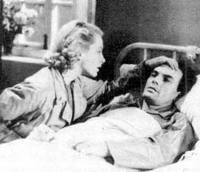
John Baxter’s film starred Deborah Kerr and Clifford Evans (see picture above) and was based on Walter Greenwood’s 1933 novel of the same name. Set in the north of England during the Great Depression, the plot concerns unemployment and poverty amongst the working classes.

Due to its subject matter, the novel was not permitted to be filmed by the British Board of Film Censors until 1941. Its realistic approach to social problems prefigures the Social Realism British films of the 1960s.

The intersection (or perhaps inherent contradiction) of realism and melodrama will provide a focus for our discussion, while the matter of class is also an important one for us to consider.

Do join us for this critically acclaimed piece of British film history.


Screening and Discussion Sessions in the Summer Term

Posted by Sarah

In the Summer Term the Melodrama Research Group will be meeting on a weekly basis.  As well as providing more screening slots (and excitingly a read-through of a script), some of these slots are 3 hours long to allow for longer films and more in-depth discussion.

screening

More information on each event will be posted in due course. Do get in touch (sp458@kent.ac.uk) if you have a film (or indeed radio play, novella, TV show etc) you would like the group to discuss.

The current, provisional, timetable for the Summer Term:

8th May, Jarman 7, 5-7 pm. We will screen Love on the Dole (John Baxter, 1941)

15th May, Jarman 7, 5-7pm. Film To Be Confirmed.

22nd May, Jarman 7, 4-7pm. Katerina will be introducing Poltergeist (Tobe Hooper, 1982)

29th May, Jarman 7, 4-7 pm. Keeley will introduce her film choice: Happy Together (Wong Kar Wai, 1997)

5th June, Jarman 7, 5-7pm. Jane will organise us for a read-through of a script.

12th June, Jarman 7, 4-7pm. Frances will introduce a film of her choice.