Dorothy Lehane and Steve Noyes

A poet and a novelist: Dorothy Lehane and Steve Noyes are two current PhD (Practice as Research) students at the University of Kent, both in their second year. Following on from the series’ previous readings of visceral and cerebral geographies, from roadkill to Freud, and on to the corrupting influence of the city in Montreal, our readers this week traversed the terroir of health and its private and public boundaries by utilising very different modes of textual transport.

Dorothy Lehane’s research explores social, ethical and perceptual questions surrounding permission and authorship in representational poetic practice. Her poetry examines questions concerning cultural encounters and embodied responses in the practice of disability poetry.

Steve Noyes read from his second novel, November Radio. The novel talks of cultural difference, mental health, artistic performance and corruption through the character of Wendy, in China, and Gary, in Canada.


Dorothy Image Bar

Dorothy Lehane is the author of Ephemeris (Nine Arches Press, 2014) and Places of Articulation (dancing girl press 2014) and she is the founding editor of Litmus Publishing, a press exploring the intersection between science and literature.

She has read her work to audiences at the Science Museum, Wellcome Trust, the Barbican, the Roundhouse and BBC Radio Kent. Recent work appears in the SALT anthology Best of British Poetry 2015, Shearsman, and Tears in the Fence and she has work forthcoming in datableed and Long Poem Magazine.

She opens with Strömen , a German term that is used to designate flow or argument in theoretical papers. She then goes on to read, as a precursor to her final reading, Debriefed, which talks of interacting with another person’s trauma with an acute empathy. The final reading, With Your Permission, features in a forthcoming Long Poem Magazine, Dorothy’s tour de force reading left the audience hushed, and somewhat stricken.

Audio Files of Dorothy Lehane

These open in a new window.

Strömen 

Debriefed

With Your Permission

In the discussion following the readings, Lehane spoke of the dual aspect of theory and practice in her PhD work, how these can occupy distinct temporal spaces and can also interweave. She admits to enjoying writing conference papers (her ‘Xanadu’ perhaps being a non-stop conference!) and how she has drawn on this in her poetry. She discussed her interest in science and poetry: not as a means of ‘explaining’ but a desire to reframe science in a new language, as well as mining scientific discourse for its own embedded metaphors.
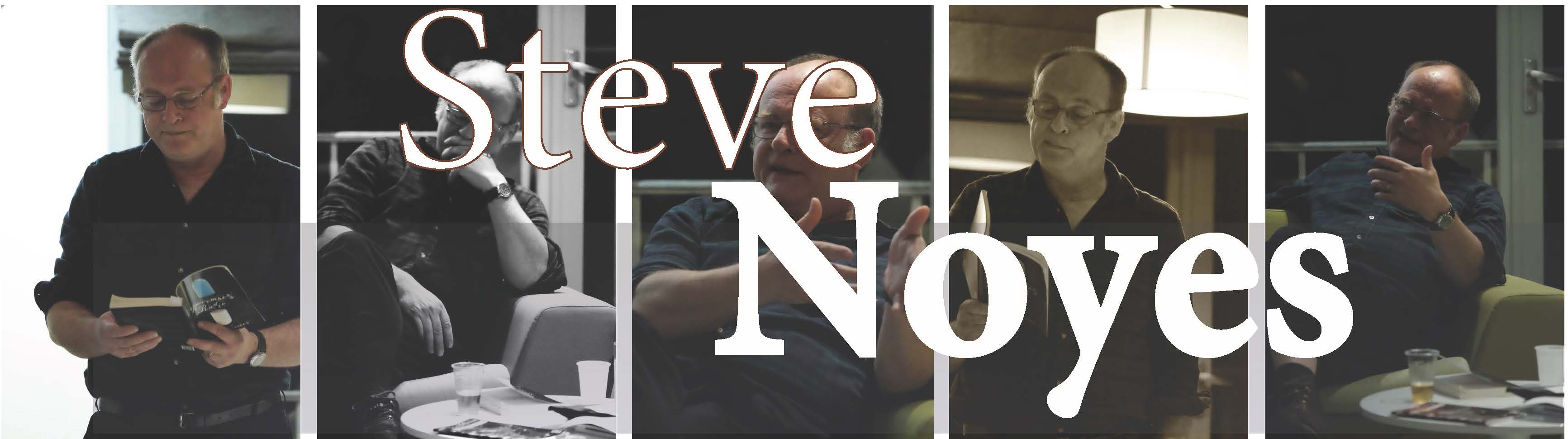
Steve Image Bar

Steve Noyes has published nine books of fiction and poetry, and more than a hundred journal publications in Canadian literary magazines and newspapers. His second novel, from which he reads tonight, November’s Radio, was published this year by Oolichan Books.

He is currently working on a long novel for his PhD concerning new age religion and systems of belief. Over the years he has worked at many jobs, including editor, parking lot attendant, printing press grunt and disabilities advocate. More recently, he has taught English in Chinese universities several times and spent more than a decade as a policy analyst in the BC Ministry of Health.

November’s Radio juxtaposes two narratives: Wendy’s, an artist who has abandoned her lover Gary to seek fulfilment in China, and Gary’s, left behind in Canada and struggling with anxiety. In the first reading, Wendy meets with two Chinese performance artists, who she will go on to work with on a moving hologram installation; in the second, Gary meets the sinister Deputy Minister of the Ministry of Wellbeing, where he works. Noyes points out that he was interested in the different ‘styles of corruption’ in Chinese and Canadian cultures, and that this informed the comic tone and satirical intent of the book. He uses his knowledge of statistical methods, drug studies and the politics of the treatment of different illnesses to inform his work.

Audio files of Steve Noyes

These open in a new window.

Audio of first reading (opens in new window)

Audio of second reading (opens in new window)

In the discussion following the readings Steve was asked why he wanted to do a PhD. He explained that he wanted to get out of his job in the Ministry of Health (it turns out his satirical ‘Ministry of Wellbeing’ is not so far removed as we might think), and to spend more time on the literary strand of his life. He also had an idea for a much longer book (700 pages so far!) and wanted to pursue writing with more time to edit, and to think in more detail about both the structure and the intellectual underpinnings of this complex work. He also wanted to visit England as it’s where his father was born.

Both writers welcomed the opportunity to read to their peers, and have been warmly welcomed to the graduate community at Kent.


Standard

Rowena Macdonald

Following Professor Iain Sinclair’s reading last week comes another author whose reading and conversation touches on the relationship of story and place, and also on the working life of the writer. Rowena Macdonald gave a very generous reading at the Creative Writing Reading Series last Tuesday evening comprising a reading of ‘The New Chef’, a short story from her collection Smoked Meat. The book is set in Montreal and are linked with themes of how the city can corrupt a person and also by characters appearing in various cameos throughout the whole.

Following Professor Iain Sinclair’s reading at the Creative Writing Reading Series last week comes another author whose reading and conversation touched on the relationship of story and place, and also on the working life of the writer. Rowena Macdonald gave a very generous reading on Tuesday evening of ‘The New Chef’, a short story from her collection Smoked Meat. The book is set in Montreal and comprises a set of stories linked through setting, theme, and recurring characters.

Her reading features Sean, the new chef at Chez Nannigan’s (MacDonald apologised in advance repeatedly for what turned out to be a respectable approximation of an Irish burr):

Alternative link to audio

Macdonald explained that the material for the book was gathered while she lived in Montreal, working without a visa for cash-in-hand, and written when she returned to England, finding it easier to exorcise her experiences having formed a distance from the place. (Conversely, she had written a novel set on the Isle of Wight, where she is from, while in Montreal.) The stories take place in the ‘demi-Monde’ of Montreal’s bars, restaurants, galleries and the down-at-heel neighbourhoods where her characters can afford the rent; she explained that Montreal at the time was a cheap, bohemian place to stay, and she wanted to ‘capture the particular milieu that [she] was living in.’ She spoke of the routine sexual harassment she experienced from staff and customers while working as a waitress, and of being an alien, working illegally amid the multi-cultural milieu of the city.

The book does not follow a single narrative, but adopts a close third person point of view throughout. Macdonald explained that the book was not through-composed and she didn’t set out to write interlinked stories when she began. She started with ‘Down to Rue Beaudry’, which ended up fourth in the collection, and worked towards the final story of the book, ‘The Life and Soul’, which she described as an homage to James Joyce’s ‘The Dead’.

The reading was followed as ever by questions. MacDonald explained that she had also written two novels, one of which is currently with her agent. She put forward that novels are far more commercially viable and perhaps the place she should have started. Her view of the short story is that it is perhaps perceived as a more ‘high brow’, more writerly form than the novel, which is a ‘big immersive experience.’ She went on to say that prefers stylistic writing and writers to plot, citing James Joyce, again, and Katherine Mansfield as examples.

She spoke about the perseverance needed to succeed as a writer, restating maxims she had heard along the way and found useful, such as getting to the desk to approach writing as work. She quoted Margaret Thatcher, with reluctant enthusiasm, as saying, ‘It’s amazing what you can get done in an hour’. She described at length the determination needed to find agency representation and subsequent publication, dealing with rejection and and not expecting ‘lucky breaks’; and, echoing Professor Sinclair’s advice last week, she urged upon budding writers in the audience: ‘you have to really want to do it.’

Rowena Macdonald has a new collection of stories due for publication by Influx Press next year.

Standard

Iain Sinclair

Professor Iain Sinclair at the Creative Writing Reading Series, 13th October

Picture of Iain Sinclair

Iain Sinclair, who joins the School of English as our first ever Guest Professor of Creative Writing for the next three years, took us on a journey last Tuesday through the writer’s territory, reading from his books London Overground: A Day’s Walk Around the Ginger Line and Black Apples of Gower. But the evening was not simply a book reading, nor reminiscence, nor an inside look at his method, although it was all of these things; Professor Sinclair’s talk spanned dimensions of past and present, shamanic caves and dead pigeons, the warp and weft of his seemingly extempore narrative taking in text, analysis, cultural history and personal anecdotes, from his beginnings in self-publishing in the 1970s to his current position at Kent.
He opened with a question of positioning; where would his books appear in a book shop? These days he most often ends up in travel writing, but his approach to writing remains the same as it was when he wrote books described as ‘novels’: to tell a story, and to do so in unexpected ways that resist generic categorisation. Regardless of any notion of genre, he aims in all of his writing to avoid the manipulation and conditioned reflexes associated with familiar narrative patterns.

He referred to his book London Orbital as an exorcism by walking, and of taking enormous, gigantic walks that define life. He outlined his writing as being in four movements: the first looks to start placing the reader somewhere physically which allows them to adjust to the microclimate; the second begins some kind of quest or movement and momentum; the third is a ‘dark night of the soul that tries to undo the simplicity of the journey’; the fourth is ‘getting away from what you’ve created or, generally, thinking into the next book—so there’s a kind of eternal project and the obligation to write for this thing goes on: one book is only an incident along a long chain of incidents that inform a life.’ (He tells us that London Overground had begun as a pilgrimage to Canterbury and he had ended up following the railway line instead, before ending at a place that took him to his next book.)

Audio of reading one: opens new window

He goes on to quote Pynchon, ‘riffing’ in a similar vein:

Off they go on a tour of the inexhaustible galleries of New York annoyance, zapping loudmouths on cellular phones, morally self-elevated bicycle riders, moms wheeling twins old enough to walk lounging in twin strollers…

In the case of London Overground, which he walked with his friend and collaborator the film-maker Andrew Kötting, Sinclair was going from the known to the unknown, from the microclimate of East London via the Overground to the parts of London he is less familiar with. He recalled passing the front door of Angela Carter and then remembering how, while he was working as a book dealer, he had visited her and been shown her stash of unsold books that had been returned by her publisher; she signed a sackful for him which he sold off to fans and ‘cultists.’ This story is emblematic of the movement and energy of the evening; providing layered and interleaved insights into the changing urban landscape of London, the shifts and vagaries of the books market, the writing process, and a long and deep-seated commitment to a writing life. It takes a ‘special kind of energy’ to pursue and persist in being a writer, he explained. When it works well there is ‘an otherness’; there must be a seriousness to storytelling and a desire to take readers along for the journey.

His next reading departed from the sinister dune structures in Milwall, where nobody can be seen except a ‘few people walking pitbulls’ against the ‘whispering presence’ of the railway.

Audio of reading two: opens new window

We journeyed from hipster-ville present to Freud’s Hampstead, to Virginia Woolf and Sherlock Holmes, via the caves formed by the railway arches around the ‘Ginger Line’. He delivered an anecdote of visiting the house where Rimbaud lived with Verlaine. Another example of curious and incongruous layering: he stepped inside to see a huge poster of Margaret Thatcher, only to be assured by the house’s current owner, ‘Don’t worry, I’m not Conservative, I’m UKIP, I’m UKIP.’  Sinclair commented on this vignette: ‘He has turned again this house into a museum of this moment.’


Audio of reading three: opens new window

This reading, like the other two before it, was delivered with great energy and urgency. He went on to admire this same trait in Louis-Ferdinand Céline’s novel London Bridge, commenting that it contains a “mad energy” that no English writer has got near to since Dickens. He described London Overground as neither fiction nor essays but ‘a kind of docu-fictional seizure’ placing it within a formal tradition that harks back to Bunyan—a journey which is at once literal and figurative, an exploration of self as territory.

His fourth and final reading, from Black Apples of Gower, took us far from London to the Gower Peninsula. This book concerns a landscape that is ‘very primal, very savage and very unknowable’, a place that allows the release of identity, in which he explores an idea that he had in London, of our ‘cave of origin.’ Black Apples of Gower is named after a series of paintings by the artist Ceri Richards, and Sinclair recounted how he walked the limestone coastline, seeking a way in to Paviland Cave, which he describes in his reading.

Audio of reading four: opens new window

With the closing of his fourth reading, we were left in the cave as he finally attained it, but also, in this fourth movement of the talk, invited into the next book, as if the next may well be our own, an invitation to continue our own Eternal Project of writing.

David and Iain

With time for questions, Professor Sinclair was asked by a student what his role was to be at the School of English.

‘I’ve been to Kent a couple of times and found that it has a much better vibe, as we used to say, than most places I’ve been to,’ he said. ‘There’s something good about it. It’s the presence of poets and the nature of the things around and its pitch, if I can call it that, of looking towards Europe—and all of those things are attractive.

‘The job is to be available to anybody who feels they can respond or get something of use from my presence and what I’ve done. And I’d be very happy to engage either one-to-one or in groups. I mean, I’ve only been here for two days: I’ve given two talks; introduced a film; and took a seminar in poetry where there was one poetry student; and a seminar in fiction. I’m learning a lot! What can I bring? We’ll see. I’m here for three years.’

If this reading to Kent students, staff and members of the public is anything to go by, it was well worth the wait for his pilgrimage to Canterbury.
Chris Scott

Standard