Amy Cutler

amycutler

In what was one of our highest tech readings so far, Amy Cutler provided an excitingly interdisciplinary event, applying poetic techniques of collage and erasure to film, text, diagrams and graphs: most frequently, though not exclusively, putting the disciplines of geography (her PhD, in geography, was on the coast and forest in modern British poetry) the philosophy of memory, an interest in materiality and in gender in conjunction through her practice. The result is a poetry that is intelligent and thoughtful about its own processes, with an impressive sense of scope – every project was different, employed different media and processes, – and an accompanying sense of depth. These works, both individually and taken together, are focussed and important, providing different ways of investigating, for example , and this was the thread that ran clearest for me through the work , the processes of memory.

Cutler’s first piece was a film and text montage that put pressure on the gendered subtext running through her source material, and the language of memory: –she said, of the French films she was using: ‘the hunt for memory in these clichés is also a hunt for a woman, recherche femme, the woman for whom Ridder becomes the subject of a time loop experiment in Je t’aime, je t’aime (1968), for whom the man journeys back to the still image of his own death in Marker’s La Jetée (1962), and for whom X dreams of Marienbad’. ‘Toast’, which Cutler read later, published in Litmus magazine, also focused its interests on the clichés of romantic memory and in aphasia, the speech condition in which impedes your ability to select the right word:

Language leaks through various holes in the skull / who’d have thought

we’d still be trying to be faithful/any of us can live on if we try / let’s say

any one of us / with one drink left on the late edges of a very cold night

Another poem, ‘Chanson’, riffed on two lines by Jacques Brel: Cutler explaining an interest in memory paradoxes through the words ‘I’ll never forget you’: which, whilst true when said in the moment of saying, has its truth invalidated by later loss of memory.

Next, Cutler read from an erasure poem: an erasure of the index of first lines of R S Thomas’s Later Poems. She was inspired, she said, by finding what she felt was a brilliant few lines of poetry:

cutlerc text

on reading the index. The idea, she said, was to ‘make a love affair’ from them – to develop a love story out of the quite often religious texts of Thomas and of his love affair with the landscape of Wales, a love affair that talked to the idea, and this is why the later poems were used, was concerned with memory, with looking back at the end of life.

R. S. Thomas’s actual poetry, of course, is the antithesis of the sort of process-based practice that Culter puts his words through – which is part of the fun of it – she was interested, she said, in the strange figure that gets constructed in his poems which isn’t there in his poems – the way a different kind of poetic can emerge, by happenstance, out of what most people would regard as the material around his work, rather than the work itself. She enjoyed, too, the way in which the internal logic of the generic form she had chosen to inhabit, the index, created the movement of tone in the poem – which changes according to the alphabet – particularly, for example, around the letter ‘I’.

The materiality of the book, and its paratexts – marginalia and appendices, is of particular interest to Cutler, both in her research and in her marginal remarks around the readings of her poems. She talked about sharing experiences of making books as children, about her clear memory of the first time she ever encountered a footnote (-in the Moomins – it told her that if she didn’t understand a particular part of the story, she should get an adult to explain it to her. As no adult could offer an explanation beyond the understanding she had of the text – as she had fully understood it – this footnote created for her the sense of there being inaccessible knowledge that she was denied access to). This interest in paratext provides the form for an exhibition Cutler is curating in Leeds in June, called, Forest Expectation Sites, in which a series of artists and poets will create responses to the work of the poet Peter Larkin, creating a contemporary and artistic collections of adversaria, a Renaissance term for scholars’ annotations.

Cutler then read a collaborative piece that had been written in 2014 for the Polish Cultural Institute in protest against the fact that polish bishops had recently announced that all mothers should breastfeed, and that there was no way of distinguishing between sex or gender in Polish. Taking a polish instruction manual for breastfeeding, she and her co-translator translated and retranslated until the text started to deconstruct and critique itself, often in very amusing ways.

Again showing an interest in the relationships between languages, and in cultural memory in the guise of fairy-tale, Cutler read a poem of names for Rumpelstiltskin . The tale exists in many different European countries, but Rumpelstiltskin, whose power resided in his refusal to tell his name, is called by a different name in every language – not just a different name, but names with entirely different etymologies and meanings.

I’ll go with Shortribs, Sheepshanks, or Laceleg: a poor girl’s milling tune. I think

I’ve forgotten him now. Dear, it’s not possible to kill off anything in rumpled words

The latter part of the reading was more obviously concerned with Culter’s interest in geographical science and in the potentials of interdisciplinarity. Talking about Douglas Oliver’s diagram poems, she said diagrams (and this offers really interesting potential for understanding how her interest in translation relates to her other interests) are ‘machines of translation’, they enable you to move between disciplines, to create new thought. What is also important in this creation of new thought, is the bringing together of different media, creating new ways in which they communicate with and inflect off one another – Land Diagrams,  an online series, curated by Cutler, in which writers respond the same visual encodings of landscape, is one example of this, and it is the crucial operation of her chapbook Nostalgia Forest (which she closed her reading with), from Oystercatcher Press  in which dendrochronological (tree-ring reading) diagrams are put against fragments of Paul Ricoeur’s Memory, History, Forgetting (2000).

20150225145459139-2

Here the interplay between the diagrams displaying how the history of a tree can be read from its physical form – rings, scars, incline – and a text on the functions of human memory poses questions about the materiality of memory, how the past is experienced in the present. Both diagrams and text are ‘found’ materials – it is in the moving between that new thought is created.


Standard

Linda Grant

linda grant

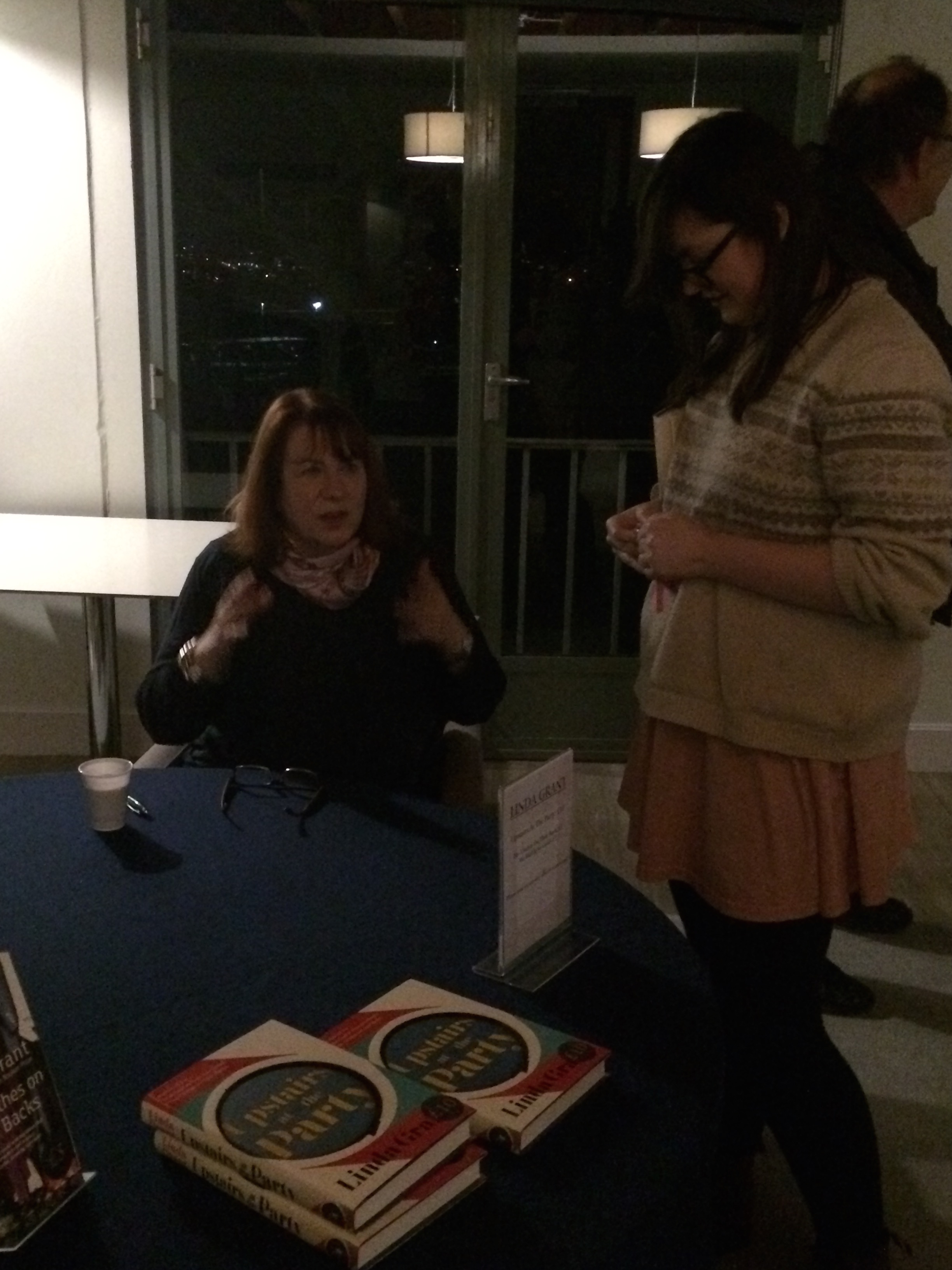
Linda Grant was at the Creative Writing Reading Series on Wednesday to read from and talk about her latest book, Upstairs at the Party, a campus novel set in an new university in the early seventies – a university that, though unnamed, is clearly the University of York, where Grant herself went as an undergraduate in the early seventies – it was then, she said, eight years old, with only 2,700 students.

Though Grant dismissed the tendency of critics and interviewers to search for autobiography in her books – describing it as a ‘modernish idea about authenticity’, this novel, given its setting in time and place, clearly has a quasi-autobiographical setting, even if the events – leading up to, and then exploring the repercussions of, a tragic event that happens upstairs at a party – are not necessarily – though it seemed to me that they perhaps also were closer than Grant explicitly said. However, this seemed needful to Grant in this novel – which seemed to be focused around trying to understand her generation – and finding that to do so, she needed to go back, in her own words to the intimate place in people’s lives they return to, their formative influences’. She was interested, she said, in her generation’s idealism and what became of it – and the novel, and her thoughts on it, seem permeated with the ideologies of the early seventies.

She described this time, at first. as the dead period between the sixties and punk, but it soon became clear that to her, and for many, this was in intensely active time, a time of heated left wing politics among her generation – of feminism, Marxism, explorations of gender and sexual identities – a time when Peter Hitchens could be found on campus hectoring fellow students into taking the Marxist pamphlets he was handing out. Grant now, and in the novel, her narrator, maintains a skepticism towards the fervor of these ideologies – it is clear that this was a time of political experimentation with identity – which is perhaps why she describes it as dead – its experimentation and ardor being both something potentially damaging to individuals, and something that has had long term societal legacies. The age perhaps needed, she said, those that would experiment with and discover the boundaries of these ideologies and identities, and those who fall off the edge.

This, she said, was what differentiates her novel from other campus novels – it is the opposite to Brideshead, the novel, she said, that they were all reading at the time, because, at York, the halls of academe didn’t really exist: the students themselves were actively creating the mythology and themselves. York, she said, was fascinating, in its ideology that totalitarianism could be defeated by the amalgamation of arts and sciences in a collegiate system built from concrete and centered around a plastic-bottomed lake. There wasn’t, she said, really any pastoral care, its students were left to sink or swim on their own. And many of them sank.

Asked about the relation of her work to the historical novel – given that Upstairs at the Party is, like her other novels, set post World War II – that is to say in the relatively recent past, Grant replied that she is far more interested in in what she feels she thinks of as modern times – with WWII providing a cut off point – she wouldn’t she said, ever write a novel set during WWII, she’d find it too like dress up, but the legacy of that war, and post world war reconstruction is something that very clearly she thinks of as part of what h some to define modernity.

She was asked too, about likeable characters – citing Doris Lessing’s The Good Terrorist as an excellent example of a brilliant novel with no likeable characters. The popularity of the likeable character, of someone you can root for, she dismissed, saying the questions you should ask of your characters are: are they alive? are they interesting? is their monstrousness interesting? do you recognize their flaws/mistakes? If you want to make friends, she said, don’t go to fiction, go to a party.


Standard

David Nicholls

IMG_1809

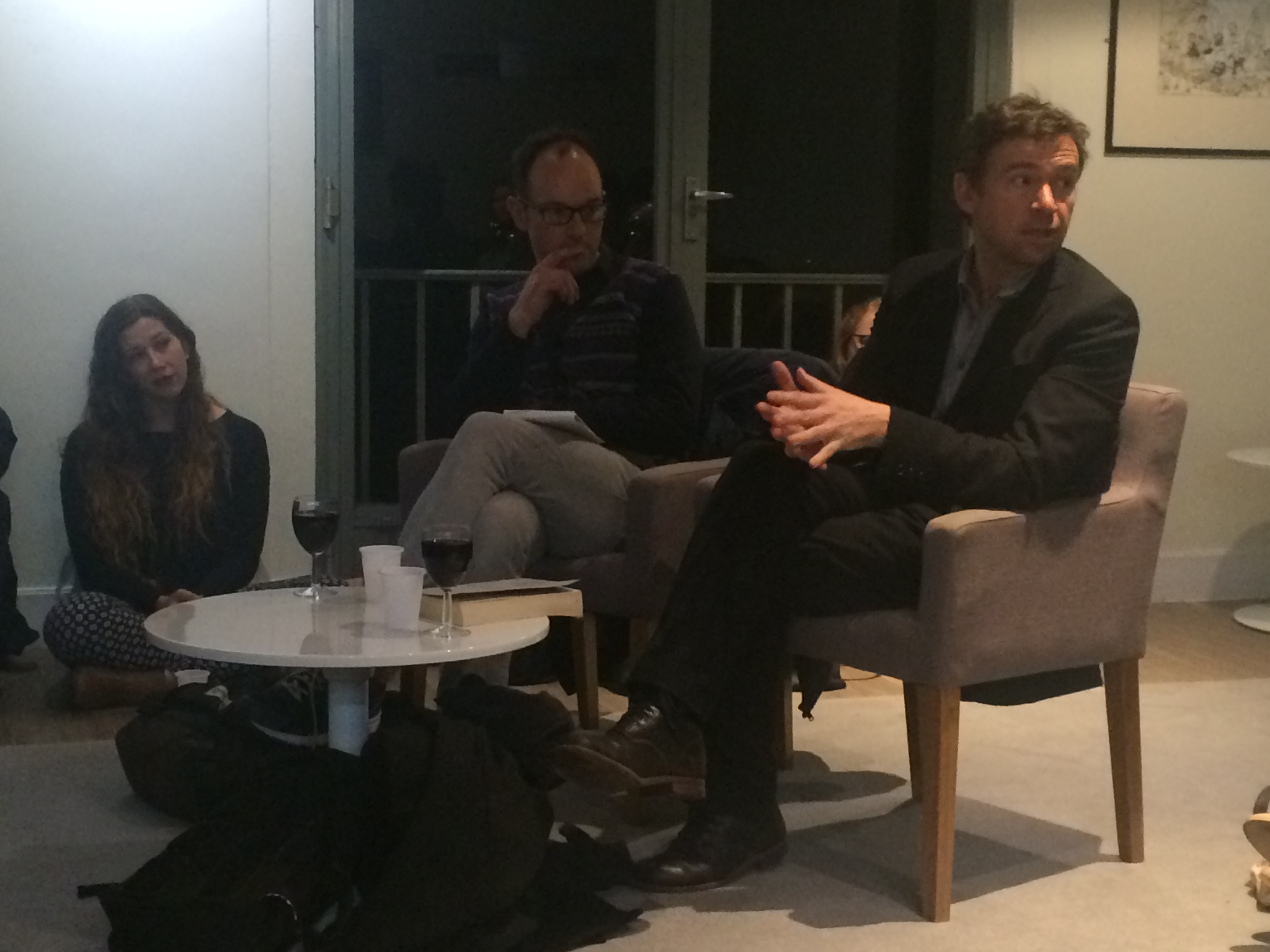
David Nicholls kicked off the Creative Writing Reading Series for the Spring term, reading and discussing his novels and screenplays to a room packed to standing room only. David started the evening by reading the first page – and the first chapter – of his latest novel Us (Hodder & Stoughton, 2014): Douglas Petersen, Nicholls’s narrator, is woken in the middle of the night and told by his wife that she is leaving him. A grim end to start with, though the tone was resolutely comic – the way shocking news can often fail to register, being so outside daily experience that it can be incomprehensible, was deftly observed: Douglas at first thinks his wife is, as she often does, asking him to check for burglars, and so dutifully checks the house for intruders before she has to repeat herself to get the message across.

This beginning puts us in rather different territory to Nicholls’s previous novels which, though they similarly often focus on relationships, track the beginnings of romance in younger couples – as was the premise in One Day, which followed the protagonists’ relationship over twenty years from university into their early forties. Us, said Nicholls, is an older book – citing a mixture of parenthood and the fact that he didn’t feel as confident, now in his mid-forties, in writing as convincing a contemporary twenty-something as he could when he was twenty-something. This was the first time, he said, he had tried to write someone older than himself: Douglas is in his mid-fifties, and not only the birth of Nicholls’s children, but the death of his father – which occurred some months into the writing of Us – have clearly had their impact upon it, the novel’s emotional core turns, with a turn in point of view, to the father-son relationship between Douglas and his son Albie.

Pressed on this potential correspondence between life and art by Alex Preston, Nicholls talked in some depth about the relation of his father’s death to the final shape and focus of the novel – which is dedicated to him. Whilst insistent that his relationship with his father – though difficult and troubled – was not identical, or even particularly similar in fact to Douglas and Albie’s relationship, this did raise the question of whether it is possible to write something you haven’t thought or felt. Nicholls’s conclusion on this was to say ‘there isn’t a single moment [in the novel] where I could say ‘that happened’, yet [his relationship with his father] overshadows the writing’. He also pointed to his use of incidents, thoughts or emotions in his own life which he has used in his novels, but transposed, projected onto other characters, scenarios and relationships – if one cannot write something alien to one’s thoughts or feelings, those emotions are always twisted, or disguised, by the operations of fiction. Although his characters, he said, were hardly ever based on people he knows, ‘little bits of myself come through’. When he does use others, he said, it is often actors – because what he takes in trying to create a character isn’t so much incidents or personalities but performance, mannerisms or rhythm – a physicality. He gave the example of Rafe Spall, who inspired some aspects of Ian in One Day, then later played him in the film.

Despite this being in some ways an older novel than his previous books, this distinction is not altogether straightforward – Great Expectations, Nicholls pointed out (Nicholls’s referents and roots are in clearly in the nineteenth century realist novel, which can be seen not just from his content and style, but his epigrams – James, Hardy, and his screenwriting CV – adapting, among others, Tess of the D’Urbervilles and Far from the Madding Crowd for television), is always thought of as a book of youth, but it’s narrated by a 55 year old man. Similarly, Nicholls described Us as ‘a travelogue in place and time’: it has two presents at once. If we start in a point of time and space – Connie telling Douglass she is leaving him – we then get two stories, one about this break up, and one about their relationship, from when they first met.

Nicholls talked about how he had consciously attempts to keep himself on his toes following the successes of his previous books – if you have a success, he said, the temptation is either to do the same again, or to do something entirely different – the trick is to try to do something in between. In order to avoid predictability, and this was a point as much to do with genre as his relation to his other books, he has to play games with structure, to misdirect – which he often does with time structures and point of view. Point of view is clearly something that preoccupies him: Us is his second novel written in the first person, the first being Starter for Ten. Nicholls’s aim in Us for this point of view is the exact opposite of his previous use of it: whilst Brian in Starter for Ten has similarities to Nicholls, Douglas is rather different, Douglass’s character and occupation as a scientist allowed Nicholls to challenge his ability to write in the first person – he was interested, he said, in writing, in the form of fiction about someone who didn’t value fiction, in writing about art through someone who wasn’t confident doing so. In some ways, also, Nicholls said, he wanted Douglas to be an anti-Dexter, the male lead character in One Day, and writing him in the first rather than third person helped him create those distinctions. Nicholls talked too about the difficulties in narration of One Day – a narrative written in the third person past tense, which put pressure on his writing. In the first person, banality is allowed; the narrative is a reflection of a character’s personality. Third person doesn’t allow for this. A first person novel, however, requires a getting into character, the assumption of a voice. Tellingly, Nicholls said this was his quickest novel to write – nine months, but that it took him four years of writing to get to those nine months. The novel started out, he said, as a much more spiteful and angry book about father and son.

The book is written rather differently, too, from his previous novels, comprising of 180 short chapters- Nicholls said he wanted to aim for a series of vignettes, or snapshots, creating an impression like flicking through a family photo album. This particular form would seem to be heavily influenced, not only by the content of the book, but by Nicholls’s background as a screenwriter – your average screenplay, he said, comprises 180 short scenes, ruthlessly edited: in screenwriting you are constantly being asked by others ‘do we need this scene?’ – it is clear that he sees screenwriting as something which has given him concision. And plotting too – Nicholls talked about how, in adapting his books into screenplays, he would immediately give his team a scene-by-scene, chapter-by-chapter breakdown of action, something they seemed surprised to get from an author. But these plot-breakdowns seem to be essential to Nicholls’s writing: he can’t, write, at least well, he said, without having first prepared structure and plot – which also goes some way to explaining the time proportions of the planning and writing of this novel!

It was clear that Nicholls credits screenwriting with developing much of his ability and style as a novelist – he claims to be influenced by Woody Allen as much as Dickens – and he sees many of his authorial techniques as equivalent to filmic devices. He described his epigrams, for example, as equivalent to captions in a movie – suggesting a tone, creating a distance from the action. His dialogue, he said, is also more immediately sharper, improvisatory, and requires less editing than other aspects of his writing. However, he also talked about the difficulties he had in adapting his own books into films. Asked by a student what the goal is in adapting a book, he agreed that often fidelity is the enemy of a good adaptation – that you need to make something that works with the potentials of its own medium. For example, he said, during a scene where Emma and Dexter have an awful dinner in One Day, in the book, one can access Dexter asking himself why he’s acting like this. In a film, of course, this is unmanageable – you have to rely on the actor to do the novelist’s work, and if the screenwriter is too tied into the novel they perhaps won’t see how to make the transition work. He also expressed discomfort around genre – saying that initially he found it uncomfortable that he was pressured into changing the ending of Starter for Ten for the film into something that more closely resembled the genre of romantic comedy – in his novels, he said, he always tries to avoid, or play with, the expectations of genre. However, he said that the also feels the film needed to end that way, the expectations and structure of film demanded a different ending to that required by the novel. He’s wary, for example, he said of someone making a speech that changes someone’s mind, of the last-minute airport dash – no-one’s mind, he said, is ever changed by this in real life, but then, he said, this isn’t quite real life. Novels, and films, give meaning and structure to a life that doesn’t have that – one of the reasons that he often tries to undercut the reader’s expectations – sometimes, as in One Day and Us, very dramatically. We didn’t get to find out, in the case of Us, how dramatically, so we were left, as I now leave you, on a cliffhanger.

Standard