Nicholas Hogg

IMG_1446 (2)

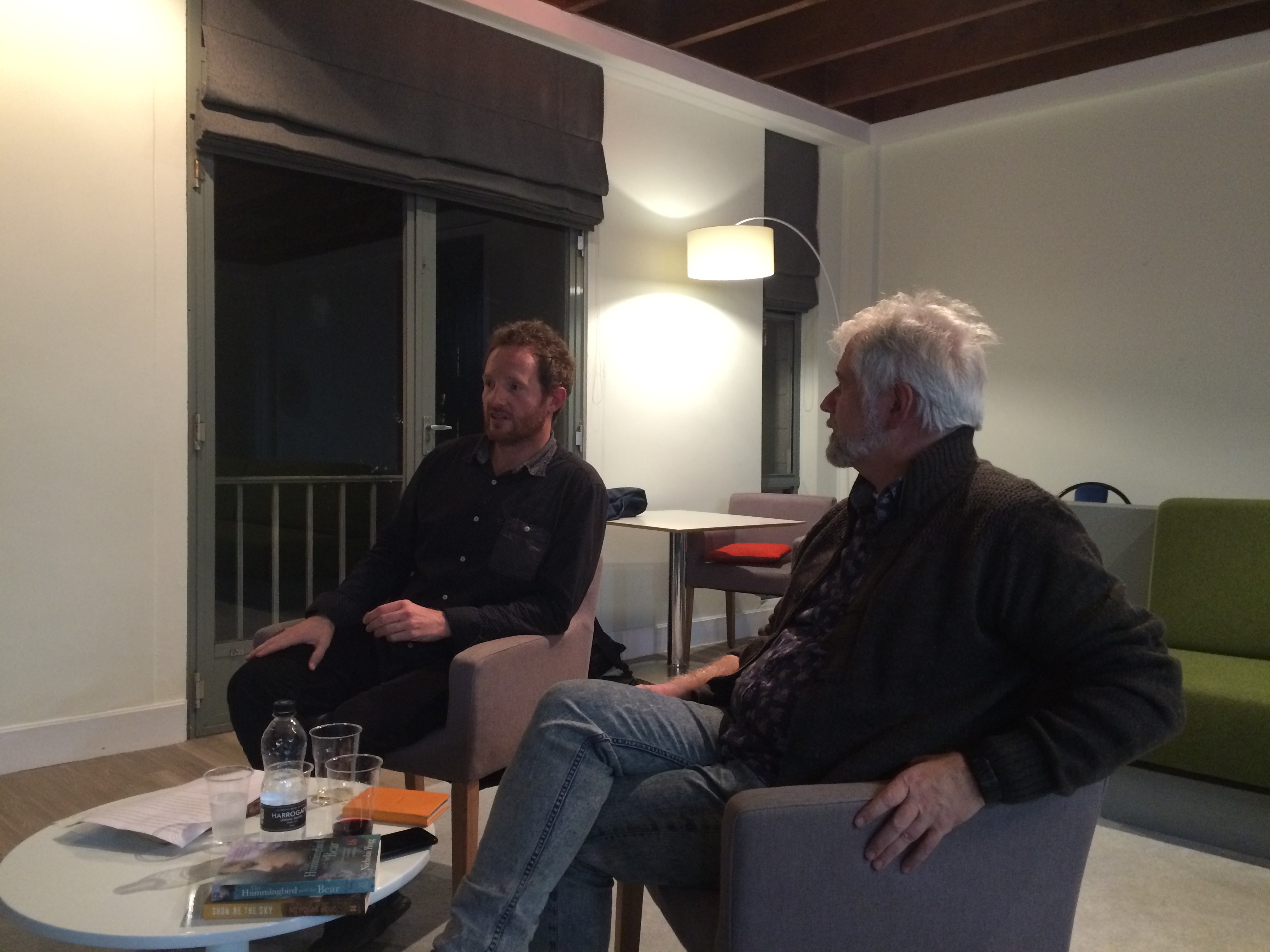
Next up in the creative writing reading series was Nicholas Hogg, novelist, poet and short story writer. Nicholas was, as a poet, twice shortlisted for the Eric Gregory award, and later, as a novelist,  His first novel, Show Me the Sky, was nominated for the 2010 International IMPAC Dublin Literary prize, and his second novel, The Hummingbird and the Bear, was published in 2011 and the recipient of a K Blundell Trust award. His third novel, Tokyo, is published by Cargo next summer., and this was his first public reading of its contents.

Nicholas didn’t always know he wanted to be a writer – it seems to be a myth that all writers do – indeed it seems we might have lost him to professional sports if not for a serious shoulder injury. He described his early adult years as itinerant – for example, to took a job on a ship aged 28 – accumulating experience that he now puts to use in his novels. And experience, personal experience, did seem to have particular importance, with Nicholas describing much of something akin to veiled memoir – with his experiences transposed onto different characters and plotlines to his own experience – the 14 year old runaway in Show me the Sky has experiences that are transposed scenes from Nicholas’s own experiences of hitchhiking. Though he assures us his life has been quite unlike the adulterous romance of The Hummingbird and the Bear, he moved to new York for 6 months in order to write the novel – walking in the city every day and building up a visceral connection with the place of the novel. Each day would impact on the story, allowing in the discoveries of exploring the city, and the story impacted on each day, sending Nicholas out to search for the locations of the scenes of his novel. Again, and as with Alex Preston and David Flusfeder, we were encouraged to practical research to fully understand the places and stories of our writing. Tokyo, though less autobiographical than his previous two books, comrs out of the two years Nicholas spent as a TEFL teacher in Japan, consciously earning the money that would then allow him some freedom to write. In fact, it was even more useful than that – Nicholas credits this teaching experience with sharpening what he believes to have been previously fairly lax use of language, vital in turning him into a writer. Worth remembering in the classroom.

Previous to Show me the Sky, Nicholas wrote a first – and he describes it as ‘baggy’ – novel that was never published. He urged budding writers not to become disheartened by initial failure, and to see the potential use of a ‘failed’ novel – saying that many pieces of Show me the Sky, including the passage he read to us about the motorcycle crash of a teenage runaway – were taken from the first novel. Sometimes, even years later, you can take pieces out of a ‘failed work’ and rework them into something successful.

He also advised, a similar technique if, unlike me, you’ve managed to be successful across disciplines – saying that he will sometimes use, not a line necessarily, but a piece, or few words, of poetry and transpose it onto the page of a novel in order to achieve a denseness, or concentration to set off the rest of the prose. He did, however, warn against overloading, repeating a piece of advice that Margaret Atwood once gave at Hay Festival and that has always stuck with him, that she restricts herself to a maximum of one simile per page.

Conversation, and reading, concentrated on Nicholas’s novels – Show me the Sky is a novel of people trying to escape their lives – the runaway, a rock star who fakes his own suicide (based on the Manic Street Preacher’s guitarist Richey Edwards’s presumed suicide, or disappearance) and the return journey of a young Fijian who has been subject to the British practice of kidnapping children, educating them in Britain and then sending them back as missionaries. Tokyo is, conversely, about people trying to find their life – the girl going out to Tokyo from California to meet her estranged father, her father’s pursuit of a Japanese ex-girlfriend, her pursuit by a man she has met on a plane, who identified her with the moon princess,  Princess Kaguya. Even now when mount Fiji smokes, legend has it that the fumes are that of the everlasting life potion of the emperor, who threw away this gift from the princess when she returned to the moon, his will to live forever broken by the fact that that life would be without her. Drawing on Japanese folk legend, and acute and sympathetic observations of Japanese culture, this promises to be a beautiful book, and one to look out for come summer.

Standard

Alex Preston

in-love-and-war

Next up in the Creative Writing Reading Series was another of our Creative Writing lecturers – Alex Preston – reading from his latest novel, In Love and War (Faber & Faber). The novel is set in Florence during the second world war – although in part it is also a Bildungsroman, with its protagonist, the British Esmond, coming of age fighting to undermine the fascist government from within.

Alex is already an award-winning novelist, his first novel, This Bleeding City, having won the Spear’s and Edinburgh Festival first book prizes as well as being chosen as one of Waterstones New Voices. His second book, The Revelations, was shortlisted for the Guardian’s Not the Booker Prize. This, his third novel, has already been selected for BBC Radio 4’s Book at Bedtime, although as Alex said, this novel – as with David Flusfeder’s two weeks ago – had rather different beginnings, coming out of what was originally intended to be a research project for a non-fiction book on fascist Florence. Alex is also a journalist, and talked about how the writing of the novel had influenced his journalistic choices – leading him to choose to do an on-the-ground piece on Boko Haram in order to help him understand his character – to put himself in a position outside his sphere of knowledge – a residing idea of the novel being that one is able to discover what sort of person you are based in how you react to situations beyond your previous experience.

As with David’s talk, Alex urged practical research upon practitioners in the room, saying that you have to involve yourself as fully as possible in the world of your story, particularly in a historical novel. He recounted an anecdote of overcoming (or at least facing) his fear of flying at Duxford Imperial War Museum, being taken for a flight in a still (just about) operational De Havilland Dragon Rapide in order to write the initial scene of Esmond’s flight from England to Italy.

Esmond is the only fictional character in Alex’s novel – all other events and characters are historical, and Alex spent three years researching the novel – the first six months of which he thought he was spending working on a non-fiction book. Whilst stressing that each book tells you how to write that book and not the one before, he said that in his own practice he had held off writing as long as possible – immersing him first in the historical resources in order to write with the requisite amount of information and immersion in the period to give him the authority to create the world of the novel. However, when it came to writing, and most particularly editing, he advised an ability to be able to abandon fascinating research if needs be – very strictly making sure that the novel’s focus was on its story and central character – cutting vast amounts of historical detail in order to have the story tell itself most effectively. In terms of the in-depth pragmatics of writing, he advised that every scene have 2-3 things absolutely right in it rather than trying to offer a panorama – keeping the focus of storytelling, but retaining the authority of research.

Why the shift from a historical account to a historical fiction? Partly for this focus – Esmund, the vehicle of the imagination in this story, allowed an outsider perspective that perhaps chimed with the author’s, being a young British man observing and coming to terms with fascist Florence in a way that, of all the characters, is closest to the work of research that had to go in to the writing of the novel. As importantly, if not more so, is Alex’s belief that the novel provides a more effective way of getting into the minds of others than any purely factual account can possibly allow – and that it is this imaginative empathy which allows for a closer readerly experience of history. Alex had wanted to write about the effect of the fascist regime on Florence, the city of the Renaissance – and the novel is imbued with a particularly visual sense of place, but it is through the Esmund that the reader is allowed access into this world.

Kat Peddie

Standard

Peter Hughes

Hughes

The first poetry of this year’s series came from Peter Hughes. Peter is already well connected with the poetry scene at the University of Kent – his pamphlet Radioactive Relicts: Petrarch Sonnets, 117 – 136  recently came out with Litmus publishing, co-run by our very own Dorothy Lehane, and other Petrarch sonnets have appeared in ZONE, co-edited by me and Eleanor Perry. In his other guise, as small press publisher, Peter has published Ben Hickman’s recent pamphlet Later Britain, and Michael Grant and Ian Brinton’s translations of Yves Bonnefoy with Oystercatcher Press, Winner of the Michael Marks Publishers’ Award for outstanding
UK publisher of poetry in pamphlet form. Oystercatcher pamphlets are consistently lovely publications from leading poets, and, Peter also being an excellent artist, they are often beautifully produced with Peter’s artwork – some of which we saw during the event.

Peter’s latest long project has been translating all of Petrarch’s sonnets – which will be produced as Quite Frankly: 
After Petrarch’s Sonnets by Reality Street in 2015 (http://www.realitystreet.co.uk), but Peter also read from his translations of Calvacanti, his Behoven (Oystercatcher Press, 2011) and The Sardine Tree (Oystercatcher), a life of Miro, and The Pistol Tree Poems (Shearsman, http://www.shearsman.com) – a collaboration with Simon Marsh in which each sent each other poems that decreased by a line each round – so that the collection ends with two one-liners. Peter’s poetry manages to at once be a very serious engagement with another artist – be it Miro, Petrarch, or Marsh and an original work that wears its learning lightly, even joyfully, something that makes the pleasure of his texts both immediate and lasting. Take this Petrarch sonnet from ZONE 2:

6 / 143

Per mezz’ i boschi inospiti e selvaggi

Thirty Seconds to Mars on the 13th

& the great Neil Young on the 25th

who help me sing along to memories

of other gigs we missed along the way


history seethes with dates & locations

in which she had nothing to do with me

such as now when my only defences

are built on the grammars of displacement


unplaced love spreads out through the surroundings

gilding the repossessed houses & shops

startling the small dogs pissing up bus-stops


making commercial music sound profound

energising all the little bushes

& helping me to grit my teeth like this

This engages with Petrarch, though Petrarch is, as Peter said a ‘springboard’ rather than a text to be faithfully translated, and that springboard allows both for complex relation and meditation on the concerns of the original text, a playfulness, and an immediacy of reference and vocabulary. And there are few poets who can marry the humorous with the profoundly moving as well as Peter can.

That most of Peter’s projects are based in engagement with other artists allowed for a very interesting discussion of how to go about creating the conditions for writing, and how to go about putting together a procedure or project that will result in a sequence, rather than an individual poem. Collaboration, creative translation, and various forms of limit were posited as points from which Peter’s own poetry had sprung – Behoven, for example, being a series of poems created from texts that Peter wrote in the spaces of time of the movements of Beethoven sonatas – thus they are both responses to the music and pieces produced under constraint. The constraint needn’t always be there in the finished piece – Behoven is edited, but its initial existence can set both the terms of engagement of a whole series of poems and provide a spur to writing that can often be hard to find – something worth bearing in min both for those who find it difficult to get started, and those MA students taking Poetry 2 next term – which focuses on ideas of sequence and/or long poems.

Peter also read with the poet Anthony Mellors the next night at Free Range – a weekly music and/or poetry event produced in collaboration with ZONE poetry that runs every Thursday from 8. Visit www.freerange.co for further details.

Kat Peddie

Standard

David Flusfeder launches new novel at Kent

David

Kicking off the 2014-15 Creative Writing Reading series was our very own David Flusfeder, launching his latest novel John the Pupil (4th Estate), a fictional account of a real-life medieval quest – the journey of Roger Bacon’s pupil, John, to deliver a copy of his master’s Opus Majus to the Pope in Rome. Roger Bacon, a thirteenth century English philosopher and Franciscan friar – circumvented the Franciscan rule banning the publication of text by friars by having Pope Clement IV personally order him to write to him concerning the place of philosophy within theology – thus John’s journey to Rome. The Opus Majus – famous for proposing the concept of the leap year  – although it was 300 years before it was finally accepted and the Julian calendar of 365 and a quarter days replaced by the Gregorian calendar – is a work that argues for the application of Aristotelian philosophy and scientific discovery and method to theology.

But John the Pupil is not about Bacon, or the Opus Majus, so much as about John – a bit-player unfilled by historical account – and the extraordinary journey he undertakes to deliver this important work from Oxford to Rome.  The novel purports to be a found document, containing fragments of John’s chronicle of his journey, translated, and arranged in an order which is plausibly, but not certainly, that of its supposed chronology of writing.

David read from sections of the novel, and spoke illuminatingly about how the writing of the book related to concerns about how to write historical fiction. Addressing issues of fictionalization and the creation of historical verisimilitude, David stressed that the novel was an attempt to challenge the oft-found fiction in historical fiction – that its characters, from whatever historical period they inhabit, are essentially ‘like us’, characters easily identifiable with how a twenty-first-century western subject understands subjectivity: a universal human, albeit one encountering different historical contexts, events and living conditions. This concern with characterization – how to present the mind of a thirteenth century monk whose primary teachings on how to encounter the world were not only formed from religious texts, but religious texts fundamentally different from those we now know – was one that permeated every aspect of style and vocabulary in the novel. David talked about how he had to expunge the rhythms and vocabulary of the King James Bible, for so many centuries the definitive version of the bible, and a work that fundamentally altered our relation to our religion, in order to present a monk raised on the Latin Vulgate. Every word in the novel has roots in the thirteenth century or is a translated Latin word – rendering certain vocabularies, and thus ways of understanding experience, inaccessible within the book, as they would have been for John.

Introducing the interroflus – an interest in presenting a mind through its available, and, to us, strange, vocabulary allows one certain imaginative freedom, and this comes in the novel in the form of a new punctuation mark – a question mark with a comma, rather than full stop underneath. This allows you to ask questions that are imbedded in a larger sentence, an innovation that could have saved me hours worth of editing if I’d known about it earlier.

Despite the dissimilarity of the medieval mind, David urged students to come into as close a contact with their materials and the experiences of their writing as possible: in his case this involved a recreation of the journey he has John take – walking from England to Rome. Whilst being an obviously different journey in many ways from the one he has John make over 700 years earlier, this helped him both understand the physical journey and landscapes and cultures encountered. It was also, in some ways, an extension of the very idea of pilgrimage (which is the venture that John’s companions, for much of the book, mistakenly believe themselves to be on) – as David’s recreation of his own characters fictional journey maps on to pilgrimage’s basis in its preoccupation of its recreation of another journey – Christ’s final journey.

The session ended with a rallying call: not to be suspicious of the pleasure, and excitement, of writing – the novel having come out of a sentence David discovered in his research on explosives for an abandoned seventh novel – and to trust those instincts that tell you when a book is going to be a pleasure, or not, to write. Sound, as well as heartening, advice.

Kat Peddie

Standard