Open Mic

The last Creative Writing reading series of the term offered us the chance to hear some of the current undergraduate and postgraduate students read their work at the open mic night.

Duncan MacKay, first-year PhD student, artist and poet (his work can be found at Poetsdoos, Enigma, PN Review and ZONE magazine, his artwork is held in collections at CERN and NASA and exhibited locally through the Lilford Gallery) kicked the night off by reading three short lyrics. Duncan is also a research fellow is astrophysics, and his poems use innovative poetic techniques to interrogate scientific methodology, and scientific language to disrupt poetic form, though he also has a more lyrical – what he described as ‘Zen-y’ – mode, which came across in ‘Refuge from a Sudden Shower’.

Polina Orlova read a poem responding to T. S. Eliot’s The Waste Land called ‘Water’, which investigated many of the tropes of the original poem.

polinaopenmic

Olivia Pinkney read a poem called ‘Body’, which interrogated the objectification of the female body, and women’s relations to their bodies – the repeated refrain ‘my body is not my own’ morphing by the end of the poem into ‘I am not my body’.

Katie Szyszko got the prose readings off to an excellent start, reading a tautly-written prose piece which explored childhood memory, family relations and diaspora experience in both funny and moving ways – reflecting upon her changing relation to her Grandparents’ orthodox faith.

joeopenmic

Joe Hill read one of the lightest ‘Dirges’ I’ve yet to hear: a response to his mother telling him that he would have to have children or face being alone, his poem, which started out by seeming to be about his inability to relate to children used a perfectly pitched repetition to achieve a humorous twist at the end of the poem.

Tom Parsons read a poem-critique of Richard Linklater’s 2014 film Boyhood, examining the premises of identification and universality that he sees as underpinning the film of ‘this young man with memories you could own’:

I wanted to see him mainline heroin

Or kill a friend

Or just alienate himself from others

In a way that wasn’t cool or introspective

tomopenmic

Neelam Saredia read two new poems – Neelam is a very accomplished performance poet whose clever observational poems are delivered with energy and panache  – she’s always an enjoyable poet to watch.

neelamopenmic

Chris Scott, a second year PhD student, read two scenes from his novel Intermission – the first a dialogue, and the second a visually descriptive piece which used short and, most particularly, sentences composed of three adjectives, to great effect.

chrisopenmic

I read some new Sappho translations out with Molly Bloom in January & which will be performed more fully at the Centre for Gender, Sexuality & Writings LGBT week from the 16-20th February.

meopenmic

Maryam Ala Amjadi read an excellent poem ‘What meets the eye may run from the mouth’, soon to be published in the next issue of the feminist magazine Hysteria, which also offered a feminist reading of the body and perception.

Then, after wine and mince pies, it was time to wish each other a merry Christmas and say goodbye until next term, when we have another fabulous rostra of writers lined up for the series.

Standard

Mark Waugh

waugh1

This week the Creative Writing Reading series welcomed Mark Waugh, author of the cult novels, Come and Bubble Ententre,  and a writer who also has his foot very firmly in the modern art world: he is currently Head of Innovation and Research at DACS, Chair of Spacex Gallery Exeter and board member of Photoworks and Brighton Photo biennial. He is an associate advisor of SUUM and Producer of the International Curators Forum.

Waugh is an experimental, bold and highly amusing writer – if his interests are highly theoretical – a close understanding of not only what Derrida meant when he said ‘there is no outside-text’, but what that continues to mean in our daily lives was very much in evidence – they are only so inasmuch as this helps us understand the culture in which we live – and an Waugh’s eye is always on consumer culture, on drug culture, on porn. This places high value on text, of course, as a form of intervention into culture – Waugh’s main aim, he says, is to ask what a text means after we’re immersed in text as our means of navigating the world.

His books are experimental in very different ways – 1997’s Come is a deliberately small, square book, with irregular typographical layout and non sequential sentence that end in very different places to where they began. The layout, Waugh said, was intended to encourage the reader to feel that they could approach the whole novel non-sequentially – just picking it up and looking at a page, then putting it down perhaps flicking to another – illustrating an interest in deconstructing narrative that perhaps owes something to his involvement in the production and practices of art-books, and the production of images. The layout, he said, is a game with the reader

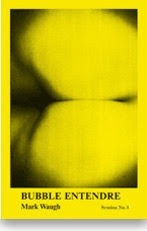
2009’s Bubble Entendre, too, has its relation to the art book – the Semina series, published by Book Works, publishes experimental prose and is named after the series of nine loose-leaf magazines issued by Californian beat artist Wallace Berman in the 1950s and 1960s. Berman is considered by many to be a pioneer of assemblage art – the magazines mixed collaged artworks with poetry by Allen Ginsberg, Jean Cocteau and many others. The design of the book itself reflects other concerns – that it is a yellow book was deliberate – a nod to another leading light in the history of avant-garde publishing – though the image is, of course, rather unlike the illustrations of Aubrey Beardsley. Waugh seemed to take some joy in this disruption, and the disruption the books cover must cause to its reader’s experience – would you take it on the tube? he wondered.

bubbleentendre

Come has a particular interest in club and drug culture – and the question around these – as with Waugh’s interest in porn – is always in the question ‘what is the significance of this? ‘, & the novel explores the wider political and social implications of fashions in drug culture – MDMA for example, Waugh said, came into fashion post-AIDS, and this trend for a drug which generates pleasure without stimulating sexual desire thus registers late twentieth-century anxieties around sexuality, non-mainstream community, and pleasure.

With porn, Waugh is both interested in how the concept of porn sits historically – in a lineage from De Sade through Bataille – and how a book operates differently to the internet – a transcription of youporn in a book will be a different thing to the video – not merely because of a difference between motion picture and text, but due to the object of the book, and the differing ways in which both mediums are policed and relate to questions of authority. Waugh recounted a story of how Book Works’s copies of Bubble entendre, destined for the New York book fair, were confiscated by the New York customs on suspicion of being a manual for terrorism. Conversely – the domain – at least printed – of porn – Penthouse magazine – has, perhaps because of the relation of porn to concepts of taste ad morality – has proved, at least historically, more open-minded to aesthetic innovation than one would expect – publishing some of Waugh’s more experimental fiction along with his partner’s art work.

Why might the New York customs office have suspected that Bubble Entendre was a manual for terrorism? The book – more traditionally plot driven than Come, although this plot is played with and chronologically disrupted and overlaid in order to disturb the reader’s sense of temporality – is set in a 2012 takeover of Claridge’s during the Olympics, putting, Waugh said, our fear of terrorism alongside the tedium of sport. Set in a time which is in our past, but at its writing and publication a point in the near future – the novel’s setting produces an odd glitch in time- a future already a past: Waugh said his aim was to create a dystopian novel set so closely in the future that it would very quickly become ridiculous by its own standards – when that future arrived differently. Half the fun, then, for the reader as well as for Waugh reading back with hindsight, is to see what in 2009 looked liked the landscape of 2012 and read it with a knowledge of 2012 – a scene, as Waugh points out, where one character asks another if they haven’t seen their face in News of the World has a completely different force given the events of 2011, and creates a surrealism completely beyond the author’s control. Which, it seems, is something he particularly relishes.

Standard