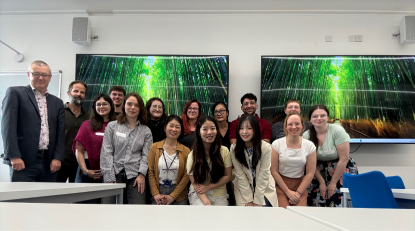
On Thursday 10 September, Skepsi hosted ‘Unmuting’, a one-day interdisciplinary conference held at the Language Centre on the University of Kent’s Canterbury campus. It was our first postgraduate conference since 2018, and the first since the journal relaunched at Kent last year.
Our call for papers started from the idea that silence is never neutral, and that unmuting raises questions of its own: who gets to speak, on whose behalf, and on what terms? Eight papers from six institutions in the UK and Greece answered in very different ways, across four panels on ecological voice, Holocaust studies, mixed media, and AI.
Ecological voices
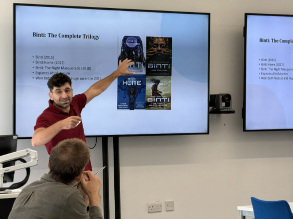
Opening the day, Panagiotis Orfanos asked whether more-than-human agents can speak, and how to avoid “giving voice” in ways that silence them again. His reading of Nnedi Okorafor’s Binti trilogy pointed to an alternative: meaning co-created through symbiotic encounters rather than speaking for others. Louise Wigglesworth explored the mashavi, the animal companions of Lauren Beukes’ Zoo City, set in an alternate Johannesburg shaped by Shona cosmology. Through what she calls the “sloth effect”, she showed how the novel blurs human and animal to gesture towards a post-anthropocentric mode of storytelling.
Holocaust Studies
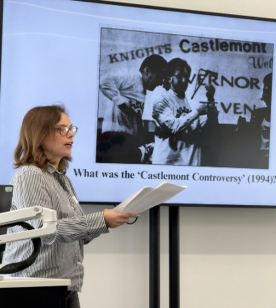
Sarah Wren examined how survivor testimonies describe sexual barter in the camps using consensual language such as “boyfriend” or “lover”. She argued that this vocabulary reflects a lack of available terminology and has contributed to the erasure of many women’s experiences of exploitation. Dr Rosalind Hulse revisited the 1994 Castlemont controversy, when African American and Hispanic teenagers were ejected from a Schindler’s List screening for allegedly laughing. She showed how the press solicited voices to speak for both the students and the Jewish audience, foregrounded Spielberg, and reinforced what she calls “Holocaust etiquette”, pushing the teenagers to the margins.
Mixed Media
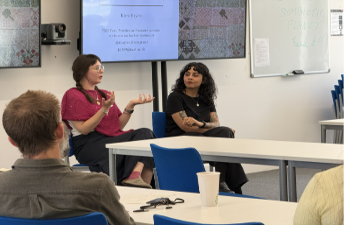
Dr Ami Nisa turned the lens on the camera itself in found-footage horror, challenging its supposed neutrality. Through a Marxist-feminist reading of the Paranormal Activity series, she presented the camera as a social actor that helps sustain an ideology of the nuclear family. Kiera Hayles built on Saidiya Hartman’s critical fabulation with her own practice of “Critical Fabric(ation)”, treating textile as a language spoken in silence. Focusing on needlework samplers, she explored their role in unmuting Black American and Indigenous lives and in girls’ protest in academic and domestic spaces.
AI
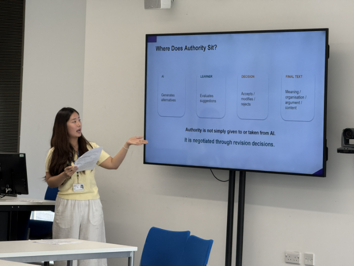
Xin Lim and Xin Cai turned to data-centre expansion, reading the proposed Mvskoke Technology and Innovation Park on Mvskoke Nation land through The Tempest, with Prospero’s control of the island as a figure for AI infrastructure. They argued that such projects continue colonial practices, appropriating land and knowledge while muting Indigenous voices. Closing the panels, Peijun Zhao asked whether AI feedback “unmutes” learners of Chinese or quietly rewrites their voices. Drawing on drafts, AI revisions, and reflections, they found that AI can expand expression but may also overwrite individual voice through standardisation.
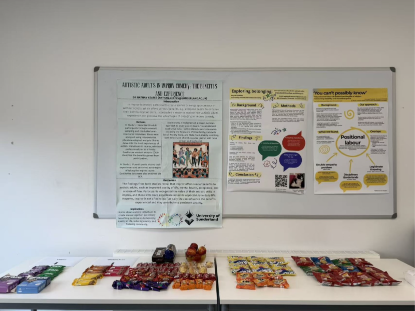
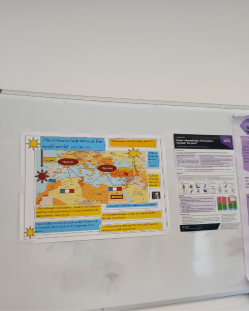
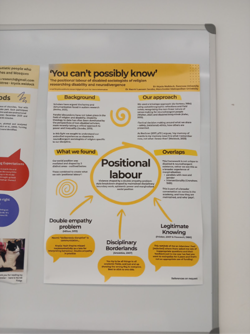
Our poster sessions over coffee featured a wide variety of research, including from autism studies, religious studies, French literature, and experimental linguistics. To round out the day we held a roundtable on journal publishing (Dr Joanne Pettitt, editor of Holocaust Studies: A Journal of Culture and History, and Dr Larry Duffy, editor of French Studies).
What stood out across the day was how many papers were less about giving voice than about the conditions under which a voice is heard: who records it, who mediates it, who speaks for whom.
Our thanks go to all our speakers and poster presenters; to our panel chairs, Dr William Rowlandson, Dr Joanne Pettitt, Dr Jeremy Scott and Dr Christina Kim; to Dr Joanne Pettitt and Dr Larry Duffy for joining our roundtable on journal publishing; to the Language Centre for their support; and to everyone who came along and kept the conversation going over coffee!