Call for contributions: Skepsi Magazine


We are looking for aspiring writers, creative artists or just anybody who would like to have a piece of their own creation published in a magazine.

We are the new General Editors of the university magazine Skepsi, the literary magazine based in the Language Centre. We are creating a unique, student-led issue which promotes the work of Undergraduates and Postgraduates and allows all students from any degree to express themselves freely.


This is our open call for submissions for our new issue, coming to you soon!


All pieces are welcome, whether they be academic, non-academic, fiction, non-fiction, literary or otherwise. We would love to see anything from an academic essay, your own creative writings – poetry or prose, we are not picky – photographic essays, artistic pieces, blog posts, or anything else you would like to share and have published. This is a fantastic opportunity to publish your work in a non-competitive and relaxed environment  (which will look great on a CV) or to just share your creativity with the world.


We are also looking for a piece of artwork to grace the front cover of our magazine, any piece of artwork is welcome, preferably inspired by literature, languages or linguistics.


All we ask is that the pieces submitted be your own works, previously unpublished, and created without the use of generative AI.


The deadline for submissions is the 27th November 2026, however extensions can be granted upon request.


If you have any questions or have a piece you would like to submit, please email us at skepsi@kent.ac.uk – please include your name and the title piece in the subject line.


We look forward to hearing from you and reading your work!


All the best,

Amelie and Melisa
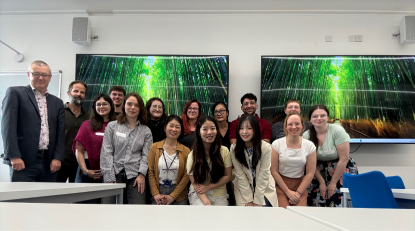
Unmuting Conference: Skepsi Blog


On Thursday 10 September, Skepsi hosted ‘Unmuting’, a one-day interdisciplinary conference held at the Language Centre on the University of Kent’s Canterbury campus. It was our first postgraduate conference since 2018, and the first since the journal relaunched at Kent last year.

Our call for papers started from the idea that silence is never neutral, and that unmuting raises questions of its own: who gets to speak, on whose behalf, and on what terms? Eight papers from six institutions in the UK and Greece answered in very different ways, across four panels on ecological voice, Holocaust studies, mixed media, and AI.

Ecological voices

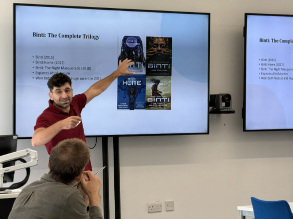
Opening the day, Panagiotis Orfanos asked whether more-than-human agents can speak, and how to avoid “giving voice” in ways that silence them again. His reading of Nnedi Okorafor’s Binti trilogy pointed to an alternative: meaning co-created through symbiotic encounters rather than speaking for others. Louise Wigglesworth explored the mashavi, the animal companions of Lauren Beukes’ Zoo City, set in an alternate Johannesburg shaped by Shona cosmology. Through what she calls the “sloth effect”, she showed how the novel blurs human and animal to gesture towards a post-anthropocentric mode of storytelling.

Holocaust Studies

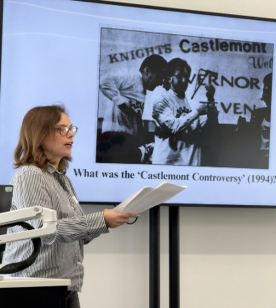
Sarah Wren examined how survivor testimonies describe sexual barter in the camps using consensual language such as “boyfriend” or “lover”. She argued that this vocabulary reflects a lack of available terminology and has contributed to the erasure of many women’s experiences of exploitation. Dr Rosalind Hulse revisited the 1994 Castlemont controversy, when African American and Hispanic teenagers were ejected from a Schindler’s List screening for allegedly laughing. She showed how the press solicited voices to speak for both the students and the Jewish audience, foregrounded Spielberg, and reinforced what she calls “Holocaust etiquette”, pushing the teenagers to the margins.

Mixed Media

Dr Ami Nisa turned the lens on the camera itself in found-footage horror, challenging its supposed neutrality. Through a Marxist-feminist reading of the Paranormal Activity series, she presented the camera as a social actor that helps sustain an ideology of the nuclear family. Kiera Hayles built on Saidiya Hartman’s critical fabulation with her own practice of “Critical Fabric(ation)”, treating textile as a language spoken in silence. Focusing on needlework samplers, she explored their role in unmuting Black American and Indigenous lives and in girls’ protest in academic and domestic spaces.

AI

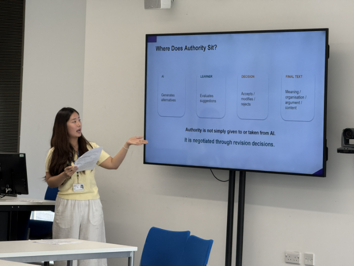
Xin Lim and Xin Cai turned to data-centre expansion, reading the proposed Mvskoke Technology and Innovation Park on Mvskoke Nation land through The Tempest, with Prospero’s control of the island as a figure for AI infrastructure. They argued that such projects continue colonial practices, appropriating land and knowledge while muting Indigenous voices. Closing the panels, Peijun Zhao asked whether AI feedback “unmutes” learners of Chinese or quietly rewrites their voices. Drawing on drafts, AI revisions, and reflections, they found that AI can expand expression but may also overwrite individual voice through standardisation.

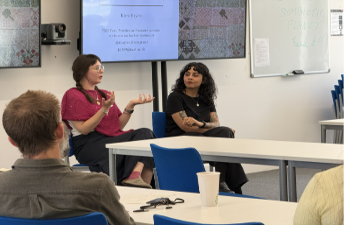
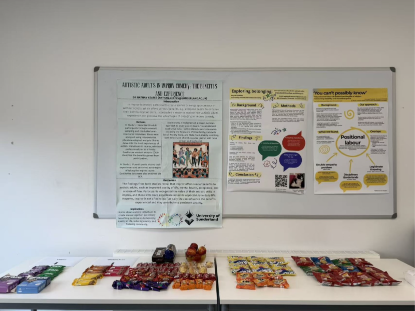
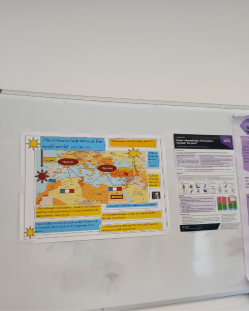
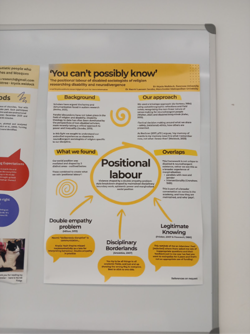
Our poster sessions over coffee featured a wide variety of research, including from autism studies, religious studies, French literature, and experimental linguistics. To round out the day we held a roundtable on journal publishing (Dr Joanne Pettitt, editor of Holocaust Studies: A Journal of Culture and History, and Dr Larry Duffy, editor of French Studies).

What stood out across the day was how many papers were less about giving voice than about the conditions under which a voice is heard: who records it, who mediates it, who speaks for whom.

Our thanks go to all our speakers and poster presenters; to our panel chairs, Dr William Rowlandson, Dr Joanne Pettitt, Dr Jeremy Scott and Dr Christina Kim; to Dr Joanne Pettitt and Dr Larry Duffy for joining our roundtable on journal publishing; to the Language Centre for their support; and to everyone who came along and kept the conversation going over coffee!


Out Now! The Nanny Nest by Shreya Modhwadia


The Nanny Nest – full story OUT NOW!

Extended Deadline


Call for Papers

Journal theme: ‘Identity’

Skepsi Postgraduate Journal, Language Centre, University of Kent

Extended Deadline

Identity is a fundamental part of human experience. It shapes how we communicate, how we are represented, how we interpret the world, and how societies construct difference and belonging. Language is a core tool we use to explore and express the different facets of our identities, through everyday conversation, written discourse, exploratory narrative, and personal reflection. Skepsi seeks to spotlight new research on this intersection between language and identity.

In the first returning issue since 2019, Skepsi invites early career researchers and postgraduate students to reflect on the theme of identity in humanities and social science contexts through interdisciplinary approaches, including (but not limited to): perspectives both experimental and non-experimental, including literature, linguistics (all subfields), cultural studies, philosophy, environmental humanities, postcolonial/decolonial studies, applied and experimental psychology, and related fields. We particularly welcome contributions that connect literary analysis and/or linguistic inquiry with adjacent fields.

Topics and themes include but are not limited to:

  • Identity and its impact on spoken communication, both in general and in unusual circumstances such as medical, educational, and work settings
  • Identity and written media, including fiction, non-fiction, diaries, letters, social media, and archival texts
  • Translation, interpreting, and mediated identity
  • Data-driven identity research, in corpus, computational, or experimental approach
  • Intersectional perspectives on identity in literature and culture, including gender, race, ethnicity, disability, sexuality, and migration
  • Postcolonial, decolonial, and global perspectives on identity in literary and cultural texts
  • Representations of personal, social, and collective identity in literature
  • The role of literature and cultural production in shaping social and cultural narratives
  • Narrative constructions of identity


Timeline and procedure

Please send enquiries and abstracts of up to 250 words to the editors (Louise Wigglesworth, Amy Bergman, Qiujing Fan & Beth Waldock) at skepsijournal@kent.ac.uk with the subject line “Identity 2026” by 15th June 2026.

Full manuscripts of 5,000-8,000 words will be expected by 30th October 2026.

You will hear from us by 5th July 2026 if your application is accepted and we wish to publish your full manuscript.

“Unmuting” PG conference

Call for Papers

Conference theme: ‘Unmuting’

10th September 2026, University of Kent, in-person conference

Language Centre, University of Kent

Silence is never neutral. Voices may be muted through structures of power, disciplinary boundaries,
linguistic limitations, or historical erasure. At the same time, acts of unmuting raise ethical and
methodological questions: who speaks, for whom, and under what conditions? Unmuting seeks to foster
dialogue on how silences are produced, sustained, contested, or transformed, and how attention to
silence can reshape critical practice.

This interdisciplinary conference invites early-career researchers, including doctoral students and
postdocs, to reflect on practices of unmuting across ecological, linguistic, cultural, and political contexts,
fostering dialogue around key issues in silence, voicelessness and representation with particular attention
to marginalised forms of knowledge, ecological discourse and identity.

We welcome papers from across the humanities, including (but not limited to) literature, cultural studies,
linguistics, philosophy, history, media studies, postcolonial and decolonial studies, digital humanities,
environmental humanities, and related fields.

We welcome contributions that engage with, but are not limited to, the following themes:

• More-than-human narratives, anthropomorphism, and non-human agency
• Silence as resistance, refusal, or method
• Decolonial, postcolonial and feminist approaches to voice, knowledge, and representation
• Speaking on behalf of others: ethics, mediation, and power
• Linguistic perspectives on silence, voice, and meaning-making
• Climate change communication across scientific, political, and popular registers
• Marginalised, erased and suppressed knowledge and knowledge-making
• Translation, mediation, and incommensurability
• Data-driven research on silence, power, and other related themes
• Platform, algorithm, audience

This conference is also connected to special edition of the Skepsi journal with the same theme, with a
planned publication schedule of winter 2026-2027, details to be announced.

Timeline and procedure:

The conference will take place in person on Thursday 10th September 2026.

Participants are invited to send the following:

– An abstract (max. 250 words), including a title of the proposed paper
– A short biography (max. 150 words)
– 3-5 keywords

Please send applications to skepsijournal@kent.ac.uk with the subject line “Unmuting Conference”.
Closing date for applications: 1st April 2026

Acceptance of applications: You will hear from us by 1st May 2026 if your application is accepted.

This conference is organised by Louise Wigglesworth, Amy Bergman, Beth Waldock and Qiujing Fan, and
will be hosted by Skepsi at the Language Centre, University of Kent.