
Optical Phased Array Antenna
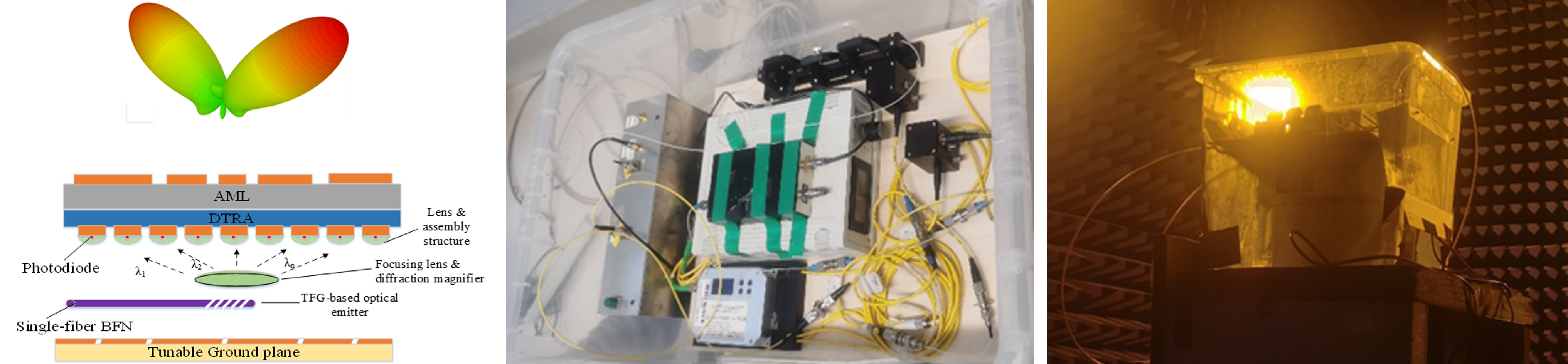
“Low-profile ultra-wideband wide-scanning multi-function beam-steerable array antennas” is a three-year research project funded by EPSRC. Future intelligent, autonomous platforms (autonomous vehicles, robots, satellites, ships, air planes) and portable terminals are expected to have multiple functions such as wireless communication (with satellites and/or terrestrial base stations and/or ground terminals), ultra-fast data transfer, navigation, sensing, radars, imaging and wireless power transfer. These wireless systems operate at various frequencies. As a single radio frequency (RF) system usually has a narrow bandwidth, multiple RF systems at different frequency bands are often employed, leading to a huge increase in the volume, power consumption and cost. To address this need, it requires a single-aperture ultra-wideband (UWB) phased array capable of operating over an extremely wide range of frequencies, and having a low profile, wide-angle-scanning steerable beams, high gain, high efficiency and multiple polarizations (e.g. right-hand circular polarization for navigation, dual linear polarizations for mobile communication). Such an advanced antenna system does not exist yet. This project aims to tackle the ambitious challenges of addressing this need. This multi-disciplinary research consortium, having RF/microwave/mm-wave phased array researchers working together with researchers in optical beamforming and 3D printing, are ideally placed to development a new generation of low-profile UWB phased arrays, which is expected to find wide uses for both civilian and military applications.
The project explored a multidisciplinary research topic combining RF engineering, materials, advanced manufacturing and optical signal processing approaches. We have completed novel designs of many antennas and phased arrays, and optical beamforming networks which achieved ultra-wideband performance and more compact size compared to the state of the art development. The antenna design and photonic beamforming networks developed in this project have been verified by solid research outcomes and experimental demos of system integration, hence can be used by industries. The key findings have been evidenced by a good number of publications, conference talks, awards and recognitions, and personal career development.
Related Publications
- L. Wen, B. Sanz-Izquierdo, W. Hu, C. Lin, and C. Wang, “Lightweight, low-cost, tightly coupled dipole array antenna for wireless power transfer,” IEEE Antennas and Wireless Propagation Letters, 23(11), 3797-3801 (2024).
- L. Wen, S. Gao, Q. Luo, W. Hu, B. Sanz-Izquierdo, C. Wang, and X. Yang, “Wideband transmitarray antenna using compact 2-bit filtering unit cells,” IEEE Transactions on Antennas Propagation, 71(10), 8344-8349 (2023).
- L. Wen, S. Gao, B. Sanz-Izquierdo, C. Wang, W. Hu, X. Ren, and J. Wu, “Compact and wideband crossed dipole antenna using coupling stub for circular polarization,” IEEE Transactions on Antennas & Propagation, 70(1), 27-34 (2022).