
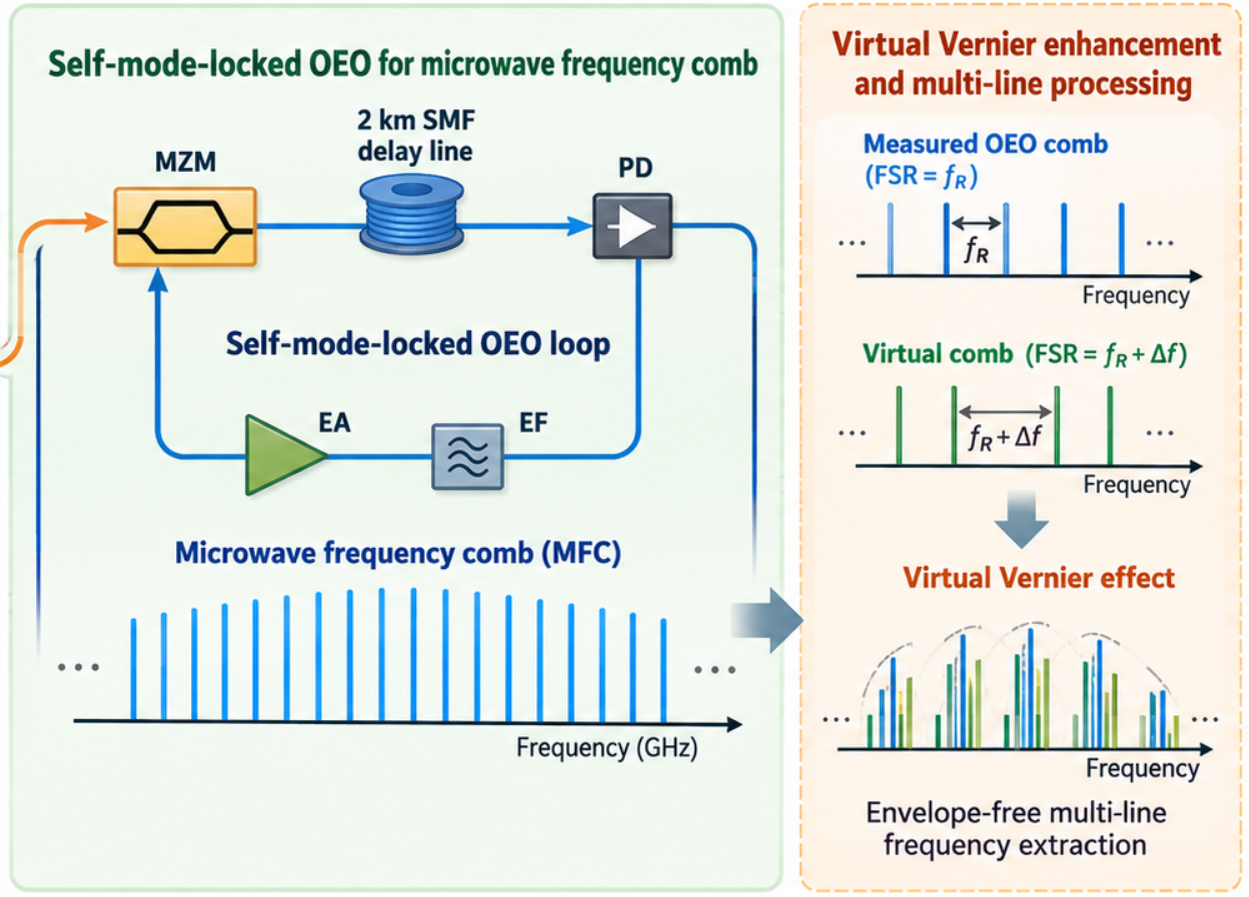
We are pleased to share our latest paper, “Microwave Frequency Comb Interrogation of Wavelength-Encoded Fiber Sensors Using Self-Mode-Locked OEO and Virtual Vernier Enhancement,” published in the IEEE/Optica Journal of Lightwave Technology. The work develops a new microwave-photonic approach for high-precision interrogation of wavelength-encoded fibre sensors.
The technique uses a self-mode-locked optoelectronic oscillator (OEO) to generate a microwave frequency comb, providing multiple sensing channels that can be processed in parallel. Compared with conventional single-frequency OEO interrogation, the multi-line comb improves measurement stability by averaging local frequency fluctuations and reducing measurement uncertainty.
A key feature of the work is a virtual Vernier enhancement scheme. Instead of introducing an additional physical optical or electrical loop, a numerically generated microwave frequency comb with a slightly different free spectral range is combined with the measured OEO comb. This creates a controllable Vernier effect in the signal-processing domain, allowing the wavelength-to-frequency sensitivity to be substantially amplified without increasing the hardware complexity.
The team also developed an envelope-free multi-line frequency extraction method, which directly processes the individual comb-line frequencies rather than relying on fitting a Vernier envelope. This improves robustness against spectral distortion, noise and peak drift.
Experimentally, the technique achieved tunable sensitivity amplification from 2.25× to 107.19×. For fine wavelength interrogation, the maximum absolute residual error was reduced from 0.14 nm to 0.068 nm, while multi-line processing further improved fitting stability and measurement repeatability.
The work demonstrates a promising route towards compact, high-precision and potentially real-time interrogation of wavelength-encoded fibre sensors, with applications in structural health monitoring, industrial sensing and other demanding optical sensing systems.
An important part of the research was supported through the Innovate UK AFCAD project under Project Reference 10097017. The AFCAD (Advanced Fuel Cells for Aviation Decarbonisation) project focuses on the development of advanced optical-fibre sensing technologies for hydrogen fuel-cell systems, including high-temperature PEM fuel cells, where accurate and robust measurement of local temperature and other operating parameters is essential. The interrogation techniques developed in this JLT paper contribute to the wider objective of enabling more sensitive, stable and compact fibre-sensor readout for demanding energy and industrial environments.
In particular, the use of microwave-photonic interrogation provides a route to move beyond conventional optical spectrum analyser-based readout, which can be limited by acquisition speed, cost and resolution. The combination of multi-line OEO sensing and virtual Vernier enhancement therefore has relevance to the broader sensing challenges being addressed within AFCAD, where reliable fibre-optic measurements are being developed for integration into practical hydrogen fuel-cell platforms.
The research was carried out by Tongtong Xie, Shouju Liu, Tianxiang Luan, Yue Feng, Hao Chen, Hongyan Fu and Chao Wang.
Paper: Microwave Frequency Comb Interrogation of Wavelength-Encoded Fiber Sensors Using Self-Mode-Locked OEO and Virtual Vernier Enhancement
Journal: Journal of Lightwave Technology
DOI: 10.1109/JLT.2026.3734947