MEMS staff, Dr David Rundle and Dr Sheila Sweetinburgh organised this year’s Fifteenth Century conference, an annual, itinerant (last year Durham, next year Cambridge) gathering of international academics who are especially interested in a wide range of topics linked to late medieval England and its continental neighbours. Sheila has written up the following report, also viewable on the KCHH blog.
This year’s conference was a very friendly gathering with lots of opportunities for informal discussions beyond the various sessions, especially during meals, and at the wine receptions, visits and refreshment breaks. Furthermore, in addition to the intellectual stimulus provided by the broad range of papers, we had a poster display by postgraduates studying very different topics from late medieval shipbuilding in the Cinque Ports a (Angela Broomfield) to disputes and their resolution (or not) in medieval Kentish communities (Christine Brandl) by way of violence on a national scale in the Wars of the Roses and the actions of Richard Duke of York (Hannah Keller).

The packed programme, which ran on parts of three days, included 15 presentations, the poster display and wine reception (sponsored by the University of Chicago Press Journals, publishers of Medium Aevum), a visit to Canterbury Cathedral Archives to see a special display, a walking tour of the city, a visit and wine reception at Eastbridge Hospital (sponsored by Boydell and Brewer), a guided tour of Sandwich and the conference dinner. Consequently, I’m going to confine this report to giving you a flavour of the range of topics covered in the papers and some ideas about the other aspects of the conference.

The first two papers by David Harrison and Susan Rose might be said to have explored travel in different ways. David looked at the network of highways across 15th-century England and Wales, as well as their associated infrastructure of bridges and the ways towns serviced those who were ‘on the road’. As a contrast, Susan considered sea journeys, including the impact of conflict, especially warfare in continental Europe, as well as the differences between the experiences and aspirations of those in eastern England compared to those of the western ports. For, as she discussed, the 15th century saw the beginnings of Bristol’s links with the Americas.

The next two pairings took us into the late medieval world of literary scholarship using a range of lens to capture the diversity of interests, knowledge and networks of writers and readers. This again brought a European, specifically Mediterranean classical (Greek and Latinate) dimension by John Colley, but added the epistolary activities of English gentry women by Assia Alami. Additionally, Charlotte Ross provided a fascinating assessment of the textual history of Hoccleve’s The Regiment of Princes, while Ryan Perry took us into the mercantile and other reading communities of 15th-century London.
The roles and activities undertaken by women from mercantile through to gentry and aristocratic families might be seen as one of the themes of the conference, as exemplified by papers from first Virginia Davis, looking specifically at the wives of various chief governors in late medieval Ireland and later by Leah Jepson, whose case study considered the life of Margaret Blackburn from a well-known York merchant family. As you might expect, late medieval piety was one of the features Leah considered, and this route into late medieval culture was explored further by first Tim Clark in relation to Richard Beauchamp, the 13th earl of Warwick, and later by Mary Franklin-Brown concerning Henry IV. Her consideration might be seen as highly pertinent bearing in mind the king’s funeral monument is just down the road in Canterbury Cathedral.


Assessing the written word might be said to have bridged Friday into Saturday for first Anne Curry looked in detail at the relationship between two Latin lives of Henry V before David Potter brought us an analysis of Louise de Savoie’s correspondence, a sizeable proportion being in her own hand. Much of this was to her daughter and son, Francis I of France, but she also corresponded with Cardinal Wolsey.
The penultimate session moved away from letters to legal documents. Mark Horowitz explored the use of written bonds, especially in the hands of Henry VII’s two chief ministers whose exploitation of such means might have been expected to spark revolt. Yet as Mark argued it didn’t, indeed Henry VIII continued in his father’s footsteps in this regard. Going further back in time to 1450, James Ross examined the record that a London physician had copied into his book which potentially offers further ideas about the politics of Richard, duke of York.


The final paper might be seen as even more exploratory because Julian Luxford asked his audience to consider whether or to what extent contemporary English art and imagery was influenced by the Lollard sub-culture of the long 15th century. This interesting proposition of heresy-angst provoked an interesting discussion that continued into lunch.

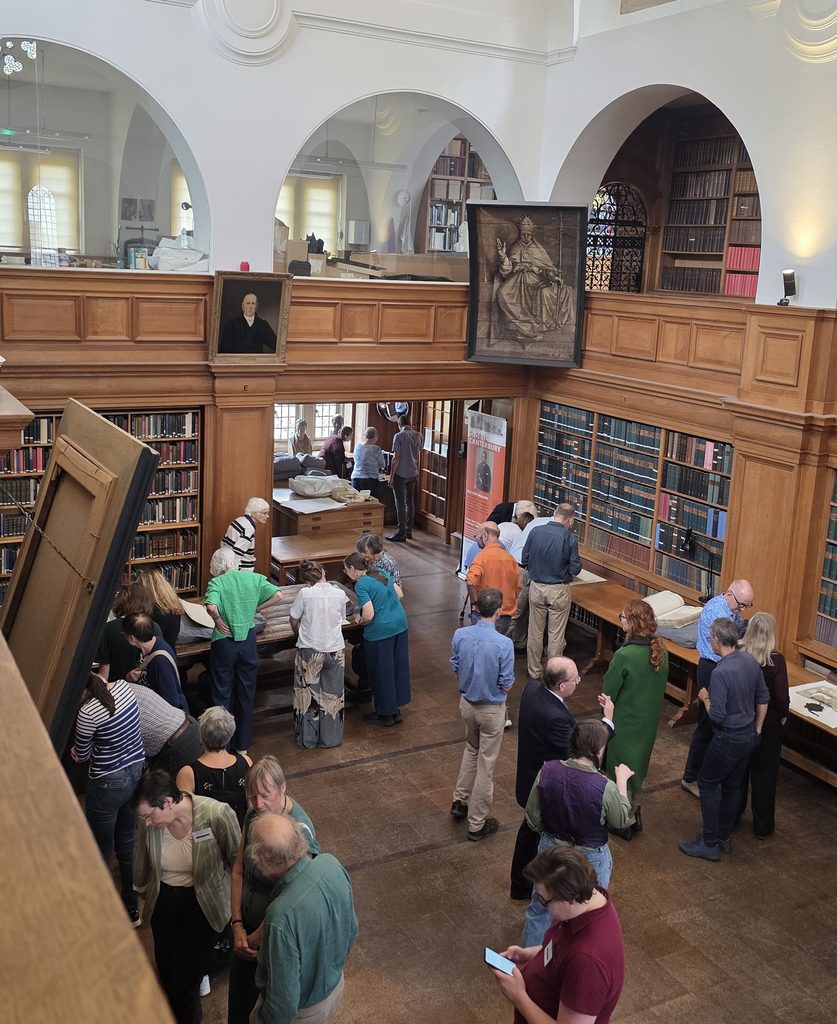
For the other aspects of the conference, David Rundle had selected a fascinating array of documents from the archives’ collection, as I hope you can see from Diane Heath’s photo. Then later we were at Eastbridge Hospital where quite a number of the delegates explored the upper chapel, including seeing its stunning king-strut roof which incorporates a bell-turret and spirelet. Stunning architecture was also on view in Sandwich during Robert Pay’s guided tour, especially at St Clement’s church, a fitting finale to a great conference.

