The Canterbury Medieval Weekend 2026, under the auspices of the Canterbury Association for Medieval and Early Modern Studies (CAMEMS) with MEMS brings new research by leading historians and writers to audiences, as well as raising funds for postgraduates in medieval and early modern studies. We want to record thanks to Dr Sheila Sweetinburgh (Associate Lecturer in MEMS) and all those who helped make it another successful occasion.

Robert Pay, chairman of CAMEMS (photo: Pepsoft Photo (www.pepsoftphoto.uk))
Firstly, thanks to all the speakers: Categorised Events List, for as one of those providing feedback said what they liked was the “Great variety of speakers and topics, very much enjoyed being able to experience the true lecture theatre style”. Similarly, thanks to everyone who chaired sessions so well: Jonathan Arnold, David Budgen, Catriona Cooper, Diane Heath, John Manley, Robert Pay, Emma Pennington, Ryan Perry and Angela Senior. Those attending were also very impressed by the MEMS postgraduates and others who formed the ‘Welcome Team’, hence many thanks to Michael Byrne and Jane Joyce who led the teams in the Grimond and Templeman lecture theatres respectively, the teams members being Tressa Biener, Christine Brandl and Elliott, Angela Broomfield, Connor Chering, Leo Dix, JJ, John Manley, Robert Pay and Elijah Vote.


As in previous years, considerable thanks to Peter Joyce, including for his photography, and to Kieron Hoyle (assisted by Benedict Fisher) and Jason Mazzocchi, who were very heavily involved before, during and after the Weekend. Talking of preparations, gratitude goes to Ben Cornwell who created the Weekend’s website and Diane Heath who designed the souvenir brochure. Many thanks, too, to Suzanna Ivanic for her help with bookings, various university processes and for supporting events on Friday and Saturday and to Karen Brayshaw and her colleagues in Special Collections and Archives, who with several MEMS postgraduates: Angela, Tressa, Elijah and Tris Lopez-Huicochea worked with Ryan and Sheila on the exhibition, as well as Torn Brown (Pilgrimage Officer at Canterbury Cathedral). If you would like to visit the exhibition, please go to the Templeman Library Reception during normal working hours and the staff will be happy to let you into the library and guide you to Special Collections. Finally, we are exceedingly grateful to Craig Dadds, who once again provided the Weekend’s bookstall, with Jean his assistant, and who was at the Weekend throughout: CCCU Bookshop. University Bookshop on tour .


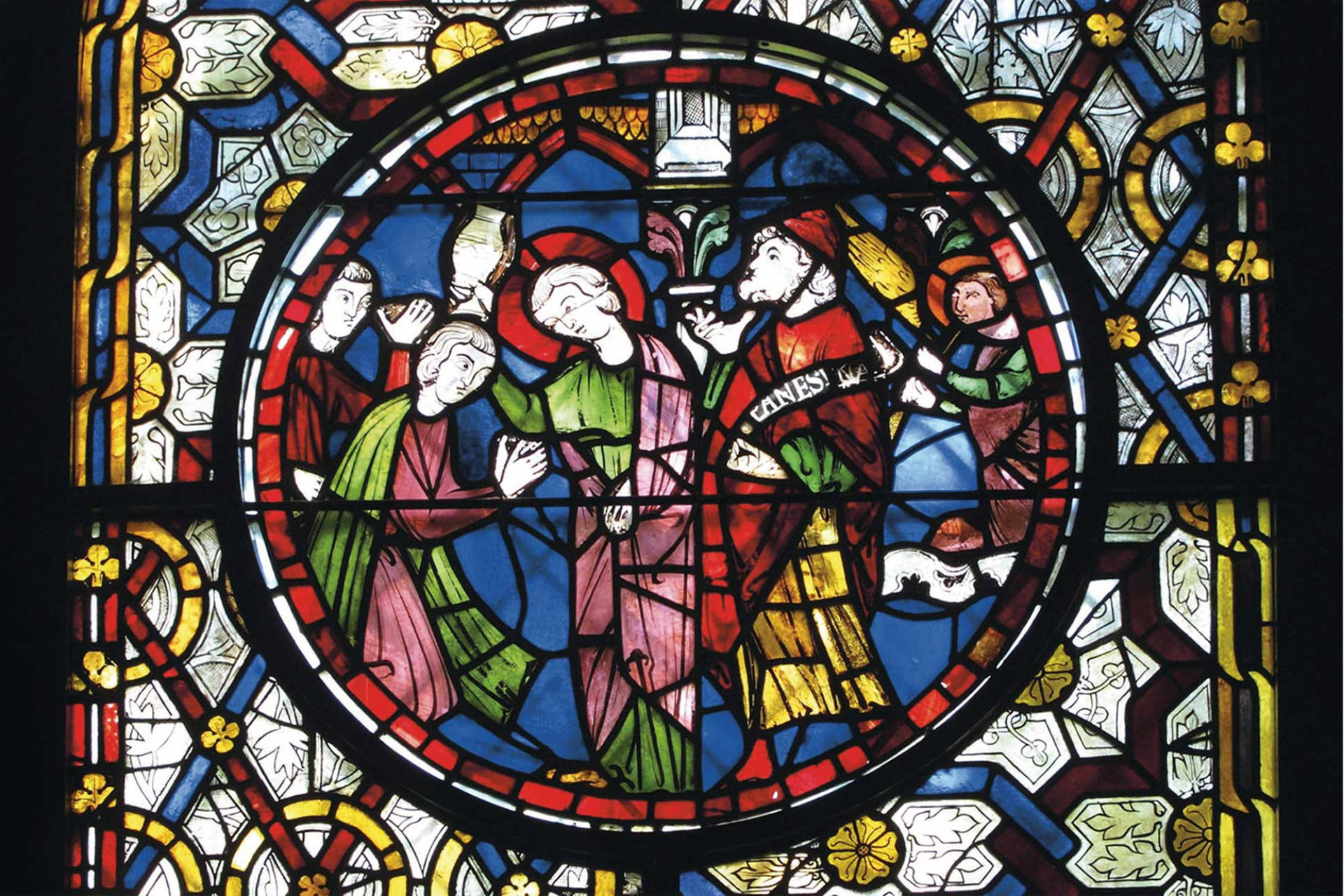
To begin, Sheila chaired the first session which saw Rachel Koopmans provide a tour-de-force on the Friday evening when she discussed the research she has been conducting with the Glass Studio conservators on nIV, an outstanding window among the surviving Becket Miracle Windows. This is the third window as part of a larger project to remove all the surviving windows for close analysis and conservation. As Rachel said, the starting point is to evaluate every individual piece of glass to ascertain whether it is medieval or modern, thereby building, correcting and extending the catalogue which Madeline Caviness produced in 1981. For unlike Rachel, Madeline was working on the glass while it was in situ, rather than following its removal and placement on the glaziers’ bench. The results from the re-evaluation have been startling, leading to far fuller descriptions of each panel and the reclassifying of individual pieces of glass, that in turn has meant Rachel has been able to identify specific miracle narratives which before were categorised as say a ‘sick man’. Another bonus has been the recovery of traces of lost paint that offer details such as facial expressions, as well as letters within inscriptions, again more vital clues concerning identifying which of the miracle narratives is being portrayed. For this, Rachel’s own recently published translation of Benedict of Peterborough’s miracle narratives has been invaluable, and the results are truly exciting. So for the first time we can ‘meet’ Richard of Stanley!


Moving to the activities of Victorian and later restorers, Rachel explored with her audience the works of first George Austin Jnr and then the more recent Samuel Caldwell Jnr. Shall we say Rachel has admiration for one and little respect for the other! Hopefully this will lead to an article as these are fascinating narratives in their own right. But, as Rachel said, to finish on a happier note, she took her audience through her analysis of a faint depiction of a miracle and two inscriptions on a high-quality ampulla from Cluny which she has deployed to, in a sense, recreate lost panels which is just amazing.
This was absolutely brilliant and therefore set up the Weekend beautifully, as you could tell from the excited buzz as people left the lecture theatre. This buzz continued throughout, as evidenced in part by extra ticket sales over the Saturday and Sunday. As a change from previous years, you might be interested to hear from some of the Welcome Team postgraduate volunteers who have kindly provided paragraphs on several of the presentations.

Working through the Weekend, Christine’s paragraph concerns Jack Newman’s lecture on Attitudes towards Royal Justice in the Early 14th Century. As she says, Dr Newman delivered an insightful talk on royal justice reflected in the literary works of the Harley scribe. Focusing on the manuscript MS Harley 2253 (c.1320-1348), often known as the Harley Lyrics, he highlighted its rich variety of Middle English, Anglo-Norman, and Latin texts, notable for including voices and perspectives of ‘common’ people. A key example was The Outlaw’s Song of Trailbaston, one of the earliest outlaw poems and sometimes linked to early Robin Hood traditions. This 100-line Anglo-Norman piece uses sharp wordplay to critique royal justice, even posing the provocative question, ‘is it just?’ directly to its audience. Dr Newman suggested the poem may allude to Roger Mortimer, 2nd Earl of March, pointing to connections with the Welsh Marches and the Harley manuscript’s likely Ludlow origins. He also situated the work within the politically turbulent years of 1340–41, during the early phase of the Hundred Years’ War, when many such politically charged texts emerged. The talk explored how legal terminology is subtly woven into the poem’s language. References to practices such as ‘complaint by bill’, active juries able to present cases, prosecution by reputation (Latin: fama), and benefit of clergy all carry layered meanings, blending technical legal concepts with poetic critique. Dr Newman demonstrated that even the poem’s imagery operates symbolically: under the ’law of the forest’, birds take on coded significance, with the sparrowhawk representing both royal authority and themes of courtly or romantic relationships. Overall, the session revealed how literature like MS Harley 2253 not only entertained but also engaged critically with contemporary debates on justice, authority, and society.

Christine’s 2nd paragraph looks at Ryan Perry’s presentation on John Colop and the culture of literary almsgiving in late medieval London. MEMS’ very own Dr Perry examined literary alms-giving in late medieval London. His talk focused on ‘common profit’ books: vernacular English texts circulated among London’s mercantile elites, guild members and clerks. These books functioned as charitable objects, passed on in exchange for prayers for the souls of their former owners. A central figure was John Colop, whose manuscripts sit on the cusp of the transition to print. His book, a miscellany of different texts compiled over his lifetime, reveal a vibrant social world of readers and scribes. Marginal notes such as quere (meaning ‘query’ or ‘questioning’ in Latin) show points of debate, hinting at an informed, sophisticated reading culture in London. Dr Perry also shared with the audience the devotional and legal framing of these texts. Colophons, written in legalistic language, frame the books themselves as acts of alms, intended for the spiritual benefit of both men and women ‘for as long as the book endures’. This reflects a broader culture in which books could serve both charitable and social purposes. The talk also placed Colop within the wider intellectual and religious context of the time, including parallels with Bishop Reginald Pecock, who wrote vernacular theology for London audiences at Whittington College (founded by Richard ‘Dick’ Whittington) before later being tried for heresy. Colop’s interests also show affinities with Lollard ideas, particularly an emphasis on biblical study, and knowledge of Wycliffite texts. Finally, Dr Perry linked these practices to broader developments in London’s literary culture, such as the establishment of a common library at the Guildhall, and revealed how common profit books were not only sources of knowledge, but also vehicles for charity, community, and shared spiritual life in late medieval London.

Tressa’s paragraph covers Lost Letters of Early Medieval Britain by Robert Gallagher. Dr Gallagher gave a talk explaining letters in early medieval Britain. Beginning by explaining what a letter is, a text originally written on parchment or papyrus addressed by one or more persons to another person or group of people to whom the message is expected to be delivered, he explained how letters were intended to travel and to act as agents of communication across distances. Because of this, combined with other factors, many letters were damaged or lost. Dr Gallagher, along with other team members, is currently exploring medieval letters that have been lost over time. What this means is that there is evidence and mentions of lost letters in other letters that have been studied. An example he mentioned is a letter from Pope John VIII to Æthelred, Archbishop of Canterbury in 877/78. Pope John was addressing a complaint previously sent from Archbishop Æthelred, but we do not have any record of the original letter from the archbishop, indicating it has been lost. The letters, both those we have records of and those that are lost, provide windows to the future indicating what was important during that time, especially as letters were expensive to write. Letters in medieval Britain were made of papyrus or parchment, both of which were expensive and tedious to obtain, and those that have been preserved showcase the great care and precision in which writing occurred, proving many must have made first drafts using other methods, like wax tablets. A few ways in which many of the letters, which is not a large number, from medieval Britain survive is that they might have been added into manuscripts, organized into letter collections, and quoted in later texts. This research is imperative to understanding medieval Britain, especially when so many original documents have been damaged or lost over time, and it helps to unpack the dynamic between the various kingdoms in medieval Britain with religion, shifting politics, and other important figures.
Next here is Angela’s paragraph on The Greatest Castles of the Middle Ages by Richard Eales. Castles are among the most well-known symbols of the medieval world. From the early, timber motte-and-bailey structures to the later formidable strongholds built in stone, historian Richard Eales took us on a journey through time and space. The peak period of castle building was during the ‘long’ thirteenth century, from 1180-1340. Richard highlighted their role as military strongholds, administrative centres and powerful status symbols, epitomised by the sophisticated structures at Dover, or the imposing Krak des Chevaliers in Syria (built by European Crusaders from 1142 to 1271). He also explored the ongoing controversy surrounding the intent and use of these buildings and the shift in the academic debate to consider their role at the centre of a decorative power landscape. This fascinating talk revealed a rich and varied story of regional identity, political authority and dramatic events.

Our next report comes from Leo Dix on Marc Morris’ lecture on that great castle builder, Edward I. Marc’s talk on Edward I, in line with the republication of his book Edward I: a Great and Terrible King, was a quite riveting experience. He is not only a shrewd and meticulous historian but also a gifted speaker who is able to convey his central theme through a mix of humour, incisive description, and skilful metaphor. In treatment of his subject, he carefully explained the nuance surrounding the perception and reputation of Edward, especially in relation to the sometimes thorny subject of Anglo-Scottish relations, with the inevitable references to Mel Gibson in the process, which I could tell the audience appreciated. Moreover, he touched on a somewhat overlooked aspect of Edward’s reign to a popular audience, namely Edward’s role as a legislative ruler, and did so in a way which held the attention of his audience on what some may perceive as a dry, technical subject. Finally, he answered the audience’s questions with his characteristic mix of scholarly detail and casual wit – you certainly left the talk feeling both informed and entertained.

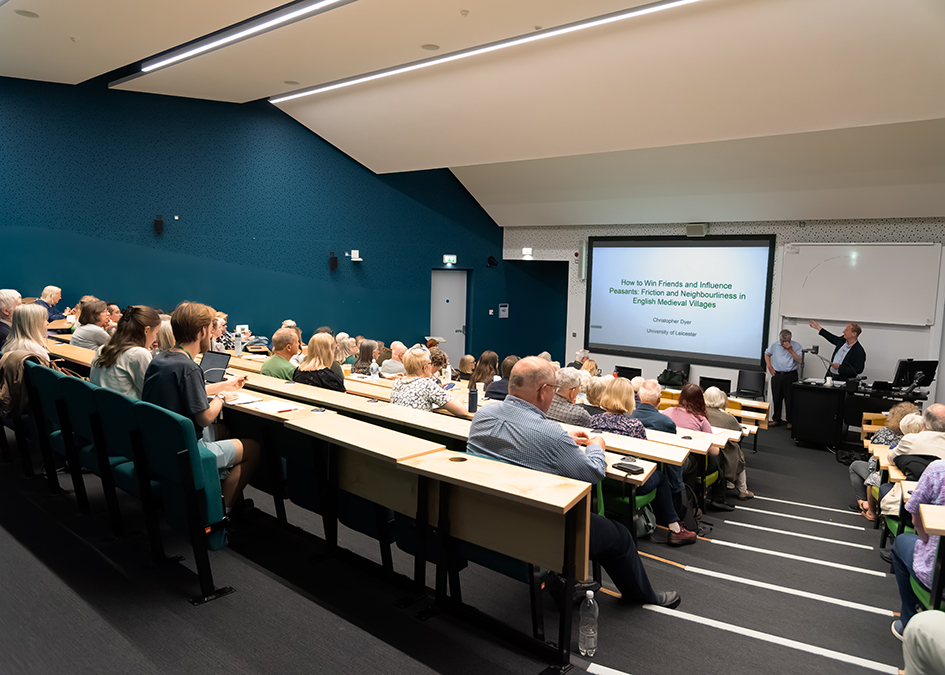
Moving from castles to peasant society, Christine looks at Christopher Dyer’s presentation on Friction and Neighbourliness in English Medieval Villages. In a slight change to the topic advertised, Professor Dyer explored the idea of ‘the common good’ in his talk, and the realities of neighbourliness and friction in medieval English villages. Drawing on the political thinking of Marsilius of Padua (c.1275–c.1342), he highlighted how communities understood society as a kind of body, working collectively toward the shared goal of living well. This ideal was reflected in everyday practices, from cooperative agricultural work like ploughing to the language of the manorial court, where disputes were framed as matters of ‘common profit’. Yet, as Professor Dyer emphasised, village life was not a simple story of harmony. Medieval society was as much horizontal as vertical, shaped by dense networks of relationships within often close-knit, face-to-face communities with clearly defined boundaries. While shared customs, from compulsory archery practice on church grounds to communal labour, could strengthen cohesion, tensions were never far beneath the surface. Enclosures (Edward I, late twelfth century), disputes over land use, market regulations like the assize of ale, and everyday misconduct, from theft to gambling, could all threaten the common good. Rather than a nostalgic vision of a ‘merry England’, Dyer presented the audience with a more complex picture in which friction was an ordinary part of village life, managed through a mix of formal courts and informal pressures such as reputation, mediation, and communal judgement.

Elijah’s 1st report concerns Diane Heath on Canterbury’s Romanesque Crypt Creatures. Dr Heath goes into detail about the Romanesque stone carvings of animals found inside the Canterbury Cathedral Crypt. Before that, she gives context about the funding of it by St. Anselm and its three-year construction. It is likely that Anselm employed stone mason’s from across Europe. The entire crypt would have better lighting and be painted assisting in a more relaxed atmosphere. Diane then switches to looking at the Stone carvings detailing where, how, and why they were made with animals as examples. Diane emphasises the importance of speculation and encourages debate on what these animals may be. Her personal favourite is on the fourth column on the southern row depicting a lion with a moustache. The moustache in Norman culture is associated with authority and acts as a reminder of God’s authority. she looks at MS Bodley 764 which says, ‘The lion is merciful to penitent men’. She also mentions towards the end that these carvings were to encourage lay people to interact with Christianity by showing stories common in the time with animals.

Angela’s second piece concerns New World Settlement and the English Middle Ages by Matthew Johnson, where he discussed the culture and settlements of the earliest emigrants to the ‘New World’ and their close connection to the medieval traditions of the land they left behind. Professor Johnson’s talk was packed with key insights into the continuity of culture shown by the early settlers on the east coast in places such as Jamestown. Their technologies, social structures and land use owed much to the medieval way of life. Matthew pointed out that the settlers were of the ‘middling sort’, a social group primarily of yeoman farmers, husbandmen, and urban artisans. Although their original cultural ‘blueprint’ was that of medieval England, they soon adapted their practices, improvised and learned from the other inhabitants of the land. Matthew explained how their culture was shaped by their past and by their new environment, but also by their shared journey across the ocean.
Matthew then considered the very different practices and land use of the plantations in the south. Although it is often associated with the eighteenth century, the plantation structure, with its profit-driven focus on crops produced using enslaved labour, was in place by the end of the 1600s. He revealed the sharp regional differences between the two areas in terms of society, economy and land use, and how they were heavily influenced by the culture and experiences of those who settled there.
For Sunday, firstly we have Tressa on The Battle of Towton by David Grummitt. The Battle of Towton, which is known as the bloodiest battle in England, has many myths surrounding it, and in his talk, Dr Grummitt challenged these myths and so-called facts about the battle. He gave a timeline for the start of the Wars of the Roses from 1459-1461 to set the scene for the Battle of Towton, and he explained that ‘unfortunately, almost nothing of this well-known story can be found in the fifteenth-century source,’ and almost every detail surrounding this battle has its origins from mid-Tudor chronicler, Edward Hall (quote from David Grummitt’s book). Details that have been glorified and made into myths include the size of the battle and armies, the fact that the snow was important, and that this was a battle central turning point during the Wars of the Roses. While contemporary estimates range from 60,000-200,000 men in each army, Dr Grummitt believes this is unlikely and states there were likely around 5,000 men in each army and not everyone would be fighting. Not only did he state that no royal army probably exceeded 20,000 men in the 14th century, but also because such a large number of men would be nearly impossible to control, the armies would be constrained by the landscape, and both the men and horses needed to be provisioned, proving how ridiculous the numbers suggested by Hall seem. It was explained that the weather had no direct impact on the battle, and as Edward IV went on to fight the Lancastrians for another three years in the North, this battle was not a decisive battle. Overall, the size of the armies used by both the Lancastrians and the Yorks have been exaggerated, thus exaggerating the death toll as well, and while it was an important battle, the Battle of Towton was not a decisive and key turning point. Dr Grummitt’s research is revelatory, and his newest book will go into more detail about the Battle of Towton and how history has gotten its information wrong.

Speaking in the other lecture theatre was Eliot Benbow on Pilgrim badges, toys and related trinkets and the report is by Elijah. Dr Benbow focuses on looking at the material conditions of everyday life in relation to pilgrimage, and everyday trinkets and toys from the 14th and 15th centuries. In these centuries objects blend heavily with devotional practice in England but also in the Low Countries. He details how there is a lack of devotional and ‘secular toys’. A painting suggests pilgrimage badges were sold alongside hobby horses, toy crossbows, and more. Eliot also looks at the movement of these objects from where they would have been relatively common. An example is the movement of Thomas Becket figures, which would have been common in Canterbury, found in London from the early 15th century. Lastly, he looks at records from custom houses, what their imports would have been, and how they relate to the cheap toys found in England. These range from simple objects like prayer beads to dices, tennis balls, and playing cards.
Staying with medieval London, Angela reports on The London Aldermen in the Fifteenth Century – new insights and discoveries by Professor Caroline Barron. Caroline Barron’s fascinating talk was illustrated by the remarkable series of individual portraits of the London Aldermen that were painted during the mayoralty of Sir John Olney (1446-47). These images have been very little studied and Professor Barron is investigating what they can tell us about the Aldermen and their contributions. The London Aldermen acted as the city’s executive body, making critical economic and political decisions. They were often members of powerful guilds and were closely linked with the mercantile wealth of the city. Caroline’s talk focused in particular on the life and achievements of Simon Eyre, who was Alderman for multiple wards between 1444 and 1458, and Mayor of London in 1445. Simon Eyre is remembered for his involvement in civic projects, such as the rebuilding of the Leadenhall granary, for his ambitions to provide free schooling, and for his donations to the poor. In his will, he left money to establish schools and pay the salaries of teachers, but his executors did not implement his bequest. However, as Caroline pointed out, although the school failed Simon was ahead of his time in his civic vision and ambitions.


Bringing a fabulous Medieval Weekend to a close, I thought I would bring you Christine’s report on Helen Castor’s lecture on The Eagle and the Hart. Dr Castor gave her talk to a packed lecture theatre on the different personalities of Richard II and Henry IV. Drawing on William Shakespeare’s evocative play Richard II, she asked a central question: what made a medieval king? Concepts such as divine right, the authority symbolised by the great seal, and the structures of feudalism, all positioned the king as God’s chosen ruler and ultimate authority within medieval social hierarchy. Richard II’s reign revealed how fragile this model could be. Following the deposition of Edward II, the only king overthrown since the Norman Conquest, his son Edward III restored stability with a long reign. Yet the early death of his father, the Black Prince, meant that Richard inherited the throne as a child of just ten. Lacking direct experience of kingship, he became highly conscious of royal image and symbolism, but had to rely heavily on the private power of great lords to uphold authority. Challenging the established order was only seen as morally justifiable under tyranny, making any tension between king and nobility particularly dangerous. Key moments in Richard’s reign underscored these tensions. During the 1381 revolt, the 14-year-old king was accepted by the rebels as a God-given leader, but Richard’s actual priorities lay less in the war with France and the concerns of the common people, and more in managing increasingly hostile relations with his nobles. In contrast, Henry Bolingbroke had been trained in jousting and statecraft by his father and had nearly lost his life during the same uprising when the young Henry (same age as Richard) was trapped at the Tower of London. The two men embodied very different models of kingship in both temperament and experience. Relations deteriorated sharply as Richard II moved against his opponents, charging powerful lords with treason and tightening his grip through military force. Henry was exiled for ten years, and Richard seized Henry’s Lancastrian inheritance. The crisis culminated in 1399 with Richard’s forced resignation and Henry’s accession as Henry IV, and the eventual outcome, regicide, underscored the high stakes of medieval kingship. At the end of her talk, Dr Castor posed another enduring question to the audience: was Richard a tyrant, or Henry a usurper?

Looking at the feedback forms, as well as the speakers featured above, favourites that came up regularly were David Carpenter, Imogen Corrigan and Catherine Delano-Smith, the latter also regarding the exhibition which, too, featured the Gough Map, the subject of Catherine’s presentation.

Moreover, there were numerous comments about the volunteers, such as “I love the whole atmosphere, speaking to students, to professors and experts, learning so much in a relaxing atmosphere.” The overarching view was that the History Weekends should continue and some said they are already looking forward to Tudors and Stuarts 2027, which seems a good note to end on!
This blog is repurposed from Dr Sheila Sweetinburgh’s Kent & Canterbury History and Heritage blog. For more of her updates, please visit it here.