The Centre for Medieval and Early Modern Studies along with the Canterbury Association for Medieval and Early Modern Studies* hosted a workshop day entitled ‘Exploring Kent History’ with Karen Brayshaw in Special Collections and Archives at the university’s Templeman Library.

The first of three workshop sessions on the ‘History of Histories or Interrogating the Historiography on Kent’ was led by Dr Sheila Sweetinburgh. Having given a brief overview of the historiography, as well as noting that it is important to explore the different approaches adopted by historians – narrative, descriptive, analytical, we adjourned to the reading room. There people examined a range of books, from a translation of Eadmer’s work via Peter Manwood’s own copy of Lambarde’s 2nd edn of his Perambulation (and therefore including the map of the Kent beacons), several volumes from the 1st edn of Hasted’s History of Kent, Thorpe’s Registrum Roffense through to Smetham’s History of Stroud (1899), as well as several others. This provided lots of talking points including the use historians had made of primary sources (and which), the assessments historians had made of others’ earlier work, the range of writing styles adopted and the how this changed over the centuries.

Participants then enjoyed a brief break for further refreshments to give Karen and others involved time to set up the next session, which was led by Dr Avril Leach and Jason Mazzocchi on ‘Exploring Kent Maps’. Having introduced the aims of the session that drew on ideas about maps, map-making and audience in the later 16th and early 17th centuries, Avril handed over to Jason to open up ideas about how we can explore and evaluate contextually such historic maps. To provide an example of how this can be done, he used John Speed’s map of Kent, looking at the depiction of the landscape as well as the importance placed on administrative jurisdictions such as lathes and hundreds at a time when the influence of central government was expanding, as well as looking back in time to when such boundaries were also judicial. Moving on, he explored other features of the map such as the arms of the earls of Kent, the depiction of the compass rose, the contrast in the ways Rochester and Canterbury are shown, and similarly why certain features such as churches, prominent houses, deer parks and windmills, as well as the emphasis on Kent as a peninsula, but with no reference to mainland Europe are important. Having provided plenty of food for thought, Avril and Jason invited participants to explore a range of maps in the reading room and this similarly resulted in numerous questions, comments and observations.

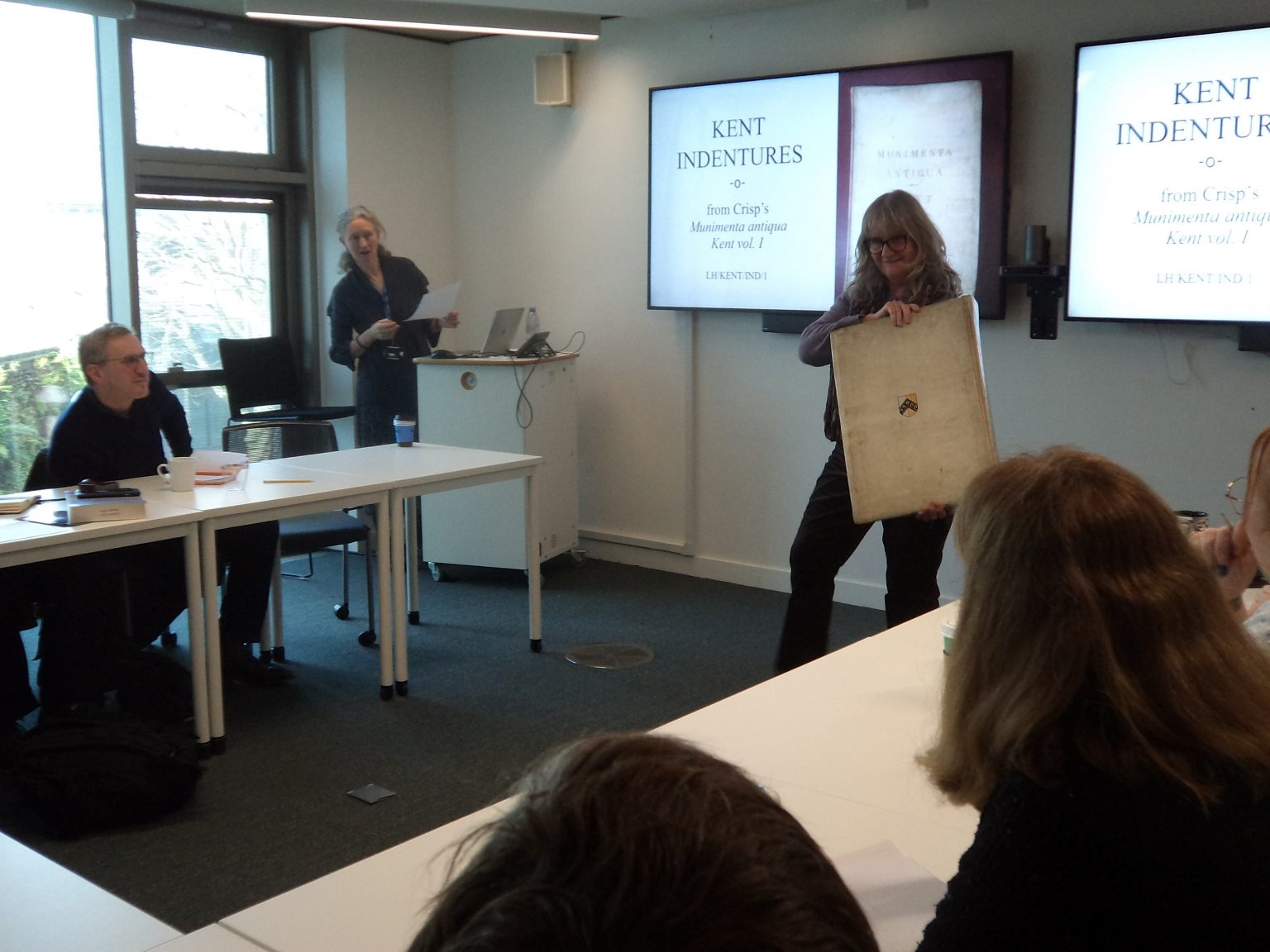
Following lunch, the third session was led by Drs David Rundle and Jacqueline Spencer who used the now unbound Munimenta Antiqua of F.A. Crisp that contains a collection of original indentures relating to land holdings in Kent from the 16th century and later. To begin the session David offered some useful information about official writings, and how, what, for whom, by whom and why they were produced with reference to early modern times, as well as the antiquarian interest in such hard written sources, especially as Crisp is an interesting member of this group of men from the late 19th/early 20th century.
Jacqueline then examined Crisp’s collecting activities in more detail, his family interests and document types he was especially interested in, how he sought to preserve them and their history after his death, including their arrival into Special Collections and Archives and the disbinding of the book because it was damaging the indentures. With this contextual information, the participants were again excited to visit the reading room to look at a selection of these documents, to see how well they could read and understand them, and to think about how historians might employ such sources in the writing of history.

For the final session we returned to the seminar room for a short Q&A. The consensus was that it had been a great and very enjoyable day and people felt they had learnt a considerable amount which they could make use of in their own research. Thus, thanks very much to Karen, Sheila, Avril, Jason, David and Jacqueline and the day had certainly showcased the value of Special Collections and Archives, the Kent MEMS MA and the enthusiasm of this research community, as well as the appetite for local and regional history more widely across the county.
We look forward to the next one!
*CAMEMS is a charitable organisation based outside the university to provide financial help for postgraduates, as a conduit for information and to offer such educational, outreach events (including involvement in the Canterbury Medieval Weekend)
This blog is repurposed from Dr Sheila Sweetinburgh’s Kent & Canterbury History and Heritage blog. For more of her updates, please visit it here.