
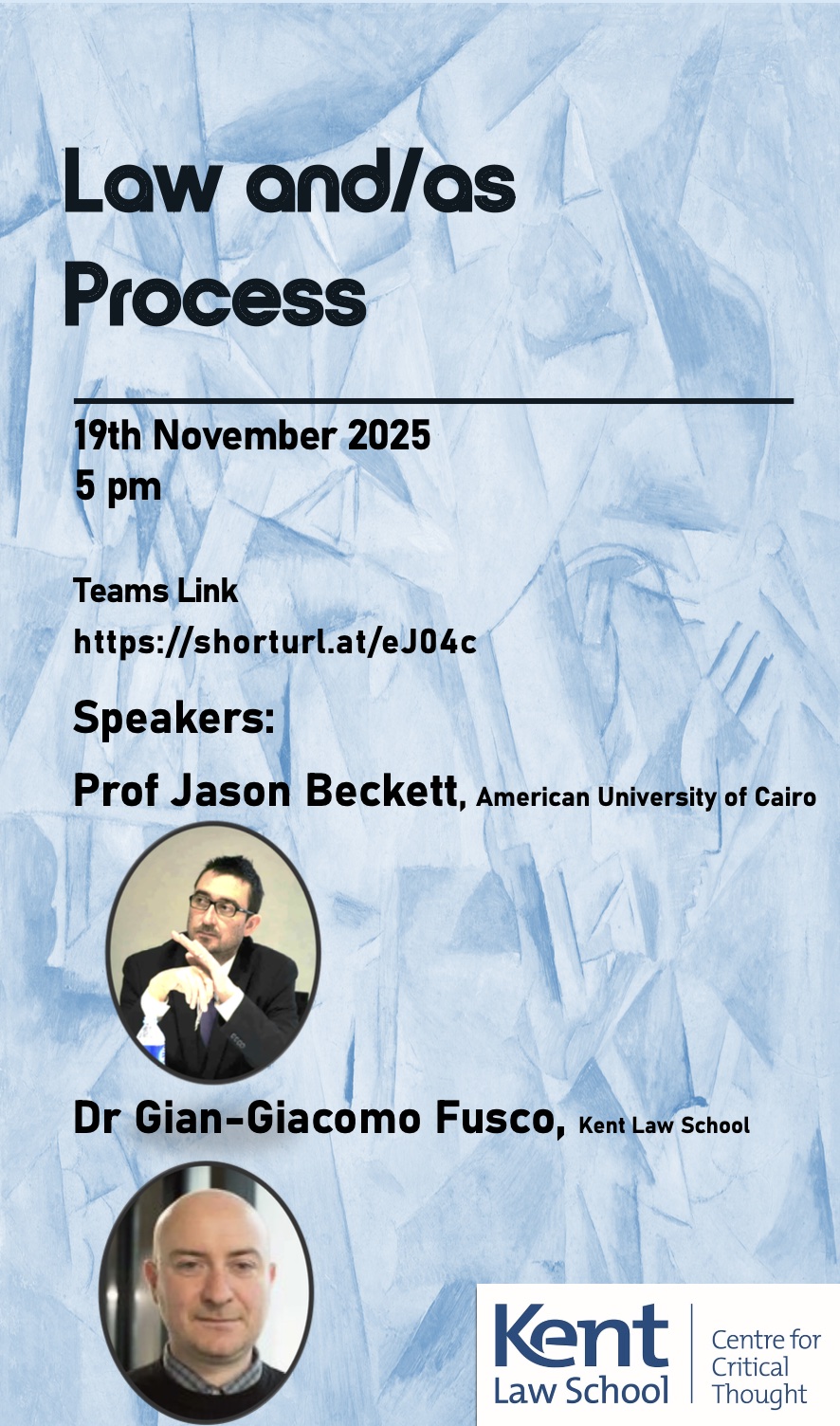
The Centre for Critical Thought (CCT)—an interdisciplinary home for critically-oriented theory and practice in the humanities and social sciences at the University of Kent—proudly launches its new seminar series, Law and/as Process.
The series continues a conversation first opened in February 2025, when Kent Law School hosted a workshop under the same theme. Building on that foundation, the CCT now seeks to develop an ongoing forum for exploring law not simply as a system of rules, but as a living, unfolding set of processes shaped by power, culture, and critical modes of inquiry.
The Centre for Critical Thought encompasses members from many disciplines across the University with a shared interest in contemporary theoretical, social, juridical and political questions. Our members, including a vibrant postgraduate contingent, are drawn from diverse fields, such as modern European philosophy, critical legal theory, political and social thought, psychoanalytic theory, religious studies, theatre studies, film studies, art history, social anthropology, and sociology.
The series warmly welcomes students of law and philosophy, as well as anyone interested in expanding the conceptual boundaries of legal thought and engaging with alternative frameworks that underpin legal reasoning.
Upcoming events:
1. Inaugural seminar
Date: Wednesday, 19 November 2025
Time: 5:00 PM (GMT)
Format: Online
Speakers:
Professor Jason Beckett (The American University in Cairo)
Dr Gian-Giacomo Fusco (Kent Law School)
Chaired by: Jessica Elias, LLM MA
Join: https://shorturl.at/eJ04c
2. Second panel discussion
Date: Wednesday, 26 November 2025
Time: 5:00 PM (GMT)
Format: Online
Speakers:
Dr Simon Thorpe (Westminster Law School)
Professor Brianne Donaldson (University of California, Irvine)
Chaired by: Dr Gian-Giacomo Fusco (Kent Law School)
Join: https://shorturl.at/eJ04c
The Law and/as Process series aims to cultivate a shared space for intellectually adventurous engagement with law, bringing forward critical, philosophical, and interdisciplinary perspectives that interrogate how legal thought operates—conceptually, practically, and politically.
All are welcome to join us in shaping this ongoing conversation.