
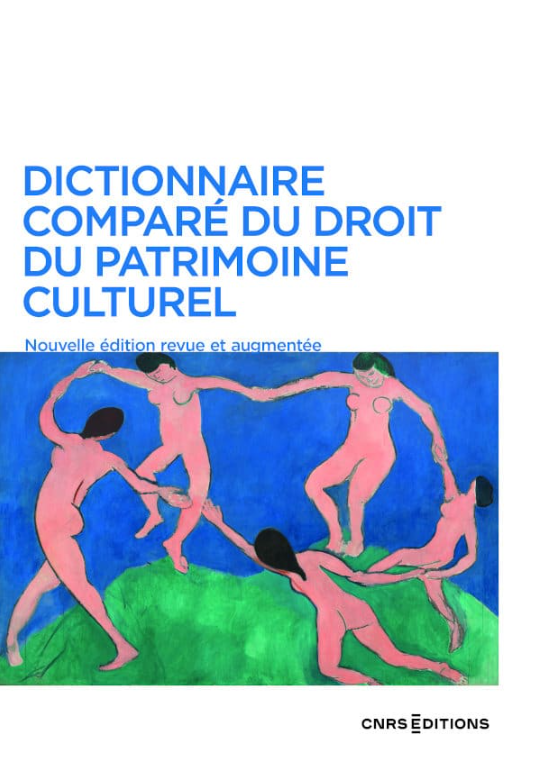
 Dr Sophie Vigneron, a leading expert in cultural heritage law, led the team responsible for the English law entries in the newly published second edition of a dictionary that compares cultural heritage law across Europe. Her team included Professor Robert Pickard (Northumbria University), Dr Charlotte Woodhead (University of Warwick), Alexander Herman and Ruth Redmond-Cooper (Institute of Art and Law), and Dr Kristin Hausler (British Institute of International and Comparative Law). The entire work was led by Dr Marie Cornu, professor Jérôme Fromageau, Dr Cléa Hance, professor Manlio Frigo, Dr Vincent Négri, professor Marc-André Renold, and Catherine Wallaert.
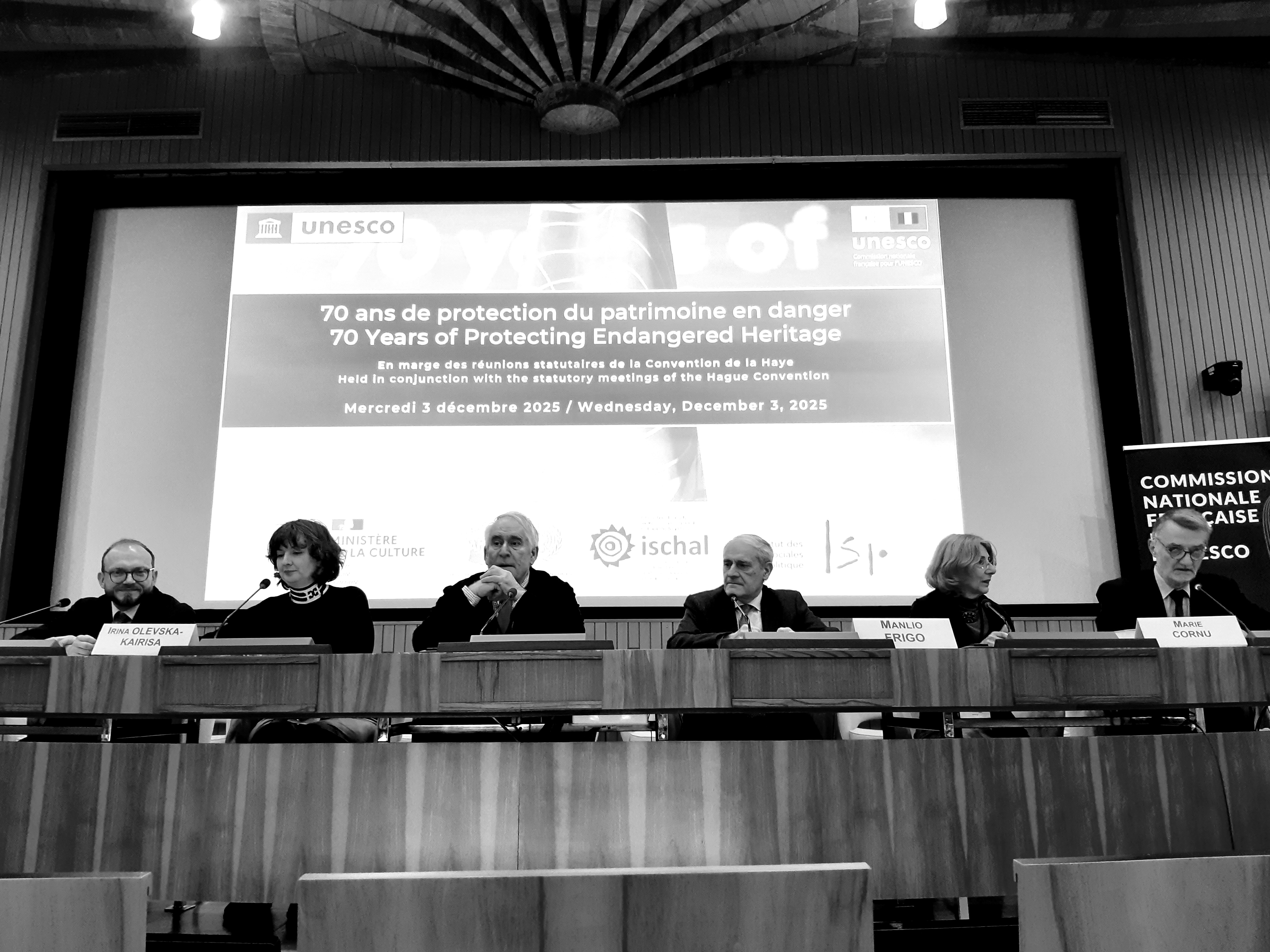 This important work was presented at a side event to the 11th Meeting of the Parties to the 1999 Second Protocol to the Hague Convention of 1954 for the Protection of Cultural Property in the Event of Armed Conflict on 3d December 2025 at UNESCO’s headquarters in Paris. This highlight that at a time when cultural heritage faces threats from conflict, climate change, and illicit trafficking, tools like this dictionary contribute to building bridges between legal systems, promoting a better understanding of national legal concepts, and supporting the shared goal of preserving cultural heritage for future generations.
The second edition of the dictionary offers a clear and comprehensive guide to the legal vocabulary on cultural heritage across Europe for legal experts, heritage professionals, or those who are simply curious about how culture is protected by law. It is a valuable resource for navigating the intricate landscape of cultural heritage law, a complex and evolving field, shaped by diverse legal traditions, national priorities, and international cooperation. It compares key concepts across ten European countries: Belgium, France, Germany, Greece, Italy, Latvia, Poland, Spain, Switzerland and the United Kingdom. These countries represent both civil law and common law traditions, offering a rich comparative perspective.
The dictionary has a dual focus: it provides a general overview of each country’s legal system and a detailed definitions of key concepts (cultural property, provenance, historic monument…) that are central to the legal protection of cultural heritage. Firstly, introductory sections outline the foundational principles of cultural heritage law in each jurisdiction, helping readers understand the broader legal context in which individual terms are used. Secondly, a concise definition capturing the essential characteristic of each concept is given followed by a legal definition, if it exists, along with a commentary and examples to illustrate the rule. This structure allows users to grasp not only what a term means but also how it functions within different legal frameworks.
The dictionary goes beyond national definitions. Some entries are accompanied by comparative analysis of key concepts that highlight commonalities and differences across jurisdictions, such as authenticity, cultural property. These comparisons illuminate shared challenges, identify ambiguities in terminology and conflicting interpretations, and suggest pathways for mutual understanding.
The influence of European legal instruments is also a key theme in the dictionary. Eight of the ten countries belong to a common legal order shaped by EU regulations and directives, particularly those governing the movement of cultural property. This shared framework affects how certain terms are defined and applied (export, import, trafficking), adding another layer of complexity—and opportunity—for cross-border cooperation.
For professionals working in cultural heritage—whether in law, museums, academia, or government—this dictionary is an indispensable tool. By mapping the legal vocabulary of cultural heritage across Europe, the dictionary fosters a deeper understanding of how different countries protect and value their cultural assets, supports clearer communication, more effective policy-making, and better-informed legal decisions.
You can find details about the publication here.