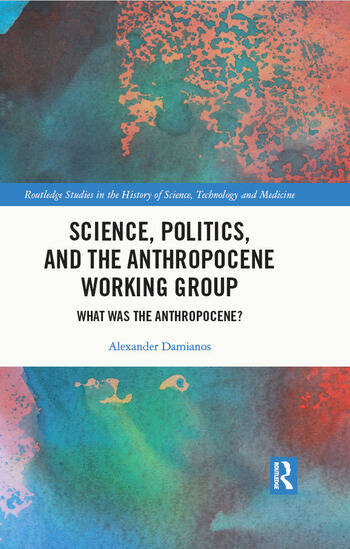
A new book, written by Lecturer in Law Dr Alexander Damianos at Kent Law School, has been published by Routledge.
The book charts the Anthropocene Working Group’s (AWG) effort to formalise the Anthropocene as a formal unit of the Geologic Time Scale.
 Alexander explains: ‘I followed them around as much as I could between 2016 and 2021 to understand what was entailed in their task. The book bears the subtitle ‘What was the Anthropocene’ because clearly the Anthropocene means different things to different people, in different places and at different times. I don’t think it’s really possible to define what the Anthropocene is, and so I provide an account of how the Working Group sought to define it during a particular period of time, and in the context of a series of constraints: from their peers, from funding bodies, from popular media interest in the term.
The book ends not long before their proposal was rejected by the Subcommission on Quaternary Stratigraphy. So there is another book to be written on what has happened since. But for now, I am glad to see this out in the world, and hope that it can contribute to conversations, or even start new ones; and that can cause people to disagree in ways that are constructive and generative of further dialogue.
In this book I explore:
– the archival story of the AWG’s journey and the formalisation process of a new geological epoch.
– how scientific practices (measurement, correlation, a “forensic science” of the Earth) meet broader political and social questions. Much of the book is dedicated to providing an understanding of why the requirements for formalising a geological unit are the way they are, and what that meant for the AWG.
– what it means to situate society within 4.5 billion years of Earth’s history from a geological perspective; and what happens when a contemporary art institutions takes interest in the effort of geologists to do so.
Why this matters:
We expect too much of scientists today, without fully appreciating that even scientific truth is constantly negotiated. My interest with this book was to explore how political procedures (such as voting) shape what comes to be known as “fact”. This book offers an interdisciplinary, critical take on the science, politics and practices shaping these debates.
Who it’s for:
Whether you are working in the geosciences, history of science/technology, environmental humanities, social studies of science, sustainability or policy, there’s something in here for you.’
Learn more / order your copy here.