
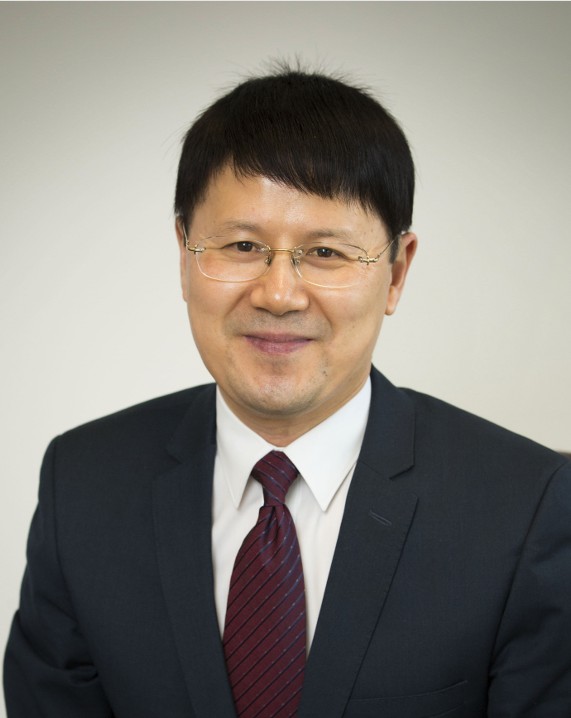
We are delighted to welcome Dr Zinian Zhang to Kent Law School, who joins us as a Senior Lecturer. Zinian brings extensive experience in commercial and business law, having previously taught at the Universities of Glasgow and Leeds, alongside a distinguished research career focusing on corporate insolvency and financial regulation.
An empirical legal scholar, Zinian’s research examines how the law operates in practice, with the aim of informing legal reform and public policy. From cross-border insolvency to the regulation of financial institutions, his work tackles complex issues with real-world impact. We spoke to Dr Zhang about his academic journey, current research, what excites him about joining Kent, and why he believe studying law can help make the world a fairer place.
Can you tell us about your academic background and what brought you to Kent Law School?
I taught law as lecturer in commercial law at the University of Glasgow before coming to Kent. Moving to Canterbury was mainly because KLS is a well-established law school in the country and beyond. The warm weather here is also a factor, though I did enjoy the overwhelming hospitality of Scottish people when I was in Glasgow.
Before teaching at the University of Glasgow (2022-2026), I worked as lecturer in business law at the University of Leeds from 2016 to 2022. I did my PhD at the University of Durham, and I still visit the beautiful town/city of Durham quite often long after I left.
How would you describe your research interests?
I am broadly a company law scholar, and more narrowly I am a corporate insolvency lawyer. Before the pandemic, I spent almost a decade writing about the corporate insolvency law in China, and at the moment, my research focus is on the insolvency of financial institutions, a field not very much explored especially by insolvency law scholars.
Different from most UK colleagues, I am an empirical legal scholar, believing that the tremendous gaps between the law on the books and the law in action should be paid more attention.
Why is this research important or timely?
My research is evidence based and aims to make a real change for a better legal system.
Could you tell us about a publication or piece of research you’re particularly proud of, and why?
I’m particularly proud of my 2022 article, ‘Globalised Cross-Border Insolvency Law: The Roles Played by China’, published in the European Business Organization Law Review. It has been downloaded more than 29,000 times, which is well above the average for the journal. It’s rewarding to know that colleagues and practitioners around the world have found the research useful.
What are you currently working on, or planning to work on next?
I am now working on my second monograph investigating the overall implementation of the UK investment bank insolvencies. It is another piece of my empirical studies.
Apart from this monograph project, I am simultaneously working on a separate paper examining the controversies of using trust property to pay for the return of trust assets in investment bank insolvencies, and I believe this paper would further develop the UK trust law, again, because most existing studies almost have ignored what happens in the real world.
My next project is on the insolvency of deposit-taking banks. My motivation of doing this research is very simple: the state should stop endlessly using public money to rescue failed banks, which is too costly and cannot be economically and morally justified. Since the last global financial crisis, many political and legislative efforts, both domestically and internationally, have been made to stop the madness of national governments in using the taxpayer money to resuscitate failed banks, but in both advanced economies, such as the USA and UK, and emerging ones, like India and China, the state continues this practice. I want to use the evidence collected from my empirical investigation to tell the true story as to the pros and cons of such decisions, in the hope of providing more informed policy recommendations.
What are you teaching at Kent Law School, and how does your research shape your teaching?
At the moment, I teach two modules on banking law, one for undergraduate and one postgraduate. I also teach another PGT module, World Trade Organization (WTO) Law and Practice, which has considerably broadened my horizons. The most rewarding part of teaching is to meet many ambitious students, who can be inspired, on the yearly basis.
What opportunities are there for students to engage with your research?
I welcome opportunities to supervise postgraduate researchers and have supervised more than ten PhD students, many of whom have gone on to academic careers in the UK and overseas, while others have taken up senior roles in industry.
What are you most excited about in your new role?
The reputation of KLS as a leading law school would be the major benefit; of course, the top quality of our students makes working here more enjoyable and meaningful.
What would you say to anyone considering studying Law in the future?
Law is a challenging but deeply rewarding subject. Beyond opening the door to a wide range of careers, it gives us the opportunity to make society fairer and improve people’s lives.
We’re delighted to welcome Zinian to Kent Law School and look forward to seeing his research and teaching continue to flourish within our community.