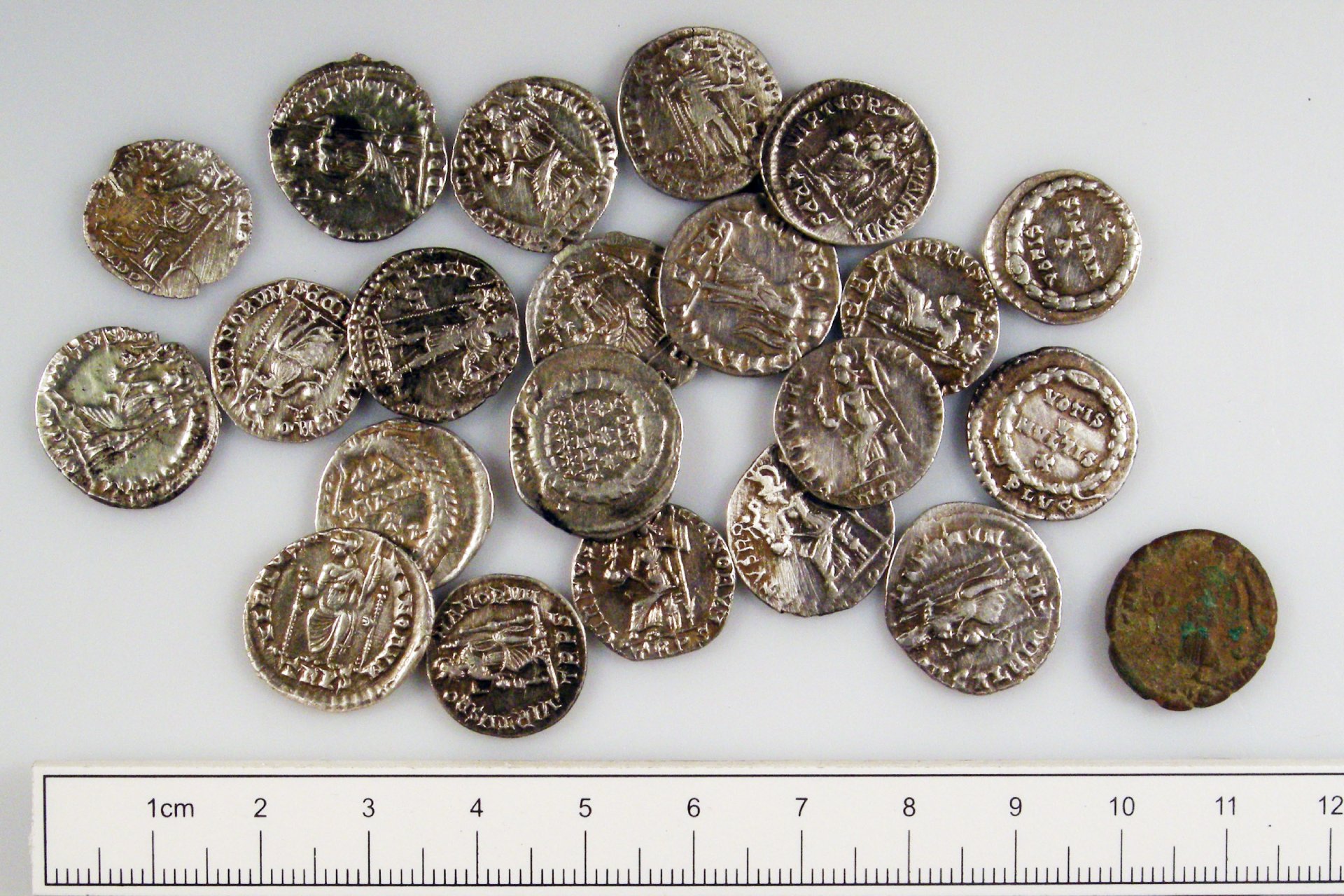
Many of the late Roman hoards that we are studying are on current display at museums across Britain. This post provides a list of some of the hoards that you can see and where you can find them.
1. National Museum of Scotland (Edinburgh):
Traprain Law Treasure
The Traprain Law Treasure was found in East Lothian in the early 20th Century and is currently the largest hoard of Roman hacksilver currently known. The hoard is currently on display in the ‘Early People’ gallery (level -1) at the museum. The NMS is free to enter, and you can find more information here: https://www.nms.ac.uk/
2. Malton Museum:
Hovingham Park Hoard
The Hovingham Park hoard is currently in the collection of Malton Museum. The hoard of 44 coins is on display in the museum and tells the incredible story of its discovery by school children in the 1980s. There is a small fee to visit the museum. To plan a visit, see the museum’s website: https://www.maltonmuseum.co.uk/visit-us/
3. Hull and East Riding Museum of Archaeology:
South Ferriby Hoard
In 1906, 228 silver coins and a silver ring were found along with a grey ware vessel in South Ferriby in 1906. Over 130 of the coins along with the ring and vessel are now on display at the Hull and East Riding Museum of Archaeology. The museum in free to enter and visiting information can be found here: https://www.hullmuseums.co.uk/hull-east-riding-museum/plan-your-visit-herm
4. The Higgins Museum Bedford:
Haynes hoard
In one of our previous posts, we discussed some of the coins and artefacts from the Haynes hoard. The hoard is amongst the latest group of late Roman hoards in Britain and contains coins issued at the beginning of the fifth century which are generally rare finds in Britain. The hoard also contains a range of artefacts including spoons, rings and necklace components. Some of the hoard is currently on display at the Higgins Museum in Bedford. To plan a visit and find out more information, see the museum’s website: https://www.thehigginsbedford.org.uk/Home.aspx
5. Verulamium Museum, St Albans:
Sandridge hoard
In 2012, 159 gold coins were recovered from a site close to St Albans. This is the second largest hoard of late Roman gold coins found in Britain to date. For further information about the find and how to plan a visit to Verulamium, see https://www.stalbansmuseums.org.uk/visit/verulamium-museum
6. Reading Museum:
Bob’s Mount hoard
Two hoards that we are studying are in the collection of Reading Museum and at least one of these hoards known as Bob’s Mount is currently on display. The Silchester Gallery at the museum also includes artefacts discovered during excavations of the Roman town of Calleva Atrebatum, Silchester. Reading Museum is free to enter, and more information can be found here: https://www.readingmuseum.org.uk/
7. Willis Museum and Art Gallery (Basingstoke):
Silchester hoard
The Silchester hoard was found by metal-detectorist in the 1980s and contains 56 silver coins, four gold finger-rings and one silver finger-ring. The rings are in the collection of Reading Museum but some of the coins are currently on display on the top floor of the Willis Museum and Art Gallery in Basingstoke. The museum is free to visit: https://www.hampshireculture.org.uk/willis-museum-and-sainsbury-gallery
8. West Berkshire Museum (Newbury):
Compton Downs hoard
The Compton Downs hoard is on display at the museum along with other late Roman material found in the region. Entry is free to the museum and more information can be found here: https://www.westberkshireheritage.org/west-berkshire-museum If you live too far away from the museum, you can also visit the museum virtually: https://my.matterport.com/show/?m=zR5tX1baZBx&hl=1
9. Salisbury Museum:
Bowerchalke hoard
The Bowerchalke hoard is currently on display at the Salisbury Museum and possibly represents a dowry payment as we explained in an earlier blog post. The hoard mostly consists of silver coins, though there is also a gold solidus and four gold finger-rings. There is a fee to enter the museum, and more information can be found on the museum’s website: https://salisburymuseum.org.uk/
Bishops Cannings hoard
The Bishops Cannings hoard contains over 7000 bronze and silver coins and hundreds of artefacts. Some of the irregular siliquae, copies of official issues, are on display in the Roman Britain Gallery (Room 49) in the British Museum. Much of the hoard’s contents were acquired by the Wiltshire Museum Devizes and some of the artefacts from the hoard such as silver jewellery are currently on display at the museum. There is a small fee to enter the museum. To plan a visit, see: https://www.wiltshiremuseum.org.uk/
11. Mildenhall Museum:
Mildenhall/Worlington hoard
The Worlington coin hoard is currently on display at the Mildenhall Museum. You can read more about the coins in our blog post (here). The hoard is displayed alongside other small coin hoards and a magnifying lens allows you to see the details on the coins up close. For further information about the museum, see their website: https://mildenhallmuseum.co.uk/
12. Museum of Archaeology and Anthropology (Cambridge):
Icklingham hoard
Some objects from the Icklingham hoard are currently on display at the Cambridge Museum of Archaeology and Anthropology. This includes a glass bead necklace which includes an unusual and rare bead type as discussed in this blog post. Entry to the museum is free: https://maa.cam.ac.uk/
Uttlesford hoard
The Uttlesford hoard contains both gold and silver coins and was found by a metal-detectorist. Like Patching, the hoard is among the latest hoards in our study as it contains four gold coins that were made at the start of the fifth century at Milan and Ravenna. The hoard also contains a gold finger-ring. The hoard was acquired by Saffron Walden Museum and is on display along with some coins from another late Roman hoard found in Essex, the Lindsell hoard. For further information, see: https://www.saffronwaldenmuseum.org/
14. Worthing Museum and Gallery:
Patching hoard
The Patching hoard one of the latest Roman hoards and perhaps one of the earliest early medieval hoards discovered in Britain. The spectacular hoard contains over 50 gold and silver coins, two gold finger-rings and hacksilver. At present, the hoard is thought to date to the late fifth to early sixth century. The hoard was acquired by Worthing Museum and Art Gallery and is currently on display. The Museum recently re-opened in Spring 2026 and you can find out more information about opening times and access here: https://wtm.uk/visit/our-venues/museum-art-gallery/
Canterbury Treasure
The Canterbury Treasure contains mostly silver spoons, together with some other silver objects such as silver and gold jewellery. In a previous blog post, we discussed the spoons from the hoard and their Christian iconography. The hoard is currently on display at the Canterbury Roman Museum. There is an admission fee and you can find out more information here: https://canterburymuseums.co.uk/canterbury-roman-museum/
16. British Museum (London)
The British Museum has many late Roman hoards in its collection and many are currently on display in the Roman Britain Gallery (Room 49) including the Hoxne, Mildenhall and Thetford hoards. In a nearby gallery (Room 41), you can also see some of the coins and artefacts from the Balinrees (Coleraine) hoard discovered in Northern Ireland. From the 27th February – 27th May, you can also see a temporary display case about our project in Gallery 68 of the museum (see here). To plan a visit, see the website: https://www.britishmuseum.org/
