
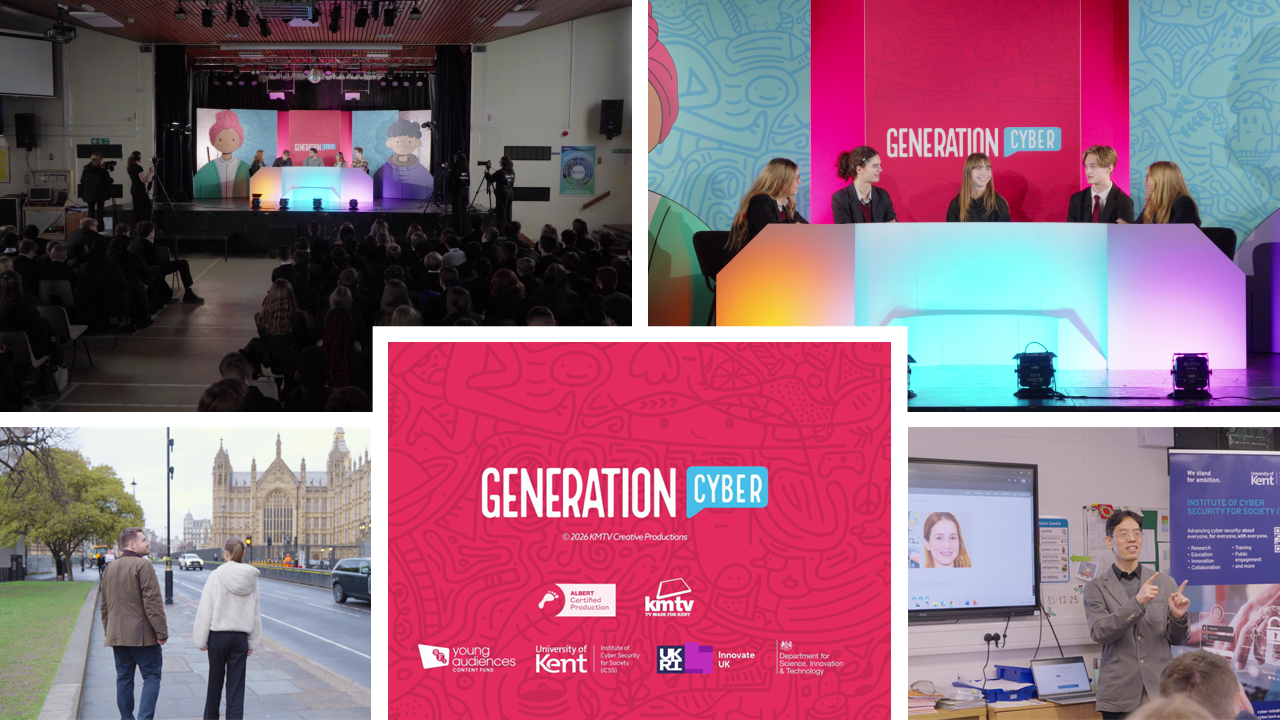
The Institute of Cyber Security for Society (iCSS) at the University of Kent co-produced a new educational TV series “Generation Cyber”, and three University of Kent researchers contributed to the production in different ways. The TV series aims to help young people aged 11 to 15 navigate the fast-changing cyber world. The series also aims to close gender and diversity gaps in the cyber sector. Currently, just 22% of the UK’s cyber workforce is female, with even lower representation from ethnic minorities and disadvantaged groups. The production of the TV series was led by KMTV, the local TV station of the Kent and Medway region. This is the first TV series on cyber security awareness co-produced by iCSS, after three animated videos iCSS produced between 2022 and 2026.
The two-part documentary series follows young presenters Henley and Eleanor as they team up with two PhD researchers to investigate the world of cyber, crime and AI across Kent and the South East England. Informed by iCSS and the Kent & Medway Cyber Cluster (KMCC), it’s both curriculum-aligned and rooted in the latest research. The documentary was made possible thanks to funding from the Department for Science, Innovation and Technology (DSIT) and Innovate UK’s Cyber Local 2025-2026 scheme.
The new TV series, which builds on the success of previous entries in the Generation franchise, including Generation Food, Generation Why and Generation Genome, is a direct response to an urgent regional and national need. According to the 2023 ICILS (International Computer and Information Literacy Study), only a quarter of UK students are proficient in basic digital skills, while shortages in the cyber workforce remain severe. In Medway alone, one in four adults lack even basic digital literacy, highlighting the importance of engaging the next generation early.
The first episode delves into how young people feel about online safety, algorithms and a potential social media ban. In Episode two, University of Kent PhD student Adel Elzemity, who is also an iCSS ECR (Early Career Researcher) Member, investigates deepfakes, ethics, misinformation and AI chatbots. In another segment, iCSS Associate Member Dr Jim A.C. Everett, a psychologist in the School of Psychology of the University of Kent leading a 5-year project on the psychology and ethics of AI , travels to Westminster with the presenter, Eleanor, to discuss AI safety with MP Dawn Butler and Baroness Beeban Kidron. In addition, iCSS Director Shujun Li, who is Professor of Cyber Security at the University of Kent’s School of Computing and Executive Producer and Research Lead for the DSIT-Innovate UK funded project, also appear in Episode two for a deepfake educational session at the Five Acre Wood School in Maidstone, a Foundation District Special School for children and young people with profound, severe and complex learning difficulties.
Hundreds of students at Walderslade and Greenacre Schools Partnership attended the live panel discussion filmed for the show, which saw industry experts, politicians, researchers and young people debate cyber-related issues.
The TV series is released as free resources for all to use as two YouTube videos.
Professor Li said: “Thanks to funding from DSIT and Innovate UK, we were very fortunate to have such a great opportunity to collaborate with KMTV on the documentary. Our research work and school outreach activities on pre-university cyber education have repeatedly highlighted the importance of cross-sectoral collaborations and creative materials for educating children about cyber and AI. The documentary comes very timely as cyber security and AI safety are becoming two of the biggest society challenges that we are facing today. We hope that the documentary will make our next generation more prepared for such challenges and inspire more to collaborate in this space.”
Recalling his experience of being a co-presenter of the TV series, Adel Elzemity said, “Generation Cyber was a fantastic opportunity to combine my passion for AI and cyber security research with public engagement. In my role as a co-presenter of the second episode, I enjoyed helping make AI especially cutting-edge generative AI technologies more accessible to our target young audience. I hope that the documentary will inspire more children and young people to explore these technologies with curiosity while understanding the importance of using them safely and responsibly.”
Dr Everett echoed Professor Li and Adel Elzemity by saying “This was a fantastic opportunity. It is clear that we still regulate systems more than we regulate the conditions that produce trust, but there is hope in the future. Young people create change by shaping norms and demanding power, and hearing the voices of young people as active participants in the future of society was truly inspiring.”
Isabelle Le Marechal, Series Director at KMTV, added: “The series felt so important to make. We interviewed Baroness Beeban Kidron MBE who said, ‘A generation of people who don’t see hope, who don’t see themselves in the world is about the most dangerous thing.’ That resonated with me when filming Generation Cyber because fitting into the world can be difficult. This is especially true when you’re growing up, and even more so when adults are making decisions about your generation and you’re not really in the discussions about what affects your future. I hope that by working alongside young people, Generation Cyber can help them to navigate their thoughts around the online world and their place in it.”
“Generation Cyber isn’t just a one-off,” Le Marechal explained. “It’s designed to be the start of a national model for youth-focused cyber education, building on Kent’s strengths and helping to shape a digitally skilled, resilient generation.”
Andy Richards, Channel Director at KMTV and Executive Producer of the TV Series, added: “Generation Cyber is our third collaboration with the Government to create live action content for young audiences, and projects like this are becoming more important than ever. At a time when commissioning of British children’s content is at a historic low, we’re incredibly proud to be producing ambitious, meaningful programming that speaks directly to young people.”